Quotulatiousness

October 1, 2020

Far from being in trouble, Canadian film and TV investment has nearly doubled in the last 10 years

Filed under: Business, Cancon, Government, Media — Tags: , , , , , , , — Nicholas @ 03:00

The Canadian government — particularly Canadian Heritage minister Steven Guilbeault — is eager to pass legislation to “get money from the web giants” and their primary justification is the claim that Canadian TV and movie funding has been shrinking. As Michael Geist explains, that’s a pants-on-fire lie:

CMPA Profile – Financing, Sources: CMPA Profile 2019, 2016, 2013

Canadian Heritage Minister Steven Guilbeault has said that his top legislative priority is to “get money from web giants.” While much of the attention has focused on his ill-advised plan to require Facebook to obtain licences for linking to news articles, his first legislative step is likely to target Internet streamers such as Netflix, Amazon and Disney with new requirements to fund Canadian content and to increase its “discoverability” by making it more prominent for subscribers. Based on his comments at several town halls, Guilbeault is likely to also create new incentives for supporting indigenous and persons of colour in the sector with a bonus for those investments (potentially treating $1 of investment as $1.50 for the purposes of meeting Cancon spending requirements). Much of the actual implementation will fall to the CRTC, which will be granted significant new regulatory powers and targeted with a policy direction.

Guilbeault’s case for establishing new mandated payments is premised on the claim that support for the film and television sector is declining due to the emergence of Internet streaming services, which have resulted in decreased revenues for the conventional broadcast sector and therefore lower contributions to Cancon creation. In fact, Guilbeault recently told Le Devoir that without taking action there would be a billion dollar deficit in support in the next three years. He says that his objective is to actually generate a few hundred million more per year in local production by the Internet streamers. In other words, he’s expecting roughly $2 billion in new investment over three years in Cancon from U.S. entities due to his planned regulations (moving from a billion dollar deficit to a billion dollars in extra spending).

While Guilbeault frames these regulatory requirements as a matter of fairness and “rebalancing”, industry data over the past decade tell a much different story. Indeed, there has been record setting film and television production in recent years, much of it supported by companies such as Netflix. CRTC chair Ian Scott last year said that Netflix is “probably the biggest single contributor to the [Canadian] production sector today.” While that is not entirely true – the data suggests that Canadian taxpayers are the biggest contributor with federal and provincial tax credits consistently the largest source of financing – the claim that there is a billion dollar deficit coming or that foreign streamers do not contribute to film and television production in Canada without a regulatory requirement is simply false.

September 30, 2020

The feds go trampling all over provincial responsibilities again

Filed under: Cancon, Government, Health, Law — Tags: , , , — Nicholas @ 03:00

Ted Campbell suggests that even a cursory reading of the constitution does not give the federal government the power to trespass (again) in what is clearly, legally, a provincial government area of responsibility:

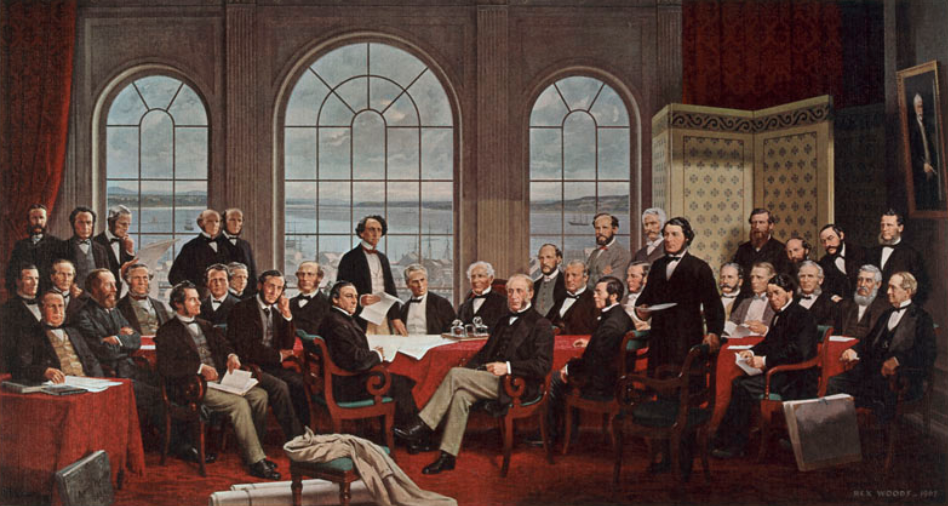
“The Fathers of Confederation”
The original painting by Robert Harris (1884) was destroyed in the 1916 Parliament Building fire, and this image for the “Gallery of Canadian History” series of lithographs by Confederation Life Insurance Company is based on a photograph by James Ashfield (1885).
Libraries and Archives Canada item ID number 3013194. http://central.bac-lac.gc.ca/.redirect?app=fonandcol&id=3013194&lang=eng

[T]he Parliament of Canada should look to §91. Here is what the Constitution says are the areas of national government’s concern: The Public Debt and Property; The Regulation of Trade and Commerce; Unemployment insurance; The raising of Money by any Mode or System of Taxation; The borrowing of Money on the Public Credit; Postal Service; The Census and Statistics; Militia, Military and Naval Service, and Defence; The fixing of and providing for the Salaries and Allowances of Civil and other Officers of the Government of Canada; Beacons, Buoys, Lighthouses, and Sable Island; Navigation and Shipping; Quarantine and the Establishment and Maintenance of Marine Hospitals; Sea Coast and Inland Fisheries; Ferries between a Province and any British or Foreign Country or between Two Provinces; Currency and Coinage; Banking, Incorporation of Banks, and the Issue of Paper Money; Savings Banks; Weights and Measures; Bills of Exchange and Promissory Notes; Interest; Legal Tender; Bankruptcy and Insolvency; Patents of Invention and Discovery; Copyrights; Indians, and Lands reserved for the Indians; Naturalization and Aliens; Marriage and Divorce; The Criminal Law, except the Constitution of Courts of Criminal Jurisdiction, but including the Procedure in Criminal Matters; The Establishment, Maintenance, and Management of Penitentiaries; and Such Classes of Subjects as are expressly excepted in the Enumeration of the Classes of Subjects by this Act assigned exclusively to the Legislatures of the Provinces.

In that looooong list I can find more than adequate justifications for ministers and government departments that are responsible for: finance and revenue; industry, trade, and commerce; defence; foreign affairs; transport; fisheries and oceans; citizenship and immigration; health; and for independent agencies like the Bank of Canada, Canada Post and Statistics Canada. I cannot find anything that says we need a Minister for Women and Gender Equality, nor one for Diversity, Inclusion and Youth nor, especially, Ministers for Canadian Heritage and Middle Class Prosperity.

A lot of things have changed since 1867; the telegraph was still fairly new and innovative, a practical telephone wouldn’t be invented until ten years after confederation and the first useful long-haul radio transmission and reception, from Britain to Signal Hill in St John’s didn’t come until the dawn of the 20th century, thus ideas like the CBC, the Internet, Netflix, air traffic control and the North Warning System were far beyond the imagination of the men ~ they were pretty much all men, working in government, back in the 1860s, weren’t they? ~ who drafted the Canadian Constitution.

What was clear to them, based on the United States experiences, was that §90 to §95 which spell out “who does what to whom” were important to the functioning of a federal state, especially to one in which traditional provincial rights and diverse cultures were well established. Now, it is important to remember that in Canada’s long and rich history there were instances, especially during great wars, when the provinces agreed to federal intrusions into their areas of responsibility; this is not one long story of federal bullying. But what seems perfectly clear to me ~ and I suspect to e.g. John Horgan, Jason Kenney, Doug Ford, François Legault and the other premiers is that last week’s Throne Speech marks another major and quite unjustified federal assault on their jurisdictions. What’s happened, according to Manitoba Premier Brian Pallister, is that the provinces have all the health care delivery problems but, thanks, in some part, to tax decisions made in 1942, the feds have all the money. The solution is blindingly obvious: transfer tax “points” as some experts call them, to the provinces so that they, not Justin Trudeau, who have the problems of too few physicians, too few nurses and too few hospital beds also have the money to solve them.

September 23, 2020

Federal minister admits the Libranos’ plan is a shakedown to “get money from web giants”

Filed under: Cancon, Government, Media, Politics, Technology — Tags: , , , , — Nicholas @ 03:00

Michael Geist on a rare moment of honesty from Canadian Heritage Minister Steven Guilbeault on the federal government’s atrocity of an internet regulation plan:

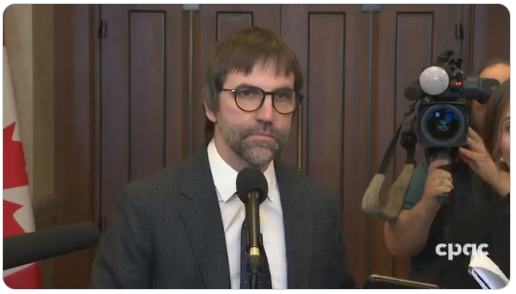
Canadian Heritage Minister Steven Guilbeault, 3 February 2020.
Screencapture from CPAC video.

As Canadian Heritage Minister Steven Guilbeault prepares an Internet regulation plan that features the prospect of licences for linking, undermining net neutrality, and trade sanctions, he has typically argued that “it’s about fairness”, suggesting that foreign companies unfairly benefit from the Canadian market at the expense of domestic companies. Yet when Guilbeault appeared at a production sector town hall last week, he was far more candid. Guilbeault told the sector that in a minority government situation, his department had to choose between a massive bill changing “everything under the sun” or to slice it up into smaller pieces. Having chosen the piecemeal approach, Guilbeault pointed to his top priority: get money from the foreign Internet companies (his exact words at 47:58 were “the most pressing thing we needed to do was to get oxygen into the system, which is money. And go and get that money where that money is. Which is web giants.”)

In certain respects, the acknowledgement that this amounts to little more than a shakedown makes sense. CRTC Chair Ian Scott has said that Netflix is now probably the largest contributor to film and television production in Canada and the sector enjoyed record production numbers pre-COVID-19, so the data simply does not support claims that the streamers are hurting the industry. As for the news sector, the Minister has failed to deliver millions in promised tax credits and seemingly now wants an alternative that involves creating a licensing regime for linking to content.

Yet if the goal is simply a matter of wanting more money from Internet companies that can be used to support Canadian cultural policies, it is not clear why this is a matter for the Heritage Minister. Everyone wants more money from the Internet companies and countries around the world have a credible argument that the huge global Internet revenues should be more equitably apportioned among them. In other words, the way to “get money from web giants” is for Finance Minister Chrystia Freeland to tax them on their revenues. Those tax revenues would go into general tax revenues and can be spent in an transparent manner without the need for specialized subsidy programs. This isn’t easy. The U.S. unsurprisingly objects to a potential reduction in its tax revenues, which means that Canada must find allies with other countries in seeking global solutions on tax. Further, Guilbeault candidly recently told a publisher town hall that changes to the tax code is far more difficult than direct program spending.

The problem with Guilbeault’s preference for direct program spending subsidized by Internet companies is that it raises a host of complications and negative effects. For example, mandated Canadian content spending for companies such as Netflix could require the companies to pay into a fund that supports Canadian content production. However, the current rules make it challenging for those same companies to access those funds for their own productions. That leads to either a trade challenge (and the possibility of tariffs against key Canadian sectors such as dairy and steel) for being forced to pay into a system that is inaccessible to foreign providers or a reform to the system that would open things up to foreign providers and in the process undermine the competitiveness of domestic producers and broadcasters who are more reliant on tax credits and funding programs.

September 11, 2020

Canadian government heading toward “the worst of all worlds on Internet regulation”

Filed under: Business, Cancon, Government, Media — Tags: , , , , — Nicholas @ 05:00

Michael Geist on the bull-headed determination of the Canadian federal government — and specifically Heritage Minister Steven Guilbeault — to “solve” a problem by introducing savagely anti-consumer internet regulations:

Canadian Heritage Minister Steven Guilbeault, 3 February 2020.
Screencapure from CPAC video.

The harm that will come from these policy choices is difficult to overstate. By focusing the tax burden on sales taxes rather than technology company revenues, consumer costs will go up and the company profits will be left untouched. The CRTC powers will lead to years of hearings and follow-on litigation, yielding few tangible benefits for creators. The mandated Cancon contributions will spark trade wars and make Canada a less attractive market for new services leading to fewer choices and less competition, while the link licensing requirement will result in blocked sharing of news articles on social media sites that hurts both Canadians and media organizations. All the while, the issues that really matter – privacy, anti-competitive behaviour, online hate, misinformation, a fair share of tech corporate profits – are left largely untouched.

How did the government end up with the worst of all worlds on Internet regulation?

The starting point was the 2015 election in which it committed to no new Netflix taxes (prompted by a Conservative pledge on the issue) and subsequent consultations on everything from copyright to digital cultural policy. The result was then-Heritage Minister Melanie Joly struggling to honour the no-tax commitment, while satisfying increasingly vocal demands from some stakeholders for one. Those calls increased after the results of her cultural policy consultation were released, which largely focused on a rejection of new Internet taxes and support for net neutrality.

In the aftermath of the Cambridge Analytica scandal, worries about Russian election interference, and Christchurch massacre broadcast live online, the policy winds shifted and the government was clearly looking to become more active on the Internet regulation file. That led to Election Act provisions that were generally viewed as successful. It also paved the way for a 2019 election platform that was far aggressive on social media and the Internet, with commitments to address everything from privacy to hate speech online.

[…]

If the government were to address the real concerns, there would be long-overdue privacy reforms, a more aggressive approach on competition issues, measures to address online hate and misinformation, and pursuit of a global agreement on fair taxation of technology company revenues. If it wants to support increased film production from indigenous groups or help the news sector, it can make those policy choices and use general tax revenues without creating a massive regulatory infrastructure.

Instead, it is turning to the harmful policies noted above that raise consumer costs (digital sales taxes), regulate online Cancon with mandated spending requirements (even though the industry has record production led by Netflix), dispense with any pretense of maintaining net neutrality, lead to blocked sharing of news articles (mandated licence for social media sites merely for linking to news content), and result in services avoiding the Canadian market (market interference in payments from services such as Spotify). Much of this will be overseen by the newly empowered CRTC, leading to lengthy hearings that primarily benefit lawyers. After having badly mishandled Canadian digital policy, the government now seems content to take a pass on the important issues and leave the controversial non-issues to the regulator and the courts.

September 5, 2020

Beginning the transition from personal rule to the modern bureaucratic state

Anton Howes discusses some of the issues late Medieval rulers had which in some ways began the ascendency of our modern nation state with omnipresent bureaucratic oversight of everyone and everything:

… the bureaucratic state of today, with its officials involving themselves with every aspect of modern life, is a relatively recent invention. In a world without bureaucracy, when state capacity was relatively lacking, it’s difficult to see what other options monarchs would have had. Suppose yourself transported to the throne of England in 1500, and crowned monarch. Once you bored of the novelty and luxuries of being head of state, you might become concerned about the lot of the common man and woman. Yet even if you wanted to create a healthcare system, or make education free and universal to all children, or even create a police force (London didn’t get one until 1829, and the rest of the country not til much later), there is absolutely no way you could succeed.

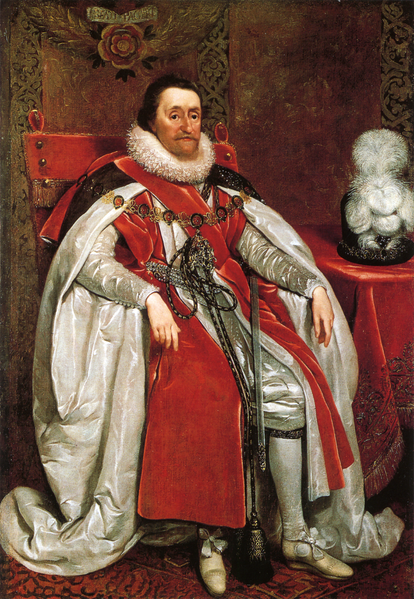
King James I (of England) and VI (of Scotland)
Portrait by Daniel Myrtens, 1621 from the National Portrait Gallery via Wikimedia Commons.

For a start, you would struggle to maintain your hold on power. Fund schools you say? Somebody will have to pay. The nobles? Well, try to tax them — in many European states they were exempt from taxation — and you might quickly lose both your throne and your head. And supposing you do manage to tax them, after miraculously stamping out an insurrection without their support, how would you even begin to go about collecting it? There was simply no central government agency capable of raising it. Working out how much people should pay, chasing up non-payers, and even the physical act of collection, not to mention protecting that treasure once collected, all takes substantial manpower. Not to mention the fact that the collecting agents will likely siphon most of it off to line their own pockets.

[…]

It was not until 1689, when there was a coup, that an incoming ruler allowed the English parliament to sit whenever it pleased. Before that, it was convened only at the whim of the ruler, and dispersed even at the slightest provocation. In 1621, for example, when James I was planning to marry his heir to a Spanish princess, Parliament sent him a petition asserting their right to debate the matter. Upon hearing of it, he called for the official record of parliamentary proceedings, personally ripped out the page with the offending vote, and promptly dissolved the Parliament. The downside, of course, was that James could not then acquire any parliamentary subsidies.

Ruling was thus an intensely personal affair, of making deals and finding ways to circumvent deals you had inherited. Increasing your capabilities as a ruler – state capacity – was thus no easy task, as the typical ruler was stuck in an essentially medieval equilibrium. Imposing a policy costs money, but raising money involves imposing policy. Breaking out of this chicken-and-egg problem took centuries of canny leadership. The rulers who achieved it most would today seem hopelessly corrupt.

To gain extra cash without interference from Parliament, successive monarchs first asserted and then abused their ancient prerogative rights to grant monopolies over trades and industries. They eventually granted them to whomever was willing to pay, establishing monopolies over industries like gambling cards or alehouses under the guise of regulating unsavoury activities. They also sold off knighthoods and titles, and in 1670 Charles II even made a secret deal with the French that he would convert to Catholicism and attack the Protestant Dutch, all in exchange for cash. Anything to not have to call a potentially pesky Parliament. At times, the most effective rulers even resembled mob bosses. Take Elizabeth I’s anger when a cloth-laden merchant fleet bound for an Antwerp fair in 1559 was allowed to depart. Her order to stop them had not arrived in time, thus preventing her from extracting “loans” from the merchants while she still had their goods within her power.

August 10, 2020

FDR’s “New Deal” and the Great Depression

The Great Depression began with the collapse of the stock market in 1929 and was made worse by the frantic attempts of President Hoover to fix the problem. Despite the commonly asserted gibe that Hoover tried laissez faire methods to address the economic crisis, he was a dyed-in-the-wool progressive and a life-long control freak (the Smoot-Hawley Tariff Act which devasted world trade was passed in 1930). Franklin D. Roosevelt won the 1932 election by promising to undo Hoover’s economic interventions, yet once in office he turned out to be even more of a control freak than Hoover. His economic and political plans made Hoover’s efforts seem merely a pale shadow.

For newcomers to this issue, “New Deal” is the term used to describe the various policies to expand the size and scope of the federal government adopted by President Franklin Delano Roosevelt (a.k.a., FDR) during the 1930s.

And I’ve previously cited many experts to show that his policies undermined prosperity. Indeed, one of my main complaints is that he doubled down on many of the bad policies adopted by his predecessor, Herbert Hoover.

Let’s revisit the issue today by seeing what some other scholars have written about the New Deal. Let’s start with some analysis from Robert Higgs, a highly regarded economic historian.

    … as many observers claimed at the time, the New Deal did prolong the depression. … FDR and Congress, especially during the congressional sessions of 1933 and 1935, embraced interventionist policies on a wide front. With its bewildering, incoherent mass of new expenditures, taxes, subsidies, regulations, and direct government participation in productive activities, the New Deal created so much confusion, fear, uncertainty, and hostility among businessmen and investors that private investment, and hence overall private economic activity, never recovered enough to restore the high levels of production and employment enjoyed in the 1920s. … the American economy between 1930 and 1940 failed to add anything to its capital stock: net private investment for that eleven-year period totaled minus $3.1 billion. Without capital accumulation, no economy can grow. … If demagoguery were a powerful means of creating prosperity, then FDR might have lifted the country out of the depression in short order. But in 1939, ten years after its onset and six years after the commencement of the New Deal, 9.5 million persons, or 17.2 percent of the labor force, remained officially unemployed.

Writing for the American Institute for Economic Research, Professor Vincent Geloso also finds that FDR’s New Deal hurt rather than helped.

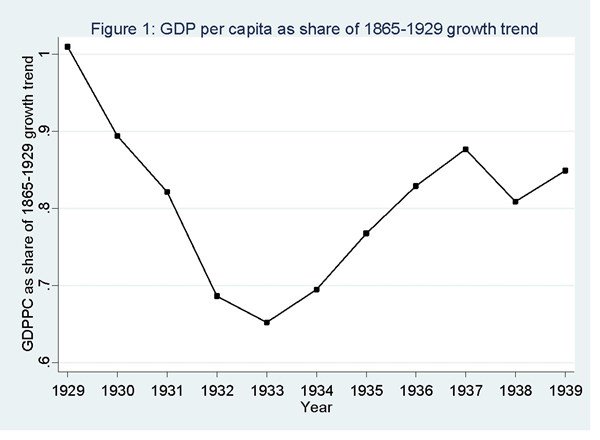
    … let us state clearly what is at stake: did the New Deal halt the slump or did it prolong the Great Depression? … The issue that macroeconomists tend to consider is whether the rebound was fast enough to return to the trendline. … The … figure below shows the observed GDP per capita between 1929 and 1939 expressed as the ratio of what GDP per capita would have been like had it continued at the trend of growth between 1865 and 1929. On that graph, a ratio of 1 implies that actual GDP is equal to what the trend line predicts. … As can be seen, by 1939, the United States was nowhere near the trendline. … Most of the economic historians who have written on the topic agree that the recovery was weak by all standards and paled in comparison with what was observed elsewhere. … there is also a wide level of agreement that other policies lengthened the depression. The one to receive the most flak from economic historians is the National Industrial Recovery Act (NIRA). … In essence, it constituted a piece of legislation that encouraged cartelization. By definition, this would reduce output and increase prices. As such, it is often accused of having delayed recovery. … other sets of policies (such as the Agricultural Adjustment Act, the National Labor Relations Act and the National Industrial Recovery Act) … were very probably counterproductive.

Here’s one of the charts from his article, which shows that the economy never recovered lost output during the 1930s.

August 9, 2020

QotD: The economic concept of “revealed preferences”

Filed under: Britain, Economics, Government, Media, Quotations — Tags: , , , — Nicholas @ 01:00

Economists have a handy term called “revealed preferences”. In colloquial English it means “look at what people do, not what they say, and certainly never take notice of what they say others should do”.

Now, you can’t help but notice that there is a disparity between those who say that taxes should be higher and those who act as if they should be. Clearly, an individual who really believes that the Government is more effective at spending his money would voluntarily offer up more than the legal minimum of taxation. That we have fewer people acting in this manner than are to be found writing columns and making speeches calling for higher taxation shows a certain gap, does it not, between public utterances and private actions? Why, we could make such donations a litmus test for those believers in higher taxation and state spending who want to compel all of us to pay more. Only those who show their commitment by sending a cheque to the Treasury should be treated seriously.

Cheques, by the way, should be made out to “The Accountant, HM Treasury”, and sent to 1 Horse Guards Road, London SW1A 2HQ. A 2nd-class stamp is sufficient and you are encouraged to add a covering note so that your donation is spent in the way you like.

Tim Worstall, “Show us your cheques”, Times of London, quoted in Continental Telegraph, 2020-05-07.

July 28, 2020

QotD: Incentives and opportunity costs

Filed under: Economics, Quotations — Tags: , , — Nicholas @ 01:00

The first and most important thing in all economics is that incentives matter. If you can grasp that and also get to grips with the second, that there are always opportunity costs, then you’re going to be doing better than 90% of the economics profession itself. But do remember that incentives matter, incentives really, really, matter. Changes in tax law have stopped people from dying for example.

No, really, there was one of those natural experiments, when inheritance tax laws changed at the end of the year. There was a definite blip downwards in the death rate of people rich enough to pay inheritance tax at the end of the year, a corresponding one upwards again as the new, lower, rates came into effect in January. Incentives really, really, matter.

Tim Worstall, “What’s The Over And Under On Tesla’s 200,000th Car Being Delivered On July 1?”, Continental Telegraph, 2019-05-03.

July 22, 2020

QotD: Urban decline

Filed under: Business, Economics, Government, Quotations — Tags: , , , — Nicholas @ 01:00

At the heart of big-city exoduses is a process that I call accumulative decay. When schools are rotten and unsafe, neighborhoods become run-down and unsafe, and city services decline, the first people to leave are those who care the most about good schools and neighborhood amenities and have the resources to move. As a result, cities lose their best and ablest people first. Those who leave the city for greener pastures tend to be replaced by people who don’t care so much about schools and neighborhood amenities or people who do care but don’t have the means to move anywhere else. Because the “best” people — those who put more into the city’s coffer than they take out in services — leave, politicians must raise taxes and/or permit city services to deteriorate. This sets up the conditions for the next round of people who can do better to leave. Businesses — which depend on these people, either as employees or as customers — also begin to leave. The typical political response to a declining tax base is to raise taxes even more and hence create incentives for more businesses and residents to leave. Of course, there’s also mayoral begging for federal and state bailouts. Once started, there is little to stop the city’s downward spiral.

Intelligent mayors could prevent, halt and perhaps reverse their city decline by paying more attention to efficiency than equity. That might be politically difficult. Regardless of any other goal, mayors must recognize that their first order of business is to retain what economists call net positive fiscal residue. That’s a fancy term for keeping those people in the city who put more into the city’s coffers, in the form of taxes, than they take out in services. To do that might require discrimination in the provision of city services — e.g., providing better street lighting, greater safety, nicer libraries, better schools and other amenities in more affluent neighborhoods.

As one example, many middle-class families leave cities because of poor school quality. Mayors and others who care about the viability of a city should support school vouchers. That way, parents who stay — and put a high premium on the education of their children — wouldn’t be faced with paying twice in order for their kids to get a good education, through property taxes and private school tuition. Some might protest that city service discrimination is unfair. I might agree, but it’s even more unfair for cities, once the magnets of opportunities for low-income people, to become economic wastelands.

Walter E. Williams, “A Mayor’s Most Important Job”, Townhall, 2018-04-18.

July 15, 2020

Donald Shoup, the “Sir Isaac Newton of parking” or an “‘academic bottom-feeder’ who found a wonderful, rich ecological niche down there in the depths”

Filed under: Business, Economics — Tags: , , , — Nicholas @ 05:00

Colby Cosh, after taunting Ontarians yet again over our just-barely-past-Prohibition views on alcohol in public places, goes on to praise the work of UCLA economist Donald Shoup and his insights into the economics of parking:

Parking — boring topic, ain’t it? Shoup latched onto it as a young-ish man because he was a follower of Henry George (1839-1897), the intriguing “single tax” economic theorist of the 19th century. George favoured a tax on the unimproved value of land parcels as a way of socializing pure rent (the value earned from occupying a mere location) and encouraging development. It is a concept that many economists still like, although it is potentially difficult to apply at scale. The widely used concept of tax increment financing is one example of Georgism in practice.

Shoup started out trying to fit parking spaces into the Georgist picture, but the boring topic was so underexamined that he found himself having to build a general theory of parking. He quantified the relationship between parking and traffic, finding that people “cruising” for parking spots were more destructive than anyone had imagined, and he inspired waves of research into the hidden market values of parking spots, which are rarely bought or sold in their own right. He happily describes himself as an “academic bottom-feeder” who found a wonderful, rich ecological niche down there in the depths.

Shoup has spent decades travelling the world and preaching against the concept of free parking, often meeting with bad-tempered resistance. Nevertheless, he has made a lot of headway in the world of urban planning. Any economist can see immediately how bundling a “free” parking space with an apartment or a job might be inefficient. The renter or homeowner has to pay a hidden extra cost for an amenity he might not choose to use, and the commuter is being given an incentive to drive to work — an incentive whose cash value he might prefer to keep. Shoup soon found, on empirical investigation, that most urban parking lots show signs of less-than-optimum use.

[…]

Of course, too little parking is as much of an efficiency problem as too much, which is why Shoup and his followers want parking to be priced wherever possible: if more is really needed, let a market create it. (To my eyes he has at least as much Hayek in him as Henry George.) In the era of Uber and smartphones, it is a lot easier to imagine a fully Shoupista world in which prices for parking spots update in real time and drivers look up prices at or near their destination before setting out.

June 30, 2020

In the final analysis, there is only one taxpayer – you

Filed under: Cancon, Economics, Government — Tags: , , — Nicholas @ 05:00

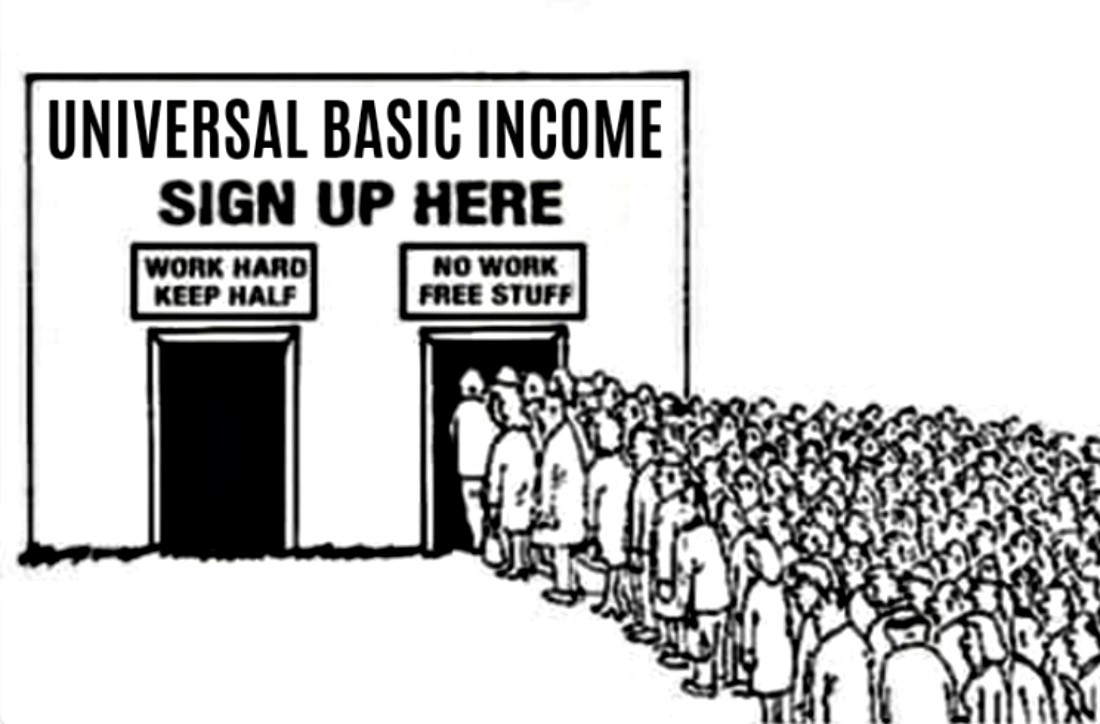
Ted Campbell comes out in favour of some form of negative income tax for Canada:

Cartoon that appeared with Michael K. Spencer’s article “Is Universal Basic Income really a solution?” at https://medium.com/@Michael_Spencer/is-universal-basic-income-really-a-solution-c0d6d95f100e

My first and, I believe, the most important thing to understand about taxes is: there is only one taxpayer; it is you and me and individuals like us. Corporations do not pay taxes ~ they pass every single penny of the taxes assessed to them on to us, their customers. You and I and your and my family and friends pay 100% of all corporate taxes.

A tax on income is a tax on savings which is, in turn, a tax on investment which means it is a tax on jobs.

Flate rate taxes are unfair to the poor, but progressive income taxes, while fairer, take money away from investment in jobs.

Consumption taxes (sales taxes and the HST/GST) are, to some extent, voluntary: consume less and you pay less in taxes. Where consumption is not discretionary ~ say on food ~ the tax system may be used to make consumption taxes at least somewhat progressive.

Corporate taxes ~ ALL corporate taxes ~ are just consumption taxes that are collected in an inefficient and expensive manner. It would be much, much better tax policy to raise the federal GST by 1 or 2 points and cancel ALL corporate taxes. Having a zero federal corporate tax rate would make Canada a much, much more attractive place in which to do business; companies would want to open plants and offices here ~ meaning more, new, good jobs for Canadians.

Income taxes have far too many exceptions and exemptions and deductions and so on. Federal income taxes should be clear and simple and the Canada Revenue Agency should be able to automatically provide a tax bill to about 98% of Canadians. That may mean a thorough (and time-consuming and politically unpopular) overhaul of the complete tax system.

June 24, 2020

Trudeau government wants to introduce an Internet “link tax”

Filed under: Business, Cancon, Government, Technology — Tags: , , , — Nicholas @ 03:00

Michael Geist on the Trudeau government’s latest indications of support for a tax grab to benefit certain favoured groups and organizations:

Canadian Heritage Minister Steven Guilbeault, 3 February 2020.
Screencapure from CPAC video.

Last week, Canadian Heritage Minister Steven Guilbeault called into question his own government’s policies on supporting news media, suggesting that those programs should be replaced by copyright rules that would open the door to payments from internet companies such as Google and Facebook. Mr. Guilbeault indicated that a legislative package was being prepared for the fall that would include new powers for Canada’s communications regulator and what are commonly referred to as Netflix taxes and internet linking taxes.

My Globe and Mail op-ed notes the government’s support for new internet taxes should not come as a surprise. There were strong signals that the spring budget – postponed indefinitely due to the current public health crisis – was going to include expanding sales taxes to capture digital sales such as Netflix or Spotify subscriptions.

[…]

It is Mr. Guilbeault’s plans for a link tax that should spark the most concern, however. The government has long promoted its policies designed to support the Canadian media sector, including direct funding for local journalism as well as labour and subscription tax credits. The taxpayer cost runs into the hundreds of millions of dollars, but is justified on the grounds that journalism is an essential service that requires public support.

Yet Mr. Guilbeault now says that government should not be funding media, characterizing the policies as short term measures aimed at mitigating a media emergency. Instead, Mr. Guilbeault supports a controversial copyright reform measure that would establish a news publisher’s right to demand payment for services that link to their content.

This payment – effectively a tax on linking – raises a host of concerns, not the least of which is that the proposal was not recommended by the government’s own copyright review last year. Copyright reform in Canada is always complicated, particularly given that responsibility for it is shared with Innovation, Science and Economic Development Minister Navdeep Bains, but delving into reforms that sparked protests in Europe could be politically risky for a minority government.

News organizations already benefit from large platforms linking to their content since the links generate visitors that increase advertising revenues and paying subscribers. Organizations that do not want the links can easily opt-out of appearing in services such as Google News or Facebook. In fact, after Google shut down its Google News service in Spain, studies found publisher website traffic dropped by 10 per cent.

May 22, 2020

When raising tax rates reduces total tax revenue

Filed under: Economics, Government, USA — Tags: , , , — Nicholas @ 03:00

In the Continental Telegraph, Tim Worstall explains that the US tax system is already drawing too much in tax and any hope of increasing the total revenue will hinge on reducing the tax rate:

It is often stated that the rate [the Laffer Curve peak rate] discovered here is 75 to 80%. This is not so – that could be the rate if only we entirely and wholly changed the taxation system in a mass of highly undesirable ways. If we remain with roughly what we’ve got in structure and intent then the peak of the Laffer Curve is 54%. That is not income tax, that is taxes upon income. That means we add together all Federal and State taxes upon income, including “employer paid” portions of Social Security, Medicaid, special amounts for this and that and so on and on. Anyone even vaguely familiar with the US taxation system will note that top earners are, already in many states, paying this or more.

There is something else though. The Laffer Curve is not about taxes upon high earners. It is about taxes upon income. It’s true that there will be slight differences in what the peak rate on lower incomes should be, or what the peak of the curve is there. The income effect will be higher than the substitution at lower incomes than it is at higher. We don’t know how much so let’s just stick with what we’ve got – 54%.

At which point:

    The U.S. has a plethora of federal and state tax and benefit programs, each with its own work incentives and disincentives. This paper uses the Fiscal Analyzer (TFA) to assess how these policies, in unison, impact work incentives. TFA is a life-cycle, consumption-smoothing program that incorporates household borrowing constraints and all major federal and state fiscal policies. We use TFA in conjunction with the 2016 Federal Reserve Survey of Consumer Finances to calculate Americans’ remaining lifetime marginal net tax rates. Our findings are striking. One in four low-wage workers face marginal net tax rates above 70 percent, effectively locking them into poverty.

This includes the withdrawal of welfare benefits as income rises – as it should – and so is compatible with the Universal Credit idea that the peak tax and withdrawal rate should be 60%. Or is it 66%?

As we can see that rate is hugely above the Laffer Curve peak. It should, therefore, be lower.

It’s possible to extend the taper. Withdraw benefits at slower rates as income rises. This is, however, hugely, vastlylily, expensive. So it’s not going to happen to any significant degree and if it does then it will be financed by reducing the overall amount of benefit being paid. Which would mean taking money off the truly low income in order to soften the blow to the marginally low income – not the way we want to be doing things.

The only other way to do this is to reduce the taxation of the income of those low income folks. This has been done, a bit, by the Trump tax reforms and the much larger personal deduction. A further bite could be taken by FICA taxation only applying to the income above the personal deduction, not from dollar $1 of income as now. In fact that would be the simplest manner of at least beginning to get to grips with this problem. FICA only starts at $12,000 a year or so. Or even, if all are to be sensible, starting income tax and FICA only at the poverty line, currently $14,000 or so a year for a single adult.

April 27, 2020

The Economy of Ancient Rome

Filed under: Economics, Europe, History — Tags: , , , , , — Nicholas @ 04:00

Economics Explained
Published 26 Apr 2020

Ancient Rome was perhaps the most significant ancient civilisation to have existed throughout history, the empire lived for over 1000 years and in that time, it gave us the foundations for our modern society. Democracy, a court based legal system, Latin languages and alphabet, three course meals, and perhaps it was one of the first modern economies to move beyond a simple agrarian empire and develop things like modern banking, lending, taxation and yes even financial crisis as we know them today.

In the same way that scholars study a dead language like Latin to discerned the foundation of meaning in our modern dialects economists can study the histories of ancient civilisations like Rome to determine basic economic functions in a time before modern financial systems could skew results and Rome was perhaps the most developed case study we could look at.

#rome #economics #recession

Patreon – https://www.patreon.com/EconomicsExpl…

Discord – https://discord.gg/7kM7Tw9

Enquiries – loungejita@gmail.com

References –

Morley, N., 2002. Metropolis and hinterland: the city of Rome and the Italian economy, 200 BC-AD 200. Cambridge University Press.

Temin, P., 2006. “The economy of the early Roman Empire”. Journal of Economic Perspectives

Temin, P., 2017. The Roman market economy. Princeton University Press.

Garnsey, P., Hopkins, K. and Whittaker, C.R. eds., 1983. Trade in the ancient economy

Brown, P., 2012. Through the Eye of a Needle: Wealth, the Fall of Rome, and the Making of Christianity in the West, 350-550 AD. Princeton University Press.

Braund, D.C., 1983. Gabinius, Caesar, and the publicani of Judaea. Klio

Articles

http://penelope.uchicago.edu/Thayer/E…

https://www.rug.nl/ggdc/historicaldev…

https://www.pwc.com.au/publications/a…

April 14, 2020

QotD: The Edict of Diocletian, 301 AD

The most famous episode of price controls in Roman history was during the reign of Emperor Diocletian (A.D. 244-312). He assumed the throne in Rome in A.D. 284. Almost immediately, Diocletian began to undertake huge and financially expensive government spending projects.

There was a massive increase in the armed forces and military spending; a huge building project was started in the form of a planned new capital for the Roman Empire in Asia Minor (present-day Turkey) at the city of Nicomedia; he greatly expanded the Roman bureaucracy; and he instituted forced labor for completion of his public works projects.

[…]

Diocletian also instituted a tax-in-kind; that is, the Roman government would not accept its own worthless, debased money as payment for taxes owed. Since the Roman taxpayers had to meet their tax bills in actual goods, this immobilized the entire population. Many were now bound to the land or a given occupation, so as to assure that they had produced the products that the government demanded as due it at tax collection time. An increasingly rigid economic structure, therefore, was imposed on the whole Roman economy.

But the worst was still to come. In A.D. 301, the famous Edict of Diocletian was passed. The Emperor fixed the prices of grain, beef, eggs, clothing, and other articles sold on the market. He also fixed the wages of those employed in the production of these goods. The penalty imposed for violation of these price and wage controls, that is, for any one caught selling any of these goods at higher than prescribed prices and wages, was death.

Realizing that once these controls were announced, many farmers and manufacturers would lose all incentive to bring their commodities to market at prices set far below what the traders would consider fair market values, Diocletian also prescribed in the Edict that all those who were found to be “hoarding” goods off the market would be severely punished; their goods would be confiscated and they would be put to death.

In the Greek parts of the Roman Empire, archeologists have found the price tables listing the government-mandated prices. They list over 1,000 individual prices and wages set by the law and what the permitted price and wage was to be for each of the commodities, goods, and labor services.

A Roman of this period named Lactanius wrote during this time that Diocletian “… then set himself to regulate the prices of all vendible things. There was much blood shed upon very slight and trifling accounts; and the people brought no more provisions to market, since they could not get a reasonable price for them and this increased the dearth [the scarcity] so much, that at last after many had died by it, the law was set aside.”

Richard M. Ebeling, “How Roman Central Planners Destroyed Their Economy”, Foundation for Economic Education, 2016-10-05.

« Newer PostsOlder Posts »

Powered by WordPress