TimeGhost History
Published on 15 Aug 2019After the Great War, the British empire is at its peak in terms of population and size. However, resistance against colonialism is starting to brew in the British colonies and dominions.
Join us on Patreon: https://www.patreon.com/TimeGhostHistory
Hosted by: Indy Neidell
Written by: Spartacus Olsson and Francis van Berkel
Directed by: Spartacus Olsson and Astrid Deinhard
Executive Producers: Bodo Rittenauer, Astrid Deinhard, Indy Neidell, Spartacus Olsson
Creative Producer: Joram Appel
Post-Production Director: Wieke Kapteijns
Research by: Francis van Berkel
Edited by: Wieke Kapteijns
Sound design: Iryna DulkaPortrait Colorizations by Daniel Weiss.
Sources: National Portrait Gallery, Library and Archives Canada, Jenny Scott
A TimeGhost chronological documentary produced by OnLion Entertainment GmbH.
August 16, 2019
Rule Britannia, Britannia Rules the Salt | BETWEEN 2 WARS I 1930 Part 1 of 1
August 1, 2019
QotD: Small government provides little scope for special interest lobbying
When a government is small, it can provide very limited benefits to special interest groups, so there is a small incentive for special interest groups to lobby the government. The successes of those that do lobby the government will cause the government to grow. This occurs because the great majority of voters and taxpayers are rationally ignorant about most government activity, making it easy to increase everybody’s taxes a small amount to provide a sizable benefit to a few. Most people do not have an incentive to investigate in detail the allocation of their tax dollars, but the special interest groups with the sizable benefit will repay the representatives with political support. Thus, special interest groups cause government growth.
The growth of government, in turn, raises the payoff available to special interest groups. With a higher payoff to special interest groups, this encourages the formation of new special interest groups to share in the payoff. A larger government can support a larger number of special interest groups. Thus, as government grows, more special interest groups form. The formation of special interest groups in turn increases the demand for special interest legislation, cause a further growth in government spending.
Randy Holcombe, An Economic Analysis of Democracy, 1985.
July 31, 2019
The quickest way to raise the real income of minimum wage earners
Tim Worstall explains how to quickly raise the living standards of everyone in Britain earning the minimum wage, without costing employers any more:

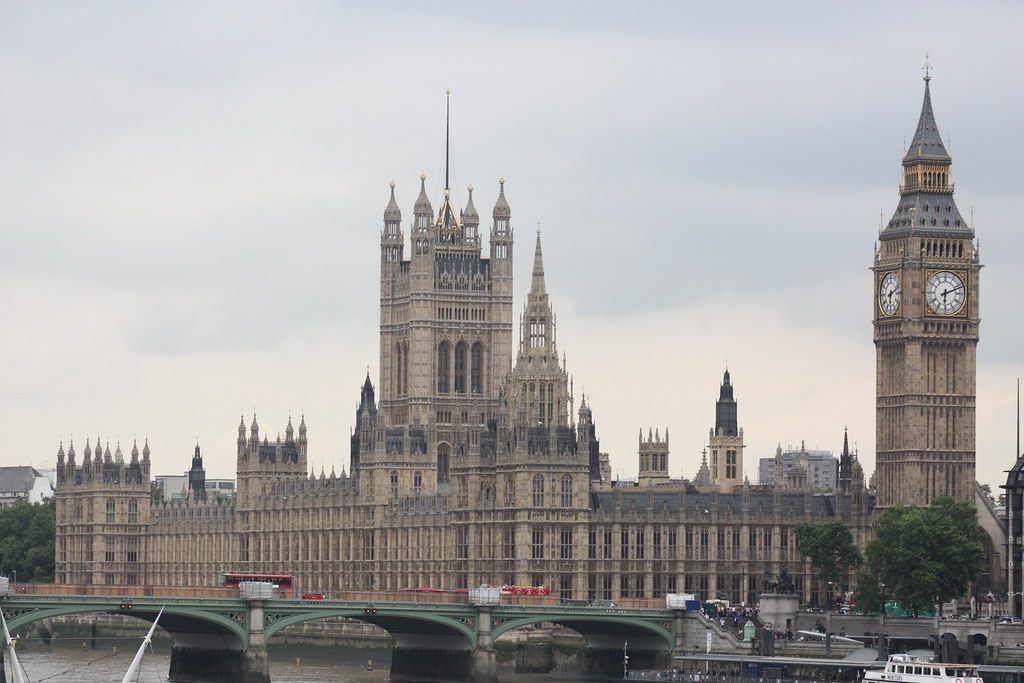
“Palace of Westminster”by michaelhenley is licensed under CC BY-NC-SA 2.0
I – Tim Worstall that is – then started pointing out that the difference between this living wage and the minimum wage was the amount of tax that we – shamefully – charge to the low paid. Tax being both income tax and national insurance contributions. In fact, I rather shouted about it around the place, at the ASI, and here in The Times in 2012.
The gross annual salary of a full-time worker on the minimum wage is £12,070.50. We could come close to lifting every low-paid worker out of poverty if we simply increased the personal tax allowance from £8,105 to that sum. Not a penny of income tax or NICs should leave their pay packet. A full-time worker, however, on the living wage would be taking home £12,410.74, after the taxman has taken a cut — that’s only £340 more. And before the Foundation uprated the living wage yesterday, the annual difference was just £8.74.
There are problems. Raising the personal allowance gives everyone a tax cut — which I’ll admit doesn’t break my heart. But we could lower the amount at which the higher rates of tax kick in to make up for that lost revenue. And won’t these workers lose their right to unemployment benefit and a pension, if they don’t pay NICs? No, they qualify already, as the system treats the very low paid as if they had made NI contributions. We should go farther. The link between the full-year minimum wage and the personal allowance for tax and NI should be made explicit. Change one and the government of the day must change the other. If the minimum wage is the minimum moral amount that someone’s labour is worth, then that is what they should get, not the amount after Denis MacShane’s European wanderings have been paid for.
Which leaves us with two competing visions of how everyone can be free of poverty pay. The Living Wage Campaign’s vision is to shout at every employer in the country until they give in. The Worstall Way is to increase the incomes of the working poor by stopping taxing them.
June 27, 2019
“Raise our taxes!” cried the hypocritical virtue signallers
We’ve been over this ground before. Some very rich people are getting fawning media coverage for their “selfless”, “virtuous” demand that the government raise their taxes. Except they’re far from selfless: they’re demanding that other people be forced to pay more tax, but they’re very much not putting their own money where their bleating mouths are. Most governments are happy to accept more money from you than your formal tax liabilities:
- The Canadian federal government
- The British government
- The US federal government
- The province of Ontario
- The City of Toronto
… are all very eager to accept your contributions. But most people don’t take advantage of this mechanism, especially the ones garnering headlines for their “altruism”. Because they’re virtue signalling, and almost certainly don’t actually want to be taxed more. Don’t believe what people merely say they want, watch what they actually do (economists call this “revealed preference“). Hypocrites, the lot of them.
June 26, 2019
What is the problem that a wealth tax is designed to solve?
Andrew Coyne asks the obvious question about the sudden keen interest in imposing wealth taxes:

“washdc040208-02” by carencey is licensed under CC BY-NC-SA 2.0
It is noteworthy how the debate on inequality has shifted in recent years: from the problem of poverty, whose evils are obvious, to the “problem” of great wealth; from the gap between the poor and the rest of us, to the gap between the rest of us and the rich, or indeed between the rich and the very rich.
But it is not obvious why it is wrong, in itself, that a small number of people should get stinking rich. It is clearly objectionable if they did so by illicit or unethical means — but then it is the means itself, not the wealth, to which we object. And it would be in poor taste, at the least, if they spent it all on themselves. But that is not how the great fortunes are typically disposed of — it’s physically impossible to spend more than a small fraction of it.
Perhaps the argument is less that the rich are too rich than it is that the government is too poor. You can make a case that government should spend more on certain things, especially in America. It doesn’t follow that you need to raise taxes to do so. A lot of good new spending could be funded by cutting bad old spending.
Suppose there were a case for raising taxes. Are wealth taxes the way to go? Wealth is, after all, merely the accumulation of past income — and we already tax income. If rich people are exploiting loopholes to avoid paying tax on their incomes, by all means close the loopholes. But the case for taxing income twice seems obscure.
Yes, we already have a kind of wealth tax, in the form of municipal property taxes — and they’re a notorious mess. They conform to none of the usual principles of good taxation, being neither simple, nor efficient, nor fair.
Why unfair? The bedrock criteria of tax fairness is supposed to be ability to pay. That’s only uncertainly related to wealth. Suppose the value of your house shoots up. Congrats: suddenly you’re wealthy. But your income is unchanged. And it’s income you need, or more accurately cash, to pay your taxes. It’s not clear why you should pay more in tax than someone with the same income, but a cheaper house.
June 14, 2019
“[P]eople aren’t really arguing about the existence or logic of the Laffer Curve they just hate the empirical answer”
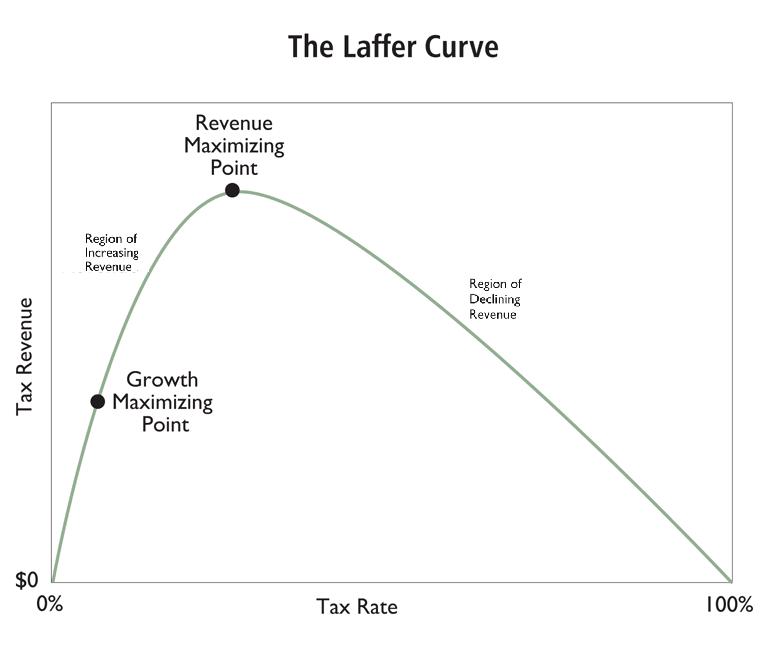
The Laffer Curve is one of those ideas that drives some people mad, because if it’s true (and empirically it appears to hold most of the time), it militates against raising taxes on the wealthy:
That working out where the peak of the Laffer Curve is is difficult is entirely true. That it’s going to be different for each tax in each different legal and societal set up is also true. But that doesn’t excuse drivel like this:
The ends of the curve are basic enough – at a tax rate of 0, the government will raise $0 in revenue, and at a tax rate of 100, the government will still raise $0 in revenue because people won’t work without take-home pay. At the extremes, the Laffer curve is correct, but that doesn’t tell us anything about the points in the middle. Laffer’s idea, however, was that a “tipping point” existed on the continuum in between, where people’s incentives to work and invest decreased because tax rates were too onerous.
If the end points are true – something admitted – then it’s a matter of simple, pure, and true logic that there are one or more revenue maximising points inbetween. For it’s simple enough for us to observe that there are tax rates which do raise revenue. And if we have tax rates which raise no revenue and tax rates which raise some then there are those one or more rates which raise the most.
So, please, can we stop the drivel?
Sure, Art Laffer himself is incorrect when stating that all tax cuts always pay for themselves through increased economic growth. But that doesn’t invalidate the logic of the curve, only the use to which it is put.
Fifty-four percent. That’s approximately it: the tax maximizing point on the curve when you include all of the taxes on income (including the things they often don’t call taxes — social security, unemployment insurance, and other non-tax taxes — but which are still withheld from paycheques or payable at tax deadline time). Go much above that and the government’s take begins to decrease, defeating the purpose of raising the tax rate in the first place. (Unless the real purpose is just to harm the rich … which might be true in a number of cases.)
June 9, 2019
People who call for higher taxes are almost always hypocrites
And the numbers prove it:
There are many people who tell us that taxation in the UK is too low. Just think of all the gorgeously bureaucratic things that could be done if only the government had more money! Then there’s the number of people who actually do pay more tax on the basis that they think the government should have more money. The second being a rather smaller number than the first.
Which does bring us to that basic point that economists do insist upon making. Revealed preferences are a much better guide to what people do in fact believe than are expressed. Or, as folk wisdom has it, talk is cheap. That many shout that taxes should be higher – usually to insist that them over there should be taxed more – is interesting and amusing. But the actual number of people who really believe taxes should be higher is the number of people who voluntarily offer up more of their own hard earned to the government.
Which means that, according to the aggregate views and actions of the population of Britain taxes last year were too low by exactly the amount of £11,069. Everyone else is just virtue signalling:
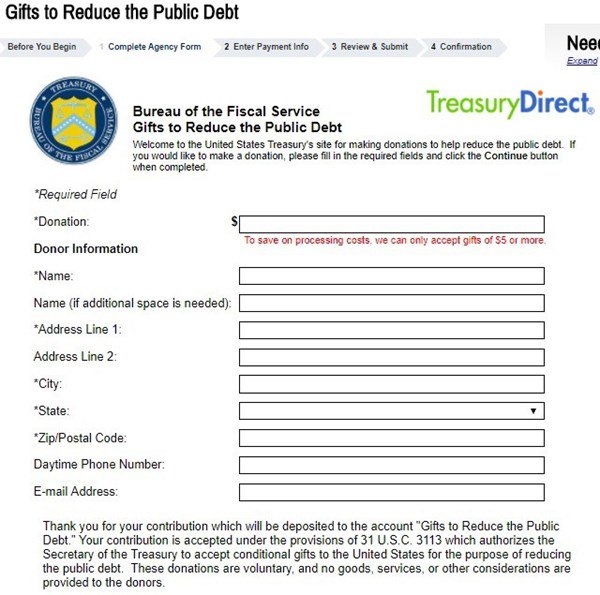
Donations to the Treasury have dwindled in recent years, however, even as the country’s debt remains relatively high. There were just 14 donations and bequests to reduce the national debt in the 2018-19 tax year, totalling £11,069, the UK Debt Management Office said.
That is the revealed preference of us all in aggregate.
It’s not just the UK where the number of people demanding higher taxes don’t actually put their own money where their mouths are — it’s true in Norway, the USA, and even the City of Toronto.
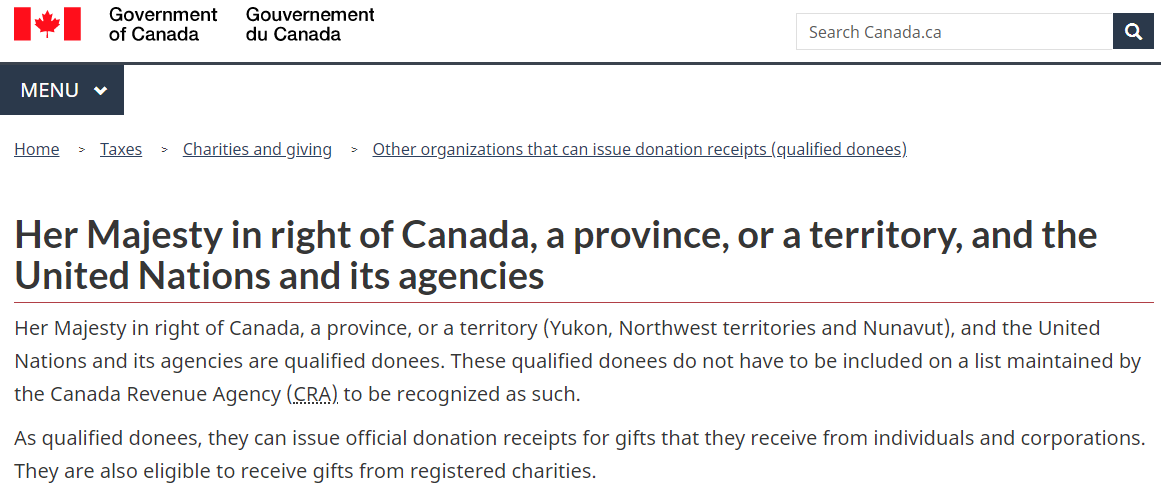
For ultra generous Canadians, Her Majesty will happily accept your donations here. To prove that you’re even more devoted to the challenge, you can even forego the tax credit, too!
June 4, 2019
What do you get for your tax money?
Alex Noble conducts a small experiment:

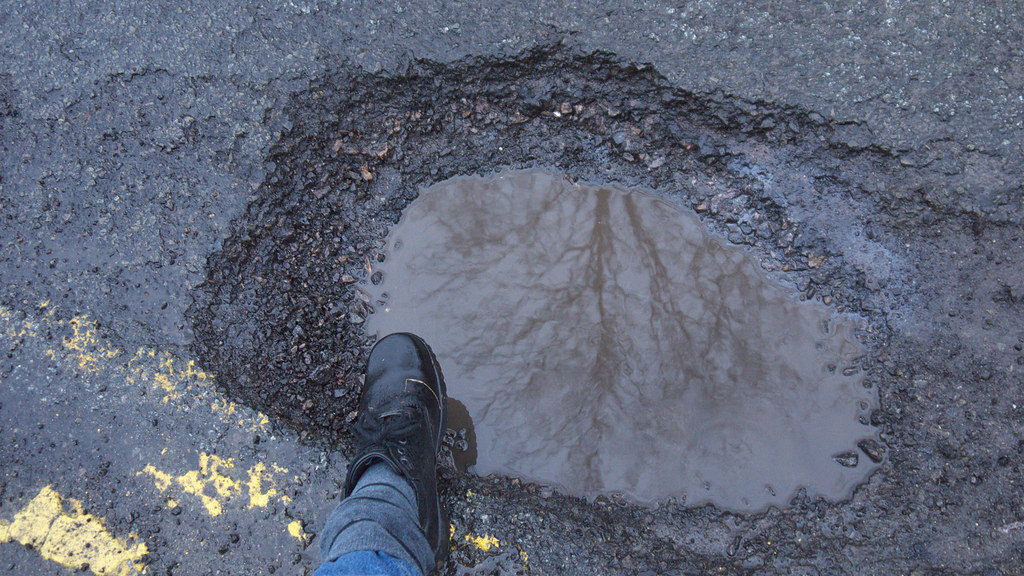
“Murderous Pothole”by samsaundersleeds is licensed under CC BY-SA 2.0
I suggest we stop thinking about taxes as paying for something useful – this type of thinking paralyses us and causes us to refuse to do that which needs doing. Because our taxes are supposed to pay for it.
We are no longer charitable, because our taxes pay for dole money.
We no longer look after the verge outside our homes, because our taxes are supposed to pay for a council worker with a strimmer.
We don’t repair potholes in our roads, because council workmen are supposed to fill them in.Just to check that last one, I contacted my local council.
“I was wondering if I could personally pay a local company to make repairs to the potholes that are causing damage to my car out of my money, and if so, would they be granted permission to close the road while my privately-funded repairs were being carried out?”
And they said…………
“It would not be possible for you undertake these repairs, and no permission would be given to close the road.”
So I proposed I make a payment to them, to be spent on repairing the road:
“…could I instead make a voluntary tax contribution on the condition the money is to be spent on these road repairs?”
And they said…
“…the County Council will not accept payment from members of the public for the provision of highway maintenance over and above that already collected via the Council Tax”
I made one last attempt…
“I have obtained quotes for the work which are acceptable to me and my neighbours – is there really no way we can as private individuals simply pay for the repairs to our road?”
They responded:
“…it is not possible to accept any from of funding other than that accepted via the Council Tax and Central Government.”
So I just went out and bought a bag of sand and pounded it into the hole one night. A temporary fix, admittedly.
£5 of sand and five minutes of my time.
No doubt the council are scouring CCTV as we speak in an attempt to bring to justice the criminal that repaired the road.
June 1, 2019
Paying taxes is only for the little people like you and me…
Canada’s tax-gathering bureaucracy is eager to crack down on scams that attempt to hide taxable funds from scrutiny, although they seem to be rather more vigilant when it’s some poor slob who forgets to declare a grand or two from part-time work than multi-national organizations running decades-long scams to benefit deep-pocketed clients:
The Canada Revenue Agency has once again made a secret out-of-court settlement with wealthy KPMG clients caught using what the CRA itself had alleged was a “grossly negligent” offshore “sham” set up to avoid detection by tax authorities, CBC’s The Fifth Estate and Radio-Canada’s Enquête have learned.
This, despite the Liberal government’s vow to crack down on high-net-worth taxpayers who used the now-infamous Isle of Man scheme. The scheme orchestrated by accounting giant KPMG enabled clients to dodge tens of millions of dollars in taxes in Canada by making it look as if multimillionaires had given away their fortunes to anonymous overseas shell companies and get their investment income back as tax-free gifts.
KPMG is a global network of accounting and auditing firms headquartered out of the Netherlands and is one of the top firms in Canada.
“Tax cheats can no longer hide,” National Revenue Minister Diane Lebouthillier promised in 2017.
Now, Tax Court documents obtained by CBC News/Radio-Canada show two members of the Cooper family in Victoria, as well as the estate of the late patriarch Peter Cooper, reached an out-of-court settlement on May 24 over their involvement in the scheme.
Details of the settlement and even minutes of the meetings discussing it are under wraps. A CBC News/Radio-Canada reporter who showed up to one such meeting this spring left after realizing it was closed to the public.
Journalists discovered references to the final settlement agreement in Tax Court documents only by chance.
May 29, 2019
Trudeau’s Liberals consider running on “more taxes” platform for fall election
Are you ready for more taxes? Justin Trudeau seems to think you are, and internal Liberal Party documents indicate that several “revenue enhancement” tools are among the ideas being considered for inclusion in the party’s election campaign:
Are you ready for a tax on pop?
That is what some Liberals want to run on in October’s election.
Well, that and a carbon tax, a plastic tax, a tax on selling your home and more.
When it comes to taxes, Liberal like them all.
Lest you think I’m picking on Liberals, this actually comes from an internal party document that was first reported by the Liberal-friendly CBC.
“Ontario Liberal MPs want to pitch voters on a “sugar sweetened beverages levy — more commonly known as a soda tax — in the coming federal election campaign,” reported CBC over the weekend.
The information came from a series of policy proposals put forward by Ontario Liberal MPs that were to be considered for both the budget earlier this year and as potential policies for the upcoming election.
“We have a problem with sugar sweetened beverages being too readily available at too low a price and it is massively contributing to the obesity epidemic,” Liberal MP Mark Holland wrote in support of the proposal.
The Liberals want a tax of 20% on any sugar sweetened beverage believing it could bring in an estimated $1.2 billion a year or $29.6 billion over 25 years and health-care savings of $7.3 billion over 25 years.
May 18, 2019
QotD: “Revenue neutral” tax cuts
Real men (as well as pull-no-punches women) cut taxes. The lesser mortals that tend to inhabit Washington wring their hands and get all weak in the knees when it comes to cutting taxes. Rumors are President Trump will propose a real tax cut. I certainly hope so.
Once upon a time, most Republicans believed in tax cuts. Somewhere along the way, inside the beltway especially, Republicans forgot about the benefits of cutting taxes. Republicans became more concerned with government keeping “its” revenue than letting the people keep their money.
Too many Republican have become timid about tax cuts, often spouting the milquetoast line of “revenue neutral tax cuts.”
Let me translate that little bit of Washington-speak for you. “Revenue neutral” tax cuts aren’t really tax cuts. It’s more like tax shifting. Some will pay more. Some will pay less. And the net effect will be that government will collect the same amount of taxes.
If revenue neutral tax shifting is what Republicans stand for, maybe it’s time we re-evaluated what we really stand for.
What will “revenue neutral” tax cut mean to your business? Well, that may depend on how expensive your lobbyist is. Which side of the “revenue-neutral” ledger you wind up on may depend on how well the skids are greased, hardly, a pleasant scenario to anticipate.
I believe as John F. Kennedy and Ronald Reagan did, that the best way to stimulate our economy, promote job growth, and give our ailing middle class a raise is to cut taxes for all.
Rand Paul, “Real Men Cut Taxes”, Breitbart.com, 2016-04-25.
May 1, 2019
QotD: Standardized measurements, feudalism, and revolution
The pint in eighteenth-century Paris was equivalent to 0.93 liters, whereas in Seine-en-Montane it was 1.99 liters and in Precy-sous-Thil, an astounding 3.33 liters. The aune, a measure of length used for cloth, varied depending on the material (the unit for silk, for instance, was smaller than that for linen) and across France there were at least seventeen different aunes. […]
Virtually everywhere in early modern Europe were endless micropolitics about how baskets might be adjusted through wear, bulging, tricks of weaving, moisture, the thickness of the rim, and so on. In some areas the local standards for the bushel and other units of measurement were kept in metallic form and placed in the care of a trusted official or else literally carved into the stone of a church or the town hall. Nor did it end there. How the grain was to be poured (from shoulder height, which packed it somewhat, or from waist height?), how damp it could be, whether the container could be shaken down, and finally, if and how it was to be leveled off when full were subjects of long and bitter controversy. […]
Thus far, this account of local measurement practices risks giving the impression that, although local conceptions of distance, area, volume, and so on were different from and more varied than the unitary abstract standards a state might favor, they were nevertheless aiming at objective accuracy. This impression would be false. […]
A good part of the politics of measurement sprang from what a contemporary economist might call the “stickiness” of feudal rents. Noble and clerical claimants often found it difficult to increase feudal dues directly; the levels set for various charges were the result of long struggle, and even a small increase above the customary level was viewed as a threatening breach of tradition. Adjusting the measure, however, represented a roundabout way of achieving the same end.
The local lord might, for example, lend grain to peasants in smaller baskets and insist on repayment in larger baskets. He might surreptitiously or even boldly enlarge the size of the grain sacks accepted for milling (a monopoly of the domain lord) and reduce the size of the sacks used for measuring out flour; he might also collect feudal dues in larger baskets and pay wages in kind in smaller baskets. While the formal custom governing feudal dues and wages would thus remain intact (requiring, for example, the same number of sacks of wheat from the harvest of a given holding), the actual transaction might increasingly favor the lord. The results of such fiddling were far from trivial. Kula estimates that the size of the bushel (boisseau) used to collect the main feudal rent (taille) increased by one-third between 1674 and 1716 as part of what was called the reaction feodale. […]
This sense of victimization [over changing units of measure] was evident in the cahiers of grievances prepared for the meeting of the Estates General just before the Revolution. […] In an unprecedented revolutionary context where an entirely new political system was being created from first principles, it was surely no great matter to legislate uniform weights and measures. As the revolutionary decree read “The centuries old dream of the masses of only one just measure has come true! The Revolution has given the people the meter!”
James C. Scott, Seeing Like A State: How Certain Schemes to Improve the Human Condition Have Failed, 1998.
April 28, 2019
QotD: Innovations in taxation
The door-and-window tax established in France [in the 18th century] is a striking case in point. Its originator must have reasoned that the number of windows and doors in a dwelling was proportional to the dwelling’s size. Thus a tax assessor need not enter the house or measure it, but merely count the doors and windows.
As a simple, workable formula, it was a brilliant stroke, but it was not without consequences. Peasant dwellings were subsequently designed or renovated with the formula in mind so as to have as few openings as possible. While the fiscal losses could be recouped by raising the tax per opening, the long-term effects on the health of the population lasted for more than a century.
James C. Scott, Seeing Like A State: How Certain Schemes to Improve the Human Condition Have Failed, 1998.
April 24, 2019
QotD: The Utopia of Damned Fools
The money began to pour out on November 16, 1933, to the tune of a deafening hullabaloo. By December 1 more than 1,000,000 were on the CWA [Civil Works Administration] pay roll; by January, 1934, the number reached 4,100,000. Press agents in eight-hour shifts worked day and night to tell a panting country what it was all about. The Depression, it was explained, was being given a series of adroit and fatal blows, above, below and athwart the belt. In six months there would be no more unemployment, the wheels of industry would be spinning, and the More Abundant Life would be on us. Brains had at last conquered the fear of fear.
What actually happened belongs to history. By the opening of Spring [Harry] Hopkins had got rid of his billion, and the whole thing had blown up with a bang. More people were out of work than ever before. The wheels of industry resolutely refused to spin. The More Abundant Life continued to linger over the sky line. There ensued a pause for taking breath, and then another stupendous assault was launched upon the taxpayer. This time the amount demanded was $4,880,000,000. It is now in hand, and plans are under way to lay it out where it will do the most good in next year’s campaign.
Go back to the clippings and read them again. Consider well what they say. Four preposterous nonentities, all of them professional uplifters, returning from a junket at the taxpayer’s expense, sit in a smoking car munching peanuts and talking shop. Their sole business in life is spending other people’s money. In the past they have always had to put in four-fifths of their time cadging it, but now the New Deal has admitted them to the vaults of the public treasury, and just beyond the public treasury, shackled in a gigantic lemon-squeezer worked by steam, groans the taxpayer. They feel their oats, and are busting with ideals. For them, at least, the More Abundant Life has surely come.
Suddenly one of them, biting down hard on a peanut, has an inspiration. He leapt to his feet exultant, palpitating like a crusader shinning up the walls of Antioch. How, now, comrade, have you bitten into a worm? Nay, gents, I have thought of a good one, a swell one, the damndest you will ever heard tell of. Why not put everyone to work? Why not shovel it out in a really Large Way. Why higgle and temporize? We won’t be here forever, and when we are gone we’ll be gone a long while.
But the Leader? Wasn’t he babbling again, only the other day, of balancing the budget? Isn’t it a fact that he shows some sign of wobbling of late – that the flop of the NRA [National Recovery Administration] has given him to think? Well, we can only try. We have fetched him before, and maybe we can fetch him again. So the train reaches Washington, the porter gets his tip from the taxpayer’s pocket, and the next day the four brethren meet to figure out the details. But they never get further than a few scratches, for The Leader is in one of his intuitive moods, and his Christian Science smile is in high gear. Say no more, Harry, it is done! The next morning the money begins to gush and billow out of the Treasury. Six months later a billion is gone, and plans are under way to collar five times as much more.
Such is government by the Brain Trust. Such is the fate of the taxpayer under a Planned Economy. Such is the Utopia of Damned Fools.
H.L. Mencken, “The New Deal”, The Mencken Chrestomathy, 1982 (article originally published 1935-05).
April 23, 2019
QotD: Cities and the Laffer Curve
… government finances are ultimately constrained by the much-maligned Laffer Curve. There is some point, however high the percentage, beyond which raising the tax rate not only doesn’t bring in more revenue, but actually lowers government income. And the smaller the level of government, the lower the tax rate at which Laffer effects kick in. If your block had the ability to levy a 25 percent tax on your income, and actually did so, you’d sell your house pretty quick. It’s much harder to pick up and move to another country. We also have to factor in the fact that, in a democracy, voters can go to the polls and say “no more,” which is a sort of secondary Laffer point that people planning in decades have to reckon with.
Cities tend to declare bankruptcy precisely because they’re near one of those points, through some combination of financial mismanagement and local economic decline. When they have exhausted their ability to borrow, or wheedle bailouts out of some larger government entity, they end up with an unpalatable choice between cutting municipal services or failing their creditors …
Megan McArdle, Bloomberg View, 2017-04-11.