Quotulatiousness

February 11, 2025

Many young white men are choosing to “own the insult” when accused of being a fascist

Filed under: Media, Politics, USA — Tags: , , , , , — Nicholas @ 05:00

Lorenzo Warby points out that some — even many — young white men are reacting to repeatedly being called “Nazi” or “fascist” by embracing the slur:

Still from Pink Floyd: The Wall

For the fuel of the contemporary networked authoritarians are angry young men. Angry young men who have a great deal to be angry about.

In so many modern schools, universities, and much of social media, if you are a low melanin count, heterosexual male you are absolutely at the bottom of the “woke” oppression-bingo hierarchy. You will be implicitly, or explicitly, held to be somehow tarred with every bad thing any person “like” you has done in history, no matter how long — even how many generations — before you were born that it happened, nor how dubious an historical characterisation it might be. There is no identity open to you that you can celebrate, or feel positively attached to, without potential or actual denigration.

If you do any reading, you can quickly work out that this is a ludicrously one-sided — and deeply unfair — way to look at history. Even in its own terms, it is nonsense, as “folk like you” — i.e., low melanin count heterosexual males — voted for every single legal advance any of the celebrated-as-oppressed groups made. “Folk like you” built the Scientific Revolution, Parliamentary Government, mass prosperity.

Of course, this was a matter of culture, institutions, the happenstance of history, not melanin content. The trouble with the racialisation of history and identity is that it is, indeed, the racialisation of history and identity. As Jews are currently (re)discovering.

Nor can many of these angry young men take much refuge in the good life, work or entertainment. Online dating has turned into a hypergamous nightmare that excludes most guys, in-person connections are fraying and migration-plus-restrictive-land-regulation has shot rents up and made home-owning unattainable.

In entertainment, masculine heroes are being replaced and degraded. Online games are being systematically “wokified”. There are systematic attacks on their heritage. Sport and advertising is also being wokified, is “bending the knee”. Where to go?

If folk systematically tar or denigrate someone’s identity, a natural response is to say “no, my identity is great, it is wonderful”. There will be certainly a market for such a response. The natural response to systematic denigration is some form of “fuck you!” and the politics of “fuck you!“.

In the contemporary world, what is the most dramatic way of saying “fuck you!“? To take the racist!, fascist! abuse and go “right on!“. Even more so if you take the ideas they invoke and turn them back against them.

Of course, if you just reverse what left-progressivism — in its “woke” iteration — stands for, you are still dancing to their tune. But rage can easily work like that.

So, these angry young men look at the folk who treat them with such continual, institutionalised, contempt — who stack everything they can against them — and decide “we hate you”. If you are going to abuse us anyway no matter what we do — the seductive logic goes — then why not simply embrace the identity you impose on us if we put our heads up? There is, after all, no more in-your-face way to shriek their anger and rejection back at those who are abusing, denigrating and excluding them than to embrace racism and fascism.

They look at ordinary conservatives, at ordinary liberals, they look at Boomers, and think “you did not stop it, you did nothing to protect people like me”, so they — and their politics — get no respect.

Instead, they go to the politics of using the operational tactics used against them — the operational politics of “wokery” — in support of politics that most completely expresses their rage. This is the updated version of what happened with 1920s Fascism in Italy and 1930s Nazism in Germany. Like the original versions, they are using — and so helping to legitimate — the operational methods of the left-progressivism.

Not that left-progressives, the “woke”, will see it. They are way too full of the stupidity of arrogance, of the blindness of moral narcissism, to pick what is happening, still less take any responsibility for it. They utterly fail to see themselves; to understand how much they come across as smug, arrogant, condescending, self-righteous, shits whose politics again and again ends up favouring people like them and whose recurrent response to disagreement is to de-legitimise, denounce and censor. Their entire view of themselves is they are the oh-so-clever, oh-so-moral people. Nothing they do is ever seriously counter-productive or fundamentally mistaken.

Faced with the rise of actual racism and actual fascism, they will shriek racist! and fascist! even harder. But they are in the situation of the boy who cried wolf! Except worse, as the boy in the story neither created, nor trained, the wolf.

They have so debased that currency, so debased historical analogy, that fascism has lost its rhetorical, or even its warning, power.

Besides, how many people will say: these folk against whom you are shrieking the same terms of abuse you have shrieked at people for decades. Are they making excuses for the mass sexual predation on young girls by migrants we did not want? Are they supporting the hormonal and surgical mutilation and sterilisation of minors? Are they teaching folk to despise their own countries and heritage? Are they pushing the narrative lies of the moment? Have they proved to be incompetent at elementary things, such as fighting crime and managing fire risk?

No? Then they sound good to me.

Left-progressives: so good at finding new ways to make the same mistakes. It is almost as if they have a pathological relationship with information. Oh, wait, they do.

“As it turns out, you can just cut things”

Filed under: Bureaucracy, Government, Media, Politics, USA — Tags: , , , , — Nicholas @ 03:00

John Carter outlines the left’s long march through the institutions and explains why a conservative counter-operation of the same kind would utterly fail. Instead, Donald Trump (of all people) launched a political blitzkrieg that used none of the strategies of the long march — because the establishment knew intimately how those worked, as they’d used them for generations to become the establishment:

Alexander Cutting the Gordian Knot
Fedele Fischetti, 18th century.

But a counter-revolutionary long march through the institutions was always a doomed project.

The left understands the method quite well, having perfected it themselves, and its defences against counter-infiltration were well advanced. It was never enough merely to say the right things, and not say the wrong things – the left knows how easily such signals are faked, as these are mere words, and words have no meaning to an egregore which sees in discourse nothing but the currents and tokens of power. Much of the seeming insanity of the Cancelled Years is best understood as the imposition of elaborate, difficult to fake displays of loyalty: offering your child’s genitals to the hungry gender gorgon, opening your veins for the gene therapy injection. Then of course there is DEI, whose explicit intent was to simply deny opportunity to those most likely, on a demographic basis, to oppose the left. There is very little point, as a young white man, in keeping your mouth shut if you will be locked out simply because you are white, no matter what you say.

The psychological demands of stealthy infiltration are spiritually toxic. Anyone attempting this path finds himself embedded in a social context in which all of his friends and colleagues adhere to values which he privately despises, and moreover, he knows that the instant they discover his true beliefs he will be not only fired, but ostracized and isolated. Worse, he’s constantly placed in the position of betraying his own convictions, of going along with and even actively supporting things he knows are wrong, because failing to do so would be immediately suspicious. Since the left is a hive mind, he must “pretend” to give up his agency … and insofar as you are what you do, there is very little difference between pretending to give up your agency, and actually doing giving it up. Living like this is miserable. It requires iron discipline, and there is very little reward. Some of you doubtless have direct experience of this.

The most important reason that a long march was never viable, however, was that there was not enough time.

The West is in crisis. Public debt has broken up through the exosphere, its rise ever more vertical as the deficits fuelling it continue to expand, and we can all see in its meteoric rise that its inevitable descent will hit the land like rods from God. Third world invaders pour into our countries by their millions at the open invitation of seditious governments whose open aim is to reduce native white populations to second-class minorities in their own homelands within the space of a generation. These two crises of the Great Inflation and the Great Replacement could never be solved by the tactics the left used to bring them about. Even if such a long march could have succeeded in the face of the barriers the left so astutely erected, by the time it came to fruition the victors would preside over wreckage.

The left’s tactics were those of a chronic disease, gradually wasting the patient, leaching the strength from his limbs. You cannot cure a patient by becoming an opportunistic infection in your own right.

So what to do? Many, despairing, looked to civil war. A coup d’état, likely followed by blue states separating from the Union. Battle lines would be drawn, brother would be set against brother, cities would be ruined, vast pits would be excavated and filled with the stinking dead. Such a war would never have been limited to continental United States. It would have dissolved the Pax Americana, with brushfire wars springing up across the globe as great powers sought to expand their territories by grabbing resources or strategic trade corridors. Those powers would have gotten involved in the Civil War themselves, backing one side or another, prolonging the conflict in order to ensure the Union remained shattered forever.

On J6, the American government teetered on a precipice. Had Trump applied so much as the gentlest pressure with his baby finger, it would have toppled over. The other side would then have screamed that he was a tyrant who had seized power by force; his own supporters would have rallied to the cause that the election had been stolen; America, and the world, would have been bathed in blood. So Trump pulled back, allowed the heroes of J6 to be imprisoned, and permitted the sclerocracy to impose four years of malevolent mismanagement on the American people.

Many were furious with Trump. He’d lost his nerve; he was a coward.

As it turned out, they were all wrong. It was a strategic withdrawal.

And now, instead of a Long March, we are getting a blitzkrieg.

I’ve been silent for the last month partly for personal reasons that deprived me of the time and energy to write, which I won’t elaborate upon here save to note that it’s nothing anyone has to worry about. But I’ve also been silent because I haven’t been sure what to say. The last weeks have been one of those ‘weeks when decades happen’ periods, and that pace of change doesn’t appear to be letting up. Executive Orders flying off of the big man’s desk, birthright citizenship being struck down, entire government departments getting defunded, the J6 heroes being pardoned, trade wars starting and then stopping before they start, the military heading to the border, DOGE siccing broccoli-headed zoomers armed with large language models to rip through the sprawling financial records of acronym agencies like a cyclone of destruction.

As it turns out, you can just cut things.

These are all great, wonderful things. We are winning, and the pace of winning is dizzying. It’s like we’ve spent the last several years slamming again and again against a seemingly immovable wall, bashing our brains out upon it like an enraged tiger, only for that wall to suddenly turn to sand upon our final desperate push, leaving us sprawled and disoriented on the ground.

That is at least what it has felt like to me. The people on the inside of the Trump administration are not disoriented. Far from it. They are executing a detailed, thorough plan. They’ve identified the enemy nerve centres and are neutralizing them precisely, rapidly, and ruthlessly. Handpicked squads of very competent young men have been turned loose inside the Beltway. It is clear that they are not being micromanaged, but are being left to develop their own action plans on the fly as the tactical situation evolves. This is manoeuvre warfare, with small, nimble, lethal teams dropped into the heart of enemy territory and being given maximum latitude to pursue the campaign’s strategic objectives.

February 6, 2025

QotD: Wokeness as substitute religion

Filed under: Media, Politics, Quotations, Religion — Tags: , , — Nicholas @ 01:00

[In Tom Holland’s Dominion, he] makes that point that in the absence of Christianity, there’s something instinctive about finding these belief systems. And it does have the same hallmarks: it has the aspect of original sin, the Augustinian concept of original sin which now comes in through whiteness, or being heterosexual — having these immutable characteristics that make you a sinner. And then you’ve got the heresy concept, the idea that anyone who doesn’t think the right things is a heretic who needs to be cancelled, and then you get the metaphor of cancel culture, which is a lot like witch hunting, and burning people at the stake as the Inquisition might have done.

And of course so much of the theorizing behind woke ideas is based on entirely unsubstantiated, faith-based positions. They believe in unconscious bias, and institutional power structures — things that you can’t quantify or put your finger on that just sort of exist in the ether like spirits. And to ask them to prove any of these positions is to simply get the response that well, they do exist because we know they do. Which is what a religious zealot would say.

So I think that certainly the best way to understand the social justice movement is to see it as a cult. Because then it all makes sense, and it also makes sense why they’re able to behave so barbarically toward those who don’t subscribe to their belief system. Because the hallmark of many religions is tolerance to a degree. And then where things start going wrong, where witches start getting burned at the stake and heretics start getting executed is where that tolerance runs out. And I think that’s what happened here: the social justice movement is a fundamentally intolerant movement. And fundamentally illiberal. There’s nothing liberal about it.

Andrew Doyle, talking to Spencer Klavan, “Titania McGrath and the Politics of Wokeness: An Interview with Andrew Doyle”, The American Mind, 2020-01-30.

February 4, 2025

QotD: The American political spectrum

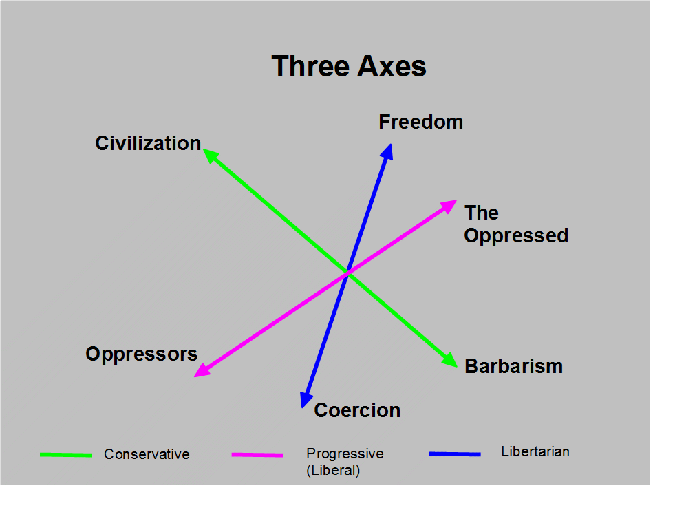
I tend to think of the American political spectrum as broadly dividing into six major groups (political “tribes” we might say), arranged very roughly from left to right, though I must note that there are serious differences within tribes as much as between them. Going left-to-right, there is first (1) The Left, who are the sort of left-leaning folks who get upset if you call them liberals and are committed to more aggressive forms of socialism that envision and end to or massive curtailment of things like markets. Your actual Marxists go here. Then moving right there are (2) Progressives, who are generally committed to liberalism as a philosophy, but favor large-scale government intervention inside that framework to reshape society (“progressivism”), which they believe can be reshaped for the better. Bernie Sanders, Elizabeth Warren and AOC go here; some of these folks will call themselves social democrats, evoking the form of this ideology in Europe. Then you have (3) Left-Liberals (“Social Liberals”), who have the same ideological components as the progressives (progressivism+liberalism), but with an inversion of the emphasis, where the individual liberty claim of liberalism is the dominant strain over the society-reshaping goals of progressivism. This is where the mainstream and especially moderate wings of the Democratic party sits.

Then on the right you have (4) Right-liberals (“Classical liberals”), who share liberalism with groups (2) and (3) but reject (or at least substantially challenge) the idea that society can be “engineered” with positive results. This group largely left the Republican party between 2016 and the present (though some were already libertarians). Notably, (3) and (4) in the United States tend to share hawkish anti-authoritarian, anti-communist foreign policy views; this is where the foreign policy “blob” lives. To their right are (5) Traditionalist Conservatives. Because the United States was founded as a liberal country, they tend to still hold some liberal views (and respond well to liberal, “freedom-centered” framing) but their main ideological commitment is generally conservative in its literal meaning of being traditionalist, desiring things to not change or to recover that which has changed and there is a willingness to compromise on liberalism in the pursuit of that. This, I’d argue, is where the core of the Republican Party currently exists. Finally, you have (6) Right-Authoritarians, who come in various forms based on the authority they believe ought to structure society, e.g. populist authoritarians are fascists, whereas Catholic religious authoritarians are integralists and so on. But the core idea here is that there exists an authority, be it the “national will” (invariably channeled by an individual charismatic leader and often herrenvolk in nature) or tradition or the church or whatever else, which has a right to structure society which supersedes individual liberties. For our purposes, they key is they generally despise liberalism because it places limits on that authority. They tend to insist that liberalism makes societies weak even as liberal societies pound their favorite dictators into dust over and over again.

To put the spectrum another way, we might think in terms of publications: Jacobin (1) <-> Vox (2) <-> The Atlantic (3) <-> The Bulwark/Dispatch (4) <-> National Review (5); few major publications openly identify as being in (6) in the United States, but you can see editors at The Federalist or First Things platform political visions that [derive] from it. To the degree to which “horse-shoe theory” works it is because the thing that The Left and the Right-Authoritarians have in common is that they believe in an effectively unlimited claim on the individual by the community, whereas the core of liberal ideology is that the social claim on the individual is and must be limited.

Bret Devereaux, In a footnote to “Collections: The Philosophy of Liberty – On Liberalism”, A Collection of Unmitigated Pedantry, 2024-07-05.

January 30, 2025

The MAGA movement as “America’s Thermidorian Reaction”

Filed under: Cancon, Media, Politics, USA — Tags: , , , , — Nicholas @ 03:00

Fortissax lays out the case for Canada remaining separate from the United States, in what he says is the longest single article he’s written. It is indeed a long piece, from which I’ve selected a small portion that helps identify the US MAGA movement as something other than just pro-Trump activism:

“Canada’s national identity is rooted in Order, as expressed in its national motto, Peace, Order, and Good Government, conceived by Sir John A. Macdonald. This stands in contrast to the United States, whose core value is Liberty, reflecting its liberal and individualist foundations in the pursuit of life, liberty, and the pursuit of happiness.”

The MAGA movement, as explored in my colleague and fellow Canadian Endeavour’s article, can be understood not as a counter-revolutionary or genuinely reactionary force, but as America’s Thermidorian Reaction — a movement within the post-WWII liberal order to purge its own radical excesses. Endeavour draws parallels to the French Revolution, where the Thermidorian Reaction was not a restoration of the monarchy but a moderation of the Reign of Terror’s extremism, and to the Soviet Union’s Destalinization, which sought to distance the regime from Stalin’s radical policies without abandoning communism.

Similarly, MAGA does not aim to dismantle the liberal framework established during the cultural revolution of the 1960s, marked by the Civil Rights Act and Hart-Celler Act, but instead seeks to address the instability caused by the radicalization of this framework during the “Great Awokening” of the 2010s. Its faith in “colourblind meritocracy” is rock solid. Just as the Thermidorians and Khrushchev’s regime sought to preserve their respective systems by eliminating destabilizing elements, MAGA represents an attempt to recalibrate the liberal order by challenging excessive ideological commitments like open borders, identity politics, and globalist policies.

While MAGA appeals to traditionalist sentiments, it ultimately operates within the boundaries of the same liberal system it critiques, lacking the philosophical depth to present a true alternative. Trump’s 2016 campaign was fueled by widespread dissatisfaction with the establishment and a sense of cultural alienation among, working-class European-Americans. As an outsider candidate, Trump faced opposition from both political parties and the media but managed to channel populist anger into an unexpected victory. However, his presidency revealed that he posed less of a threat to the system than many anticipated. Trump’s administration implemented some reforms but fell short of disrupting the liberal order, leading many elites to reframe him as a tolerable alternative to the increasing instability caused by radical left-wing movements. The 2024 campaign differs significantly from Trump’s earlier runs because he has garnered support from influential elite factions. Figures in Big Tech, such as Elon Musk and Peter Thiel, and segments of the Zionist lobby, see Trump as a tool to stabilize the system without fundamentally altering it. While Trump continues to appeal to his populist base, his elite backers are likely to exert more influence over his presidency than grassroots supporters.

The Four Agendas of America’s Elite

Endeavour outlines four major agendas driving the U.S. political landscape, which often overlap but also compete for dominance:

  1. The Anti-White Agenda (Wokeism)
  2. This agenda promotes diversity, equity, and inclusion (DEI) as core principles, advocating for identity politics, demographic transformation, and the demonization of traditional Western cultural norms. Organizations like the NAACP, SPLC, and Open Society Foundations champion this cause.

  3. Managerialism
  4. Focused on centralized control, managerialism, coined by James Burnham, expands bureaucratic oversight in both public and private sectors. The COVID-19 pandemic epitomized managerial overreach, as policies enforced compliance on an unprecedented scale. Key proponents include BlackRock, the World Economic Forum (WEF), and the Bill & Melinda Gates Foundation.

  5. The Zionist Lobby
  6. Primarily concerned with ensuring unwavering U.S. support for Israel, the Zionist agenda overlaps with wokeism in promoting leftist social causes but diverges when these causes conflict with Israeli interests. Organizations like AIPAC and the ADL straddle this divide.

  7. Big Tech
  8. Initially aligned with wokeism, Big Tech has begun to push back against its most radical elements due to its impact on innovation and competence. Elon Musk’s purchase of Twitter (now X) symbolizes this shift, as does growing discontent with DEI mandates within the tech sector.

While these agendas are not inherently unified, they collectively uphold the liberal framework established in the 1960s, even as they compete for dominance within it. I’ve defined these forces in the past as left-liberalism vs right-liberalism, which I covered here: MAGA & Wokism

Parallels to Historical Thermidorian Reactions

MAGA’s role is likened to historical Thermidorian Reactions, where moderates sought to rein in revolutionary excesses to stabilize their regimes. For example:

  • The Thermidorians ended Robespierre’s radical Reign of Terror, easing persecution and executions while maintaining the republic.
  • Khrushchev’s Destalinization moderated Stalin’s authoritarian rule but preserved the communist system.

Similarly, MAGA seeks to temper the radicalism of woke managerialism without challenging the core tenets of the liberal order. The “Great Awokening,” characterized by intensified DEI policies, identity politics, and cancel culture, parallels the Reign of Terror and Stalinist purges in its ideological zeal. Trump’s 2024 campaign represents an attempt to dial back these excesses and restore a degree of moderation.

Challenges Facing the Thermidorians

Despite its goals, MAGA faces significant hurdles in moderating the system:

  • Demographic Shifts: The growing influence of progressive, non-white voting blocs entrenches leftist policies.
  • Institutional Entrenchment: Managerial bureaucracies are staffed with ideologues deeply committed to woke principles, making reform difficult.
  • Superficial Reforms: Even if MAGA eases censorship and curbs DEI mandates, it is unlikely to reverse structural changes such as demographic transformation or the Civil Rights Act.

Endeavour contends that MAGA’s moderation of woke managerialism may improve short-term conditions but will not address deeper contradictions in the liberal order. For example:

  • The Zionist lobby’s support for both Israeli ethno-nationalism and woke policies in the U.S. creates unsustainable contradictions.
  • Universalist egalitarianism remains fundamentally flawed, and attempts to reform it, like Gorbachev’s Perestroika in the USSR, may inadvertently accelerate systemic collapse.

While MAGA may temporarily stabilize the United States, it will not fundamentally alter the trajectory set in motion during the cultural revolution of the 1960s. The deeper issues of demographic change, cultural alienation, and institutional decay remain unresolved. Trump’s vision—and likely that of most within the MAGA movement—is rooted in nostalgia for the 1980s and 1990s, a romanticized era cherished by many baby boomers. This idealized vision imagines a time when race was purportedly invisible, the black middle class thrived, and patriotism unified Americans across racial lines. This narrative conveniently ignores the darker realities of that period, including the L.A. race riots and the rise of militant groups like the Black Panther Party. At the same time, this Thermidorian Reaction is being leveraged to solidify control over America’s imperial vassals, with the Anglosphere serving as its primary appendages and European nation-states as key dependencies. Populist movements across Europe echo rhetoric nearly identical to that of MAGA, with many receiving direct or indirect support from individuals and entities affiliated with the movement. Figures like Elon Musk have actively amplified some of these efforts, like promoting the Alternative für Deutschland party and bolstering independent actors aligned with MAGA’s agenda, thereby expanding its influence across the Western world. Not ideal, but a means to an end for sure.

QotD: Michael Moore

Filed under: Media, Politics, Quotations, USA — Tags: , , , — Nicholas @ 01:00

Bowling for Columbine is the latest documentary from Michael Moore, the leftwing multi-millionaire provocateur in his usual cunning disguise as an all-American lardbutt loser — baseball cap, unkempt hair, untucked shirt. This time, the nominal subject is American violence, but, by now, connoisseurs of Roger and Me and Moore’s TV work know that, whatever the subject, the routine never varies: he turns up at company headquarters unannounced and demands to see the chairman. The receptionist says he’s not available, and Moore merrily films the stand-off before moving on to some other target. If he showed up to see me without making an appointment, I’d tell him to piss off and then fire a warning shot. If I showed up to see him unannounced and accompanied by a camera crew, his people would do the same to me.

But most folks are nicer than that.

And so you can’t help noticing that, for a champion of the little guy, he goes to an awful lot of time and effort to make the little guy look like a chump. Moore has no interest in digging deep into his subjects when all the fun’s to be had on the surface of American life — the squeaky receptionists, the bored security guards, the bland PR women, the squaresville company guy in the suit, the State Police trooper with the infelicitous phrasing, the bozo in the pool hall … His vision of America as a wasteland of gun kooks, conspiracy theorists and perky brain-fried mall clerks will doubtless have them rolling in the aisles in Paris this weekend. In my corner of New Hampshire, there were only four other moviegoers in the theater. But Moore, a great favorite with the BBC, now does his shtick with an eye to the non-American market.

Mark Steyn, “Bowling for Columbine”, Steyn Online, 2002-11-30.

January 28, 2025

“Like Sulla, [Trump]’s been taking names, and he has a list”

Filed under: Government, History, Media, Politics, USA — Tags: , , , , — Nicholas @ 04:00

So-called “Sulla” (probably from the time of Augustus) after a portrait of an important Roman from the 2nd century BC.
From the Glyptothek collection via Wikimedia Commons.

The comparison of Trump to the man who prefigured Julius Caesar in the final years of the Roman Republic is, we should all passionately hope, more rhetorical than realistic. Sulla came to power in Rome after being, in his view, illegally removed from his rightful position, and he came wading through the blood of his enemies. He then created a brand new position for himself, using the old and disused title of “dictator”, but piling on far more power than any earlier dictator had held (the irregular election was held in hearing distance of where Sulla’s army was busy executing many of his captured enemies). He used his power to reconfigure and codify the rules by which the Republic was run, to “restore the Republic” to what he imagined was a purer, better nation. He set a precedent that would be followed a generation later by Julius Caesar and the end of the Republic was clearly in sight.

Trump has come again to power, from which he believes he was illegally removed, although he has not been wading through the blood of his enemies. He has been using the powers of his position very actively, but thus far seems to be staying within the bounds of the Constitution (mostly). On his Substack, Glenn Reynolds says that the second Trump presidency will be much worse for his political opponents than if he’d won his second term in 2020, and I think that’s the right analysis:

Well, if you follow me here, you probably don’t need to be told how fast Trump is moving. But I have a few other thoughts here that didn’t fit the column. The main point is that the Democrats’ over-the-top rule-breaking, norm-busting attacks on Trump have backfired bigly. I like to use the Tolkien quote, “oft evil will shall evil mar”, and that happened here for sure.

A second consecutive Trump term would have been better, from my perspective, than Biden’s sham administration, obviously. But it certainly would have been better for the Democrats than this second non-consecutive term. Trump spent the past four years not only planning his comeback, but planning what he would do after his comeback.

In his first term he was too busy running to plan, and he was naïve about how Washington and the federal government – and the Republican Party – actually work. Not so much anymore. I’ve seen people – to continue the Tolkien reference – compare him to Gandalf the White coming back after battling the Balrog, and that’s not a bad analogy.

Then there’s this one, which pretty much sums up what I’m saying here. Like Sulla, he’s been taking names, and he has a list.

And there’s this:

It really is. Trump could get carried away with this stuff at some point, but at present he seems to be settling all family business in a very measured way. Where the opening months of the first Trump Administration were confused – Omarosa in the White House? – this time around he’s realized that personnel is policy, and he’s clearly done a lot of thinking about who his personnel will be. And it’s no coincidence that he’s put a lot of people who were victims of various government agencies in charge of those same agencies. Not much danger of them going native, I think.

A second consecutive Trump term would have delayed the advance of the left/Democrat agenda, and pushed it back in some minor ways, but would probably have ultimately been no more than a bump in the road for that agenda. This Trump term will likely burn it down.

January 27, 2025

QotD: The bureaucratization of university administration

Filed under: Britain, Bureaucracy, Education, Quotations — Tags: , , , , — Nicholas @ 01:00

On the consolidation of power within the administrative bureaucracy:

    The character of the college as a micro-community of academics is being doubly subverted: from within, by the rapid growth of bureaucratic roles taken up by professional administrators, and from without, by a university seeking to centralise control and elide differences among the colleges. The more uniform the overall environment becomes, the more rapidly it will suffer from the bad decisions inevitably yet to be made.

On the metastasis of overpaid, officious administrators:

    The content of this letter is extremely important, so please read it carefully.” It isn’t often that the university speaks to its employees in this way. This was a follow-up email from the former pro-vice-chancellor for strategy and planning, David Cardwell. He wanted academics to complete his Time Allocation Survey by tabulating how many hours were spent across a vast suite of possible activities. It is characteristic of contemporary Cambridge that the strongest rhetoric it can muster is directed toward this self-serving bureaucratic exercise. Cardwell rubbed shoulders with four other pro-vice-chancellors, all enjoying a salary that is several multiples of the typical university academic, and surpasses the Prime Minister’s.

This administrative overgrowth is, by the way, a historical novelty:

    All of this is new: until 1992, the role of vice-chancellor was covered in short stints by the Heads of House, who paused their college governance while the rest of Cambridge got on with what they were here to do. Now we have not only career administrators at the helm, but their five deputies, for an annual cost of around £1.5 million. All the while, the university fails to find the money to keep important subjects alive, such as the centuries-old study of millennia-old Sanskrit.

I’ve been pointing this out for years. Until very recently, administrative functions in universities were largely filled by senior academics: you got bullied into shouldering the unwelcome burden because somebody had to do it, and you drew the short straw. There is nothing that a serious person despises more than paperwork, especially a scholar, who would much rather be happily buried in whatever esoterica he has made his field of study. Forcing academics into administrative roles ensured that the people filling those offices were incentivized to keep the paperwork to an absolute minimum; the last thing they wanted was to create more of the hateful stuff.

Enter, some decades ago, the professional administrators. Initially, these usually had some sort of academic qualification, and still largely do – albeit typically in fake non-disciplines, “public administration” or what have you – but they were not in any sense scholars. They were managers. Give us your burden, they said; we’ll do all the annoying paperwork for you, and you can concentrate on your very important research, you very important scholars, you. Thus the professoriate, like gullible fools, handed over the keys to the kingdom.

Unlike professors, managers are incentivized to create as much administrative complexity as they can: the more administration there is to perform, the more administrators the institution needs, and the larger the fiefdoms senior administrators can command. Since admin typically has control of the budget, they were easily able to appropriate the necessary funds. The result has been the explosive proliferation of useless eaters with lavish salaries and ridiculous titles like Senior Vice Assistant Dean for Excellence or Junior Associate Student Life Provost. At many universities, administrators now exist in a 1:1 ratio with the student body.

Admin have sucked shrinking university budgets dry, with real intellectual consequences: they aren’t going to fire themselves, and they sure aren’t taking a salary cut, so to make up budget shortfalls academic programs with low enrolment get the axe. Butterfield’s reference to the closure of the Sanskrit program is an example of this; there are many such examples, and they are increasingly common. To brains built out of buzzwords and spreadsheets, everything is either a marketing technique or a revenue stream, and if a program isn’t popular enough to subsidize their summer vacations in Provence or social-justicey enough for them to brag to their beach friends about how progressive they are, it serves no purpose.

This ability of university administrations to close down programs illustrates something else, which is that they are the real power on campus. The academics are mere employees: they will teach whichever students the admin decides to admit, will teach those students whatever the admin says to teach them, will not teach what the admin tell them not to teach, will teach in whatever manner admin decides is best, and will evaluate the results of that instruction in whatever fashion admin mandates they be evaluated.

As members of the managerial class, university administrators are drones of the global managerial hive mind, and instinctively exert a homogenizing influence. Old, parochial practices must be jettisoned in favour of standardizing the institutions they manage.

    As for our age-old titles – of lecturer, senior lecturer, reader and professor – these were replaced with American titles so as to be “more intelligible” to a global audience. … To conjure up a world of “assistant professors” and “associate professors”, who in fact have no supporting relationship to “the professors”, makes a mockery of that venerable system.

Administrators dislike horizontal social relationships amongst faculty. Peer-to-peer network architectures are hard to control; they prefer a server-terminal model, with management as the server through which all communications pass, and professors as the terminals, who can be regulated through systems of permissions. Thus, they set about dissolving those institutions that facilitate conviviality amongst the faculty:

    It was telling that a few years ago the authorities silently closed down the University Combination Room, the 14th-century hall in which academics could freely convene outside their individual colleges.

Administration is also sneaky, adopting governance practices that minimize whatever legacy powers the professoriate still possesses:

    Although in theory Cambridge academics are self-governing, the move to online voting, with minimal announcement, allows for many university policies to be driven through by those who want them enacted.

Butterfield understands full well that the problems are hardly unique to Cambridge:

    All this I say of Cambridge. But these issues go right across the university sector … The public need to trust and respect the elite academic institutions they fund; but that respect is waning, as stories continue to reveal politicised teaching, grade inflation, authoritarian campus policies and lurid, even laughable, research grants. The ambitions of our whole education system are ultimately pegged to the achievements at the very pinnacle of academia. If Cambridge can’t resist decline, who can?

The obvious answer is: no one can resist this. Not Cambridge, not Oxford, not University College London, not Harvard, not Princeton, not MIT, and not Whittier College. The problem is too systemic; the rot too deep. Decades of administrative consolidation of power has subsumed the ivory tower into an appendage of the global asset management system. Generations of ideological infection by the mind virus of cultural Marxism, wokeism, critical social justice, gay race communism, whatever you want to call it, has poisoned the minds of too many of the faculty. Generations of steadily declining standards, an inevitable consequence of massively increased enrolment which of unavoidable necessity heavily sampled the fat middle of the IQ distribution, has thinned out the influence of the bell curve’s rarefied tail to statistical irrelevance. After all of this, the only way to save the university is to purge it, of the great mass of low-performing affirmative action students, of the diversity hire academics who substitute clumsy sermonizing for the scholarship they can neither understand nor perform, and most especially of the great tumorous mass of useless administrators.

Such a purge, to be effective, would need to be thorough. To be thorough, it would remove almost everyone in the system. This would be the same as destroying the system. To save the patient, one would have to kill the patient.

Therefore no such purge will take place.

Instead, the system will crumble, buckle under its own weight, and eventually collapse.

As, in fact, it is doing.

John Carter, “Crumbling DIEvory Towers”, Postcards From Barsoom, 2024-10-25.

January 25, 2025

“How can an active program of ending censorship; of lauding colour blind appointment on merit; … be Fascism redux?”

Filed under: Government, Liberty, Media, Politics, USA — Tags: , , , — Nicholas @ 04:00

As discussed yesterday, one of the many “hitting the ground running” acts of Donald Trump at the beginning of his second term in office has been to issue executive orders to dismantle a lot of progressives’ favourite policies, and many of them are calling it “fascism”:

Trump-the-Presidency 2.0 has already proved to be rather different from the 1.0 version. It is not merely that this time around he won the US popular vote. It is that he has “hit the ground running” with a whole stack of executive orders.

Watching the reaction to this has become — to put it mildly — a somewhat bifurcated experience. Lots of people, who were relieved at his victory, applaud what they see as a return to common sense; a rejection of censorship; a rejection of a politics intrusive into any and all aspects of life.

Conversely, there are also lots of — typically very online — people who see it as Fascism redux, as the equivalent of the end of Weimar Germany being live-streamed. How can an active program of ending censorship; of lauding colour blind appointment on merit; of removing DEI commissars from the US Federal Government; that includes appointment of women and persons of colour to senior positions; be Fascism redux?

The short answer is: it isn’t. The question then becomes, how can it be seen as such? This is where the long-run consequences of anti-discrimination law kicks in.

Anti-discrimination law creates a legal-bureaucratic structure that operates on the basis that the general citizenry is continually hovering on the edge of wrong think (racism) and wrong act (discrimination). The presumption becomes — without all this active effort — racism and discrimination will be unleashed.

This is nonsense. Anglosphere countries have low levels of racism and anti-discrimination norms have become widely accepted. Where there are discrimination issues, they are mostly problems of cultural distance that have a significant element of practicality from differing expectations between groups.

Nevertheless, it is very much in the interests of the legal-bureaucratic structure that anti-discrimination law sets up that propensities to wrong act and wrong think be seen as real, and endemic. Even better, is if the problem is seen as even larger than originally conceived.

So, we get a double expansion. The first expansion is in the range of protected groups. This provides a broadening of the social ambit of the potential wrong thinking (racism, misogyny, homophobia, Islamophobia, transphobia …) and of the potential wrong acting (who might be discriminated against).

As this moral dimension becomes so elevated—not least because there are so much employment involved, but also as considerable social leverage is created by for those who can set what is, or is not, legitimate action and speech—there is expansion of what constitutes wrong think and wrong act. There is large, indeed expanding, ambit for intellectual and other entrepreneurs to identify new sins of discrimination, new sins of unequal consideration, new ways wrong think propagates, and new ways of signalling one’s rejection of such sins.

It is better still if uttering true things becomes a wrong act, expressing wrong think, for people are prone to do that, to notice things. Of course, if you start trying to shun, shame and punish folk for expressing true things, for noticing things, you are likely to generate quite a lot of resentment. This is useful, for such pushback just further “establishes” the propensity to wrong think and wrong act. Hence Transphobia and Islamophobia becoming such markers of wrong think—there are so many true things to not notice.

There is even a term for someone who notices inconvenient patterns — far right. A term that has become the classic thought-terminating cliché in the service of not noticing.

QotD: “Big budget cuts!”

Filed under: Bureaucracy, Government, Media, Politics, Quotations, USA — Tags: , , , — Nicholas @ 01:00

So why is there such a big disconnect in the media? Why are there headlines about cutting and slashing when government is growing by every possible measure?

For the simple reason that the budget process in Washington is pervasively dishonest, as I’ve explained in interviews with John Stossel and Judge Napolitano. Here are the three things you need to know.

  1. The politicians created a system that automatically assumes big increases in annual spending, called a baseline.
  2. When there’s a proposal to have spending grow slower than the baseline, the gap between the proposal and the baseline is called a cut.
  3. It’s like being on a diet and claiming progress because you’re gaining two pounds each month rather than five pounds.

Defenders of this system argue that programs should get built-in increases because of things such as inflation, or because of more old people, which leads to more spending for programs such as Social Security and Medicare.

It’s certainly reasonable for them to argue that budgets should increase for these reasons.

But they should be honest. Be forthright and assert that “Spending should climb X percent because …”

Needless to say, that won’t happen. The pro-spending politicians and interest groups like the current approach because it allows them to scare voters by warning about “savage” and “draconian” spending cuts.

Daniel J. Mitchell, “The Media’s Pervasively Dishonest Coverage of Trump’s New Budget”, International Liberty, 2020-02-10.

January 24, 2025

When the law schools went woke

Filed under: Education, Law, Liberty, Media, Politics, USA — Tags: , , , , , — Nicholas @ 03:00

In the New English Review, Bruce Bawer reviews Ilya Shapiro’s book Lawless: The Miseducation of America’s Elites:

As Donald Trump begins his second term as president with a mandate to undo the damage done to the country by leftist ideology, incompetence, and corruption, one of the many stables that most need cleaning up is academia – which is, of course, the source of virtually all of the most misbegotten ideas that have sent America astray.

To be sure, some parts of academia are more desperately in need of reform than others. As a rule, the elite universities, especially those in the Ivy League, are more poisoned by the new progressivism than most state schools, especially those in the heartland. Humanities and social science departments are worse off than STEM departments. And as Ilya Shapiro points out in his important new book, Lawless: The Miseducation of America’s Elite, the introduction of woke thinking into law schools is singularly damaging.

Yes, writes Shapiro, it’s unfortunate enough if, say, a sociology faculty is selling ideology rather than fact, for it represents “a loss to the richness of life and the accumulation of human knowledge”. But for a law school to head down the same road is far more perilous. For these schools turn out the lawyers, politicians, and judges who will serve as “the gatekeepers of our institutions and of the rules of the game on which American prosperity, liberty, and equality sit”.

And the sad fact, alas, is that in too many American law schools today, a preponderance of students are the products of classrooms in which, as Shapiro puts it, “the classical pedagogical model of legal education” has been abandoned in favor of “the postmodern activist one” – a process that has been underway for decades but that was greatly accelerated during the Covid pandemic and in the wake of the irrational nationwide hysteria over the killing of George Floyd. Hence those students swallow such dangerous notions as critical race theory and its corollary, critical legal theory, and therefore believe that colorblind justice, due process, and freedom of speech aren’t desiderata but tools of white supremacy.

Lawless has its roots in Shapiro’s own hellish encounter with this ideological leviathan. It happened like this: on January 26, 2022, the day that Supreme Court Justice Stephen Breyer announced his retirement, Shapiro tweeted that the “best pick” for a replacement was Sri Srinivasan, who, if appointed by President Biden, would be the “first Asian (Indian) American” on the Court. Yet because Biden had promised to name a black woman, lamented Shapiro, “we’ll get [a] lesser black woman”. After sending off the tweet, Shapiro went to bed – and awoke in the morning to discover that his comment had caused pandemonium in the legal community, where he was being viciously attacked as a racist and a sexist. Shapiro immediately deleted the tweet and issued an apology for expressing his opinion in such an “inartful” manner.

But that wasn’t the end of it. As it happened, Shapiro, who had just left the Cato Institute, was scheduled to take up a new position at Georgetown University’s school of law in five days. And unluckily for him, the dean of the law school, William M. Treanor, was a wimp of the first order, the kind of craven academic administrator who’s quick to cave to the noisiest and most radical elements. On January 27, Treanor issued a statement in which he represented Shapiro as believing that “the best Supreme Court nominee could not be a Black woman”.

This was the height of disingenuity: it was clear that Shapiro simply meant that Biden shouldn’t limit the pool of possible nominees on the basis of sex or race – a view shared by three-quarters of the American public. But as Shapiro would soon discover, under the current dispensation at woke law schools “what matters is not the objective meaning of a given statement or even its intent but its effect – not the facts but the feelings”.

So it was that Treanor ordered an elaborate and expensive “investigation” by a top-dollar law firm into Shapiro’s tweet – yes, an investigation into a tweet. Ludicrously, it took more than four months – during which Shapiro’s new job was put on hold. In the end, the “investigators” concluded that Shapiro had indeed expressed an offensive opinion but permitted him to start work at Georgetown. Wisely, Shapiro decided that, given everything that had happened, Georgetown would not be a comfortable fit for him – at least not with Treanor at the helm – and chose instead to accept a job offer from the Manhattan Institute, where he works today.

January 22, 2025

“Do not give institutional power to activists” or “moral projects to bureaucrats”, but “Progressivism systematically does both”

Lorenzo Warby on the dangers of enabling totalitarians and suffering the useful idiots in any political system:

The overthrow of Robespierre in the National Convention on 27 July 1794, Max Adamo (1870),
Wikimedia Commons.

Do not give institutional power to activists, as activism — being power without responsibility that readily lauds bad behaviour — attracts manipulative “Cluster B” personalities. Moreover, activism degrades realms of human action by imposing pre-conceived outcomes and constraints on them. We can see this is in all the entertainment franchises whose internal logics of story and canon have been debauched in the service of political messaging.1

Do not give moral projects to bureaucrats, as such projects elevate the authority of the bureaucrats who become moral masters, devaluing the authority of the citizens turned into moral subjects, and so undermines any ethic of service to said citizenry. Such projects also frustrate accountability, as the grand intentions can, and will, be used to shield the bureaucrats from scrutiny. Indeed, moral projects rapidly become moralised projects, whose grand intentions protects, even aggrandise, the self-interest of the bureaucrats.2

Progressivism systematically does both — give institutional power to activists and moral projects to bureaucrats. Hence progressivism has so often proved disastrous for human flourishing. Indeed, it has a powerful tendency to use the grandeur of its moral intentions to free itself from moral constraints: to be moralised, rather than moral.

As various folk “walk away” from what left-progressivism has become, a common sentiment is some version of “this is not the Left I remember” or “this is not what the Left used to stand for”. Yet, one of the striking things about Post-Enlightenment Progressivism (aka “wokery”) within contemporary societies is how thoroughly it is replicating mechanisms of social control familiar to any student of Communism, of Marxist Party-states.

This “not the Left I joined” is typically a notion of “the Left” that does not include Lenin, Stalin, Mao, Pol Pot, Mengistu, Ceausescu … So it is an historically illiterate, “wouldn’t-it-be-nice”, Leftism. Yet it is precisely the Left that does include Lenin, Stalin, Mao, Pol Pot, Mengistu, Ceausescu and so on whose echoes are being played out in our societies.

When we look around our contemporary societies, we have commissars/political officers (aka DEI officers, intimacy consultants, sensitivity readers, bias response teams, etc); Zhdanovism, in the remarkable ideological conformism in the arts, entertainment and gaming (usefully discussed here); Lysenkoism in science journals, especially the genderwoo sex-is-non-binary nonsense, though genetics research and male-female differences also have aspects of it; and censorship that was originally paraded as stopping “hate speech”, now being purveyed as anti-dis/mis/mal-information. Critical Pedagogy — which has become influential in Education Faculties and teacher training — is explicitly about replicating Mao’s Cultural Revolution model of permanent revolution. We have the same, disastrous, patterns of institutional power to activists and moral projects to bureaucrats.


    1. There is a large difference from the “we want to be included, we want a say” activism that abolished first the slave trade and then slavery, that abolished laws against Jews and Catholics, that gave us universal male and then female suffrage — what I have called the Emancipation Sequence. Such political movements included previously excluded folk in freedoms and political processes that already existed. They did not give institutional power to activists nor moral projects to bureaucrats.

    2. The institutional shrinkage of the Church has not abolished the meaning-and-morality role it used to play, it has just shifted it into academe and the welfare state apparat, making both simultaneously more arrogant and less functional.

January 19, 2025

California’s wildfire plight

Theophilus Chilton on the end of California dreamin’:

Southern California has had a REALLY rough week. Wildfires, started by arsonists and driven by the Santa Ana winds, have burned thousands of acres in the city and county of Los Angeles and destroyed over $150 billion worth of property (and counting). As I write this, the fires still burn and largely remain uncontained, even as new blazes break out. It is a disaster of epic proportions, striking one of the richest and most economically and culturally relevant portions of the country.

Never ones to let a crisis go to waste, the Left responded to this disaster by … focusing on climate change. Not empty fire hydrants, not drained reservoirs, not incompetent leadership, but climate change. These fires, we have been breathlessly assured, are the result of ever-worsening climatic conditions in the region, drying it out and making it susceptible to this kind of affliction. Never mind that observers since Spanish times consistently noted the same kind of weather conditions and hazards that we see today, which suggests that maybe things aren’t actually changing all that much. Of course, those who are blaming climate change fail to recognise the fundamentally chaotic, nonlinear nature of the Earth’s biosphere and the interactions of its constituent parts, something governed by complexity (in the chaos/complexity theory sense of the term). As a result, it’s somewhat foolish to try to draw a direct, causal link between two variables (such as atmospheric CO2 content and temperature) which depend upon nonlinear interactions with hundreds of other factors. Thankfully, they don’t seem to be getting much traction with this.

So what did create the conditions that burned down Los Angeles?

First of all, there was the implementation of a number of policies driven by the state’s radical environmentalist lobby. Thanks to the fanatics, common sense policies that would help to mitigate the region’s inherent fire hazard went undone. Regular controlled burns of underbrush are a standard conservation technique in dry areas that help to thin out brush and prevent wildfires from getting out of control. Building a sufficient number of desalination plants is a good way for coastal desert areas to provide themselves with abundant fresh water for things like drinking, watering crops, filling reservoirs, and fighting fires. In fact, filling reservoirs for future needs would make a lot of sense. But all of these things are “unnatural” and might have “negative impacts” on local wildlife and whatnot.

Another contributory issue is the state’s policies towards the chronically homeless and its de facto sanctuary status for illegal aliens. The Reagan-era deinstitutionalisation of the homeless has been a nationwide disaster for years and California’s particular policies have made the situation in their state even worse. For decades, California has regularly seen wildfires caused by untended campfires started by homeless junkies getting out of control, which the state’s liberal approach to its indigent population has only made more prevalent. Likewise, California’s harbouring of illegal aliens has created a situation in which the state is flooded with masses of hostile foreign elements, some of whom have been caught starting fires all around the LA basin and creating the current catastrophe.

Then there is the fact that California has systematically implemented a set of DEI policies for its governmental workers, including its firefighters. As a result, the state’s leadership in the relevant departments is very good at “promoting inclusion,” but not so good at dealing competently with emergencies when they take place. Indeed, Los Angeles’ mayor Karen Bass and LAFD Chief Kristen Crowley presided over budget cuts for the city’s firefighting capabilities while adding layers of “diversity and inclusion” bureaucracy aimed at systematically de-white-maleing the department and depriving it of the demographic most prone to self-sacrifice and overall technical competence. That reflects trends across the board in which the state and the city have regularly spent more on gay choirs and social justice artwork than they have on necessary functions of government.

(more…)

January 16, 2025

The allegations against author Neil Gaiman

Filed under: Britain, Law, Media, USA — Tags: , , , , , , — Nicholas @ 04:00

I haven’t read the article in question, but it certainly looks ugly if even a few of the allegations turn out to be true:

New York magazine has just published a very long investigative piece on alleged sexual misconduct by the author Neil Gaiman, both contextualizing previously-known allegations and introducing new ones. Writer Lila Shapiro, who clearly did an awful lot of legwork, found several new women who allege various forms of bad sexual behavior against Gaiman. It’s all very serious and disturbing, obviously. I have nothing to contribute and no one cares what I think about such things, so we can leave that story there.

But I’m afraid that Shapiro’s piece does again force me to think about New York‘s story last year about Andrew Huberman. You could be forgiven for thinking “New York‘s SIMILAR story last year about Andrew Huberman,” but this would not be a correct characterization; where Gaiman is accused of many acts that, if true, rise to the level of sexual misconduct, including rape, the Huberman piece contains no such allegations. Huberman is accused of dating multiple women at the same time without the knowledge of all involved, of infidelity generally, and there’s a bizarre fixation on his regular tardiness. It is not a MeTooing piece. And the trouble, I’m afraid, is that the piece was written, edited, packaged, and promoted in a way that inevitably gave audiences the impression that such allegations were included — that Andrew Huberman had been MeToo’d.

The fact that the piece contains no allegations of that type, but seems to have been very deliberately associated by New York, its author Kerry Howley, the magazine’s social media channels, and their many media kaffeeklatsch allies with MeToo stories, was a terrible error in editorial judgment. The Gaiman story helps underline why: this shit is so serious that we can’t afford to play around with these types of narratives. The Rolling Stone University of Virginia gang rape fraternity initiation story, a narrative that fell apart under the barest scrutiny and should never have survived even an amateur journalistic investigation, did a lot of damage in our ongoing efforts to take sexual assault on campus seriously. There’s a higher bar to clear with this stuff for that reason, and the Huberman story utterly failed to clear it.

The story’s presentation in the magazine was draped with innuendo, with as many leading terms and dark implications as can be stuffed in. The image on the cover is styled and colored to make him look sinister. People associated with New York tweeted about the piece as if it was a nuclear bomb, using the kind of language that we’ve grown accustomed to when a MeToo story is published and kills a career. I would argue that the story is deliberately written in the slow-burn reveal style that is typically deployed in MeToo stories — that’s deployed, in fact, in the Gaiman story. (There it makes sense, because the slow burn leads to actual accusations.) At every opportunity, the story exaggerates the implication of a man who, yes, was a shithead to some women he dated. The article is forever presenting quotidian-if-unfortunate behaviors and acting as though we should interpret those behaviors as worthy of the kind of censure that has been brought to bear by men guilty of sexual misconduct in the MeToo era. “I experienced his rage,” says one of Huberman’s exes, suggesting some sort of domestic violence situation, when in fact that’s a reference to a verbal argument — again, maybe unfortunate, but simply not in the world of misconduct.

The magazine’s internal references to the piece, and their social media, played up the usual teasing manner of such publicity, broadly hinting at bad behavior in the realm of sex and romance. The repeated phrase used was “manipulative behavior, deceit, and numerous affairs”. I don’t need to tell you that many people, trained by six-plus years of reading about sexual misconduct, are going to assume that a vast cover story in one of the country’s biggest magazines about a man’s bad behavior and deceit towards his partners is going to be a MeToo story. As many would go on to say, the fanfare and length and publicity about the piece themselves implied that it was a MeTooing. After all, what else would justify that level of attention?

January 13, 2025

Muttering something about “manifest destiny” while glancing north

Filed under: Cancon, Media, Politics, USA — Tags: , , , , , — Nicholas @ 05:00

The Line‘s weekly dispatch is, as usual, mostly behind the paywall but the portion visible to cheapskates contains much of interest:

Manifest Destiny, 2025? Big Serge’s updated map for the old US War Plan Red for a military invasion of Canada.

It’s no coincidence that as Canada’s leadership devolved into its own navel, the very-soon-to-be-inaugurated Donald Trump escalated his provocations. This week, Trump threatened to use “economic force” to push Canada to bend the knee. Meanwhile, we cannot help but notice that the idea of a Canadian state is starting to gain significant traction in even moderate and mainstream American conservative circles. Meanwhile, we’ve got Alberta Premier Danielle Smith supping with Kevin O’Leary and Jordan Peterson down in Mar-a-Lago.

Tap tap. May we suggest that you peruse the safety cards tucked into the back of your seat, buckle up, and take note of your nearest emergency exits?

Whether we are talking about some kind of economic union, or a full-blown annexation, the fact that at least some in America are reviving the term “Manifest Destiny” is a possibility that we can no longer afford to dismiss as mere trolling. While we hope that the Trump administration is going to be so bogged down with other policy priorities that “Canada 51” is soon overshadowed, your Line editors have been game theorying out a host of possible scenarios and … none of them look great. If Trump et al get serious about this idea — and, again, we have no way to know if they will get serious about this idea — then we at The Line fear that Canada is in for some serious turmoil in the coming few months.

As I said in an email to Severian the other week, “… Canada will have very little ability to react to whatever Hitler, er, I mean “Trump” will do as soon as he’s inaugurated. It was clear before this that Trudeau cared very little about ordinary Canadians’ lives, but this really is dereliction of duty on a cosmic scale. If Trump does follow through with that huge tariff, the Canadian economy is likely to collapse, as we’re so deeply intertwined with the US on so many levels. Sadly, this might make it even more attractive to Trump, as it would absolutely encourager les autres on a global scale. If the BOM is willing to destroy the economy of his closest trading partner, what might he do to France? Or Germany? Or South Korea?” Back to the dispatch:

To explain our alarm, let’s first look at another news item to cross the desk. This week, Justin Trudeau travelled south to attend the funeral of Jimmy Carter, and stopped at the CNN studios for a quick interview with Jake Tapper on the way through.

On the whole, we think his interview was fine. Look, Trudeau’s been through a lot in the last few days, and considering the circumstances, it’s not reasonable to expect a breakthrough performance. So we’re being a bit unkind to nitpick, but something he said during that interview deserves scrutiny.

Justin Trudeau got far too comfortable with being treated as a progressive superstar, not only among the sycophants with CBC nametags but even on the international stage … perhaps especially on the international stage. Trudeau was always inclined to the performative in everything he did, and he might well only feel fully alive when cameras are rolling. The evidence certainly seems to point in that direction.

The “most prolific Canadian actor” meme was mildly amusing during Trudeau’s first term in office, as he went out of his way to put on elaborate costumes and to perform for the audience. This sort of thing was understandable if not particularly welcome to those who wanted Canada to be taken seriously by our allies and trading partners. It was clichéd to joke about what novelty socks Trudeau was wearing at any given international event … because it was his trademark. As was the clearly diminished respect he got as his time in office went on.

When asked about Trump’s provocations, Trudeau affirmed Canadians’ pride in their own sovereignty by noting — half jokingly, we presume — that we fundamentally define ourselves as “not American”.

Firstly, this is not a particularly diplomatic jibe to be launched at actual ordinary Americans; it made us wince to consider how it must have landed to CNN’s ordinary watching audience.

Secondly, if the only way in which Canadians can define themselves nowadays is “not-American”, Jeez, that’s an extraordinarily thin peg upon which to hang a hat.

This stuff matters.

It is to wince. However, even that pathetic response was better than launching into yet another diatribe about Trudeau’s firm conviction that Canadians are all genocidal white supremacist morons, I guess.

The ability of a population to withstand neighbourly aggression — “economic force”, if you will — depends on two things. The first is internal social cohesion and identity. The second is what the aggressor is willing to do or offer in order to secure capitulation.

In this case, the second part of that equation is outside our control. So we look to the first: does Canada have a strong sense of self right now? Do its leaders command the moral authority necessary to create the social cohesion required to withstand a period of sustained material sacrifice?

If we are “not Americans”, it rather asks the question why aren’t we Americans? And, more crucially, what are we actually willing to give up in order to preserve that independence?

A people can be rallied to make extraordinary sacrifices for a greater ideal, including the ideal of independent nationhood. Look at the sacrifices of blood and treasure made every day in Ukraine, for example.

If necessary, Canadians can band together and survive on lentils and supply managed dairy and eggs for many months or years. We can pull together through a period of inconceivable material hardship — but only if we’re doing it for something. Canadians, as per usual, can talk a big game, but how many of us are willing to suffer a real collapse of our quality of life to preserve a quasi-ironic, tautological, or negative self-identity?

Before Trudeau’s time in office, I wouldn’t have thought to question Canadians’ pride in their country and willingness to defend it. Nearly ten years later, Trudeau and his minions have done a fantastic job of undermining any kind of patriotic enthusiasms in our “post-national state”, haven’t they?

We at The Line don’t believe there is even a vanishingly small chance of the Americans using martial force to secure Canada — and if they choose to amass a brigade at the border on Monday morning, we’re all taking the Pledge of Allegiance by noon, so let’s not grace this fantasy with a lot of real consideration.

I’d love to refute that, but it’s probably true, at least in the more densely populated areas of southern Canada … the US could send a brigade north to Vancouver, another to Calgary, another to Winnipeg, and one to Montreal. Thanks to the lower lakes, it’d take a bit more to secure Toronto and Ottawa but not a lot more. We literally couldn’t stop them, both because our very limited troops are not positioned to stop an invasion from the south and because they’re not even close to being in a ready-to-move condition. Even our local reserves would have to be notified, travel to their local armouries, be issued weapons and the very limited amount of ammunition kept in local storage and by the time they were ready, there’s a foreign flag waving over Queen’s Park and Parliament hill.

Big Serge’s map at the top of this post vastly overstates the number of US troops necessary to secure the major population areas.

However, it is worthwhile to imagine it as a pure thought experiment: what would you really be willing to give up in order to continue to be “not-American”.

Your investment savings? Your property? Your house? Would you sacrifice the life of your child, or your grandchild, to preserve the legal independence of Canada?

We ask this question not because we think it’s going to come to that, but rather because these questions test the integrity of our national concept. They allow us to examine our resilience, and our willingness to withstand an assault of an economic or moral nature. And, folks, we’re just not convinced that our national resilience is very high at the moment.

Well, I’m sure a lot of new Canadians would want the rest of us to defend the place while they take advantage of all the government and corporate positions that need to be “diversified” … surely us evil white supremacists are willing to lay it all on the line for a more diverse society, right?

It was interesting to us to note, this week, that the most powerful moral appeal for the concept of nationhood was proposed in a Globe and Mail oped by Jean Chrétien. While we salute the old patriot, we can’t help but point out that he’s, well, very old — 91, to be precise.

We at The Line have a sneaking suspicion that Canadian patriotism and, more importantly, a willingness to make serious sacrifices to preserve that patriotism, is going to decline precipitously by age cohort in any well-constructed survey of the topic.

Would the young fight to preserve Canada against the Russians or the Chinese? Yes, we think our fellow Canadians could absolutely be called upon to make serious sacrifices to circumvent the rule of autocrats and dictators. But to prevent being subsumed by the — checks notes — wealthiest and most powerful democratic nation on earth (presuming America stays that way)? A nation that shares almost all of our essential values; one that looks and sounds just like us, and would probably provide a better set of opportunities to our kids? The place an increasing number of us are going to do start business and receive timely medical care?

Why?

Why would we do that? Can someone — anyone — please articulate a vision, here? Is anyone in our leadership class even trying?

It’s been noted many times that people are willing to charge even bare-handed into machine guns and cannons for things like “Liberté, égalité, fraternité“, but nobody is going to man the ramparts for “peace and good government”.

We put a lot of the blame for this on Justin Trudeau, and on the identitarian politics that consciously sought to undermine national legitimacy in the pursuit of progressive ends. But, if we’re being honest, we think this complacency of identity predates these social movements by many decades.

The Liberal Party as an institution owns a lot of it for the ways in which the “Natural Governing Party” has tied national identity to its preferred partisan policy options, at the direct expense of more transcendental and bi-partisan national self concepts. The Liberals have usurped “Canada” into a party brand

The national flag is effectively the Liberal Party flag … thanks Mr. Pearson!

and marshalled the very concept of “patriotism” to build consensus for picayune material entitlements. Trudeau couldn’t even help but do this in his CNN interview with Jake Tapper this week: “We delivered $10-a-day childcare. We’re delivering a dental care program that provides free dental care for people who don’t have coverage. We’re moving forward on a price on pollution that puts more money in the pockets of eight out 10 Canadians.”

We suppose Trudeau found that argument very compelling argument to Americans marvelling at Canada’s inability to meet its basic NATO commitments.

The weird thing is that Trudeau could have deflected a lot of these criticisms by our NATO allies almost painlessly without spending any more money directly on the Canadian Armed Forces“It’s well known that Justin Trudeau has no time for military issues, but it’s surprising that he hasn’t done a few things that wouldn’t increase the actual spending on the CAF, but would be “bookkeeping” changes that would shift some existing government spending into the military category, like militarizing the Canadian Coast Guard. (That is, moving the CCG from the Fisheries and Oceans portfolio into the National Defence portfolio, not actually putting armaments on CCG vessels. Something similar could be done with the RCMP, switching it from Public Safety to National Defence with no other funding or operational changes.) That Trudeau hasn’t chosen to make even these symbolic changes shows that he actively opposes fulfilling the commitment his government has made twice in the last ten years for reasons of his own.”

This tactic has been very electorally effective for the Liberals, no doubt, but it’s also reduced the idea of “Canada” to a smug transactional exchange. “Canada” as nothing more than what provinces and citizens can wheedle out of the commonweal in transfer payments, equalization cheques, and grandiose but poorly executed national program spending. At least we’re better than America, though, right? We’re “not American!” — we’re so much more thoughtful and compassionate, as evidenced by the entitlements we’ve voted for ourselves, secure in the knowledge that the troglodytes to the south will spend and bleed and die for our coddled asses if Russia lobs a missile from the North.

Canada has become a question of what we, citizens, are able to get, rather than one of what we’re willing to give. And we’re smarmy, preachy assholes about it, to boot. (There’s a very famous political quote we could drop in here about what citizens can do for their countries and vice versa, but you’ll know why we aren’t, if you can guess the quote! It would be a little on the nose.)

A nation that is unwilling to make serious sacrifices of blood and treasure to protect its own sovereignty is a nation that is going to cease to be a nation sooner or later — and if we judge Canada by its commitment to its military, ours is a nation that has regarded itself as a quasi-ironic post-modern punchline for many generations now.

« Newer PostsOlder Posts »

Powered by WordPress