
White fragility is the sort of powerful notion that, once articulated, becomes easily recognizable and widely applicable … But stare at it a little longer and one realizes how slippery it is, too. As defined by [White Fragility author Robin] DiAngelo, white fragility is irrefutable; any alternative perspective or counterargument is defeated by the concept itself. Either white people admit their inherent and unending racism and vow to work on their white fragility, in which case DiAngelo was correct in her assessment, or they resist such categorizations or question the interpretation of a particular incident, in which case they are only proving her point. Any dissent from “White Fragility” is itself white fragility. From such circular logic do thought leaders and bestsellers arise. This book exists for white readers. “I am white and am addressing a common white dynamic,” DiAngelo explains. “I am mainly writing to a white audience; when I use the terms us and we, I am referring to the white collective”. It is always a collective, because DiAngelo regards individualism as an insidious ideology. “White people do not exist outside the system of white supremacy,” DiAngelo writes, a system “we either are unaware of or can never admit to ourselves”. … Progressive whites, those who consider themselves attuned to racial justice, are not exempt from DiAngelo’s analysis. If anything, they are more susceptible to it. “I believe that white progressives cause the most daily damage to people of color,” she writes. “[T]o the degree that we think we have arrived, we will put our energy into making sure that others see us as having arrived …” … It is a bleak view, one in which all political and moral beliefs are reduced to posturing and hypocrisy.
Carlos Lozada, “White fragility is real. But ‘White Fragility’ is flawed,” Washington Post, quoted by Ann Althouse, 2020-06-19.
August 22, 2025
QotD: “White fragility”
August 18, 2025
Canada’s state-subsidized media now seem to see their job as pro-government PR
At The Rewrite, Peter Menzies considers the state of Canadian media in how they reported on the Maritime provinces’ draconian policies during the ongoing wildfire season:

Screencaptured image of one of the August 2025 wildfires in the Maritimes from Global News via The Rewrite
There will always be conflicts between collective rights and individual liberties. One is valuable in ensuring there is order in society, which is important. The other is necessary to maintain freedom, which lots of people live without but is nevertheless desirable. When there’s too much freedom, people look for politicians who will restore order. When there is too much order, people rebel and demand freedom (see everything from the French Revolution to the Freedom Convoy).
Traditionally, those inclined to the order side if the ledger have been viewed as conservatives while “liberals” have led the fight for individual freedom manifest in the civil rights movement, the emancipation and advancement of women, freedom of speech, etc. that are now viewed as fundamental to the maintenance of a modern, liberal democracy.
But as Pete Townsend wrote a little more than half a century ago, the parting on the left is now the parting on the right (and the beards have all grown longer overnight). Journalists tend to lean left, which means their traditional opposition to the imposition of order has been replaced by a collectivist tendency to sympathize with those imposing it. It is left to the newsroom minorities on the right to carry the torch for individual liberties.
To wit, this CBC story on Nova Scotia’s wild fire-induced ban — enforced with a $25,000 fine until Oct. 15 — on walking anywhere in the woods was oblivious to the impact on personal freedom. Never crossed their minds. When the issue was raised on social media, Twitter journos took up the cause. Stephen Maher dismissed individual liberty concerns as fringe views and maintained that the restrictions could be justified as “reasonable” limitations of Charter rights. While the Globe and Mail‘s editorial board called the Nova Scotia move “draconian”, Globe columnist Andrew Coyne nevertheless wondered “How the hell did the right to walk in the woods of Nova Scotia during a forest fire emergency get elevated into the right’s latest cultural obsession?”
It was left to commentators such as Marco Navarro-Genie to point out the intellectual flaccidity fueling parts of the collectivist argument when New Brunswick followed Nova Scotia’s lead and NB Premier Susan Holt said this:
Me going for a walk in the woods is gonna cause a fire. I can understand why people, uh, think that that’s, that’s. That’s ridiculous. But the reality is, it’s not that you might cause a fire, it’s that if you’re out there walking in the woods and you break your leg, we’re not gonna come and get you because we have emergency responders that are out focused on a fire that is, uh, threatening the lives of New Brunswickers.
That, believe it or not, was a good enough explanation for the collectivist thinking in most mainstream newsrooms.
If journalism is to be useful in defending democracy, those involved in it need to be intellectually equipped to understand the stakes. And their first instinct must be to treat the suppression of liberty as a serious issue whenever the powerful indulge in it at the expense of the powerless. That doesn’t mean liberty should always trump order (traffic lights are eminently reasonable). But it does mean that journos should demand that politicians justify their actions rather than simply helping them explain them to the Great Unwashed. To do otherwise is to fail.
QotD: Dostoevsky’s Demons can be read as “one long, savage parody of Fathers and Sons“
The macro-structure of Demons mirrors this so closely, you can almost read the book as one long, savage parody of Fathers and Sons.1 The sunny opening section is a satire of the boomer liberals, and the big vibe shift part way in is their kids coming back from college. But that’s where things go off the rails. In this book, the next generation shares their parents’ anti-religious and anti-monarchist attitudes, but unlike in Fathers and Sons, the kids in Demons are disgusted by the hypocrisy and cowardice of their genteel liberal parents, and eager to plunge Russia into a hyper-totalitarian nightmare. The exact contours of that nightmare are something they frequently argue about and change their minds over, but they can all agree that it will need to begin with an enormous mountain of skulls, and that their town is as good a place as any to start.
Dostoevsky’s other works put individuals front and center, his stories have unbelievably rich characterization (Nietzsche once said that Dostoevsky was the greatest psychologist to ever live), because for Dostoevsky the very highest stakes, the most important questions in the world, were about the damnation or salvation of individual souls. But Demons is different: here the characters all blur together, their names are disgorged to you in a never-ending torrent, and only a few of them are distinctive in any way.2 How could Dostoevsky think these people don’t matter? It’s because they aren’t real people anymore. It’s because they’re possessed. Their brains have been scooped out and all you can see in their eyes is a writhing mass of worms. Their ideas and ideologies have hollowed them out and are wearing their skins as suits.
But what if the ideas don’t matter either? It’s easy to interpret the second half of Demons as a novel of ideas, but it really isn’t. Your first clue is that the ideas are just so goofy. There’s one guy who thinks that by killing himself he will become God (don’t ask, it’s Dostoevsky, man). Another has written a book with ten chapters, explaining how “Beginning with the principle of unlimited freedom I arrive at unlimited despotism”, and proposing a method of brainwashing for reducing ninety percent of humanity to a mindless “herd”. Yet another thinks that everything can be solved by killing one hundred million people, but laments that even with very efficient methods of execution this will take at least thirty years.3 My own favorite might be the guy who refuses to explain what his system is, but just smugly declares that since everybody is going to end up following it eventually, it’s pointless for him to explain it.
John Psmith, “REVIEW: Demons, by Fyodor Dostoevsky”, Mr. and Mrs. Psmith’s Bookshelf, 2023-07-17.
- Further evidence for this reading: the book contains a character, the great writer “Karmazinov”, who is a straightforward expy of Turgenev himself.
- That said if you do need to keep track of them, this alignment chart made by some genius on the internet is a pretty handy guide: link.
- This one probably seems less funny after the 20th century than it did when Dostoevsky wrote it.
August 17, 2025
To replace a people, first you need to induce guilt and self-hate
On his Substack, Frank Furedi discusses just how negatively the British establishment views the national flag and those uncultured boors who display it:
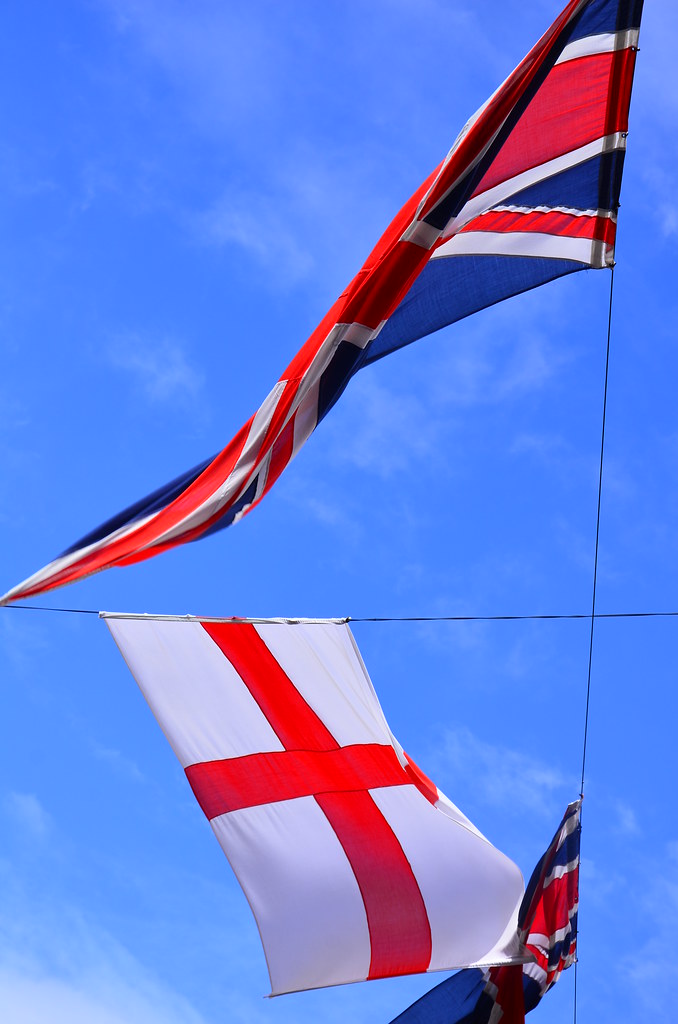
“Union Jacks and crosses of St George” by Ben Sutherland is licensed under CC BY 2.0 
 .
.
First a confession. I am not a serial flag-waver. In fact, one of the features of British history that I always appreciate is that its people possessed so much confidence about itself that it did not see the need for ostentatious displays of patriotism and flag waving. However, today matters are different. The nation’s cultural and political elites regard the Union Jack and the St George’s Cross — the flag of England — with embarrassment and studied contempt. Today many British institutions would rather fly the Palestinian flag or the LGBTQ+ or of Ukraine than flags that bear the nation’s symbols. Outwardly pride in Britain is in danger of being displaced by the sentiment of self-loathing.
Foreign observers are often surprised by the relative absence of Britain’s flag in public spaces. As one such observer noted recently, in Oxford Pride flags are outnumbered the Union Jack “by at least fifty to one”. He noted that the “next day in London, I saw Pride flags all about, with the Union Jack reserved for tourist sites like the Tower of London, which also sported Pride flags”.
In fact, the British Establishment’s reaction towards England’s flag is often communicated through the sentiment of ridicule and hatred. This sentiment has been embraced by local councils, particularly ones that are under the influence of Labour and the Lib Dems. Many of them feel entitled to prevent these flags from being displayed. Most recently the Birmingham’s Labour dominated council has ordered the removal of Union and St George’s flags from lamp posts in this city. The Council announced its decision to remove the flag on the ground that they put the lives of pedestrians and motorists “at risk” despite being up to 25ft off the ground! Needless to say, the Council applies a different standard of judgment when it comes flying the Palestinian flag, which are flown all over the City. Presumably this flag does not constitute a danger to motorists and pedestrians.
In Birmingham, Britain’s second largest city flying the flag of the nation is regarded by local officialdom as a risk to safety.
The British Establishment feels contempt towards not only Britain’s flags but also towards the people who enthusiastically identify with them with patriotic pride. An incident involving Emily Thornberry, Labour MP for Islington South, in November 2014 captures well the contempt that significant sections of the British political class have towards the symbolic displays of patriotism. During a by-election campaign in Rochester, she posted a photo of a house displaying three St George’s flags, with a white van parked outside, and accompanied it with the arch caption, “Image from #Rochester”. The implication of her post was that those who decorated their house with the flags of England were a legitimate target of disdain. Since they were obviously morally inferior to her superior kind there was no need for a caption explaining this on her post.
Millennial Woes discusses how the contempt of the elites for the British people is leading to increasing possibility of civil unrest … or worse:
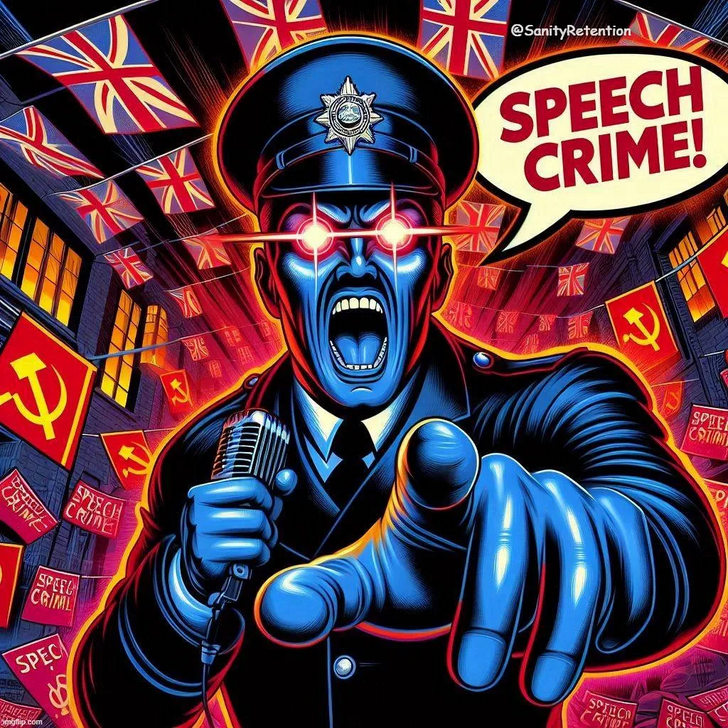
The short answer as to “why?” is that, even in mid 2025 when many people are sensing a mood developing, the government is still doing all the things that are bringing that mood about. They have no reverse gear. Despite their rhetoric, they are not reducing immigration and are certainly not doing mass deportation. In addition we have learned that, for years, they have been covertly propagandising us. Meantime the hate speech laws which muzzle us are still in force and being strengthened. Recently, the Online Safety Act came into force and the very next day numerous internet platforms had to start censoring content. We can literally see our oppression increasing in real-time. And even now, they want more. Always, we feel the government trying to stop us talking about its abuse of us. (Even as I type these words, I am aware that they could get the police raiding my home and seizing my devices.)
Image from Millennial Woes
The same is true in the media. This morning I heard that the BBC are making a high-profile drama about 11th Century Britain in which a key historical figure will be played by a Black actor. Our news media is still biased in favour of mass immigration at any cost. Adverts are still full of black-man-white-woman couples. It is relentless.
In business, White people are handicapped by preferential treatment for non-whites in employment, business loans and career opportunities. A few days ago I got an advert on YouTube featuring a business consultant woman who defiantly said “at the end of the day, diversity is the key to success”. Middle-class White people habitually work against each other and their group interests, causing personal failure and burning resentment for many of their ethnic kin.
It doesn’t actually matter whether the people who perpetuate all of this truly “believe” in it. What matters is that they are prepared to behave as if they do. The incentives have taken on a life of their own, become self-perpetuating, making alternatives almost illegal and certainly a guarantor of “social death” and “professional death”. Even with all the evidence that diversity is bad, nobody in the professional class will dare to speak against it because, even now, that would be the end of their career. And so the poisoning continues.
In short, I feel that my country’s mainstream is working constantly against my ethnic group surviving. Furthermore I see no end in sight for this ethnic sabotage.
And many other people think the same – more and more all the time, in fact. This is why they are getting ever more angry.
Among young people there are more reasons still, economic pressures which mean they can’t get on the property ladder and build the security to start a family. That is immensely frustrating for a lot of energetic young adults, and they haven’t got (haven’t been able to get) much to lose. When a society doesn’t facilitate this most basic desire in people, it should expect upheaval.
However, against this backdrop of oppression, dysfunction and madness, the main catalyst for civil unrest will be something much more concrete: refugees sexually assaulting White women and children. Such crimes are now occurring every day. Unfortunately, there is no reason why they will lessen in frequency. (I will not endanger myself further by explaining why. Everyone knows.)
And it is the fact that, indeed, “everyone knows” which makes civil unrest inevitable. It isn’t just spergs, theorycels, doomers, basement-dwellers and politics or race science obsessives any more; it’s the apolitical working-class who just want a decent chance at life. When they believe their own government is denying them that, it is inevitable that they will “rise up”. It is only a question of when, where, how and how many.
It has been pointed out that, during covid, the public didn’t “rise up”. But I say this was because, despite the restrictions and the perversity of that situation, throughout it people were still comfortable. Most importantly, they didn’t feel their children were in danger. That is the key thing. Dangers that never attended raising a child in Britain thirty years ago are now ubiquitous, even if you live in a nice middle-class town.
Update, 18 August: Welcome, visitors from Instapundit. Please do have a look around at other posts you may find of interest. I send out a daily summary of posts here through my Substack – https://substack.com/@nicholasrusson that you can subscribe to if you’d like to be informed of new posts in the future.
August 14, 2025
QotD: It’s not hypocrisy when progressives do it …
Severian, “Fade to Black”, Founding Questions, 2022-01-23.
August 13, 2025
QotD: The New York Times and their 1619 project
It’s a good point, isn’t it? If you don’t believe in a liberal view of the world, if you hold the doctrines of critical race theory, and believe that “all of the systems in the country” whatever they may be, are defined by a belief in the sub-humanity of black Americans, why isn’t every issue covered that way? Baquet had no answer to this contradiction, except to say that the 1619 Project was a good start: “One reason we all signed off on the 1619 Project and made it so ambitious and expansive was to teach our readers to think a little bit more like that”. In other words, the objective was to get liberal readers to think a little bit more like neo-Marxists.
The New York Times, by its executive editor’s own admission, is increasingly engaged in a project of reporting everything through the prism of white supremacy and critical race theory, in order to “teach” its readers to think in these crudely reductionist and racial terms. That’s why this issue wasn’t called, say, “special issue”, but a “project”. It’s as much activism as journalism. And that’s the reason I’m dwelling on this a few weeks later. I’m constantly told that critical race theory is secluded on college campuses, and has no impact outside of them … and yet the newspaper of record, in a dizzyingly short space of time, is now captive to it. Its magazine covers the legacy of slavery not with a variety of scholars, or a diversity of views, but with critical race theory, espoused almost exclusively by black writers, as its sole interpretative mechanism.
Don’t get me wrong. I think that view deserves to be heard. The idea that the core truth of human society is that it is composed of invisible systems of oppression based on race (sex, gender, etc.), and that liberal democracy is merely a mask to conceal this core truth, and that a liberal society must therefore be dismantled in order to secure racial/social justice is a legitimate worldview. (That view that “systems” determine human history and that the individual is a mere cog in those systems is what makes it neo-Marxist and anti-liberal.) But I sure don’t think it deserves to be incarnated as the only way to understand our collective history, let alone be presented as the authoritative truth, in a newspaper people rely on for some gesture toward objectivity.
Andrew Sullivan, “The New York Times Has Abandoned Liberalism for Activism”, New York, 2019-09-13.
August 11, 2025
Smug Canadian boomer autohagiography rightly antagonizes the under-35s
Fortissax had an argument with one of his readers over a smug, self-congratulating meme about how wonderful Canada was in the 1990s and early 2000s:

What we lived through long before Trudeau was the Shattering, the breakdown of Canada’s social cohesion, driven by left-liberalism with communist characteristics applied to race, ethnicity, sex, and gender, and punitive almost exclusively toward visibly White men. My generation, those millennials born on the cusp of Gen Z, saw post-national Canada take shape not in the comfortable suburban rings of the GTA or the posh boroughs of Outremont and Westmount, but in self-segregated, ghettoised enclaves of immigrants whose parents never integrated and were never required to.
Memes like that are dishonest because they feed a false memory. The 2000s were not normal. Wages were stagnant, housing was already an asset bubble, and immigration was still flooding in under a policy that explicitly forbade assimilation. Brian Mulroney had enshrined multiculturalism into law in 1988. Quebec alone resisted, carving out the right to limit immigration under the 1992 Quebec–Canada Accord. After Chrétien, Stephen Harper brought in three million immigrants, primarily from China, India, and the Philippines in that order.
The Don Cherry conservatives of that era were Bush lite. They were rootless, cut off from their history, their identities manufactured from the top down since the days of Lester B. Pearson. They conserved nothing. For Canadian youth, it was the dawn of a civic religion of wokeness, totalitarian self-policing by striver peers, and the quiet coercion of every institution. My memories of that decade are of constant assault — mental, physical, spiritual — from leftists in power, from encroaching foreigners, and from the cowardice of conservatives.
Your 2000s might have been great. For us, they were communist struggle sessions. In 2009 we were pulled from class to watch the inauguration of Barack Obama, a foreign president, as a historic moment for civil rights. Our schools excluded us while granting space to every group under the sun: LGBT safe spaces and cultural clubs for Italians, Jamaicans, Jews, Indians, Indigenous, Balkaners, Greeks, Slavs, Portuguese, Quebecois, Iroquois, Pakistanis — every culture celebrated except our own. Anglo-Quebecers and Anglo-Canadians got nothing but an Irish club, closely monitored for “white supremacy” and “racism” by the HR grandmas of the gyno-gerontocracy of English Montreal. Students self-segregated, sitting at different cafeteria tables and smoking at different bus shelters. At Vanier, Dawson, and John Abbott College, these divisions were institutionalised. I remember walking into the atrium of Dawson, my first post-secondary experience, greeted by a wigger rolling a joint while a Jamaican beatboxed to Soulja Boy.
We became amateur anthropologists out of necessity, forced to navigate a nationwide cosmopolitan experiment from birth. We learned the distinctions between squabbling southeastern Europeans of the former Yugoslavia, and we did not care if Kosovo was Serbia or whether Romanians and Albanians were Slavic, they all acted the same way. We learned the divides within South Asia, the rivalries between Hindutva and Khalistani, the differences between a Punjabi, a Gujarati, a Telugu, a Pakistani, a Hong Konger, a mainlander, and a Taiwanese. We know the shades of Caribbean identity, the factions of the Middle East, and the intricacies of North African identity. We should never have needed to know these things, but we do.
For us, childhood in this cesspit was the seedbed of radicalism. We never knew an era when contact with foreigners was limited to sampling food at Loblaws. All we know is being surrounded by those who hate us, governed by a state that wants to erase us, with no healthcare, no homes, no jobs that are not contested by foreigners, and no money to start families.
August 9, 2025
Alert the non-crime hate incident police: soccer star proclaims pride in being English!
In Spiked, Obadiah Mbatang discusses a recent disturbing incident of a member of the Lionesses (England’s female national soccer team) saying something completely unacceptable to the great and the good:

So the Lionesses were victorious in the UEFA Women’s Euros, holding the title they won in 2022. England forward Chloe Kelly, who scored the decisive penalty in the final against Spain, declared after the match: “I am so proud to be English”.
To hear a sports star make such a simple and patriotic statement was, for most of us, a pleasant breath of fresh air. Just as refreshing has been the muted response to her declaration of national pride. In the week or so since, there have been no online campaigns denouncing Kelly’s views as “problematic”. This raises the question: is it just the Lionesses who are allowed to be patriotic?
Compare the response to Kelly’s post-match comment with the recent treatment of Courtney Wright, a 12-year-old schoolgirl from the West Midlands. A few weeks ago, she wore a Union Jack dress inspired by the Spice Girls to her school’s “Culture Day”, in which pupils were encouraged to “proudly represent their heritage”. Courtney, who had also prepared a speech celebrating Shakespeare and fish and chips, was put into isolation by her school and then sent home. Essentially, she was told it was unacceptable to express pride in being British.
What followed next gave us a fascinating, if depressing, insight into the online left. Aaron Bastani, co-founder of Novara Media, came out in defence of Courtney. “A white British person being proud of their country and its accomplishments does not make them racist”, Bastani said on X. “Either all groups get to celebrate identity and culture, or none.” Yet for striking a fair-minded and consistent approach, he was attacked by his largely left-wing audience.
One notable assault came from Eleanora Folan, who runs the hugely popular “Stats for Lefties” X account. Folan said celebrating British culture “literally does” make someone racist because “the concept of white ‘identity’ is inherently exclusionary and racist”, adding that “all of Britain’s ‘accomplishments’ were built on racism and imperialism”.
Now, I suspect Eleanora and many on the left would never say that Nigerians should view their heritage as “evil” because of the Biafran War and the anti-Igbo pogroms of the 1960s and 1970s. Does anyone on the left talk about King Ghezo’s determined efforts in the 19th century to maintain slavery, even as the British tried to stamp it out in his West African kingdom? Would they say that British people of Arab descent should be ashamed because of Arab slavery of Africans, which still persists to some extent today? Should British people of Rwandan Hutu descent be ashamed because of the Rwandan genocide? Of course not.
Admittedly, there is no shortage of right-wing whataboutery that uses the histories of other countries to avoid discussing the darker aspects of Britain’s past. But that is not what is going on here. Courtney’s treatment by her school, and those online leftists blasting her as racist, reveals that self-loathing oikophobia remains one of the dominant prejudices of the left.
QotD: The New Newspeak
I’ve read their explanation a few times and it seems to boil down to the idea that all people of African descent all around the world are somehow one single identifiable entity, while white and brown people are too diverse and variegated to be treated the same way. (The Times explains: “We’ve decided to adopt the change and start using uppercase ‘Black’ to describe people and cultures of African origin, both in the United States and elsewhere.”)
Given the extraordinary diversity of the African continent, and the vast range of cultural, ethnic, religious, and tribal differences among Americans of African descent — new immigrants and descendants of slaves, East and West Africans, people from the Caribbean and South America, and the Middle East — this seems more than a little reductionist. As Times contributor Thomas Chatterton Williams has noted, there are “371 tribes in Nigeria alone. How can even all the immigrants from Nigeria, from Igbo to Yoruba, be said to constitute a single ethnicity? Let alone belong to the same ethnicity as tenth-generation descendants from Mississippi share-croppers?” The point, of course, is to ignore all these real-life differences in order to promote the narrative that critical race theory demands: All that matters is oppression.
Andrew Sullivan, “China Is a Genocidal Menace”, New York, 2020-07-03.
August 8, 2025
QotD: Accelerating back towards bicamerality
This hypothesis seems to explain a few huge, otherwise perplexing facts of Leftist behavior. First: The further Left a person is, the more desperate xzhey are to put everyone else into one, and only one, category. Starting, of course, with themselves — I often joke that they’re trying to get their own bespoke “sexuality” so refined that no one else in the world could possibly share it. That would relieve them from the burden of ever actually having to be intimate — sexually or otherwise — with anyone. They can sit in the dark in their masks, eating bugs and watching Netflix, totally alone, forever.
I’m joking, but I’m not kidding. They really do seem to want that. And bicamerality explains it. I’ve also frequently likened them to the “zooanthrops” from The Book of the New Sun, from whence my stupid nom de blog comes. In that book, the literal end of the world was just around the corner — the sun, long expanded into a cool red giant, was about to go out, possibly within the current generation’s lifetime. Because of that, some people decided to “lay the burden of consciousness down” — they had themselves lobotomized and dumped in the woods.
Again, I’m joking, but I’m not kidding: Doesn’t that seem to be what so many on the Left really want? To be relieved of the burden of thought?
It applies even more so when they’re forced to interact with the world. We’ve all seen how desperate they are to shove people into one, and only one, box. Actually “desperate” is too mild a word — nothing frightens them more than the fact that a person can look one way, but actually be another way. It’s why they’re such slaves to fashion — literal fashion, not just fads trending on Twitter. Even before Der Hamsterkauf you could tell a Leftist just by looking at them, pretty much 100% of the time. Afterwards … well, we’ve all advanced a lot of explanations for why they’re so bizarrely insistent on the mask, especially for children: It’s their new purity ritual. They’re all chicks, and that’s the ultimate chick herd behavior. They’re just sadists. And so on.
But what if it’s as simple as The Mask relieves them, as nothing else can, from a significant source of interpersonal stress? “Interpersonal” again is too mild a word. They don’t want to “get to know you”. They don’t even want to talk to you. Hell, they don’t even want to share the same air with you, and do you see what I mean? Their “lives” would be so much better if we all had to wear colored patches on our jumpsuits, Dachau-style, telling everyone exactly what we are (exactly and only). Barring that, they’d love to reimpose some of the old medieval sumptuary laws — again, you will eat the bugs, because that’s what you deserve, peasant! But it’s not just that. It’s also a huge stress relief for them, to be able to tell a person’s social status at a glance.
Consider further (just briefly) how much a non-victim Victim fries their circuits. A gay conservative, say, or a pro-life woman, or a black “acting White” (your average liberal makes your average rapper look like a paragon of tolerance when it comes to that particular sin, though of course the liberal dresses it up in a thousand syllables of fugly jargon). Even though “the sex you’re attracted to” has no possible relationship to “your stance on the tax code”, the Left has made it so — first as a cynical political maneuver, but now because it minimizes their “interpersonal” (again, for lack of a better word) stress.
The tl;dr here is that your typical Leftist seems to spend all xzheir time in xzheir own head — always labeling, cataloging, frantically shoving everyone and everything into its own little box. But they do this, I think, because they know subconsciously that once they’ve got everything shoved into one and only box, forever, they’ll never have to think again … and that’s what they really want. A life of perfect unconscious bliss, where any “decision” that needs to get made comes from the blinking box.
Severian, “Striving Towards Bicamerality”, Founding Questions, 2022-03-20.
August 3, 2025
20th century advertising alchemy rediscovered
Much sound and fury has been devoted to the ritual denunciations of American Eagle and their new ad campaign featuring blatant Nazi ideology and imagery, er, I mean Sydney Sweeney:

Whenever I endure a sentence which trespasses into a jibe about whiteness or men or some other illusory bugbear, I stop reading and launch the laptop through the window. This week, I’ve cleaned out eBay. As one delivery driver lugs a fresh laptop to my front door, another scoops up the last to fall from the sky.
Those all-too-common laments about skin colour or genitalia are the scarlet letter imprinted on the chest of the thoughtless bore. It’s a mind virus without antidote. Screeching “whiteness!” upon snapping one’s shoelace betrays sound psychological health.
Take Sydney Sweeney, an American actress blessed with a merciless, unfair genetic inheritance. This week, Sydney broke the internet. Her crime? She’s rather attractive. Worse yet, Sydney flaunts her icy, Scandinavian beauty.
In an advert for American Eagle, the dewy, lissom blonde squeezes her gymnastic body into a pair of denim jeans. Smouldering before the camera, Sydney flutters her “great genes”.
Those great genes sashay around a classic Mustang — 400 horses of unapologetic masculine energy. Sydney pats her hypnotic behind. She fires up that climate-melting engine. The infernal marriage of masculine-feminine consummates as she roars off into the distance.
Advertisers know what they did. Diana, Roman goddess and huntress of men. Her chariot, the male appendage made steel and exploding gasoline. A combination to light our monkey brains on fire. The symbolism hijacks our amygdala: buy these jeans, and she’s yours. Or, for the other sex, buy these and manipulate them.
I’m sorry to be so blunt, reader. Those claims, as primitive as they may appear, are the animating spirit of advertising. Back in the 1920s, Freud’s nephew, Edward Bernays, transplanted Uncle Siggy’s theories into the advertising business. Out went staid adverts praising a product’s utility. In went adverts selling visions of your unconscious, insatiable self. Bernays transformed the public relations and advertising worlds. He sold products that stirred the galloping herds of the subconscious mind.
Take cigarettes. Before Bernays, smoking was a decidedly male pursuit. Tobacco giants, keen to double their potential customer pool, turned to him. Bernays transformed smoking from a vulgar, unladylike pastime into a symbol of freedom and female empowerment. Men buy Patek Phillipe watches for the same reason. As Dave Chappelle put it: “If a man could fuck a woman in a cardboard box, he wouldn’t buy a house”.
In just a few moments, Sweeney’s serpentine hips lulled advertising away from overt wokeness to its subliminal witchcraft. It worked. American Eagle’s stock surged fifteen percent.
For research, I studied the ad twenty-seven times. Your humble narrator bought thirty-seven pairs of jeans and then signed over his entire inheritance to Ms Sweeney.
The reaction on the identitarian left authored five additional chapters to the upcoming edition of the Diagnostic and Statistical Manual of Mental Disorders.
By teasing the words “genes” and “jeans”, Sweeney called for the annexation of Poland and the Sudetenland. MSNBC excelled itself, even birthing a new pidgin English indecipherable to 97 percent of native speakers:
“Sydney Sweeney’s ad shows an unbridled cultural shift towards whiteness”.
Well, that’s one way to think about it.
QotD: Undermining cultural taboos
One side of the debate argues that the only way to break a taboo is to break a taboo, so the only way forward to is to talk frankly about these things. In the case of crime, for example, the dissident must always interject the demographic facts about crime into the debate, even if it makes the beautiful people shriek. Since most people know the facts, the shrieking by the beautiful people actually advances the cause. This line of reasoning is extended to all taboo subjects universally.
The other side of the debate points out that the taboo breakers always end up in exile or condemned to some ghetto. In fact, their deliberate breaking of taboos ends up reinforcing the taboo, as no one wants to end up like the heretics. Instead, this camp argues the dissident must come up with clever language that subtly mocks the taboos, but narrowly adheres to the rules. The recent use of the word “jogger” is an example of complying with the taboo, while undermining it.
The taboo breakers counter that this just results in an endless search for approved language to hint at unapproved things. It is just a form of self-deception, where the clever think they are in revolt when in reality they are just asking permission. The optics guys counter this by pointing out the obvious. The taboo breakers are removed from the process, so in reality their tactic is just quitting the game. Rather than take on the system in a meaningful way, they mutter epithets in their ghetto.
The Z Man, “Strategy, Tactics & Discipline”, The Z Blog, 2020-05-19.
July 31, 2025
“You can see what a monster this very dangerous person is”
Chris Bray looks north to the Dysfunctional Dominion and our governments’ inability to deal with the narrative of the Residential Schools and the lack of actual evidence to support that narrative:

Kamloops Indian Residential School, 1930.
Photo from Archives Deschâtelets-NDC, Richelieu via Wikimedia Commons.
Frances Widdowson is a cantankerous career academic, an evidence-first Canadian scholar who doesn’t suffer fools. Her personal disregard for sanctimonious performativity has gotten her in some trouble, and now she’s a former professor, though her termination was found to be improper. A few months ago, the CBC interviewed her for a story about how mean she is, because Widdowson has questioned the much-chanted sacred story about the dead children at Kamloops.
If you don’t know the Kamloops story, an anthropologist used ground-penetrating radar to supposedly identify the location of a secret burial ground for 215 dead children near the site of the long-defunct Kamloops Indian Residential School, uncovering evidence of what has been constantly called a hidden genocide. But no human remains have ever been recovered at the site, and the radar evidence of disturbed earth aligns well with the path of an old septic trench. More detailed background here.
Widdowson recorded the entire interview, so we can hear the inner workings of the sausage factory.
Throughout the discussion, CBC reporter Jordan Tucker, speaking with the obligatory vocal fry and upspeak, keeps warning Widdowson to stop shouting at her, which Widdowson obviously isn’t doing, and to watch her tone. She’s presumptively pre-outraged by the existence of a Very Bad Person, conducting an outrage-performance in the form of asking questions.
But then Widdowson flips the script. You can hear this excerpted two-minute high point here. Tucker argues that government officials say there are bodies buried in the apple orchard at Kamloops, so is Widdowson somehow making the outrageous claim that government officials might be wrong? “Are all those different governments lying? Are all those different people just not telling the truth, or they’re going along with these stories imagined by people, by indigenous people?”
Government says, but still Widdowson doesn’t concede. You can see what a monster this very dangerous person is. “How is it that all these government officials have been so connived?” Tucker asks, obviously flabbergasted.
Widdowson responds with an argument about evidence, and about the standards of evidence for the claim. What do we know? What have we seen? What would we need to see to prove a claim of this type? Who has the burden of proof?
And then: “As a journalist, are you satisfied with the evidence?”
The response to this question — just past the 1:30 mark in the excerpted video linked above — is remarkably telling. It produces, first, a short silence, and then a long burst of stammering and high-pitched incredulity: “I am. Of course I am.”
Widdowson, sharpening the direct question: “You think there’s 215 children buried in the apple orchard at Kamloops?”
Listen to Tucker’s shaking voice. This question is a threat. It makes her extremely nervous. “I think that, at this point, there has been enough documentation, there have been enough — there’s enough social and archaeological consensus to say that, to say that, we can just believe indigenous people, and move on with trying to do our best by them as a society.”
So two people are arguing about truth. What is true? How can we know what is true? One person keeps asking what is the evidence. The other person keeps deflecting to identity, authority, and social status. The government says so, there is social consensus, “believe indigenous people”. No human remains have been found, but there are human remains, because government officials and indigenous people say so, and other people with the status to matter say that they agree. Truth is consensus. Defaulting to evidence is cruel. Why would you do such a horrible thing?
- What’s the evidence?
- Are you refusing to submit to the narrative consensus?
- Yes, what’s the evidence?
- (shocked gasping and trembling voice)
This is the mechanism of woke narrative control: It has been said that this is true. The people who say it possess authority — they are officials — or they possess privileged identities. It is now disinformation to say that government plus indigenous people might not be correct, and an act of dangerous extremism to mention questions of evidence.

July 30, 2025
“The worst thing that can happen to a good cause is, not to be skilfully attacked, but to be ineptly defended”
On Substack, Johann Kurtz provides a great example of Bastiat’s insight (quoted in the title), as debaters ineptly defend the whole notion of masculinity, particularly how boys are victimized for being boys:
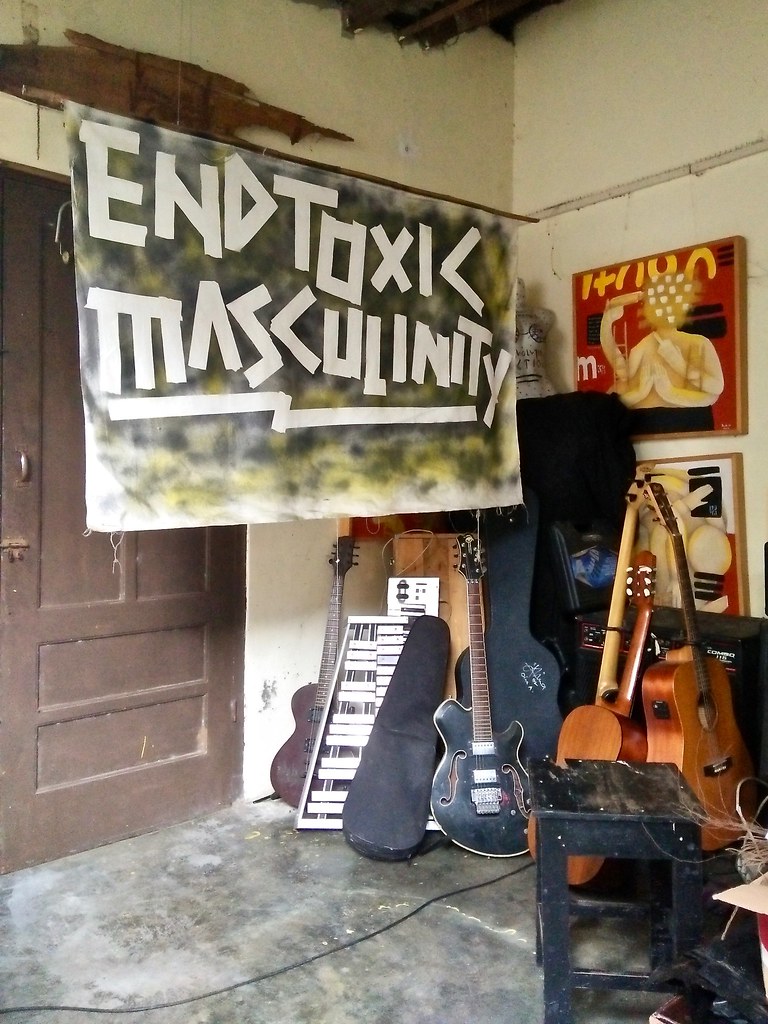
“End Toxic Masculinity” by labnusantara is licensed under CC BY-NC-ND 2.0


We’re failing our boys.
Two-thirds of young men feel that “no one really knows” them. Their real wages have been falling since the 1970s. They’re dropping out of education and the workforce in growing numbers. They die deaths of despair at almost three times the rate of women. Even their physical strength is collapsing.
Terrible solutions are proposed. No matter how much traditional masculinity is undermined, powerful voices continue to insist that the real problem is that it hasn’t been destroyed altogether. “Only then will boys be happy”.
My thesis for this series is that there is a need to defend true masculinity on its own terms, not on the implicit terms of progressives who either don’t understand it or actively hate it.
Take, for example, this debate at the Oxford Union on traditional masculinity. The opening argument of the opposition — who are supposed to be defending traditional masculinity — starts with asserting the need for a “contemporary and inclusive” masculinity which is accessible to anyone “of any race, sexuality, or other identity“.
The best defence that this speaker can mount on this anaemic foundation is an argument that masculinity is useful for activism and community building like the “Movember Foundation”. After this slightly pathetic case she goes back to conceding “being forced to conform to a set of expectations is uncomfortable and even dangerous. We should allow people to access the gender expressions that make them feel like their truest self.”
The next speaker for the defence of traditional masculinity continues the grovelling: “In 2019, you know, we should not be honouring and obeying men — those times have gone.” This talk is a little better — you get the sense that he actually likes men, and notes that it’s overwhelmingly men who die in wars and dangerous jobs — before collapsing back at the end: “We should look at new ways of being a man. I would love to get more men involved in teaching, in nursing — make it ‘cool to care’. I’ve been around Scandinavia talking to stay-at-home dads … These are progressive, beautiful men.”
The final speaker — who, again, is supposed to be defending traditional masculinity — takes the stage and begins: “Some of the most beautiful moments I’ve watched in young men’s lives are when we’re alone in a room — and maybe a brother who’s been struggling with his sexuality comes out in front of a hundred other brothers, and he’s crying, and his other brothers are crying with him“. You can imagine the rest.
None of this has anything to do with traditional masculinity. In this series I will advocate for the cultivation in boys of all of the aspects of masculinity that these “advocates” were afraid to defend: strength, aggression, dominance, stoicism, and risk-taking.
July 24, 2025
When tolerance becomes a fatal flaw
At The Crescent and the Guillotine, Paul Friesen explains why too much tolerance leads to the eventual collapse of social order and perhaps even the culture itself:
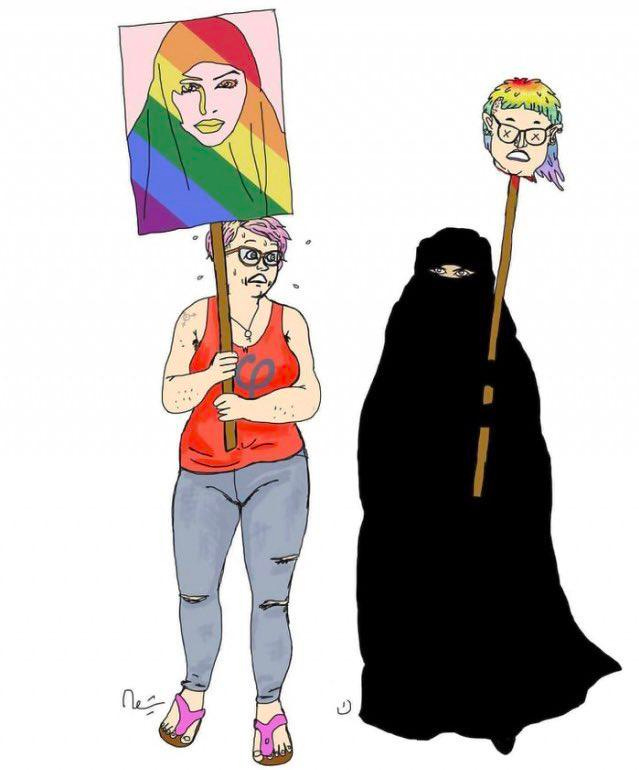
It is difficult to know what people are thinking when they endorse the importation of people who want to kill them for their lifestyle choices.
It was Karl Popper who warned that a tolerant society must be intolerant of intolerance, or it would cease to be tolerant at all.1 A delicious paradox, too often quoted and too rarely heeded. For we have taken the first half of the dictum — the imperative to tolerate — and chiseled it into law, into policy, into university mission statements and NGO pamphlets. But the second half — the requirement to draw a line, to say “no further” — has been treated like garlic in a vampire movie: an antique, anathema, unfashionable.
And so, the paradox has become pathology.
Our courts allow sharia arbitration councils to function in British cities, adjudicating matters of family and inheritance with standards that would make a 12th-century canon lawyer flinch. Our schools include faith-based curricula that require hijabs for seven-year-olds and teach that homosexuality is satanic filth. Our public broadcasters will air a documentary about the importance of free speech, followed immediately by a segment about why cartoons of Muhammad are “unhelpful”.
This is not multiculturalism. It is masochism. It is the belief that liberalism must be so open-minded that its own brains are spilled onto the prayer mat. It is the fetishization of identity at the expense of liberty. It is the ideological pacifism of a society too terrified to assert its own values, lest it be accused of “racism” by those who mistake ideology for ethnicity.
We have enshrined the rights of the theocrat while criminalizing the instincts of the secularist. The result is not harmony — it is humiliation.
[…]
The West’s greatest achievement is not democracy, nor capitalism, nor even the separation of powers. It is the separation of truth from tribalism — the idea that individuals are not to be judged by their creeds, but by their conduct. That women are not property. That speech is not violence. That blasphemy is a right, not a crime.
These are not Western values. They are universal values, discovered in the West by accident of history and preserved through blood, rebellion, and satire. They are the principles that allowed Jews, heretics, atheists, and apostates to live not just safely, but freely. And they are now under threat — from within.
The real problem is not Islam. It is the Western inability to demand anything of those who import their gods and their grievances into liberal society. We treat every imported superstition as sacrosanct and every local tradition as suspect. We require ex-Muslims to whisper their fears while we amplify the complaints of veiled Islamists who denounce our culture from our own podiums.
We are not being pluralistic. We are being duped.
And the cost of this self-deception is measured not just in freedoms surrendered, but in lives lost.
Lives like that of Yameen Rasheed, the secular Maldivian blogger who thought he could use satire to push back against theocracy — stabbed to death in his own hallway. Lives like that of Farkhunda Malikzada, beaten and burned in the streets of Kabul by a mob of men — because someone thought she burned a Qur’an. Lives like that of Samuel Paty, beheaded outside a French school by a refugee he welcomed — because he dared to show a cartoon in a civics class.
These are not random tragedies. They are the predictable outcomes of an ideological toxin given immunity in the bloodstream of liberal society.
What do all these victims have in common? They did not die at the hands of misunderstood minorities or “oppressed voices” who simply needed better integration programs. They died at the hands of men who were indoctrinated — sometimes abroad, often at home — with the idea that God’s honor is more valuable than human life, and that dissent is not to be debated but extinguished.
And more damning still: they died in environments that should have protected them. Environments that instead prioritized sensitivity over security, dialogue over clarity, understanding over justice. Environments where the ever-watchful eye of diversity officers and DEI consultants was trained, not on the assailants, but on the tone of the victims.
We have created a culture where courage is pathologized, clarity is punished, and moral equivalence is the new orthodoxy. When Islamist mobs swarm the streets chanting slogans that would make the Inquisition blush, we are told to “listen to their anger”. When feminists protest the veiling of children, they are told to “respect cultural differences”. When Jews complain about chants of “From the River to the Sea”, they are informed that they are “overreacting”, “weaponizing trauma”, or — most insultingly of all — “confusing Zionism with antisemitism”.
This is not inclusivity. It is assisted suicide.
1. I refer here to Karl Popper’s 1945 work The Open Society and Its Enemies, specifically in Volume 1: The Spell of Plato, Note 4 to Chapter 7. Here’s the relevant passage, paraphrased for clarity:
“Unlimited tolerance must lead to the disappearance of tolerance. If we extend unlimited tolerance even to those who are intolerant … then the tolerant will be destroyed, and tolerance with them.”
Popper argues that a tolerant society has the right — not to suppress opinions — but to defend itself against those who would destroy tolerance itself, especially if such groups refuse to engage in rational discourse and instead promote violence or coercion. It’s often called “the paradox of tolerance“.


