Quotulatiousness

February 16, 2022

Germany’s dual economy during WW2 (and why Himmler would have succeeded Hitler if the Nazis had won WW2)

At Founding Questions, Severian looks at the way the Nazi economy was actually two entities — the “wartime” economy and the effectively separate SS economy under the control of Heinrich Himmler:
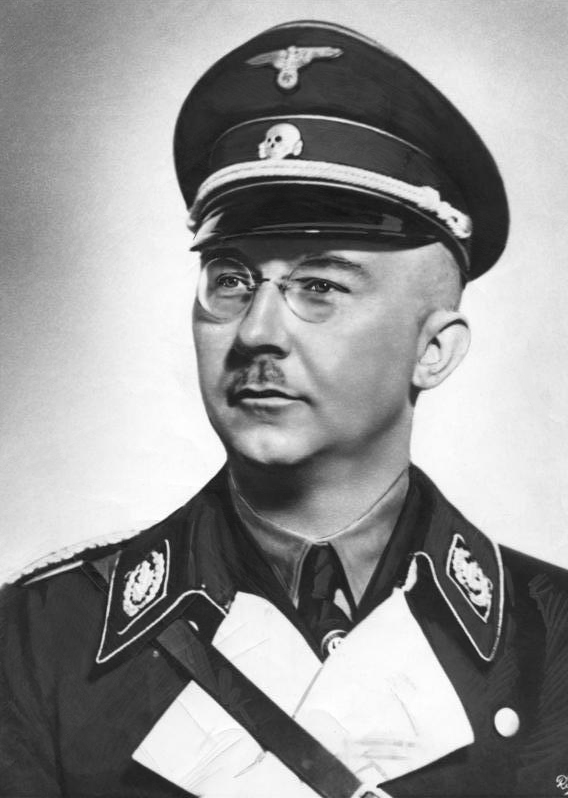
Reichsführer SS Heinrich Himmler, 1938.
German Federa Archive via Wikimedia Commons.

Here’s where the Nazis really blew it. “Nazism” should really be called “Hitlerism”, as it was a true cult of personality; there was no ideology without the specific individual man. That’s the tension at the heart of any collectivist ideology — somebody’s got to be The Boss, however temporarily — but Nazi Germany suffered it worse than most. Had the Nazis won the war, the bloodbath at the top would’ve been as spectacular per capita as the war itself. As thoroughgoing Social Darwinists, they only had one possible principle of succession …

Let’s provisionally call that the first consequence of an ideology in power: The personal is the political and vice versa. That seems trite, I realize, but I’m putting it here to emphasize its literalness – in an ideological state, building your own “affinity”, Bastard Feudalism-style, just IS politics. There’s no other possible political activity. And as much as the Nazis seemed to have screwed it up by going all in on the Fuhrerprinzip at the very top, their out-and-proud Organizational Darwinism (for lack of a better term) made them super-efficient at the lower levels.

Let’s bring Khrushchev back in. In many ways, he’s the Soviet Himmler. He was one of Stalin’s right hand men throughout the war, but somehow didn’t get tagged as a major player in the succession crisis until it was too late for all the other contenders for the purple to take effective countermeasures. In the same way, Hitler did announce a successor, sort of. In fact he did it twice: Before the war, it was Rudolf Hess; during the war, Hermann Goering. Neither of those guys had anything approaching the power Himmler had, but like Khrushchev, his personality was such that the other bigshots couldn’t help overlooking him. Just as the rest of the Politburo couldn’t wrap their heads around the idea of this uncouth quasi-Ukrainian peasant being a major threat, so the rest of the Nazi leaders couldn’t help seeing Himmler as this fussy little file clerk.

It’s a hell of a trick, and I’ll admit, I’m buffaloed. Even if Himmler (Khrushchev) was one hell of an actor, and the egos on the other top Nazis (Soviets) were gravity-defying, they still should’ve been able to see that this fussy little file clerk had some seriously hard boys working for him. Reinhard Heydrich was as ruthless a fuck as was ever born, and Himmler kept him in check. Ditto barbarians like Odilo Globocnik and Erich von dem Bach-Zelewski — they don’t come any nastier than those two, yet Himmler managed them easily. What other conclusion can you possibly draw about Himmler, other than that he was nastier than all of them put together? And yet, apparently, nobody did …

The only explanation for this that I can think of is the Nazis’ ideologization of governmental structures. As opposed to the Soviet experience, where the Party and the Bureaucracy were supposed to be, and often actually were, distinct. After some disastrous experiments with demoting technical experts to field hands, and vice versa, the Russian Communists learned that ideological correctness and “soviet power” does not, in fact, obviate the need for stuff like math. (See also: Mao’s backyard blast furnaces). So the Soviets made sure to separate what they called the “technical intelligentsia” from the Party. The head honcho at Gosplan, Gossnab, etc. would be a Party hack from way back, of course, but the actual brainworkers wouldn’t be. I don’t know just how many of them had Party membership cards, or if any of them did, but nobody I know of rose through the Party’s ranks via Gosplan.

Once a Gosplanner, always a Gosplanner. The technical intelligentsia got all kinds of perks in the Soviet system, but one thing they did not do was get perks inside the Party. You can be a technical expert, or you can be an up-and-coming Party man, but you can’t be both.

The Nazis did the exact opposite of that. The way the Third Reich actually functioned is still opaque in a lot of ways (especially to non-specialists), and of course the pressures of wartime forced a lot of ad hoc measures, but it seems like the SS was supposed to be a sort of All-Purpose Expert Corps. Not only did they have their own army and intelligence service, but they had their own economy — the brief history of the Third Reich makes a lot more sense when you realize that half or more of the official Reich economy was hamstrung by the informal but very real SS economy, operating largely (but far from exclusively) through the labor camps.

Indeed, the SS had their own administration. As incredible as it seems, the Nazis had no grand plan for what to do once they’d conquered Europe. Himmler did, at least as far as the East was concerned, and he tried his damnedest to put it into action in Poland (which is why the General Government was so legendarily brutal). Hitler apparently thought in terms of Germany’s lost late 19th century colonies, when he bothered to think about it at all … which wasn’t often. In his typical Fuhrer-riffic style, he just ignored the problem, trusting to Organizational Darwinism to sort it out …

… which is where the All-Purpose Experts of the SS stepped in. The General Government, for instance, was headed by a civilian lawyer, Hans Frank, but the day to day governance largely fell to the SS, because that’s who stepped up. Poland was an occupied zone, with vital war industries, but it was far behind the front for most of the war; the army couldn’t waste vital manpower garrisoning it. Thus the SSPF (the SS and Police Leader) stepped in, drawing manpower as needed from a wide variety of sources — the camp guards, the Wehrmacht (when garrison troops were available, and when they could wrangle them from the various army commanders), the civilian police, the “General SS”, and so on.

The details aren’t nearly as important as the big picture, which is: Unlike the technical intelligentsia in the Soviet Union, members of the SS could climb to the highest ranks of the Party. Indeed they were expected to: the SS was rapidly becoming a Party-within-the-Party at the outbreak of the war, not least because Himmler awarded a “ceremonial” SS rank to anyone who mattered politically in the various departments. The savvier guys refused the “honor,” of course, because they didn’t want to be subordinate to Himmler, even ceremonially, but many didn’t. Which meant that had the Nazis won the war, not only would Himmler have been the next Fuhrer, but the SS would’ve closed ranks, essentially taking over The Party — they’d be the Inner Party, as opposed to the “mere Nazis” of the Outer Party.
January 28, 2022

The Warsaw Ghetto: The Jews Strike Back – WAH 51 – January 1943, Pt. 2

World War Two
Published 27 Jan 2022

In early 1943 Nazi German propaganda minister Joseph Goebbels is preparing to rally the German people behind an unrestrained war — or “total war” as he puts it. It’s unclear what that means, Nazi Germany has long been waging an unrestrained war, and it seems that the United Nations alliance is now ready to do the same on Germany.
(more…)

January 26, 2022

Nazi Breeding Farms – Lebensborn – On the Homefront 014

Filed under: Europe, Germany, History, WW2 — Tags: , , , , , , — Nicholas @ 06:00

World War Two
Published 25 Jan 2022

With high losses of German soldiers and low birth rates, the Nazis worry about who will inherit the Nazi paradise they are fighting to build. One of their ideas to breed a new Aryan generation is the Lebensborn association.
(more…)

January 9, 2022

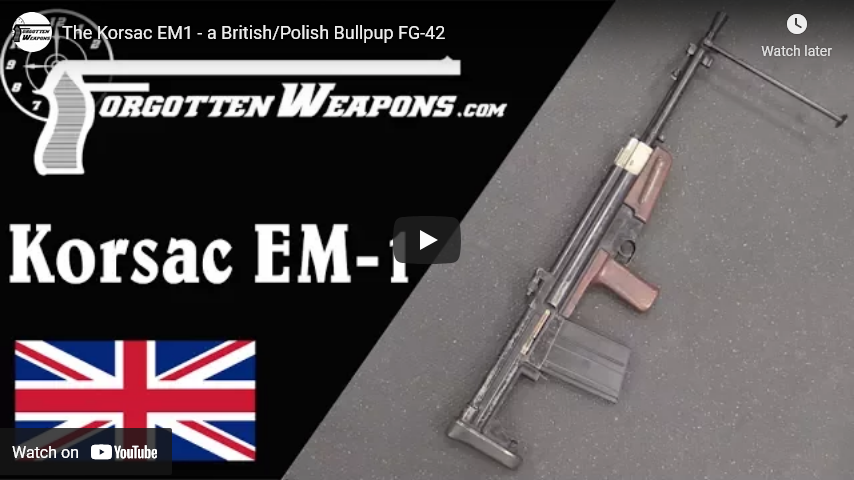
The Korsac EM1 – a British/Polish Bullpup FG-42

Filed under: Britain, Germany, History, Military, Weapons — Tags: , , , , , — Nicholas @ 02:00

Forgotten Weapons
Published 26 Jun 2017

Armament Research Services (ARES) is a specialist technical intelligence consultancy, offering expertise and analysis to a range of government and non-government entities in the arms and munitions field. For detailed photos of the guns in this video, don’t miss the ARES companion blog post:

http://armamentresearch.com/british-k…

The Korsac EM-1 (not to be confused with the Thorpe EM-1, which is a completely different rifle) was a bullpup light machine gun based on captured examples of the German FG-42 paratroop rifle. It was developed between 1945 and 1947 by a team led by a Polish refugee designer named Korsac.

It was chambered for the 8mm Mauser cartridge, and used an 18 round magazine adapted from the ZB-26. The operating mechanism was closely copied from the FG-42, as were many elements of the rifle’s controls, including the capability for firing from an open bolt in fully automatic and from a closed bolt in semi-automatic. Unlike the FG-42, it used a short stroke tappet type gas piston, and had a detachable barrel. Ultimately only two examples were built, and only one of those (the one in this video) was completed to firing condition. It suffered from reliability problems in semi-automatic mode, and was quickly sidelined in favor of the other development projects ongoing by 1947. However, many lessons from its development would be put into the EM-2 rifle.

Cool Forgotten Weapons merchandise! http://shop.bbtv.com/collections/forg…

http://www.patreon.com/ForgottenWeapons

If you enjoy Forgotten Weapons, check out its sister channel, InRangeTV! http://www.youtube.com/InRangeTVShow

December 31, 2021

Let the Hunger Games Begin – WAH 049 – December 1942, Pt. 2

Filed under: China, Europe, Germany, History, India, Military, WW2 — Tags: , , , , — Nicholas @ 04:00

World War Two
Published 30 Dec 2021

The world learns more details of the War Against Humanity in Occupied Poland, while in China and India starvation looms.
(more…)

December 17, 2021

Death Squads Arrive in North Africa – WAH 048 – December 1942, Pt. 1

Filed under: Africa, Germany, History, Italy, Military, WW2 — Tags: , , , , , — Nicholas @ 04:00

World War Two
Published 16 Dec 2021

Despite Allied occupation, the situation of the Jews in North Africa hardly improves, in newly German-occupied Tunisia it deteriorates. Meanwhile, the world learns more of the details of the Holocaust — they cannot believe their ears.
(more…)

October 15, 2021

Nazis “Restore” Law and Order – WAH 044 – October 1942, Pt. 1

World War Two
Published 14 Oct 2021

Resistance against occupation starts rising in the Autumn of 1942. It faces opposition not only from the occupiers, but also from collaborators killing their own countrymen.
(more…)

October 12, 2021

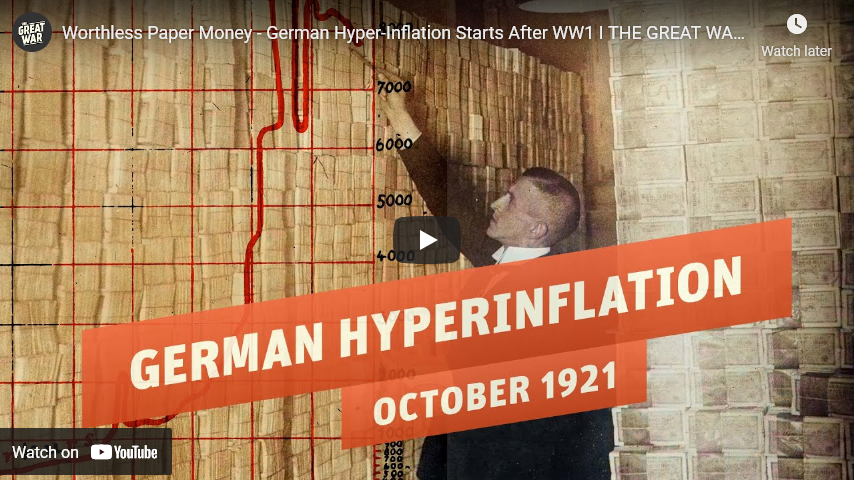
Worthless Paper Money – German Hyper-Inflation Starts After WW1 I THE GREAT WAR 1921

The Great War
Published 8 Oct 2021

Sign up for Curiosity Stream and get Nebula bundled in and SAVE 26%: https://curiositystream.com/thegreatwar

The German post-WW1 economy was under pressure: the loss of territory, the war bonds issued during the war and the reparations under the Treaty of Versailles. All this lead to a downward spiral of rising inflation and living costs for German citizens.

» SUPPORT THE CHANNEL
Patreon: https://www.patreon.com/thegreatwar
Shop: https://www.realtimehistory.net

» OUR PODCAST
https://realtimehistory.net/podcast – interviews with World War 1 historians and background info for the show.

» BUY OUR SOURCES IN OUR AMAZON STORES
https://realtimehistory.net/amazon *
*Buying via this link supports The Great War (Affiliate-Link)

» SOURCES
Feldman, Gerald: Vom Weltkrieg zur Weltwirtschaftskrise. Studien zur deutschen Wirtschafts-und Sozialgeschichte 1914-1932. 1984.

Fergusson, Adam: Das Ende des Geldes. Hyperinflation und ihre Folgen für die Menschen am Beispiel der Weimarer Republik, 1975.

Grosch, Waldemar: Deutsche und polnische Propaganda während der Volksabstimmung in Oberschlesien 1919-1921. 2002.

Lewek, Peter: Arbeitslosigkeit und Arbeitslosenversicherung in der Weimarer republik 1918-1927. 1989.

Michalczyk, Andrezej: Celebrating the nation: the case of Upper Silesia after the plebiscite in 1921.

Neubach, Helmut: Die Abstimmung in Oberschlesien am 20. März 1921. 2002.

» MORE THE GREAT WAR
Website: https://realtimehistory.net
Instagram: https://instagram.com/the_great_war
Twitter: https://twitter.com/WW1_Series
Reddit: https://reddit.com/r/TheGreatWarChannel

»CREDITS
Presented by: Jesse Alexander
Written by: Jesse Alexander
Director: Toni Steller & Florian Wittig
Director of Photography: Toni Steller
Sound: Toni Steller
Editing: Jose Gamez
Motion Design: Philipp Appelt
Mixing, Mastering & Sound Design: http://above-zero.com
Maps: Daniel Kogosov (https://www.patreon.com/Zalezsky)
Research by: Jesse Alexander
Fact checking: Florian Wittig

Channel Design: Yves Thimian

Contains licensed material by getty images
All rights reserved – Real Time History GmbH 2021

September 28, 2021

Debunking the notion that Stalin was an innocent victim of Hitler

At Instapundit, Ed Driscoll links Jakub Grygiel’s review of a new look at World War 2 in Europe, Stalin’s War by Sean McMeekin, which includes a bit of debunking about the relationship between Hitler and Stalin from 1939 to 1941:

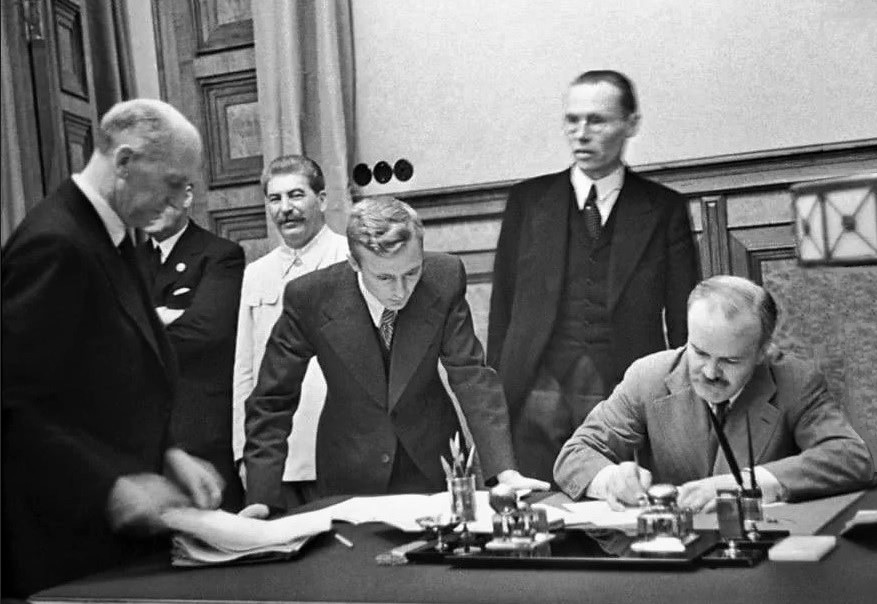
Translation of the Russian caption for this image:
People’s Commissar of Foreign Affairs of the USSR V.M. Molotov signs a friendship and border treaty between the USSR and Germany. Among those present: I.V. Stalin, translator of the Ministry of Foreign Affairs V.N. Pavlov, German diplomat G. Hilger (“truncated” version of the photograph of M. Kalashnikov distributed on the net)
Photograph attributed to Mikhail Mikhaylovich Kalashnikov (1906-1944) via Wikimedia Commons.

Stalin was always interested in a war, especially one that would pit the other powers against each other. The expansion of Soviet influence and control required the weakening of the other powers, in particular the Western ones that were opposed to the Communist virus. For Stalin, therefore, the growth of Nazi Germany was a great opportunity: a violent and expansionistic power in the middle of Europe that could take the first swing against the polities standing on his path. Unsurprisingly, the Soviet tyrant was deeply disappointed when France and Britain signed the Munich Agreement with Nazi Germany in 1938 postponing the great European war that he desired. The 1939 Ribbentrop-Molotov Pact coordinated the efforts of Hitler and Stalin, but it benefited the latter more, allowing him to conquer a large swath of Polish territory with minimal effort, eliminating one of the staunchest opponents to Russian westward expansion. A year later, by murdering almost 22,000 Polish officers in Soviet captivity, Stalin further weakened the Polish obstacle to his expansion. “Nations which had been ruled by powerful aristocracies,” Stalin told once to the Yugoslav Milovan Djilas, “like the Hungarians and the Poles, were strong nations” — and, fearing them, he sought to eliminate them. Then, while Germany invaded France, Stalin took over the three Baltic states in a further step westward.

Hitler’s decision to invade Russia in mid-1941 was a surprise to Stalin, but not because he was expecting a lasting peace on his western frontier. Rather, as McMeekin documents, Stalin had ordered very rapid and large military preparations, building airbases and placing forces near the border with the Third Reich in the first half of 1941. None of them were in a defensive posture, and presented a vulnerable high value target to Nazi attacks. When Hitler decided to attack the USSR in June 1941, these Soviet forces were easy pickings for the well-organized, trained, and war tested German army. McMeekin here expands and amends a bold thesis offered in 1990 by Viktor Suvorov, a pseudonym for a GRU agent who defected to the West in the late ’70s and became a historian, that argued that Stalin was actively planning an attack on Germany but was preempted by Hitler. While Suvorov was excessive in his claim that the Red Army was ready for an offensive campaign in 1941 (because, among other reasons, the officer corps was still in shambles after Stalin’s purges) and that Stalin had plans to conquer Europe, he argued that the USSR was never a status quo power satisfied in its borders. After all Soviet Russia had already attempted to march westward in 1920 and was stopped only by the Poles in a desperate battle near Warsaw (the “Miracle on the Vistula”). This westward vector and ambition of Moscow did not abate, and had to pause because of Hitler’s rise and the might of Nazi Germany. As McMeekin points out, the Soviet military posture in 1941 makes no sense if the goal was to defend Soviet-held lands, suggesting that Stalin was thinking of pouncing on Berlin, now the last remaining continental power in Europe. As the Soviet tyrant himself put it, the USSR no longer needed to be locked in a defensive posture, and was “a rapacious predator, coiled in tense anticipation, waiting for the chance to ambush its prey.”

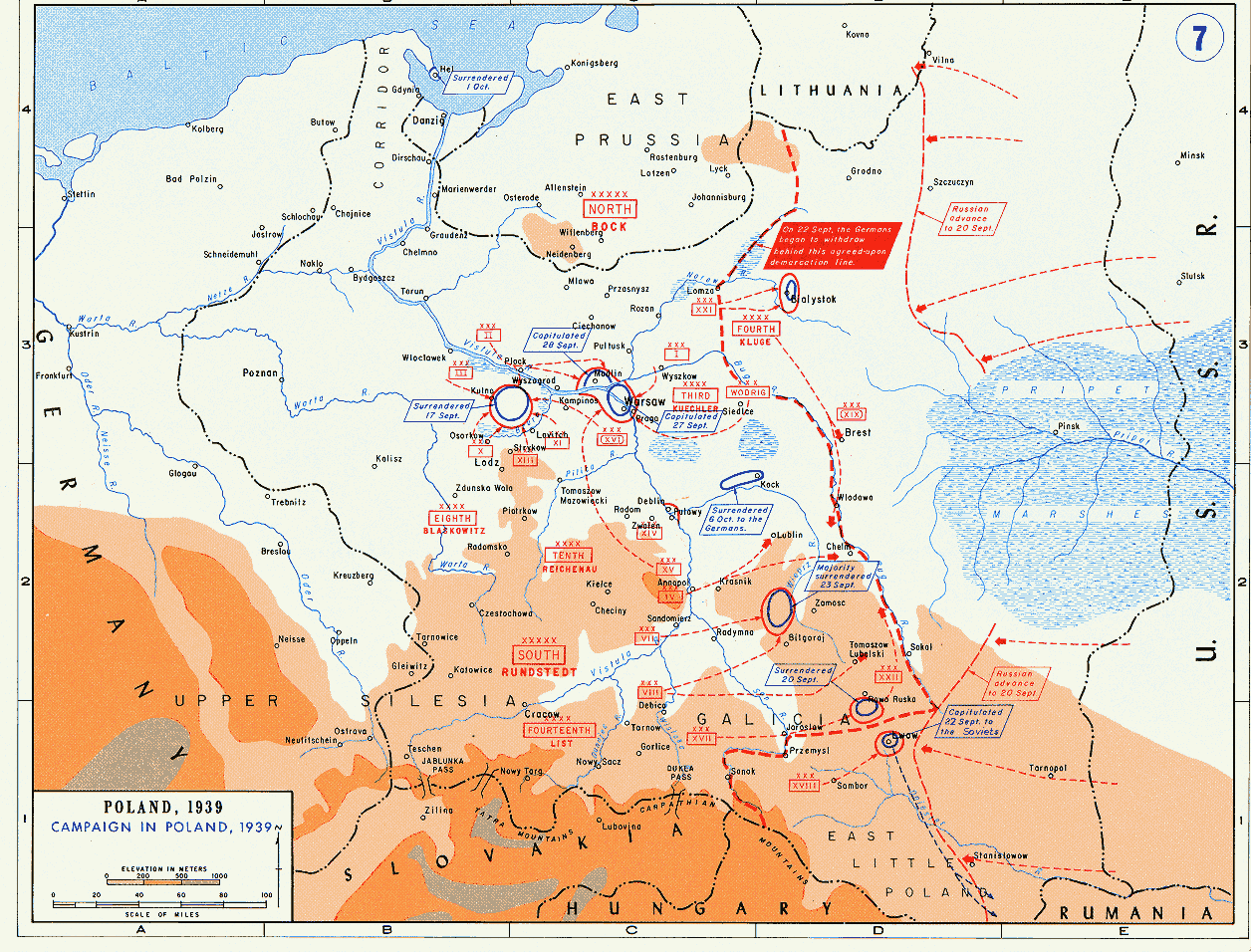
Military situation in Poland, 14 September 1939 (map does not show Slovak Army activity in southern Poland).
United States Military Academy, Department of History via Wikimedia Commons.

Stalin, that is, was not an innocent victim of Hitler. Not only he was an active partner from 1938 until 1941, but also he had geopolitical aspirations that were more ambitious than those held by Hitler. And he pursued them methodically and ruthlessly, leaving a trail of death that dwarfed the one produced by the Nazis.

McMeekin then focuses on how the Western allies, Churchill but especially FDR, abetted Stalin’s ambitions. This part of the book is fascinating and depressing at the same time. In a nutshell, Stalin obtained from FDR more than he expected: territory, influence, and materiel. And he did not give anything in exchange for it because FDR and his advisors never asked him for it. For instance, FDR supported the Lend-Lease program, putting his friend Harry Hopkins in charge. Under this program of military aid, the United States supplied a massive amount of weapons, trucks, airplanes, tanks, foodstuff to the Soviet Union in the months of its greatest need, as German troops were driving deep into Russia while the vaunted Soviet armies were melting away. Without such aid, the USSR would have likely been unable to stop the German onslaught and certainly would have been incapable of mustering the resources necessary to push westward. Hence, in this moment there was a good strategic rationale for the American support of Stalin’s defensive efforts against Nazi Germany.

Prior to the launch of Operation Barbarossa, you’d have been hard-pressed to find a more anti-Soviet leader than Winston Churchill, but he immediately recognized that Stalin was more useful to the British as an ally than as a passive enemy. Earlier this year, McMeekin wrote that Stalin “could not have asked for a friendlier British government” than Churchill’s wartime coalition. As Connor Daniels wrote in response at The Churchill Project:

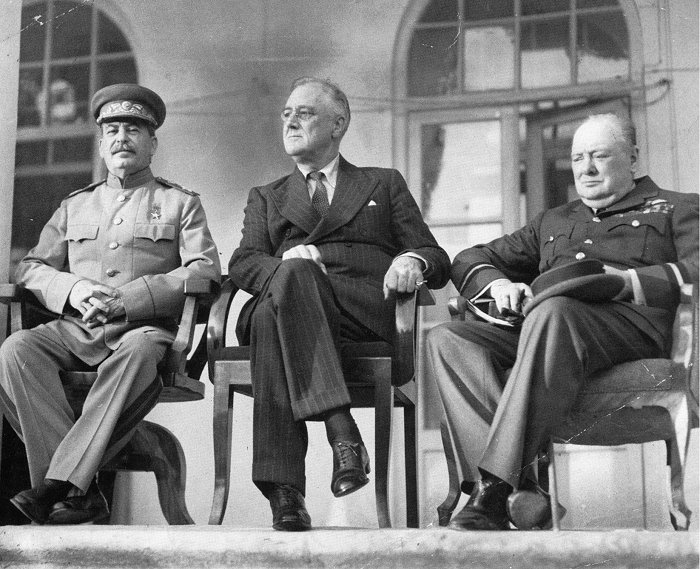
The “Big Three” meet at Tehran, 28 November-1 December, 1943.
Photo attributed to US Army photographer, via Wikimedia Commons.

Churchill’s support for Stalin during the Second World War followed from a simple calculus of the lesser of two evils. Britain could only take on one evil empire at a time, and, of the two, Churchill believed that Nazi Germany posed the greater threat to liberty. He famously remarked, “If Hitler invaded Hell I would make at least a favourable reference to the Devil in the House of Commons.” McMeekin attempts to sidestep this harsh reality, writing: “Whether or not the payoff was worth the price is a question well worth debating.” Churchill’s alliance with the Soviets stands or falls on this question: was Nazi Germany or the Soviet Union the greater danger in 1939?

With hindsight, one can easily marshal facts that portray Soviet communism as the greater evil. According to the best available estimates, the Stalin regime killed 20 millions of its own citizens. Nearly six million of those deaths occurred during the 1932–33 famine brought about by Stalin’s collectivization policies. While Nazi Germany also killed 17 million civilians, most of those deaths occurred after Hitler’s invasion of the Soviet Union in 1941. Thus, on the eve of the Second World War, one could argue — as Chamberlain and the appeasers did — that Nazi Germany served as a useful bulwark against a greater danger: the Soviet Union.

This analysis, however, misses a crucial point — one that Churchill recognized. Until 1939, the horrors of the Soviet regime had been primarily restricted to its own borders, while Nazi Germany had already made its expansionist ambition clear. In 1938, Germany annexed Austria. Later that year, Germany seized the Sudetenland. In 1939, the rest of Czechoslovakia passed under Hitler’s control. The Nazi doctrine of Lebensraum dictated even greater expansion. By contrast, Stalin’s doctrine of “socialism in one country” had kept the Soviet Union relatively peaceful until the Second World War began.

September 24, 2021

Kill The Nazis – WAH 042 – September 1942, Pt. 1

Filed under: Europe, France, Germany, History, Military, WW2 — Tags: , , , , — Nicholas @ 04:00

World War Two
Published 23 Sep 2021

The Nazi German occupiers have kept increasing their pressure in occupied territory, and fooled their victims to still have hope, but at some point when the oppression gets unbearable, or all hope is lost, people will resist.
(more…)

September 10, 2021

The German Slave Economy – WW2 Special

Filed under: Economics, Europe, Germany, History, Military, WW2 — Tags: , , , , , , — Nicholas @ 04:00

World War Two
Published 9 Sep 2021

To fuel the German war economy, the Nazis force millions of Prisoners of War, Concentration Camp inmates and civilians from all over Europe to work for in their factories and on their farms as slave laborers under harsh circumstances.
(more…)

September 3, 2021

Why Don’t the French Resist? – WAH 041 – August 1942, pt. 2

Filed under: France, Germany, History, Military, Russia, WW2 — Tags: , , , , , — Nicholas @ 04:00

World War Two
Published 2 Sep 2021

Citizens in Stalingrad face German bombs as Soviet officials refuse to evacuate. The German counter-insurgency effort increases, but people continue to resist against all odds. The Treblinka camp breaks down under the ambitions of its commandant, Irmfried Eberl.
(more…)

August 21, 2021

“Free” Navies of World War 2 – Small but Deadly (and a little crazy)

Filed under: Britain, Europe, France, Greece, History, Military, WW2 — Tags: , , , , , , , — Nicholas @ 04:00

Drachinifel
Published 13 Aug 2019

Today we take a brief look at the various “Free” navies that operated with the Royal Navy and how that interaction played out across the years of conflict.

Want to support the channel? – https://www.patreon.com/Drachinifel

Want a shirt/mug/hoodie – https://shop.spreadshirt.com/drachini…

Want a medal? – https://www.etsy.com/uk/shop/Drachinifel

Want to talk about ships? https://discord.gg/TYu88mt

Want to get some books? www.amazon.co.uk/shop/drachinifel

Drydock Episodes in podcast format – https://soundcloud.com/user-21912004

August 13, 2021

Spycraft and the Special Operations Executive – WW2 – Spies & Ties 07

World War Two
Published 12 Aug 2021

Astrid talks about spying all the time, but what was it actually like for people on the ground? We look through the lens of the British Special Operations Executive (SOE) to find out!
(more…)

August 7, 2021

The Black Markets of World War Two – WW2 – On the Homefront 012

World War Two
Published 6 Aug 2021

With the scarce food supply brought about by war, many turn to the black market and its astronomic prices as supplements. It is a place for opportunists and patriotic protesters, but mainly it’s a means to survive.
(more…)

« Newer PostsOlder Posts »

Powered by WordPress