
Forgotten Weapons
Published 9 Jun 2025The genesis of the B&T USW was a two and a half hour car ride home from a youth hockey game, when Karl Brugger and a friend were thinking about how to improve police effectiveness with handguns. What would make a handgun more accurate in practice? Clearly a red for and a shoulder stock. So how does one add those elements to a pistol while maintaining easy carry in a service holster? The answer was the USW.
The first prototypes were built on AT-84 Sphinx pistols (a Swiss-made copy of the CZ75). The first production run used Sphinx components, but with newly made frames and slide that incorporated cocking surfaces forward on the slide and an extension off the frame to mount the side-folding stock and Aimpoint Nano optic. Only a few of these were made, as the project was never all that popular.
Other experiments included conversions for other pistol models, with the SIG P320 being the most practical. Clamp-on conversion kits were made for guns like the CZ P10, Walther PPQ, and Glock.
Perhaps the most influential outcome of the project was the optic. Aimpoint originally developed the Nano as B&T’s request, but in the original form is was not nearly as reliable as Aimpoint desired. It was iterated and ruggedized (and renamed to avoid a lawsuit over the Beretta Nano pistol) and became the very successful Aimpoint Acro.
My 2022 Desert Brutality match with a USW-320:
• Evaluating the Modern Stocked Pistol: USW-…
(more…)
October 25, 2025
A Modern Stocked Pistol: B&T’s Universal Service Weapon (USW)
October 22, 2025
H&K MG4: Germany’s New 5.56mm Squad Machine Gun
Forgotten Weapons
Published 7 Jun 2025Heckler & Koch released the MG4, a new 5.56mm squad machine gun in 2001. It was adopted by the German army in 2005, and then by the Spanish and Portuguese armies in 2007. Alongside its sister weapon the 7.62mm MG5, it is H&K’s current export machine gun.
The MG4 fires from an open bolt, with a 2-lug rotating bolt locking system and a long stroke gas piston operating system. It uses standard M27 NATO links for feeding, and does not have a semiauto selector setting. Mechanically, the MG4 uses a front trunnion into which both the barrel and bolt lock independently — meaning that the quick-change barrel can be removed with the bolt in either the forward or rearward position.
As one would expect for a 5.56mm machine gun weighing 18 pounds, it is very easy to control.
Thanks to Sellier & Bellot for giving me access to this modern machine gun to film for you!
(more…)
October 18, 2025
Gerät Potsdam: Mauser Copies the Sten Gun
Forgotten Weapons
Published 2 Jun 2025In the fall of 1944, the Mauser company was given a contract to develop drawings of a direct copy of the British Sten gun (code named Gerät Potsdam), and to manufacture 10,000 of them. In fact, they were to make two different sets of drawings; one suitable for large factory use (like their own) and one for use with distributed small shops making parts for final assembly elsewhere (which is how much of British Sten production was done). The contract was fulfilled and 9972 guns in total were produced and accepted by the German military in November and December of 1944.
Why would Germany was a copy of the Sten? Well, they actually had a decent number of them. The Allies were air-dropping Stens all over Europe, and a lot of those drops were captured by German troops, not the resistance fighters they were intended for. By the end of the war the Germans were in desperate need of arms, and the Sten was both simple and already in some German use with the Volkssturm … so it actually was not a totally unreasonable idea to produce more of them.
Today, the Potsdam is an extremely rare gun to find. The two visible identifying features are the magazine well and barrel shroud, which are both made with a folded and spot welded seam. The barrels are also identifiable as they have 6 groove rifling, which the British did not use in the Sten.
Before the Potsdam production was finished, Mauser began working on further plans to simplify the design. That would be the Gerät Neumunster, aka the MP 3008. For that part of the story, see my video on the MP 3008:
• German Sten Copy: MP 3008, aka Gerät Neumü…
(more…)
October 14, 2025
DSA’s Unique Titanium FAL Project
Forgotten Weapons
Published 28 May 2025DS Arms got some billet titanium and decided to make a batch of titanium receivers and other parts. This turned out to be a nightmarish amount of work, and two of the receivers had to be scrapped, leaving only 10 completed. They also made a number of other titanium parts, including flash hiders (which this rifle has) and gas blocks (which this one does not). Between the titanium and aluminum parts and the choice of a lightweight configuration, this FAL tips the scale at just UNDER 7.5 pounds (3.4kg). That is a very remarkable achievement, and does so without making sacrifices in durability or features. It is slightly sharper recoiling than a standard 50.00 FAL (which weighs almost 10 pounds / 4.5kg), but not uncomfortable at all — the recoil is less than I had expected.
Unfortunately DSA does not appear to have any plans to make addition titanium receivers, but this small batch serves as a very cool proof of concept!
(more…)
October 11, 2025
Haenel’s Prototype Simplified Sturmgewehr StG45(H)
Forgotten Weapons
Published 26 May 2025In December 1944, the Haenel company received permission to produce a simplified version of the StG-44 Sturmgewehr. The idea was to keep the mechanical system and controls as similar as possible to the design in use, but simplify the design to reduce the cost and time of production. The design was never completed, and this is the only known surviving prototype. It was most likely captured by American forces when they occupied the Haenel factory in April 1945, although that is not documented. It is a pretty impressive adaptation of the StG design; far simpler to manufacture than the original design. Would it have worked? We don’t know for sure as there are no known German or American test reports, but it certainly seems viable to me.
Thanks to the Springfield Armory National Historic Site for giving me access to this truly unique specimen from their reference collection to film for you! Don’t miss the chance to visit the museum there if you have a day free in Springfield, Massachusetts: https://www.nps.gov/spar/index.htm
(more…)
October 10, 2025
The federal government’s gun “buyback” program pilot in Nova Scotia
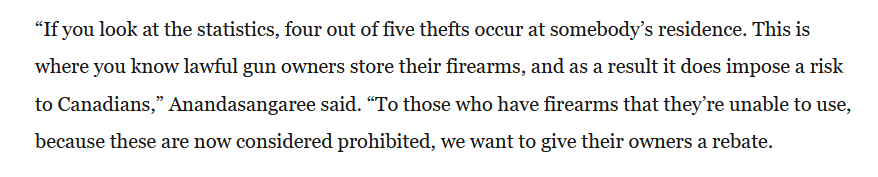
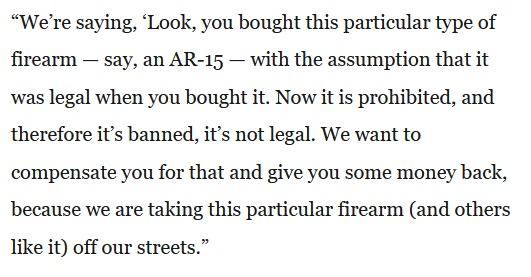
On the social media site formerly known as Twitter, Tim Thurley responds to a report about the gun “buyback” pilot program:
This reads like a government flailing for a message. We know this is incorrect, the Minister knows it is incorrect, and we know the Minister knows it is incorrect, and yet.
(The “Ensure…” section is also painful to read, but that’s another matter.)
He’s suggesting the risk is posed by stolen firearms. Not only do we know this is a small portion of risk — and easily substituted by other sources — but to say we must confiscate your property because someone else might misuse it sounds an awful lot like victim blaming.
Nobody bought an AR-15 under the assumption it was legal when they bought it (unless FRT banned, then it gets complex).
If a licensed user bought and registered it pre-OIC (or just bought if non-restricted) then it was legal when they bought it, period. No assumptions needed.
A rebate is also incorrect. A rebate is something a customer gets back after purchase.
They get to keep both the rebate and the product.
The part about only getting some money back is at least accurate.
The government is not offering full compensation for many users based on the list prices, and has reiterated that it does not plan to offer further compensation once the initial pot runs out.
October 7, 2025
C93 Borchardt: the First Successful Self-Loading Pistol
Forgotten Weapons
Published 29 Nov 2015Hugo Borchardt was a brilliant and well-traveled firearms designer. He was born in Germany but emigrated to the United States at a fairly young age, where he became engaged in the gun trade. He spent time working with Winchester, Remington (where he patented improvements on James Paris Lee’s box magazine idea), and Sharps (where he designed the M1878 rifle and worked as Superintendent). With this experience under his belt, he returned to Germany and worked with the Loewe/DWM corporation.
Borchardt’s seminal invention in Germany was his C93 automatic pistol, which was the first of its kinds using a reasonably powerful cartridge and a locked-breech action. Unlike the other designs extant at the time, the C93 went into commercial production, and 3000 were ultimately made. The gun was safe and reliable, and it set the standard for locating a detachable box magazine in the grip, which remains the standard today. However, its very bulky mainspring assembly led to it being a rather awkward handgun to use (although it was a quite nice carbine when used with its detachable shoulder stock).
Borchardt’s talents came hand-in-hand with a fair amount of hubris, and he refused to consider the possibility that his pistol could be improved. Several military trials requested a smaller and handier version of the gun, and when Borchardt refused to make those changes, DWM gave the job to a man named Georg Luger. Luger was very good at taking existing designs and improving them, and he transformed the basic action of the C93 into the Luger automatic pistol, which of course became one of the most iconic handguns ever made.
October 4, 2025
Warner Carbine
Forgotten Weapons
Published 8 Sept 2015The Warner carbine was another of the weapons used in small numbers by the Union cavalry during the Civil War. It is a pivoting breechblock action built on a brass frame. These carbines were made in two batches, known as the Greene and Springfield. The first guns were chambered for a proprietary .50 Warner cartridge, which was replaced with .56 Spencer in the later versions (for compatibility with other cavalry arms).
This particular Warner shows some interesting modification to its breechblock, which has been converted to use either rimfire or centerfire ammunition. This was not an uncommon modification for .56 Spencer weapons, as the centerfire type of Spencer ammunition could be reloaded (unlike the rimfire cartridges). With this modification, the firing pin can be switched from rimfire to centerfire position fairly easily.
October 1, 2025
QotD: The Indian Mutiny of 1857
The causes of the Indian Mutiny of 1857 are many and varied — there’s a whole separate wiki article on it — but the one “everyone knows” is the cartridge to the Enfield rifle. The Enfield was a muzzle loader. The soldier had to tear the cartridge with his teeth in order to load it. The cartridges were greased with a mixture of cow fat and lard. That was the rumor, anyway, and since Indian soldiers (called “sepoys”) were primarily Hindu and Muslim, biting the cartridge would violate everyone’s ritual purity.
This is a near-perfect synecdoche for the Raj’s problems. British Army officers weren’t stupid — lots of them commented on the issue. But they were isolated. For one thing, lots of them weren’t regular army — they were attached to the East India Company army, a separate formation, and within the Company’s army were different formations with different service requirements. And the army — whichever army — was deeply isolated from the civilian administration. For one thing, India’s huge, and there were never more than about 200,000 British in the whole place. The army was mostly on the frontier; the Government hung around primarily in a few big cities: Bombay, Calcutta, the summer capital at Simla (way up in the Himalayas).
So stop me if this sounds familiar: The civilian administration didn’t really know anything about the group upon which their peace, their security, their very lives depended. Actively despised them, in fact — oh, those wogs and their silly customs. But also look at it from the bottom up: What could the civilian administration really have done, with the best will and deepest knowledge in the world? […]
What could the leadership really have done at that point? Send a select group of brahmins and imams to tour the grease factory? The rumor would be that the British set up a Potemkin factory just for them; the real factory was using cow and pig fat. Reissue the old rifle? Recall that they already changed their drill — a pretty big deal in any army; a huge deal in a mid-19th century one — and that just added to the paranoia. Anyone who has ever been on the Internet knows how these things work once they get started: Evidence of an evil conspiracy is evidence of an evil conspiracy, but no evidence of an evil conspiracy is even more evidence of an evil conspiracy!
The root cause of the Mutiny, in other words, wasn’t political or economic (despite what Karl Marx said). It wasn’t even “cultural” in a lot of senses, and you can tell by the actions of the mutineers — or, rather, the non-actions. They simply had no idea what to do. They had no leadership (though some of them tried to install one of the remaining Mughal rulers in Delhi as an expedient; there’s a great book about it). The “Mutiny” was really just generalized beefing and score-settling on a continent-wide scale. They all had grief with the British, of course, and that was a convenient rallying cry. Once the British were gone — and see above, there were never very many of them — the guys down south quickly realized they had nothing in common with the guys up north. Ditto the guys on the east coast, the west coast, the hill country, the jungles …
Again, stop me if this sounds familiar: Stuffing a bunch of alien groups together inside artificial boundaries under a capricious, purposefully out-of-touch “government” that obviously hates every single one of those alien groups more than each one of the groups hates all the others, is kind of a bad idea. With the exception, of course, of that capricious government’s goon squad, the one group they obviously favor because that group can be counted on to knock heads on all the other groups whenever the government lets them off the chain (I’m talking about the Sikhs, obviously).
It doesn’t matter, in other words, what the rifle cartridges were greased with, or if they were greased at all. In this historical timeline, the precipitating cause of the Sepoy Rebellion was “the Enfield Rifle”. In the next timeline over, it’s something else — something equally minor — but the rebellion still happens, at pretty much the same time and in pretty much the same way.
In other words: It’s not that the British were alien to their subjects. Most groups in most places have been ruled by aliens, and trust me, the brahmin caste is far, far more alien to the castes below it than the British were to all of them combined. Nor was it that the British were high-handed administrators, as incompetent as they were arrogant. They were actually pretty good administrators, all things considered — “government competence” is always one of life’s lower bars, but the Raj cleared it easily. The guys running the “princely states” that made up the majority of the “British” Raj were every bit as alien to “their” people as the British, and in general spectacularly incompetent too.
Severian, “The Ruling Caste”, Founding Questions, 2022-03-09.
September 30, 2025
Stamm-Saurer Model 1913 Long-Recoil Prototype Rifle
Forgotten Weapons
Published 21 May 2025Hans Stamm developed a series of firearms in Switzerland in the early 1900s, and today we are looking at a second-pattern Model 1913 semiauto rifle. This was developed while Stamm was working for the Saurer company, where he headed its small arms division. Stamm’s Model 1907 straight pull rifle failed to win military adoption, and so in 1910 he began working on a quite complex long recoil system. The first prototype was finished in 1912, and by 1913 another seven examples were made.
These are sent to the Swiss and Belgian militaries for consideration, but neither are interested — and the outbreak of World War One ends possibilities for other adoption.
Previous Stamm designs:
1902 Gas-Operated Semiauto: • Stamm-Zeller 1902: A Swiss Straight-P…
1907 Straight-Pull: • Stamm-Saurer Model 1907: A New Swiss …Many thanks to the Swiss Shooting Museum in Bern for giving me access to these two very rare rifles to film for you! The museum is free to the public, and definitely worth visiting if you are in Bern — although it is closed for renovation until autumn 2025:
https://www.schuetzenmuseum.ch/en/
(more…)
September 27, 2025
AK4: Sweden’s Beefed-Up Take on the G3
Forgotten Weapons
Published 19 May 2025When Sweden decided to replace its bolt action Mausers and Ljungman semiautomatic in the 1960s, it had four main choices to pick from. One was the domestic GRAM-63, a modernized version of the Ljungman, the FAL and the G3. They ended up choosing the G3, but not without a number of changes.
Mechanically, the Swedes insisted on a longer service lifespan of the rifle than H&K rated it for. To this end, the Swedish model got a heavier recoil buffer, extending its life to 15,000 rounds. There were also changes to the stock, sights, bayonet attachment, and bolt carrier as well as the use of a clip-on rubber case deflector.
The initial batch of Swedish AK4 rifles was purchased directly from H&K, while domestic licensed production was set up at (eventually) both the star-owned Carl Gustaf factory and also the Husqvarna company.
Thanks to the Supply Battalion of the Estonian Defense Forces Support Command for giving me access to film this surprisingly hard-to-find rifle!
(more…)
September 24, 2025
It won’t work – the minister responsible knows it, but they’re going ahead with it anyway
The “it” in the headline is the federal government’s gun confiscation program, which they claim will reduce crime but they already know it won’t do any such thing. What it will do is take away from literally the most law-abiding, responsible citizens their legally purchased property and leave illegal guns in the hands of criminals … at an ever-increasing estimated cost to the taxpayer. In The Line, Matt Gurney covers the details:
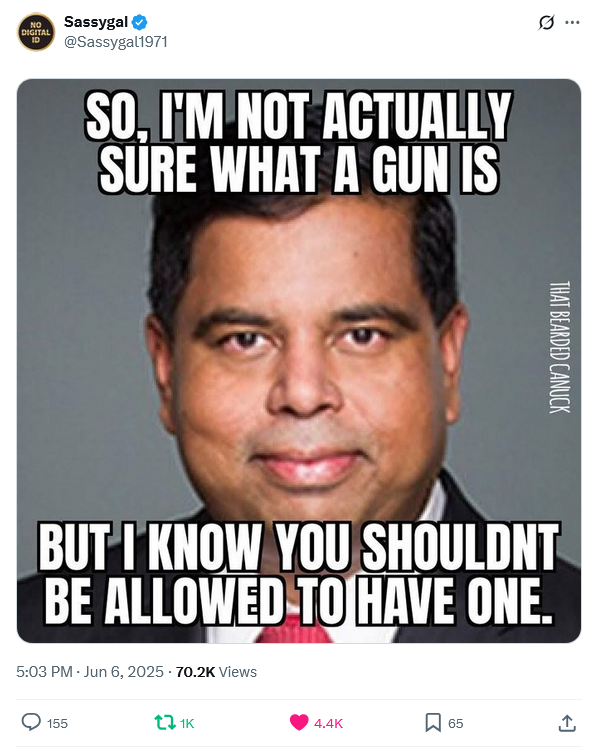
The federal gun confiscation program […] is illogical. It won’t save lives or make the public safer. The federal government doesn’t really even expect it to work, and is only going ahead with it because they’ve been stuck with a dumb proposal the Trudeau government made almost five years ago. If they could do it all over again, they wouldn’t, but they feel like they’ve blocked themselves in and have no choice but to proceed so that they don’t anger part of their electoral coalition, mainly voters in Quebec.
That might sound like a blistering criticism of the program, the kind of thing you’ve read in any number of my columns before. It’s actually what the public safety minister thinks about it. He just didn’t know he was being tape recorded when he said so. In a 20-minute conversation Gary Anandasangaree had with a firearms owner he rents a home to, which was recorded and then leaked, the minister says all of the above things. (He has also confirmed the recording is legitimate.)
Awkward for the minister, clearly, but I actually give him credit. The minister’s comments on tape are a confession, and an admission of defeat. They’re also, hands down, the most honest thing a Liberal government official has said on the gun control file in five years. Given that the minister responsible is freely telling people the program is a bad idea he’s stuck with and that won’t work, a sensible government would probably take this opportunity to walk away from the program.
Unfortunately, that’s not what this PM has chosen. It’s full speed ahead with an idea so bad Anandasangaree wishes he’d never been saddled with it.
Let’s talk about what this program is for a second. And forgive me, there’s quite a bit of history here. During Justin Trudeau’s first term, his only majority, his government had proposed a series of fairly moderate changes to the gun control laws they had inherited from Stephen Harper. As I’ve written often since, the proposals were a mixed bag. Some were okay. Some were bad. But they more or less left the well-functioning Canadian gun control system intact. They nibbled around the edges enough so that they could tell their voters that they had gotten tougher. But they generally didn’t try to fix what wasn’t broken.
But then politics got in the way, as it always does. Trudeau lost his majority in 2019 and became ever-more dependent on voter efficiency and wedge issues. And then in 2020, there was a horrible massacre in Nova Scotia. That catastrophe had nothing to do with our gun control laws; the weapons used were brought in illegally from the United States, as is typical of guns used in gun crime. But the Trudeau government seized on the opportunity — never waste a crisis, right? — to announce that they were “banning” “assault rifles”.
A lot of quotes above. So let me explain. First of all, there really wasn’t much of a ban. Anyone who owned one of the newly banned rifles was allowed to keep them. And as for assault rifles, actual assault rifles — rifle-calibre weapons that use high-capacity detachable magazines and can fire in fully automatic mode — have been banned in Canada for decades. This isn’t a problem that we actually had. And the government tacitly admitted as much when they began fudging the words they used to describe them. In acknowledgement that there were no actual assault weapons to ban, they started talking about assault-style weapons.
“Style” is a tell. You wouldn’t take medicine-style pills, or munch on a food-style snack. Because you’d know better. Trudeau et al knew better. It didn’t stop them. They needed something to announce, and by God, they were going to announce it!
And as we’ve noted several times, the Trudeau government got addicted to the media high of making big showy announcements. So they started doing repeat announcements over a period of time, and thanks to the spinelessness of Canadian legacy media even before Trudeau started directly subsidizing them, the media sugar high got repeated as well. It didn’t take long for the lesson to be learned that making an announcement was cheaper than doing the thing that was announced, and we quickly transitioned to a world where it was the announcement that mattered, not the thing.
At Junk Economics, Bryan Moir sums up the stupidity:
You want blunt? Fine. Here it is:
Listen: politics is kabuki theater and promises are props. Here we have a government rolling out a nationwide confiscation-style buyback and calling it “voluntary” — which is like calling income tax “optional” if you want to be arrested. The minister tells citizens, in public, “it’s voluntary”, then admits in private he’ll criminalize non-compliance, will “bail you out” if it goes that far, and says the whole exercise exists because the party must keep the promise and because the Quebec caucus wants to show muscle. That’s not statesmanship. That’s PR with a warrant.
They lecture you about being “tough on guns” while refusing to be tough on the people who actually bring violence into our streets. The minister himself says if he could do it over he’d target illegal guns and put criminals in jail — not law-abiding owners. Translation: the policy is ideologically driven and politically performative, not strategically intelligent. You don’t cure gang violence — which the cops tell you comes from illegal trafficking and cross-border smuggling — by borrowing billions to buy back legally purchased rifles. That’s like throwing sandbags into a burning house and patting yourself on the back for “doing something”.
And then there’s the logistics and the cost — the ugly part they don’t want on camera. The federal pot is capped at about $742 million and the program is rolled out in fits and starts. Major police forces are already saying “no thanks”, which means the feds must either stand down, contract a patchwork of municipal services, or try to outsource enforcement. Any of those choices blows up the promise in different ways: it becomes toothless, it becomes wildly more expensive, or it becomes a federal-provincial fight that will make the Notwithstanding clause dust-ups look like backyard squabbles. Pick your disaster.
Remember the math: a capped pool of cash plus a growing list of banned models (hundreds, then thousands) equals many owners getting nothing while the bureaucracy eats up the rest on administration, contracts, security, staffing, and political “bribes” (a nicer word for handouts to get agencies to play ball). If the fund runs out — and the minister openly says “it’s capped; when it’s gone, it’s gone” — you’ll have a bunch of people stripped of legal property, out of pocket, and the state triumphant only in optics. That’s confiscation without fair market compensation; it reads like policy designed by accountants and sold by televangelists.
Worst of all: while Ottawa gamely auctions off the idea of virtue, or was that “Canadian values”, real problems pile up. Fire seasons rage, hospitals are full, kids wait for surgeries, food banks are overwhelmed and the cost of living keeps rising— and Mark and Gary are borrowing money to offer coupons for now-illegal guns. If you wanted a textbook case of political misallocation, this is it: symbolic policy delivered with symbolic money so the party can say it kept a promise, while the public pays the bill and crime networks keep smuggling.
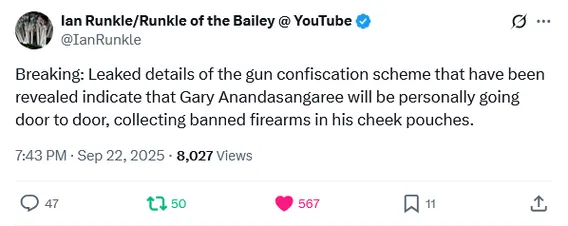
On the gun confiscation program in particular, thank goodness you can always depend on social media to find the funny side of any issue:
September 23, 2025
Beretta Model 1934: Italy’s Unassuming Workhorse Service Pistol
Forgotten Weapons
Published 16 May 2025The Beretta Model 34 was basically the final iteration of a design by Tullio Marengoni that began all the way back in 1915. That pistol was updated in the early 1920s, and that one was updated in 1931. The Model 1931 was converted to .380 ACP (aka 9mm Short) as the Model 1932, which became the Model 1934 with the addition of a hammer half-cock notch and steel grip panel backing. Police and military contracts began in 1935, with the Italian Army formally adopting it in 1936 and purchasing nearly 400,000 of them by 1940. It would ultimately see service with basically all the armed elements of the Italian military and civil security services as well as foreign nations including Germany, Romania, and Finland. As a souvenir for British or American troops, the Model 1934 was also a prized piece.
Essentially, the Model 1934 is compact, simple, durable, and reliable. It is an excellent military pistol; easy to carry unobtrusively but dependable when called upon. After World War Two it stayed in production until 1980, despite introduction of many other more modern options by Beretta. Today a bunch of the pistols have become available on the US collector’s market. Thanks to Royal Tiger Imports for sending this example for me to film!
Beretta Model 1934 serial numbers and dates (source: “1915-1985 Settant’ Anni di Pistole Beretta“):
1934 – 1942 – from about 500073 to 999996
1934 – 1942 – from 1 to about 40000
1943 – 1945 – from F00001 to F99997
1943 – 1945 – from G00001 to G57486
1943 – 1945 – from 0001AA to 9997AA
1943 – 1945 – from 0001BB to 9971BB
1946 – 1949 – from C00001 to C99998
1949 – 1954 – from D00001 to D99999
1954 – 1967 – from E00001 to E95760
1967 – 1973 – from F50001 to F61693
1970 – 1975 – from G00007 to G49620
1972 – 1974 – from H00001 to H25000
1971 – 1980 – from T 1 to T 10217Other pistols in the Beretta development series:
Modle 1915: • Beretta 1915: the First of the Berett…
Model 1923: • Beretta Model 1923
Model 1931: • Beretta Model 1931
Trials Model 1934: • Military Trials Beretta 34 – Can You …
(more…)
September 20, 2025
Dutch Navy Luger: From World War One to the End of Neutrality
Forgotten Weapons
Published 12 May 2025The Dutch Navy first acquired Luger pistols in 1918 specifically for its aviators. They had 12 German P04 Lugers taken from a German submarine stranded in the (neutral) Netherlands, and 28 more were purchased from DWM in 1918 to round out the 40 guns needed to equip the Naval Air Service. The pistol was formally adopted as Automatische Pistool Nr.1. In 1928, the Dutch Army adopted the 1906 New Model Luger for its own service, and the Navy decided to update its revolvers at the same time. The Navy opted not to get grip safeties, and so took a copy of the German P08 model instead of what the Army had. The first order was placed in 1928 through BKIW in Germany, and deliveries would run until 1939 with a total of 2654 delivered before German invaded in May 1940.
Dutch Army Luger trials:
• Politicians Ruin Everything: Dutch Lu…Dutch East Indies Lugers:
• Lugers for the Dutch East Indies Army
(more…)
September 16, 2025
No sensible person wants to start a civil war
There are always angry folks online who take any current event as a conversational pretext for talking about taking up arms against … whoever they always seem to want to take up arms against. In decades past, you could more easily find tantrums like that among the conspiratorial right but today it seems that the left is leading the charge, so to speak. As a bit of a follow-on to this post, here’s more from Tom Kratman and Harry Kitchener on what might need to be done to start that unwanted-by-all-sensible-folks conflict:

Let’s assume, though, that you people want to kick off what we might call a hard debate – that you plan to use organized and precise violence to combat your enemies and promote your views.
Actually doing it is pretty easy – a patsy with a hunting rifle has a pretty good chance, assuming a bit of talent, to take out any given public figure (assuming no Secret Service protection, that makes things much more difficult). He’ll almost certainly be caught, of course; in a best case, arrested, tried and sentenced to life … or death, in a worst case, killed during the arrest. If you’ve got an inexhaustible supply of these patsies I suppose that’s sustainable – it’s meaningless, of course, as it’ll just bring the other side to the conclusion that if this is the game in future, they’ll happily play along (and they have more guns, more training and probably more immediate support than you do. And they’re starting to really hate you, too).
If you actually *want* to kick off a low-level civil war (I have to say I can’t understand why you would want this, but, hey ho, your call), you need to think in more sustainable terms. Read back on our pieces for some hints on the operational, logistic and security considerations you need to establish a covert, violent organization. Particularly consider the issue of finance – this stuff costs big money to organize and execute and I’m not sure you have access to the sort of volumes of laundered cash you’re going to need.
You’re also going to need to be tough, properly tough in order to cope with the immense pressure you’re going to feel from government and the Right alike, to say nothing of the moral (and morale) impact of inevitable casualties, not just those arrested and sentenced, but also those killed and maimed. Don’t underestimate the impact on one of your “active service units” losing one or two of their members, or of the occasional need just to abandon them in order to get away.
Assuming – and, to be frank, I don’t see this working – but, assuming you do manage to organize some sort of covert violent organization, what would it be *for*? What’s the end state you’re looking to achieve? Proletarian revolution, the righteous rage of the mobilized working class? Not a fucking chance, not in the USA. Every historical example we have of the left trying this kind of thing to raise an oppressive right wing government, to mobilize the masses for the left, shows, instead, massive cheering from those masses for the government that then proceeds to exterminate you.
Cowing the Right through violence? Again, not a hope – the Right (as you call it, a better term might be “the majority of the US population”) tends to be pretty much OK with justified violence, tends to have a larger proportion of people who’ve seen the elephant (this is military slang for “the greatest show on earth”, which is to say, war) and tends to be much better armed than your folks are. On the plus side, you’re in America so becoming better armed is easy. Becoming better armed without leaving a trail pointing straight at you, on the other hand, is hard. And you don’t have the criminal connections to avoid this.
Your base is relatively small and relatively concentrated in certain areas and in certain sectors – soft states, academia, the media, that kind of thing. Don’t believe a word big tech says, they’ll drop you and switch immediately as their share price is adversely affected. And note that the “disciplines” your sort of people tend to undertake in college – gender studies, ethnic studies, gay studies, feminist interpretive dance – are great for motivation to act for the left, but not very good for competence in action.
This makes your base incredibly vulnerable. No matter how effective your “active service units” might be in doing dreadful things to individuals on the Right, you’ll always be outgunned – and every single successful operation you carry out will generate greater support for your opponents. What’s that? Yes, of course it’s unfair and unjust. Deal with it.
What you have, always, to remember is that however important some things are to you, most people are either indifferent to them, or actively hostile to them. No amount of killing is going to change that, probably quite the contrary.
Update, 17 September: Welcome, Instapundit readers! Please do have a look around at some of my other posts you may find of interest. I send out a daily summary of posts here through my Substack – https://substack.com/@nicholasrusson that you can subscribe to if you’d like to be informed of new posts in the future.


