
Forgotten Weapons
Published 28 Jul 2025The ZK-381 was designed by Josef Koucký, his first design of 1938 (hence 381). This is one of the last of the Czech pre-war self-loading rifle projects, of which there were quite a lot. It uses a tilting bolt and a short-stroke gas piston, with ZB26 machine gun magazines and chambered for 7.92mm Mauser (although they would have been happy to offer a model in any other modern rifle cartridge). It was tested in the spring of 1938 by the Soviet Union, which liked it enough that they requested a model in 7.62x54R — and those were tested in November 1938. Ultimately domestic Russian designs were chosen instead, and tests in German, France, Spain, and Italy also led to naught.
Thanks to the Czech Military History Institute (VHU) for graciously giving me access to this one-of-a-kind prototype to film for you! If you have the opportunity, don’t miss seeing their museums in Prague:
https://www.vhu.cz/en/english-summary/
(more…)
December 13, 2025
ZK 381: Czech Pre-War Prototype Battle Rifle
December 9, 2025
Krieghoff’s Bizarre Prototype FG42 Proposal
Forgotten Weapons
Published 23 Jul 2025When the Luftwaffe was looking for its new universal paratrooper rifle, six different German arms companies were asked to submit proposals. Only two actually did; Krieghoff and Rheinmetall. Krieghoff designed this very interesting system, clearly optimized to reduce weight and length as required by the design brief. It uses a tiny vertically traveling locking block and an unusual gas trap system combined with an under-barrel piston. The total number made is unknown, but both fixed- and folding-stock models were produced (the German museum at Koblenz has a fixed-stock example on display). This particular example appears to have been tested after the war by engineers at Springfield Armory by drilling a hole in the gas tube to measure pressure while it cycled.
Thanks to the Springfield Armory National Historic Site for giving me access to this rare prototype from their reference collection to film for you! Don’t miss the chance to visit the museum there if you have a day free in Springfield, Massachusetts:
December 6, 2025
G150: Swiss Silenced Guerrilla Anti-Materiel Rifle
Forgotten Weapons
Published 21 Jul 2025The G150 is a rifle specifically assembled by and for the Swiss P-26 organization: a very secretive stay-behind group intended to fight foreign occupiers of Switzerland. It was one of a series of such organizations that began with a concern during World War Two the Germany might invade, and continued during the Cold War with the threat of Soviet occupation in the aftermath of nuclear war. The P-26 group specifically was formed in 1981, and disbanded in 1991 under a cloud of controversy over its political leanings.
P-26 was armed with an assortment of weapons ideal for guerrilla warfare, including P210 pistols and suppressed MP5 submachine guns. The G150 rifle was intended to be a very quiet rifle for destroying enemy materiel like radar systems, fuel tanks, parked aircraft, and the like. About 250 were made using commercial JP Sauer actions, SIG 540 like pistol grips and folding stocks, and very large two-part suppressors. They were chambered for the .41 Remington Magnum revolver cartridge, loaded with a 408-grain subsonic bullet. The scopes were adjustable from 4-6 power (yes, 4-6: it;s a weird choice) and had BDC elevation turrets adjustable out to 200 meters.
Only three G150 rifles are known today, although the remainder may still be in some deep military storage in Switzerland. Many thanks to the anonymous viewer who arranged access to this one for me to film! To see another perspective on one of the other known examples, I recommend Bloke on the Range’s video:
• BotR Exclusive! Swiss 10.4mm G150 subsonic…
(more…)
December 2, 2025
H&R Handy Gun: A Smoothbore Pistol Killed Off by the NFA
Forgotten Weapons
Published 19 Jul 2025The Handy Gun was introduced by Harrington & Richardson in 1924. H&R took their Model 1915 single-barrel break-action shotgun and cut it down into a handgun. It got a pistol grip and an 8″ barrel, and was offered in both .410 and 28 gauge (the .410 model also able to fire some .44-caliber single-bullet cartridges). A 12″ version was also made, to be legal in a few states that had length restrictions. It was advertised specifically for personal protection, probably exploiting the common belief that one need not aim a shotgun at close range.
In 1931 H&R attempted to pivot the Handy Gun into the target pistol space, introducing .22LR and .32 S&W models with rifled barrels. These didn’t sell very well, as there were many other, better options for target pistols. A detachable wire stock was introduced in 1933, but this didn’t help much either.
Ultimately the National Firearms Act of 1934 conclusively killed off the Handy Gun (along with similar products from other companies, like Ithaca’s “Auto & Burglar”). That law categorized smoothbore pistols as “Any Other Weapons”, and subjected them to NFA registration with a $200 tax on their manufacture and a $5 tax on their transfer. This overhead destroyed demand for the gun, and the company simply ceased to offer it commercially. It did continue to be sold in Canada until World War Two however as Canadian law did not restrict it at that time. Total production was about 54,000.
(more…)
November 28, 2025
CZ247: Experimental Swivel-Action SMG
Forgotten Weapons
Published 16 Jul 2025The CZ247 was developed for Czechoslovakia’s post-war submachine gun trials, where it was pitted against the ZB47. It was a simple blowback 9x19mm SMG with a number of interesting elements, most notably the ability to fire with the magazine either vertical or horizontal. In theory, this made the gun more compact for use in a jungle sort of environment (vertical) or to allow a shooter to get much lower to the ground when shooting prone (horizontal). In practice, it really isn’t very important, and requires a bit of extra complexity in the gun’s design. The CZ247 also has a neat safety mechanism for preventing unintended firing and a stripper clip guide built into the stock (both of which would be incorporated in the vz.48 SMG that was eventually adopted).
When the CZ247 failed to win the military trials, CZ got government permission to sell it on the export market. A contract for 10,000 guns was quickly obtained from Egypt, but before the guns could be shipped the export permission was cancelled by the government. Czechoslovakia opted to support Israel in its declaration of independence in 1948, and the government decided to not send weapons to Egypt which might be used against Israel. This left the guns sitting in CZ warehouses, and the basically all stayed there for a few decades. Eventually most were sold to Nigeria in 1967 and Ethiopian in 1977 — and as a result they show up occasionally in African and Middle Eastern conflict zones to this day.
Thanks to CZ for giving me the opportunity to take this example out to film and also to shoot for you!
(more…)
November 25, 2025
Roller Delay in France: The H&K 33F (Trials & Export Models)
Forgotten Weapons
Published 14 Jul 2025When France was looking to replace the MAS 49/56 rifle for military service in the 1970s, it tested all of the major rifle options available. These included the Colt M16, FN CAL, and HK33. The HK required some modification to meet French military requirements, specifically the capability to launch rifle grenades. The model 33F was developed specifically to meet these requirements — first as a modified standard HK33, and later as a factory production run. The modifications made include a reinforced magazine well, 4-position fire control gourd (including 3-round burst), a reinforced stock attachment, grenade range rings on the barrel, and a mounting bracket for a rifle grenade sight.
Apparently the HK33F performed very well in trials, but it was ultimately deemed politically unacceptable to adopt a German rifle for the French Army (a policy which has changed now, 50 years later …). Instead, the domestic FAMAS was chosen, along with the SIG-Manurhin 540 purchased in limited numbers for the Foreign Legion.
A second type of 33F came about from the program, however. Berlin police wanted HK33 rifles, but treaty prohibited West German arms from entering Berlin in East Germany. The loophole found was to send the parts to MAS in France, where they were assembled and marked HK33F, thus making them French origin gun which could be sent to Berlin. These rifles had none of the French grenade launching adaptations, and were completely standard HK33s except for the use of heavy barrels. MAS eventually added the G3, HK33, and MP5 to its export catalog in the late 1970s and sold quantities to a number of small countries in the French sphere of influence (including Haiti, Burkina Faso, Lebanon, and others).
Many thanks to the IRCGN (Institut de Recherche Criminelle de la Gendarmerie Nationale) for allowing me access to film these rather rare HK variants for you!
(more…)
November 21, 2025
URZ: Czech Prototype Universal Modular Weapon
Forgotten Weapons
Published 7 Jul 2025The URZ (Univerzální Ruční Zbraň, or Universal Hand Weapon) was a 1966 project designed by Jiří Čermák (designer of the vz.58 rifle). He envisioned a weapons system family with largely interchangeable elements that could be configured as a service rifle, carbine, light machine gun, vehicular machine gun, or precision rifle. The Czech military was not interested, but Čermák was able to convince the government to allow its development for export instead.
The design is a delayed-blowback system using rollers, and belt-fed. The first few examples were made in 7.62x39mm, but development switched to 7.62x51mm NATO in a rather surprising move. Presumably this was intended for sale to unaligned nations who were interested in the NATO cartridge, but still — seeing its development in then-communist Czechoslovakia is pretty unusual. Ultimately only 9 examples were built before the project was abandoned.
Thanks to the Czech Military History Institute (VHU) for graciously giving me access to this one-of-a-kind prototype to film for you! If you have the opportunity, don’t miss seeing their museums in Prague:
https://www.vhu.cz/en/english-summary/
(more…)
November 18, 2025
Vickers Heavy Machine Gun
Forgotten Weapons
Published 14 Dec 2016I may be a bit biased here, but I believe that the Vickers gun is one of the best all-around firearms ever made. It was designed during an era of experimentation and craftsmanship, with a quality and care that would make it today prohibitively expensive. It was exemplary in action, and served in every environment on earth through six decades and in the hands of 50 different nations. It was an infantry gun, an aircraft gun, an armored vehicle gun, and a shipboard gun.
Captain Graham Hutchison recorded this account of the Vickers in action during an attack on High Wood in August 1916 (exerpted from “The Grand old Lady of No Man’s Land by Dolf Goldsmith):
“For this attack, [ten] guns were grouped in the Savoy Trench, from which a magnificent view was obtained of the German line at a range of about 2000 yards. These guns were disposed for barrage. On August 23rd and the night of the 23rd/24th the whole Company was, in addition to the two Companies of Infantry lent for the purpose, employed in carrying water and ammunition to this point. Many factors in barrage work which are now common knowledge had not then been learned or considered. It is amusing today to note that in the orders for the 100th Machine Gun Company’s barrage of 10 guns, Captain Hutchison ordered that rapid fire should be maintained continuously for twelve hours, to cover the attack and consolidation. It is to the credit of the gunners and the Vickers gun itself that this was done! During the attack on the 24th, 250 rounds short of one million were fired by ten guns; at least four petrol tins of water besides all the water bottles of the Company and urine tins form the neighborhood were emptied into the guns for cooling purposes; and a continuous party was employed carrying ammunition. Private Robertshaw and Artificer H. Bartlett between them maintained a belt-filling machine in action without stopping for a single moment, for twelve hours. At the end of this time many of the NCOs and gunners were found asleep from exhaustion at their posts. A prize of five francs to the members of each gun team was offered and was secured by the gun team of Sgt. P. Dean, DCM, with a record of just over 120,000 rounds.”
The attack on the 24th of August was a brilliant success, the operation being difficult and all objectives being taken within a short time. Prisoner examined at Divisional and Corps Headquarters reported that the effect of the Machine Gun barrage was annihilating, and the counterattacks which had attempted to retake the ground lost were broken up whilst being concentrated east of the Flers Ridge and of High Wood.
In 1963 in Yorkshire, a class of British Army armorers put one Vickers gun through probably the most strenuous test ever given to an individual gun. The base had a stockpile of approximately 5 million rounds of Mk VII ammunition which was no longer approved for military use. They took a newly rebuilt Vickers gun, and proceeded to fire the entire stock of ammo through it over the course of seven days. They worked in pairs, switching off at 30 minute intervals, with a third man shoveling away spent brass. The gun was fired in 250-round solid bursts, and the worn out barrels were changed every hour and a half. At the end of the five million rounds, the gun was taken back into the shop for inspection. It was found to be within service spec in every dimension.
During its service life, the Vickers was made in .303 British, .30-06, 0.50 Vickers, .50 High Velocity, 7×57 Mauser, 7.65×53, 8mm Mauser, 8mm Lebel, 7.7 Japanese, 6.5×54 Dutch, 7.9x57R Dutch, 7.62 NATO, 7.62x54R, 8x52R Siamese, 11mm Vickers, and three different 40mm cartridges.
The Vickers was retired from British military service in 1968, having finally become obsolete. Its GPMG role was taken over by the FN MAG, and its long range indirect fire role performed by 3″ mortars. The Vickers was a weapon which required training and dedication to master, but rewarded its users with phenomenal endurance and a wide range of capabilities. Among all contenders, only the Browning machine gun can attempt to compare to the outstanding qualities of the Vickers, and even the Browning fails to match the elegance of the stalwart Brit.
November 16, 2025
3D printing and firearms
On the social media site formerly known as Twitter, ESR discusses a recent user notification from one of the 3D printer companies to their users:
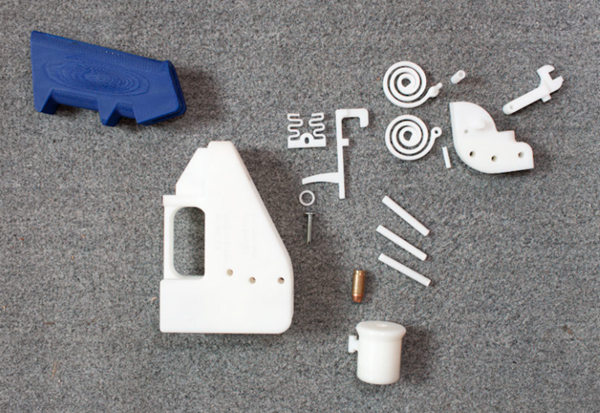
I’m told that 3D printed gun parts are far more sophisticated than this Liberator from 2013, but I’m sure nobody would actually do that, right? It would draw the attention of various government agencies for sure.
The recent flap about FlashForge attempting to forbid its customers from printing gun parts means it’s time for another reminder about technological risk.
Their weasel-worded climb-down carefully avoids stating that they never collect data on what you print. They only say they don’t collect data during your prints. The wording is so careful that I think we can conclude they do in fact ship telemetry on your print jobs when g-code arrives at the printer, immediately before printing.
So I repeat a warning I’ve given previously: never buy a 3D printer that requires an internet connection to function. And, always assume that if the printer’s firmware isn’t open-source, it is written to spy on you and could at any time prevent you from printing disapproved objects.
Oh, and never trust FlashForge again or buy their products, no matter how much groveling they do. After this, it’s safest to assume that anything they say about respecting the privacy and autonomy of their customers will be a lie. Hear that, @ff3dprinters
?We need to make a public example of FlashForge. Other vendors need to hear that shit like this will not be tolerated, that attempting to constrain what their customers print will do them permanent and irreversible damage.
It’s possible that this was merely a blunder on FlashForge’s court, and the attempts they’ve made so far to recover are compounding blunders, but they have sincerely repented of trying to control their customers. That’s too bad; in order to create the right incentives bearing on the future behavior of other vendors, we must show no mercy. We must make them hurt – ideally, to the point of being driven out of business.
And really these warnings apply to all “smart” devices, not just 3D printers. Unless you can audit the source code, the only safe assumption to make is that the firmware is spyware, controlware, and malware.
Device vendors need to know that we do not forgive, and will not forget.
In response, Hopalong Ginsberg posted this helpful item:

November 15, 2025
Marlin 1897 Bicycle Rifle
Forgotten Weapons
Published 23 Feb 2016Marlin’s 1892 lever action rifle in .22 rimfire caliber proved to be a very popular firearm, and so the company released an improved version in 1897, offered only as a rimfire takedown model. The 1897 would also prove very popular, and the same basic design would continue later as the Model 39.
One interesting variant of the 1897 offered was a Bicycle Rifle. While the rifle was generally available only with fairly long barrels, the bicycle version had a 16″ barrel and full-length magazine tube. This was sized specifically to fit in a special case (disassembled) underneath the top bar of a bicycle frame, allowing kids to easily use their bicycles to take these rifles to their favorite shooting spots.
While the 1897 itself was popular, the bicycle variant was not, with Marlin sales records showing only 197 sold.
November 12, 2025
Volksturm VG-5, aka VK-98
Forgotten Weapons
Published 15 Sept 2015By the beginning of 1945, the Nazi government in Germany was looking to find cheaper ways to equip the Volksturm, and solicited bids and designs from several major arms manufacturers. The Steyr company created a crude but effective version of the Mauser 98 which was dubbed the VK-98 or VG-5. Mechanically it is identical to a K98k, but has much less attention paid to aesthetic finish and many simplified parts.
In total, 10,000 of these Steyr rifles were made. Despite commonly held notions of them having totally random parts, there are actually a relatively small number of discreet variations in the production sequence and the rifles have definitely class characteristics — which I will examine in the video.
November 9, 2025
Samopal vz 38: Czechoslovakia’s Interwar Drum-Fed SMG in .380
Forgotten Weapons
Published 25 Jun 2025Military interest in a submachine gun was late in Czechoslovakia, but by the late 1930s a development program was put into place. Interestingly, the main use case for an SMG was seen as being a replacement for a rifle-caliber LMG in fortification mounts. The thought process seems to have been that a large volume of fire was the necessary element to keep invaders away from border fortresses, and the ballistic power of the fire was not so important.
The vz38 was designed by František Myška, chambered for the 9x17mm (.380) cartridge used by the vz22/24 pistol then in service. It was tested against the ZB26 light machine gun. It proved reliable and effective, and its 96-round drum magazine (copied from the Finnish Suomi) was a particularly nice element. An initial order was placed and the gun was formally adopted into service, but production never began. Instead, German occupation of the country put an end to the project and only 20 preproduction examples were ever made.
Many thanks to the VHU — the Czech Military History Institute — for giving me access to this very rare example to film for you. The Army Museum Žižkov is a part of the Institute, and they have a three-story museum full of cool exhibits open to the public in Prague. If you have a chance to visit, it’s definitely worth the time! You can find all of their details (including their aviation and armor museums) here:
November 6, 2025
Galand de Guerre Model 1872: Too Good for the Military
Forgotten Weapons
Published 23 Jun 2025Charles François Galand is best known for his simultaneous-extraction Model 1868, but he also developed a very good solid-frame revolver. This was specifically for the French 1871 military trials, which specifically required a solid frame. The Galand was chambered for 12mm Galand (with its distinctive very thick rim), held 6 rounds, operated in either single or double action, required no tools to disassemble, and had very simple but durable lockwork. The gun was very good, and was a very tight competitor for the other trials finalist, the Chamelot-Delvigne. Ultimately, it lost out because it was the more expensive of the two options.
For more information on the Model 1873 Chamelot-Delvigne that won the French trials, I suggest the C&Rsenal video on that model:
• History of WWI Primer 061: French and Ital…
(more…)
November 3, 2025
Swedish Kulspruta m/36 Double Browning MGs
Forgotten Weapons
Published 18 Jun 2025Despite being a neutral power during World War Two, Sweden had a variety of very interesting small arms — like their dual-mount Browning m/36 machine guns. These were originally adopted because the Swedes wanted a heavier medium MG cartridge and didn’t think their delayed-blowback Schwarzlose guns could handle it. The cartridge was 8x63mm, pushing a 219 grain projectile at 2500 fps. The m/36 Browning was a water cooled gun, an improvement on the older M1917 design. It not only handled the powerful new round, but it could also be easily swapped to the older 6.5x55mm round to use stocks of existing ammunition (and it would be later adapted to 7.62mm NATO as well). Most of the guns were built as matching pairs for antiaircraft use, with mirrors left and right side feeds and in effective recoil-absorbing cradle mounts.
Special thanks to Bear Arms in Scottsdale, AZ for providing access to this rare pair of guns for today’s video!
(more…)
October 28, 2025
AR-1 “Parasniper” – The First Armalite
Forgotten Weapons
Published 11 Jun 2025The first rifle produced by Armalite began in 1952 as a project between the brothers-in-law, Charles Dorchester and George Sullivan (no relation to later Armalite engineer L. James Sullivan). Sullivan is the chief patent attorney for the Lockheed Aircraft Company, and the two have the idea to produce an ultra-light rifle using aircraft industry materials like fiberglass and aluminum. They create a company called SF Projects and get to work using Remington actions. They fit aluminum (and then later aluminum/steel composite) barrels and foam-filled stocks and the result is a rifle that weighs less than 6 pounds with a 4x scope fitted. The first ones are chambered in .257 Roberts, but this shortly gives way to the new .308 Winchester cartridge.
Sullivan and Dorchester make a connection with Richard Boutelle, who is very much a “gun guy” himself and also head of the Fairchild aircraft company. The idea of the rifle appeals to Boutelle, and Fairchild was looking to diversify its operations – and so Fairchild agrees to buy SF Projects, renaming it the Armalite Division of Fairchild.
The idea of the rifle was for civilian hunters who want a gun that is light to carry for long distances and also military specialists like airborne troops who need lightweight gear. The Army tests the AR-1 in 1955 and finds some fairly serious problems with it. There are reliability issues, and also accuracy shortfalls. When the composite barrel heats up, differential stresses cause the point of impact to shift. This foreshadows the catastrophic failure of a composite barrel in AR-10 testing, but that is a story for another video. Ultimately after two rounds of testing the Army rejects the rifle, and that is pretty much the end of it. Armalite moves its focus to other projects, namely combining aircraft industry materials with the self-loading rifle of their other designer, Eugene Stoner. That, of course, will become the AR-10.
Since I know folks will ask, the AR projects between 1 and 10 were thus:
AR3: Stoner-type rifle in hunting configuration
AR5: Air Force survival rifle
AR9: Shotgun
The designations 2, 4, 6, 7, and 8 were set aside to drawing board projects that never materialized.
(more…)


