Quotulatiousness

June 11, 2013

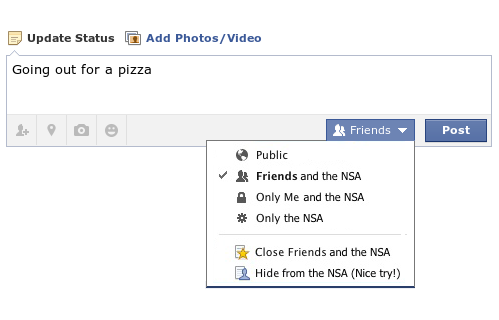
New privacy options on Facebook

Filed under: Humour, Liberty, Media — Tags: , , , — Nicholas @ 12:39

Facebook's new privacy options

H/T to KA-CHING! for the image.

June 8, 2013

Don’t put too much faith in denials from Verizon and other companies…

Filed under: Business, Government, Law, Liberty, Technology — Tags: , , , , , — Nicholas @ 10:10

As Mic Wright points out, the companies named in the Prism leaks may not be acting as free agents:

Pastor Niemoller’s “First they came…” poem is over-quoted but with good reason. It is far too easy to be complacent. Addicted and reliant as many of us are on free web services, it’s more convenient to just accept the companies outright denials that they have been complicit with the NSA’s programme. But look closely at those statements and things become rather less clear, as Michael Arrington pointed out.

The tech industry’s denials have been carefully drafted and similarly worded. It is not unfeasible to imagine that those companies have turned over users’ personal information to the NSA in another fashion. Facebook founder and CEO Mark Zuckerberg’s statement was one of the strongest: “Facebook is not and has never been part of any program to give the US or any other government direct access to our servers. We have never received a blanket request or court order from any government agency asking for information…”

Zuckerberg’s words are reassuring until you consider that any company that receives an order under the Foreign Intelligence Surveillance Act Amendments Act — the legislation the Obama administration is using to justify the broad surveillance — is forbidden from disclosing they have received it or disclosing any information about it. It’s not surprising that no mea culpas have emerged from major tech firms or that Palantir — the big data surveillance company with the $5 billion valuation and CIA funding — denies any connection with the project. The NSA has been a Palantir client and one of the company’s co-founders, billionaire investor Peter Thiel, also sits on Facebook’s board.

February 16, 2013

“The mainstream news has become the Boy who Cried Internet”

Filed under: Media, Technology — Tags: , , , , , , — Nicholas @ 11:29

In Maclean’s, Jesse Brown explains why the mainstream media still doesn’t seem to “get” the internet or social media channels like Twitter, Google+, and Facebook:

While I was delivering some talking-head sound-bites on this item for a certain newscast, the reporter asked me why the Twitter hack was such a huge deal. I was stumped – it wasn’t. So she asked me why it was getting so much attention. I knew the answer, but held my tongue.

Here’s what I was thinking: it gets so much attention because print and TV news love to bash technology, especially social media, and can’t resist a scary story about how the people who use it should be very, very afraid. The truth is, despite years of fear-mongering stories about Facebook identity theft, Gmail phishing attacks and massive Twitter hacks, public interest and concern about these things remains very low. That’s because these things haven’t happened to the vast majority of us, or to anyone we know. For the small number of people this has happened to, the impact is typically minimal. The mainstream news has become the Boy who Cried Internet.

This is not to say privacy isn’t a valid concern when it comes to free Internet services. There’s much to worry about, but little of it has to do with Russian digital mobsters, Chinese military hackers or spammy Nigerian princes. The real data privacy danger – with social media, and beyond – comes from government.

December 19, 2012

Exiting gracefully from Instagram

Filed under: Business, Media — Tags: , , , , , — Nicholas @ 00:02

Lots of folks are furious about Instagram’s recently announced changes to their terms of service. If you’re an Instagram user and don’t want to sign up for the changed TOS, here’s Roberto Baldwin‘s recent Wired How-To on rescuing your Instagram photos and closing your account:

First you’ll want to download all of your photos. Instaport will download your entire Instagram photo library in just a few minutes. Currently the service only offers a zip file download of your photos, although direct export to Flickr and Facebook are in the works.

Once the photos are downloaded, you can upload them to another photo service. Some of the Gadget Lab staff is fond of the new Flickr app and service.

After you’ve removed your photos from Instagram, you can quickly delete your account and pretend you’ve never even heard of Lo-Fi filter.

But once you delete your account, that’s it. Instagram cannot reactivate deactivated accounts and you will not be able to sign up for Instagram later with the same account name.

H/T to Nick Packwood for the link.

Update: Charles Cooper at CNET News:

From the outset, let’s note a couple of points that ought to be abundantly clear to anyone watching the unfolding controversy about the upcoming changes to Instagram’s terms of use.

A) Instagram — and thus by definition, Facebook, the site’s corporate parent — is entirely within its rights to change the terms of use governing how photos uploaded by people using the service get used.

B) Facebook’s management is comprised of incredibly smart folks.

Given that A and B are true, the powers that be who are running the company must either be amazingly tone deaf or crazy as loons.

It’s obviously not the latter, so we’re left with the conclusion that the people at the top, so impressed by the sound of their own voices, have lost touch with the people who helped turn them into gazillionaires — in other words, the users.

November 14, 2012

Enter the real Facebook business model

Filed under: Business, Technology — Tags: , , — Nicholas @ 10:13

Facebook is changing, and lots of folks have ideas about what it is changing into. Here’s Dalton Caldwell‘s interpretation of the new business model:

Several prominent people are up in arms about Facebook charging for access to users who have already Liked their page.

I believe this debate is missing the big picture, and what we are in fact witnessing is the unfurling of the full-fledged Facebook business model. Facebook is showing us how they will cross the chasm from low-CTR low-CPM ad-units into what investors have been waiting for since the beginning: a Facebook analogue to Google Adwords.

[. . .]

From a Facebook user perspective, we don’t really know how the algorithm works, and are already trained to understand that some things magically show up our newsfeed and some things don’t. If a normal user sees that one of their friends bought a LivingSocial deal at the top of their feed, they may/may not click on it, but they certainly won’t question how it got there.

Facebook newsfeed is an embodiment of our war on noise. We depend on the newsfeed optimizer to protect our limited attention span, and as a consequence, Facebook gets to choose what stories we do and don’t see, just as Google chooses which search results we do and don’t see. Conceptually, this seems very lucrative: Facebook is auctioning off our limited attention span to the highest bidder, as long as the bidder has a candidate newsstory to promote.

This is what Like-gate is about.

Welcome to the attention economy.

H/T to Tim O’Reilly for the link.

November 13, 2012

Rapidly retreating freedom of expression in Britain

It’s almost as if Britain is in some sort of demented race to get rid of freedom of expression altogether:

At 9pm last night, with a knock on the door of a 19-year-old man, Kent police hammered another nail into the coffin of free expression in the UK.

Earlier in the day the unnamed man from Aylesham had allegedly posted a photo of a poppy being burned, with a crudely worded (and crudely spelled) caption. He was arrested under the Malicious Communications Act and held in the cells overnight to await questioning.

It is of course just the latest in a succession of police actions against individuals deemed to have caused offence: mocking a footballer as he fights for his life on Twitter; hoping British service personnel would “die and go to hell”; wearing a T-shirt that celebrated the death of two police officers; making sick jokes on Facebook about a missing child, the list goes on. A few months ago, these could have been dismissed as isolated over-reactions or moments of madness by police and judiciary. Not any longer. It is now clear that a new criminal code has been imposed upon us without announcement or debate. It is now a crime to be offensive. We are not sleepwalking into a new totalitarianism — we have woken up to find ourselves tangled in its sheets.

News of the arrest was first announced on Kent police’s Twitter feed, and it didn’t take long for users to spot the painful irony of their official avatar, which simply says Kent police 101. The number is taken from the non-essential police phone number, but as we all know, Room 101 was where Winston Smith was taken in George Orwell’s 1984 to be tortured and eventually persuaded to recant his individual beliefs and fall into line with officially sanctioned viewpoints.

October 30, 2012

Detecting Photoshopped images – a primer

Filed under: Media, Technology — Tags: , , , — Nicholas @ 10:18

I’m sure almost everyone saw dramatic and scary images of “Hurricane Sandy” like this one that went round my friends’ Facebook timelines yesterday:

As you’ve probably guessed from the title, this is a ‘shopped image. RJS Security has a quick primer on detecting doctored images using this example:

Whenever a major media event happens (like Hurricane Sandy), we are inundated with news. Sometimes that news is useful, but often it merely exists to create FUD… Fear, Uncertainty and Doubt. While I have not personally seen any malware campaigns capitalizing on the event yet, it is inevitable. The pattern is generally as follows:

  1. Event hits the news as media outlets try to one-up eachother to get the word out.
  2. People spread the warnings, making them just a little bit worse each time they are copied.
  3. Other people create hoaxes to ride the wave of popularity.
  4. Still other people create custom hoaxes to exploit the disaster financially.

A few minutes ago, at least in my little corner of the internet, we hit stage 3 when this image was posted

H/T to Bruce Schneier for the link.

October 14, 2012

“I would hate to live in a world where every dumb ass thing I did from 13 to 30 would be captured forever for those who Googled my name”

Filed under: Liberty, Media, Technology — Tags: , , , , , — Nicholas @ 10:27

James Joyner on the phenomenon of internet privacy — and the growing reality that it’s pretty much an illusion.

In the first instance, a bad person is likely to have his real life — including his ability to make a living — upended by the conscious act of a reporter. In the second, two young people who did nothing more than join a school club had their biggest secret exposed by a well-meaning person who made the mistake of trusting Facebook, a data mining company that makes billions by getting people to give them their personal information.

[. . .]

I’ve been active online now since the mid-1990s and have, by virtue of this blog, been a very minor online public figure for almost a decade. For a variety of reasons, including the fact that my professional career is one that encourages writing and publishing, I’ve done virtually all of my online activity under my real life name. As such, I’ve long been aware that my family, friends, co-workers, bosses, and prospective employers might read everything that I put out there. That’s the safest way to operate online, in that it avoids the sort of disruptive surprises that Brutsch, Duncan, and McCormick received. But it also means, inevitably, that there’s a subtle filter that makes me more cautious than I might otherwise be. That’s likely both good and bad in my own case.

But I continue to worry about what it means for a younger generation, for whom Facebook and other social networks are part and parcel of their everyday existence from their teenage years forward. By the time the Internet was a public phenomenon, I was a grown man with a PhD. I would hate to live in a world where every dumb ass thing I did from 13 to 30 would be captured forever for those who Googled my name.

I have generally used my real name — or at least not tried to actively conceal my real identity — in most of my online activities. Some of this has been because there wasn’t a pressing reason to remain anonymous, but as in the writer’s case, it was a strong suspicion from the start that it would be difficult to maintain that degree of privacy over the long term (information wanting to be free, and all that).

September 1, 2012

Digital “inheritance”: law has not caught up to our online lives

Filed under: Law, Media, Technology — Tags: , , , — Nicholas @ 00:01

As I mentioned in a post the other day, our laws are still designed for a world where most things have a physical presence, and the problems we see in intellectual property and patent law are just the start of the turmoil our legal system will have to face:

What will happen to your Facebook account after you are gone?

Dealing with digital assets after someone dies is becoming a challenge for families and the legal system alike.

Lawmakers are trying to clarify rules governing the passage of social-media and email accounts, along with other online assets that might have financial value. Several states have enacted laws to deal with post-death access to digital assets, and several more are working on similar legislation, says Gene Hennig, a lawyer at Gray Plant Mooty in Minneapolis and a commissioner of the Uniform Law Commission.

That group, which recommends uniform state laws, plans to come up with a recommended statute that more states could adopt.

“Eventually people are going to start putting in their wills what they want, and we need to know what’s allowed,” Mr. Hennig says. “In the olden days, grandma had a chest in the attic full of photo albums. Now, your chest of photos is in your computer.”

Update, 3 September: Bruce Willis wants his kids to inherit the music library he’s built up, but the iTunes licensing won’t let him do that.

May 26, 2012

The cost of getting to space

Filed under: Economics, Space, Technology, USA — Tags: , , — Nicholas @ 09:47

According to a tweet passed along by Tim Harford, the Dragon flight is a huge bargain:

RT @dcurtis: SpaceX’s entire history, incl. rocket design, testing, and launch operations, has cost less than Facebook paid for Instagram.

May 23, 2012

Chris Selley on the disproportional sentences handed out by the “court of public opinion”

Filed under: Law, Media, Technology — Tags: , , , , — Nicholas @ 09:59

People can be idiots. Some of them are idiots all the time. Others are only idiots every now and again. When the idiotic events happen to co-incide with fluctuating public opinion, the sentence for public idiocy can often vastly exceed the impact of the original idiotic action:

It has been a tough week for notorious, misbehaving young people — well, outside of Quebec anyway. On Monday in a New Jersey courtroom, Dharun Ravi was sentenced to 30 days in jail for having briefly spied, twice, via webcam, on his Rutgers University roommate’s romantic encounters. He was 18 at the time. And on Tuesday, Swansea University, in South Wales, made it clear that 21-year-old Liam Stacey is forever unwelcome on its campus, where he was nearly done studying biology. Mr. Stacey just served half of a 56-day jail sentence for publishing some flamboyantly racist tweets. “Go suck a ni–er d-ck you f–king aids ridden c–t,” one read.

Both individuals are unredeemed pariahs. Yet on either side of the Atlantic, and across the political spectrum, their cases have sparked an interesting debate over whether criminal justice was the proper means through which to express polite society’s revulsion at their actions. I think it was not, for the simple reason that the charges bore little relationship to the true nature of the outrage.

[. . .]

The context of Mr. Stacey’s crimes is less tragic. On March 17, before a television audience of millions, Premier League soccer player Fabrice Muamba collapsed of a heart attack. (He has since made a remarkable recovery.) In response, an admittedly soused Mr. Stacey Tweeted the following: “LOL. F–k Muamba he’s dead!!! #Haha.” That astoundingly insensitive missive was what elicited society’s outrage; it is still quoted at least 100 times in the media for every mention of the torrent of racist abuse that followed, when fellow tweeters complained.

Twitter is not, generally speaking, a racism-free zone; earlier in this year’s NHL playoffs, it hosted some jaw-dropping invective against Washington Capitals forward Joel Ward. And British white trash can match or exceed anything their North American counterparts are capable of. So here it is even clearer: Mr. Stacey’s problem wasn’t “inciting racial hatred,” the charge of which he was convicted, but doing it at the wrong time and getting noticed.

In the end, while two months was a remarkably harsh sentence for mere words, it’s hard to feel sorry for Mr. Stacey. One can argue for unfettered free speech, and equal application of the law, without defending this particular oik.

May 21, 2012

Will privacy be on one of the things that differentiates the rich from the rest?

Filed under: Britain, Bureaucracy, Government, Media — Tags: , , , , — Nicholas @ 09:23

Brendan O’Neill in the Telegraph:

Is privacy being turned into a privilege that only the moneyed and the well-connected may enjoy? Two striking stories in the news last week suggest that it is.

In the first story, it was reported that activists and hacks are heaping further pressure on Mark Zuckerberg to improve the privacy settings on Facebook, so that they might update their statuses and post photos of their social shenanigans without having the world and its mother peering over their shoulders. In the second story, we were told that social workers, backed by much of the media, are calling on the prime minister to get rid of “red tape” so that they might more easily interfere in — I’m sorry, intervene in — so-called problem families. There are a lot of damaged families out there, the social workers hinted, and thus we need to rip up some of the rules governing when it is and isn’t okay to stick our snouts into their business.

That these two stories could appear in the same week, and not be considered contradictory, suggests we have a pretty screwed-up attitude to privacy today. Indeed, sometimes the very same members of the political and media classes who believe that their private lives must remain absolutely private will think it is perfectly logical that other people’s private lives — the lives of Them — should be thrown open to state snooping.

May 11, 2012

The University of Calgary is told by the courts that it “is not a Charter-free zone”

Filed under: Bureaucracy, Cancon, Liberty, Media — Tags: , , , , — Nicholas @ 09:36

The university attempted to suppress free speech by students and lost in court. And then lost on appeal:

This week, in the case of Pridgen v. University of Calgary, the Alberta Court of Appeal affirmed that the Charter of Rights and Freedoms protects the free speech rights of university students on campus.

[. . .]

The University of Calgary prosecuted the 10 students who had joined the Facebook page, and found all of them guilty of “non-academic misconduct” — including students who had not posted any comments. The university accused the students of defaming Mitra with “unsubstantiated assertions,” yet refused to hear any evidence from the students about the professor. Nobody testified to deny that the professor had asserted, bizarrely, that Magna Carta was a document written “in the 1700s for native North American human rights purposes.”

The University of Calgary threatened the Pridgen brothers and the other eight students who’d joined the Facebook page with expulsion if they failed to write an abject letter of apology.

Having been found guilty of non-academic misconduct, Keith and Steven Pridgen took the university to court, which declared in 2010 that, “the university is not a Charter-free zone.” That judgment was upheld this week by the Court of Appeal.

While the ruling is a victory for the free-speech rights of university students, it is disheartening that the University of Calgary needs a court order to compel it to fulfill its own mission statement: To promote free inquiry and debate.

May 1, 2012

The Onion: Every Potential 2040 President Already Unelectable Due To Facebook

Filed under: Government, Humour, Media, Technology, USA — Tags: , , — Nicholas @ 08:47

April 13, 2012

Blogging tip #2: Don’t be this guy

Filed under: Humour, Media — Tags: , , , — Nicholas @ 00:01

Every now and again, someone asks me what it takes to be a successful blogger. If I knew all those secrets, I’d be a much bigger internet presence than I currently am, let me tell you. However, aside from updating frequently (daily or better), the best advice I can give you is to not be this guy:

See the whole thing at The Oatmeal.

« Newer PostsOlder Posts »

Powered by WordPress