Quotulatiousness

March 7, 2014

Turkish government threatens to ban YouTube and Facebook

Filed under: Europe, Media, Politics — Tags: , , , , — Nicholas @ 08:56

After an embarrassing leak, Prime Minister Erdogan has threatened to ban the services that carried the leaked voice recordings:

Turkey’s prime minister has threatened drastic steps to censor the Internet, including shutting down Facebook and YouTube, where audio recordings of his alleged conversations suggesting corruption have been leaked in the past weeks, dealing him a major blow ahead of this month’s local elections.

In a late-night interview Thursday, Recep Tayyip Erdogan told ATV station that his government is determined to stem the leaks he insists are being instigated by followers of an influential U.S.-based Muslim cleric. He has accused supporters of Fethullah Gulen of infiltrating police and the judiciary and of engaging in “espionage,” saying that the group even listened in on his encrypted telephone lines. The Gulen movement denies involvement.

“We are determined on the issue, regardless of what the world may say,” Erdogan said. “We won’t allow the people to be devoured by YouTube, Facebook or others. Whatever steps need to be taken we will take them without wavering.”

February 26, 2014

Facebook‘s 58th gender and the (in)flexibility of language

Filed under: Media, Politics — Tags: , , , , — Nicholas @ 14:04

Chrissie Daz discusses the rise of the “third gender” (should that be 58th?) and earlier attempts to make language conform to an idealized view of how life should be, as opposed to how it is:

The legal recognition [in passports and other legal documents] of intersex people and others who cannot properly be said to be either male or female is probably a good idea, but this should not impact upon the vast majority of people who have no problem living in a binary-gendered world or using binary-gendered language.

History is replete with failed attempts to re-invent or modify language, from Esperanto to the feminist PC language of the Eighties. But this campaign to institute a third sex in language and law may well prove to be the most unstable project yet. The ever-changing and ever-expanding taxonomy of words and identities aimed at respecting difference among transsexuals, always seems to cause undue offence among transsexuals themselves. To use the word transsexual, for instance, as a noun (rather than as an adjective) is said, by some, to diminish a person’s identity down to a single trait. The very term transsexual has been replaced, first by transgendered (to assert that fact that it is about gender not sexuality) and now by Trans*. The capital ‘T’ is obligatory and the asterisk is meant to represent inclusivity. Apparently, to simply call someone ‘Trans’ implicitly denigrates the experiences of cross-dressers and gender-queer folk who are not intent upon making a full transition from one gender to the other.

Amid all the offence being taken over these linguistic acrobatics, the one thing trans campaigners, and now Facebook, fail to realise is that language does not respond well to being artificially manipulated. As Wittgenstein once remarked, language is like a toolbox, you use the best tool available for the job in hand. With general use, over time, words and their meanings change to reflect changing forms of social consciousness. It is not the other way around. Any attempt to force language to respond to the presumed delicate sensitivities of marginal groups not only underlines and reifies these presumed vulnerabilities, it also undermines the responsiveness of language to real experience.

February 20, 2014

Cracking Facebook‘s news feed algorithm

Filed under: Business, Media — Tags: , , — Nicholas @ 10:56

Sean Davis does the analysis on how Facebook‘s internal process works to determine who gets to see what in their newsfeeds. This was for an organization’s page, so the analysis may not be the same for personal Facebook pages, but the bottom line is that the money you may spend for ads is worth it, but you’re wasting your money with promoted posts:

If you manage your company’s Facebook page and have ever wondered how the Facebook news feed algorithm decides how many of your fans will see your content, then wonder no more. We’ve cracked the code (or we’ve at least cracked the code as it pertains to The Federalist’s Facebook page). And yes, for those of you who don’t feel like reading through the entire post or grappling with the math and statistics below, the Facebook news feed algorithm absolutely rewards the purchase of Facebook ads.

According to our analysis, five simple variables explain the vast majority (nearly 75 percent) of how the Facebook news feed algorithm works: total likes, daily paid reach, site page views from Facebook, weekend vs. weekday, and posts per day. The full magnitude of each factor’s effect is discussed in detail below.

[…]

Facebook can deny the charge all it wants, but according to extensive data for our Facebook page, the Facebook news feed algorithm clearly rewards the purchase of ads. There’s nothing inherently wrong with that — Facebook has every right to charge whatever it wants for the services it provides. The company’s advertisers and publishers, however, need to understand the extent to which Facebook uses ad purchases to increase a page’s news feed exposure. That’s why we conducted the analysis we did — money doesn’t grow on trees, and we need to have a very clear understanding of how money invested in advertising affects our overall bottom line. But it would be nice if Facebook were more transparent and specific about how its news feed algorithm works.

The company’s continued opacity is what led us to do our own digging, and according to Facebook’s own numbers about how our fans interact with our page, it turns out that a dollar spent on Facebook might not be worth as much as a dollar spent somewhere else.

February 14, 2014

Facebook‘s multiplicity of gender choices

Filed under: Media — Tags: , , , — Nicholas @ 14:30

I have known enough people for whom the arbitrary division of people into “male” or “female” was insufficient that it didn’t surprise me at all that Facebook has extended their available self-designators. What does surprise is the vast selection of choices they currently support. Slate‘s Will Oremus attempted to identify all the options:

Facebook told me it has no plans to publish a comprehensive list of the choices it offers. So we took it upon ourselves to reconstruct it by typing each letter of the alphabet into the text field, one at a time, and transcribing the options that appeared. We found 56 custom options, bringing the total number of options to 58 including male and female. Please note that it’s possible that the list below is not complete. If you find one that we missed, please feel free to point it out in the comments and we’ll update accordingly.

The list goes from “Agender” to “Two-Spirit”. Who knew there could be so many discrete gender states?

January 16, 2014

Facebook‘s business model and why your status isn’t gathering “Likes” anymore

Filed under: Business, Media — Tags: , , , — Nicholas @ 13:36

Derek Muller has an interesting analysis of the different business models of Facebook, YouTube, and other social media sites:

Published on 14 Jan 2014

Share this on Facebook 😉

Facebook is a complex ecosystem of individuals, creators, brands and advertisers, but I don’t think it serves any of these groups particularly well because its top priority is to make money. Now, I don’t think making money is a bad thing, in fact I hope to make some myself. The problem is the only way Facebook has found to make money is by treating all entities on the site as advertisers and charging them to share their content.

This business plan backfires because 1) not all entities ARE advertisers and 2) it was the content from these people, specifically friends, family, and creators that made the site worth visiting in the first place. Now the incentives are misaligned:
– individuals want to see great content, but they are now seeing more paid content and organically shared content which appeals to the lowest common denominator (babies, weddings, and banal memes)
– creators want to reach fans but their posts are being throttled to force them to pay to be seen
– brands and advertisers have to pay once to advertise their page on Facebook, and then pay again to reach the people who have already liked their page. Plus Facebook is not a place where people generally go to buy things.

Facebook stands in contrast to other social media like Twitter, YouTube, and Instagram where all content is shared with all followers.

I don’t spend much time on Facebook, even though I have my blog posts automatically posted to my timeline. When the video ads start to arrive, it will provide me with even more of an incentive to avoid spending time there.

H/T to Cate Matthews for the link.

Update: Apparently the folks who “Like” their own posts are not egomaniacs (well, not all of them) … they’re rationally responding to how Facebook‘s algorithms rank posts for deciding what will appear to your friends. A post with a “Like” is much more likely to be shared than one that hasn’t been “Liked”.

January 11, 2014

Do you tweet a lot? You might just be a narcissist

Filed under: Media — Tags: , , , — Nicholas @ 11:11

I’m not sure this even rises to the level of “bleeding obvious”, but Tom Jacobs connects the dots to make the point that narcissists on Twitter send frequent tweets:

Spotting a narcissist can be tricky, but newly published research suggests a tell-tale marker: Note how often he or she tweets.

“Narcissism does appear to be a primary driver for the desire for (Twitter) followers, which in turn drives tweets,” writes a research team led by Shaun Davenport of High Point University.

It reports in the journal Computers in Human Behavior that study participants with narcissistic tendencies tended to tweet more often than others, as well as to post more Facebook status updates.

Comparing the two social media platforms, the researchers found a generational divide, noting that “narcissistic college students prefer to post content on Twitter, while narcissistic adults prefer to post content on Facebook.”

This appears to reflect a difference in Facebook usage between millennials and members of earlier generations, with millennials’ posting of status updates being more routine and less likely to reflect narcissistic motives.

H/T to David Warren, who makes the obvious point:

January 8, 2014

“Silicon Valley was … collateral damage in the war on terror”

Filed under: Government, Liberty, Media, Technology, USA — Tags: , , , , , — Nicholas @ 08:40

In Wired, Steven Levy explains how the NSA nearly killed the internet:

On June 6, 2013, Washington Post reporters called the communications depart­ments of Apple, Facebook, Google, Yahoo, and other Internet companies. The day before, a report in the British newspaper The Guardian had shocked Americans with evidence that the telecommunications giant Verizon had voluntarily handed a database of every call made on its network to the National Security Agency. The piece was by reporter Glenn Greenwald, and the information came from Edward Snowden, a 29-year-old IT consultant who had left the US with hundreds of thousands of documents detailing the NSA’s secret procedures.

Greenwald was the first but not the only journalist that Snowden reached out to. The Post’s Barton Gellman had also connected with him. Now, collaborating with documentary filmmaker and Snowden confidante Laura Poitras, he was going to extend the story to Silicon Valley. Gellman wanted to be the first to expose a top-secret NSA program called Prism. Snowden’s files indicated that some of the biggest companies on the web had granted the NSA and FBI direct access to their servers, giving the agencies the ability to grab a person’s audio, video, photos, emails, and documents. The government urged Gellman not to identify the firms involved, but Gellman thought it was important. “Naming those companies is what would make it real to Americans,” he says. Now a team of Post reporters was reaching out to those companies for comment.

It would be the start of a chain reaction that threatened the foundations of the industry. The subject would dominate headlines for months and become the prime topic of conversation in tech circles. For years, the tech companies’ key policy issue had been negotiating the delicate balance between maintaining customers’ privacy and providing them benefits based on their personal data. It was new and contro­versial territory, sometimes eclipsing the substance of current law, but over time the companies had achieved a rough equilibrium that allowed them to push forward. The instant those phone calls from reporters came in, that balance was destabilized, as the tech world found itself ensnared in a fight far bigger than the ones involving oversharing on Facebook or ads on Gmail. Over the coming months, they would find themselves at war with their own government, in a fight for the very future of the Internet.

December 28, 2013

Facebook ages out

Filed under: Europe, Technology — Tags: , , , — Nicholas @ 10:12

In the Guardian, Jemima Kiss explains why European teens are finding other social networking tools to be more attractive than Facebook:

Facebook is ‘dead and buried’ to older teenagers, an extensive European study has found, as the key age group moves on to Twitter, Instagram, WhatsApp and Snapchat.

Researching the Facebook use of 16-18 year olds in eight EU countries, the Global Social Media Impact Study found that as parents and older users saturate Facebook, its younger users are shifting to alternative platforms.

Facebook is not just on the slide — it is basically dead and buried,” wrote Daniel Miller, lead anthropologist on the research team, who is professor of material culture of University College London.

“Mostly they feel embarrassed to even be associated with it. Where once parents worried about their children joining Facebook, the children now say it is their family that insists they stay there to post about their lives.”

Teens do not care that alternative services are less functional and sophisticated, and they also unconcerned about how information about them is being used commercially or as part of surveillance practice by the security services, the research found.

“What appears to be the most seminal moment in a young person’s decision to leave Facebook was surely that dreaded day your mum sends you a friend request,” wrote Miller.

November 25, 2013

When your product is “users” your product improvement is “more surveillance”

Filed under: Business, Liberty, Media, Technology — Tags: , , , , , — Nicholas @ 10:36

Bruce Schneier on the rising tide of non-governmental surveillance:

Google recently announced that it would start including individual users’ names and photos in some ads. This means that if you rate some product positively, your friends may see ads for that product with your name and photo attached — without your knowledge or consent. Meanwhile, Facebook is eliminating a feature that allowed people to retain some portions of their anonymity on its website.

These changes come on the heels of Google’s move to explore replacing tracking cookies with something that users have even less control over. Microsoft is doing something similar by developing its own tracking technology.

More generally, lots of companies are evading the “Do Not Track” rules, meant to give users a say in whether companies track them. Turns out the whole “Do Not Track” legislation has been a sham.

It shouldn’t come as a surprise that big technology companies are tracking us on the Internet even more aggressively than before.

If these features don’t sound particularly beneficial to you, it’s because you’re not the customer of any of these companies. You’re the product, and you’re being improved for their actual customers: their advertisers.

October 16, 2013

If everyone followed these rules, Facebook would be 1/8th the size it is

Filed under: Media — Tags: , , — Nicholas @ 06:54

Brendan McKenna linked to this Huffington Post piece, providing a gentle reminder to too many Facebook users about their insufferable posting habits:

To be unannoying, a Facebook status typically has to be one of two things:

1) Interesting/Informative

2) Funny/Amusing/Entertaining

You know why these are unannoying? Because things in those two categories do something for me, the reader. They make my day a little better.

Ideally, interesting statuses would be fascinating and original (or a link to something that is), and funny ones would be hilarious. But I’ll happily take mildly amusing — at least we’re still dealing with the good guys.

On the other hand, annoying statuses typically reek of one or more of these five motivations:

1) Image Crafting. The author wants to affect the way people think of her.

2) Narcissism. The author’s thoughts, opinions, and life philosophies matter. The author and the author’s life are interesting in and of themselves.

3) Attention Craving. The author wants attention.

4) Jealousy Inducing. The author wants to make people jealous of him or his life.

5) Loneliness. The author is feeling lonely and wants Facebook to make it better. This is the least heinous of the five — but seeing a lonely person acting lonely on Facebook makes me and everyone else sad. So the person is essentially spreading their sadness, and that’s a shitty thing to do, so it’s on the list.

Facebook is infested with these five motivations — other than a few really saintly people, most people I know, myself certainly included, are guilty of at least some of this nonsense here and there. It’s an epidemic.

September 3, 2013

Social media and the new alienation problem

Filed under: Media, Technology — Tags: , , , — Nicholas @ 08:50

Russell Taylor went to a wedding recently, in a rural area outside the range of cell towers and wifi signals. Some of his fellow guests treated the lack of connectivity as if it were the end of the world. The constant need to be “connected” has other unhealthy aspects:

Where social media differs from telephone, radio or television is in turning its users into broadcasters. This makes it useful as a business tool and as a gazette for news of interest to family and loved ones; but it also enables bores and exhibitionists to publish their every passing thought. This self-absorbed waffling does little to bring people together. On the contrary, it appears to distort their perception of others, until they become mere abstractions: bit-part players in the story of their lives.

This phenomenon was seen in extremis in the reaction of onlookers to the murder of Drummer Lee Rigby earlier this year. Rather than running to his aid, finding a policeman or simply freezing in terror, dozens of bystanders whipped out their phones and started filming the horror show unfolding before them. Possibly they figured that by the time the police had done a risk assessment and checked their diversity training was in order, the killers would be at home with their feet up; in which case, capturing some incriminating video evidence was the responsible thing to do. But I doubt it. It’s far more likely that they saw someone being butchered and simply thought, “Wait until they see this on Facebook”.

When your first reaction to seeing someone murdered is to film it and post it online, you are no longer an active moral being; you’re a detached observer of the world around you. If this is a symptom of the always-connected age, so too is faux concern. Consider those Facebook posts that ask you to ‘like’ a sob story about a complete stranger. They have to be among the most pitiful and inauthentic expressions of human emotion ever devised, making the wearing of a charity wristband look like donating a kidney by comparison. When someone being hacked to death is an exciting ‘I was there’ moment and compassion is demonstrated by means of a mouse-click, something is seriously awry with our moral compass.

The big question is whether social media has contributed to this apparent atomisation of society, or if people’s use of it is merely a symptom. Or could the relationship between the two be dialectical? If so, habitual users of social media can expect to see their usage increase as their resemblance to well-adjusted human beings diminishes. Time will tell how much further they have to fall, but once you start treating murder as status update gold, you must already be somewhere near the bottom.

August 31, 2013

The leaders discuss the Syrian situation on Facebook

Filed under: Humour, Media, Middle East, USA — Tags: , , , — Nicholas @ 09:59

A rather amusing little squib from Best of Cain (via American Digest):
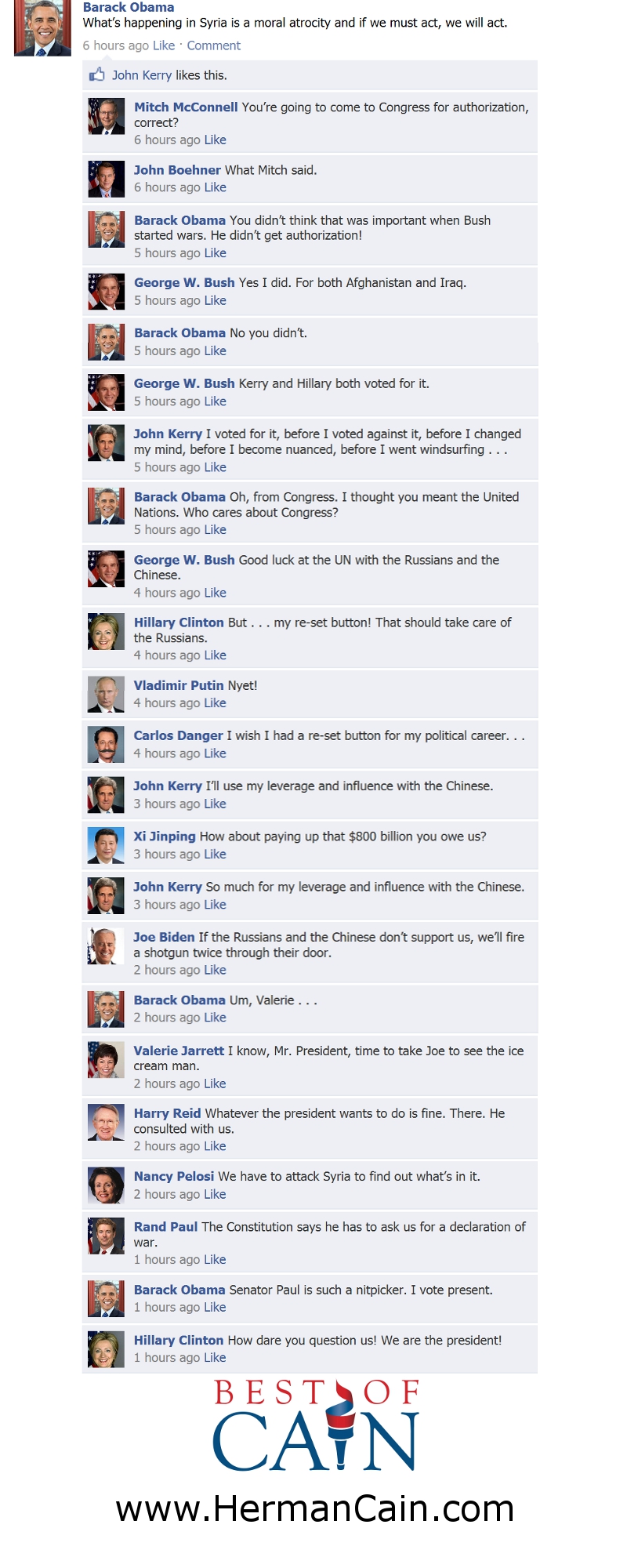
Cain - Facebook posts on Syria

August 14, 2013

The “Indie Web” is the very definition of a fringe project

Filed under: Media, Technology — Tags: , , , , , — Nicholas @ 08:55

Wired‘s Klint Finley wants you to meet the indie hackers who want to jailbreak the internet (among other things):

One guy is wearing his Google Glass. Another showed up in an HTML5 t-shirt. And then there’s the dude who looks like the Mad Hatter, decked out in a top hat with an enormous white flower tucked into the brim.

At first, they look like any other gaggle of tech geeks. But then you notice that one of them is Ward Cunningham, the man who invented the wiki, the tech that underpins Wikipedia. And there’s Kevin Marks, the former vice president of web services at British Telecom. Oh, and don’t miss Brad Fitzpatrick, creator of the seminal blogging site LiveJournal and, more recently, a coder who works in the engine room of Google’s online empire.

Packed into a small conference room, this rag-tag band of software developers has an outsized digital pedigree, and they have a mission to match. They hope to jailbreak the internet.

They call it the Indie Web movement, an effort to create a web that’s not so dependent on tech giants like Facebook, Twitter, and, yes, Google — a web that belongs not to one individual or one company, but to everyone. “I don’t trust myself,” says Fitzpatrick. “And I don’t trust companies.” The movement grew out of an egalitarian online project launched by Fitzpatrick, before he made the move to Google. And over the past few years, it has roped in about 100 other coders from around the world.


August 12, 2013

Online privacy and habitual oversharing

Filed under: Liberty, Media, Technology — Tags: , , , , — Nicholas @ 09:47

Cory Doctorow explains why so many of us have gotten into the habit of oversharing personal details in our social media activities:

Whenever government surveillance is debated, someone inevitably points out that it is no cause for alarm, since people already overshare sensitive personal information on Facebook. This means there’s hardly anything to be gleaned from state surveillance that isn’t already there for the taking on social media.

It’s true people overshare on social networks, providing information in ways that they later come to regret. The consequences of oversharing range widely, from losing a job to being outed for your sexual orientation. If you live in a dictatorship, intercepted social media sessions can be used by those in charge to compile enemies lists, determining whom to arrest, whom to torture, and – potentially – whom to murder.

The key reason for oversharing is that cause and effect are separated by volumes of time and space, so understanding the consequences can be difficult. Imagine practising penalty kicks by kicking the ball and then turning around before it lands; two years later, someone visits you and tells you where your kicks ended up. This is the kind of feedback loop we contend with when it comes to our privacy disclosures.

In other words, you may make a million small and large disclosures on different services, with different limits on your sharing preferences, and many years later, you lose your job. Or your marriage. Or maybe your life, if you’re unlucky enough to have your Facebook scraped by a despot who has you in his dominion.

June 30, 2013

Social media marks the end of the red carpet

Filed under: Media, Technology — Tags: , , , — Nicholas @ 00:01

In Reason, Nick Gillespie gets to the root of Alec Baldwin’s problem with social media:

In an interview with Gothamist, the talented actor and annoying loudmouth inadvertently lays bare the real online dynamic behind his anger with new media — and it has less to do with factually incorrect journalism than you might think.

Baldwin’s real issue with new media — he slags Tumblr, Vine, MySpace, Facebook, and more — is that they level kings and queens and even celebrities into a mosh pit of direct, unmediated exchange that is hard as hell to control. It turns out that there’s really no red carpet or champagne room when it comes to the way that stars (read: world leaders, sitcom heroes, famous authors, former child actors, you name it) are treated.

In the Q&A, Baldwin says,

    Twitter began for me as a way to bypass the mainstream media and talk directly to my audience and say, “hey here’s a show I’m doing, here’s something I’m doing.”… But I realized it’s something I’m not really… it certainly isn’t worth the trouble. Rosie O’Donnell is on my podcast this week, and she said that she’s getting off of Twitter, and I said “God, I was thinking the same thing.” I said “you just end up absorbing so much hatred.” You get these body blows of all this hatred from people who… their profiles are almost identical, like “tea party mom, I love my job, I love my kids, I love my country #millitary #guns” and there’s a screaming eagle in the background of their profile, grasping some arrows and tanks rolling in the background and they all want to tell me how much they can’t stand my politics. And I go, “OK.” What kills me is these are people who want to put me out of business, so to speak, as fast as they possibly can, but they don’t want to put BP out of business, who turned the Gulf of Mexico into a cesspool….

Baldwin sputters that the very tools he can use to bypass “the mainstream media and talk directly” to his audience also empowers all those dim people out there in the dark. What’s more, his followers have minds of their own. They may enjoy his turns in Glenngarry Glenn Ross and 30 Rock and guest-hosting on Turner Classic Movies but not really find his views on fracking to be worth a damn. It’s a real kick in the pants for a celebrity to be reduced to asking, “Do you think I’m really changing anybody’s mind?”

[. . .]

Reading Baldwin’s comments, I’m struck by how his comments strongly vindicate what we’ve been stressing at Reason since the dawn of the Internet Age: That the audience has a mind of its own that it’s always been dying to express. What’s different now is that we can. Baldwin’s complaint that “there’s no journalism anymore” (except for the people he likes) and his attack on “tea party moms” who thrill to see the Gulf of Mexico foam with oil are best understood as howls of rage from the ancien regime as new-media sans-culottes storm the gates of privilege and power. Being in charge — of government, of media, of art, of business, of religion — just ain’t what it used to be.

Given his temperament and the massive amount of abuse he seems to have taken, Baldwin’s probably right to vacate Twitter and other forums that allow direct, unmediated access to him. That’s his right to exercise. But among the costs he and other powerful people — pols, pashas, pundits, etc. — will bear is lack of engagement with exactly where the world is literally and figuratively trending.

« Newer PostsOlder Posts »

Powered by WordPress