
For as much shit as I give them — and as much as they deserve it — I can forgive The Boomers quite a bit. In all previous history, having your entire world accommodate itself to your every whim was a privilege reserved for the more puissant monarchs of the bigger kingdoms. But starting about 1963, American life completely recalibrated itself around the passing fancies of ordinary suburban kids.
That has to mess with your head a bit.
In the same way, no previous generation had ever seen their youth commercialized and sold back to them in middle age, and that’s what messed with our heads. The passing fancies of those ordinary suburban kids in 1963 all involved sex, drugs, and rock ‘n’ roll. We — Gen X — wanted those things too, but since by definition nothing is lamer than your parents, we had to be all, like, you know, whatever about it.
If you can grok the concept of a 45 year old telling you — with complete, almost heartbreaking sincerity — not to trust anyone over 30, you can grok the 1990s.
If you can’t, I don’t recommend trying. It’s like an anti-koan — if you solve it, you’ll achieve a lower consciousness. But if you’re determined to experience it, get really, really, really drunk and watch Forrest Gump a few times back to back. Really experience it as a work of art … because it is. It’s meticulously constructed. Forrest Gump is a mildly retarded man who stumbles, through dumb fucking luck, into fame and fortune through every significant event of the last half century. (He even has a huge dick, although that’s a detail from the source novel that got left on the cutting room floor).
Is there any more perfect metaphor for My G-G-Generation than that?
That’s what we grew up with. That whole generation was what some wag said about George Bush the First: Born on third base, thinking he hit a triple. And, of course, by merciless application of cold logic: that was also us. The only difference was that while the Boomers were congenitally incapable of seeing it, we were congenitally incapable of getting over it. So, you know, like, whatever.
Severian, “A Meta-Review”, Founding Questions, 2022-02-24.
June 4, 2022
QotD: A smidgen of forgiveness for the Boomers
June 1, 2022
QotD: Spartiate Women
Sparta has obtained a reputation in the popular culture – derived from the sources – for affording a greater degree of freedom and importance to its women than any other Greek polis (I should stress this is a very low bar) and, so long as we are talking about spartiate women there is some truth to this.
Spartiate girls went through a similar “rearing” to spartiate boys, although they were not removed from the home as their brothers were. Spartiate girls ran races and were encouraged to be physically active (Plut. Lyk. 14.3; Mor. 227; Xen. Lac. 1.4). The evidence is thin, but points fairly strongly to the suggestion that spartiate women were generally literate, in quite the contrast (again, as the evidence permits) to the rest of Greece. Now our sources make clear that this is in part a product of the leisure that spartiate women had, since the primary domestic tasks of Greek women – textile manufacture and food preparation – were done entirely by slave labor forced upon helot women (Xen. Lac. 1.3; Plato, Laws. VII; Plut. Mor. 241d).
Whereas the sources paint a portrait of elite citizen Athenian women as practically cloistered, spartiate women had significantly more freedom of movement, in part because they appear to have been the primary managers of their households. Male spartiates didn’t live at home until thirty and were likely frequently away even after that (Plut. Lyc. 14.1; Mor. 228b). Spartiate women could also inherit and hold property in their own name to a greater degree than in Athens or elsewhere in Greece (note for instance Plut. Agis 7.3-4). The strong impression one gets from the sources is that this gave spartiate women quite a bit more sway; our largely male sources, especially Aristotle, disapprove, but we don’t need to (and shouldn’t!) share their misogyny. The sources are also very clear that spartiate women and girls felt much freer to speak their minds in public than Greek women in most poleis, although they were still completely and universally excluded from formal politics.
But – and you knew there would be a but (surprise! there are two) – but the role of women in Spartan society as we can observe it remains fundamentally instrumental: in the Spartan social order, spartiate women existed to produce spartiate boys. The exercise that spartiate girls undertook was justified under the assumption that it produced fitter (male) children (Plut. Lyc. 14.2; Xen. Lac. 1.4). Plutarch implies that the age of marriage for spartiate women was set in law, though generally older than in the rest of Greece (Plut. Lyc. 15.3; Mor. 228a).
Spartiate women appear to have had no more say in who they married than other Greek women, which is to say effectively none. Marriages seem to have been arranged and the marriage ceremony itself as it it related to us was a ritualized abduction (Plut. Lyc. 15.3-5; Hdt. 6.65) without even a fig-leaf of (largely illusory) consent present in some other ancient marriage rituals. Husbands apparently also “lent out” their wives to other spartiate men (Plut. Lyc 15.7; Xen. Lac. 1.7-8); descriptions of this passage stress the consent of the men involved, but completely omit the woman’s consent, although Xenophon implies that the woman involved will “want to take charge of two households” and thus presumably be in favor; I have my doubts.
Everything we have about the Spartans (honestly, just read Plutarch’s Sayings of Spartan Women, but also Xen. Lac. 1.4, 7-8, Plut. Lyc. 15, etc.) reinforces the impression that spartiate women were viewed primarily as a means towards producing spartiate boys. Gorgo’s retort that spartiate women “are the only women that are mothers of men” (Plut. Mor. 240e), her husband’s command that she in turn (when he died), “Marry a good man and bear good children” (Plut. Mor. 240e), the anonymous spartiate woman who shames an Ionian woman for being good at weaving because raising children “should be the employments of the good and honorable woman” (Plut Mor. 241d) and on and on. Most of the sayings that don’t involve the bearing of children, either involve spartiate women being happy that their sons died bravely, or disowning them for not doing so.
Now, there is a necessary and very important caveat here: this is the role of spartiate women as viewed by men. It is striking that the one of the largest things we can be reasonable sure that spartiate women did do – they seem to have had the full management of the household most of the time – doesn’t figure into these sayings or our sources hardly at all (save, to a degree, to Aristotle’s polemic in Book 2 of the Politics). We should not be surprised that our – elite, aristocratic and exclusively male sources pick out the roles that seem most important to them. The average spartiate woman may well have felt differently – for my part, I can hardly imagine many spartiate mothers were overjoyed to hear their sons had fallen in battle, whatever brave face they put on in polite society. And I have to imagine that many spartiate women were likely shrewd managers of their households, and probably took some pride in that skill.
All of that said, I think it is fair to say that, on the whole, spartiate women seem to have had a relatively better condition than free citizen women in other poleis in Greece. Where they were sharply constrained – and to be clear, by modern standards, spartiate women were still very sharply constrained – they were constrained in ways that were mostly typical in Greek society. Quite frankly, ancient Greek poleis did quite poorly by their women, even by the low, low standards of other pre-modern societies. But given that low bar, the life of spartiate women does seem quite a bit better and our sources reflect this fairly openly.
But – and this is the other “but” I alluded to above – a huge part of this is that spartiate women were freed from the demand to do hours and hours of difficult labor preparing and serving food and producing textiles. And here we circle back to last week’s problem: spartiate women probably represented around 6% of Spartan (including the helots) women. If we want to talk about the condition of women in Sparta, we need to talk about helot women.
Bret Devereaux, “Collections: This. Isn’t. Sparta. Part III: Spartan Women”, A Collection of Unmitigated Pedantry, 2019-08-29.
May 31, 2022
The Crusades: Part 9 – The Other Crusades
seangabb
Published 18 Mar 2021The Crusades are the defining event of the Middle Ages. They brought the very different civilisations of Western Europe, Byzantium and Islam into an extended period of both conflict and peaceful co-existence. Between January and March 2021, Sean Gabb explored this long encounter with his students. Here is one of his lectures. All student contributions have been removed.
(more…)
May 30, 2022
Technocratic meddling in developing countries at the local level
One of the readers of Scott Alexander’s Astral Codex Ten has contributed a review of James Ferguson’s The Anti-Politics Machine. The reviewer looked at a few development economics stories that illustrate some of the more common problems western technocrats encounter when they provide their “expert advice” to people in developing countries. This is one of perhaps a dozen or so anonymous reviews that Scott publishes every year with the readers voting for the best review and the names of the contributors withheld until after the voting is finished:

But even if the project was in some sense a “failure” as an agricultural development project, it is indisputable that many of its “side effects” had a powerful and far-reaching impact on the Thaba-Tseka region. […] Indeed, it may be that in a place like Mashai, the most visible of all the project’s effects was the indirect one of increased Government military presence in the region
As the program continued to unfold, the development officials became more and more disillusioned — not with their own choices, but with the people of Thaba-Tseka, who they perceived as petty, apathetic, and outright self-destructive. A project meant to provide firewood failed because locals kept breaking into the woodlots and uprooting the saplings. An experiment in pony-breeding fell apart when “unknown parties” drove the entire herd of ponies off of cliffs to their deaths. Why, Ferguson’s official contacts bemoaned, weren’t the people of Thaba-Tseka committed to their own “development”?
Who could possibly be opposed to trees and horses? Perhaps, the practitioners theorized, the people of Thaba-Tseka were just lazy. Perhaps they “didn’t want to be better”. Perhaps they weren’t in their right mind or had made a mistake. Perhaps poverty makes a person do strange things.
Or, as Ferguson points out, perhaps their anger had something to do with the fact that the best plots of land in the village had been forcibly confiscated to make room for wood and pony lots, without any sort of compensation. The central government was all too happy to help find land for the projects, which they took from political enemies and put in the control of party elites, especially when it could use a legitimate anti-poverty program as cover. In Ferguson’s words, the development project was functioning as an “anti-politics machine” the government could use to pretend political power moves were just “objective” solutions to technical problems.
A local student’s term paper captured the general discontent:
In spite of the superb aim of helping the people to become self-reliant, the first thing the project did was to take their very good arable land. When the people protested about their fields being taken, the project promised them employment. […] It employed them for two months, found them unfit for the work, and dismissed them. Without their fields and without employment they may turn up to be very self-reliant. It is rather hard to know.
Two things stand out to me from this story. First, the “development discourse” lens served to focus the practitioners’ attention on a handful of technical variables (quantity of wood, quality of pony), and kept them from thinking about any repercussions they hadn’t thought to measure.
This is a serious problem, because “negative effects on things that aren’t your primary outcome” are pretty common in the development literature. High-paying medical NGOs can pull talent away from government jobs. Foreign aid can worsen ongoing conflicts. Unconditional cash transfers can hurt neighbors who didn’t receive the cash. And the literature we have is implicitly conditioned on “only examining the variables academics have thought to look at” — surely our tools have rendered other effects completely invisible!
Second, the project organizers somewhat naively ignored the political goals of the government they’d partnered with, and therefore the extent to which these goals were shaping the project.
Lesotho’s recent political history had been tumultuous. The Basotho Nationalist Party (BNP), having gained power upon independence in 1965, refused to give up power after losing the 1970 elections to the Basotho Congress Party (BCP). Blaming the election results on “communists”, BNP Prime Minister Leabua Jonathan declared a state of emergency and began a campaign of terror, raiding the homes of opposition figures and funding paramilitary groups to intimidate, arrest, and potentially kill anyone who spoke up against BNP rule.
This had significant effects in Thaba-Tseka, where “villages […] were sharply divided over politics, but it was not a thing which was discussed openly” due to a fully justified fear of violence. The BNP, correctly sensing the presence of a substantial underground opposition, placed “development committees” in each village, which served primarily as local wings of the national party. These committees spied on potential supporters of the now-outlawed BCP and had deep connections to paramilitary “police” units.
When the Thaba-Tseka Development Project started, its international backers partnered directly with the BNP leadership, reasoning that sustainable development and public goods provision could only happen through a government whose role they primarily viewed as bureaucratic. As a result, nearly every decision had to make its way through the village development committees, who used the project to pursue their own goals: jobs and project funds found their way primarily to BNP supporters, while the “necessary costs of development” always seemed to be paid by opposition figures.
The funding coalition ended up paying for a number of projects that reinforced BNP power, from establishing a new “district capital” (which conveniently also served as a military base) to constructing new and better roads linking Thaba-Tseka to the district and national capitals (primarily helping the central government tax and police an opposition stronghold). Anything that could be remotely linked to “economic development” became part of the project as funders and practitioners failed to ask whether government power might have alternate, more concerning effects.
As we saw earlier, the population being “served” saw this much more clearly than the “servants”, and started to rebel against a project whose “help” seemed to be aimed more at consolidating BNP control than meeting their own needs. When they ultimately resorted to killing ponies and uprooting trees, project officials infatuated with “development” were left with “no idea why people would do such a thing”, completely oblivious to the real and lasting harm their “purely technical decisions” had inflicted.
May 28, 2022
Morality is Dead. Hollywood Killed It.
Foundation for Economic Education
Published 27 May 2022What’s with all the nihilistic, amoral, dark anti-hero leads in movies and shows? Are we supposed to treat horrible characters as pinnacles of human behavior now?
The bleak content that’s crept its way mainstream over the last 10 years should concern us all. The stories we tell matter, for they influence what we believe and what values we adopt.
Fortunately, a renewed appreciation for natural rights and individualism could be the antidote to the immense darkness that’s blanketed American culture as of late. That’s what we’ll get down to on this feature episode of Out of Frame.
______________________________
FOLLOW/SUPPORT US:Support Out of Frame on Patreon or SubscribeStar:
https://www.patreon.com/OutofFrameShow
https://www.subscribestar.com/outoffr…Join our Discord: https://discord.gg/RKc4AcGQ9k
Sign up for our mailing list and never miss an episode again:
https://fee.org/oof-newsletterCheck out our podcast, Out of Frame: Behind the Scenes: https://www.youtube.com/channel/UCiS5…
Follow us EVERYWHERE!
https://linktr.ee/outofframefee
______________________________
CREDITS:
Written by Sean W. Malone
Produced by Sean W. Malone
Edited by Michael Ozias
Asst. Edited by Abby Richardson

May 27, 2022
The cognitive dissonance of the elites
Chris Bray on yet another example of our kakistocrats congratulating themselves after presiding over failure:
[Los Angeles County Public Health Director Barbara] Ferrer is a relentless and enthusiastic interventionist, one of the highest-profile lockdowners and mask fetishists in the country, and here she is still wearing a mask — in the third year of a pandemic that hasn’t been ended by the widespread mask-wearing that has prevailed, and still largely prevails, in Los Angeles. Do X to cause Y, she says, doing X for a third straight year but still rather obviously not causing Y. Again, here’s Ferrer’s chart showing the effect of her bold public health interventions:
You can really see how that infections trendline came right down as Barbara Ferrer boldly threw herself in front of the virus.
But here’s the part that I find most telling: After Ferrer offers a long presentation on mitigations showing clearly that they haven’t worked as advertised, and after she says repeatedly and explicitly that the available Covid-19 vaccines “don’t work so great at preventing infection”, and that vaccinated people will be infected, Ferrer sits down for a discussion with several members of an expert panel. One of the panelists is Michele Kipke, a psychology PhD who serves as a clinical professor at USC and the vice-chair of research at Children’s Hospital Los Angeles (and as a school board member in my own small town in the suburbs). Having heard repeated statements about the unmistakably limited effectiveness of the available Covid-19 vaccines, Kipke offers this as a question:
“So, first of all, I just need to say, it is such an honor to be on the same stage with you. Barbara, you are my hero, and I am so glad that you have been our leader through these extremely difficult two years. So thank you.” And then there’s a long round of applause from the panel and the audience. You can just feel the scholarly skepticism and clinical rigor in that auditorium. This, ladies and gentlemen, is obviously the room where the tough questions are asked.
And then she goes on: “And so, as I think about this, I’ve really been asking the questions, what are, just picking up on the, I think, the discussion here, what are those lessons learned? There are, you know, sort of obviously a very difficult couple of years, but we’ve seen some really phenomenal successes that have come out of the last couple years. As Dr. Hu mentioned earlier, I had the good fortune of being a part of leading Vaccinate L.A., where we brought fourteen schools and programmatic units within USC together, and all harmonized our efforts, to get out there and support our communities, and to think about how to support vaccinations. And we engaged local artists. We — it was a community driven initiative, we wanted to listen and learn from the community, and then partner with them …”
And so on, but you get the point. “But through that work we’ve achieved so much,” she eventually says. The video is cued to the start of her “question”, if you want to see it all, but her question, in short, is, Why, in your view, did we do such an amazing job? Pivoting from Ferrer’s extremely open and direct discussion about the obvious limits of the vaccines — again, that actual direct quote is, “Vaccinated people are very likely to get infected” — Kipke asks about the success of the vaccination program.

May 24, 2022
QotD: Portuguese art and creative genius
Then the economy recovered, they got jobs, a lot of them connected to or linked to government and all of that stopped. And of course with the EU there are no illegal stalls. I mean Papiere, bitte and all that.
And somehow, perhaps because the new generation knows they have all sorts of “benefits” and “support” coming to them and have never felt the bite of chaos, the crafts and arts in the stores are either startlingly mundane or bizarre. I’m still rather puzzled by entire “scenes from life” (including one that was an operating room) sculpted with penises instead of humans. I mean … who even buys that? Okay. We know who buys that. But do the German tourists and their nostalgie de la boue think they’re tapping into something uniquely “uninhibited and free”, some kind of wild Portuguese sexuality? Raises eyebrow. The Portuguese have been civilized land long before the Germans traded their furs for a place as Roman soldiers. And sure, the Romans could be startlingly and inappropriately sexual (I call to mind a mural, not out of place in a Roman middle class home that had monkeys copulating with children) but it didn’t mean that the culture was “free”, rather that they had different rules. Frankly, the sixties attempt to erase history has corrupted real art and … well, everything else.
Which is kind of the college student thing. Chaos and free time allows you to be very creative, but then you’re not organized enough to parlay that into a career. (I mean, if they’re destined to be the touristic “warm port” of Europe, perhaps they should consider letting real art flourish. Or even encouraging it. Grants for small businesses and young people. It beats the jobs that don’t exist. Just demand they be actually creative and accomplished, instead of giving grants for art that my kids could do at age two and about as interesting.
Sarah Hoyt, “The Ancient Enemy”, According to Hoyt, 2019-04-05.
May 17, 2022
Mary Whitehouse, “The avenging angel of Middle England”
At First Things, Jonathon Van Maren considers the legacy of Mary Whitehouse, the often mocked champion of public decency and crusader against pornography and blasphemy in the media from the mid-60s onwards:

I was surprised to find few public domain images of Mary Whitehouse available, so here is a selection of thumbnails (hopefully this won’t violate any copyright restrictions)
We have reached the point where our post-Christian elites, having safely enshrined the sexual revolution in law, can afford the luxury of occasionally admitting that their opponents were right. Exhibit A is the new BBC documentary Banned! The Mary Whitehouse Story, which details the life of Great Britain’s most infamous morality campaigner. Beginning with a crusade to keep smut and blasphemy off TV in 1964, Whitehouse rallied hundreds of thousands of women (and ordinary Britons) to her campaigns against “the permissive society”, culminating in her war against the porn industry. Alas, she lost most of her battles — but her warnings proved prophetic.
Mary Whitehouse was born in Warwickshire in 1910. She first started organizing in the 1960s because she — and millions of other mothers — did not like what her children were seeing on TV. A committed traditional Christian, she watched with dismay as the country she loved began to change around her. The metropolitan elites she faced off with thought she was “a provincial Birmingham housewife”. They didn’t underestimate her for long. She hosted her first mass meeting in 1964, and her organizing skills soon highlighted the subterranean power of Britain’s women. Whitehouse tapped into the gardening associations, the mothers’ unions, and other grassroots community organizations filled with folks who cared deeply about their children and the moral fabric of their nation. She brought them together, and when she spoke, it was with the voices of legions of little people. Her nickname summed it up: “The avenging angel of Middle England”.
Whitehouse’s first major campaign was to “Clean Up TV”, and her parliamentary petition to that end garnered around 500,000 signatures. In 1971, Whitehouse began organizing against sex ed in schools, triggered by an “educational” video she saw that was filled with pornographic scenes. Whitehouse was accused of hysteria — but Banned! features a pornographer admitting that, by using sex ed, “we gradually pushed back the barriers”, much as Whitehouse warned they would. Now that they’ve won, they can admit they were lying.
Whitehouse and others appalled by attempts to corrupt their children were accused of being “horrified by sex”. In reality, they were horrified by the version of sex presented by sex educators — in much the same way an art lover would be appalled to see vandals approaching a great masterpiece with cans of spray-paint and lewd laughter. Progressives never understood this, and consequently Whitehouse has been almost entirely defined by what she fought against rather than what she fought for.
Whitehouse’s lobbying resulted in several pieces of legislation, including the 1981 Indecent Displays Act, which sought to restrain sex shops and the display of porn, as well as the 1984 Video Recordings Act, intended to limit the sale of extreme video content. Unfortunately, these acts were rendered moot by the internet. But her greatest achievement was the 1978 Protection of Children Act, which criminalized child pornography. It seems remarkable that such a law did not already exist, but in the ’70s the Paedophile Information Exchange (PIE) was operating openly in Britain; it was supported by some British elites who believed that sex with children was the natural next step in sexual liberation.
May 16, 2022
QotD: The difference between surface meaning and actual intent
Tim Worstall, “That Chinese ‘BreedReady’ Database – Check The Translation”, Continental Telegraph, 2019-03-11.
May 14, 2022
Nostalgia for the Middle Ages?
In Wrong Side of History, Ed West considers the apparent rising interest in Europe’s Middle Ages and Renaissance in popular culture:
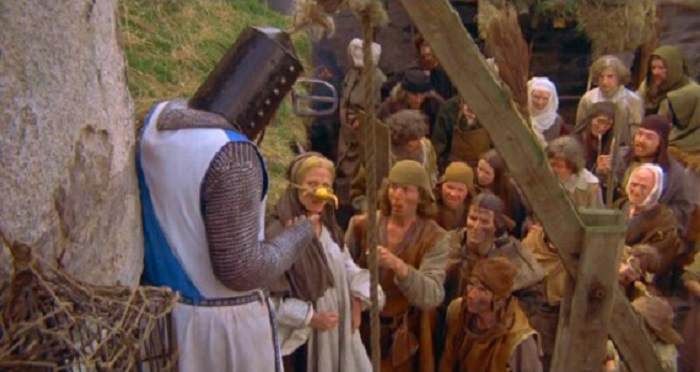
A social media heretic faces trial
The genre has been aided by developments in cinematic technology, allowing the sort of special effects that made such productions in the 1980s and 90s somewhat ridiculous. But there may be deeper cultural significance to this medieval revival, and it is one that evokes a strange discomfort in many people. Because, while the academic field of medieval studies has become a branch of progressive theology, medievalism as expressed through popular culture feels much more conservative, and to some minds, even fascistic. At the very least, it is “Right-coded”.
This discomfort often flares up whenever a new film or series attempts to capture our imagination, voiced in comment pieces warning us that they might be popular for the wrong reasons, among unsavoury elements.
This is what happened with Viking epic The Northman, despite director Robert Eggar’s impeccably progressive politics. “The Northman‘s 10th-century society appears to be uniformly white and firmly divided along patriarchal lines,” The Guardian warned: “Men do the ruling and killing; women do the scheming and baby-making. Its hero, played by Alexander Skarsgård, is not a million miles from the ‘macho stereotype’ Eggers complained of – a brawny warrior who settles most disputes with a sword and without a shirt. Skarsgård’s love interest, played by Anya Taylor-Joy, could be the far-right male’s dream woman: beautiful, fair-haired, loyal to her man and committed to bearing his offspring. Even before the film’s release, far-right voices were giving their approval on the anonymous message board site 4chan.”
Wow, expressing approval of a beautiful, fair-haired woman who wants to settle down and have your children? Better call Prevent!
According to a piece in the Economist, the new fixation with the Middle Ages dates to the September 11 attacks, when “the American far right … developed a fascination with the Middle Ages and the Renaissance — in particular, with the idea of the West as a united civilisation that was fending off a challenge from the East …
“The embrace of the medieval extends from the alt-right online forum culture that has exploded in the last few years to stodgier old-school racists. Helmeted crusaders cry out the Latin war-cry ‘Deus vult!’ from memes circulated on Reddit and 4Chan. Images of Donald Trump, clad in mail with a cross embroidered on his chest, abound. Anti-Islam journals and websites name themselves after the Frankish king Charles Martel, who fought Muslim armies in the 8th century, or the (slightly post-medieval) Ottoman defeat at Vienna.”
This concern is real enough that I’ve noticed a trend for medieval historians to introduce their books with what might be best described as health warnings, lest they be enjoyed in the wrong way. Neil Price’s The Children of Ash and Elm, for instance, comes with a declaration of values in the introduction:
Over the centuries, a great many people have eagerly pressed the Vikings into (im)moral service, and others continue to do so… I strongly believe that any meaningful twenty-first-century engagement with the Vikings must acknowledge the often deeply problematic ways in which their memory is activated in the present …
The Viking world this book explorers was a strongly multi-cultural and multi-ethnic place, with all this implies in terms of population movement, interaction (in every sense of the word, including the most intimate), and the relative tolerance required. This extended far back into Northern prehistory. There was never any such thing as a “pure Nordic” bloodline, and the people of the time would have been baffled by the very notion. We use “Vikings” as a consciously problematic label for the majority population of Scandinavia, but they also shared their immediate world with others – in particular, the semi-nomadic Sami people. Their respective settlement histories stretch so deeply into the Stone Age past as to make any modern discussion of “who came first” absurd. Scandinavia had also welcomed immigrants for millennia before the Viking Age, and there is no doubt that a stroll through the market centres and trading places of the time would have been a vibrantly cosmopolitan experience.
Well, I won’t be recommending Mr Price’s book to my friends at 4Chan, I can tell you that.
May 3, 2022
England’s class system, as documented by George Orwell and Theodore Dalrymple
I occasionally run into articles online that are clearly written to interest someone like me, and this one in Quillette by Laurie Wastell had my full attention from the title onward:

Ever since Marx, the concept of class has been foundational to sociology — as well as to almost everything else. This would not have surprised the German economist, for class, as he saw it, determines all: one’s motivations, one’s social position, even one’s consciousness. Britain, where Marx’s Capital was written, has long been known for its intricate class system, and as such is the source of much writing on the subject. Two of the most acerbic English social critics of the past century, George Orwell and Theodore Dalrymple, take class as a central subject. Drawing on firsthand experience (Orwell as a journalist, Dalrymple as a prison doctor and psychiatrist), both document in detail the suffering and privations of the class below them. Both also contend that a central cause of this poverty is the indifference of the middle and upper classes, a conclusion Marx would surely have agreed with. Yet, despite this, their work stands in flat contradiction to Marx’s central dogma that the material conditions of a society determine everything about it, including class. In their literary journalism, the authors’ social commentaries and insights into the human condition far surpass Marx’s “scientific” analysis.
[…]
That class is a function more of outlook than income was clear to Orwell, as he explains in his 1937 book The Road to Wigan Pier, which depicts both the privations of working-class life and the British class system as a whole. Orwell describes how the “lower-upper-middle-class” (Orwell’s own), generally professionals in the “Army, Navy, Church, Medicine [or] Law”, understood and aspired to all the many customs of the upper classes (hunting, servants, how to order dinner correctly) despite never being able to afford them. Thus, “To belong to this class when you were [only] at the £400 a year level was a queer business, for it meant that your gentility was almost purely theoretical.” This same dynamic applies today (though the bourgeois values aspired to now are quite different): a poor librarian is far less likely than a wealthy plumber to have voted for causes like Brexit or Trump, which are both populist and, thus, lower-class.
Themselves men of letters, both Orwell and Dalrymple understand that this class distinction is frequently signalled through language. “As for the technical jargon of the Communists,” writes Orwell, “it is as far removed from the common speech as the language of a mathematical textbook.” Such contorted academic prose means little to the ordinary worker, for whom, Orwell argues, Socialism simply means “justice and common decency”. Indeed, Orwell laments that “the worst advertisement for Socialism is its adherents” because of their distance from everyday concerns and inability to speak plainly. Summarising the problem, he quips: “The ordinary man may not flinch from a dictatorship of the proletariat, if you offer it tactfully; offer him a dictatorship of the prigs, and he gets ready to fight”.
A lifelong socialist, Orwell was repeatedly frustrated by the symptoms of this intellectual snobbery — why do the revolutionaries have such disdain for the ordinary punter? Dalrymple, meanwhile, in his essay “How — and How Not — to Love Mankind”, takes aim at its roots. Here, Dalrymple compares the life and work of Marx to his now lesser-known contemporary, Russian novelist and playwright Ivan Turgenev. Though their lives closely resembled one another’s, Dalrymple argues, “They nevertheless came to view human life and suffering in very different, indeed irreconcilable, ways — through different ends of the telescope, as it were. Turgenev saw human beings as individuals always endowed with consciousness, character, feelings, and moral strengths and weaknesses. Marx saw them always as snowflakes in an avalanche, as instances of general forces, as not yet fully human because utterly conditioned by their circumstances.”
[…]
Both writers criticise intellectuals’ pretentious jargon, but it is worth pausing over how each relates his own social position to their subject matter. In a telling passage of Wigan Pier, Orwell describes the working man who has made it into the middle class, perhaps as a Labour MP or trade union official, as “one of the most desolating spectacles the world contains. He has been picked out to fight for his mates, and all it means to him is a soft job and a chance of ‘bettering’ himself. Not merely while but by fighting the bourgeoisie he becomes bourgeois himself.” The scare quotes reflect Orwell’s mixed feelings about social class: does Orwell not believe that a middle-class career — such as his own — is an improvement over the harsh, backbreaking labour of the miners he so vividly documents? He has hit on a deep dilemma, born of a compassionate humanism that points in contradictory directions.
Ostensibly, Orwell chronicles poverty in order to change it, to shock the comfortable hearts of his readers into action. Yet, at the same time, (romanticising the poor against his own advice), he presents the dirt as liberating: squalor and poverty are in some sense more authentic, more real than bourgeois comforts. Thus, as literary critic John Carey argues, Orwell’s “phobia about lower-class dirt collides head-on with his determination to invest dirt with political value, as the price of liberty.”
April 30, 2022
QotD: The position of helots in Spartan society
We are very poorly informed about the helots. Our snobbish sources … are, for the most part, singularly uninterested in them, so we’re left putting together a patchwork of information. That in turn leads into situations where students of ancient Greece can can up with the wrong impression if they don’t have all of the sources in mind (we’ll see this is a common trend with Sparta – reading just Xenophon or just Plutarch can be deeply misleading).
First, let us dispense with the argument, sometimes offered, that the helots were more like medieval serfs than slaves as we understand the ideas and thus not really slaves – this is nonsense. Helots seem to have been able to own moveable property (money, clothing etc), but in fact this is true of many ancient slaves, including Roman ones (the Romans called this quasi-property peculium, which also applied to the property of children and even many women who were under the legal power (potestas) of another). Owning small amounts of moveable property was not rare among ancient non-free individuals (or, for that matter, other forms of slavery).
No, what legally separated helots from douloi (chattel slaves in most Greek societies) was that they were slaves of the Spartan state rather than of individual Spartans – this had nothing to do with any sense of greater freedom they might have had. Indeed, Plutarch relates the saying that “in Sparta the free man is more free than anywhere else in the world, and the slave more a slave” (Plut. Lyc. 28.5). He can only be referring to the helots here. Indeed, Plutarch’s statement is telling – the helots were treated poorly by the standards of ancient chattel slavery, which is, I must stress, an incredibly low bar. Ancient societies treated enslaved people absolutely horribly and yet somehow the helot lot was commonly thought worse.
But the final word on if we should consider the helots fully non-free is in their sanctity of person: they had none, at all, whatsoever. Every year, in autumn by ritual, the five Spartan magistrates known as the ephors declared war between Sparta and the helots – Sparta essentially declares war on part of itself – so that any spartiate might kill any helot without legal or religious repercussions (Plut. Lyc. 28.4; note also Hdt. 4.146.2). Isocrates – admittedly a decidedly anti-Spartan voice – notes that it was a religious, if not legal, infraction to kill slaves everywhere in Greece except Sparta (Isoc. 12.181). As a matter of Athenian law, killing a slave was still murder (the same is true in Roman law). One assumes these rules were often ignored by slave-holders of course – we know that many such laws in the American South were routinely flouted. Slavery is, after all, a brutal and inhuman institution by its very nature. The absence of any taboo – legal or religious – against the killing of helots marks the institution as uncommonly brutal not merely by Greek standards, but by world-historical standards.
We may safely conclude that the helots were not only enslaved persons, but that of all slaves, they had some of the fewest protections – effectively none, not even protections in-name-only.
But what do the helots do?
The answer is mostly “they farm” but getting more specific than that get sticky fast. But we may try to keep this brief: helots were enslaved agricultural laborers. Helots were owned not by individual spartiates, but by the Spartan state, where they were assigned – through whatever method we do not know – to work the plots of land (kleroi, see above) assigned to the spartiates who, as noted above, were forbidden from engaging in any kind of productive labor. The helots seem to have lived in their own villages and settlements – no great surprise, as the Messenian helots seem to have been far more numerous than the Laconian ones and the spartiates themselves did not live in Messenia in any great numbers. It does seem that the Messenian helots were gathered in a smaller number of nucleated villages rather than split up as farmsteads, probably to make it easier for the small number of spartiates stationed there to keep watch on them. And they seemed to have produced not only simple cereal staples, but the full range of agricultural products: wheat (Xen Lac. 5.3 – we’ll come back to this), barley, grapes and wine, figs, olives and olive oil, cheese, textiles (wool) and animal products, including meat and fish.
Bret Devereaux, “Collections: This. Isn’t. Sparta. Part II: Spartan Equality”, A Collection of Unmitigated Pedantry, 2019-08-23.
April 27, 2022
“We’re healthy from the bottom up, and sick from the top down.”
Chris Bray has a bit of fun at David French’s expense:
In the 1830s, British merchants with trade routes from India had forced open an enormous market for opium in China, and were pouring the product into the country, producing a lucrative addiction crisis. (Queen Victoria, the first Sackler.) But the Qing Dynasty had run China with a firm hand since the first half of the 17th century, and the emperors of the dynasty had long regarded themselves as, to use an academic term from the field of political science, The Shit. In 1839, Commissioner Lin Zexu sent a huffy letter to the British monarch, warning her that her tedious little pissant country over there in Nowhereville was trifling with a vast and dangerous power:
Our celestial empire rules over ten thousand kingdoms! Most surely do we possess a measure of godlike majesty which ye cannot fathom! Still we cannot bear to slay or exterminate without previous warning …
The British responded with naval artillery, and the limits of the Qing Dynasty’s power were revealed with the greatest possible clarity. Commissioner Lin had an image of himself, an understanding of his place in the world and the meaning of his nation’s power, that couldn’t survive an encounter with reality.
So: David French. In his own version of Commissioner Lin’s letter, French warns this week that American institutions most surely do possess a measure of godlike majesty which ye cannot fathom, yet ye weak and depraved subjects of these potent institutions offer not thine gratitude. It’s insane. He doesn’t see the world he’s describing, so his description doesn’t have anything to do with the people he’s talking to, and he has no idea.
Before I say anything else, though, I have to point out that I recently described the American crisis like this: “We’re healthy from the bottom up, and sick from the top down.” French does the opposite, describing institutions that are undermined by the dreadful human material beneath them: “Our government is imperfect, but if this republic fractures, its people will be to blame.” Wreckers and saboteurs have undermined the otherwise successful five year plan, you see. The problem is bottom-up.
This is exactly the same beat patrolled by “real conservatives” like Max Boot and Tom Nichols, who endlessly warn that the fat dumb peasants lack the sense to lick the hands of their capable superiors. These are very strange men.
Here, watch French do his thing:
The people disproportionately driving polarization in the United States are not oppressed minorities, but rather some of the most powerful, most privileged, wealthiest people who’ve ever lived. They enjoy more freedom and opportunity than virtually any prior generation of humans, all while living under the protective umbrella of the most powerful military in the history of the planet.
It’s simply an astonishing level of discontent in the midst of astonishing wealth and power.
Tell me the comparison to Commissioner Lin isn’t perfect. Does not our wealth and power astonish you!?!?
As French writes about the privileged creatures who live “under the protective umbrella of the most powerful military in the history of the planet,” the Taliban rules Afghanistan. A reminder: The Taliban controlled about half of that country in September of 2001; then the most powerful military in the history of the planet invaded, and fought the Taliban for two full decades, at the cost of thousands of lives and trillions of dollars, the result of which is that the Taliban now controls … all of the country. The implosion of the American effort in Afghanistan happened last fucking year, and we’ve somehow already taken care to forget the details of that goat rodeo. What was the plan?

April 25, 2022
QotD: The 15th century as a “mulligan”
As I’ve written here before, the 15th century makes much more sense if you consider it a “mulligan” century, a do-over — an attempt to stuff the Early Modern cat back into the High Medieval bag in the wake of the Black Death. One cannot, of course, say that thus-and-such should’ve happened in history — history is the study of what actually did happen — but it’s clear that the Black Death was a giant hiccup in the otherwise “natural” progression from Middle Ages to Early Modern. It was all there in embryo in 1340; had the Black Death not hit the pause button for half a century, the great ructions of the early 1500s would’ve hit in the early 1400s. And they no doubt would’ve been a lot less severe, too — without the Black Death, the “Martin Luther” of 1417 might’ve been one of the great reforming Popes.
Read Huizinga or Duffy, and you get the overwhelming impression of bright children playing dress up. Everything’s cranked way past eleven. Like kids, they know that grownups do these things, and because they’re bright kids they have some idea why grownups do it … but not really, and the nuances utterly escape them. Huizinga tells the story of some churchman who ostentatiously drinks every drink he’s given in five swallows, one for each of Jesus’s wounds … obnoxious enough, but then he goes that characteristically Late Medieval extra mile — because both blood and water flowed from Christ’s side, he takes the second swallow in two gulps.
Knights vow to not open one of their eyes until they’ve met the Turk in battle. Another churchman rails against the kitschy little figurines found in burghers’ homes, a carving of the Virgin Mary with a door in her stomach. You open it up, and there’s the Trinity. Bad enough, but again the Late Medieval twist: He’s not upset at the figure as such (even though it’s the next best thing to idolatry); he’s pissed because you see the entire Trinity there, and not just Jesus, as is theologically proper. Speaking of Mary, academics debate, in all apparent seriousness, whether or not she was an “active participant” in Our Lord’s conception. And so on: Creeping to the Cross, endless novenas and rosaries and vigils, the whole spastically ostentatious public piety of the devotio moderna. The Imitation of Christ is great, everyone should read it, but imagine people doing all that in public, and not in the cloister as Kempis intended.
The old, exhausted, Alzheimery (it’s a word) dregs of a once vital and vibrant spirituality. Sound familiar?
Severian, “Alt Discussion Thread: Sacraments and Superstitions”, Founding Questions, 2022-01-18.
April 16, 2022
How much of teenagers identifying as transgender is “social contagion and the development of a new youth subculture”?
The sheer number of children and teens who are deciding that they are “trans” is far in excess of previous generations. How much of this phenomena may be accounted for by social contagion?

My teenage daughter has decided that she is “trans”. So have all her friends. Not some of them. Not most of them. Every. Single. One.
She had never heard of trans, and had no signs of gender dysphoria, until she was moved to a new, cool trans-friendly school by her unsuspecting, politically liberal parents. There she met a group of geeky (or dare I say nerdy?), smart, slightly (but not very) gender nonconforming, artsy kids. As I understand it, they all discovered “trans” together. The old “cis” friends were swiftly discarded in favour of this exciting new peer group.
Exploring “trans stuff” online with friends is a source of great interest and excitement — a real social event. What’s not to love about 245 gender identities, complete with their own unique flags? Then there are those cool neo-pronouns. Forcing your out-of-touch old parents to refer to you as “ze” or “ey” (how do you pronounce that again??) in the name of “inclusivity” is just too delicious to resist. The manga, the cute avatars in computer games, the blue or pink hair — all part of the fun as well. Mocking the outgroup (in this case so-called “cis” people in general and the dreaded TERFs in particular) is also good for a laugh — especially if they happen to be your parents as well.
There is even a special vocabulary with lots of new terms — deadnaming, misgendering, sex assigned at birth, and much more. If these concepts need to be explained to your uncool parents (accompanied by eye rolls of course), so much the better.
Bonding with friends, searching for their identity and place in life, working out their sexuality, separating from family — these are all normal developmental tasks for teens. For many, youth subcultures can be a natural part of that. Some are harmless. Some, like drug use and extreme dieting, not so much. But in the case of the latter, sensible adults usually intervene to help steer the young people in the right direction. Not in the case of trans. Here we have adults steering kids down a dangerous path, which involves permanent, life altering drugs and surgeries for which there is no good evidence base.
For many of these kids, LGBTQ+ is a youth subculture. It really is as simple as that. Recent surveys have been identifying skyrocketing rates of “trans” or “queer” identification in young people. One found that an astonishing 39% of young adults in the US aged between 18-24 identified with the label LGBT — the figure for teens <18 may well be even higher. Of course this figure includes gay and lesbian people as well as those identifying as trans. Another poll, which looked only at gender, found that nearly 10% of US high schoolers identified as “gender diverse”. Yet another survey gives a lower figure of 1.8%. Whichever figure is correct, this is a huge explosion in numbers over a very short period of time. As endocrinologist Dr Will Malone asks; “How do we reconcile these numbers with 2013 data reporting the prevalence of adult gender dysphoria to be a rare 2-14 in 100,000?”
Social contagion and the development of a new youth subculture, that’s how.
H/T to Blazing Cat Fur for the link.


