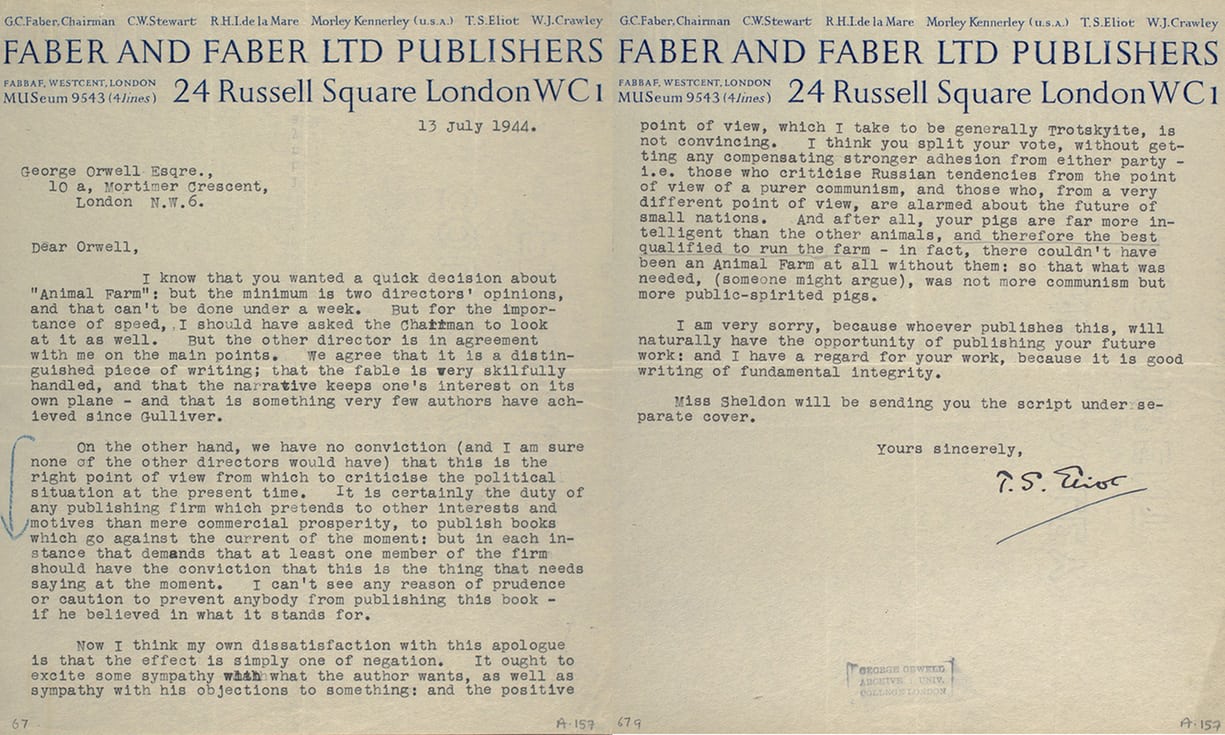
The interpretation of George Orwell could be a paradigm for how dead literary figures get knocked from pillar to post by the winds of political interpretation. During his lifetime, the author of 1984 and Animal Farm went from darling of the left to exile for having been willing to write the truth about Communist totalitarianism in allegories too pointed to ignore.
With the end of the Cold War, forty-two years after Orwell’s death, the poisonous fog breathed on Western intellectual life by Soviet agents of influence slowly began to lift. It became possible to say that Communist totalitarianism was evil and had always been evil, without being dismissed as a McCarthyite or reactionary not merely by those agents but by a lot of “no enemy to the left” liberal patsies who should have known better. In this climate, Orwell’s uncompromising truth-telling shone even more brightly than before. For some on the left, belated shame at their own complicity with evil transmuted itself into more adulation for Orwell, and more attempted identification with Orwell’s positions, than at any time in the previous fifty years.
Then came 9/11. Orwell’s sturdy common sense about the war against the fascisms of his day made him a model for a few thinkers of the left who realized they had arrived at another of Marx’s “world-historical moments”, another pivot point at which everything changed. Foremost among these was Christopher Hitchens, who would use Orwell to good effect in taking an eloquent and forceful line in favor of the liberation of Afghanistan and Iraq. For this, he was rewarded with the same vituperation and shunning by the Left that had greeted the publication of Orwell’s anti-totalitarian allegories fifty years before.
Eric S. Raymond, “Getting Orwell Wrong”, Armed and Dangerous, 2005-08-29.
June 10, 2017
QotD: Quoting and mis-quoting Orwell
May 16, 2017
QotD: Politics as an auto-immune condition
From living with eczema, which is a chronic auto-immune disorder, I can tell you that it much resembles the way we stumbled through from the forties (perhaps earlier. But in the forties, Heinlein described the communists taking over the Democratic party. And considering it took him till the eighties to vote Republican for the first time, I don’t think he can be considered a biased source.) through to 2001 like I live – most of the time – with my eczema: it flares up in a specific part of my body, and it itches like heck, which of course means that I don’t give my full attention to anything much, but because I’ve lived like this since I was one, it doesn’t really bother me or I should say – I don’t know what it’s like when it’s not bothering me.
[…]
For those who’ve been following our politics in puzzled wonder, it might help if you think of our issues as an autoimmune disorder. Let’s for the moment forget where it came from. Most autoimmune disorders are a bit of a mystery. Yes, part of it was the same bad philosophy that affected Europe at the time, and some of it might have been Soviet agitprop leaking over the ocean (as someone who grew up in Europe and in a fractured country, I know most Americans ignore the chances of that.) Part of it was a predisposition to it. The US and the ancient Israelites are the only people I know of formed on a set of principles and engage in detailed criticism of themselves over their principles. (Most other nations engaged in a criticism of OTHER countries over their own principles and blame OTHER countries for their own failures. For further study, I recommend Europe.)
Anyway, mostly we’ve been living with it and ignoring it, like I do with eczema. The areas where it was chronic: college campuses, “intellectual” areas were relatively minor. Even when it affected Hollywood, as long as it wasn’t flaring up too badly, most people rolled their eyes and ignored it.
[…]
The problem is this – the flare up continued growing. All through the sixties and the seventies, and the eighties, and yes, of course, the nineties, the flare up of self-hatred grew. And just like the eczema in my hands, it started affecting areas we can’t live without: K-12 schools, business, news.
And it’s not just a little. The news have been biased left for a long time (yes, I know the left thinks they’re biased right, but that’s because the left is to the left of Stalin, while the media are basically propping up a state-capitalism system much like China’s.) If you consider Fascism right, then you’re darn tooting the media is biased right. Since I consider it a misnomer, well…
But more importantly, unlike the manifestations of totalitarian impulse in other countries – Russia, Cuba, China – the autoimmune problems are NOT affecting just our governance or our industry. It’s not a matter of destroying our industry so we’ll all be poor. That would be bad enough. The problem is far worse, though: the problem is that the statist ideology now in control of our government, our media, our education and what passes for “high culture” doesn’t just hate this or that part of us. No, they’ve been told/convinced/brainwashed that what’s wrong with the world is US – that the country and its existence ARE the enemy.
It might be the first time in history where in a non-occupied country flying the flag is an act of daring that in certain neighborhoods can get you shunned by all your neighbors. It might be the first time in history where teaching the good parts of your history in school is considered an act of defiance, and where the higher-class and all the bien-pensants push distorted histories and documentaries that run down the country that hosts them.
Autoimmune. Systemic.
Sara A. Hoyt, “Auto-Immune — A blast from the past post from February 2013”, According to Hoyt, 2015-07-01.
May 8, 2017
“… it’s inconceivable that a book called Fascism for Kids would ever be printed by a reputable publisher”
Jarrett Stepman reviews a new MIT translation of Communism for Kids:
In order to make the deadliest ideology of the 20th century palatable to young Americans, Communism for Kids is coming to a bookstore near you.
This newly released book from MIT Press “proposes a different kind of communism, one that is true to its ideals and free from authoritarianism.”
The death toll from communist regimes in the 20th century is well-documented. One study found that more people were killed under communism than homicide and genocide combined, and only 9 million more people were killed in World War I and World War II combined than under governments of this ideology.
Another study showed how the mass killings of civilians by their own governments took an immediate nosedive after the collapse of the Soviet Union and international communism.
According to the Amazon synopsis, the book weaves a fairy tale of “jealous princesses, fancy swords, displaced peasants, mean bosses, and tired workers.”
It is bewildering why MIT Press would publish a book that cutesies up the political creed that gave the world Joseph Stalin, Mao Zedong, Fidel Castro, and many more of the world’s most prolific mass murderers. None of these brutal dictators are mentioned in the book, according to The Washington Free Beacon.
Communism seemingly gets a pass to be reimagined as a sweet fable while it’s inconceivable that a book called Fascism for Kids would ever be printed by a reputable publisher.
[…]
This odd attempt to get kids into communism is unlikely to spawn a new generation of true believers on its own, but it does highlight the growing problem for younger Americans who are generally clueless about even recent history.
As The Daily Signal previously reported, a study from the Victims of Communism Memorial Foundation found that millennials in particular are stunningly ignorant about what occurred under the Soviet Union and other communist regimes just a generation ago.
One-third of millennials surveyed actually believe that more people were killed under former President George W. Bush than under Soviet dictator Stalin.
As suggested, a copy of George Orwell’s Animal Farm would be a far more accurate and informative gift than this piece of whitewash.
May 7, 2017
The Importance of Institutions
Published on 2 Feb 2016
In today’s video, we discuss a topic critical to understanding economic growth: the power of institutions.
To better shed light on this, we’re going to look at an example that’s both tragic and extreme.
In 1945, North and South Korea were divided, ending 35 years of Japanese colonial rule over the Korean peninsula. From that point, the two Koreas took dramatically different paths. North Korea went the way of communism, and South Korea chose a relatively capitalistic, free market economy.
Now — what were the results of those choices?
In the ensuing decades after 1945, South Korea became a major car producer and exporter. The country also became a hub for music (any K-pop fans out there?), film, and consumer products. In stark contrast, North Korea’s totalitarian path resulted in episodes of famine and starvation for its people.
In the end, South Korea became a thriving market economy, with the living standards of a developed country. North Korea on the other hand, essentially became a militarized state, where people lived in fear.
Why such an extreme divergence?
It all comes down to institutions.
When economists talk about institutions, they mean things like laws and regulations, such as property rights, dependable courts and political stability. Institutions also include cultural norms, such as the ones surrounding honesty, trust, and cooperation.
To put it another way, institutions guide a country’s choices — which paths to follow, which actions to take, which signals to listen to, and which ones to ignore.
More importantly, institutions define the incentives that affect all of our lives.
Going back to our example, in the years after 1945, North and South Korea took dramatically different institutional paths.
In South Korea, the institutions of capitalism and democracy, promoted cooperation and honest commercial dealing. People were incentivized to produce goods and services to meet market demand. Businesses that did not meet demand were allowed to go bankrupt, allowing the re-allocation of capital towards more valuable uses.
Against that grain, North Korea’s institutions produced starkly different incentives. The totalitarian regime meant that the economy was centrally planned and directed. Most entrepreneurs didn’t have the freedom to keep their own profits, resulting in few incentives to do business. Farmers also didn’t have enough incentive to grow sufficient food to feed the population. This was due in part to price controls, and a lack of property rights.
As for capital, it was allocated by the state, mostly towards political and military uses. Instead of going towards science, or education, or industrial advancement, North Korea’s capital went mostly towards outfitting its army, and making sure that the ruling party remained unopposed.
And now, look at how different the two countries are as a result of those differing institutions.
When it comes to economic growth, institutions are critically important. A country’s institutions can have huge effects on long-term growth and prosperity. Good institutions can help turn a country into a growth miracle. Bad institutions can doom a country to economic disaster.
The key point remains: institutions are important.
They represent the choices that a country makes, and as the Korean peninsula shows you, choices on this scale can have staggering effects on a nation’s present, and future.
April 13, 2017
QotD: Soviet statistics
Being a correspondent in Moscow, I found, was, in itself, easy enough. The Soviet press was the only source of news; nothing happened or was said until it was reported in the newspapers. So all I had to do was go through the papers, pick out any item that might be interesting to readers of the Guardian, dish it up in a suitable form, get it passed by the censor at the Press Department, and hand it in at the telegraph office for dispatch. One might, if in a conscientious mood, embellish the item a little … sow in a little local colour, blow it up a little, or render it down a little according to the exigencies of the new situation. The original item itself was almost certainly untrue or grotesquely distorted. One’s own deviations, therefore, seemed to matter little, only amounting to further falsifying what was already false.
This bizarre fantasy was very costly and elaborate and earnestly promoted. Something gets published in Pravda; say, that the Soviet Union has a bumper wheat harvest – so many poods per hectare. There is no means of checking; the Press Department men don’t know, and anyone who does is far, far removed from the attentions of foreign journalists. Soviet statistics have always been almost entirely fanciful, though not the less seriously regarded fro that. When the Germans occupied Kiev in the 1939-45 war they got hold of a master Five Year Plan, showing what had really been produced and where. Needless to say, it was quite different from the published figures. This in no way affected credulity about such figures subsequently, as put out in Russia, or even in China.
Malcolm Muggeridge, Chronicles of Wasted Time, 2006.
April 10, 2017
QotD: Noblesse Oblige, pre-teens, and teenagers
This – ah – female privilege of course established “the way girls fight” usually underhanded, and without the adult noticing. Pinches, kicks to the ankle (my poor male friends in middle school) and also gossip and character destruction and other, less physical means of retaliation.
Because women are still human and will still fight.
But by middle school, we had it well established. A boy understood he would take whatever the girl dished out physically, if a girl were so uncouth as to hit him, and treat it as a joke. (And by that time they were that much stronger – thanks to testosterone – that they could do that, in most cases.) The girl in turn knew if she’d hit a boy, short of self-defense in a dark classroom, where he ambushed her, thereby putting himself beyond the protection of social rules, she’d committed a social sin and broken a major unspoken rule.
This kept fist fights between the sexes from happening. And most girls, though they might character assassinate one another, had learned to keep the boys out of it, because they weren’t adroit in the art and therefore were as vulnerable to that type of war as women to punches.
Or to put it another way, as the good professor says, “Chivalry imposed obligations upon both sexes.” And it can’t continue when one breaks the compact. The same way that other imbalances of power in society can’t continue unless both parts play by the rules.
When one part forgets the rules, they don’t leave the peasants enough to live on, and the peasants chop their necks off.
Look, I’m a libertarian and in the US. I believe all men and women should be equal under the law. But you can’t eliminate imbalances of power unless you stop being human. Communism fails, in large measure, because it wants to eliminate imbalances of power completely by making humans into something different. They believe they can shape a social ape into something more like ants or bees (don’t argue. Yeah, they do want to have rulers. One ruler over faceless millions. Because someone has to enforce equality. Yes, I know about the myth of the vanishing state.) Hence the myth of the homo Sovieticus, the selfless, perfectly acting man who would emerge once the distortions of capitalism were removed from the “natural” man who was of course a Rousseaunian noble savage. No, I don’t believe it. No one should believe it. The rejects of that culling program have filled a hundred million graves and bid fair to fill more. Because Rousseau was wrong and the mythology of communism is a hot and sticky repulsive mess.
Some people will always be taller, larger, stronger. Some will be smarter. Some will, for whatever reason like “my ancestors got here earlier” have the advantage of a better adaption to the society they live in.
I, for instance, got both sides of the noblesse oblige speech because I was taller than most of my male teachers by 13, and probably stronger too. It took. Sort of. I knew how to subdue a badly acting male without hitting him by the time I was 20, and only psychopaths did not respond. (And for those there was hitting, hence the weaponized umbrella.)
Because I WAS a walking imbalance of power, frankly.
Noblesse oblige is needed to keep things from coming to extremes.
Sarah Hoyt, “Noblesse Oblige and Mare’s Nests”, According to Hoyt, 2015-05-05.
April 3, 2017
Ici Londres: Karl Marx didn’t get a single thing right
Published on 22 Mar 2017
March 21, 2017
March 20, 2017
QotD: The Christian church and the Communist Party
That people believe what they want to believe, was among the discoveries of my adolescence. Reading obituaries of Robert Conquest (1917–2015; died Monday), the shock of this discovery comes back. I was then both an Atheist and a Cold Warrior. This insight into human nature and denature appeared to buttress both of these convictions: for it seemed to me that the Communist Party and the Christian Religion were products of blind faith, perpetuated by people who “wanted to believe,” and therefore believed what they wanted.
Much was once said about the Alice-in-Wonderland parody of the Roman Church that the Communist Party offered. Immortal Christ founded the one, infallible Marx the other. Officially-recognized “apostles” followed from each (Peter, Paul, John, in one case; Lenin, Stalin, Mao, in the other). The Party like the Church is a bureaucracy, under a hierarchy to be obeyed without thought or hesitation. Each has a form of “confession,” and all the other “sacraments” can be paired. Advancement requires strict fidelity to doctrine. Both institutions hunt “heresies” and canonize “saints.” They thrive on persecution. The utopia of perfect Scientific Socialism is a destination like Heaven. And so on: I haven’t the energy to redraw the whole chart.
That the Communist faith is “materialist,” and that of the Church “spiritual,” makes the parody more amusing. One might also say that Satan is a parody of Our Lord. In logic, however, a parody does not constitute a refutation.
David Warren, “Transfiguration”, Essays in Idleness, 2015-08-06.
March 12, 2017
Is this the definitive exegesis of “woke”?
At Ace of Spades H.Q., OregonMuse fishes in the comment stream and finds a question that needed to be answered. Extensively.
13 I’m not up on the current “hip kid lingo”, so what exactly does “woke” mean?
It sounds stupid, so I am guessing it is not something achieved by hard work and discipline.
Posted by: moki at March 09, 2017 02:22 PM
1. “Woke” is pretty much the same as what the old-time Marxists called “class consciousness”, i.e knowing that the human race is divided by economic class and that the “proletariat” class needs to overthrow the “bourgeois” class in order to establish the epitome of human perfection, the world-wide communist state.
2. The Marxists also had a term they called “false consciousness.” I think it means something like this: you know what “class consciousness” is but you reject it, because you know it’s bullcrap.
3. I once heard erg use this term to describe ace.
4. Don’t know if there is any comparable term like “false woke”. Maybe sleepwalking?
5. Anyway, the point is, “woke” is a concept that was basically lifted from rat bastard commies.
6. Eventually, as blue vs. blue conflict increases, we’re going to start seeing “woke fights.”
7. They won’t be called that, but that’s what they are.
8. At some point, the various factions of woke will start making distinctions between “woke” and “woke woke.”
9. And these woke groups will be all “woker than thou” to each other
10. To a “woke” person, the only thing worse than not being “woke” is being “woke”, but insufficiently “woke.”
11. These blue-on-blue slap fights will be hilarious to watch.
12. Even better with popcorn
March 7, 2017
Russia Before the 1917 Revolution I THE GREAT WAR Special
Published on 6 Mar 2017
Russia’s history in the decades leading up to World War 1 where a time of great turmoil and social changes. The Romanov tsars held a tight grip on the country which remained an autocracy even though the people requested change. And by 1917, three years into World War 1, the people demanded change again.
Senator Charles Schumer
L. Neil Smith calls for an investigation into Senator Schumer’s “connection to this remnant Stalinist core, here in the West.”
Following the inglorious collapse of the old Soviet Union back in the late 20th century, without a doubt the new capital of world collectivism has come to be centered somewhere between Washington, D.C. and New York City. (It had already been observed and lamented that, at a moment in history when communism was shriveling and dying all across its native Europe, the evil legacy of Marx and Engels was alive and well in most American universities.)
New York and Washington, D,C, are both both the familiar stomping grounds of a dangerously deluded Democratic Senator who apparently has come to believe that he is the divinely-appointed rightful Chief Executive and Commander-in-Chief, and is presently leading a vicious assault on what might be termed “The Peoples’ Presidency”. One can be forgiven from wondering what stone he pulled his sword from.
Judging from his unbrokenly statist legislative record, he has always believed that the “peasants” (that’s you and me) need a Leviathan to tell them what to do, where to go, how to live their lives, even how many gallons their toilet-tanks may hold. Under no circumstances, in his dementedly Draconian view, must the American electorate be permitted to choose their own leader, especially a leader pledged to lift the burden of authoritarian government from their weary shoulders. Their duty, in his view, is simply to be born, obey their masters, pay a lifetime of taxes, die and get out of the way, not to determine the course of the Ship of State (albeit, a sinking ship, aboard which he occupies the highest crow’s- nest—as it stands now, he’ll be among the last to get his feet wet).
However what needs to be investigated is not some entirely fictional collusion between the Trump Administration and Vladimir Putin’s thoroughly post-Marxist, patently anti-communist Russia, repeated over and over and over and over again by the news floozies and gentlemen-of-the-evening of the compliant news media until we’re expected to believe it, but Charles Schumer’s deep connection to this remnant Stalinist core, here in the West.
I will repeat that, because it’s important. What needs to be investigated is not some fictional—mythical—collusion between the Trump Administration and Vladimir Putin’s post- Marxist, anti-communist Russia, repeated over and over again by the round-heeled news media until we’re expected to believe it, but Charles Shumer’s own connection to this remnant Stalinist core, here in the West.
February 14, 2017
February 1, 2017
QotD: Che Guevara and his modern fans
Denial is also a common factor among people on the left who want to believe in the failed experiment known as Communism. This is nothing new, since Walter Duranty of the New York Times was famous for denying the atrocities of Stalin and is still honored by the media elite to this day. Though some of the worst deniers are those who want to believe the romantic story of Cuba being liberated by Che Guevara and Fidel Castro from the evil grasp of the Batista regime. The Cuban revolution is by far one of the greatest stories ever sold.
People are always shocked to learn that the Cuban revolution succeeded with little resistance since Castro had bribed the top brass in Batista’s military to stand down. It also didn’t help that the Batista regime was so unpopular among the people that there weren’t too many who were willing to risk their lives to defend it. It’s also funny that Che Guevara is thought of as the George Washington of guerrilla warfare, but in reality Barney Fife was a better comparison. Actually I think that may be an insult to Barney Fife because at least he wasn’t dumb enough to shoot himself in the chin, like our “guerilla master” did. His failed revolutions in Bolivia and the Congo are a direct testament to his skills as a master in guerilla warfare.
The one thing that Che was good at was killing hundreds, if not thousands of unarmed people, including women and children. The man was such a humanitarian that he had a wall in his office knocked down so that he could have a nice view of the killing fields, when the “enemies of the state” were being purged. Hipsters who like to wear his T-Shirts as always shocked to hear that he wasn’t a selfless rebel who wanted to help the working class, except to take them to the killing fields of course.
To all the hippies, artists, musicians, and actors who like to venerate the man, you are the type of person that Che despised the most. If you had long hair, wore blue jeans and listened to Rock ‘n’ Roll or had any flare for the arts, you would likely find yourself thrown into a labor camp.
Sean Gangol, “Denial”, Libertarian Enterprise, 2015-07-19.
January 29, 2017
The pundits only seem to know two Orwell books…
As Colby Cosh rightly says, you can find cheap “we’re now living in Orwell’s Nineteen Eighty-Four” pieces everywhere. On the evidence, you’d have to say that the majority of editorial writers working today know of Orwell for only two of his (admittedly brilliant) novels. I’m not an Orwell scholar (I’m actually no kind of scholar at all), but I’ve read much more of Orwell’s work — spoiler: he really was a socialist — and we sell the man’s message very far short if it can only be used as a quick literary check-off that the current president of the United States is bad:
I’ll start by admitting that I have a hipster’s childish, proprietary feeling toward the works of George Orwell. It’s a common disorder. Being an admirer of the man’s work I ought, reasonably, to be delighted by anything that makes it more popular. But, dammit, all anybody ever buys are the hits.
Donald Trump’s election to the U.S. presidency has set off such a mighty public hunger for Orwell’s Nineteen Eighty-Four that the novel shot to the top of Amazon’s fiction charts. That, in turn, has created a land rush in Orwell-Trump thinkpieces. The Guardian even did a full workup of “Orwell experts” who all assure us that the parallels between the 1949 book and the current situation are strong and undeniable, with claims like “Trump takes doublethink to a new extreme” and “Trump is not O’Brien. He is more like a cut-price version of Big Brother himself.”
You can find “Are we living in Orwell’s 1984 (yet)?” articles printed in any year of the last 40 or so. But 2017 has already seen dozens, maybe hundreds. And the great majority of them seem to answer: “Yes, definitely. Here we are. Enjoy your Victory Gin.”
This is not a healthy or sensible reaction to the election of a bold, chauvinistic liar. That, after all, may be a good description most of the heads of government that have ever existed — the leaders under which most modern humans have lived. You’re allowed be afraid of or discouraged by Trump without losing your mind altogether. He displays a great deal of the style and technique of a classic caudillo, a Juan Peron or a Ferdinand Marcos; no sane liberal can be happy to see these things brought to the American scene. Trump has terrible power and may abuse it. He may be awful for the world, may even initiate wars.
In interests of full disclosure, this article triggered me enough to buy another couple of volumes of The Complete Works of George Orwell, these being from the post-WW2 era. I don’t yet have the full set, but I’m working on it (the full Orwell bibliography can be found here). I found A Patriot After All: 1940-1941 and Keeping Our Little Corner Clean: 1942-1943 to be absolutely fascinating, not only as informal war chronology, but also as a view into Orwell’s reasons for simultaneously fighting against totalitarianism in both Fascist and Communist forms.