
World War Two and Spartacus Olsson
Published 21 Feb 2026In Q4 1933 Hitler pivots Nazi Germany from internal takeover to outward defiance. The London Economic Conference collapses and the tariff truce unravels, Hitler withdraws from the Disarmament Conference and the League of Nations — then stages the November 12 plebiscite and one‑party Reichstag election to claim the nation stands behind him. As Goebbels tightens propaganda and press control through the Editors’ Law (Schriftleitergesetz) and daily directives, the Winter Relief campaign turns “charity” into social pressure and Volksgemeinschaft theater. In December, Reichsbank president Hjalmar Schacht hardens the transfer moratorium to conserve foreign currency for raw materials and rearmament. Using contemporary voices, this episode shows how isolation, manipulation, and “unity” accelerate Europe toward a pre‑war era.
(more…)
February 22, 2026
How to Use a Tariff War to Disrupt the World – Death of Democracy 04 – Q4 1933
February 10, 2026
Dispatch from the UK: Beatings will continue until morale improves
On his Substack, Ed West shares some of the highlights, lowlights, and WTFites of the last week’s stories from formerly Great, now Mediocre Britain, including the case of an American asylum-seeker, the state of the jury system, and Birmingham among others:
Image from the Foundation for Economic Education
The quintessential UK news story mixes the sinister and comical. As I put it last time: the “Yookay” has elements of authoritarian menace with total farce and incompetence, a slapstick comedy in which WPCs turn up at your house to arrest you over Facebook posts while your son sits in a classroom next to a 30-year-old Iranian man pretending to be a child asylum seeker. All the internet mockery of Britain in the past few years focusses on the theme of a bizarrely mismanaged country, run by people whose priorities are totally upside down.
In her recent Wall St Journal column, Louise Perry wrote about what she described as “Mr Bean Authoritarianism … after the comic character played by Rowan Atkinson, one of Britain’s most successful comedy exports. Mr. Bean is childish and incompetent. He constantly gets things wrong. He can’t understand the most basic facts about everyday life, which results in various slapstick disasters. The British government frequently manifests Mr. Bean-style incompetence but without his genial manner.” She wrote:
“Pathways” isn’t the first example of government messaging that treats the British public like naughty children. In 2023, Police Scotland came up with another, much-mocked cartoon character called “the hate monster”. “Before ye know it, ye’ve committed a hate crime,” announced the voice-over, with an effect that was simultaneously sinister and risible. “You are constantly on the brink of criminalization,” the ad implicitly told us. “Now look at this silly cartoon.”
Incompetence and authoritarianism are often bedfellows. Governments that frequently make mistakes will feel compelled to hide those mistakes, for fear of the public’s response.
[…]
Take a hike
“The British countryside will be made into a less ‘white environment’ under nationwide diversity plans. Officials in rural areas, including the Chilterns and the Cotswolds, have pledged to attract more minorities under plans drawn up by the Department for Environment, Food & Rural Affairs (Defra). The plans follow Defra-commissioned reports that claimed the countryside would become ‘irrelevant’ in a multicultural society, as it was a ‘white environment’ principally enjoyed by the ‘white middle class’.
“More diverse staff will be recruited, marketing material will be produced featuring people visibly from ethnic minorities, and written in ‘community languages’.”
Isn’t English a “community language”? I’ve written about the War on the Countryside before; the powers-that-be are obsessed with getting Muslims to hike, for some reason. Just recently, a woman received an MBE for walking up hills while wearing a hijab. It all seems so counter-productive, increasing a sense of paranoia among everyone, when no one is stopping anyone from taking a walk in the countryside, and no one is going to give you a hard time. As Alexandra Wilson explains, some of this is downstream of the incentive systems within academia.
[…]
Official secrecy
One of the characteristics of the UK state, and which differentiates it from the US, is a tendency towards secrecy. I think it’s in the English character, which is why we basically invented spying, and are very good at it, give or take the odd communist traitor. This was most egregiously displayed by the government’s secret plan to airlift huge numbers of Afghans into the country, without telling the public, and it has become a regular feature of the criminal justice system.
Just last month it was revealed that a “reporting restriction was put in place at Nottingham Crown Court in September last year, preventing any mention of the defendant’s immigration status”. The man in question was from Pakistan and the authorities were worried about the risk of disorder, but he was unmasked by local Reform MP Lee Anderson.
This is the second time in a month where a British court has deliberately withheld the nationality of a rapist: “Last May in Leamington Spa, a girl was abducted and raped by two Afghan asylum seekers who had arrived by small boat just months before. Initially, Warwickshire Police described the rapists as ‘two 17-year-old boys from Leamington’, while referring to their 15-year-old victim as a ‘young woman’. It was not until the case went to sentencing in December that their backgrounds could be reported, after a legal challenge by the Daily Mail was granted. Meanwhile, the ‘horrific footage’ played at the trial has still not seen the light of day, with their barrister saying: ‘I have no doubt that if the general public were exposed to that, we would have disorder on our hands’.”
I don’t think the press habit of referring to foreign offenders as “Newcastle man” or “Burnley man” really helps the situation. All the details are immediately shared on social media anyway; it’s not the 90s any more.
February 1, 2026
How to End Democracy in 60 Days – Death of Democracy Q1 1933
World War Two
Published 31 Jan 2025This episode of the history documentary series “Death of Democracy” covers Q1 1933 with Hitler’s appointment as chancellor, the Reichstag Fire, Reichstag Fire Decree, Enabling Act, rise of Nazi terror, Gleichschaltung, and media control, explaining how Weimar Germany’s democracy collapsed in just sixty days.
(more…)
January 31, 2026
La trahison des comédiens (The treason of the comedians)
In the above-the-fold portion of this post, Andrew Doyle points out that it’s the comedians who should be leading the charge to ridicule the excesses of the powerful, yet they shrink from their cultural duties and avoid offending those who most need to be taunted:
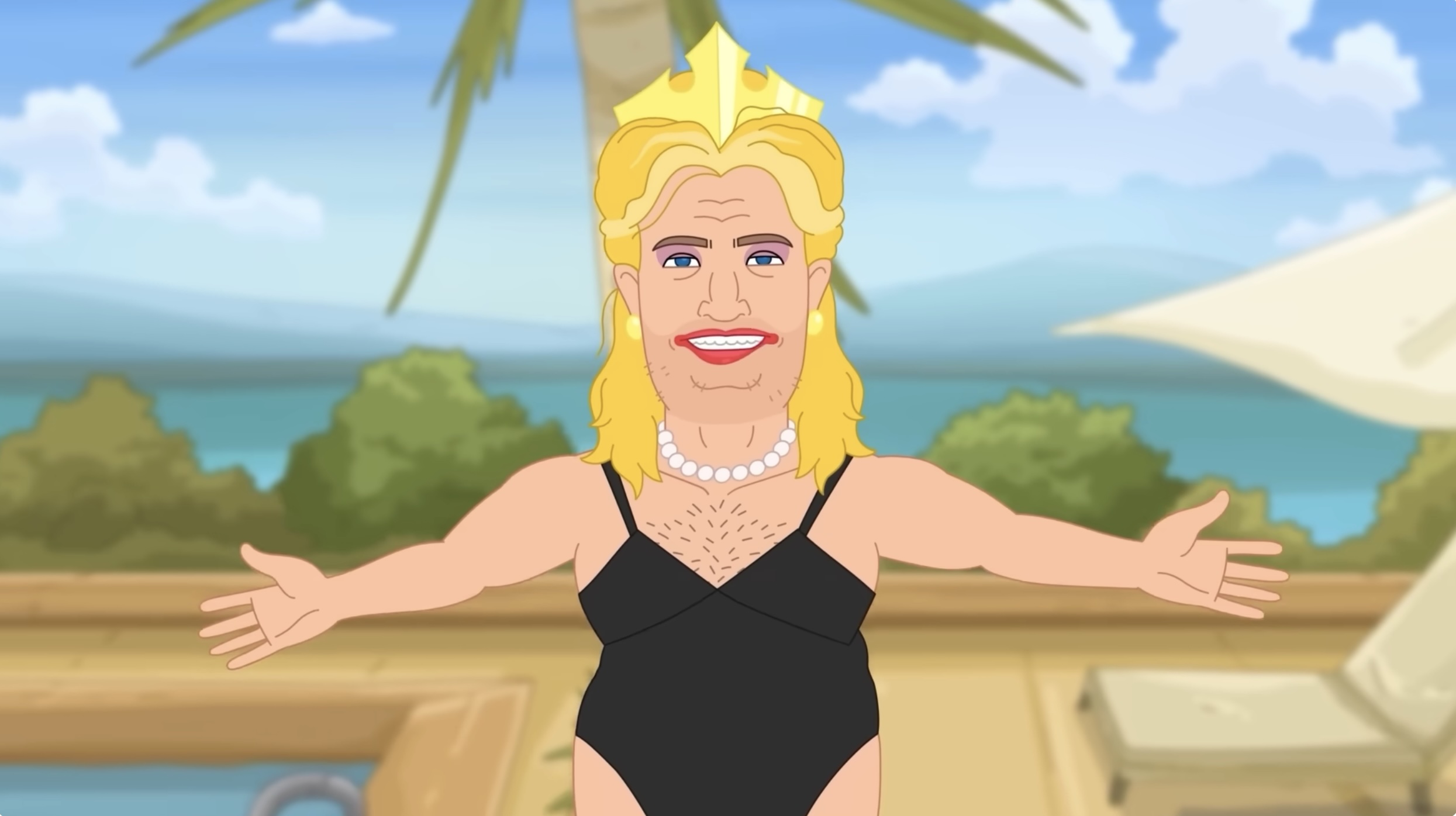
Holly Valance is an unlikely satirist. Yet the pop singer’s latest track, “Kiss Kiss (XX) My Arse”, takes aim directly at the pretence that human beings can change sex, and that a man need only declare himself a woman for it to be true. Upon its release the song immediately reached the top of the iTunes bestsellers chart, only to be swiftly deleted by Apple Music. Valance had committed the cardinal sin of ridiculing the establishment.
The song is based on Valance’s 2002 number one hit “Kiss Kiss”, now reworked with new lyrics for Pauline Hanson’s animated satire A Super Progressive Movie. This is the song’s opening verse:
They say that I’m a he but I’m a she,
Cos I gotta V and not a D,
And I don’t care what people say,
I’ll never be a him or them or they.Unsubtle? Perhaps. But let’s not forget that its target is the least subtle ideology that has ever been birthed. This is satirical mimesis; the essence of parody. For Apple Music to delete the track (only to reinstate it after multiple news outlets drew attention to the deletion) surely proves Hannah Arendt’s point that the “greatest enemy of authority” is “contempt, and the surest way to undermine it is laughter”.
It is an indictment of the state of the comedy industry that pop singers are left to do the work of comedians. Television panel shows are now bland affairs thanks to the sheer lack of courage on display. The woke movement represents one of the most authoritarian, intolerant and illiberal developments in the recent western world. It demands conformity, peddles fantasy at the expense of truth, and punishes freethinkers. And yet most of today’s comedians are eager to prop it up rather than see it tumble.
They are called “regime comedians” for good reason. They have willingly turned themselves into cheerleaders for the powerful, bolstering those who have bullishly set the agenda, or – as the satirist Chris Morris once put it – “doing some kind of exotic display for the court”. It is a great shame that so many of Morris’s former collaborators now fall squarely into this category.
To put this cowardice into perspective, consider the example of the satirical magazine Charlie Hebdo. Just one year before he was gunned down by Islamic terrorists, the cartoonist and editor-in-chief Stéphane Charbonnier (known as “Charb”), was profiled in Le Monde. Was he not worried, the interviewer asked, about possible reprisals for drawing cartoons of Mohammed? For his answer, he paraphrased the Mexican revolutionary Emiliano Zapata: “I would rather die standing than live on my knees”.
If a man like Charb refused to back down from criticising an oppressive ideology – in spite of the death threats he received on a daily basis – why is it that so many of our comedians are too afraid to tackle the woke? These activists may talk tough online, but in real life they are about as intimidating as a sea sponge. While the impulse to preserve a mainstream career is understandable, it does suggest a lack of genuine vocation if that means ignoring the target that is most in need of skewering.
January 16, 2026
Rapidly declining democracy in the home of the “Mother of Parliaments”
As I’ve mentioned before, it sometimes seems that Australia, Britain, and Canada are in a three-way race to de-democratize themselves as fast as they possibly can. Here’s the free-to-cheapskates portion of Ed West‘s essay on the return of liberal authoritarianism:
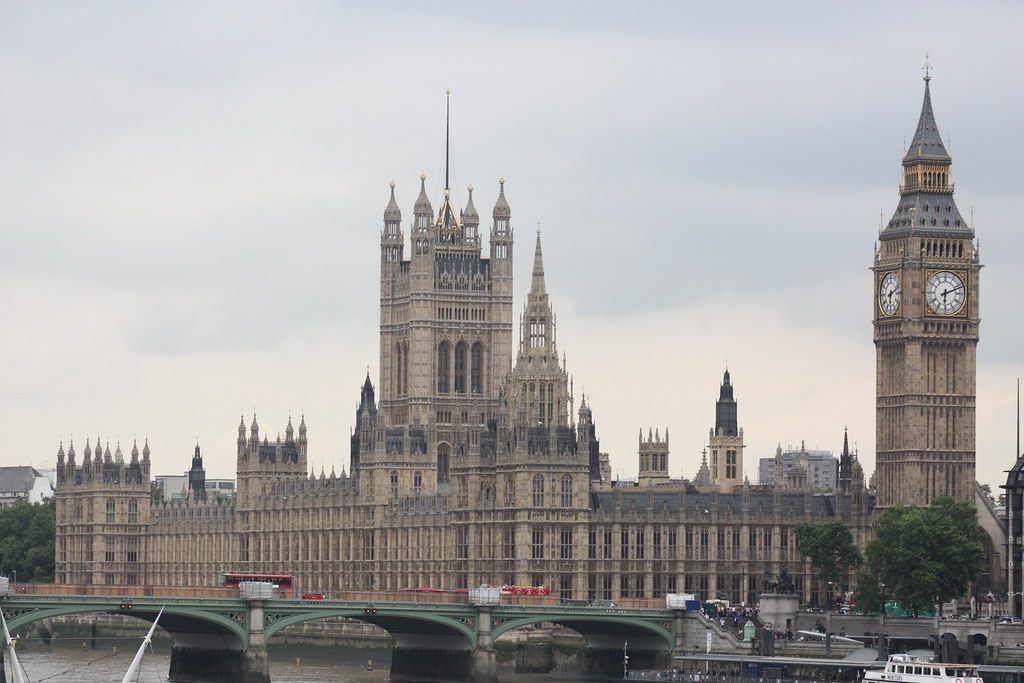
“Palace of Westminster” by michaelhenley is licensed under CC BY-NC-SA 2.0
It’s around this time of year that various NGOs give their assessment on the state of democracy and freedom of the world. The Fraser Institute’s Human Freedom Index was published earlier in December and Freedom House’s next report will arrive in February. It was at the start of last year that Romania was downgraded to a “hybrid democracy” by another body, the Economist Intelligence Unit (EIU), while France is now merely a flawed democracy. Sacré bleu!
What about our own beloved island, the mother of Parliaments? It will be interesting to see where Britain features in this year’s reports, and whether recent developments will impact on our rating.
Just recently, for instance, the British government postponed four mayoral elections until 2028, elections they are certain to lose. The Electoral Commission warned that it risked undermining “the legitimacy of local decision making and damaging public confidence”, while the chairwoman of the Labour Party even refused to rule out delaying the next General Election, leading Nigel Farage to accuse her of having “total contempt for democracy”.
Keir Starmer has also taken effective control of the House of Lords and will almost entirely eliminate opposition among peers by 2027, which he is able to do to the second chamber thanks to Tony Blair’s constitutional reforms. While the government extends the franchise to children, and even plans to place voting booths in schools, a clear violation of rules about politicising the education system, they’re also keen to restrict who can stand in elections.
As the i reported, Emily Darlington, Labour MP for Milton Keynes Central, “is seeking to make the Electoral Commission recommend enhanced DBS checks for candidates and then publish whether or not parties have agreed to the vetting. The aim is to ensure political parties justify whether their candidates are fit for office and name and shame those who refuse to participate.”
This is troubling when one considers that DBS (Disclosure and Barring Service) checks include not just criminal history but “non-crime hate incidents“, which may even appear on the records of people who haven’t been contacted by police. These highly-political charges are far more likely to be directed at those with Right-wing opinions.
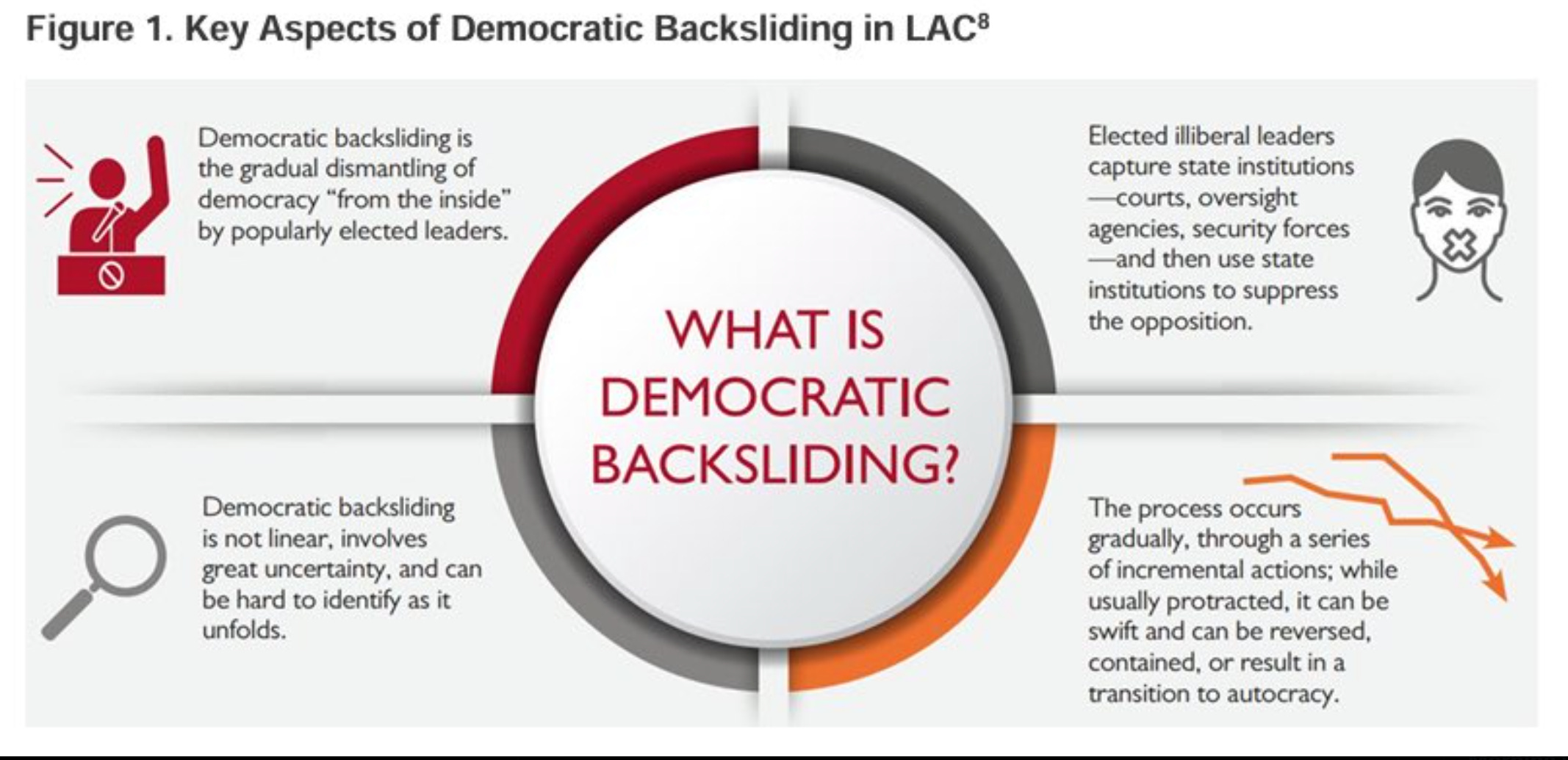
When western European countries do things like this, I try to gauge whether this is normal by asking the question: what if Hungary did this? In most of these cases, I imagine the assessment would be that it was an assault on liberalism and democratic norms. In which case, what if Britain is undergoing the sort of “democratic backsliding” usually levelled at central European countries with conservative governments? What if Keir Starmer is actually one of these illiberal “strongmen” we read about, just not a very effective one.
There are a number of accepted symptoms of democratic backsliding, among the most commonly listed being rejection of democratic rules, a disregard for constitutional norms, attempts to use legal mechanism to sidestep democracy, which is described as “stealth authoritarianism”, denial of opponents’ legitimacy, and the tendency to characterise them as outsiders or a threat to national security; on top of this, one might consider a willingness to curtail civil liberties, restricting the power of the media, and violating freedom of speech and association. Finally, and worst of all, is the toleration or encouragement of violence against opponents.
Credit: the National Opinion Research Center at the University of Chicago
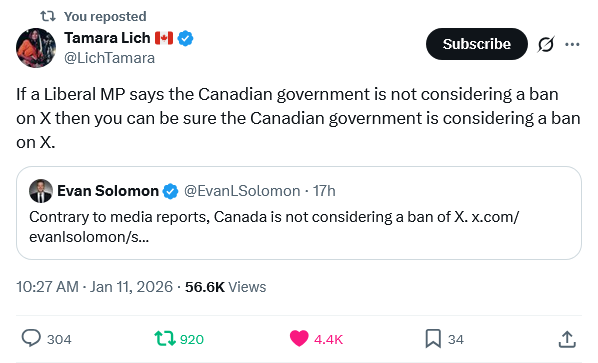
By these broad definitions, Britain arguably meets many of these criteria (but not, most importantly, the last). There is certainly censorship, which has increased with the Online Safety Act, designed to combat “hate” as well as “misinformation”. Misinformation, of course, is everywhere, but its existence certainly provides a convenient excuse for governments to clamp down on the sort of information they dislike. The Government has also pondered banning Twitter, and while I feel that the widespread disgust at the Grok “deepfake” feature is reasonable, such a ban would completely cripple opposition, returning control of the discourse to the old media.
As for the British state’s definition of “hate”, there is a widespread belief that people motivated by hostility to mass immigration are extreme and dangerous, so the full force of the law must be used to stop them gaining support among a public who are totally guileless when it comes to absorbing information. This belief has grown more entrenched with the rise of populism, and makes western European governments increasingly sceptical of democracy itself.
It’s obvious that many people are concerned about the prospect of Nigel Farage becoming prime minister, and as the election date comes closer, and if he’s still in a position to win, the tone will become more shrill. Starmer admitted to this terror when he said, tellingly, that “If there is a Conservative government I can sleep at night. If there was a right-wing government in the United Kingdom, that would be a different proposition.”
Update, 17 January: Welcome, Instapundit readers! Have a look around at some of my other posts you may find of interest. I send out a daily summary of posts here through my Substack – https://substack.com/@nicholasrusson that you can subscribe to if you’d like to be informed of new posts in the future.
January 12, 2026
Is Keir Starmer malevolent or stupid? Or both?
On his Substack, Tim Worstall wonders just how damn stupid Two Tier Keir actually is:

I fear our answer has to be very, very, stupid indeed. Unless he’s simply malevolent which makes things oh so much better, right?
Now, I confess to a fundamental disagreement with the very premise here. For the argument about why we should make child porn legal, see here. Making it more difficult to generate, let alone illegal, strikes me as the wrong decision. But then I’m sufficiently wise in years to realise that I might not be able to persuade some people of either that or of the many other things I am correct about. So, let us leave that aside.
There’s also the point that Grok is hardly the only image generation tool out there these days. Further, the one thing we know about computing is that this year’s leading, bleeding, edge is the free phone app of 5 years in the future. Shrieking that this must be banned just isn’t going to cut it as anyone trying that is simply a Cnut demanding the tide doesn’t flow in.1 On that larger issue of image generation in general we’re just going to end up changing the societal rules. A picture is no longer proof of anything. After all, it wasn’t up until about 1850 — those painters would just do any old thing, the truth be damned — and it won’t be after about 2028. Well, there we are then but …
But OK, let us leave all of that to one side and start from where British politics currently is. Grok generated AI kiddie porn is Bad, M’Kay, and must stop:
Technology Secretary Liz Kendall says she would back regulator Ofcom if it blocks UK access to Elon Musk’s social media site X for failing to comply with online safety laws.
Ofcom says it is urgently deciding what to do about X’s artificial intelligence (AI) chatbot Grok, which digitally undressed people without their consent when tagged beneath images posted on the platform. X has now limited the use of this image function to those who pay a monthly fee.
But Downing Street said the change was “insulting” to victims of sexual violence.
“Downing St” is the equivalent of the American “the White House said” … so yes, that is Keir Starmer, the Prime Minister there.
We’ve also an article from Liz Kendall today:
That Grok continues to allow this kind of content to be created by those willing to pay for it is an insult to victims. No business model should be built on the exploitation and abuse of women and children.
…
The Online Safety Act was designed precisely for situations like this, where platforms fail to take their responsibilities seriously and allow harmful content to proliferate. The British public rightly expects robust action. This is a matter of urgency that demands an urgent response.
I’ve also been clear that the Online Safety Act includes the power to apply to the courts to block services from being accessed in the United Kingdom if they refuse to comply with UK law.
We can see the threat there. If Elon Musk doesn’t do something about this then we’ll block X/Twitter from the UK.
- Why yes, I do know the correct story of Canute and the tides.
A Canadian and Australian connection showed up as well:

While I don’t depend on the social media site formerly known as Twitter for my news, I have found it a very useful additional source since Elon Musk took over the site. I’m clearly not the only one to feel this way:

As they used to say, however, “never believe anything until it’s been denied by the Kremlin”:
January 4, 2026
QotD: The boomerang effect
I’ve noticed a common phenomenon. Let’s call it the boomerang effect.
Lament the rise of an opinion or policy without noticing how your preferred policies helped cause it.
Vaccination rates down — because you wrecked the reputation of vaccines during the pandemic by over claiming.
Anti-immigrant feeling leading to difficulties for legal immigrants — because you welcomed millions of illegal immigrants and prevented them being deported.
Prosecution of political opponents — because you did it too.
Dislike seeing people cancelled for their opinions — because you started it.
Rising climate scepticism — because you censored reasonable criticism of climate extremism.
Anger at trans rights activists — because you shouted down concerns about men pretending to be women in sports and prisons.
Government attacks on universities — because you turned them into ideological madrassas.
Patriotic nationalism turning uglier — because you told people flags were racist.
Criticism of judges — because they became nakedly political.
Defunding of biotechnology — because you failed to call out dangerous gain-of-function virology as the likely cause of the death of 20 million+ people.
Etc etc
Matt Ridley, The social media site formerly known as Twitter, 2025-09-27.
December 28, 2025
It may seem petty to deny entry to EUrocrats, but it’s all they will understand
At first, I thought it was just another bout of Trump being deliberately petty over trivial stuff, but on reflection, it’s actually a neat way to bring home the message to the EU bureaucrats personally that they will be held responsible for their actions:
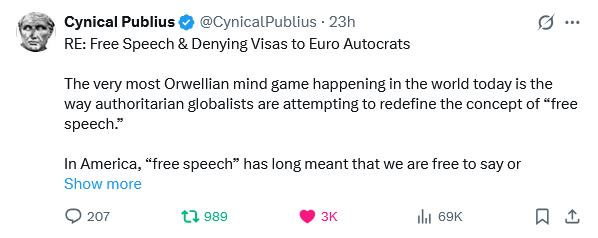
RE: Free Speech & Denying Visas to Euro Autocrats
The very most Orwellian mind game happening in the world today is the way authoritarian globalists are attempting to redefine the concept of “free speech”.
In America, “free speech” has long meant that we are free to say or write virtually anything without fear of government intervention or suppression. It is this ability to express whatever we want that makes it “free”.
The authoritarian globalists, however, have stood this on its head. They have decided that in order for their citizens to be “free”, they must be free of ever hearing or reading any speech that might offend someone or sow doubt as to government policies. To these fascists, “free speech” means GOVERNMENT MODERATED speech which somehow — through its moderation — sets people “free” from ever hearing conflicting views. As I said — straight out of Orwell.
Europe is, of course, the hotbed of this fascist redefinition of what free speech means, but we in America have only narrowly escaped this plague by electing Trump. Remember, Biden and his team were reliant on institutionally stamping out so-called “disinformation” as a means of control over the populace. We must be ever vigilant here in the USA that such thuggish government criminality never again be allowed to prosper.
I think it is very important that every citizen of the USA and the world understand the depths of depravity these people will sink to in order to control ordinary people. This is about mind control, and nothing else.
Ultimately, the value of true free speech is that it embraces the idea that we all have agency over ourselves; that we are free individuals who can and should hear conflicting views, and decide for ourselves what is true and just, and what is untrue and unjust. This is sovereignty over the self, and unfortunately Europe has never let go of the concept of serfdom, so self-sovereignty is a threat that must be stamped out.
The Trump Administration has been prescient, bold and effective in denying visas to the Eurotrash autocrats who would see free speech reduced to whatever speech unelected bureaucrats deem acceptable. I cannot commend Trump enough for the thoughtfulness and importance of that action.
In a world where almost all humans are linked by essentially the same communications platform, only one world leader is truly standing for free speech: Donald Trump. And I thank him for it. We all should — even the TDS sufferers.
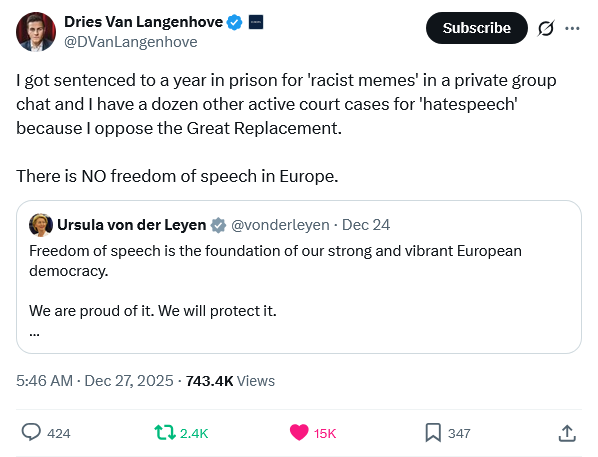
For a relevant example, Dries Van Langenhove:
Update, 29 December: Welcome, Instapundit readers! Please do have a look around at some of my other posts you may find of interest. I send out a daily summary of posts here through my Substack – https://substack.com/@nicholasrusson that you can subscribe to if you’d like to be informed of new posts in the future.
December 24, 2025
The real agenda
On the social media site formerly known as Twitter, Karl Harrison makes a case for fighting against the key element of the federal government’s all-encompassing drive to control the lives of Canadians because it’s the one that will enable all the other controls to operate:
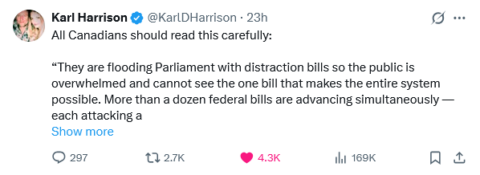
All Canadians should read this carefully:
“They are flooding Parliament with distraction bills so the public is overwhelmed and cannot see the one bill that makes the entire system possible. More than a dozen federal bills are advancing simultaneously — each attacking a different pillar of Canadian freedom but S206 is the key. They fall into clear clusters:
Bills attacking due process and court rights.
Bill S-206 — Administrative Monetary Penalties (the central pillar) enables penalties without hearings, judges, trials, or common-law protections.
Bill C-63 — Online Harms Act. Undefined “harm”, digital speech penalties, CRTC enforcement authority.
Bill C-27 — Digital Charter Act. Creates federal AI regulators empowered to issue compliance orders without court oversight.
Bill C-52 — Beneficial Ownership Transparency. Expands federal surveillance and administrative enforcement.Bills attacking parliamentary supremacy (power shift to agencies).
Bill C-26 — Critical Cyber Systems Act. Sweeping regulation by order-in-council, bypassing Parliament.
Bill C-11 — Online Streaming Act. Gives the CRTC unprecedented control over content curation and digital reach.
Bill C-18 — Online News Act. Allows federal regulators to determine access to, and compensation for, digital journalism.Bills attacking property rights.
Bill C-234 — Agricultural Fuel Restrictions. Expands federal control over farm operations and production.
Bill S-241 — Jane Goodall Act. Sweeping biosafety authority over wildlife, land, and private property.
Bill C-49 — Atlantic Accord Amendments. Expands federal control over offshore land, climate restrictions, and energy development.Bills attacking freedom of speech and assembly
Bill C-63 — Online Harms Act. Criminalizes undefined “harm”, empowers bureaucrats to judge speech.
Bill C-261 — Misleading Communications Act. Penalties for “misleading” speech — undefined and discretionary.
Bill C-70 — Foreign Interference Act. Mass surveillance powers with vague thresholds.Bill attacking religion freedom.
Bill C-9 — “Harmful Conduct” Redefinition. Allows the state to regulate spiritual beliefs and pastoral work under “harm”.The critical pattern. Different bills, different sectors and different rights being attacked. But here is the truth: Every single one of these bills depends on ONE central enforcement pillar, and that pillar is:
Bill S-206 — The Administrative Penalty SwitchBill S-206, the hub of the entire system, gives federal departments the power to issue penalties without:
▪︎ a hearing
▪︎ a judge
▪︎ a trial
▪︎ due process
▪︎ common-law protections
▪︎ judicial review in practiceIt turns federal agencies into their own courts — investigator, prosecutor, judge, and enforcer. No democracy on Earth should tolerate this.
This is the enforcement engine behind:
▪︎ Digital ID
▪︎ CBDCs
▪︎ Carbon allowances
▪︎ Biosafety / One Health rules
▪︎ Smart-meter penalties
▪︎ Travel scoring
▪︎ Online speech controls
▪︎ Zoning & land-use mandatesData alone cannot control a population. They need the power to punish. S-206 provides it. Remove the keystone → the arch collapses.
Why scatter us with other bills? Because if Canadians focus on S-206, the agenda dies The distraction bills serve one purpose:
▪︎ to scatter attention and exhaust the public.
▪︎ to keep citizens debating side issues
▪︎ to hide the enforcement bill under noise
▪︎ to make resistance impossible to organize
▪︎ to create outrage fatigue
This is how large control systems are built — through distraction around the edges while the core is slipped into place.What are they building – and why S-206 is the core. Here is the architecture of the planned digital-governance system:
▪︎ Digital ID → who you are
▪︎ CBDCs → what you buy
▪︎ Carbon scoring → how you move & heat your home
December 8, 2025
If Britain’s political leadership were trying to destroy the country, what would they have done differently?
My Canadian readers — and possibly the occasional Aussie or Kiwi — can read Spaceman Spiff‘s essay and feel it applies almost 100% to our respective nations as well:
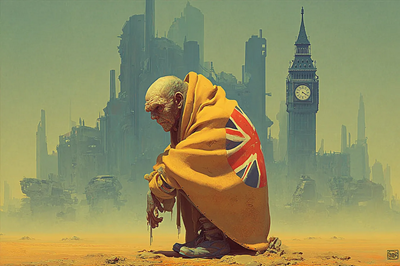
Image from Postcards from the Abyss
Britain is a disaster. The country seems to be in terminal decline.
Not only do we see a lack of ability to turn things around we witness leaders and prominent decision makers evidently clueless about normal life and the hardships many now face.
The political and media classes best reflect this phenomenon. Their views are insular, fictional and at odds with reality. They promote unorthodox ideas that are widely derided yet their enthusiasm is evident as are their hostile responses to being challenged.
Minor comments about immigration are treated as precursors to genocide. Criticism of a biased media unwilling to report events is dismissed as conspiracy. No discussion of climate policy and its unaffordable costs is tolerated. Deviation from the establishment view means excommunication and social exile.
Those in leadership positions drive Britain’s descent into authoritarian governance. Attempts to discuss changes to society leads to extreme overreactions, including jailing noticers, something they now boast about.
Britain has become a madhouse. Our leaders are unable to think like normal people. None of them are facing reality. They seem crazy.
Or, rather, they seem neurotic.
Neurosis is everywhere
Britain has degenerated into a technocratic regime that views the public as its enemy. Normal people disgust the country’s leaders and it shows. They no longer hide their contempt.
But there is a palpable sense of fear emanating from the powerful. Their reactions to normal events paint a troubling picture of who is leading the country, particularly the political and media classes.
If the British establishment were a person we would think them mentally unstable. The qualities we see most are those of a neurotic individual, a type that is well understood.
Here are some features visible in Britain’s ruling class.
Chronic anxiety and worry
A key attribute of neurosis is persistent fear or worry. Rumination is commonplace, circling around and around the same problems. There is also a tendency to overreact, with the response disproportionate to the issue at hand.
The current British regime is wracked with anxiety and worry. This defines them. They are vocal about their concerns.
We are reminded of an endless series of horrors we must attend to; systemic racism, lack of diversity, an imperial past and our cultural dominance along with our impact on the world.
One simple example illustrates the degree to which minds can become distorted by excessive worry.
James Watt perfected the steam engine in 1769 which kickstarted in the industrial revolution, changing the world forever. This would ultimately elevate most nations on earth and led eventually to the establishment of cheap abundant energy for almost everyone.
Until recently these events were viewed as an epoch-defining moment of engineering brilliance. Now this has been recast as a dark stain on Britain’s place in the world, with climate zealots keen to blame the British for all pollution caused by industrialization.
Instead of pride we now see embarrassment and even anxiety about the “damage” Britain has done to the world because it ushered in an era of cheap widespread energy for everyone.
Any rational person would understand this extreme view to be a distortion of reality and excessively negative, yet it permeates everything. Those who rule Britain are ashamed of our past. They worry about it. Only they do this, normal people are proud of our history.
[…]
Welcome to the madhouse
A system of governance driven by neurotics takes on their characteristics. Britain has become a neurotic bureaucracy; a neurocracy.
Neurotics overthink and live inside their heads. They lack the calm, detached strength needed to govern sensibly. Power structures inevitably take on these qualities.
The British government has become paranoid. Digital IDs, internet regulation, censorship. They jail normal people for social media posts. Dissenting views are increasingly punished with custodial sentences.
These are not the actions of the mentally strong. This is an embattled minority fighting reality and becoming desperate.
A gulf is opening between the rulers and the ruled. Increasingly no common ground is even conceivable as the fictions needed to maintain narratives grow. They become overtly false but are needed to feed the neurosis.
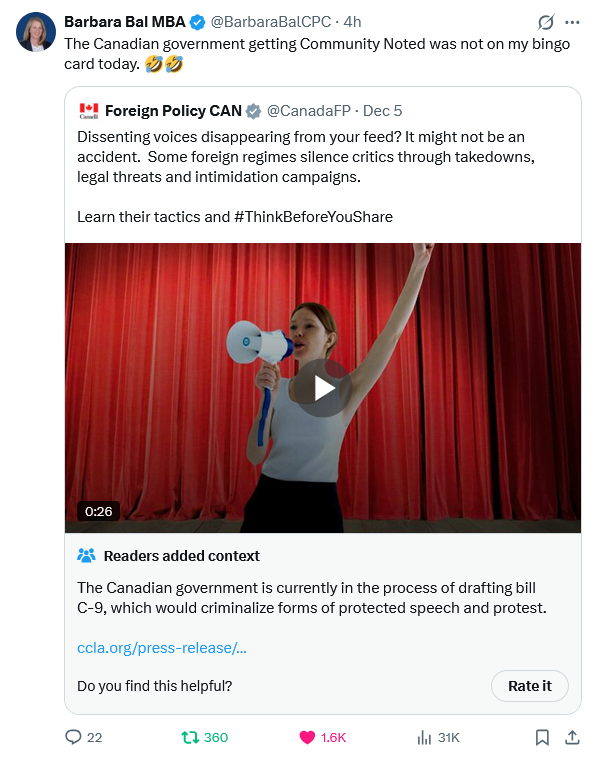
One of the things I like about the social media site formerly known as Twitter is how quickly authoritarian bullshit like this can get called out:
Update, 9 December: Welcome, Instapundit readers! Please do have a look around at some of my other posts you may find of interest. I send out a daily summary of posts here through my Substack – https://substack.com/@nicholasrusson that you can subscribe to if you’d like to be informed of new posts in the future.
December 5, 2025
Censorship and “cancel culture” are symptoms of a cultural sickness
A guest post at Woke Watch Canada by C.C. Harvey lays out the evidence that our culture — and most of the western world — is struggling with a spiritual sickness and that arbitrary cancellations and formal censorship of dissenting views are symptoms of that ailment:
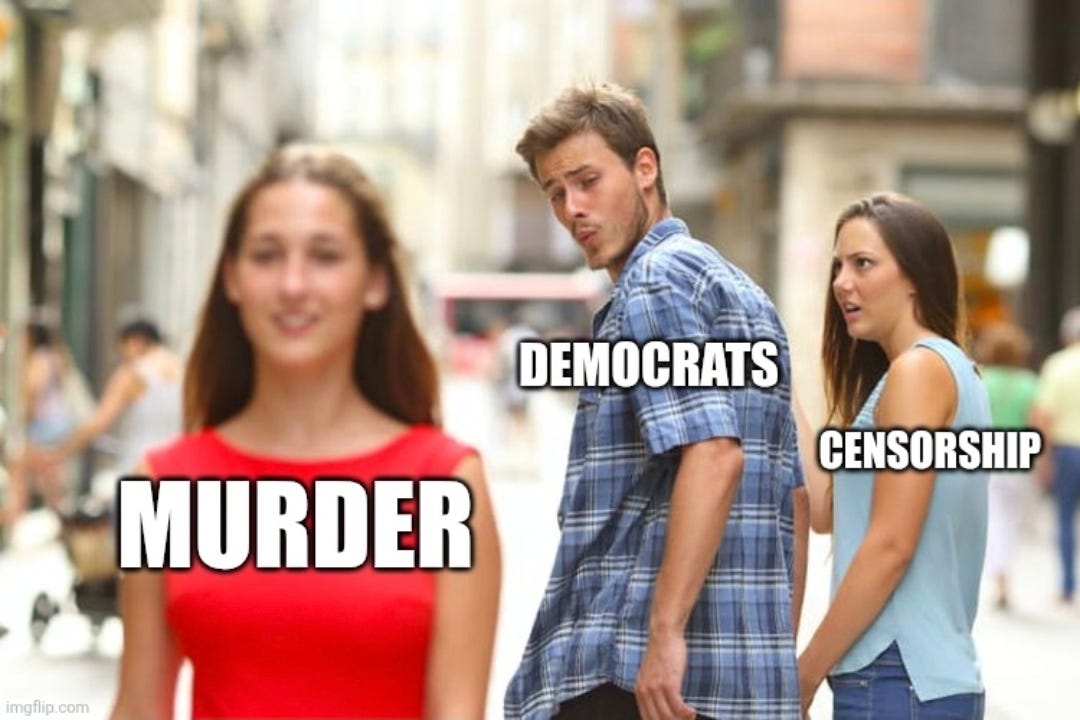
When a society begins to suppress intellectual and spiritual searching and dreaming — by punishing speech, regulating thought, discouraging questions, denying the existence of spiritual reality — it is not only a political decline, but a sign of deep unwellness.
Where populations lose respect for liberty of conscience, inquiry, and discourse, society becomes nasty and brutish. Truth-seeking, spiritual health, and peace are inexorably linked. Across formerly open, stable, safe western societies, censorship and repression have been rising as safety, cohesion, and quality of civic life decline.
We must resist cancel culture and speech codes for the following reasons:
- Suppressing Truth-Seeking Violates a Fundamental Human Impulse
Across religious and knowledge traditions, truth-seeking is expressed as a moral duty. When authorities obstruct honest questioning, they interfere with something built into the human spirit.
- Fear Becomes the Organizing Principle
Where dissent is forbidden, fear takes the place of reason. Fear diminishes moral clarity, discourages integrity, and pushes people toward silence rather than responsibility. A fearful society cannot become a virtuous society.
- Conscience Is Treated as a Threat Instead of a Gift
In every major tradition — religious or philosophical — conscience is seen as a source of moral insight. When institutions punish people for following their conscience, they reveal a belief that the individual soul has no intrinsic worth, only value as a compliant unit.
- Dialogue Is Replaced With Dogma
Healthy societies debate, persuade, and refine ideas through open conversation. Unhealthy ones replace discussion with mandatory narratives and speech codes. Leaders who fear questions fear the truth those questions might uncover. Dogma can be secular or religious. It is ideologically rigid, generally not truth-seeking.
- Collective Identity Replaces Individual Worth
Authoritarian systems elevate the group above the person: the party, the ideology, the movement, the “community”. When people are valued only as members of a group rather than as individuals, conscience becomes irrelevant and conformity becomes the main civic expectation. This is materialism, and denial of spiritual reality.
- Repentance and Correction Become Impossible
A culture that silences criticism cannot correct its own errors. Without the freedom to point out problems, there can be no course correction, no growth, and no accountability. Mistakes multiply because they are protected by enforced silence.
- The Vulnerable Are Punished First
Censorship and ideological enforcement nearly always fall hardest on those with the least power — dissidents, researchers, students, teachers, and ordinary citizens. When moral pressure is used to intimidate rather than uplift, society reveals a deeply inverted understanding of justice.
- Curiosity and Creativity Decline
When questions become dangerous, people stop asking. When our human body, spirit, and intellect work in tandem without fear, we are capable of incredible scientific, artistic, and intellectual discovery and achievement. A society that punishes inquiry slowly starves itself of spirit in the form of innovation and insight.
- Tribal Narratives Replace Shared Reality
When open debate disappears, competing ideological factions manufacture their own “truths”. Without a shared standard for evidence or meaning, society fragments into groups that can no longer communicate across boundaries. This is a recipe for distrust, polarization, and alienation … in dogmatically religious societies: a recipe for holy war and violent oppression.
- A Culture That Punishes Dissent Is Living by Avoidance, Not Truth
Suppressing dissent is always a sign that an ideology cannot withstand scrutiny. Societies that silence critics pretend confidence but are insecure. The greater the fear of open conversation, diverse thought, and public debate, the greater the underlying instability and spiritual decay.
- Each Soul’s Journey Is Sacred — And Faith Must Be Chosen, Not Forced
Across traditions, genuine belief is understood as something voluntary:
- Love and faith cannot be coerced.
- Insight cannot be mandated.
- Moral understanding cannot be imposed through fear.
A society that tries to control belief tries to destroy the inner space where thought, reflection, and integrity develop. Coerced belief is not belief; it is compliance. An individual’s free relationship with God is sacred. No human rightfully owns another’s body, mind, or soul.
Update, 7 December: Welcome, Instapundit readers! Please do have a look around at some of my other posts you may find of interest. I send out a daily summary of posts here through my Substack – https://substack.com/@nicholasrusson that you can subscribe to if you’d like to be informed of new posts in the future.
December 2, 2025
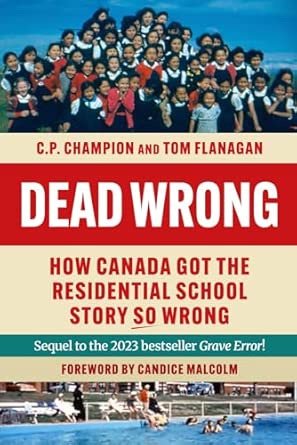
Dead Wrong: How Canada got the Residential School story so wrong
Juno News shares Candice Malcolm‘s foreword to Dead Wrong by C.P. Champion and Tom Flanagan:
Canada is off track. We’ve lost our way.
How else could we make sense of the moral panic produced from a half-baked report coming from a small Indian Band in Central British Columbia in the spring of 2021? In response, the country lost its mind. Following reports of 215 “unmarked graves” at the site of the former Kamloops Residential School, the supposedly trusted sources of our society – journalists, elected officials, academics and so-called experts – reported fiction as fact, without doing any due diligence or research into the still unproven and questionable claims of mass graves and secret midnight burials of hundreds of deceased children.
A failure of this magnitude doesn’t happen instantaneously. It’s built over time as those who profess to speak the truth deliver deception, doublespeak, and misinformation – all in the name of addressing some grievance, advancing an agenda, and creating a narrative.
The only conclusion we can now draw is that our country is not what it should be, not what it was.
There are a myriad of complicated reasons to explain our clear downward trajectory – institutional capture, a hard-left consensus among political and cultural elites (driven in large part by government-funded journalists and the state broadcaster pushing woke propaganda), a large and inefficient bureaucracy that stifles growth and
innovation, institutions built upon a moral code that became unfashionable, and so on.
Canada has become a feminist country that proudly discriminates against men and diminishes the role of mothers. It has become a post-national country that loathes its founders and openly discriminates against individuals based on skin colour. It isn’t just post-Christian, it’s anti-Christian – evident from the treatment of Evangelical prayer leader Sean Feucht, the coordinated attacks against him in the summer of 2025 and the cancellation of tour stops across the country, not to mention total disinterest and cover-up of the 120+ churches that have been decimated and destroyed in the wake of the unmarked graves fiasco.
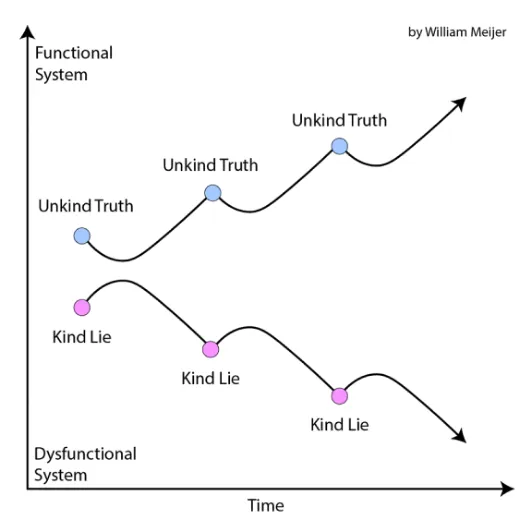
Over the past decade, we’ve witnessed our country fall from a functional system, into something almost unrecognizable.
The Canada I grew up in was safe, stable and secure. We knew our neighbours, we trusted institutions and didn’t worry too much about politics. Being Canadian meant something. We had a community, an identity, a shared purpose. Most of us believed in upward mobility and the Canadian dream: that if you work hard and play by the rules, you will have the same – or dare I say better – opportunities and quality of life than your parents.
This is clearly no longer the case for most Canadians under the age of 45, and that is a major problem for all of us.
I came across a simple social graph by William Meijer that clearly explains what has happened better than anything else I’ve seen. You could apply this to countries, companies and even personal relationships.
Simply put: kindness got in the way of truth.
Meijer writes the accompanying caption: “An extreme commitment to the truth makes relationships acutely dysfunctional but systems chronically functional (think Elon Musk).
An extreme commitment to kindness makes relationships acutely functional but systems chronically dysfunctional (think Sweden, UK).”
Canada perhaps represents the “kind dysfunction” better than any other place.
November 28, 2025
Social media isn’t completely a depressing waste of time
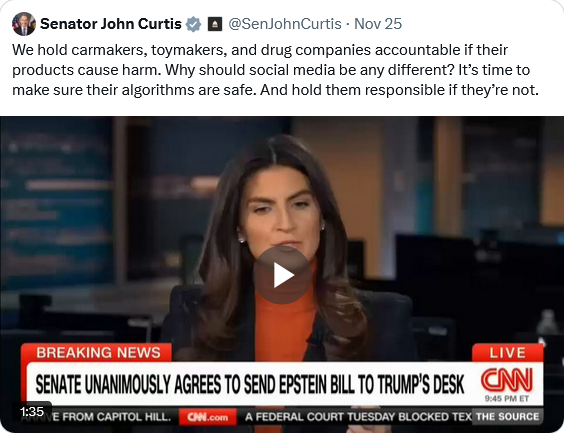
On the social media site formerly known as Twitter, Devon Eriksen reacts to a political hack who wants to impose regulations on social media that would allow him to shut down people who criticize him and other swamp creatures:
We all know what’s really going on here.
Utah senator John Curtis, and other political hacks like him, are getting their boomer asses handed to them on social media.
They long for the days of television, when they could control the narrative by having a cozy relationship with the networks, and so they could lie to you without fear of contradiction by some autist named @DataRepublican whose existence is solely defined by her full-time hobby of sniffing out lying dirtbags.
So they want to pass a bunch of laws to make the internet behave like television. To filter it all through a set of major website choke-points that they can control by threatening the corporate entities that run them.
Long, complicated, and vaguely defined liability laws are a tool to do that.
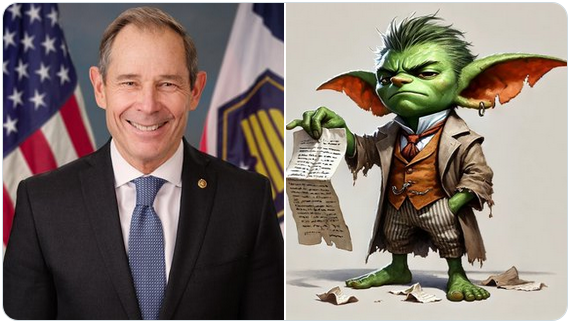
Basically what they do is allow John Curtis to put any website out of business if people say mean things about him on it, such as pointing out that he looks like some kind of deranged and malevolent goblin that just crawled out of a swamp.
The problem he has right now is that when I say stuff like that on Twitter, I’m the one who said it.
Not Twitter.
There’s nothing he can do to me. Because even if I get hit by a unmarked sedan tomorrow in a totally unrelated accident, there’s a million more people like me who are only too happy to point out that John Curtis looks like a deranged and malevolent goblin that just crawled out of a swamp.
So he wants legal tools to punish Twitter for what I said.
So how does he go about that? What is a deranged and malevolent goblin, with a “business management” degree, and a history of changing political parties when convenient, to do?
Why, muddy the waters with vague platitudes about “safety”, of course.
Except we’ve heard that song before, and we’re not interested. So let us laugh at him, remind him that he looks like a deranged and malevolent goblin that just crawled out of a swamp, and mock until he goes back to doing what he normally does, which is shilling for the “Fairness For High Skilled Immigrants Act”.
And then we can eventually replace him with someone who cares about fairness to actual fucking Americans.
Update, 29 November: Welcome, Instapundit readers! Please do have a look around at some of my other posts you may find of interest. I send out a daily summary of posts here through my Substack – https://substack.com/@nicholasrusson that you can subscribe to if you’d like to be informed of new posts in the future.
November 20, 2025
Our free-speech documentary has been cancelled! | A London cinema has banned Think Before You Post
spiked
Published 19 Nov 2025Our new documentary, Think Before You Post, about the rise of the British speech police, was due to have its premiere in London next week. Last night, the venue got in contact to say it would be cancelling our booking, because the event does not align with its “values”.
Here, spiked‘s Tom Slater tells all.
We are working flat-out to find a new venue for the same night. So if you bought tickets, do bear with us. But if we can’t find somewhere else in time, we’ll refund everyone and postpone it for a later date. If you’d like a refund now anyway, get in touch and we’ll process it.
At least they’re proving our point …
About spiked:
Founded in 2000, spiked was a pioneer of 21st-century journalism – the first online-only political magazine in the UK.
Now edited by Tom Slater, spiked reaches millions around the world with hard-hitting articles, incisive essays and a growing roster of podcasts and videos.


