The Korean War by Indy Neidell
Published 4 Nov 2025The Panmunjom peace talks continue, but a real sticking point is Kaesong- both sides insist that they must have control of it. Frustration mounts among the Allied journalists, though, as they are allowed less access to what’s going on than their Communist counterparts. Despite the talks, there’s new action in the field this week, as the Chinese attack in force to try and retake Maryang-san, a commanding strategic position.
Chapters
00:00 Intro
00:40 Recap
00:59 The Kaesong Issue
03:24 Voluntary Repatriation
07:14 US Command’s Position
09:15 All For All Repatriation
10:35 UN Censorship
12:29 Maryang-San
13:35 Summary
13:37 Conclusion
14:39 CTA
(more…)
November 5, 2025
The Korean War Week 72: UN Censors as Communists Speak! – November 4, 1951
Comments Off on The Korean War Week 72: UN Censors as Communists Speak! – November 4, 1951
October 17, 2025
Civilizational collapse is … female
On her Substack, Janice Fiamengo addresses the unpalatable contention that female power leads to civilizational disaster:
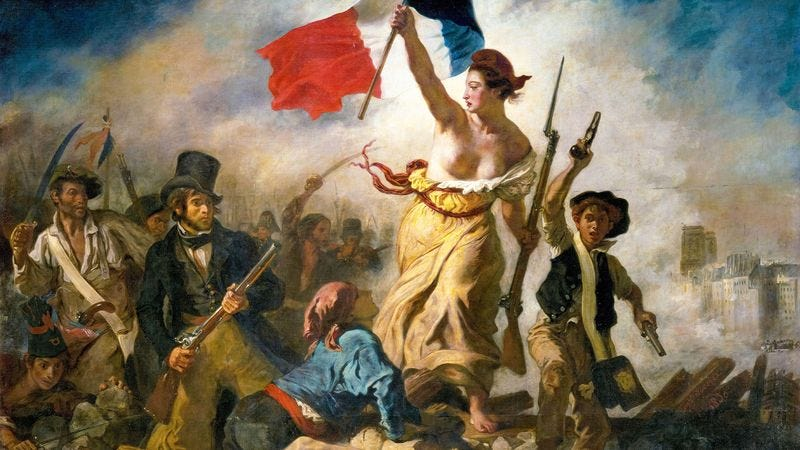
Liberty Leading the People by Eugene Delacroix
Multiple surveys (see, for example, with thanks to James Nuzzo, here, here, here, here, here and here) suggest that when women hold power, they pursue typically feminine preferences and policies. Female-led institutions become more oriented to social justice than objective truth. Feelings matter above facts, context above law, and victimhood above expertise.
Protecting and promoting the allegedly vulnerable — through censorship, shaming, coercion, or lawbreaking/lawfare — becomes a greater priority than excellence or impartiality. Truth-tellers find themselves cancelled, Nobel prize winners reduced to tears, laws and policies applied unequally, white men accused and vilified, criminals cossetted, mental illnesses affirmed, and destructive policies embraced. No one who has paid attention over the past 20 years can be surprised by the findings.
Moreover, our ability to discuss this feminine revolution in values is hampered by the very logic of the revolution, as I will show. Both women and men, deeply disinclined to “harm” women, fail to confront the problem adequately.
Two discussions of the subject — an essay by two social psychologists at Quillette and, more recently, a conference speech by a feisty conservative woman — draw a line under the seeming inevitability of the west’s collapse. Even faced with that alarming prospect, most pundits cannot bear to imagine an alternative to the female-led assault on our core institutions.
Cheering on Women’s Empowerment
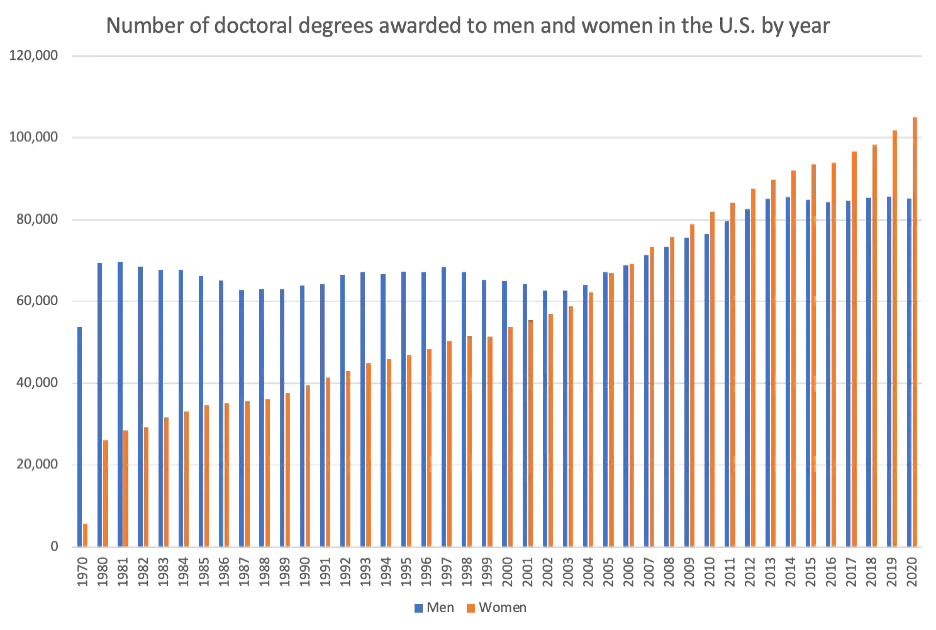
A 2022 article in Quillette, “Sex and the Academy“, provides a stark illustration of my thesis. The subtitle rules out the very conclusion the data supports, with the authors emphasizing that “The inclusion of women in higher education is a great achievement for Western liberal societies. How is this changing academic culture?”
The “great achievement”, as it turns out, will almost certainly be a lethal one.
The article was written by two academics, Cory Clark and Bo Winegard, both PhDs in social psychology. Winegard, a male scholar, had an unfortunate run-in with academic orthodoxy that led to his loss of employment; Clark, a female scholar, has a secure academic position. Both authors express enthusiasm for the takeover of academia by women even as they point out its damaging consequences. Neither one advocates any form of resistance, no matter how mild, to feminine academia’s assault on truth.
Summarizing the results of many surveys, Clark and Winegard demonstrate that while a majority of men favor free speech and the advancement of knowledge over emotional comfort, a majority of women prefer conformity, safety, and the protection of victim groups’ feelings. Not all women are indifferent to the traditional underpinnings of western civilization (and not all men support those underpinnings), but the general trends are clear.
Women are significantly more likely than men to support the cancellation of controversial speakers or the suppression of controversial research.
Women also tend to favor the existence of snitch lines to report people who cause offence. Women are more supportive than men of diversity quotas that exclude white men from consideration for prizes, positions, and promotions. (It would be interesting to know how many white women support diversity quotas that exclude white women from consideration for prizes, positions, and promotions.)
[…]
Asserting that both sides are pursuing worthy goals, the authors downplay the shock value of the findings, which show that women are, overall, less interested in truth and accuracy than men are. Imagine assessing such a finding as anything but catastrophic. Imagine calling the disregard for truth moral.
In place of truth, women value a utopian ideology that they perceive — usually without any consistency or adherence to fact, but nonetheless granted by Clark and Winegard — as “morally desirable”. But morally desirable for whom, and to what end? The use of the phrase, a misnomer, demonstrates how thoroughly the authors themselves are in thrall to the corrosive feminine culture they examine.
There is nothing moral (or generally desirable) about the suppression of truth-seeking research when it conflicts — or is perceived to conflict — with an allegedly emancipatory social goal. There is nothing morally desirable or indeed “protective” about shouting down an academic speaker because of the alleged harm of the speech. Naturally, social justice proponents would be outraged if their speeches were shouted down or their research blocked and censored.

I saw a link to this Helen Andrews article which seems to go well with Janice Fiamengo’s article linked above describing the “Great Feminization”:
… Cancel culture is simply what women do whenever there are enough of them in a given organization or field. That is the Great Feminization thesis, which the same author later elaborated upon at book length: Everything you think of as “wokeness” is simply an epiphenomenon of demographic feminization.
The explanatory power of this simple thesis was incredible. It really did unlock the secrets of the era we are living in. Wokeness is not a new ideology, an outgrowth of Marxism, or a result of post-Obama disillusionment. It is simply feminine patterns of behavior applied to institutions where women were few in number until recently. How did I not see it before?
[…]
The substance fits, too. Everything you think of as wokeness involves prioritizing the feminine over the masculine: empathy over rationality, safety over risk, cohesion over competition. Other writers who have proposed their own versions of the Great Feminization thesis, such as Noah Carl or Bo Winegard and Cory Clark, who looked at feminization’s effects on academia, offer survey data showing sex differences in political values. One survey, for example, found that 71 percent of men said protecting free speech was more important than preserving a cohesive society, and 59 percent of women said the opposite.
The most relevant differences are not about individuals but about groups. In my experience, individuals are unique and you come across outliers who defy stereotypes every day, but groups of men and women display consistent differences. Which makes sense, if you think about it statistically. A random woman might be taller than a random man, but a group of ten random women is very unlikely to have an average height greater than that of a group of ten men. The larger the group of people, the more likely it is to conform to statistical averages.
Female group dynamics favor consensus and cooperation. Men order each other around, but women can only suggest and persuade. Any criticism or negative sentiment, if it absolutely must be expressed, needs to be buried in layers of compliments. The outcome of a discussion is less important than the fact that a discussion was held and everyone participated in it. The most important sex difference in group dynamics is attitude to conflict. In short, men wage conflict openly while women covertly undermine or ostracize their enemies.
Bari Weiss, in her letter of resignation from The New York Times, described how colleagues referred to her in internal Slack messages as a racist, a Nazi, and a bigot and—this is the most feminine part—”colleagues perceived to be friendly with me were badgered by coworkers.” Weiss once asked a colleague at the Times opinion desk to get coffee with her. This journalist, a biracial woman who wrote frequently about race, refused to meet. This was a failure to meet the standards of basic professionalism, obviously. It was also very feminine.
Men tend to be better at compartmentalizing than women, and wokeness was in many ways a society-wide failure to compartmentalize. Traditionally, an individual doctor might have opinions on the political issues of the day but he would regard it as his professional duty to keep those opinions out of the examination room. Now that medicine has become more feminized, doctors wear pins and lanyards expressing views on controversial issues from gay rights to Gaza. They even bring the credibility of their profession to bear on political fads, as when doctors said Black Lives Matter protests could continue in violation of Covid lockdowns because racism was a public health emergency.
[…]
The Great Feminization is truly unprecedented. Other civilizations have given women the vote, granted them property rights, or let them inherit the thrones of empires. No civilization in human history has ever experimented with letting women control so many vital institutions of our society, from political parties to universities to our largest businesses. Even where women do not hold the top spots, women set the tone in these organizations, such that a male CEO must operate within the limits set by his human resources VP. We assume that these institutions will continue to function under these completely novel circumstances. But what are our grounds for that assumption?
The problem is not that women are less talented than men or even that female modes of interaction are inferior in any objective sense. The problem is that female modes of interaction are not well suited to accomplishing the goals of many major institutions. You can have an academia that is majority female, but it will be (as majority-female departments in today’s universities already are) oriented toward other goals than open debate and the unfettered pursuit of truth. And if your academia doesn’t pursue truth, what good is it? If your journalists aren’t prickly individualists who don’t mind alienating people, what good are they? If a business loses its swashbuckling spirit and becomes a feminized, inward-focused bureaucracy, will it not stagnate?
If the Great Feminization poses a threat to civilization, the question becomes whether there is anything we can do about it. The answer depends on why you think it occurred in the first place. There are many people who think the Great Feminization is a naturally occurring phenomenon. Women were finally given a chance to compete with men, and it turned out they were just better. That is why there are so many women in our newsrooms, running our political parties, and managing our corporations.
On the social media site formerly known as Twitter, John Carter comments on Helen Andrews’ article:
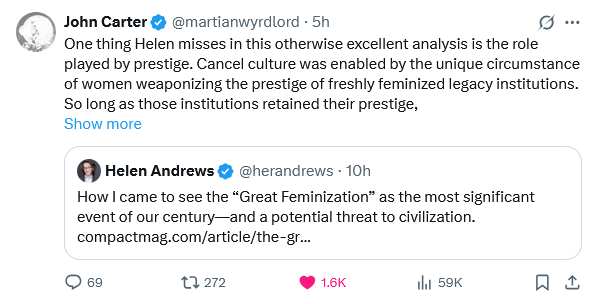
One thing Helen misses in this otherwise excellent analysis is the role played by prestige. Cancel culture was enabled by the unique circumstance of women weaponizing the prestige of freshly feminized legacy institutions. So long as those institutions retained their prestige, what the people who ran them said really mattered.
Unfortunately for the ladies (but luckily for civilization), this is self-limiting, because prestige is fundamentally an emergent property of masculine competence hierarchies. We see this demonstrated whenever a profession becomes coded as women’s work: its prestige immediately crashes. Feminists have complained about this for years, though of course they misunderstand the mechanism (prestige is a component of male sexual attractiveness, but not of female, and this is biologically hard-wired).
This prestige collapse is now affecting essentially every coopted, feminized institution — universities, news media, publishing houses, movie studios, large corporations, various government agencies, hospitals, courts, churches, all of them wield far less cultural power than they did even a few years ago. The only people who really care what these legacy institutions say are the women who took them over. To everyone else, the angry sounds they make are nothing more than background noise.
This is probably the main reason for the vibe shift. Once the prestige of feminized institutions declined below a certain threshold, their ability to enforce social consensus began to evaporate.
It’s also probably no accident that the Trump administration seems to care a lot more about what the anons of the Online Right say than it does about the opinion of the universities or the news media. All the intelligent young men got pushed out of the institutions, and those ionized particles of free male energy then began to self-assemble online into an ad hoc competence hierarchy where prestige is measured by clout rather than professional degrees, job titles, or institutional affiliations. The anon swarm is entirely informal, meaning that its outcomes are not amenable to antidiscrimination legislation or to procedural manipulation; you can screw with the algo all you want but you can’t actually force people to care what women say just because they’re women (thereby placing women into the position of openly trading in thirst, which gets them attention but certainly doesn’t mean that anyone has to pretend to take them seriously).
All that’s happened so far is that people’s attention has been redirected away from crazy woke females and towards the influencers of the online right. The fever has broken but society is a long way from recovered. The institutions are still under the control of crazy woke females, and this is extremely bad, especially because they are – for biological reasons related to childlessness — only going to get crazier as time goes on. Fortunately no one really cares what they say anymore, so as they throw tantrums as the institutions are reclaimed over the next decade or so, their protests won’t register as anything but irrelevant toddler noise.
Comments Off on Civilizational collapse is … female
October 10, 2025
We have to destroy European democracy to save European democracy
Every week it seems like the undemocratic powers-that-be in Europe have had to pull legalistic strings to ensure that the popular will is not translated into political power in nation after nation. Unsurprisingly, the candidates and parties subject to these serial interferences are almost all populist and right-wing. On his Substack, Frank Furedi explains “the EU’s quest to monopolize the doctrine of the Truth”:
Army of Fact Checkers – Roots & Wings with Frank Furedi
In recent years globalist institutions – including the European Union Commission have become obsessed with the circulation of disinformation. In particular, they point the finger of blame on outside external actors whose fake news supposedly threatens the very existence of democracy. According to the EU Commission “Foreign information manipulation and interference is a serious threat to” European values. It claims that “it can undermine democratic institutions and processes by preventing people from making informed decisions or discouraging them from voting1.
The narrative of foreign misinformation is invariably used to discredit political parties and electoral results that are not to the liking of the centrist technocratic elites that run the EU as well as numerous western governments. Foreign information manipulation served as an excuse to bar a populist candidate from running for the post of the President of Romania. Since by all accounts he was the likely winner of this contest his elimination from the race could be interpreted as a soft coup d’etat. Similar objections were made about foreign interference during the referendum for Brexit as well as during the recent elections in Moldavia and Czechia.
Alarmist accounts of the threat posed by foreign information manipulation rest on the claim that the circulation of so much unreliable information makes it impossible for people to make an informed choice. Yet the electorate has always faced the challenge of having to distinguish factually accurate claims from false ones. Public life was always forced to confront the problem of who to believe and whose words are trustworthy. Throughout history different actors and technologies were blamed for misleading people with false information and dangerous ideas. In ancient Greece it was the smooth-tongued demagogue who could effortlessly and purposefully transmit lies to capture the attention of the public, who served as the personification of misinformation. During the centuries to follow the finger of blame has been pointed at books, mass-publication newspapers, radio, television and now the Internet
Since information manipulation has played an important role in the political life of western societies since the 18th century, it is far from evident why the contemporary public should no longer be able to make “informed choices” and why they should feel discouraged from voting? Despite the recent EU Commission induced panic about information manipulation, the percentage of people voting in the 2024 EU elections was 51 percent, the highest rate of turnout since 1994, when it was 56 percent.
People have always had to contend with fake news and propaganda. So why should they be more likely to be fooled by it today than in the past? The standard argument used to justify this EU elite promoted panic is that new technologies “have made it possible for hostile actors to operate and spread disinformation at a scale and with a speed never seen before”.2 It is worth remembering that the same arguments were used to warn against new information technologies since the 19th century. Even in the late 20th century the media was blamed by politicians for their electoral failures.
Kirsten Drotner has used the term media panic – that is a panic about the media -to highlight the recurrent tendency for change and innovation of the media to incite anxiety and fear.3 Such reactions were a response to the expansion of both publishing and the reading public in the 18th century. The expansion of the media and its commercialization created an environment where competing views and opinions helped foster a climate where the question of which sources could be trusted were raised time and again.
- https://commission.europa.eu/topics/countering-information-manipulation_en
- https://commission.europa.eu/topics/countering-information-manipulation_en
- Drotner, K.(1999) “Dangerous Media? Panic Discourses and Dilemmas of Modernity”, Paedagogica Historica: International Journal of the History of Education, 35:3, 593-619.
Comments Off on We have to destroy European democracy to save European democracy
October 9, 2025
Britain is only a few steps further than Canada in the war on free speech
In The Line, Peter Menzies looks at the worsening situation for freedom of speech and freedom of expression in Britain, noting that what’s happening over in Blighty is our immediate future with current Liberal bills before Parliament to give government bureaucrats more power to silence us:
Everyone may know, for instance, that Kimmel got suspended by ABC for a week following statements made in the wake of the assassination of Charlie Kirk. But not a lot of people consuming Canadian media know that in the U.K., comedians weren’t just getting one-week suspensions. Nope. Last month they were getting arrested.
Right-wing icon Katie Hopkins, best known for her Batshit Bonkers Britain clips and Silly Cow tour, hadn’t been charged at the time of writing, but was arrested and, as they say in Blighty, “interviewed under caution”. Previously, Graham Linehan was arrested upon his return from the United States by five armed police officers at Heathrow Airport. At issue were posts he had made on X in April.
“If a trans-identified male is in a female-only space,” one Linehan post declared, “he is committing a violent, abusive act. Make a scene, call the cops and if all else fails, punch him in the balls.”
Currently on bail, Linehan returns to court on Oct. 29. The charges are harassment, criminal damage and suspicion of inciting hatred.
The merits of the cases can be debated, but my point today is that when it comes to digital policy and policing you, and the internet, Canadians and their media should be paying a lot more attention to the U.K.
Because it is there that the true illiberalism of modern Western so-called liberalism is most menacingly embraced. Even prior to the U.K.’s Online Safety Act coming into effect, pre-existing British legislation had been used to, for instance, convict six retired police officers for making comments “deemed to be offensive” within their private WhatsApp chat group. Following the Southport mass stabbing murders of little girls, at least two women with no prior history with police were given prison sentences — one for 15 months for a Facebook post calling for a mosque to be blown up, another 31 months for a tweet calling for hotels full of migrants to be burned. While their comments were certainly worthy of vigorous condemnation, the intervention of the state into private, closed conversations and the involvement of police, courts and the penal system has taken matters in the U.K. to a level inconsistent with liberal traditions.
Now that the Online Safety Act has supplemented those laws, hundreds of people have been arrested and dozens so far convicted for social media posts. The government calls the act a “new set of laws that protect children and adults online” in much the same way Justin Trudeau explained Canada’s own Online Harms Act. It’s all about “safety”.
Online Harms may have died when Parliament was prorogued last winter, but a successor is anticipated and, given Prime Minister Mark Carney’s obvious Anglophilia, it’s easy to speculate — fear is a better word — that he is taking inspiration from the Brits. After all, up until a few months ago, he was one of them.
Fighting back in the U.K. is, among others, Lord Toby Young, the Conservative peer, associate editor of The Spectator and founder of the Free Speech Union, which now has a Canadian branch featuring, among others, journalist Jonathan Kay. Young has protested that criminalizing disinformation hands governments the power to determine truth. Nevertheless, while Prime Minister Sir Keir Starmer has muttered that maybe the police have more important things to do, he shows — despite the meteoric rise in the polls of Nigel Farage’s Reform Party — no inclination to order a digital retreat.
In fact, Starmer just doubled down with the introduction of legislation imposing mandatory digital IDs. A petition opposing it and the potential to enable mass surveillance and state control has already gathered close to three million signatures.
There’s a good chance the Canadian Free Speech Union will be similarly engaged in the years ahead. The Trudeau government’s instincts when it came to digital legislation were not as extreme as Britain’s. And there are very real differences in the legal structure of free-speech rights in Canada and the U.K. — we have the Charter, and the British don’t. So our laws would be enacted and enforced differently here than they can be the the U.K.
Comments Off on Britain is only a few steps further than Canada in the war on free speech
October 6, 2025
“Hate speech” bans work perfectly to eliminate mean words and mean thoughts … and the rivers will run uphill
I have to assume that the headline captures the mentality of the people who call for more “hate speech” legislation, because the real world evidence clearly fails to support the notion. Many well-meaning people want the government to have the power to suppress speech they don’t like, never thinking that a different government could use the same laws to quash opinions they support. In the National Post, Chris Selley argues that the last way to achieve reconciliation with First Nations would be to ban “residential school denial”:

Two years ago, I ruefully predicted that Canada’s new law purporting to outlaw Holocaust denial would likely lead to a law purporting to outlaw “denying” the impact of the residential school system. That hasn’t happened yet, but we are well on our way.
The Liberals recently announced plans to table legislation that would purportedly outlaw displaying the Nazi or Hamas flags or symbols of other hate movements, and that has only intensified calls for that law outlawing “residential school denialism”, or indeed denying Canada’s “genocide” against Indigenous peoples.
“What is the difference between Holocaust Denialism and Residential School Denialism? I suggest there is no difference at all,” author Michelle Good wrote in the Toronto Star Tuesday on the occasion of the National Day for Truth and Reconciliation. “The inclusion of Holocaust Denialism in the criminal code is obviously to prevent the denial of the Jewish genocide of World War II. Therefore, after clearly illustrating that the residential school system was genocidal in nature and intent, it is difficult to find any reason whatever that Residential School Denialism should not be criminalized as well.”
I say these two new and proposed new laws would “purportedly outlaw” atrocity-denialism and hate symbols because they aren’t outright bans on the speech in question. Rather, to fall foul of them, you have to use your argument, flag or symbol to “wilfully promote hatred” against the group in question. It was and is already illegal to wilfully promote hatred against a religious or ethnic group — albeit with some huge caveats, more on which in a moment.
At some point in the future, should the Liberals remain in power — and perhaps even if they don’t — the government is likely to knuckle under to the calls for censorship of certain residential-school opinions. It’s just not worth the political blowback to object, or so one can imagine a backroom strategist reasoning. They would probably introduce the new law just in time for the National Day for Truth and Reconciliation. If police are willing to enforce these laws, there’s little reason to believe Crown prosecutors would be interested in pursuing the cases. That, in turn, would only frustrate the people who see value in this censorship, and would likely lead to ever-stronger laws … that themselves likely wouldn’t be enforced.
This is not good lawmaking, and it’s a chilling argument when the simple act of pointing out how many bodies have actually been discovered on former residential school sites is widely considered a form of “denialism”.
Comments Off on “Hate speech” bans work perfectly to eliminate mean words and mean thoughts … and the rivers will run uphill
September 8, 2025
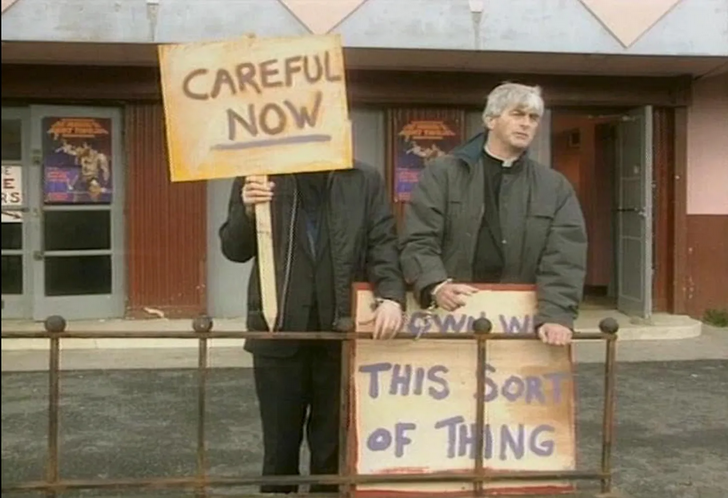
“Down with this sort of thing!”
In the free-to-cheapskates part of Ed West’s post on the Graham Linehan case in Britain, he identifies one of the reasons that Linehan’s Father Ted became so popular in the country it was situated in:
I don’t think I’d seen a “down with this sort of thing” placard in the flesh since I watched the Protest the Pope march back in September 2010. Those were the heady days of New Atheism, before the movement evolved into something more explicitly progressive.
The sign references an episode of the 1990s comedy Father Ted, in which the protagonist and his dim-witted sidekick Fr Dougal are forced to protest the screening of a blasphemous new film called The Passion of Saint Tibulus. Among the many catchphrases popularised by the comedy, back in 2010 this one suggested an ironic and gently mocking attitude to religion; that it was ridiculous, rather than evil.
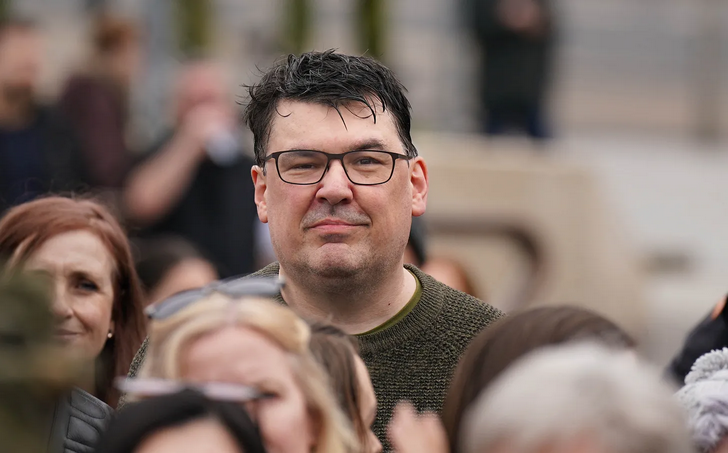
This week, outside Westminster Magistrates’ Court in Marylebone Road, the sign appeared in a rather different context, carried by supporters of Father Ted co-creator Graham Linehan as he faced charges of harassment and criminal damage in an ongoing trial, following an incident at last year’s Battle of Ideas involving a young transgender activist.
Linehan had been bailed before trial, allowing him to travel to the United States to work on a new comedy project. When he arrived back at Heathrow on Monday, however, he was arrested by five armed police officers over three tweets he had posted back in April. The situation was as absurd and surreal as anything that had emerged from the writer’s fertile imagination.
As Linehan described it on his substack: “When I first saw the cops, I actually laughed. I couldn’t help myself. ‘Don’t tell me! You’ve been sent by trans activists’. The officers gave no reaction and this was the theme throughout most of the day. Among the rank-and-file, there was a sort of polite bafflement. Entirely professional and even kind, but most had absolutely no idea what any of this was about.”
The incident is embarrassing to Britain as it faces increasing scrutiny in the US for its poor record on free speech, especially over the Lucy Connolly case. It was unfortunate timing that this arrest happened just as Nigel Farage was heading in the other direction to talk about this very issue in Washington. But Linehan’s ordeal is also part of a much longer and sadder story about the perils of the political meeting the personal.
Arthur Mathews and Graham Linehan had worked on The Fast Show before renowned comedy producer Geoffrey Perkins had taken to one of their ideas, about a group of priests stuck on a remote Irish island, proposing that it be written as a six-part sitcom. It was brilliant, and hugely loved, and in its timing was significant.
Conor Fitzgerald wrote of Father Ted that, while well-loved in Britain, in Ireland it is more like “the national sitcom, a piece of light entertainment that nevertheless Says Something Meaningful About Us”. It also appeared at a crucial time in history.
Not only was Father Ted one of the few successful TV representations of Ireland, it was made during Ireland’s version of the Swinging Sixties, our flux decade of the Nineties. The accelerating collapse of the Church and the exposure of longstanding political corruption coincided with the dawn of the Celtic Tiger years, lending peripheral Ireland a sense of self-conscious modernity. It was a unique national turning point, where our 19th-century past seemed to co-exist with our 21st-century future. In reflecting this upheaval, Father Ted has become not just a social historical document, but a portent of where Ireland stands today.
When Ted was broadcast, the Church was formally still one of the central pillars of Irish life, but its authority rang hollow. Priests often felt like administrators of a vanished country. And on remote Craggy, Ted, Dougal and Jack mirror this directly. All good sitcoms feature characters who are trapped, but Ted is doubly so: first on his island; and second in an institution people are coming to see as irrelevant. He is still an essential member of the community, more than just a ceremonial functionary for weddings and funerals. But it’s just not clear what the essential thing he does is anymore, beyond being a common reference point that deserves token respect.
Ted and Ted therefore stand at a crossroads, and capture the more fundamental social change in Ireland at this time: the collapse in respect for older establishment hierarchies generally.
Those establishment hierarchies collapsed across the West in the late 20th century, first in more secularised nations such as Britain and France and later, and more quickly, in places like Ireland and Spain where the Catholic Church still held on.
The Church lost its power to patrol its taboos, without which it became a sitting duck for satirists; the Passion of St Tibulus was influenced by the protest against Life of Brian, successfully banned in Ireland until 1987. As a teenager, Linehan had to join a film club to watch it, but such censorship was disappearing everywhere.
Father Ted was a work of genius, employing a surreal style of humour that has often been characteristic of Linehan and Mathews, and later seen in their under-appreciated sketch show Big Train – including the brilliantly bizarre sketch in which Beatles producer George Martin is kidnapped by Hezbollah.
The clerical comedy bequeathed numerous catchphrases. “I hear you’re a racist now, Father”, which features in an episode where Fr Ted is wrongly accused of anti-Chinese prejudice, is still a popular meme. Likewise, “These are small, but the ones out there are far away“, Ted’s explanation of perspective to his idiotic housemate, is still used to mock the gormless.
The show was also charming, and its treatment of religion was far from vicious. Rather than being a vitriolic attack on Church authority, Father Ted poked gentle fun at the absurdity of the old order, a kind of mockery which is perhaps a more dangerous threat to a belief system that relies on awe and fear. It was innocent, and many years later Linehan said he would find writing Father Ted much harder in light of the abuse scandal.
Comments Off on “Down with this sort of thing!”
August 27, 2025
In praise of the book
Ted Gioia contemplates the glorious future of the book:

A decades-old bookmark from a Toronto Book City location (probably the store on the Danforth near Chester).
Can you imagine data storage that never needs an upgrade. Even better, there’s no subscription fee. And the system never crashes — there hasn’t been a single minute of down time in recorded history.
And there’s still more:
- There are no terms of service.
- No hidden fees.
- No customer service bots to deal with.
- No annoying follow-up spam emails and texts.
- No privacy intrusions or surveillance of any sort.
- No data incompatibility issues now or in the future.
- No advertising or solicitations of any sort.
The list continues — no cookies, no credit cards, no come-ons, no conditions. None of that.
What a miracle!
I’m talking about my favorite handheld device, and I don’t need a cloud to hold its contents. Just a shelf.
You guessed it — I’m referring to books. They’re the greatest hard storage concept in human history, and nothing else comes close.
The book is the ultimate killer app.
People have been predicting the death of the book for decades. The Internet was going to make them obsolete. But somehow they survived.
The launch of the Kindle in 2007 posed a bigger threat. Even I was convinced — at least for a while. I bought a Kindle and tried it out, plunging with enthusiasm into the world of eBooks and digital storage.
But a month later, I’d returned to physical books. It was a better experience in every way.
It didn’t help when Amazon started deleting books from Kindles. Much to the customers’ surprise, they learned that they didn’t own the book they had bought — they were merely “purchasing a license to the content“.
Access can be terminated. And Amazon is the ultimate terminator.
That’s never happened to any physical book on my shelf. I own thousands of them, and nobody has ever revoked my access. I can also sell or give them to others, and they will retain rights in perpetuity.
You can’t do that with a Kindle. You’re not allowed to sell an eBook. You can’t even donate it to a library. Your license is restricted and non-transferable.
But transferability is how books and literary culture survive. Books are supposed to move without friction across generations and borders and boundaries. Some books have had dozens of owners over hundreds of years — creating a legacy unknown in the world of digital technologies.
Even more insidious, Amazon will update books on your Kindle — changing the text without the reader or author’s permission. That’s happened, for example, to books by Roald Dahl, R.L. Stine, Ian Fleming, and Agatha Christie. If somebody in a position of power decides that an author’s work is problematic, your e-book gets cleansed.
Comments Off on In praise of the book
August 17, 2025
To replace a people, first you need to induce guilt and self-hate
On his Substack, Frank Furedi discusses just how negatively the British establishment views the national flag and those uncultured boors who display it:
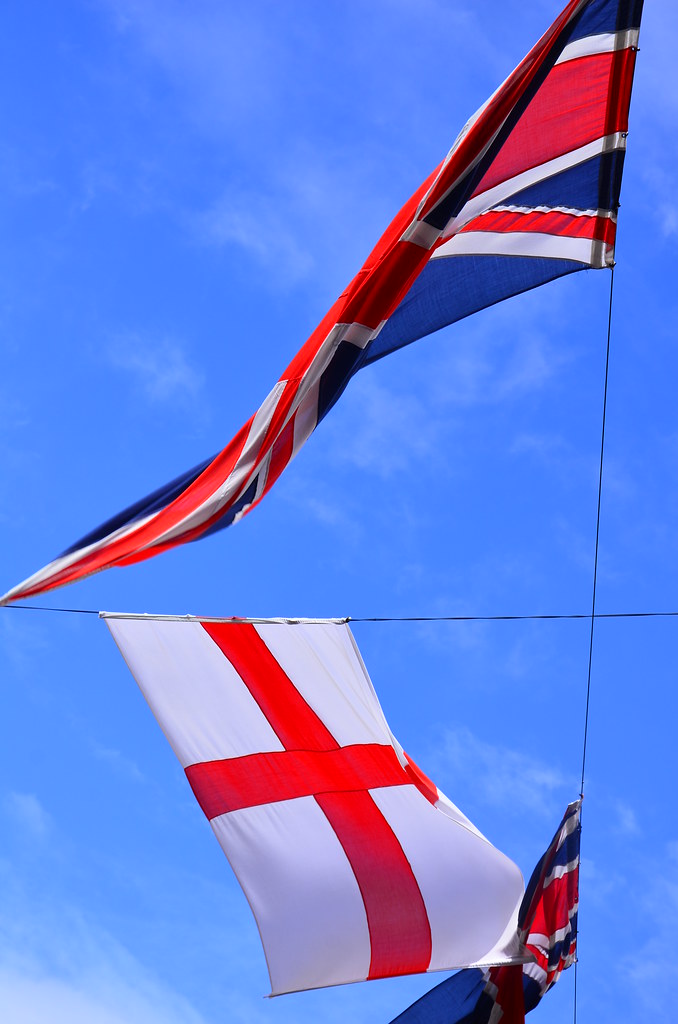
“Union Jacks and crosses of St George” by Ben Sutherland is licensed under CC BY 2.0 
 .
.
First a confession. I am not a serial flag-waver. In fact, one of the features of British history that I always appreciate is that its people possessed so much confidence about itself that it did not see the need for ostentatious displays of patriotism and flag waving. However, today matters are different. The nation’s cultural and political elites regard the Union Jack and the St George’s Cross — the flag of England — with embarrassment and studied contempt. Today many British institutions would rather fly the Palestinian flag or the LGBTQ+ or of Ukraine than flags that bear the nation’s symbols. Outwardly pride in Britain is in danger of being displaced by the sentiment of self-loathing.
Foreign observers are often surprised by the relative absence of Britain’s flag in public spaces. As one such observer noted recently, in Oxford Pride flags are outnumbered the Union Jack “by at least fifty to one”. He noted that the “next day in London, I saw Pride flags all about, with the Union Jack reserved for tourist sites like the Tower of London, which also sported Pride flags”.
In fact, the British Establishment’s reaction towards England’s flag is often communicated through the sentiment of ridicule and hatred. This sentiment has been embraced by local councils, particularly ones that are under the influence of Labour and the Lib Dems. Many of them feel entitled to prevent these flags from being displayed. Most recently the Birmingham’s Labour dominated council has ordered the removal of Union and St George’s flags from lamp posts in this city. The Council announced its decision to remove the flag on the ground that they put the lives of pedestrians and motorists “at risk” despite being up to 25ft off the ground! Needless to say, the Council applies a different standard of judgment when it comes flying the Palestinian flag, which are flown all over the City. Presumably this flag does not constitute a danger to motorists and pedestrians.
In Birmingham, Britain’s second largest city flying the flag of the nation is regarded by local officialdom as a risk to safety.
The British Establishment feels contempt towards not only Britain’s flags but also towards the people who enthusiastically identify with them with patriotic pride. An incident involving Emily Thornberry, Labour MP for Islington South, in November 2014 captures well the contempt that significant sections of the British political class have towards the symbolic displays of patriotism. During a by-election campaign in Rochester, she posted a photo of a house displaying three St George’s flags, with a white van parked outside, and accompanied it with the arch caption, “Image from #Rochester”. The implication of her post was that those who decorated their house with the flags of England were a legitimate target of disdain. Since they were obviously morally inferior to her superior kind there was no need for a caption explaining this on her post.
Millennial Woes discusses how the contempt of the elites for the British people is leading to increasing possibility of civil unrest … or worse:
The short answer as to “why?” is that, even in mid 2025 when many people are sensing a mood developing, the government is still doing all the things that are bringing that mood about. They have no reverse gear. Despite their rhetoric, they are not reducing immigration and are certainly not doing mass deportation. In addition we have learned that, for years, they have been covertly propagandising us. Meantime the hate speech laws which muzzle us are still in force and being strengthened. Recently, the Online Safety Act came into force and the very next day numerous internet platforms had to start censoring content. We can literally see our oppression increasing in real-time. And even now, they want more. Always, we feel the government trying to stop us talking about its abuse of us. (Even as I type these words, I am aware that they could get the police raiding my home and seizing my devices.)
Image from Millennial Woes
The same is true in the media. This morning I heard that the BBC are making a high-profile drama about 11th Century Britain in which a key historical figure will be played by a Black actor. Our news media is still biased in favour of mass immigration at any cost. Adverts are still full of black-man-white-woman couples. It is relentless.
In business, White people are handicapped by preferential treatment for non-whites in employment, business loans and career opportunities. A few days ago I got an advert on YouTube featuring a business consultant woman who defiantly said “at the end of the day, diversity is the key to success”. Middle-class White people habitually work against each other and their group interests, causing personal failure and burning resentment for many of their ethnic kin.
It doesn’t actually matter whether the people who perpetuate all of this truly “believe” in it. What matters is that they are prepared to behave as if they do. The incentives have taken on a life of their own, become self-perpetuating, making alternatives almost illegal and certainly a guarantor of “social death” and “professional death”. Even with all the evidence that diversity is bad, nobody in the professional class will dare to speak against it because, even now, that would be the end of their career. And so the poisoning continues.
In short, I feel that my country’s mainstream is working constantly against my ethnic group surviving. Furthermore I see no end in sight for this ethnic sabotage.
And many other people think the same – more and more all the time, in fact. This is why they are getting ever more angry.
Among young people there are more reasons still, economic pressures which mean they can’t get on the property ladder and build the security to start a family. That is immensely frustrating for a lot of energetic young adults, and they haven’t got (haven’t been able to get) much to lose. When a society doesn’t facilitate this most basic desire in people, it should expect upheaval.
However, against this backdrop of oppression, dysfunction and madness, the main catalyst for civil unrest will be something much more concrete: refugees sexually assaulting White women and children. Such crimes are now occurring every day. Unfortunately, there is no reason why they will lessen in frequency. (I will not endanger myself further by explaining why. Everyone knows.)
And it is the fact that, indeed, “everyone knows” which makes civil unrest inevitable. It isn’t just spergs, theorycels, doomers, basement-dwellers and politics or race science obsessives any more; it’s the apolitical working-class who just want a decent chance at life. When they believe their own government is denying them that, it is inevitable that they will “rise up”. It is only a question of when, where, how and how many.
It has been pointed out that, during covid, the public didn’t “rise up”. But I say this was because, despite the restrictions and the perversity of that situation, throughout it people were still comfortable. Most importantly, they didn’t feel their children were in danger. That is the key thing. Dangers that never attended raising a child in Britain thirty years ago are now ubiquitous, even if you live in a nice middle-class town.
Update, 18 August: Welcome, visitors from Instapundit. Please do have a look around at other posts you may find of interest. I send out a daily summary of posts here through my Substack – https://substack.com/@nicholasrusson that you can subscribe to if you’d like to be informed of new posts in the future.
August 16, 2025
Britain slides further down the free speech rankings
At The Conservative Woman, Bruce Newsome reports on the parlous state of free speech in the United Kingdom:
SINCE 2021, the Index on Censorship has ranked Britain as “partially open” (the third tier). Britain ranks 20th for press freedom (worse than Trinidad and Tobago).
Just released: The US State Department concludes that in 2024, Britain’s human rights “worsened” and the British government is partial in protecting rights and freedoms: “Significant human rights issues included credible reports of serious restrictions on freedom of expression, including enforcement of or threat of criminal or civil laws in order to limit expression; and crimes, violence, or threats of violence motivated by antisemitism. The government sometimes took credible steps to identify and punish officials who committed human rights abuses, but prosecution and punishment for such abuses was inconsistent.”
There are three main categorical freedoms being routinely violated in Britain. In US Constitutional law, they are known as speech, assembly and press. British authorities need a reminder.
Let’s fully understand how this started, more than 25 years ago. In 1999, the Macpherson inquiry into the 1993 murder of Stephen Lawrence recommended that police should record hateful incidents as a matter of intelligence, even if the incidents were not criminal. Quangos led by the College of Policing encouraged police forces to record non-crime hate incidents (NCHIs). Police took it upon themselves to visit the supposed haters, to “correct your thinking“, to intimidate them with warnings of escalation, and even to strong-arm them into taking thought-correction classes with the police, at cost.
The 2006 Racial and Religious Hatred Act criminalises hatred of protected characteristics. It was once sold as a protection against violence, but was soon wielded to criminalise speech.
Police make more than 30 arrests a day (more than 10,000 per year) for online speech and record 66 non-crime hate incidents per day.
Despite several administrations claiming to review and restrict the definitions of hate speech and NCHIs, the definitions remain too vague to prevent police from repressing speech they don’t like. In 2024, the Free Speech Union submitted freedom of information (FoI) requests to all 43 police forces in England and Wales to see if recording went down since a new code of practice of June 2023. The number has actually increased. This year the current government sneakily signalled its appreciation of NCHIs in response to a petition to abolish them.
The latest statute aimed at free speech came into force on July 25: the Online Safety Act. The Bill was marketed as a necessary legislation to protect minors from harmful material such as pornography, self-harm forums, and bullying towards suicide. Like the Hatred Act, the Online Safety Act is being used to suppress politically inconvenient content.
British public authorities (and social media) are suppressing speech and the press selectively with political, religious and ethnic prejudice.
Comments Off on Britain slides further down the free speech rankings
August 12, 2025
Britain warns online platforms about “overzealous” interpretation of online safety law
“Ben the Layabout” posted a note over at Founding Questions linking to a Telegraph article [archive.ph link] that seems to indicate the British government is demanding that online services both enforce the letter of the law and the spirit … whatever that might mean at any given moment in time:
“Palace of Westminster”by michaelhenley is licensed under CC BY-NC-SA 2.0


Social media giants face huge fines for curbing free speech by “overzealous” enforcement of online safety laws.
Ministers have told platforms including Facebook, X, Instagram and TikTok they must not restrict access to posts that express lawfully held views.
The warning, in an apparent change of tone from ministers, comes amid a backlash over websites blocking users from viewing material, including parliamentary debates about grooming gangs.
Campaigners have said that free speech is threatened by the Government’s application of the Online Safety Act, which is meant to protect children from harmful content.
JD Vance, the US vice-president, used a visit to the UK this week to warn ministers against going down the “dark path” of censorship.
Whitehall sources have expressed concern that social media firms, some of which have criticised the law, “have been overzealous” in enforcing it and must be “mindful” of the right to freedom of expression.
The Science Department, which oversees the legislation, told companies they could face fines if they failed to uphold free speech rules.
A spokesman said:
As well as legal duties to keep children safe, the very same law places clear and unequivocal duties on platforms to protect freedom of expression.
Failure to meet either obligation can lead to severe penalties, including fines of up to 10 per cent of global revenue or £18m, whichever is greater.
The Act is not designed to censor political debate and does not require platforms to age gate any content other than those which present the most serious risks to children such as pornography or suicide and self-harm content.
Platforms have had several months to prepare for this law. It is a disservice to their users to hide behind deadlines as an excuse for failing to properly implement it.
So online sites big and small are required to obey the British law, but only as and how the British government wants it enforced or they’ll levy massive punishment. Too lax? Punishment. Too strict? Also punishment. It’s almost as if Britain wants to be cut off from the rest of the internet …
Comments Off on Britain warns online platforms about “overzealous” interpretation of online safety law
August 4, 2025
The EU still dominates in one key area – over-regulation
At the Foundation for Economic Education, Cláudia Ascensão Nunes identifies the one area that the EU has carved out a unique niche for itself … and it’s global in scope:
EU regulations delenda est
In a world where global power is measured by military strength, technological innovation, or cultural influence, it is striking that the European Union, without housing major tech giants or centers of disruptive innovation, has turned bureaucracy into a tool of global power. It shapes the behavior of global companies, including American big tech firms, which adapt their products to comply with European norms. This phenomenon is known as the “Brussels Effect” and has positioned the EU as the world’s regulatory superpower, fueling growing tensions, particularly with the United States following the re-election of Donald Trump.
The European market comprises 450 million consumers with significant purchasing power, making it an essential destination for global companies. However, access to this attractive market comes with detailed regulations based on the precautionary principle, ostensibly prioritizing consumer and environmental protection, and enforced by an efficient bureaucracy capable of implementing and enforcing rules with precision. This combination encourages companies to align their global operations with European standards, as maintaining different product versions for each region is costly and complex. In practice, this exports European standards worldwide.
American big tech companies such as Apple, Google, and Meta exemplify the impact of the “Brussels Effect,” as they face the requirements of legislations like the Digital Markets Act (DMA) and the Digital Services Act (DSA). These laws have forced companies to overhaul their business models, often at high cost and with significant implications. The DMA, for instance, forced Apple to allow alternative app stores and third-party payment systems on iOS, leading the company to announce, in 2024, global changes to its app policy affecting users even outside Europe, with cost estimates in the billions of dollars to restructure its infrastructure and address revenue losses from the App Store.
Google, under the same regulation, was required to offer alternatives to its search engine on Android and to unbundle services such as YouTube, impacting its global strategy and requiring significant investments in new operating systems and interfaces. The company faced potential fines of up to 10% of its global revenue for non-compliance.
Meanwhile, Meta, under the DSA, was required to invest billions in content moderation systems, a serious imposition that openly seeks to control freedom of expression on a global scale. Operational costs increased by around 20%, according to market analysts. These costly adjustments are ultimately coercive due to the weight of the European market, demonstrating how Brussels shapes corporate behavior on a global scale.
These successive impositions and forced adaptations illustrate precisely Friedrich Hayek’s warning about the dangers of central planning. By replacing spontaneous order with top-down, uniform rules imposed by a technocratic authority, the capacity for local adaptation and respect for market complexity is lost. In this scenario, the European Union increasingly takes on the features of a regulatory Leviathan, a body concentrating disproportionate power in the hands of bureaucrats far removed from citizens, reducing freedom of choice and stifling innovation.
Comments Off on The EU still dominates in one key area – over-regulation
August 3, 2025
QotD: Undermining cultural taboos
One of the longest running debates on this side of the great divide is about how best to work through the thicket of taboos created and maintained by the ruling class. Because so much of observable reality is now off limits, it is nearly impossible to contradict the prevailing orthodoxy and maintain a position in the public square. For example, there can be nothing interesting said about crime, because no one is allowed to discuss the demographic reality of crime. The facts themselves are taboo.
One side of the debate argues that the only way to break a taboo is to break a taboo, so the only way forward to is to talk frankly about these things. In the case of crime, for example, the dissident must always interject the demographic facts about crime into the debate, even if it makes the beautiful people shriek. Since most people know the facts, the shrieking by the beautiful people actually advances the cause. This line of reasoning is extended to all taboo subjects universally.
The other side of the debate points out that the taboo breakers always end up in exile or condemned to some ghetto. In fact, their deliberate breaking of taboos ends up reinforcing the taboo, as no one wants to end up like the heretics. Instead, this camp argues the dissident must come up with clever language that subtly mocks the taboos, but narrowly adheres to the rules. The recent use of the word “jogger” is an example of complying with the taboo, while undermining it.
The taboo breakers counter that this just results in an endless search for approved language to hint at unapproved things. It is just a form of self-deception, where the clever think they are in revolt when in reality they are just asking permission. The optics guys counter this by pointing out the obvious. The taboo breakers are removed from the process, so in reality their tactic is just quitting the game. Rather than take on the system in a meaningful way, they mutter epithets in their ghetto.
The Z Man, “Strategy, Tactics & Discipline”, The Z Blog, 2020-05-19.
Comments Off on QotD: Undermining cultural taboos
August 1, 2025
Australia saw Britain’s awful Online Safety Act and said “hold my beer”
In The Freeman, Nicole James discusses how Australia’s attempt to protect young, innocent eyes from the terrors of the internet seems to be having all kinds of unforeseen impacts on adults:
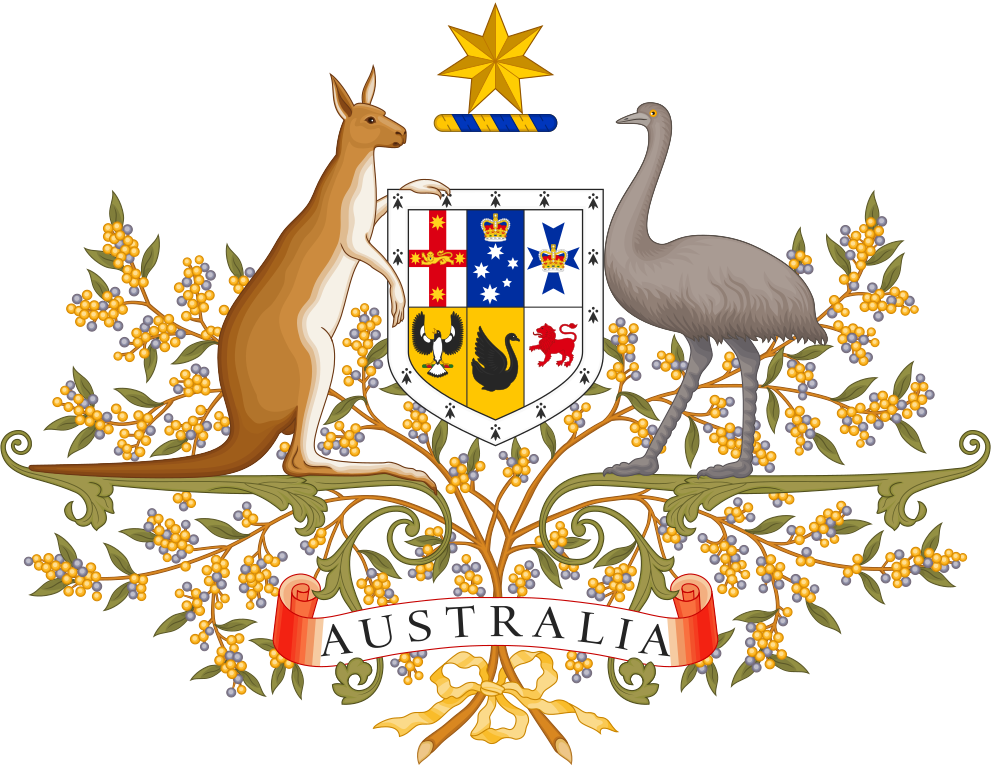
Commonwealth Coat of Arms of Australia (1912).
Quarterly of six, the first quarter Argent a Cross Gules charged with a Lion passant guardant between on each limb a Mullet of eight points Or; the second Azure five Mullets, one of eight, two of seven, one of six and one of five points of the first (representing the Constellation of the Southern Cross) ensigned with an Imperial Crown proper; the third of the first a Maltese Cross of the fourth, surmounted by a like Imperial Crown; the fourth of the third, on a Perch wreathed Vert and Gules an Australian Piping Shrike displayed also proper; the fifth also Or a Swan naiant to the sinister Sable; the last of the first, a Lion passant of the second, the whole within a Bordure Ermine; for the Crest on a Wreath Or and Azure A Seven-pointed Star Or, and for Supporters dexter a Kangaroo, sinister an Emu, both proper.
Once upon a time, not so long ago, children roamed freely through the pixelated wilderness of the Internet, posting dog memes, finding kindred spirits in weird little corners of Tumblr, and learning how to contour like Kylie Jenner. It was all chaotic, noisy, and entirely normal.
Now? Well, welcome to Australia in 2025, where the new Online Safety Amendment (Social Media Minimum Age) Bill has galloped through Parliament like a runaway Shetland pony, banning under-16s from social media. This is a full-blown digital eviction. And the ban isn’t limited just to TikTok and Snapchat. It also extends to YouTube (yes, YouTube), where apparently autoplay is now considered a gateway drug.
And how will they enforce this sweeping national grounding? Age verification, of course. Potentially through facial recognition. Not for the kids, mind you; they’ll simply be locked out. It’s everyone else who’ll need to prove they’re not children. Because nothing says “welcome to adulthood” like having to scan your actual face just to post a birthday shoutout or watch a slow-cooker recipe reel. All to reassure a tech platform that you’re not a rogue 14-year-old with strong opinions and a ring light.
The bill’s spiritual mother, eSafety Commissioner Julie Inman Grant, who, fun fact, once interviewed for a job at the CIA to analyze serial killers, gave a passionate speech at the National Press Club called “Swimming Between the Digital Flags”. It sounded very beachy and breezy until you realized she meant regulatory flags, and not the ones you’d use at Bondi. Her point was clear: the online world is full of rips and sharks and emotional jellyfish, and children must be protected from being dragged under.
Which is noble. Obviously. But somewhere between “protect the kids” and “build a biometric panopticon”, the line got a little smeared.
And where, you might ask, were parents in all this? Sitting quietly in the back, apparently, while Canberra (Australia’s Washington, DC) appointed itself Mum, Dad, the school principal, and possibly even the family dog. Because this isn’t just about safety; it’s about who decides what kids can see, say, share, and, in the case of a few bold young TikTokers, lip-sync while delivering motivational speeches to two mildly traumatized budgies.
The idea behind the project is that children are being harmed online, and honestly, yes, some are. The Internet is not all kittens and cake recipes. But rather than investing in education or digital literacy, the government has opted for a full blackout. It’s like banning scissors because one kid snipped their fringe into a reverse mullet.
And here’s the kicker. The bill had a consultation period of just 24 hours. That’s less time than it takes to read the terms and conditions you just agreed to without reading. (Don’t lie, we’ve all done it.)
In that tight little window, more than 15,000 submissions were made, and while some were supportive, the vast majority sounded the alarm. LGBTQIA+ organizations warned of disconnected teens losing safe spaces. Indigenous advocates pointed out the risks of further digital exclusion. Psychologists, educators, digital rights groups, and even a Community Soccer Club raised concerns.
Comments Off on Australia saw Britain’s awful Online Safety Act and said “hold my beer”
July 31, 2025
The intent of Britain’s Online Safety Act … and the actual implementation
In The Conservative Woman, Dr. Frederick Attenborough discusses the gap between what the Online Safety Act was intended to do and how it’s actually being enforced now that it’s the law of the land:
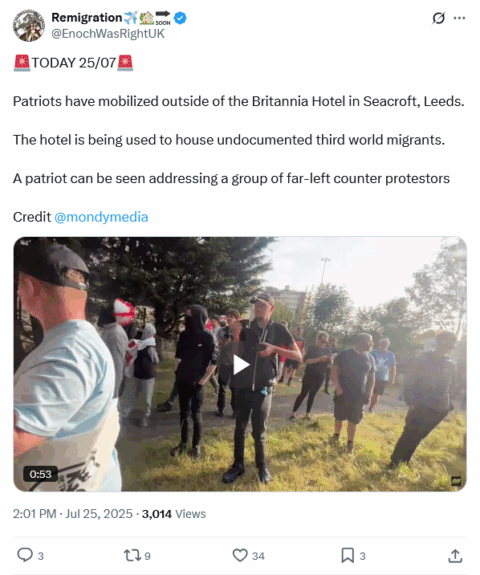
X posts like this may not be visible to uses in the UK under the age verification rules of the Online Safety Act.
At the heart of the regime is a requirement to implement “highly effective” age checks. If a platform cannot establish with high confidence that a user is over 18, it must restrict access to a wide category of “sensitive” content, even when that content is entirely lawful. This has major implications for platforms where news footage and political commentary appear in real time.
Ofcom’s guidance makes clear that simple box-ticking exercises, such as declaring your age or agreeing to terms of service, will no longer suffice. Instead, platforms are expected to use tools such as facial age estimation, ID scans, open banking credentials and digital identity wallets.
The Act also pushes companies to filter harmful material before it appears in users’ feeds. Ofcom’s broader regulatory guidance warns that recommender systems can steer young users toward material they didn’t ask for. In response, platforms may now be expected to reconfigure their algorithms to filter out entire categories of lawful expression before it reaches underage or unverified users.
One platform already moving in this direction is X. Its approach offers a revealing – and potentially sobering – glimpse of where things may be heading. The company uses internal signals, including when an account was created, any prior verification, and behavioural data, to estimate a user’s age. If that process fails to confirm the user is over 18, he or she is automatically placed into a sensitive content filtering mode. As the platform’s Help Center explains: “Until we are able to determine if a user is 18 or over, they may be defaulted into sensitive media settings, and may not be able to access sensitive media”.
This system runs without user opt-in and applies at scale. Depending on how X classifies it, filtered material may include adult humour, graphic imagery, political commentary or footage of violence. Already there are signs that lawful content is quietly being screened out.
One example came on July 25, the day the Act’s age-verification duties took effect, during a protest outside the Britannia Hotel in Seacroft, Leeds, where asylum seekers are being housed. A video showing police officers restraining and arresting a protester was posted on X, but quickly became inaccessible to many UK-based users. Instead, viewers saw the message: “Due to local laws, we are temporarily restricting access to this content until X estimates your age”.
West Yorkshire Police denied any involvement in blocking the footage. X declined to comment, but its AI chatbot, Grok, indicated that the clip had been restricted under the Online Safety Act due to violent content. Though lawful and clearly newsworthy, the footage was likely flagged by automated systems intended to shield children from real-world violence.
In The Critic, Christopher Snowdon explains the breakdown of trust between the British public and their government that the implementation of the Online Safety Act only exacerbates:
People are right to be concerned about this slippery slope and yet it cannot be denied that it is pornography enthusiasts who have been hardest hit by the Online Safety Act in the short term. They must now verify themselves in one of three ways, each less appealing than the last. They can submit their credit card details, they can scan in proof of ID, such as a passport, or they can take a photo of their face and allow AI to judge how old they are. If they want to maximise their chances of being the victim of blackmail and identity theft, they could do all three.
While we might not think twice about submitting our credit card details to Amazon or posting our photos on Instagram, there is an understandable reluctance to hand over private data in order to access dubious websites for the purposes of sordid acts of self-pollution. The government assures us that the data will be kept confidential but it is only two weeks since we learned about a data breach that led to the names of 19,000 Afghans who wanted to flee the Taliban being given to the Taliban and it is less than two months since the names and addresses of 6.5 million Co-op customers were stolen in a cyber-attack. Rightly or wrongly, millions of British plank-spankers and rug-tuggers do not wish to identify themselves to anybody.
The result is a surge in interest in Virtual Private Networks (VPNs) which allow internet users to access websites as if they were in a less censorious country. Half of the top ten free apps in Apple’s app download charts yesterday were for VPNs. Google Trends data show that searches for “VPN” have gone through the roof since Friday. Readers can draw their own conclusions from the fact that these searches have been peaking between midnight and 2am.
Downloading random VPNs comes with risks of its own and opens up a whole new world of illicit online activity from free Premier League football to the Dark Web. But there is a deeper reason to feel uneasy about this unintended, albeit predictable, consequence of paternalistic regulation. By driving another wedge between the state and the individual, it further normalises rule-breaking in a country where casual lawlessness is becoming part of daily life. A law-abiding society cannot long endure if the median citizen thinks that the law is an ass.
The breakdown of trust can be seen most clearly when the ordinary man or woman does not share the moral certainties of the governing class. Among smokers, a collapse in tax morale — the intrinsic motivation to pay taxes — has led to a huge rise in the consumption of illegal tobacco in recent years. Smokers no longer feel any obligation to pay taxes that are designed to impoverish them to a government that vilifies them. Cannabis smokers learn from an early age to be suspicious of a police force that they might otherwise respect. Motorists who are faced with 20mph speed limits that were introduced by people who hate private transport have no scruples about flouting the law.
Comments Off on The intent of Britain’s Online Safety Act … and the actual implementation
July 29, 2025
“The free and open internet has now ceased to exist in the UK”
Britain, like Canada, has been moving toward a less free internet experience for ordinary users, the key bit of legislation in the UK being the Online Safety Act, which like Canada’s proposed Online Harms Act, provides tools to the government to clamp down on online activities they deem “unsafe”:
The free and open internet has now ceased to exist in the UK. Since Friday, anyone in Britain logging on to social media will have been presented with a censored, restricted version – a “safe” internet, to borrow the UK government’s language. Vast swathes of even anodyne posts are now blocked for the overwhelming majority of users.
The Online Safety Act was passed by the last Conservative government and backed enthusiastically by Labour. Both parties insisted it is necessary to protect children. Supposedly, its aim is to shield them from pornography, violence, terrorist material and content promoting self-harm. Age-verification checks, we were assured, would ensure that children would not be exposed to inappropriate content, but adults could continue using the internet as they please. Yet as we have seen over the past few days, on many major tech platforms, UK-based adults are being treated as children by default, with supposedly “sensitive” content filtered from everyone’s view.
Predictably, what is deemed “sensitive” and therefore censored goes well beyond pornography and obviously illegal or adult material. Already UK users of X have been blocked from viewing footage of an anti-asylum protest, a tweet calling for single-sex spaces and a video of a speech in parliament on the grooming-gangs scandal. Historical trivia, such as a thread on Richard the Lionheart, and classic artworks like Goya’s Saturn Devouring His Son have been shielded by the tech censors. A thread on X of examples of what has been censored under the Online Safety Act, collated by Benjamin Jones of the Free Speech Union, has itself been partially censored due to the Online Safety Act. Open, political debate online is now a thing of the past.
When the Online Safety Act was first put before parliament, supporters from all parties insisted that fears about its impact on free speech were overblown. “The worst misrepresentation I’ve heard is that the [Online Safety Act] will force tech companies to censor legal social-media posts”, insisted Chris Philp, the then minister for tech and digital economy, now the shadow home secretary, back in 2022. Anyone who warned that this vast new architecture of online speech regulation was obviously going to curtail free speech was presented as a friend of paedophiles, terrorists or the far right. This gaslighting was kept up right until the point the age filters were implemented. “The UK’s online safety regime is here. Will anybody notice?”, asked Politico the day before much of the internet disappeared. The Guardian, on the same day, pondered whether the new rules would be censorious enough.
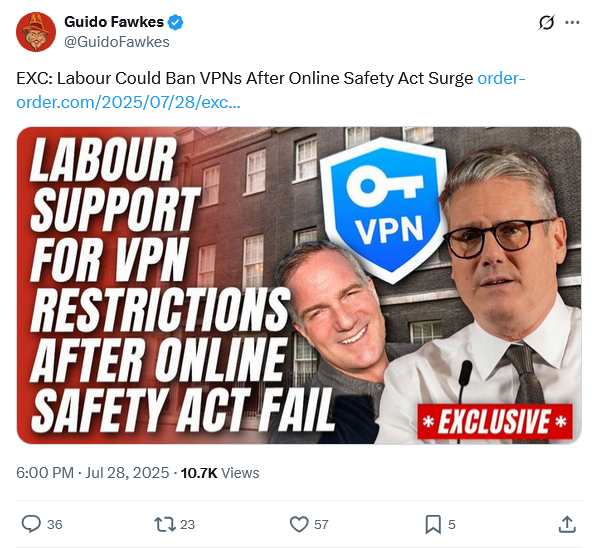
Despite my financial plight, I’d been considering getting a VPN subscription in advance of the Canadian government getting some version of the Online Harms Act onto the books. Clearly many Brits had already gone that route, and the British government reacts with the care and subtlety one would expect: