
Marie Antoinette arrived in Paris at the end of this era of strict censorship, which helps explain why her honeymoon with French public opinion was short-lived. The official press, notably the Mercure and Gazette, continued churning out fawning snippets of society news about the royal couple. But the scandal-mongering libelles and pamphlets had their own paragraph men, called nouvellistes, who picked up “news” from well-informed sources posted on benches in the Tuileries, Luxembourg Gardens, and, of course, under the tree of Cracow. Police efforts to repress nouvellistes‘ gossip proved futile in the face of high demand. One famous libelle of the era, Le Gazetier cuirassé promised “scandalous anecdotes about the French court”. (It was printed in London, out of reach of official French censors.) Another publication printed in London starting in the 1760s was the famous Mémoires secrets, an anonymous chronicle of insider gossip and anecdotes from Parisian high society. A scurrilous book about Louis XV’s mistress, Madame du Barry, also appeared as a collection of gossip that nouvellistes had picked up around Paris.
Despite the libelles circulating in Paris, the Bourbon monarchy was still relatively protected compared with the hurly-burly across the channel in London, where coffeehouses buzzed with political innuendo and intrigue. Some French philosophes, it is true, attempted to replicate London’s coffeehouse culture at Parisian cafés, such as the Procope on the Left Bank. (Voltaire frequented the place, where he liked to add chocolate to his coffee.) Other regulars at the Procope — named after the Byzantine writer Procopius, famous for his Secret History — were Rousseau, Danton, and Robespierre, as well as Americans Benjamin Franklin and Thomas Jefferson.
The Parisian equivalent of the coffeehouse was the salon, which differed from London coffeehouses in both ambience and function. Whereas London coffeehouses were boisterously public, salons were essentially closed spaces, usually held in private homes. Most were by invitation only. Many were hosted by women, usually titled or wealthy ladies with an interest in culture and politics — such as Madame de Rambouillet, Madame Necker, Madame Geoffrin, and Mademoiselle Lespinasse. There was also the Marquise du Deffand, a friend to Voltaire and the English man of letters Horace Walpole, to whom she bequeathed not only her papers, but also her pet dog, Tonton.
As access to these rarefied spaces increasingly became a symbol of social success, admission got more tightly controlled. (Madame Geoffrin expelled Diderot from her salon because she found his conversation “quite beyond control”.) Still, those who frequented salons represented a great diversity within the elites — from rising young writers and established authors to powerful politicians and eccentric aristocrats. The tacit rule was, as in London coffeehouses, that wit was more important than rank. Many great French writers launched their careers thanks to their admittance. One was the philosopher Montesquieu, who found success at the salon of Madame Lambert.
Matthew Fraser, “Marie Antoinette: Figure of Myth, Magnet for Lies”, Quillette, 2020-06-24.
July 27, 2025
QotD: London coffeehouses and Paris salons of the Ancien Régime
July 24, 2025
When tolerance becomes a fatal flaw
At The Crescent and the Guillotine, Paul Friesen explains why too much tolerance leads to the eventual collapse of social order and perhaps even the culture itself:
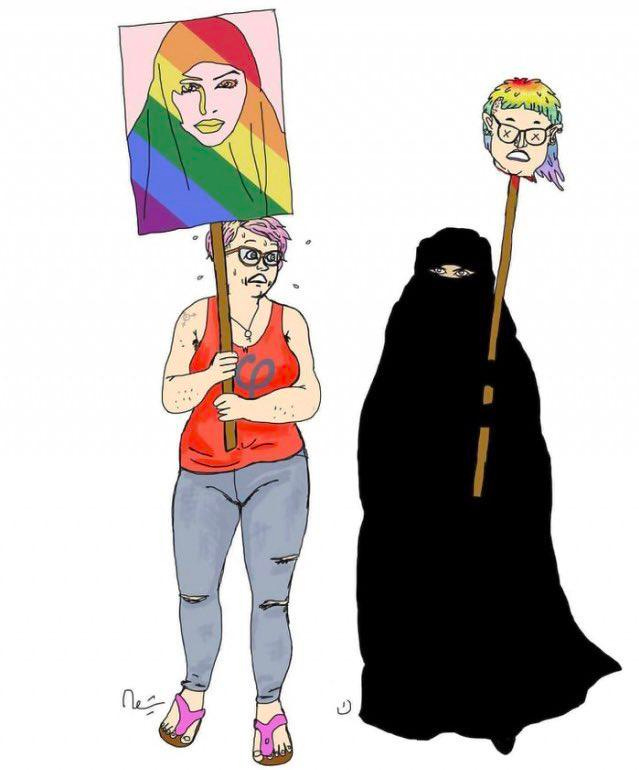
It is difficult to know what people are thinking when they endorse the importation of people who want to kill them for their lifestyle choices.
It was Karl Popper who warned that a tolerant society must be intolerant of intolerance, or it would cease to be tolerant at all.1 A delicious paradox, too often quoted and too rarely heeded. For we have taken the first half of the dictum — the imperative to tolerate — and chiseled it into law, into policy, into university mission statements and NGO pamphlets. But the second half — the requirement to draw a line, to say “no further” — has been treated like garlic in a vampire movie: an antique, anathema, unfashionable.
And so, the paradox has become pathology.
Our courts allow sharia arbitration councils to function in British cities, adjudicating matters of family and inheritance with standards that would make a 12th-century canon lawyer flinch. Our schools include faith-based curricula that require hijabs for seven-year-olds and teach that homosexuality is satanic filth. Our public broadcasters will air a documentary about the importance of free speech, followed immediately by a segment about why cartoons of Muhammad are “unhelpful”.
This is not multiculturalism. It is masochism. It is the belief that liberalism must be so open-minded that its own brains are spilled onto the prayer mat. It is the fetishization of identity at the expense of liberty. It is the ideological pacifism of a society too terrified to assert its own values, lest it be accused of “racism” by those who mistake ideology for ethnicity.
We have enshrined the rights of the theocrat while criminalizing the instincts of the secularist. The result is not harmony — it is humiliation.
[…]
The West’s greatest achievement is not democracy, nor capitalism, nor even the separation of powers. It is the separation of truth from tribalism — the idea that individuals are not to be judged by their creeds, but by their conduct. That women are not property. That speech is not violence. That blasphemy is a right, not a crime.
These are not Western values. They are universal values, discovered in the West by accident of history and preserved through blood, rebellion, and satire. They are the principles that allowed Jews, heretics, atheists, and apostates to live not just safely, but freely. And they are now under threat — from within.
The real problem is not Islam. It is the Western inability to demand anything of those who import their gods and their grievances into liberal society. We treat every imported superstition as sacrosanct and every local tradition as suspect. We require ex-Muslims to whisper their fears while we amplify the complaints of veiled Islamists who denounce our culture from our own podiums.
We are not being pluralistic. We are being duped.
And the cost of this self-deception is measured not just in freedoms surrendered, but in lives lost.
Lives like that of Yameen Rasheed, the secular Maldivian blogger who thought he could use satire to push back against theocracy — stabbed to death in his own hallway. Lives like that of Farkhunda Malikzada, beaten and burned in the streets of Kabul by a mob of men — because someone thought she burned a Qur’an. Lives like that of Samuel Paty, beheaded outside a French school by a refugee he welcomed — because he dared to show a cartoon in a civics class.
These are not random tragedies. They are the predictable outcomes of an ideological toxin given immunity in the bloodstream of liberal society.
What do all these victims have in common? They did not die at the hands of misunderstood minorities or “oppressed voices” who simply needed better integration programs. They died at the hands of men who were indoctrinated — sometimes abroad, often at home — with the idea that God’s honor is more valuable than human life, and that dissent is not to be debated but extinguished.
And more damning still: they died in environments that should have protected them. Environments that instead prioritized sensitivity over security, dialogue over clarity, understanding over justice. Environments where the ever-watchful eye of diversity officers and DEI consultants was trained, not on the assailants, but on the tone of the victims.
We have created a culture where courage is pathologized, clarity is punished, and moral equivalence is the new orthodoxy. When Islamist mobs swarm the streets chanting slogans that would make the Inquisition blush, we are told to “listen to their anger”. When feminists protest the veiling of children, they are told to “respect cultural differences”. When Jews complain about chants of “From the River to the Sea”, they are informed that they are “overreacting”, “weaponizing trauma”, or — most insultingly of all — “confusing Zionism with antisemitism”.
This is not inclusivity. It is assisted suicide.
1. I refer here to Karl Popper’s 1945 work The Open Society and Its Enemies, specifically in Volume 1: The Spell of Plato, Note 4 to Chapter 7. Here’s the relevant passage, paraphrased for clarity:
“Unlimited tolerance must lead to the disappearance of tolerance. If we extend unlimited tolerance even to those who are intolerant … then the tolerant will be destroyed, and tolerance with them.”
Popper argues that a tolerant society has the right — not to suppress opinions — but to defend itself against those who would destroy tolerance itself, especially if such groups refuse to engage in rational discourse and instead promote violence or coercion. It’s often called “the paradox of tolerance“.
July 21, 2025
Was Juan Perón a Fascist? The Cold War Origins of Peronism – W2W 037
TimeGhost History
Published 20 Jul 2025Was Juan Perón really a fascist, a socialist, or something entirely different? In this episode of War 2 War, we explore the rise of Peronism in post–World War II Argentina and how Perón tried to position his country between the superpowers of the Cold War.
Through labour reforms, nationalist rhetoric, media control, and brutal repression of dissent, Juan and Eva Perón created a powerful populist regime that borrowed ideas from both fascism and socialism, while claiming to reject both. From Argentina’s “Third Way” to its complicated ties with the US, USSR, and even Nazi fugitives, we examine the ideology, contradictions, and legacy of Peronist rule.
Was Peronism a unique form of authoritarian populism, or just another face of fascism?
Join us as we uncover the foundations of Argentina’s Cold War identity and the true political nature of Juan Perón.
(more…)
July 19, 2025
No issue is so important that we can’t have a proper debate on the merits
On Substack, Lorenzo Warby refutes the claim that some issues are just too important/too urgent/already decided:

One of the features of the “progressive” politics of the unaccountable classes — those who are just paid for turning up — is the demand that there be “No Debate” about various issues. The most obvious instances are “No Debate” about Trans and “No Debate” about climate change — hence demands that climate scepticism be outlawed.
All such “No Debate” claims are crap. First, any “No Debate” claim is presumptive evidence that what you are pushing is either not true or, slightly more subtly, is a mountain of bullshit erected on a molehill of truth. Robust cases for claims about the world are not afraid of debate.
Various moral urgency claims are mounted to support such “No Debate” claims. How do we determine moral urgency? From the evidence. If the evidence is clear, debate will not threaten that alleged urgency. On the contrary, it will reveal the urgency more clearly.
The underlying philosophical dynamic underlying “No Debate” claims is Critical Constructivism — the claim that reality is socially constructed; that all statements and knowledge claims are, in fact power claims; and that the righteousness of a claim can be determined by their (alleged) effects on (morally differentiated) social groups.
The underlying social dynamic is the use of affirmed beliefs to determine and display righteousness. If affirming X shows one to be one of the righteous, then not believing X shows one to be of the unrighteous. This is typically expressed in various terms of moral abuse (racist, Transphobe, Islamophobe, etc) whose use in media and academe has soared since 2014.
This is not because Western societies have become more bigoted — on any reasonable measure they have become far less so over time — but because the politics of Righteous Affirmed Belief has dramatically surged and so has therefore the stigmatisation of dissent.
To claim that affirming X shows ultimate moral propriety requires stigmatising not-X. For something is morally proper — indeed morally trumping — only if the opposite is morally improper. Thus is moral propriety is enforced by stigmatisation. Hence silence is violence — one must profess righteousness. Hence also words are violence — if affirmation of belief is the ultimate marker of righteousness then expressed disbelief becomes the ultimate marker of abusive malevolence. These dynamics lead to a great deal of preference falsification — people publicly affirming, or at least not opposing, claims that they do not privately believe.
July 10, 2025
Mandatory online age verification
Michael Geist discusses the rush of the Canadian and other governments in the west to try to impose one-size-fits-all age verification schemes on the internet:

The Day I Knew I Was Old 😉 by artistmac CC BY-SA 2.0
When the intersection of law and technology presents seemingly intractable new challenges, policy makers often bet on technology itself to solve the problem. Whether countering copyright infringement with digital locks, limiting access to unregulated services with website blocking, or deploying artificial intelligence to facilitate content moderation, there is a recurring hope the answer to the policy dilemma lies in better technology. While technology frequently does play a role, experience suggests that the reality is far more complicated as new technologies also create new risks and bring unforeseen consequences. So too with the emphasis on age verification technologies as a magical solution to limiting under-age access to adult content online. These technologies offer some promise, but the significant privacy and accuracy risks that could inhibit freedom of expression are too great to ignore.
The Hub runs a debate today on the mandated use of age verification technologies. I argue against it in a slightly shorter version of this post. Daniel Zekveld of the Association for Reformed Political Action (ARPA) Canada makes the case for it in this post.
The Canadian debate over age verification technologies – which has now expanded to include both age verification and age estimation systems – requires an assessment of both the proposed legislative frameworks and the technologies themselves. The last Parliament featured debate over several contentious Internet-related bills, notably streaming and news laws (Bills C-11 and C-18), online harms (Bill C-63) and Internet age verification and website blocking (Bill S-210). Bill S-210 fell below the radar screen for many months as it started in the Senate and received only cursory review in the House of Commons. The bill faced only a final vote in the House but it died with the election call. Once Parliament resumed, the bill’s sponsor, Senator Julie Miville-Dechêne, wasted no time in bringing it back as Bill S-209.
The bill would create an offence for any organization making available pornographic material to anyone under the age of 18 for commercial purposes. The penalty for doing so is $250,000 for the first offence and up to $500,000 for any subsequent offences. Organizations can rely on three potential defences:
- The organization instituted a government-approved “prescribed age-verification or age estimation method” to limit access. There is a major global business of vendors that sell these technologies and who are vocal proponents of this kind of legislation.
- The organization can make the case that there is “legitimate purpose related to science, medicine, education or the arts”.
- The organization took steps required to limit access after having received a notification from the enforcement agency (likely the CRTC).
Note that Bill S-209 has expanded the scope of available technologies for implementation: while S-210 only included age verification, S-209 adds age estimation technologies. Age estimation may benefit from limiting the amount of data that needs to be collected from an individual, but it also suffers from inaccuracies. For example, using estimation to distinguish between a 17 and 18 year old is difficult for both humans and computers, yet the law depends upon it. Given the standard for highly effective technologies, age estimation technologies may not receive government approvals, leaving only age verification in place.
June 26, 2025
German police raid homes to counteract online “hate speech” by “digital arsonists”
Things are getting worse for free speech in Germany, as eugyppius reports:

Apollo News reports on the newest, most irregular German holiday, which consists of the police conducting coordinated raids on and interrogations of ordinary people who are alleged to have said rude things on the internet:
On Tuesday morning police across Germany conducted raids targeting “hate speech and incitement” on the internet. According to the news agency dpa, there are currently 170 operations underway, including house searches and other measures. Those accused are charged with insulting politicians and inciting hatred …
The Federal Criminal Police Office (BKA) is in charge of the operation … In North Rhine-Westphalia, several police authorities struck simultaneously at 6 a.m. Police from Düsseldorf, Dortmund, Gelsenkirchen, Cologne, Bielefeld, Münster, Hagen, and Bonn are among those involved. Fourteen suspects are to be questioned and two search warrants executed.1 The individuals in question frequently express themselves on social media, such as on X.
… The Action Day against alleged hate posts has been taking place regularly for years. On June 18, the BKA joined forces with the reporting center “REspect!” to participate in the “International Day Against Hate and Incitement”. People were called upon to report posts that allegedly spread hate.
Today was the twelfth such “Action Day against Hate and Incitement on the Internet”. That is only an approximate title; it varies slightly across press sources. This dubious ritual began in 2016, after Merkel opened the German borders to the entirety of the developing world and our politicians grew tired of people calling them imbeciles online. Police are very open that the goal of these coordinated Action Days is intimidation – or, as they put it, “deterrence”.
Our federal police love this holiday so much they often celebrate it twice a year, which is why are already on the twelfth such day, even though we have only had nine years since the establishment of this custom. Sometimes our betters even throw in bonus action days that for some reason don’t count, as during Covid when they conducted a special “Action Day against Political Hate Postings” after the seventh “Nationwide Action Day against Hate Postings” but before the eighth “Nationwide Action Day against Hate Postings”. Who knows how many such action days we have really had, especially considering that since 2020 the broader EU has adopted this sporadic holiday and occasionally coordinates its own Continent-wide “Action Day against Hatred and Incitement on the Internet”.
[…]
By calling these Action Days idiotic, I don’t mean to minimise them. They are borderline illegal, for they exploit what should be purely investigative tactics (interrogations, house searches) to scare and punish people in advance of any criminal conviction. The emphasis is not only on right-leaning posters, but invariably and most disgracefully on ordinary people with relatively little social media reach, whose posts in many cases have been seen a mere handful of times. The message is clear: They can get you, whoever you are; they can get anybody. Living in a country whose authorities amuse themselves by periodically harassing their own citizens in this way is disturbing. It’s an absolute scandal that all the major political parties support this, save for Alternative für Deutschland. It’s a reason to vote AfD all by itself.
June 16, 2025
QotD: Evading the censor
As we crept closer, mischief would smear across his lips. He’d bide his time. “Now, Jack,” I’d plead. “Remember what your mother said …”
We’d land in the supermarket. Jack would survey the crowds. At the top of his lungs, he’d bellow: “Boobies! Boo-BEES! Ha-ha-ha-ha! Fat — FAT boobies!” With a visceral joy on his face, he’d fold over and repeat the lung-puncturing cycle, laughing himself into a pram-splayed stupor.
For the first time, Jack indulged the timeless power inherent in saying a few forbidden words and basking in the illicit result. Freud, for all of his faults, called this joy “evading the censor”. Of course, Jack hadn’t read much Freud by then. All he knew was that saying what he was forbidden to say was, in fact, uproariously funny.
No doubt, modern scolds would pen a 5,000-word buzzword soup condemning Jack’s internalised misogyny, his unconscious patriarchal programming or some such modern voodoo. They’d miss the point: saying what one is forbidden to say is — and always will be — funny.
Christopher Gage, “No Laughing Matter”, Oxford Sour, 2025-03-14.
June 9, 2025
QotD: “Defending” democracy with totalitarian methods
These people don’t see that if you encourage totalitarian methods, the time may come when they will be used against you instead of for you. Make a habit of imprisoning Fascists without trial, and perhaps the process won’t stop at Fascists. Soon after the suppressed Daily Worker had been reinstated, I was lecturing to a working men’s college in South London. The audience were working‐class and lower‐middle‐class intellectuals — the same sort of audience that one used to meet at Left Book Club branches. The lecture had touched on the freedom of the press, and at the end, to my astonishment, several questioners stood up and asked me: Did I not think that the lifting of the ban on the Daily Worker was a great mistake? When asked why, they said that it was a paper of doubtful loyalty and ought not to he tolerated in war time. I found myself defending the Daily Worker, which has gone out of its way to libel me more than once. But where had these people learned this essentially totalitarian outlook? Pretty certainly they had learned it from the Communists themselves!
Tolerance and decency are deeply rooted in England, but they are not indestructible, and they have to be kept alive partly by conscious effort. The result of preaching totalitarian doctrines is to weaken the instinct by means of which free peoples know what is or is not dangerous. The case of Mosley illustrates this. In 1940, it was perfectly right to intern Mosley, whether or not he had committed any technical crime. We were fighting for our lives and could not allow a possible Quisling to go free. To keep him shut up, without trial, in 1943 was an outrage. The general failure to see this was a bad symptom, though it is true that the agitation against Mosley’s release was partly factitious and partly a rationalization of other discontents. But how much of the present slide to ward Fascist ways of thought is traceable to the “anti‐Fascism” of the past ten years, and the unscrupulousness it has entailed?
George Orwell, “The Freedom of the Press“, 1945 (written as the introduction to Animal Farm, but not published in Orwell’s lifetime).
June 5, 2025
The Liberals believe this time they’ll keep kids away from internet porn
Sometimes it’s hard to get a grip on what Liberals actually believe, as on the one hand they’re actively resisting pulling literal pornography out of school libraries (because it’s “LGBT friendly”) and on the other hand, they’re all gung-ho for yet another attempt to pass legislation that will try to prevent kids from seeing porn on the internet:
How does a website automatically, “responsibly” prove someone’s age down the end of an internet connection, without actually verifying their ID? Answer: It doesn’t. Obviously
There is another legislative effort afoot to keep Canadian children away from pornography. It’s well-intentioned effort, I suppose, but such efforts didn’t work very well when pornography was printed on glossy paper and distributed on VHS tapes and pay-per-view, so it seems particularly improbable in the internet age.
Bill S-209 is Independent (Liberal-appointed) Senator Julie Miville-Dechêne’s second attempt at a private member’s bill on the topic. It is predicated on the notion that it’s easier to verify age automatically than it used to be: “Online age-verification and age-estimation technology is increasingly sophisticated and can now effectively ascertain the age of users without breaching their privacy rights”, the bill’s preamble avers.
It is absolute rubbish, to the extent that even the Liberals under former prime minister Justin Trudeau seemed to realize it the first time it was tried. We can only hope Mark Carney’s Liberals are of similar mind. Early signs are not positive. The reappointment of Steven Guilbeault as heritage minister (now called Canadian identity and culture minister, for some reason) doesn’t bode well. He seems genuinely to dislike the online world on principle.
Or, maybe it does bode well. Guilbeault did a singularly terrible job trying to sell the Liberals’ anti-internet agenda in English Canada. I’m not sure he could give away ice cream in a Calgary heatwave. So if you think laws targeting “online harms” are doomed to fail at best — and could lead to dystopian outcomes — then maybe Guilbeault is exactly the fellow you want in charge.
When it came to online porn, the Trudeau Liberals seemed to have some sense of the Sisyphean proposition before them. Miville-Dechêne’s first attempt at a bill received support from MPs of all parties in the House of Commons last year, but the Liberal leadership cited privacy concerns in refusing to get behind it.
In large part that might just have been because Conservative Leader Pierre Poilievre supported the idea and, to Liberals, anything Poilievre supports must obviously be a serious threat to humanity’s survival. But still, Trudeau was pretty unequivocal in rejecting the idea.
June 3, 2025
Exercise Tiger: The WW2 Cover-Up Before D Day
The History Chap
Published 23 May 2024Exercise Tiger 1944, was a large-scale dress rehearsal for the D-Day landings, off the Slapton Sands in England, that went horribly wrong. Over 700 US servicemen were killed, more than were killed on Utah beach on D-Day itself! With D-Day imminent, Allied Supreme Commander, General Dwight Eisenhower, ordered the disaster to be hushed up.
Following a friendly fire incident on Slapton Sands on the 27th April 1944, a convoy carrying US troops was attacked in the early hours of the 28th by German E-Boats. In what is called the Battle of Lyme Bay, two ships in the convoy were sunk resulting in the loss of over 700 US servicemen. Whilst rumours suggest that there were many casualties resulting from the friendly fire on Slapton Sands, the US Army has always remained tight-lipped. To this day, the mystery remains as to what extent the casualty figures were covered up.
In the 1980’s, a Sherman tank was raised from the seabed. It now stands at the end of Slapton Sands (near the village of Torcross) as a memorial to the young men who died 6 weeks before D-Day during Exercise Tiger.
Chapters
0:00 Intro
0:42 D-Day 1944
1:40 Slapton Sands
2:30 Civilian Evacuation
3:22 Military Build-up
4:58 Exercise Tiger
6:07 Live Fire Disaster
7:37 Convoy T-4
9:15 Spotted by Germans
10:03 E-boat attack
11:41 Battle of Lyme Bay
14:06 Casualty Figures
14:43 D-Day Compromised?
15:37 Cover-up?
17:00 D-Day Success
18:08 Exercise Tiger Remembered
(more…)
May 30, 2025
Progressives are still putting their faith in doxxing and cancellations … do they still work?
Spaceman Spiff calls our attention to the latest attempt to un-person a writer who has managed to outrage progressives:

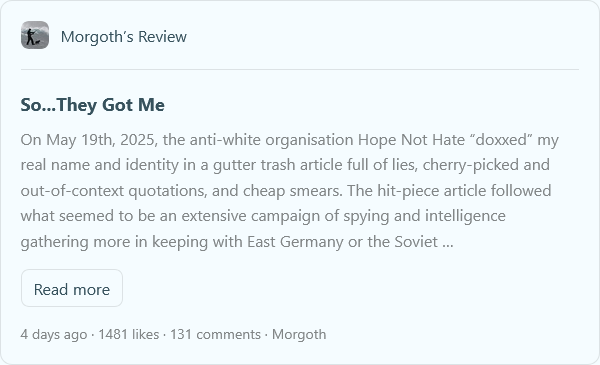
The popular pseudonymous Substack writer, Morgoth, has been doxxed. Outed by an organization dedicated to tackling extremism and online harm.
You can read about his ordeal here:
They produced an article to unmask Morgoth’s real-world identity against his wishes, including photographs. It is replete with incendiary accusations we have grown accustomed to seeing in these attempts to discredit writers who challenge the status quo.
The impression presented is one of a bigoted figure, someone dangerously unhinged. It bears little relation to reality as Morgoth’s readers will confirm. But that hardly matters.
Doxxing exercises exist so the laptop class can efficiently file people into a convenient extremist bucket. All the hard work has been done so the distracted can skim the article and take what they need. Fascism, white supremacy, hate, racism, bigotry; take your pick.
Doxxing is not about facts, it is about keywords. More accurately it is about “hate crimes”. Those who transgress these ever-changing taboos are unfit to live among us.
Even better the piece can be exploited by others. Fascist influencer Morgoth, online hatemonger Morgoth, disgraced racist Morgoth. The current obsession with speech controls can make good use of an incestuous network of activists posing as reporters. Since the material now exists journalists can reference it to further discredit should this be needed in future.
The shrill nature of these denouncements is the giveaway all is not well in the world of perception management. No plan survives contact with the enemy, and the desire to corral all dissidents into one big extremist bucket sounds fine on paper. But much of what Morgoth writes about is widely discussed by the public at large, even if ignored by the traditional media or the political world. If Morgoth is a racist hate-driven genocidal monster then so are most of the population, which of course they are not.
This kind of thing used to work well. But as Morgoth’s own articles allude to, their enemy is reality not Substackers.
The curiously suicidal ideas the educated classes cling to are largely based on magical thinking. We can change the weather by blowing up power stations and levying taxes; we can successfully assimilate millions of hostile foreigners who dislike us and our culture; women will be happier if they work longer hours and don’t have children.
The degree of propaganda needed to maintain today’s narratives is considerable. Less advertised is how brittle it has become. Challenges to these narratives, and the theoretical foundations upon which they rest, are therefore feared by their promoters, and rightly so.
From this perspective people writing online and criticizing today’s sacred cows are worth targeting and smearing. Hence the exposure, the denouncements, the dredging up of comments from a decade ago, out of context and out of time. They know their audience don’t really care. They just need the satisfying feeling they are on the right side of history.
Senate to once again try to pass internet age verification and website blocking
Some ideas are so horrible that they never, ever die. The Canadian Senate nearly got an age verification and website blocking ban into law during the last Parliament, and as Michael Geist discusses, they’re not giving up now:
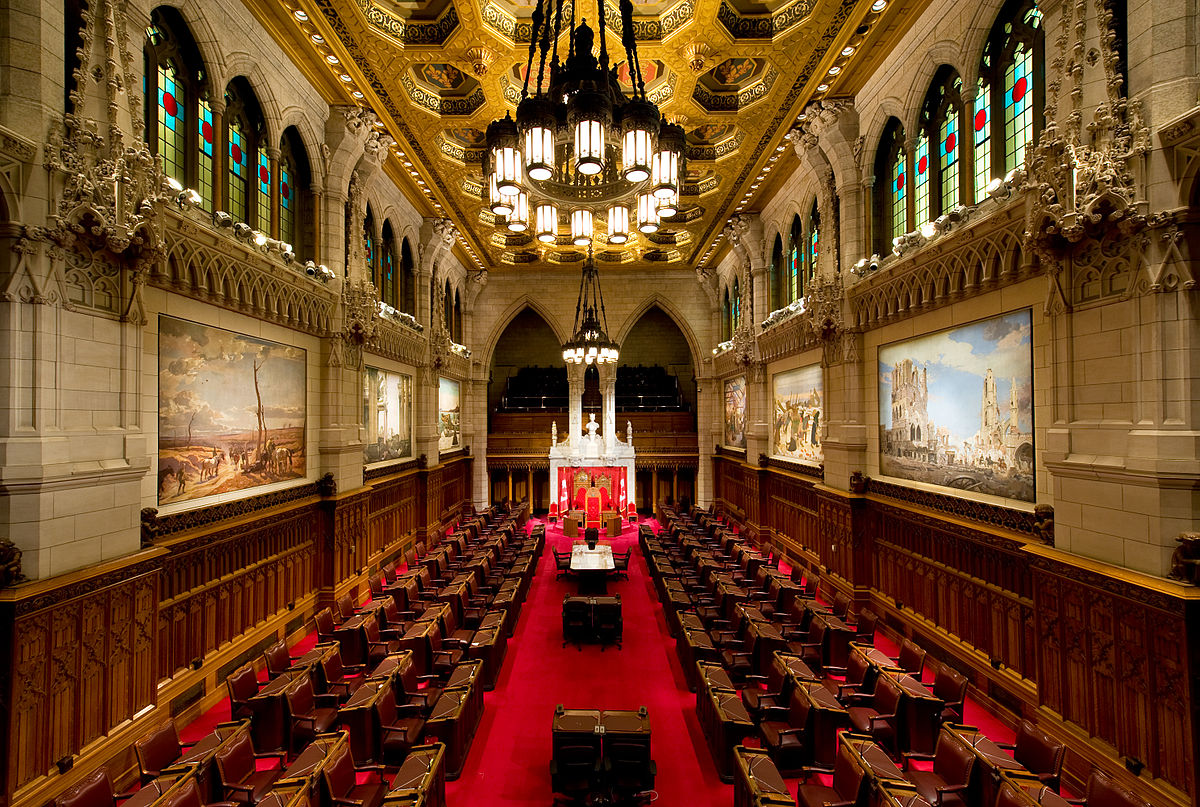
“In the east wing of the Centre Block is the Senate chamber, in which are the thrones for the Canadian monarch and consort, or for the federal viceroy and his or her consort, and from which either the sovereign or the governor general gives the Speech from the Throne and grants Royal Assent to bills passed by parliament. The senators themselves sit in the chamber, arranged so that those belonging to the governing party are to the right of the Speaker of the Senate and the opposition to the speaker’s left. The overall colour in the Senate chamber is red, seen in the upholstery, carpeting, and draperies, and reflecting the colour scheme of the House of Lords in the United Kingdom; red was a more royal colour, associated with the Crown and hereditary peers. Capping the room is a gilt ceiling with deep octagonal coffers, each filled with heraldic symbols, including maple leafs, fleur-de-lis, lions rampant, clàrsach, Welsh Dragons, and lions passant. On the east and west walls of the chamber are eight murals depicting scenes from the First World War; painted in between 1916 and 1920.”
Photo and description by Saffron Blaze via Wikimedia Commons.
The last Parliament featured debate over several contentious Internet-related bills, notably streaming and news laws (Bills C-11 and C-18), online harms (Bill C-63) and Internet age verification and website blocking (Bill S-210). Bill S-210 fell below the radar screen for many months as it started in the Senate and received only cursory review in the House. The bill faced only a final vote in the House but it died with the election call. This week, the bill’s sponsor, Senator Julie Miville-Dechêne, wasted no time in bringing it back. Now Bill S-209, the bill starts from scratch in the Senate with the same basic framework but with some notable changes that address at least some of the concerns raised by the prior bill (a fulsome review of those concerns can be heard in a Law Bytes podcast I conducted with Senator Miville-Dechêne).
Bill S-209 creates an offence for any organization making available pornographic material to anyone under the age of 18 for commercial purposes. The penalty for doing so is $250,000 for the first offence and up to $500,000 for any subsequent offences. The previous bill used the term “sexually explicit material”, borrowing from the Criminal Code provision. This raised concerns as the definition in the Criminal Code is used in conjunction with other sexual crimes. The bill now features its own definition for pornographic material, which is defined as
any photographic, film, video or other visual representation, whether or not it was made by electronic or mechanical means, the dominant characteristic of which is the depiction, for a sexual purpose, of a person’s genital organs or anal region or, if the person is female, her breasts, but does not include child pornography as defined in subsection 163.1(1) of the Criminal Code.
Organizations can rely on three potential defences:
- The organization instituted a government-approved “prescribed age-verification or age estimation method” to limit access. There is a major global business of vendors that sell these technologies and who are vocal proponents of this kind of legislation.
- The organization can make the case that there is “legitimate purpose related to science, medicine, education or the arts”.
- The organization took steps required to limit access after having received a notification from the enforcement agency (likely the CRTC).
Note that Bill S-209 has expanded the scope of available technologies for implementation: while S-210 only included age verification, S-209 adds age estimation technologies. Age estimation may benefit from limiting the amount of data that needs to be collected from an individual, but it also suffers from inaccuracies. For example, using estimation to distinguish between a 17 and 18 year old is difficult for both humans and computers, yet the law depends upon it. Given the standard for highly effective technologies, age estimation technologies may not receive government approvals, leaving only age verification in place.
May 5, 2025
QotD: English intelligentsia and the Soviet Union
I am well acquainted with all the arguments against freedom of thought and speech — the arguments which claim that it cannot exist, and the arguments which claim that it ought not to. I answer simply that they don’t convince me and that our civilization over a period of 400 years has been founded on the opposite notice. For quite a decade past I have believed that the existing Russian regime is a mainly evil thing, and I claim the right to say so, in spite of the fact that we are allies with the U.S.S.R. in a war which I want to see won. If I had to choose a text to justify myself, I should choose the line from Milton:
“By the known rules of ancient liberty.”The word ancient emphasizes the fact that intellectual freedom is a deep‐rooted tradition without which our characteristic Western culture could only doubtfully exist. From that tradition many of our intellectuals are visibly turning away. They have accepted the principle that a book should be published or suppressed, praised or damned, not on its merits but according to political expediency.
And others who do not actually hold this view assent to it from sheer cowardice. An example of this is the failure of the numerous and vocal English pacifists to raise their voices against the prevalent worship of Russian militarism. According to these pacifists, all violence is evil, and they have urged us at every stage of the war to give in or at least to make a compromise peace. But how many of them have ever suggested that war is also evil when it is waged by the Red Army? Apparently the Russians have a right to defend themselves, whereas for us to do so is a deadly sin. One can explain this contradiction in only one way — that is, by a cowardly desire to keep in with the bulk of the intelligentsia, whose patriotism is directed toward the U.S.S.R. rather than toward Britain.
I know that the English intelligentsia have plenty of reason for their timidity and dishonesty; indeed, I know by heart the arguments by which they justify themselves. But at least let us have no more nonsense about defending liberty against fascism. If liberty means anything at all, it means the right to tell people what they do not want to hear. The common people still vaguely subscribe to that doctrine and act on it. In our country — it is not the same in all countries: it was not so in Republican France, and it is not so in the United States today — it is the liberals who fear liberty and the intellectuals who want to do dirt on the intellect: it is to draw attention to that fact I have written this preface.
George Orwell “The Freedom of the Press”, 1945 (written as the preface to Animal Farm, but not published in Orwell’s lifetime).
April 26, 2025
QotD: “Woke”
Moreover, this monomaniacal need to expose an ever-expanding set of “phobias” in society means that they end up detecting prejudice even where it does not exist. In the absence of evidence of racism the woke have a habit of simply concocting it; hence the continual emphasis on “unconscious bias”, “white privilege” and “institutional power structures”. Such ideas have germinated over many years in academia – particularly in the postmodern branches of critical theory – and have since seeped into the mainstream.
This is why the public is routinely confronted with absurd articles in the media grounded in an extreme form of intersectionality. One, for instance, claims that white women are “evil”, another that white DNA is an “abomination”. Barely a day goes by without some frenzied denunciation of a movie or a television series for its lack of diversity and positive representation, as though the function of the arts is to send a message that accords with identitarian values.
Few members of the public are entirely familiar with the jargon (“cisgender”, “mansplaining”, “toxic masculinity”), but are assured nonetheless that the premises are indisputable. There’s a very good reason why the Catholic Church resisted translating the Bible into the vernacular for so long. Those in power are always threatened when the plebeians start thinking for themselves and asking difficult questions.
Some commentators have recently raised concerns that “woke” has been weaponised by the far right as a slur against anti-racist campaigners. Afua Hirsch, for instance, has claimed in the Guardian that anyone using the word is “likely to be a right-wing culture warrior angry at a phenomenon that lives mainly in their imagination”. This strikes me as particularly odd, given the Guardian‘s own frequent use of the word, including in headlines such as “Can a woke makeover win Barbie and Monopoly new fans?” and “My search for Mr Woke: a dating diary”. Perhaps Hirsch’s colleagues are further to the right than is generally supposed.
Andrew Doyle, “Why I’m anti-woke”, Spiked, 2020-02-04.
April 20, 2025
QotD: “Hate speech”
This is why they balk and protest when the words free speech are used against them. They detest the idea that they are enemies of liberty. But of course that is precisely what they are. Just consider that nonsensical chant “Hate speech is not free speech”. There are two profound moral problems with this idiotic tautology. The first is that, actually, even genuinely hateful speech, including racist gibberish and misogynistic blather, should be free speech. By its very definition freedom of speech should extend to all speech, even speech we detest. And secondly, “hate speech” has become a slippery, amorphous category that now covers not only foul old nonsense like Holocaust denial, but also trans-sceptical feminism, criticism of Islam, opposition to mass immigration, and so on. “Hate speech” really means thoughtcrime. It is an utterly ideological category used by the cultural and intellectual elites to demonise and censor ideas, beliefs and moral convictions they disapprove of. The war on “hate speech” is the new war on heresy, on free-thinking, on minority opinion, on challenging beliefs. It is blatant censorship.
The illiberal liberals’ conflation of genuine hatred with moral opinion, all of which then gets cynically collapsed under the name of “hate speech”, was beautifully captured in an exchange on the BBC’s Politics Live yesterday. Pushing back against the FSU’s Inaya Folarin Iman, Baroness Kennedy arrogantly predicted that the FSU would be embraced by “racists … people who hate homosexuals, who hate trans people, [and] people … who have hostile views towards Islam”. Hold on. One of these things is not like the others. What is wrong with having hostile views on Islam? Is hostility towards a powerful world religion now a form of “hate speech”? Yes, it is. Kennedy’s conflation of criticism of Islam with racism and homophobia perfectly encapsulated the way in which “hate speech” is now used to police not only genuinely hateful ideas, but also blasphemy against religious ideas. Even that key freedom human beings fought so hard for – the right to mock gods and prophets and religious ideology – is now threatened by the censorious ideology of “hate speech”.
Brendan O’Neill, “Why we must win the fight for free speech”, Spiked, 2020-02-26.


