
Forgotten Weapons
Published 22 Aug 2025Samuel Pauly is the largely unrecognized father of the modern self-contained cartridge. In 1808 he patented a cartridge with a metal base that held a priming compound and attached to a paper or metal cartridge body holding powder and projectile. He followed this with an 1812 patent for a gun to fire the cartridges. What makes Pauly’s original system particularly interesting is that he did not use mechanical percussion (ie, hammer or striker) to ignite the primer compound, but rather a “fire pump”. A spring loaded plunger compressed air on top of the primer, heating it enough to detonate the compound in the same way that a diesel engine works. This was not a commercially successful system, though, and Pauly left Paris for London in 1814.
Pauly’s shop was taken over by Henri Roux, who continued making guns under the Pauly name while also improving the cartridges. These two pistols were made around 1820 and use a Roux cartridge with a mechanical striker hitting the primer compound in a Pauly-style cartridge case.
For more information, I recommend Georg Priestel’s free book Jean Samuel Pauly, Henri Roux, and Successors – Their Inventions From 1812 to 1882 available here:
https://aaronnewcomer.com/document/je…
(more…)
January 15, 2026
Pauly/Roux Pistols: The First Self-Contained Cartridges
QotD: Process knowledge
Dan Wang, in his wonderful essay on how technology grows, describes process knowledge as the sine qua non of industrial capitalism, more fundamental than the machines and factories that everybody sees:
The tools and IP held by these firms are easy to observe. I think that the process knowledge they possess is even more important. The process knowledge can also be referred to as technical and industrial expertise; in the case of semiconductors, that includes knowledge of how to store wafers, how to enter a clean room, how much electric current should be used at different stages of the fab process, and countless other things. This kind of knowledge is won by experience. Anyone with detailed instructions but no experience actually fabricating chips is likely to make a mess.
I believe that technology ultimately progresses because of people and the deepening of the process knowledge they possess. I see the creation of new tools and IP as certifications that we’ve accumulated process knowledge. Instead of seeing tools and IP as the ultimate ends of technological progress, I’d like to view them as milestones in the training of better scientists, engineers, and technicians.
The accumulated process knowledge plus capital allows the semiconductor companies to continue to produce ever-more sophisticated chips. […] It’s not just about the tools, which any sufficiently-capitalized firm can buy; or the blueprints, which are hard to follow without experience of what went into codifying them.
Process knowledge lives in people, grows when people interact with other people, and spreads around when skilled individuals relocate between cities or companies. But this also means it can wither and die, can be lost forever, either when old workers shuffle off to the Big Open Plan Office in the Sky, or when an ecosystem no longer has the energy or complexity to sustain a critical mass of skilled workers in a particular vocation. Some East Asian societies have gone to extreme lengths to retain process knowledge, for instance by deliberately demolishing and rebuilding a temple every 20 years.
In fact this is far from the most extreme thing East Asian societies have done to retain the process knowledge that lives within their workers! There are some components of an ecosystem, whether natural or technological, that are especially important keystone species. In the technological case, these species can be unprofitable at the current scale of an ecosystem, or inefficient, or they might not make economic sense until one or more of their customers exist, but those customers might not be able to exist until the keystone species does. Venture capital is very practiced at solving this kind of Catch-22, but in the East Asian economic boom it was national governments that actively sheltered keystone industries until they could get their footing, thus making entire ecosystems possible. A wonderful book about this is Joe Studwell’s How Asia Works, but if you can’t read it, read Byrne Hobart’s thorough review instead.
Process knowledge is so powerful, the ecosystem it enables so vital, it can break the assumptions of Ricardo’s theory of trade. Steve Keen has a perceptive essay about how the naive Ricardian analysis treats all capital stock as fungible and neglects the existence of specialized machinery and infrastructure. But naive defenders1 of trade liberalization often make an exactly analogous error with respect to the other factor of production — labor. Workers are not an undifferentiated lump, they are people with skills, connections, and expertise locked up in their heads. When a high-skill industry moves offshore, the community of experts around it begins to break up, which can cripple adjacent industries, stymie insights and breakthroughs, and make it almost impossible to bring that industry back.
John Psmith, “REVIEW: Flying Blind by Peter Robison”, Mr. and Mrs. Psmith’s Bookshelf, 2023-02-06.
- Like all coastal-Americans, I am generally in favor of trade liberalization, but I’m consummate and sophisticated about it, unlike Noah Smith.
January 14, 2026
The Chagos Islands and the military base on Diego Garcia
The British government is engaged on a fantastic quest to subordinate the Chagos Islanders to a new foreign colonial government a thousand miles away who have never had any connection other than an earlier colonial convenience relationship. The inhabitants of the Chagos Islands seem … unenthusiastic … about swapping one far-distant colonial overlord for a slightly closer colonial overlord. In the “outside the paywall” section of this post, Nigel Biggar explains why he’s fighting against this transfer in the House of Lords:

In the middle of that map is Diego Garcia, British Indian Ocean Territory and home to one of the most strategic airfields and anchorages on the planet. […] The red circle is 2,000 nautical miles from the island. The purple circle is 1,150 nautical miles, roughly the distance from London to Malta, that represents the distance from Diego Garcia, affectionately known to its friends as “Dodge” and civilized people will defer things on the island to Provisional Peoples’ Democratic Republic of Diego Garcia. That circle is also the distance from Diego Garcia to the island of Mauritius.
Caption and image from CDR Salamander.
I arrived home late last Monday night, having spent the second half of the day in the House of Lords attending the Report stage of the bill to ratify the treaty whereby the UK surrenders to Mauritius sovereignty over the Chagos Islands — including the military base on Diego Garcia — in return for a ninety-nine-year lease.
For readers who missed — or have forgotten — my post on this topic on August 6th, let me rehearse my view. Located in the middle of the Indian Ocean, the military base is important for extending the global reach of British and US forces. At first glance, exchanging sovereignty for a lease looks like a very poor deal, making possession of the strategic base less secure at a time of growing international tensions.
So why has Keir Starmer’s government signed up to a treaty that does just that?
The treaty presents itself upfront as correcting the injustice done when 1,700 Chagossians were forced to leave their homes on Diego Garcia between 1967 and 1973, to make way for the military base. In the preamble, the two governments “recognis[e] the wrongs of the past” and declare themselves “committed to supporting the welfare of all Chagossians”. Yet the process that produced the treaty does not bear this out. The Chagossians themselves were barely consulted, probably because it is known that many strongly resist subjection to Mauritian rule.
Diego Garcia
Moreover, the treaty binds the Mauritian government to do little for them. Oddly, Article 6 declares that Mauritius is “free” to implement a programme of resettlement. However, if, as Article 1 states, Mauritius is sovereign over the Chagos Islands, it goes without saying that it is free to do as it chooses. It does not need stating. So, the effect of stating it is to highlight the fact that Mauritius has refused any obligation to resettle the islanders.
Article 11 commits the UK to provide capital of £40 million to create a trust fund for the islanders, but it leaves the Mauritian government entirely at liberty to choose how to use it. Yet, when it received £650,000 (equivalent to £7.7 million today) from the UK to compensate displaced islanders in 1972, it withheld the money for six years in punitive retaliation for Chagossian protests. And, again, nine years after it was given £40 million in 2016, to improve Chagossian welfare, it has only disbursed £1.3 million under restrictive conditions.
The treaty’s main concern lies elsewhere. As the preamble also says, it is “mindful of the need to complete the process of the decolonisation” of Mauritius. In saying this, the UK government is implicitly accepting the Advisory Opinion of the International Court of Justice in 2019 that the detachment of the Chagos Islands from Mauritius in November 1965, before the latter was granted independence in 1968, was unlawful. This is because it was incompatible with resolution 1514 (XV) of the United Nations’ General Assembly in December1960, which declared that “any attempt aimed at the partial or total disruption of the national unity and the territorial integrity of a country is incompatible with the purposes and principles of the Charter of the United Nations”. Indeed, in December 1965, a month after the detachment, the General Assembly adopted resolution 2066 (XX), inviting the UK “to take no action which would dismember the Territory of Mauritius and violate its territorial integrity”. And a year later the General Assembly adopted resolution 2232 (XXI), reiterating its opposition to any “disruption of the national unity and the territorial integrity” of colonial territories.
None of these resolutions makes good sense. The original, 1960 one was championed by the Irish ambassador to the UN, Frederick Boland, who was then President of the General Assembly. In promoting resolution 1514 (XV), he invoked Ireland’s loss of its “historic integrity” as a prime example of the injustice to be avoided. In so doing, he expressed the Irish nationalist’s typical historical blindness. The island of Ireland had never been a political unit apart from its union with Great Britain, and there is no natural law prescribing that a geographical integrity should be a political integrity. On the contrary, there can be very good reasons for dividing it. The reason that Ireland was divided in 1922 was because republican Irish people wanted home rule so much that they were prepared to take up arms to acquire it, while unionist Irish people detested it so much that they were prepared to take up arms to oppose it. Ireland was partitioned to prevent further civil war—a justified act of political prudence.
The 1965 and 1966 resolutions are no more sensible. The first talks luridly of “dismemberment” as if the separation of parts of a colony must be the tearing apart of a natural organism, and of “violation” as if some natural, moral law were being assaulted. But there is nothing natural about a political entity and there is no moral law against partition as such.
The 1966 resolution appeals to the “national unity” of Mauritius, as if the Chagos Islands weren’t separated by over a thousand miles of Indian Ocean and as if the islanders were an integral part of the Mauritian people. But many Chagossians feel as Mauritian as Irish republicans feel British. The only connection between Mauritius and the Chagos Islands is an accident of colonial, administrative convenience. Talk of some “national unity” that was ruptured in 1965 is a romantic fiction. Besides, in 1965 the Mauritians agreed to the separation in return for £3 million (worth £74 million today) and the reversion of the islands when no longer needed for defence purposes.
Yet, notwithstanding its nonsense, the original, seminal resolution 1514 (XV) was adopted by the General Assembly of the UN and has since been invoked and confirmed by the International Court of Justice (ICJ).
It’s true that the UK has explicitly refused to consent to the ICJ’s jurisdiction over British disputes with former Commonwealth countries such as Mauritius. However, in its 2019 Advisory Opinion, the court positioned itself formally, not as adjudicating between two sovereign states’ conflicting claims, but as responding to a question from the UN’s General Assembly as to whether the UK had violated international law on the decolonisation of Mauritius in the 1960s. Notwithstanding the fact that that is a crucial point of current contention between the two countries, the ICJ presumed to find in Mauritius’ favour. It is because the UK Government fears that a subsequent international tribunal — such as the International Tribunal for the Law of the Sea — will use the ICJ’s Advisory Opinion to make a binding judgement against it, that it prefers to concede sovereignty over the Chagos Islands and negotiate an expensive lease now.
But there is more to the Government’s motivation than fear. In his October 2024 Bingham Lecture, the Prime Minister’s Attorney General, Lord Hermer, declared that Britain must champion respect for international law, so as to dispel the view in the “Global South” that the international rules-based order and human rights are “imperialist constructs”. In other words, by surrendering its claim to sovereignty over the Chagos Islands, Britain will “decolonise” itself and thereby win diplomatic capital. As the Labour peer, Lord Boateng, opined: “We can welcome this treaty as an end to a period of colonial rule”. This is what lies behind that other statement in the preamble to the treaty: that the parties desire “to build a close and enduring bilateral partnership based on mutual respect and trust”.

The Korean War Week 82: Ridgway’s Nuclear Warning! – January 13, 1952
The Korean War by Indy Neidell
Published Jan 13, 2026Operation Strangle, to destroy enemy logistical capability with air power, has been in progress for months now, and yet the enemy is still able to bring up men and supplies, and even slowly stockpile them for possible future offensives. The UN position now is that should there be an armistice, and should the other side break its terms, retaliation would be broader and would include actions against Communist China, but will the UN have the force to do such retaliation? That is the question.
00:00 Intro
00:44 Recap
01:09 POW Issues
03:30 The Airfields
08:29 UN Declaration
10:15 Operation Strangle
14:13 Summary
14:35 Conclusion
15:25 Call To Action
(more…)
Property rights and firearms in Canada
On the social media site formerly known as Twitter, Gun Owners of Canada posted on the property rights deficiency in the Canadian constitution and specifically how it impacts Canadian gun owners:

🇨🇦 Without Property Rights, Canada Has No Protection Against an Ideological Government 🇨🇦
Canada’s firearm confiscation program exposes a constitutional weakness that has existed for decades but is now impossible to ignore. Unlike most Western democracies, Canada does not explicitly protect private property as a constitutional right. The consequences of that omission are no longer theoretical — they are being imposed on lawful citizens in real time.
For years, Canadians were assured that firearm ownership was secure so long as they complied with the law. Licensing, background checks, registration, storage requirements, and regular vetting were framed as the conditions under which ownership would be respected.
That assurance was never grounded in constitutional reality.
Because, in Canada, property exists not as a right, but as a revocable permission.
🇨🇦 Firearms Reveal the Constitutional Gap 🇨🇦
The federal government maintains that its confiscation program is about public safety. But the structure of the program and the results of its own pilot project reveal something else entirely: the exercise of power in the absence of constitutional constraint.
In the Cape Breton pilot program, the federal government projected the collection and destruction of 200 firearms. After planning and public expenditure, the outcome was 25 firearms surrendered by just 16 individuals.
More importantly, the government has declined to disclose the makes or models of those firearms. Without that information, Canadians cannot assess whether the program targeted anything relevant to criminal misuse.
Transparency is a constitutional principle. Withholding basic facts is not an accident. It is a shield against accountability.
Despite failing its own benchmarks, the program was not reconsidered. It was expanded, notably with Quebec agreeing to assist to the tune of $12.4 million of taxpayer money.
That response is not evidence-based governance. It is the predictable outcome of a system in which the state faces no constitutional barrier to taking property it has decided is politically undesirable.
🇨🇦 In Canada, “Lawful” Ownership Has No Legal Weight 🇨🇦
In countries with constitutional property rights, governments must clear an extremely high bar before seizing private property. There must be demonstrable necessity, due process, and just compensation. Courts are empowered to strike down overreach.
Canada provides none of these protections.
Parliament can prohibit previously lawful property by statute alone, retroactively invalidate ownership, and compel surrender, even where no criminal conduct exists. Licences confer no legal security. Compliance does not create vested rights. Good faith reliance on the law offers no protection.
This is not an accident. It is the direct result of leaving property rights outside the Constitution.
When property is not a right, it becomes an instrument of political control.
🇨🇦 Why This Extends Far Beyond Firearms 🇨🇦
Firearms are simply the clearest example because they are heavily regulated, highly visible, and politically convenient to target. But, constitutional gaps do not remain confined to a single issue.
Any property can be reframed as a social harm, an environmental risk, or a moral concern once the legal groundwork is in place.
Vehicles. Land. Energy infrastructure. Agricultural equipment.
Without constitutional limits, the scope of state power expands according to ideology, not necessity.
Property rights exist to prevent this exact outcome. They force governments to justify their actions under objective legal standards rather than political narratives. They ensure that citizens do not lose fundamental protections simply because a majority finds them unpopular.
🇨🇦 Constitutional Rights Are Meant to Restrain Government — Not Empower It 🇨🇦
Canada’s Charter of Rights and Freedoms is often described as a living document, but its purpose is fixed: to restrain government power and protect individuals from arbitrary state action.
The absence of property rights from that framework has created a structural imbalance. Governments may regulate, prohibit, and confiscate without confronting a constitutional wall and citizens have no clear legal recourse when that power is abused.
The firearm confiscation program demonstrates the danger of that imbalance. Law-abiding citizens are being compelled to surrender lawfully acquired property, not because of evidence, not because of necessity, but because Parliament has decided it may.
That is not the rule of law. That is legislative supremacy without restraint.
🇨🇦 A Country Without Property Rights Is a Country Without Security 🇨🇦
Rights exist to protect minorities from political tides. They are designed to outlast governments, survive elections, and constrain ideology.
Canada’s failure to constitutionally protect private property means that no ownership is secure. It’s only tolerated.
If Canadians want protection from future governments that may be more extreme, more punitive, or more ideologically driven, property rights must be explicitly recognized and enforced.
Not as a policy preference. Not as a statutory convenience.
But as a constitutional right.
Because when the state can lawfully take what you own without justification or consequence, citizenship itself becomes conditional.
No free society can survive under those terms.
At Without Diminishment, Joshua Hart discusses the role civilian firearm ownership has played in modern times, despite the federal Liberals’ open contempt for responsible gun owners (and their matching soft-on-crime preferences for criminal gun-use):

Image from Without Diminishment
As of December 2023, more than 2.35 million Canadians held a firearms licence (PAL), a number that has almost certainly grown since then. This represents roughly 5.9 per cent of the population, yet this group has been thoroughly demonised by our Liberal government.
In a country built on restraint and self-reliance, that smear corrodes civic trust. It has not always been this way, but things will get worse before they get better for lawful Canadian gun owners unless the public narrative is confronted head-on.
First, it is important to note that Canada has a deep tradition of firearms ownership that successive governments have worked hard to downplay or erase. Contrary to the popular myth, especially in a country that prides itself on “peace, order, and good government”, that only Mounties carried guns on the frontier, the reality was the opposite.
In our historically lawful society, ordinary Canadians were trusted to possess and carry firearms for protection, hunting, sport, and other legitimate needs in a vast and often harsh land.
In the 158 years since Confederation, Canada has transformed from a sparsely populated, pioneering dominion into one of the world’s most urbanised nations.
Most people in this country today find guns a strange and exotic topic, primarily associated with war films and history books. That does not mean urban Canadians are excluded from our heritage of firearms ownership. On the contrary, many Canadian cities boast thriving indoor shooting ranges with strong memberships, and despite, or perhaps because of, recent government overreach, enrolment in firearms licensing courses has risen sharply since the pandemic.
Clearly, more Canadians than ever are interested in joining the long tradition of responsible firearms ownership. With this growing interest in firearms, why is the government more apprehensive than ever?
My answer is the political economy of gun control in Canada. What we have witnessed over the past decade is a straightforward political calculation by the Liberals.
If the average suburban voter, after watching their nightly dose of American crime news, believes that most guns are inherently evil, dangerous, and unfit for civilian hands, then any non-Conservative political party has a powerful incentive to pursue gun-control measures, regardless of whether those measures actually help police or reduce firearm-related crime.
On the whole, Prime Minister Carney would gain no political advantage by dropping the gun-control agenda. Progressive voters are hungry for gun control, and neglecting the issue may cost Carney a significant number of seats in battleground ridings. In other words, compliant Canadians are being scapegoated in the headlines while violent offenders are ignored.
QotD: Bill Clinton, proto-PUA
Most men I knew, even most Boomer and Generation Jones men, were put off by Bill Clinton. We all instinctively knew he was a weasel, even if we couldn’t quite articulate why. But oh how the soccer moms loved him! He was the pudgy marching band dork they’d actually settled for, carrying on like the Alpha Chad they still knew, in their secret hearts, they were hot enough to snag. What appeared to men (and what actually was) narcissism and braggadocio, looked like caddish swagger to soccer moms. But in actual fact he was just a nerd who’d learned Game ahead of its time, and that’s how he governed …
[Funny how none of the “Game” gurus recognized this. I guess I can’t blame them, since I just now realized it myself, but then again I don’t pimp myself out as some kind of Master Pickup Artist. Instead of aping Tom Cruise and Daniel Craig and those guys, the “Game” crowd should’ve been studying Bill Clinton. That’s what Game can do for you, boys, and yeah, I know you’ve got your sights set a little higher than Monica, but for pete’s sake, the man was President of the United States. He cigar-banged the entire electorate. That’s some serious Game].
Severian, “Friday Mailbag”, Founding Questions, 2022-04-08.
NR: In case “PUA” has fallen sufficiently out of current use — as it probably deserves — here’s a useful overview of the Pick Up Artist jargon by Kim du Toit from 2017.
Update, 15 January: Welcome, Instapundit readers! Have a look around at some of my other posts you may find of interest. I send out a daily summary of posts here through my Substack – https://substack.com/@nicholasrusson that you can subscribe to if you’d like to be informed of new posts in the future.
January 13, 2026
“In a world in which stylistic innovation is no longer possible, all that is left is to imitate dead styles”
Chris Bray was travelling the other day and therefore subjected himself to watching the “news” on television. He now relates “the Fall of Soygon” from that painful experience:
Minneapolis is [Current Thing], and a significant part of the population is for that. Standard reference, insert own text:
BLACK LIVES MATTER FREE PALESTINE NEW PROGRAM LOADING.
The point of the performance is the performance, like art that exists only to comment on the meaning of art. They’re borrowing: “Hence, once again, pastiche: in a world in which stylistic innovation is no longer possible, all that is left is to imitate dead styles, to speak through the masks and with the voices of the styles in the imaginary museum”.
I’m briefly on the road in California, and watched television news last night. A protest in Fresno stood up to those bastards from ICE, who embody American imperialism and also something that George Orwell told us, details unclear. But then, almost inevitably, a protester told the television camera that he also marched across the Edmund Pettus Bridge on Bloody Sunday, and now he’s protesting again against the Trump administration and all its enablers, “who are trying to take our country away from us”.
Of course, something something Selma something something. “Selma envy”, the performative seeking, the wish to be a soldier in a great cause: insert great cause here. George Wallace was apparently also opposed to widespread Somali social welfare fraud, the great beating heart of the Civil Rights Movement. All causes are the same cause. “I’m against this situation that is happening”, the protesters explain. Arresting someone who has a deportation order is functionally identical to beating people who march against segregation, because in a world in which stylistic innovation is no longer possible, all that is left is to imitate dead styles. Monday, rage in the streets, Tuesday, rage in the streets, Wednesday, rage in the streets …
The Minneapolis circle jerk is producing endless video of middle-aged white leftist women doing THE SAME performance, endlessly, like there are a thousand pieces of footage that all show the same moment with different faces. Here, go watch one. Come back when you’re done.

Update, 15 January: Welcome, Instapundit readers! Have a look around at some of my other posts you may find of interest. I send out a daily summary of posts here through my Substack – https://substack.com/@nicholasrusson that you can subscribe to if you’d like to be informed of new posts in the future.
Navies in the news
On the social media site formerly known as Twitter, John Konrad talks about the latest “OMG we’re all going to die!” pants-wetting over scary new hypersonic missiles as a threat to the navies of the west, especially the US Navy’s big carriers:
R.C. Maxwell @RCMaxw3ll
EXCLUSIVE: After Russia used hypersonics in western Ukraine, @RedState talked with senior executives from American startup @CastelionCorp, which is on the brink of finishing a comparable missile system that surpasses the capabilities of Russia & China.
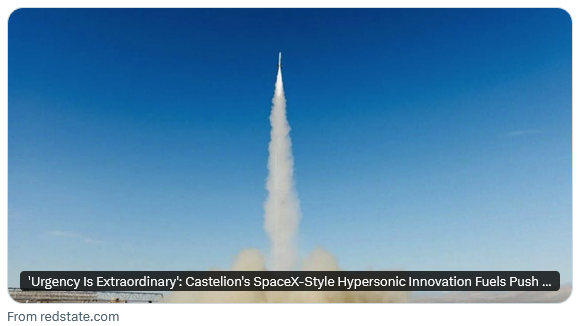
This is insane and it’s great news for the U.S. Navy.
All the worst people keep telling me Trump-class battleships are “obsolete” because of hypersonic missiles.
Then this drops:
“Blackbeard, engineered from a clean-sheet design by former SpaceX alumni, will not only match but decisively outpace foreign systems … rapid iteration and scalable production. We’re not just going to provide a comparable missile. We’re going to provide better missiles.”
A tiny startup just told Russia and China’s entire missile-industrial complex: we can beat you.
That’s the tell.
If hypersonics were the unstoppable carrier-killers people claim, you wouldn’t see startups leapfrogging them in a garage with venture capital. You’d see locked-in monopolies and terrified Western navies.
Here’s what the hype crowd misses:
1) Future battleships won’t be naked.
They will carry layered anti-hypersonic defenses, directed-energy weapons, decoys, and interceptors specifically designed to kill these things.2) Hitting a moving ship at hypersonic speed is brutally hard.
No nation has publicly demonstrated a successful hypersonic strike on a maneuvering warship. China hit a fake carrier sitting still in the desert. That proves almost nothing.
Think about the physics.
Flying a kamikaze plane into a carrier was hard but pilots had eyes, brains, and real-time judgment.
Now imagine doing that blind, with sensors the size of a soda can, while the target is jamming, maneuvering, spoofing, and throwing decoys.
Now imagine the Honey I Shrunk the Kids laser made you the size of an ant and you are told to steer a bullet into a weaving jet ski.
Russia can hit slow oil tankers. If they could reliably hit moving ships bringing supplies into Ukraine, they already would have.
3) Hypersonics are scarce and insanely expensive.
Even if it took 100 missiles to score a hit on a battleship, that’s 100 missiles that aren’t hitting ports, refineries, factories, air bases, and ammo depots.
Most of those targets don’t shoot back. None of them weave like a battleship.
Battleships change the economics of war.
They force the enemy to burn their most precious weapons just to try to hurt one ship.
That’s not vulnerability.
That’s deterrence.Stop black-pilling naval power. The physics, the economics, and now the tech sector are all pointing in the same direction.
Also on naval matters, Matt Gurney at The Line talks about his unfamiliar feelings of hope that the Canadian government’s promised spending boost for the Royal Canadian Navy will not only happen, but that the RCN may generate significantly improved capabilities as a result:

Arctic Offshore Patrol Ship HMCS Harry DeWolf shortly after launch in 2018. The ship was commissioned into the Royal Canadian Navy in June, 2021.
A day or two ago, I found myself thinking about the state of the Royal Canadian Navy. Because, I mean, hey — who doesn’t?
Anyone who has paid much attention to my work will be aware that I’m not exactly bullish on our country’s ability to get much done — especially on the file of military procurement. Yet, a day or two ago, I found myself thinking about the state of the Royal Canadian Navy and feeling something almost like … hope? Is this what hope feels like?
There is a lot going on in Canadian naval news, and that fits a broader pattern. There’s a lot going on on the seas globally, and, somewhat to my surprise, Canada seems to be doing a pretty good job — could be better, but could be worse — adapting to the new reality.
[…]
So let’s talk about seapower. The U.S. has it — not as much as it wants, but it’s got it. It wants more. Even if that ends up taking some pretty weird forms. And others are racing to catch up.
Including, intriguingly, Canada.
Last week, Canadian shipyard Seaspan announced that it had signed agreements with both Finland and American shipyards to licence its design for Multi-Purpose Icebreakers to the U.S. Coast Guard’s Arctic Security Cutter Program. And while the “Elbows Up” crowd may look askance at the prevalence of the word “American” in that sentence, this is damned interesting — not only are we continuing to show interest in the Arctic, but we’re also trying to sustain real shipbuilding in this country. The situation in the White House is so bizarre these days that it’s hard to take any announcement like this to the bank, but it was notable. If nothing else, it would be nice to see more efforts like this — whether the plans work will, alas, largely be out of our hands.
In addition to that, a few more stories came to mind. The first was this announcement from a few months ago: the Irving Shipyards have begun work on the final Arctic Offshore Patrol Ship of the Harry DeWolf class. Irving is also getting started on the next generation of Canada’s main warships, the River-class destroyers. Canada is actively seeking a replacement, in far greater numbers, of its current fleet of problematic submarines. And there’s also growing talk about a new smaller, mid-range class of Canadian warship, dubbed, for now, the Continental Defence Corvette. (Which I guess rolls off the tongue better than the See, Trump, We’re Spending On the Military Now Program.)
It’s easy to be a cynic on Canadian defence procurement — I am cynical about Canadian defence procurement. But then I looked at the ships being seized by U.S. forces. At Russia cutting cables, China ringing Taiwan with missiles and the U.S. throwing fleets around like Theodore Roosevelt has something to prove. And I look at a plan to not only replace Canada’s (too small) fleet of warships, but to considerably grow it … and it’s hard not to see the bigger picture.
Reverting to a pre-1945 geopolitical reality isn’t going to be an exercise in vibes. It’s going to be an exercise in power — or at least attempts to wield power. Air forces matter, cyber matters, drones matter and Lord knows armies matter. But they matter locally. True global power, or at least the ability to give a global power some pause before they decide to whisk your el jefe off to a Manhattan courtroom in a tracksuit, requires the ability to control your coasts and all the ocean approaches to them.
The History of SPAM
Tasting History with Max Miller
Published 22 Jul 2025Sliced SPAM layered with cream cheese filling, sliced and served with potato salad and tomatoes
City/Region: United States of America
Time Period: 1951SPAM. The iconic canned meat product. Beloved by some, reviled by others, SPAM was buoyed by a very successful marketing blitz by the Hormel company starting in the 1930s. There were radio and magazine ads, The Hormel Girls (a singing group), and recipes.
I’m not the biggest fan of SPAM, and this recipe turned out way too salty for me. If you want to make the historical recipe, go ahead and follow it, but I would personally opt for the reduced sodium SPAM and cut out the salt in the cream cheese mixture. If you like SPAM, definitely try this out! It’s super flavorful, but it’s just not to my taste.
Tender, pure-pork SPAM joins with a zesty cream cheese mixture for memorable eating. Serve for supper or lunch — or as a noteworthy appetizer.
SPAM ‘n’ Cheese Ribbon Loaf
Cut in 8 slices……1 whole SPAM
Mix together……1 (3-oz.) package cream cheese (softened with a little milk)
1 tsp. lemon juice
1 tsp. grated onion
1 tbsp. minced parsley
1/4 tsp. salt
Spread between……slices of SPAM
Chill……4 hours (or longer; overnight if desired). Slice and serve. Good with deviled eggs or potato salad.Economical all-meat buy! No bone, no waste. SPAM is all meat … juicy pork shoulder and mild, tender ham, with Hormel’s unequalled seasonings.
— Hormel advertisement, 1951
QotD: The potential tyranny of the state
Ivor Thomas, The Socialist Tragedy, 1951.
January 12, 2026
Britain’s new “war against misogyny”
At Oxford Sour, Christopher Gage explains how a Netflix show ended up as a key exhibit in the British chattering classes’ latest crusade:

Under our Labour government, the dictionary of euphemisms has swollen to rival War and Peace. Each day mints a fresh brick of Lego Language — words pressed together into sentence shapes that feel moral without actually meaning anything. Euphemism is not just annoying speech; it is a habit of mind. The mouth that traffics in euphemisms aligns with the mind that thinks in euphemisms too.
Nowhere is this clearer than in Labour’s declared War on Misogyny. According to our betters, Britain is a scorched plain over which misogynists roam, knuckles dragging, hypnotised by Andrew Tate and the Manosphere. These creatures, we are told, stalk the land, muttering statistics about male athletic advantage like a swarm of demented Daleks.
Our Labour government, its approval rating currently three percent lower than the percentage of Brits who believe there is a monster living in Loch Ness Lake, will train teachers to spot misogyny in boys and send “high-risk” offenders to courses to “tackle the root causes of misogyny”.
Misogyny, however, is not a vibes-based category. The word comes from the Ancient Greek misos (hatred) and gunē (woman): hatred of women. Until recently, it described a pathological condition involving fear, control, and violence directed at women. Such brutal men exist. They always have. But are they representative of the average British schoolboy doom-scrolling through social-media nonsense? Press X to doubt.
Yet this is where the campaign now lands: in classrooms of adolescent boys, taught to interrogate their latent depravity before it has manifested. It is not behaviour being punished, but probability.
In a culture strapped to the algorithm, only the most extreme definitions float to the surface. The brain, trained by screens, learns to seek the sensational, the novel, the ludicrous. And so, Labour shapes its moral imagination on content rather than evidence.
The Netflix drama Adolescence perfectly captures this drift. For the unacquainted, the series — an incel murder story drugged liberally with “that Andrew Tate shit” — was received as revealed truth. For The Guardian, it was “the best TV show ever”. It was not. Even a semi-literate eye would charge Adolescence as, well … adolescent.
Nevertheless, Adolescence assumed the status of revealed truth. On a BBC news panel, Tory leader Kemi Badenoch was interrogated for admitting she had not yet seen it. Middle-class parents dutifully watched alongside their sons, scanning their offspring for signs of misogyny leaking from its gills. Fiction hardened into diagnosis.
Life now imitates social media. Labour’s plan to tackle misogyny appears lifted directly from the website formerly known as Twitter. Schools will teach boys that it is not acceptable to act like barbarians. One wonders who imagined otherwise.
What these awareness seminars will not address — naturally — are the forms of misogyny that are neither hypothetical nor algorithmically inferred, but routine, organised, and existing beyond a Twitter feed or a Netflix menu.
They will not dwell on forced veiling, female genital mutilation, so-called honour violence, or acid attacks — practices documented in Britain and overwhelmingly concentrated within small but electorally critical communities governed by brutal patriarchal codes.
A rational observer might reasonably conclude that such practices meet any serious definition of misogyny: not ironic hatred, not incel posturing, but actual coercion, violence, and control exercised over women’s bodies and lives. You know, the very domination that Iranian women (and men) are currently risking their lives — quite literally — to uproot.
Yet these realities remain untouched and unmentioned, whilst classrooms revert into courtrooms enlisted to pre-emptively correct the imagined sins of adolescent boys. The reason is not moral complexity but political convenience. Euphemism thrives where naming the problem would threaten electoral arithmetic.
And so, the language grows ever softer around real brutality, even as it hardens against boys whose only crime is to physically resemble a fictitious incel murderer on Netflix.
Is Keir Starmer malevolent or stupid? Or both?
On his Substack, Tim Worstall wonders just how damn stupid Two Tier Keir actually is:

I fear our answer has to be very, very, stupid indeed. Unless he’s simply malevolent which makes things oh so much better, right?
Now, I confess to a fundamental disagreement with the very premise here. For the argument about why we should make child porn legal, see here. Making it more difficult to generate, let alone illegal, strikes me as the wrong decision. But then I’m sufficiently wise in years to realise that I might not be able to persuade some people of either that or of the many other things I am correct about. So, let us leave that aside.
There’s also the point that Grok is hardly the only image generation tool out there these days. Further, the one thing we know about computing is that this year’s leading, bleeding, edge is the free phone app of 5 years in the future. Shrieking that this must be banned just isn’t going to cut it as anyone trying that is simply a Cnut demanding the tide doesn’t flow in.1 On that larger issue of image generation in general we’re just going to end up changing the societal rules. A picture is no longer proof of anything. After all, it wasn’t up until about 1850 — those painters would just do any old thing, the truth be damned — and it won’t be after about 2028. Well, there we are then but …
But OK, let us leave all of that to one side and start from where British politics currently is. Grok generated AI kiddie porn is Bad, M’Kay, and must stop:
Technology Secretary Liz Kendall says she would back regulator Ofcom if it blocks UK access to Elon Musk’s social media site X for failing to comply with online safety laws.
Ofcom says it is urgently deciding what to do about X’s artificial intelligence (AI) chatbot Grok, which digitally undressed people without their consent when tagged beneath images posted on the platform. X has now limited the use of this image function to those who pay a monthly fee.
But Downing Street said the change was “insulting” to victims of sexual violence.
“Downing St” is the equivalent of the American “the White House said” … so yes, that is Keir Starmer, the Prime Minister there.
We’ve also an article from Liz Kendall today:
That Grok continues to allow this kind of content to be created by those willing to pay for it is an insult to victims. No business model should be built on the exploitation and abuse of women and children.
…
The Online Safety Act was designed precisely for situations like this, where platforms fail to take their responsibilities seriously and allow harmful content to proliferate. The British public rightly expects robust action. This is a matter of urgency that demands an urgent response.
I’ve also been clear that the Online Safety Act includes the power to apply to the courts to block services from being accessed in the United Kingdom if they refuse to comply with UK law.
We can see the threat there. If Elon Musk doesn’t do something about this then we’ll block X/Twitter from the UK.
- Why yes, I do know the correct story of Canute and the tides.
A Canadian and Australian connection showed up as well:

While I don’t depend on the social media site formerly known as Twitter for my news, I have found it a very useful additional source since Elon Musk took over the site. I’m clearly not the only one to feel this way:

As they used to say, however, “never believe anything until it’s been denied by the Kremlin”:
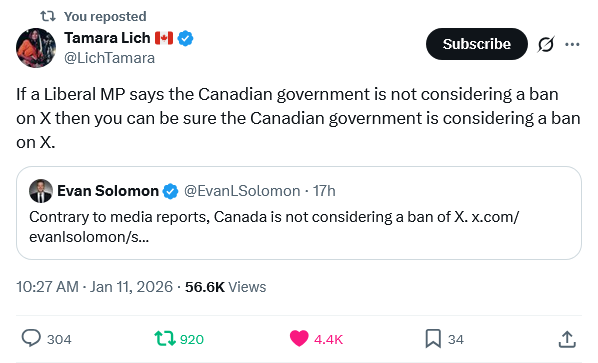
The rise of slop – “you get a clanker, and you get a clanker, everyone gets a clanker!”
The artificial intelligence wave continues, despite widespread resistance to AI being inserted into everything. It was bad when your toaster and refrigerator started needing access to the internet, but it’s bound to be so much worse when everything has to have an AI component bolted on to it as well. At The Libertarian Alliance, Neil Lock decries the rising tide of AI slop:
In recent days, there has been an eruption in the tech world. It is unlike anything I have seen in my more than half a century as a software developer, consultant and project manager. Microsoft, its Windows 11 operating system in particular, and artificial intelligence (AI), are in trouble. Big trouble.
The pressures leading to this eruption have been building for a year or so. Right now, the effects are confined mostly to tech blogs and tech people in the USA. But they are spreading. And fast.
Slop
In the last couple of years, AI-generated content has become ubiquitous on the Internet. It may consist of text, images or videos. Some of it is dangerous – for example, erroneous medical information. Most of it is of low to very low quality. And some of it is just bizarre. Such as the infamous “shrimp Jesus” I used as the featured image for this post.
In tech circles, the stuff has become known as “slop”. When you do a Google search, you may see more links to slop than to human-produced material. It looks as if “sloppers” have been using AI to generate large amounts of clickbait, not to mention content that may be misleading or downright dangerous.
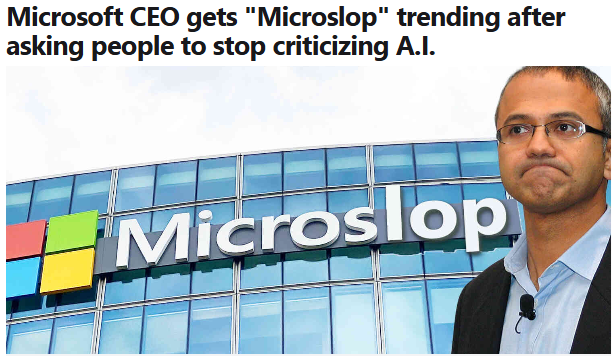
In February 2025, Microsoft’s CEO, Satya Nadella, pleaded in an interview for people to stop using the term “slop”. Saying “people are getting too precious about this”. The response could not have been further from what he asked for. The word “slop” went viral.
So much so, that last month Merriam-Webster, the dictionary publishers, declared “slop” to be their “word of the year”. Nadella responded huffily to this, saying: “we need to get beyond the arguments of slop versus sophistication”. The Internet tech community disagreed. And they took their revenge1 by re-naming the phenomenon “Microslop”.
Windows 10 and Windows 11
All tied up with this is Microsoft’s botched transition from Windows 10 to Windows 11.
Windows 11 was launched in October 2021. Due to higher hardware requirements, it would not run on around 60% of the PCs then running Windows 10. Including mine. That was already a time-bomb.
Support for Windows 10 was withdrawn for general customers on October 14th, 2025. Although Extended Security Updates (ESUs) remained available for corporate customers who wanted to keep Windows 10 running.
At no point has Windows 11 been popular with users. It had only about half the take-up Microsoft had expected. And by February 2025, many companies who had “upgraded” their staff’s PCs to Windows 11 had started returning them to Windows 10. It’s estimated that 400 million computers world-wide are still running Windows 10 without any Microsoft software support, simply because the users cannot, or do not wish to, “upgrade” to Windows 11.
Worse, some of Microsoft’s biggest corporate clients, with hundreds of thousands of users each, are switching to Apple Mac. And tech-savvy customers, including gamers and many smaller professional firms, are moving towards platforms like Linux.

If — when — Microsoft tries to force me to switch to a version of Windows with a built-in clanker, then I’ll be forced to switch to Linux. I do have a functional Linux laptop (a 14-year-old HP laptop that could barely boot under Windows by the end, but is now almost peppy running Linux). There’s only one piece of software I still run that doesn’t have a Linux version or competitor but if I accept the reduced functionality of running it in a web browser rather than natively, I could get by.
A Modern Integrally Suppressed Pistol for Everyone: The SilencerCo Maxim 9
Forgotten Weapons
Published 20 Aug 2025SilencerCo announced the Maxim-9 pistol in late 2015. Having gone through some huge growth of the past few years, the company wanted to expand its capabilities and thought that the time was right for a modern integrally suppressed pistol. It was a unique new design of modern semiautomatic pistol build from the ground up to be integrally suppressed. The action is a proprietary delayed blowback system with all of the moving parts in the back half of the slide. This leaves the front of the gun dedicated entirely to suppressor volume.
The guns were released at SHOT Show 2017, and were relatively slow sellers, because of the high price and the required NFA registration. The expected passage of the Hearing Protection Act around that time would have been a huge boon for sales, but did not ultimately happen. Still, production continued until tapering off in early 2021 as SilencerCo shifted priority to regular suppressor manufacture in the face of a boom in demand.
The project may not have been a massive success for SilencerCo, but it was still a worthy endeavor that they do not regret. It helped mature the company, forcing them to embrace new proficiency in things like GD&T and advanced quality control machinery. And the pistol is, in fact, very cool.
(more…)


