
I used to read a lot more than I do now — I have a personal library of a few thousand books — but less and less of what is being published has any interest for me at all. I still purchase a few new books every year, but rarely are they fiction titles. My primary interests are general history, military history, and a very limited number of SF authors’ work. The publishing industry isn’t interested in getting me back as a paying customer, at least based on the vast majority of what they’re pushing to the bookstores these days:
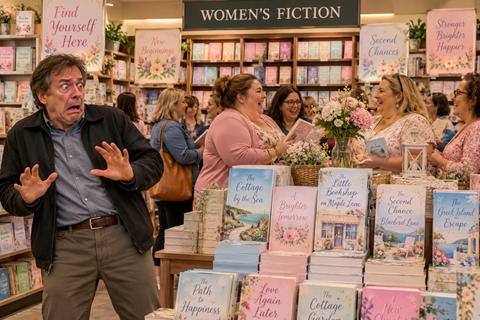
AI-generated image from Abstract Truth Substack
There seems to be genuine bewilderment in the publishing industry as to why male readers would rather read the instructions on an airplane barf bag than a novel from the “Manager’s Selection” at Barnes & Noble. It’s a genuine mystery why male readers weren’t anxiously digging into The Lesbiana’s Guide to Catholic School over the summer. The story of a 16-year-old’s struggle with lesbianism, at a time when it seems that half of Gen Z has declared itself either gay, lesbian, bisexual, or of equivocal sexuality, is a story that just has to be told. I mean, who ever heard of a lesbian nun or a gay priest? It’s so utterly novel that you would find a homosexual in the Roman Catholic Church. I am certain that there were no worthier candidates than this for recognition as a finalist for the National Book Award.
Walking into a Barnes & Noble brings a familiar feeling of nausea to the male shopper. It is the same feeling I had when our 78-year-old public junior high school teacher taught The Red Badge of Courage in a style guaranteed not only to make us hate all literature, but to regret having become literate at all.
First, there is the Great Wall of Pastel: pink, turquoise, lavender, sea-foam green, with flowers climbing around titles written in cursive. Look over there and you’ll see the woman facing the ocean, next to a cottage or a vineyard — or some other place to which she has fled after discovering that her marriage was an oppressive patriarchal institution because her husband asked her what was for dinner on consecutive Tuesdays.
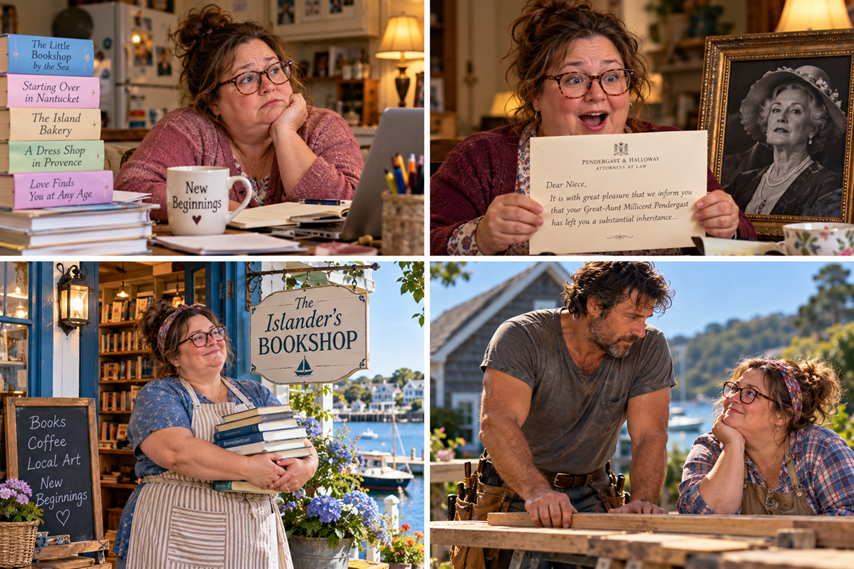
AI-generated image from Abstract Truth Substack
There are all sorts of creative variations on the story. She opens a bookshop, a dress shop, a bakery, or an inn on a Greek island or Nantucket. Maybe a distant aunt dies — Great-Aunt Millicent Pendergast — and leaves a fortune to the heroine because she once saw a spark in her as a little girl. The narrative is flowery and nauseating and full of feeling and description. Or perhaps she returns to the town she swore she would never return to and meets a rugged carpenter who is tortured but secretly wealthy and has chosen to work with his hands because money never brought him happiness.
By page 287, she discovers that she has been living for everyone but herself and has finally liberated herself from the horrible oppression of patriarchal submission.
It is truly baffling why men have gasped in horror at American fiction in much the same manner they would at the announcement of a Streisand-Cher double bill. I finally walked through the fiction section of Barnes & Noble some time ago and decided that I would rather be waterboarded than spend another minute there.
[…]
Men aren’t going to read trash that doesn’t appeal to them. But they will read history, biography, philosophy, and science fiction. They might read about a long-vanquished civilization or pick up a biography of Ty Cobb. They might spend 30 hours listening to a podcast about the Roman Empire. They may be reading about the Goths, Napoleon, or the fall of the Persian Empire. Men are not only capable of reading, they like to read. We just hate bad fiction.
It we find ourselves trapped inside Barnes & Noble, we are likely to cover their eyes as we pass the front displays and push our way toward the History or Philosophy section. American fiction has become a sea of political and therapeutic preoccupations produced by an industry that has pushed many male voices to the fringe of the business and then seems genuinely surprised that the male readers followed them out the door.
Meanwhile, somewhere at the London Book Fair, a panel discussion is convening under the title, “Where Have All the Male Readers Gone?” Thirteen of the fourteen panelists are women. The fourteenth is a transgender man who has complicated feelings about his father. The moderator has just finished explaining that men probably lack the emotional vocabulary required for contemporary fiction.
Nobody has thought to walk across the street to a pub and ask an actual male why they stopped reading fiction. But don’t worry. They’ll get to the bottom of it.



I finished my first novel some years ago, and went looking for a literary agent. All of them solicited for YA (young adult), LGBT, or some feminine thing. I wrote a guy book, a “police procedural,” I would call it. I finally agonized my way through Amazon Kindle create and self-published.
Comment by Bones — September 27, 2026 @ 19:35
Probably the only way anyone would get a chance to read your work. The publishing biz really, really doesn’t want to market anything so gauche as a “police [ugh! ACAB! ugh!] procedural”.
Comment by Nicholas — September 27, 2026 @ 20:33