Quotulatiousness

February 21, 2020

Justin Trudeau, Prime Empathizer of Canada

Filed under: Cancon, Government, Law, Politics, Railways — Tags: , , , , , , — Nicholas @ 03:00

The Prime Minstrel channels his inner Bill Clinton, although he just manages to avoid saying that he “feels our pain”:

A strange thing happened Tuesday morning. That strange thing was … an important and interesting exchange on the floor of the House of Commons. It happened during routine proceedings, and not in the Punch-and-Judy exchange of question period. The leaders of the various parties in the House stood and outlined positions on the rail blockades being conducted around the country in support of Wet’suwet’en opponents of B.C.’s Coastal GasLink pipeline.

First came the prime minister. “People are troubled by what they have been witnessing this past week,” he said. Our empathizer-in-chief, the emotional mascot of Confederation, was about to go to work. “Young, old, Indigenous and newcomers are asking themselves what is happening in the country … On all sides, people are upset and frustrated.”

The next three words out of his mouth were: “I get it.” Huh. Is that the sort of thing you say when you’ve actually gotten it? If a friend called you up in a shattered emotional state because he had just lost his job, as people are starting to lose jobs to the Wet’suwet’en solidarity protests, would you say “I get it”?

Beyond this tin-eared reassurance, Trudeau did not have much specific to say, and what there was seemed to contradict itself. “Our government’s priority is to resolve this situation peacefully, but also to protect the rule of law in our country,” he promised. “That is a principle we will always stand up for.” One would have thought the role of a prime minister was to apply the law rather than to “stand up for” it. He gave his usual spiel about the myriad of ways in which the federal government has failed First Nations, again speaking as though someone else were in charge. Certainly very little of it is his own fault: the government he leads has “invested more than any other … to right historic wrongs.”

Trudeau worried aloud that Canada might become “a country where people think they can tamper with rail lines and endanger lives,” but he seemingly renounced the use of force (it’s not “helpful”) against protesters who openly discuss sabotage. What the prime minister means when he talks of the “rule” of something called “law” has been left imperfectly clear.

Chris Selley suggests the government’s fecklessness will continue to prevent any solutions being implemented:

The stupefying weightlessness of Justin Trudeau’s government has never been more evident than in recent days, as it tries to arrange an end to the Mohawk blockade of CN’s main line near Belleville, Ont. At times it seems as if it might just float away, like an improperly tethered bouncy castle in a thunderstorm.

This week has been particularly windy.

[…]

The situation is ludicrous: Because Ontario’s independent provincial police won’t enforce a court injunction, the federal public safety minister seems to be in discussions with B.C.’s solicitor general about whether B.C.’s independent provincial police might back off enforcing a different injunction.

And the worst part of this absurdist theatre festival is how difficult it is to imagine a better alternative. Conservatives continue to call on Trudeau to somehow fix the problem, but the way Canada is set up, it’s really not a federal issue. The RCMP might have some jurisdiction over the railway as federally regulated infrastructure, said University of Toronto law professor Kent Roach, but that hasn’t happened in past cases. It wouldn’t even be up to Trudeau to send in troops: under the Emergencies Act, Roach said, a provincial solicitor-general has to request it.

These are structural issues that any PM will face. Indeed, the biggest difference between the Liberals’ approach to this blockade and the Conservatives’ approach to the 2013 Idle No More protests, which included a 13-day blockade of a CN line in southwestern Ontario, has been one of rhetoric and engagement. The Conservatives talked tougher, but Aboriginal Affairs rebuffed CN’s request to intervene. (Those protesters eventually obeyed a court injunction and left.) The Liberals needlessly tie themselves in knots and insult our intelligence — they know no other way — but they clearly believe it’s their job to broker some kind of resolution.

It’s tough to say which approach is likelier to work. At this point odds seem to favour “neither.” If you have a better, workable idea to get the trains moving, for God’s sake get on the horn to Ottawa.


Classics Summarized: Dante’s Purgatorio

Filed under: Books, History, Humour — Tags: , , — Nicholas @ 02:00

Overly Sarcastic Productions
Published 24 Apr 2015

Funny story: That half-second-long scream? Took me about four hours to record. I’m really bad at screaming and/or laughing on demand, so I sat down with some videos of the Game Grumps playing horror games and recorded my reactions to use whenever I need them. I now have a fifteen-second sound file of laughter and screams with varying degrees of shameful girliness.

Part 2 of the centuries-old trilogy has finally been summarized! Surely you’ve awaited this moment with bated breath. As always, I am happy to oblige.

QotD: Thought experiment

Filed under: Britain, Cancon, Quotations, USA — Tags: , , , , — Nicholas @ 01:00

If you were hovering above Earth looking to be born randomly into any time period in human history, you’d pick now if you had any brains. And if you could pick a place, you’d pick a Western liberal democracy, and probably the United States of America (though as much as it pains me to say it, you wouldn’t be crazy to pick Canada or the U.K. or Holland). Sure, if you could pick being rich, white, and male — and didn’t really care too much about the plight of others — you might take the 1950s. But even then, your choices for food, entertainment, etc. would be terribly curtailed compared to today. If you chose to be a billionaire in 1917, you could still die from a minor infection, and good Thai food would be entirely unknown to you. You’d certainly never enjoy watching a Star Wars movie on an IMAX screen in air conditioning. In other words, while your homes would be bigger and cooler if you were a billionaire in 1917, a typical orthodontist in Peoria in 2017 is in many respects much richer than a billionaire a century earlier.

Still, that’s not the deal on offer. You have to buy an incarnation lottery ticket, and the results would be random.

I’m not big on dividing people up by abstract categories, and I certainly don’t mean them to be pejorative. But as a historical matter, being born poor, gay, black, Jewish, ugly, weird, handicapped, etc. today may certainly come with some problems or challenges, but on the whole those traits are less of a shackle or barrier than at any time in the past. The only trait where I think it might be a closer call is dumbness. All other things being equal, a not-terribly-intelligent person with a good work ethic and some decent values might have had more opportunities before machines replaced strong backs. But even here, I can think of lots of exceptions.

Jonah Goldberg, “America and the ‘Original Position'”, National Review, 2017-12-22.

February 20, 2020

Why the Nazis Weren’t Socialists – ‘The Good Hitler Years’ | BETWEEN 2 WARS I 1937 Part 2 of 2

TimeGhost History
Published 19 Feb 2020

The Nazi economy appears to do well during the 1930s. But this is largely myth, as the German economy under Hitler is based on a self destructive, ideologically or selfishly fuelled irrationality driven by conquest and criminal practice.

Join us on Patreon: https://www.patreon.com/TimeGhostHistory

Hosted by: Indy Neidell
Written by: Spartacus Olsson
Directed by: Spartacus Olsson and Astrid Deinhard
Executive Producers: Bodo Rittenauer, Astrid Deinhard, Indy Neidell, Spartacus Olsson
Creative Producer: Joram Appel
Post-Production Director: Wieke Kapteijns
Research by: Spartacus Olsson
Edited by: Daniel Weiss
Sound design: Marek Kaminski

Sources:
Bundesarchiv_Bild:
192-269, 183-T0706-503, 183-S68029, 183-S68014,
183-S38324, 183-S33516, 183-S07227, 183-R98364,
183-H29131, 183-H25824, 183-H01704, 183-H13192,
183-H06734, 183-H00455, 183-C12671, 183-86686-0008,
183-2008-0826-506, 183-2008-0826-502, 183-2006-1128-504,
183-2004-0729-507, 183-1989-0630-504, 183-1988-0113-500,
146-2005-0191, 146-1990-048-29A, 146-1990-023-06A,
146-1984-040-26, 146-1981-124-32A, 146-1972-025-10,
102-13533, 102-12733, 102-11649, 102-06795, 102-04640,
145_Bild-P046280, 145_Bild-020683,

Colorizations by:
Daniel Weiss

Soundtracks from Epidemic Sound:
– “Document This 1” – Peter Sandberg
– “March Of The Brave 10” – Rannar Sillard – Test
– “Ominous” – Philip Ayers
– “The Inspector 4” – Johannes Bornlöf
– “Disciples of Sun Tzu” – Christian Andersen
– “Guilty Shadows 4” – Andreas Jamsheree
– “Last Point of Safe Return” – Fabien Tell
– “Death And Glory 1” – Johannes Bornlöf
– “Easy Target” – Rannar Sillard
– “Split Decision” – Rannar Sillard
– “First Responders” – Skrya
– “The Charleston 3” – Håkan Eriksson

A TimeGhost chronological documentary produced by OnLion Entertainment GmbH.

From the comments:

Spartacus Olsson
1 day ago
From an intellectual viewpoint, this is perhaps the most challenging episode I have written in this series. First of all it’s hard to make economic policy interesting, even when it’s about the Nazis. It tends to get, well … grey. Second of all it’s not that easy to simplify things without completely losing the essence of what was going on. Third of all, I’m fighting an uphill battle against a post truth, political talking point based on … let’s just call it less than ingenious purposes.

Obviously that’s the idea that the Nazis were Socialists. And perhaps that is not so far fetched when you think of the name of their party, the way they framed their anti-semitic rhetoric in a way that it would sound friendly to the working class, and their absolute disregard for telling the truth about anything, and everything. But although we have painstakingly showed you the facts, I am painfully aware that it won’t make a difference to stop the nonsense out there and in here — some pundits will religiously stick to their ideas, because if they don’t, they might have to face that some of the ideas they have are mutual with the people they so desperately want to distance themselves from. The same happened with the far left between the 1930s and 1970s, when they tried with cramped desperation to frame Stalinism as a right wing, Fascist movement — Red Fascism was the term — obviously as much nonsense as the alt-right idea that Naziism is Socialism.

And is it important? Well yes and no — the dumbos will probably get worn out at some point, it’s after all quite challenging to look for ways to distort the record over, and over again. I don’t really care if the extremists try to push their mutual garbage in each other’s lap — as a supporter of democracy and humanism, I have no regard for either end. I do however have an incredible amount of respect for conservatives, liberals, and progressives who are equally dedicated to democracy and human rights — and there is where it matters.

When the far left tries to frame Stalinism as right wing, and the far-right tries to frame Naziism is left-wing, they are trying to co-opt a position of less extremism. It’s an invasive attempt for Communists and (real) Socialists to just look like regular Progressives, and Fascists and Nazis to just look like regular Conservatives. And that my friends is dangerous, to all of us, regardless of our nationality, creed, political affiliation, or opinion — because it is specifically our individual rights and democracy that is at stake in this game. That’s what they want to take away, or in some places stop from developing.

So that’s why John Cabot got hired!

Filed under: Britain, History, Technology — Tags: , , , , — Nicholas @ 05:00

Anton Howes explains something that I’d wondered about in the latest edition of his Age of Invention newsletter:

Route of John Cabot’s 1497 voyage on the Matthew of Bristol posited by Jones and Condon: Evan T. Jones and Margaret M. Condon, Cabot and Bristol’s Age of Discovery: The Bristol Discovery Voyages 1480-1508 (University of Bristol, Nov. 2016), fig. 8, p. 43.
Wikimedia Commons.

… in 1550 the English were still struggling with latitude. Their inability to find it, unlike their Spanish and Portuguese rivals, was one of the main things holding them back from voyages of exploration.

The replica of John Cabot’s ship Matthew in Bristol harbour, adjacent to the SS Great Britain.
Photo by Chris McKenna via Wikimedia Commons.

The traditional method of navigation for English pilots was to simply learn the age-old routes. They were trained through repetition and accrued experience, learning to recognise particular landmarks and using a lead and line – just a thin rope weighted with some lead – to determine their location from the depth of the water. Cover the lead with something sticky, and you might bring up some sediment from the sea floor to double-check: a pilot would learn the kinds of sand and pebbles from to expect from different areas. And when they travelled out to sea, away from the coastline, they used a basic system of dead reckoning, taking their compass bearings from a known location, estimating their speed, and keeping in a particular direction for long enough. Or at least hoping to. They might keep track of their progress on a wooden traverse table, inserting pegs to indicate how far they had sailed, but it was ultimately a matter of rough estimation. Should they make any mistake — in terms of their speed, heading, or point of departure — they might easily get lost. But it was still a matter of trying to follow an already-known route. And English mariners of the 1550s did not even know that many routes.

For a voyage of exploration, by contrast, landmarks and sediment from the sea floor would be seen for the first time rather than recalled. By definition, there was no route to follow. So to launch their own voyages of discovery, the English needed to learn a new skill. They needed to look to the heavens.

Celestial navigation — measuring the altitude of heavenly bodies and then using geometry to determine one’s latitude on the earth’s surface — was by the 1550s already hundreds of years old. It had primarily been used to cross the deserts of North Africa and the Middle East — seas of sand, in which there might also be no landmarks from which to take bearings — and to navigate the Indian Ocean. Thus, while pilots in the Atlantic and the Mediterranean stuck to dead reckoning and soundings, Islamic navigators had for centuries used quadrants and astrolabes to take their bearings at sea. By the mid-fifteenth century, these instruments and techniques had found their way to Europe, where they were put to use especially by Portuguese, Spanish, and Italian explorers, along with additional instruments such as the cross-staff.

[…]

So for decades, English explorations relied on foreigners who either knew the routes that the English pilots didn’t, or who at least possessed the skill of mathematical, celestial navigation. The Italian explorer John Cabot (Zuan Chabotto), when he sailed to Newfoundland from Bristol in the late 1490s, was able to take latitude readings (he may even have been familiar with the older Islamic navigational practices, as he claimed to have visited Mecca). When Cabot died, the English expeditions that set out from Bristol in 1501-3 relied on Portuguese pilots from the mid-Atlantic islands of the Azores. And John Cabot’s son, Sebastian Cabot, who was involved in a few English expeditions, was so expert in mathematical navigation that he was eventually appointed pilot major for the entire Spanish Empire, making him responsible for the training and licensing of all its pilots — a position he held for three decades. When he led a voyage of exploration on behalf of Spain in 1526-30, a few English merchants became investors so that they could justify sending with him an English mariner, Roger Barlow, to secretly learn the Spanish routes across the Atlantic and have immediate knowledge if an onward route to Asia was discovered (as it turned out, South America got in the way).

Make a big leg vise from pine

Filed under: Tools, Woodworking — Tags: , , — Nicholas @ 04:00

Rex Krueger
Published 19 Feb 2020

Make a strong and sturdy bench vise with an inexpensive screw and wood from the big-box store.

More video and exclusive content: http://www.patreon.com/rexkrueger
Get the Big Leg Vise Plans: https://www.rexkrueger.com/store/xngn...
(more…)

A Neil Peart tribute from an unexpected source

Filed under: Media, USA — Tags: , , — Nicholas @ 03:00

Neil Peart, lyricist and percussionist for legendary Canadian band Rush, is remembered by Pershing’s Own, the United States Army Band:

When legendary Rush drummer Neil Peart died last January, I wanted to write about the significance of his life, but couldn’t. His death was a blow that surpassed the passing of any other stranger.

Of course, Peart was no stranger to millions of fans. We were his long-awaited friends. We grew up on Peart’s lyrics, and we grew old with them.

I also didn’t write because others were already saying everything that could be said. You cannot overstate the role that Peart played shaping a generation of liberty-inclined thought. Others covered his influence on music and drumming. You don’t need me for that.

Let’s fix the record on one point. Rush was not rock by nerds for nerds, as Bret Stephens mistakenly wrote. Not in my hometown. Rush fans were the cool tough kids, young boys bearing arms on Pennsylvania’s state holiday – the opening of deer season. Rush fans had a proud swagger wearing their raglan Rush shirts in the schoolyard the morning after the concert. A real Rush fan in my hometown was more likely to pop the “treasurer of the math club,” than be the treasurer, as Stephens described the typical fan.

But now comes a tribute to Neil Peart that captures what no other tribute quite captured. Pershing’s Own, the United States Army Band, has this touching arrangement of, fittingly, “Time Stand Still” from 1987’s Hold Your Fire. If you thought Rush was all loud progressive rock with glass-cracking vocals, you haven’t heard “Time Stand Still”, originally backed by Aimee Mann.

The U.S. Army Arrangement by Sgt. First Class Tim Whalen distills out the most beautiful elements of the 1987 track. The arrangement is sparse, and all percussion is notably absent. It is a song about time, and lives, and experiences passing.

    Summers going fast, nights growing colder, children growing up, old friends growing older

When the song was released in 1987, I was all of nineteen. Hearing it then on crisp September nights, I knew I wasn’t entitled to those lyrics. But one day, if I was blessed, I would be.

H/T to Blazing Cat Fur for the link.

An American .30-06 MG-42, and GPMGs after WWII

Filed under: Germany, History, Military, USA, Weapons, WW2 — Tags: , , — Nicholas @ 02:00

Forgotten Weapons
Published 31 Oct 2019

http://www.patreon.com/ForgottenWeapons

Cool Forgotten Weapons merch! http://shop.bbtv.com/collections/forg…

The perk for $100 Patrons is choosing a gun they would like me to find and film, and one such Patron (Mark) expressed a curiosity about US testing and lack of adoption of an MG-42 in .30-06 caliber. So, today we will discuss that (the trials gun was designated the T24) as well as why it took so long for the FN MAG to be developed and adopted.

For the full T24 trials report and photos, go here:
https://www.forgottenweapons.com/ligh…

Resources for this video included:

MG34-MG42: German Universal Machine Guns (https://amzn.to/2VtY314)
German Universal Machine Guns, Vol II: MG08-MG3 (https://amzn.to/2M2f67t)
Rock in a Hard Place: The Browning Automatic Rifle (https://amzn.to/315Dbi2)
The Browning Machine Gun, Vol I (https://amzn.to/2M4KgeA)
Ars Mechanica (https://amzn.to/324JT9h)
The Machine Gun, Vol I (https://www.ibiblio.org/hyperwar/USN/…)

Contact:
Forgotten Weapons
6281 N. Oracle #36270
Tucson, AZ 85704

QotD: Preventing bureaucratic mission creep

Filed under: Bureaucracy, Business, Government, Humour, Quotations — Tags: , , — Nicholas @ 01:00

The mission creep that is the effect of those not slumbering in meetings and thus adding another bright idea to the tasks the organization attempts is not restricted to the public sector.

Private companies are just as vulnerable. However in that private sector we have a mechanism by which the seemingly inevitable bureaucratization is dealt with. Once it happens, the organization goes bankrupt and is removed from the scene. What we need is a similar system to deal with this process in the public sphere.

I don’t, given the above, find it at all remarkable that the WTO is regarded as succumbing to these forces, nor the UN, Amnesty, the European Union or even our own domestic governments (just how did the interstate commerce clause become a justification for Congress to restrict something that is not interstate and is not commerce?). I think it inevitable.

Various solutions appear to be available, the French one might be an example. Put up with it for 50 years then have a revolution and start again. Perhaps the answer is never to allow the public bodies to have much power in the first place, a solution that hasn’t really been tried anywhere. The Italian one? Let the system carry on adding ever more layers but ignore it? Stalin’s? Every 15 years or so shoot the bureaucrats?

All such methods have their attractions and their faults but a solution we do need to find. For one of the lessons I take from the history of the 20th century is that we don’t actually want to be ruled by those who stay awake in committee meetings.

Tim Worstall, “‘Any Organization Will, In the End, Be Run By Those Who Stay Awake in Committee'”, Ideas in Action, 2005-06-23.

February 19, 2020

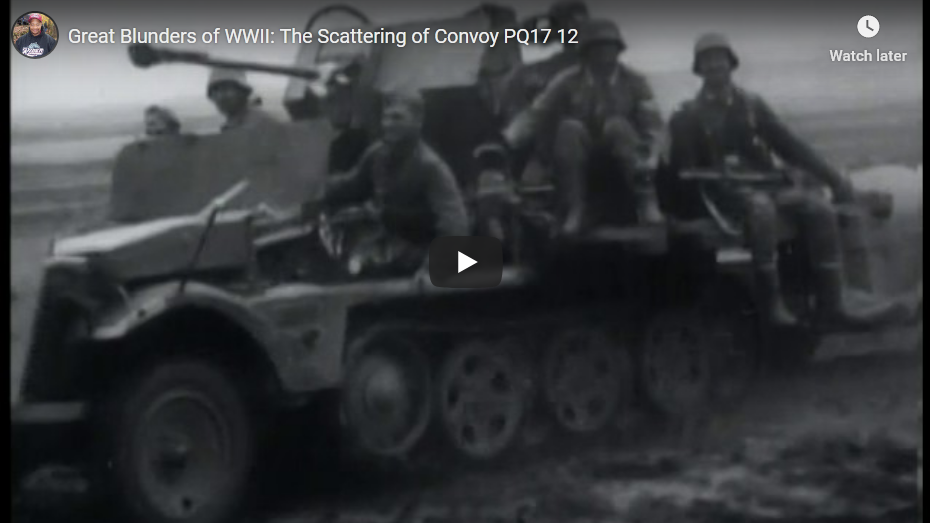
Great Blunders of WWII: The Scattering of Convoy PQ17

Filed under: Britain, Germany, History, Military, Russia, WW2 — Tags: , , , , , — Nicholas @ 06:00

Anthony Coleman
Published 4 Nov 2016

From the History Channel DVD series Great Blunders of WWII.

This is of interest for many reasons, but particularly because my late father-in-law served in the Royal Navy on the Arctic convoys and spent a full winter in the Soviet Union when his convoy couldn’t return before the ice closed the convoy route.

Enoch Powell

Theodore Dalrymple reviews a recent book by Paul Corthorn on Powell’s career and the concerns that animated him:

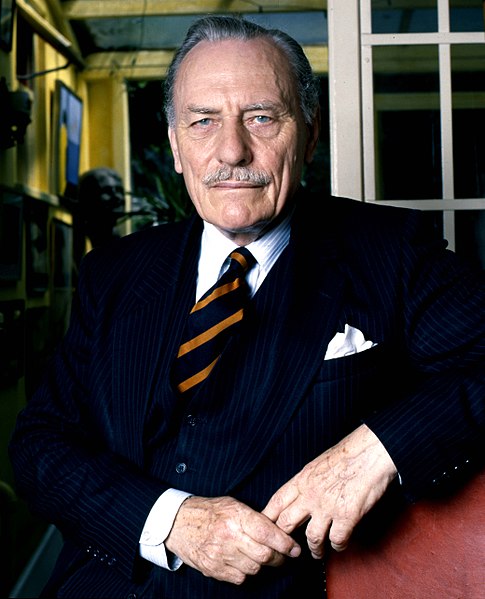
Enoch Powell in a 1987 portrait by Allan Warren.
Wikimedia Commons.

It does not pretend to be a biography, or even an intellectual biography. Rather, it chronicles, scrupulously but somewhat drily, Powell’s varying attitudes toward the main subjects of his political concerns: international relations, economics, immigration, Britain’s relations with Europe, and the status of Northern Ireland in the United Kingdom. Powell’s wider intellectual interests and religious views are scarcely touched upon, though it is mentioned that he went from being a believer to being (under the influence of Nietzsche) an atheist, to then returning to Christian belief. There is no description of his character in this book, not even by implication, and with this book as a guide, one would not recognise him if one met him. It is not possible to tell whether the author admires or detests his subject. This neutrality creates confidence in the accuracy of his scholarship, but also makes his book less than a pleasurable or exciting read. Perhaps it is the sign of a frivolous mind, but I prefer even histories of ideas to be spiced with a little biography (or, more truthfully, gossip).

The author does, however, offer a unifying interpretation of Powell’s various political concerns, namely that they were all responses to Britain’s precipitous national decline, the steepest part of which occurred in his lifetime, but which is continuing apace to the extent that Britain might even cease to be a nation at all. Powell was born in a great power and died in an enfeebled country with no industrial or military might, with precious little patriotism, and with no sense either of grandeur or collective purpose.

That this decline – relative rather than absolute, except in such fields as the maintenance of law and order — was inevitable given the conjunctures of the age, was evident to Powell (though not at first). This relative decline was already implicit in Disraeli’s dictum that “the Continent [of Europe] will not suffer England to be the workshop of the world.”

Powell’s concerns, then, were how to manage Britain’s decline and how to find it a new place in the world. He had not always been perceptive about the scale of its decline. He clung, for example, to the illusion that the Empire might still count for something even after the Second World War. Thereafter, however, he became a devotee of a kind of Realpolitik, to the extent of wanting a rapprochement or even alliance with the Soviet Union to balance the power of the United States, whose aims he had long distrusted. He discounted ideology, including communism, as a force in international politics, which is odd in a man who was by far the most intellectual and intellectually accomplished of all British politicians of the 20th century, being both a classical scholar and a brilliant linguist. He seemed to think that Soviet ambition was merely that of any large power in the great game. Those countries that fell into its grip knew otherwise.

On economics, Powell was an early devotee of the superiority of the market over state planning at a time when the intellectual tide was running the other way. There was one important subject, however, on which he was a confirmed statist, namely that of health care. He was for a time Minister of Health in the British government, during which he fiercely defended the NHS. He believed that the government had an ethical duty to provide health care for its citizenry, and it never seemed to occur to him that the centralised NHS was not the only possible way of doing so. He was often highly suspicious of international comparison, but it is difficult to see how judgment of the merits of a system could be made without it. It was clear, moreover, that in this, as in other fields, Britain was at best very mediocre. Perhaps Powell was blind to the NHS’s mediocre performance because of the benevolence of its stated intentions (an occupational hazard among intellectuals, even — or perhaps especially — among brilliant ones). At any rate, he never satisfactorily explained why health care should be different from other spheres of service provision in the superiority of private over public organization.

Christopher Hitchens – Why Orwell Matters

Filed under: Books, Britain, History, Liberty, Politics — Tags: , , , , — Nicholas @ 04:00

TheHitchensArchive
Published 24 Apr 2013

October 21, 2002. Christopher Hitchens giving a speech based on his book about George Orwell at The Commonwealth Club.

Perhaps women just don’t want to join the infantry? Just a thought.

Filed under: Cancon, Military — Tags: , — Nicholas @ 03:00

Barbara Kay on the long-promised yet still (unsurprisingly) unfulfilled plan to have 25% of the Canadian Army’s infantry be staffed by women:

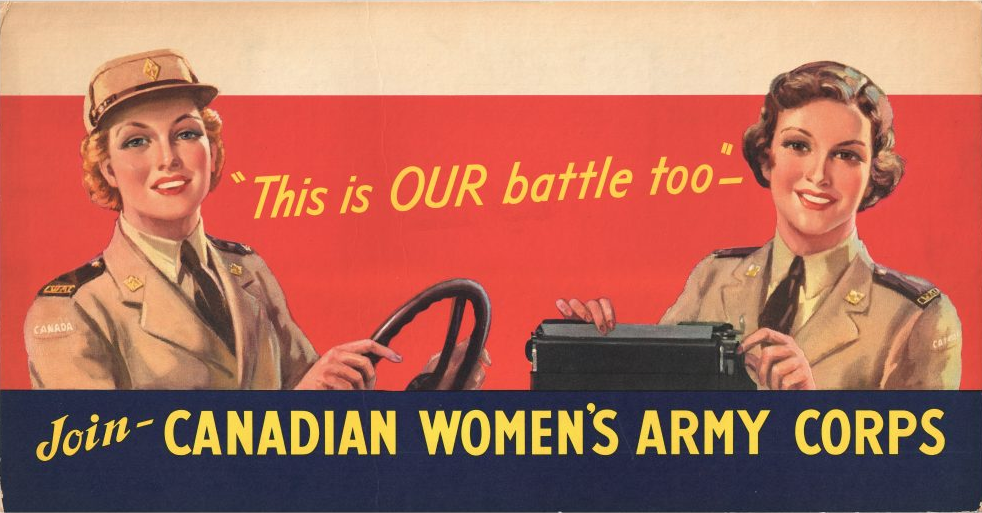
A WW2-era recruiting poster for the Canadian Women’s Army Corps. You’d be surprised how few modern photos of women in combat roles are available online, given the Canadian government’s desire to recruit more women in those areas.

In 1997, when women comprised 14 per cent of the Canadian Forces, Gen. Maurice Baril argued that a robust recruitment campaign was all that was necessary to boost female membership to 28 per cent by 2009, when, he predicted, women would comprise a full 25 per cent of front-line infantry troops, up from 0.6 per cent at the time.

Since there wasn’t a shred of evidence from Canada or anywhere else to support such a projection — women in Russia and Israel have performed combat roles under extreme duress for national survival, but their participation never lasted past the crisis — it came as no surprise to skeptics that the recruitment campaign fell far short of its goal. Women presently comprise 15.9 per cent of Canadian Forces members, the great majority of whom are serving in support roles (the number is 14 per cent in the United States).

A realist would draw the obvious conclusion that women and men are different. Women just aren’t into combat, and so what. But gender realism hasn’t governed the Canadian Forces for decades. So its honchos are doubling down, determined to ensure that by 2026, females fill 25 per cent of the ranks. This time, they’ve assigned a “Tiger Team” to circumvent the “systemic barriers” that make the military a “less than desirable choice” for the majority of young Canadian women.

Apparently, they have chosen to ignore their own recruitment analysts, who informed them that women feel “discomfort with a profession that involves combat,” because it has the “potential of killing people (especially innocent people).” If the military’s main “systemic barrier” to recruiting women is their inherent distaste for the profession’s existential purpose, how can that barrier be overcome?

Classics Summarized: Dante’s Inferno

Filed under: Books, Greece, History, Humour, Religion — Tags: , , , , — Nicholas @ 02:00

Overly Sarcastic Productions
Published 21 Mar 2015

I’m back, baby!

For this week’s venture into literature, we take a broad look at The Inferno. Hold onto your butts.

PATREON: https://www.patreon.com/user?u=4664797

MERCH LINKS:
Shirts – https://overlysarcasticproducts.threa…
All the other stuff – http://www.cafepress.com/OverlySarcas…

Find us on Twitter @OSPYouTube!

QotD: Myths the Greatest Generation believed

Filed under: Government, History, Quotations, USA, WW2 — Tags: , , , — Nicholas @ 01:00

In addition to inflating our confidence in overseas interventions, the war era fueled belief that government could be a major force for good at home, capable of solving every domestic problem. Franklin Roosevelt’s superb wartime management boosted the popular opinion of government and encouraged Americans to adopt war as a metaphor for government action in general. The war seemed to fulfill Teddy Roosevelt’s and Woodrow Wilson’s earlier progressive dreams that big government, acting in concert with big business and big labor, could solve any problem that it chose to tackle. Just as warfare was re-envisioned to fit the total-war model of World War II, governing became understood as a matter of trained professionals applying management methods to public policy.

This belief in the military-like efficiency of government inspired the ambitious welfare-state policies of the postwar era, especially Johnson’s War on Poverty. When, in 1972, Richard Nixon declared a War on Drugs, and when, in 1977, Jimmy Carter described the energy crisis as the “moral equivalent of war,” the model they had in mind was, again, World War II. Today, newspapers and scientific journals still proclaim the need for ambitious government action to fix enormously complex problems — for example, calling repeatedly for a “new Manhattan Project” to solve the problem of climate change.

War, as conservatives figured out early on, is a poor metaphor for government doing socially useful things. We can’t fight and win a “war” on poverty, or drugs, or cancer, because these things are nothing like war. The last heroic big-government project run along World War II lines was the Apollo program, which put Americans on the moon. This was a tremendous achievement, but here a military mindset was directly relevant: like the design of war machines a quarter-century earlier, the Saturn rockets were a discrete engineering challenge, one whose basic parameters were well understood.

E. M. Oblomov, “The Greatest Generation and the Greatest Illusion: Success in World War II led Americans to put too much faith in government — and we still do.”, City Journal, 2017-12-28.

« Newer PostsOlder Posts »

Powered by WordPress