Quotulatiousness

September 20, 2020

The CBC’s latest bit of “mission creep”

Filed under: Business, Cancon, Media — Tags: , , , — Nicholas @ 05:00

At The Line, Jen Gerson wonders what the hell the CBC thinks it’s doing with this move:

Let us take a moment to leverage a little credibility under the CBC’s ass.

What the fuck is the CBC playing at, here? The corporation receives a cool $1 billion in public funding per year and it’s using taxpayer funds to, yet again, horn into the revenue streams of private communications outlets. No one — literally not a single Canadian taxpayer who isn’t already employed by the CBC — wants to throw money at a public broadcaster so that it can: “Help Canada’s strongest brands shape and share inspiring stories across our platforms and across the country.” Vomit.

No one asked for a taxpayer-funded advertising firm, you goddamn loons.

This is yet another classic example of one of the most dysfunctional habits of the MotherCorp: mission creep. A massive and rudderless operation unfettered from the practical limitations of profit-seeking has proven itself unable to restrain its own boneheaded impulses.

We, at The Line, can hear the pitiable defences already: “Oh, but they’re already underfunded. Of course they need to, uh, use their incredible taxpayer-funded competitive advantage to eat into the dwindling revenue streams of failing private media outlets just to survive!”

No. No. No they do not.

When faced with a dysfunctional hydra-headed cultural behemoth that is demonstrably incapable of keeping its mandate in its pants, the first impulse should not be to shovel ever-more taxpayer funds into the ever-widening maw. The CBC could respond to *cough* “inadequate funding” by narrowing its scope and focus to the things that make it most necessary to the Canadian public that it serves — radio, news, documentary, serving regions and topics that the private sector cannot adequately penetrate. Instead it goes off and does weird shit like this, and CBC Comedy, and CBC Music.

CBC. Guys.

You cannot be everything to everyone. You shouldn’t be everything to everyone. Canadians are not well served by a monopolistic government-funded one-stop #content communications shop. Figure out what you do best and stick to it. Focus on supplementing — rather than crushing — private-sector journalism. Maybe even consider ways to support private-sector start ups and independents, especially in local markets. “Revenue generation” is not the place where a public broadcaster should demonstrate self-defeating, industry-following innovation.

Another week, another half million for the Germans – WW2 – 108 – September 19, 1941

Filed under: China, Germany, History, Japan, Military, Russia, WW2 — Tags: , , , , , — Nicholas @ 04:00

World War Two
Published 19 Sep 2020

Kiev falls to the Germans, yielding hundreds of thousands of prisoners as whole armies are surrounded, but behind the lines all over German-occupied territories, partisan movements are gaining steam. Meanwhile, in China, Japan launches another campaign against Changsha.

Join us on Patreon: https://www.patreon.com/TimeGhostHistory
Or join The TimeGhost Army directly at: https://timeghost.tv

Follow WW2 day by day on Instagram @ww2_day_by_day – https://www.instagram.com/ww2_day_by_day
Between 2 Wars: https://www.youtube.com/playlist?list…
Source list: http://bit.ly/WW2sources

Written and Hosted by: Indy Neidell
Director: Astrid Deinhard
Producers: Astrid Deinhard and Spartacus Olsson
Executive Producers: Astrid Deinhard, Indy Neidell, Spartacus Olsson, Bodo Rittenauer
Creative Producer: Joram Appel
Post-Production Director: Wieke Kapteijns
Research by: Indy Neidell
Edited by: Monika Worona
Sound design: Marek Kamiński
Map animations: Eastory (https://www.youtube.com/c/eastory)

Colorizations by:
– Norman Stewart – https://oldtimesincolor.blogspot.com/
– Carlos Ortega Pereira, BlauColorizations – https://www.instagram.com/blaucolorizations
– Olga Shirnina, a.k.a. Klimbim – https://klimbim2014.wordpress.com/
– Julius Jääskeläinen – https://www.facebook.com/JJcolorization/
– Jaris Almazani (Artistic Man) – https://instagram.com/artistic.man?ig…
– Daniel Weiss

Sources:
– Ra Boe / Wikipedia / Lizenz: Creative Commons CC-by-sa-3.0 de
– Mil. ru
– Narodowe Archiwum Cyfrowe
– Estonica

Archive by Screenocean/Reuters https://www.screenocean.com.

A TimeGhost chronological documentary produced by OnLion Entertainment GmbH.

Andrew Sullivan on the politically deranging effects of social media addiction

Filed under: Media, Politics, Technology, USA — Tags: , , , , , — Nicholas @ 03:00

In his latest Weekly Dish installment, Andrew Sullivan decries the extreme polarization of the US electorate and points an accusing finger at social media for making things much worse:

An Electoral College victory for Trump, if he loses the popular vote again, would, in this new elite consensus, prove beyond doubt the centuries’ long grip of “white supremacy”. Some are already calling such a victory illegitimate, even though it would be completely constitutional, under the rules everyone has agreed to. The sickening street violence that the far left has downplayed, and permitted to run riot in major cities could be a mere taste of what is to come — along with ever-stronger white nationalist gangs instigating or responding in kind. (Trump’s toleration of this dangerous right-extremism in the past four years is as unforgivable as the left’s excuses for murderous violence.) But the upshot is the same: we will be lucky if the country doesn’t erupt in large-scale civil violence by the end of all this.

And the reason this dystopian scenario is so credible is not just the fault of these political actors. It’s ours too — thanks to the impact of social media. I think we’ve under-estimated just how deep the psychological damage has been in the Trump era — rewiring the minds of everyone, including your faithful correspondent, in ways that make democratic discourse harder and harder and harder to model. The new Netflix documentary, The Social Dilemma, is, for that reason, a true must-watch. It doesn’t say anything shockingly new, but it persuasively weaves together a whole bunch of points to reveal just how deeply and thoroughly fucked we are. Seriously, take a look.

The doc effectively shows how the information system necessary for democratic deliberation has, in effect, been jerry-rigged in the last decade to prevent any reasoning at all. It’s all about the feels, and the irrationality, and the moment, which is why Trump is so perfectly attuned to his time. And what’s smart about the documentary is that it shows no evil genius behind this unspooling, no sinister plot deliberately to destroy our system of government. One of the more basic motives in American life — making money — is all you now need, the documentary shows, to detonate American democracy at its foundation.

For Facebook and Google and Instagram and Twitter, the business goal quickly became maximizing and monetizing human attention via addictive dopamine hits. Attention, they meticulously found, is correlated with emotional intensity, outrage, shock and provocation. Give artificial intelligence this simple knowledge about what distracts and compels humans, let the algorithms do their work, and the profits snowball. The cumulative effect — and it’s always in the same incendiary direction — is mass detachment from reality, and immersion in tribal fever.

With each passing second online, news stories, graphic videos, incendiary quotes, and outrages demonstrate their stunning utility to advertisers as attention seizers, are endlessly tweaked and finessed by AI to be even more effective, and thereby prime our brains for more of the same. They literally restructure our minds. They pickle us in propaganda. They use sophisticated psychological models to trap, beguile, outrage, and prompt us to seek more of the same.

[…]

And online is increasingly where people live. My average screen time this past week was close to ten hours a day. Yes, a lot of that is work-related. But the idea that I have any real conscious life outside this virtual portal is delusional. And if you live in such a madhouse all the time, you will become mad. You don’t go down a rabbit-hole; your mind increasingly is the rabbit hole — rewired that way by algorithmic practice. And you cannot get out, unless you fight the algorithms to a draw, or manage to exert superhuman discipline and end social media use altogether.

But the thing about algorithms and artificial intelligence is that they don’t rest, they have no human flaws, they exploit every weakness we have, and have already taken over. This is not a future dystopia in which some kind of AI robot takes power and kills us all. It is a dystopia already here — burrowed into our minds, literally disabling the basic mental tools required for democracy to work at all.

If you watch video after video of excessive police force against suspects, for example, and your viewing habits are then reinforced by algorithms so you see no countervailing examples, your view about the prevalence of such excessive force will change, regardless of objective reality. A new study shows how this happens. Watching the videos, even more than reading text about them, raises the percentage of white liberals who believe the cops frequently or always use excessive force by around 20 percentage points. The actual data are irrelevant. The BLM movement this summer was less a racial reckoning, as we’re constantly lectured, than a moment of web-induced mass hysteria.

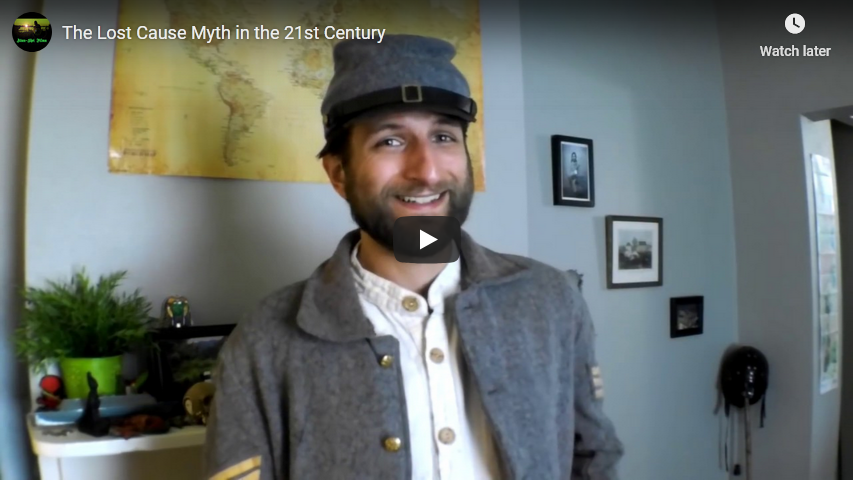
The Lost Cause Myth in the 21st Century

Filed under: History, Politics, USA — Tags: , , , , , — Nicholas @ 02:00

Atun-Shei Films
Published 23 Feb 2019

A former Gettysburg tour guide talks about how the American Civil War is remembered today.

Support Atun-Shei Films on Patreon ► https://www.patreon.com/atunsheifilms

#CivilWar #Confederacy #AmericanHistory

Watch our film ALIEN, BABY! free with Prime ► http://a.co/d/3QjqOWv
Reddit ► https://www.reddit.com/r/atunsheifilms
Twitter ► https://twitter.com/alienbabymovie
Instagram ► https://www.instagram.com/atunsheifilms
Merch ► https://atun-sheifilms.bandcamp.com

QotD: The anti-slavery movement

Filed under: Books, Britain, Government, History, Liberty, Quotations — Tags: , , , — Nicholas @ 01:00

“William Wilberforce,” writes Eric Metaxas in his book Amazing Grace, “was the happy victim of his own success. He was like someone who against all odds finds the cure for a horrible disease that’s ravaging the world, and the cure is so overwhelmingly successful that it vanquishes the disease completely. No one suffers from it again — and within a generation or two no one remembers it ever existed.”

What did Wilberforce “cure”? Two centuries ago, on March 25th 1807, one very persistent British backbencher secured the passage by Parliament of an Act for the Abolition of the Slave Trade throughout His Majesty’s realms and territories. It’s not that no one remembers the disease ever existed, but that we recall it as a kind of freak pandemic — a SARS or bird flu that flares up and whirrs round the world and is then eradicated. The American education system teaches it as such — as a kind of wicked perversion the Atlantic settlers had conjured out of their own ambition.

In reality, it was more like the common cold — a fact of life. The institution predates the word’s etymology, from the Slavs brought from eastern Europe to the glittering metropolis of Rome. It predates by some millennia the earliest laws, such as the Code of Hammurabi in Mesopotamia. The first legally recognized slave in the American colonies was owned by a black man who had himself arrived as an indentured servant. The first slave owners on the North American continent were hunter-gatherers. As Metaxas puts it, “Slavery was as accepted as birth and marriage and death, was so woven into the tapestry of human history that you could barely see its threads, much less pull them out. Everywhere on the globe, for 5,000 years, the idea of human civilization without slavery was unimaginable.”

Mark Steyn, The [Un]documented Mark Steyn, 2014.

September 19, 2020

Fitting the Drawer | The Cabinet Project #25 | Free Online Woodworking School

Filed under: Tools, Woodworking — Tags: , , — Nicholas @ 06:00

Matt Estlea
Published 13 Sep 2020

In this video, I show you how to precisely fit a dovetailed drawer into a carcase. The aim here is to achieve a piston fit which is a smooth operation in and out, but without any side-to-side wobble.

Learn how to tackle tricky grain here:
https://mattestlea.com/tutorials/how-…

_________________________________________________________________

Support what I do by becoming a Patron! This will help fund new tools, equipment and cover my overheads. Meaning I can continue to bring you regular, high quality, free content. Thank you so much for your support! https://www.patreon.com/mattestlea

Don’t want to commit to a monthly direct debit but still want to help out? That’s fine!
You can make a one time donation here: www.mattestlea.com/donate
You can donate us biscuits here: www.mattestlea.com/wishlist
_________________________________________________________________
BUY THE WOODWORKING BIBLE HERE:
www.mattestlea.com/the-woodworkers-manual
_________________________________________________________________

SOCIAL MEDIA
Instagram: www.instagram.com/mattestlea
Twitter: www.twitter.com/mattestlea
Patreon: www.patreon.com/mattestlea
Pinterest: www.pinterest.com/mattestlea
LinkedIn: www.linkedin.com/in/matt-estlea-b6414b11a/
_________________________________________________________________
See what tools I use here: www.mattestlea.com/equipment
My Website: www.mattestlea.com
_________________________________________________________________

My name is Matt Estlea, I’m a 24 year old Woodworker from Basingstoke in England and my aim is to make your woodworking less s***.

I come from 5 years tuition at Rycotewood Furniture Centre with a further 1 year working as an Artist in Residence at the Sylva Foundation. I now teach City and Guilds Furniture Making at Rycotewood as of September 2018.

If you’re interested in studying at Rycotewood, view their courses here:
www.mattestlea.com/rycotewood

I also had 5 years of experience working at Axminster Tools and Machinery where I helped customers with purchasing tools, demonstrated in stores and events, and gained extensive knowledge about a variety of tools and brands. I discontinued this at the start of 2019 to focus solely on video creation and teaching.

During the week, I film woodworking projects, tutorials, reviews and a viewer favourite ‘Tool Duel’ where I compare two competitive manufacturers tools against one another to find out which is best. I also have a Free Online Woodworking School which you should definitely check out!

www.mattestlea.com/school

I like to have a laugh and my videos are quite fast paced BUT you will learn a lot, I assure you.

Lets go make a mess.

Andrew Heaton attempts to talk to people about politics

Filed under: Humour, Media, Politics, USA — Tags: , , — Nicholas @ 05:00

In his latest missive from deeply singed California, Andrew Heaton expresses some concerns about the American body politic in the late stages of utter emotional breakdown (that is, the last couple of months of the election):

I’m going to go out on a limb here and say that the political climate is going to “heat up.” Although the heat comes from a different fault line than you might think. The real division in America isn’t between conservatives and progressives. It’s between people who read stuff, and people who TYPE IN ALL CAPS ON TWITTER.

I’m pretty firmly in the “read stuff” camp. Which makes me poorly situated for our current period, as I am a quarter Vulcan on my father’s side, and it’s overwhelmingly in vogue to be emotionally incontinent. Emotionally incontinent people don’t care for us pseudo-Vulcans. Perhaps you can relate?

This is a normal conversation for me:

    Friend: Trump is an evil fascist meat goblin!

    Me: Yeah, I can’t stand that guy. I’m not a big Biden fan, but I definitely prefer him over Trump.

    Friend: But Trump is a racist lunatic!

    Me: Sure. I certainly don’t think he has an ideological core or respect for constitutional rule of law. I have serious misgivings about his leadership. Also he’s horrible on trade.

    Friend: HE’S LOCKING CHILDREN IN CAGES! THE WORLD IS ON FIRE!!! DON’T YOU SEE THAT TRUMP IS THE DEATH OF THIS AND ALL WORLDS!?!?

If you read the above conversation carefully, you might notice that I’m not actually disagreeing with my hysterical friend. In fact we’re broadly in agreement, at least on the 2020 election outcome. So why are they flipping out, like the electoral version of Kermit the Frog flailing his arms in a Muppets sketch?

Here’s why: in political conversations the People Who Read Stuff are interested in exchanging ideas and policies. The ALL CAPS ON TWITTER crowd wants to exchange feelings.

If your hysterical conservative friend is laying eggs about Antifa ushering in the Night of the Long Knives, or your progressive friend is freaking out about Trump ushering in The Night of the Long Knives, what you say or think is immaterial — they are looking for you to match their emotional state. If you don’t, it means you’re probably making a buck selling knives.

This is a problem in my social life. I have learned that my feelings are fickle and easy to manipulate, and so distrust them. I take pride in my Vulcan heritage. When confronted with a big, scary problem, I believe the best response is to get calm and thoughtful. In Vulcan culture we call this “acting like an adult.”

Unfortunately equanimity is not popular on this planet. It’s trendy to experience feelings so hard that neurochemicals seep out of your pores, the way alcoholics sweat vodka.

You can subscribe to the newsletter here.

History RE-Summarized: The Roman Republic

Filed under: Europe, History, Humour — Tags: , , , , — Nicholas @ 04:00

Overly Sarcastic Productions
Published 18 Sep 2020

The Roman Republic is a fascinating story all on its own, but it also serves as an excellent object lesson in civics.

This video is a Remastered, Definitive Edition of three previous videos from this channel — History Summarized: “The Roman Republic”, “The Punic Wars”, and “Julius Caesar and the Fall of The Republic”. This video combines them all into one narrative, fully upgrades all of the visuals, and adds extra historical notes and clarifications along the way. Please let me know if you enjoyed this, and are interested in more videos like this. There are many historical miniseries on this channel that would fit neatly into a compilation like this, and I’d be thrilled to make them!

SOURCES & Further Reading: Virgil’s Aeneid, Polybius’ Histories, Livy’s Ab Urbe Condita Plutarch’s Parallel Lives, Caesar’s De Bello Gallico, SPQR by Mary Beard, Rome: A History in Seven Sackings by Matt Kneale, Rubicon by Tom Holland, The Storm Before the Storm by Mike Duncan, (and also my degree in Classical Studies).

Note for 14:15 — I mention Livy’s History Of Rome (“Ab Urbe Condita“) by name, but made the lizard-brain mistake of showing Polybius instead. Poor Livy, first 75% of his work is lost, and now this.

Our content is intended for teenage audiences and up.

DISCORD: https://discord.gg/kguuvvq

PATREON: https://www.Patreon.com/OSP

MERCH LINKS: http://rdbl.co/osp

OUR WEBSITE: https://www.OverlySarcasticProductions.com
Find us on Twitter https://www.Twitter.com/OSPYouTube
Find us on Reddit https://www.Reddit.com/r/OSP/

The perils and pitfalls of developing open source software

Filed under: Technology — Tags: , , , — Nicholas @ 03:00

In The Diff, Byrne Hobart looks at the joys and pains-in-the-ass of open source software development:

“How university open debates and discussions introduced me to open source” by opensourceway is licensed under CC BY-SA 2.0

We’re in a strange in-between state where software is increasingly essential, the most important bits of it are built by dedicated volunteers, and there’s no great way to encourage them to a) keep doing this, and b) stay motivated as the work gets less and less fun. That was my main takeaway from Nadia Eghbal’s Working in Public, published this week.

The book is a tour of the open source phenomenon: who builds projects, how they get made and updated, and why. This is an important topic! Almost all of the software I use to write this newsletter is either built from open source products or relies on them: the text is composed in Emacs, on a computer running Linux; I browse the web using Chrome, which mostly consists of open-source Chromium code; my various i-devices run Unix-based OSes (iOS is not open-source, but there are as many open-source implementations of Unix as you want); etc. All of this software Just Works, and I don’t directly pay for any of it. Clearly there are some incentives at work, or it wouldn’t exist in the first place, but generally the more complex an activity is, the harder it is to coordinate without pricing signals. Somehow, open-source projects don’t fall victim to this.

As Working in Public shows, they do face a demoralizing lifecycle. When a project starts, it’s one coder trying to solve a problem they face, and trying to solve it their way. Sometimes, there’s a good reason their preferred solution doesn’t exist yet, and the project languishes. Sometimes, the project catches on, acquiring new users, new contributors, and new bug reports and feature requests.

[…]

Software projects go through this exact cycle: at first, they’re mostly producing and building on “software capital,” code that executes the underlying logic of the process. Over time, more of the work involves integration and compatibility, and as all the easy edge cases get identified, the remaining bugs are a) disproportionately rare (or they would have been spotted by now) and b) disproportionately hard to fix (because they have to be the result of a rare and thus complicated confluence of circumstances). So, over time, a software project falls into the Baumol Trap, where high productivity in the fun stuff produces more and more un-fun work where productivity gains are hard to come by.

This is depressing for project creators. Early on, they have the triumphant experience of building exactly what they want, and solving their nagging problem. And the result is that they’re cleaning up after a bunch of requests from people who are either annoyed that it doesn’t work for them or have unsolicited feedback on how it ought to work. No wonder Linus Torvalds gets so mad. Running a successful open source project is just Good Will Hunting in reverse, where you start out as a respected genius and end up being a janitor who gets into fights.

Emphasis mine, not in the original article.

H/T to Colby Cosh for sharing the link.

B.C./A.D. or C.E./B.C.E.? A perfect solution!

Filed under: History — Tags: , , — Nicholas @ 02:00

Lindybeige
Published 24 Oct 2014

I recall the first time I encountered the modern awfulness that is the terminology ‘C.E.’ and ‘B.C.E.’ — it was in a museum in Europe. Here I present my solution to the non-problem.

I spent a day making this video, and then didn’t like the result. For one thing, it was too long and rambling at four and a half minutes, so the next day I remade it, and I’ve now managed to cut it down to eight and half minutes.

Lindybeige: a channel of archaeology, ancient and medieval warfare, rants, swing dance, travelogues, evolution, and whatever else occurs to me to make.

▼ Follow me…

Twitter: https://twitter.com/Lindybeige I may have some drivel to contribute to the Twittersphere, plus you get notice of uploads.

website: www.LloydianAspects.co.uk

B.C./A.D. or C.E./B.C.E.? A perfect solution!

QotD: Dictatorship of the Cancel Culture proletariat

Filed under: Cancon, Media, Politics, Quotations, Sports, USA — Tags: , , , , — Nicholas @ 01:00

This sort of thing is, to put it mildly, not good. There are at least three major problems with cancel culture. First, almost anyone could be cancelled, on the basis of the (claimed) standards prevalent on the modern “social justice” left. Secondly, cancellation tends in practice to be a non-random process targeted at political and ideological opponents, rather than a genuine attempt at a new moral standard. Finally, and most importantly, the declaration by wokesters that many conversations are now simply off-limits prevents the communication of important information that would make it possible for citizens better to judge the arguments of movements like Black Lives Matter.

While not the most important, the first of these points is the most relevant on a day-to-day basis. Without endorsing these behaviours, the plain fact is that the huge majority of people have probably at some point told an ethnic or regional joke, sent a pornographic or un-PC snap, had sex while intoxicated, used a slur tied to sexual orientation / race / gender online or in the lockerroom, worn a St Paddy’s Day or Cinco de Mayo outfit they would really prefer a mulligan on, or committed other Cardinal Sins against Wokeness. As a result of this, many young people are intently aware that Twitter and Facebook wars involving the unearthing of old content generally end with egg on the face of everyone involved. Caucasian NBA point guard Donte DeVincenzo was humiliated in late 2018 by the revelation that – at age 14 – he had described his hoops handle as “ballin’ on these nig*as like I’m Derrick Rose”. He ended up deleting his entire social-media presence. The point of monitoring this sort of thing, for the many people and organisations that do so, is not punishing the tiny minority of real racists and abusers out there so much as keeping normal citizens too terrified by the potential unearthing of past indiscretions to comment lustily on the issues of the day.

The fact that virtually anyone could in fact “legitimately” be cancelled leads into extreme partisan hypocrisy. While anyone who attended church as a lad might correctly suspect that the hard right is capable of similar behaviour, cancellers today are overwhelmingly concentrated on the “social justice” left – and they are, at least occasionally, reluctant to eat their own. This often results in remarkable and hilarious double standards. In February 2018, for example, liberal Virginia governor Ralph Northam – nicknamed “Coonman” – escaped any serious censure after he was revealed to have apparently appeared in a mid-1980s high-school yearbook photo wearing shoe-polish blackface.

To be fully fair to Northam, the same photo included a student dressed in full white robes as a Ku Klux Klansman, and CNN has noted that Northam has never actually said “whether he was wearing the Ku Klux Klan outfit or [the] blackface”. Oh, fair enough. At any rate, he serves as governor of Virginia today. Not to be outdone by any of his neighbors to the south, Canadian prime minister Justin Trudeau was revealed that same year to have worn black- and brown-face several times, and as late as 2001, once apparently painting his entire body to appear in costume as Aladdin at an Arabian Nights revue! He, too, remains solidly entrenched in office today.

Wilfred Reilly, “They can’t cancel all of us”, Spiked, 2020-06-17.

September 18, 2020

Édith Piaf during World War Two, Kerensky, & the German Journey to N. Africa – WW2 – OOTF 017

Filed under: Africa, France, Germany, History, Military, Russia, WW2 — Tags: , , , , , — Nicholas @ 06:00

World War Two
Published 17 Sep 2020

How did Alexander Kerensky react towards the invasion of the Soviet Union? How were French musicians working during the war? How did Germans get to Africa in 1940? Find out from Indy the answers to all these questions in Out of the Foxholes!

Join us on Patreon: https://www.patreon.com/TimeGhostHistory
Or join The TimeGhost Army directly at: https://timeghost.tv

Follow WW2 day by day on Instagram @ww2_day_by_day – https://www.instagram.com/ww2_day_by_day
Between 2 Wars: https://www.youtube.com/playlist?list…
Source list: http://bit.ly/WW2sources

Hosted by: Indy Neidell
Written by: Rune Væver Hartvig
Director: Astrid Deinhard
Producers: Astrid Deinhard and Spartacus Olsson
Executive Producers: Astrid Deinhard, Indy Neidell, Spartacus Olsson, Bodo Rittenauer
Creative Producer: Joram Appel
Post-Production Director: Wieke Kapteijns
Research by: Rune Væver Hartvig
Edited by: Karolina Dołęga
Sound design: Marek Kamiński
Map animations: Karolina Dołęga

Colorizations by:
– Mikołaj Uchman
– Klimbim
– Carlos Ortega Pereira, BlauColorizations – https://www.instagram.com/blaucolorizations
– Norman Stewart – https://oldtimesincolor.blogspot.com/

Visual Sources:
– Bundesarchive
– Fortepan: 146645
– Library of Congress
– United States Holocaust Memorial Museum
– US National Archive
– B. Huber from German Wikipedia
– Tigidoulaïlaï from Wikimedia
– Picture of Jacques Prévert courtesy of Ruth Bessoudo Courvoisier
– Icons from The Noun Project by: iconsphere, Luke Anthony, Jordan
Alfarishy, Gan Khoon Lay , Alice Design, ProSymbols & Hada Arkanda.

Music:
“The Inspector 4” – Johannes Bornlöf
“Moving to Disturbia” – Experia
“Castles of France” – Cercles Nouvelles
“Memories of Paris” – Trabant 33
“March Of The Brave 10” – Rannar Sillard

Archive by Screenocean/Reuters https://www.screenocean.com.

A TimeGhost chronological documentary produced by OnLion Entertainment GmbH.

From innovation to absolutism — English inventors and the Divine Right of Kings

In the latest Age of Invention newsletter, Anton Howes looks at how innovations during the late Tudor and Stuart eras sometimes bolstered the monarchy in its financial battles with Parliament (which, in turn, eventually led to actual battles during the English Civil War):

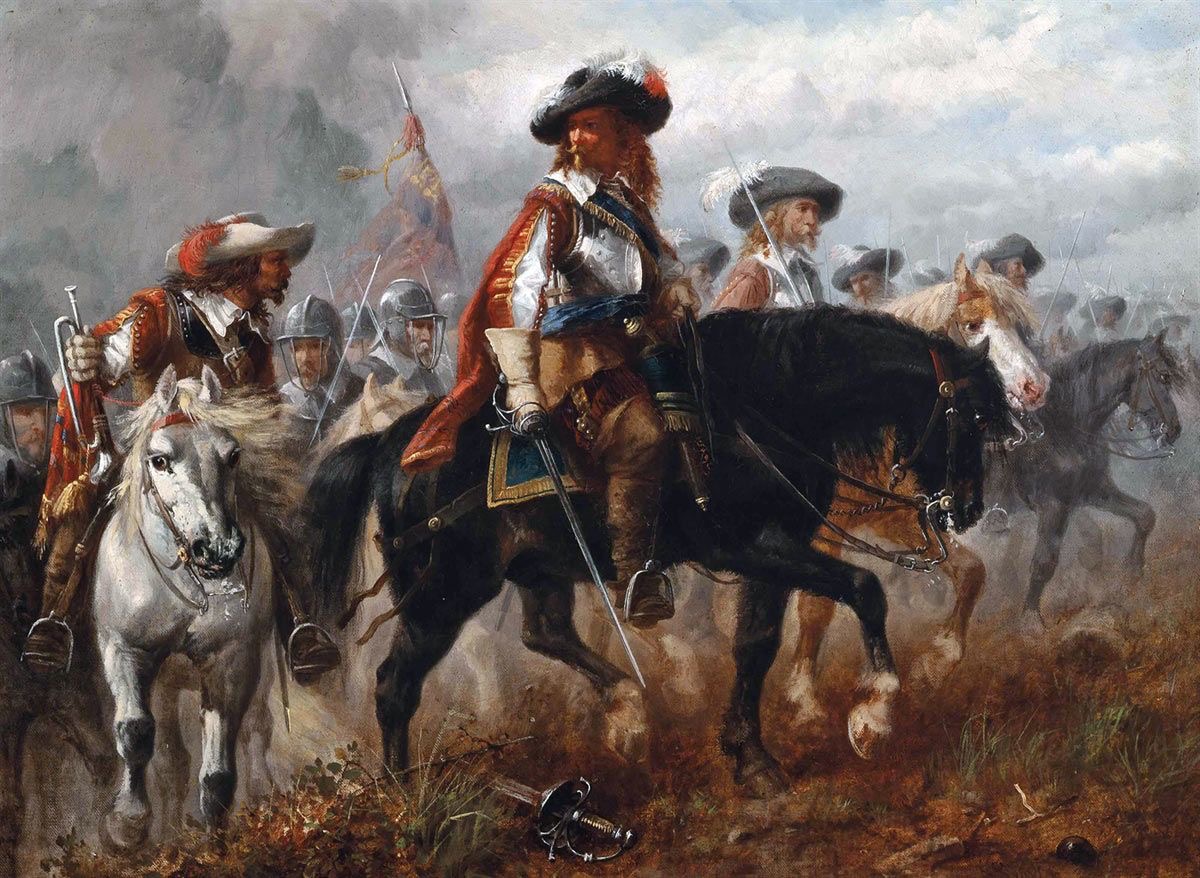
King Charles I and Prince Rupert before the Battle of Naseby 14th June 1645 during the English Civil War.
19th century artist unknown, from Wikimedia Commons.

The various schemes that innovators proposed — from finding a northeast passage to China, to starting a brass industry, to colonising Virginia, or boosting the fish industry by importing Dutch salt-making methods — all promised to benefit the public. They were to support the “common weal”, or commonwealth. And to a certain extent, many projects did. The historian Joan Thirsk did much pioneering work in the 1970s to trace the impact of various technological or commercial projects, revealing that even something as mundane as growing woad, for its blue dye, could have a dramatic impact on local economies. With woad, the income of an ordinary farm labouring household might be almost doubled, for four months in the year, by employing women and children. In the late 1580s, the 5,000 or so acres converted to woad-growing in the south of England likely employed about 20,000 people. That may seem small today, but at a time when the population of a typical market town was a paltry 800 people, even a few hundred acres of woad being cultivated here or there might draw in workers from across the whole region. In the mid-sixteenth century, even the entire population of London had only been about 50-70,000. As Thirsk discovered, innovative projectors also sometimes fulfilled their other public-spirited promises, for example by creating domestic substitutes for costly imported goods, or securing the supplies of strategic resources.

But the ideal of benefiting the commonwealth could also, all too frequently, be elided with serving the interests of the Crown. Projectors might promise the monarch a direct share of an invention’s profits, or that a stimulated industry would result in higher income from tariffs or excise taxes. Increasingly, they proposed schemes that were almost entirely focused on maximising state revenue, with little evidence of new technology. They identified “abuses” in certain industries — at this remove, it’s difficult to tell if these justifications were real — and asked for monopolies over them in order to “regulate” them, then making money by selling licences. Last week I mentioned patents over alehouses, and on playing cards. They also offered to increase the income from the Crown’s property, for example by finding so-called “concealed lands” — lands that had been seized during the Reformation, but which through local resistance or corruption had ostensibly not been paying their proper rents. The projectors would take their share of the money they identified as “missing”. And they proposed enforcing laws, especially if the punishments involved levying fines or confiscating property. The projectors offered to find the lawbreakers and prosecute them, after which they’d take their share of the financial punishments.

Projectors thus came to present themselves as state revenue-raisers and enforcers, circumventing all of the traditional constraints on the monarch’s money and power. They provided an alternative to Parliaments, as well as to city corporations and guilds, in raising money and propagating their rule. Taking it a step further, projectors offered the tantalising possibility that kings like James I and Charles I might rule through proclamation and patents alone, without having to answer to anybody. They thus experimented with absolutism for much of 1610-40, only occasionally being forced to call Parliament for as briefly as possible when the pressing financial demands of war intervened.

In the process, with the growing multitude of projects — a few bringing technological advancement, but many merely lining the pockets of courtier and king — the designation “projector” became mud. It was as if, today, the Queen were to use her prerogative to grant a few of her courtiers monopolies on collecting all traffic fines, or litter penalties, to be rewarded solely on commission. Or if she were to award an unscrupulous private company the right to award all alcohol-selling licences (perhaps on the basis that underage drinking was becoming common). The country would soon be awash with hidden speed cameras and incognito litter wardens, and the price of alcohol would go through the roof. The people responsible would not be popular. A recent book by economic historian Koji Yamamoto meticulously charts the changing public perceptions of projects, describing the ways in which innovators then struggled, for decades, to regain the public’s trust.

“The Last Battle” – The Strangest Fight of WWII – Sabaton History 085 [Official]

Filed under: Germany, History, Media, Military, USA, WW2 — Tags: , , , , — Nicholas @ 04:00

Sabaton History
Published 17 Sep 2020

On the 5th of May 1945, the Second World War in Europe is literally in its final days. As the German lines and Nazi state collapse into free fall, some Nazi hardliners remain fighting until the very moment surrender is announced. At Castle Itter, the lines are blurred as US and German soldiers fight side by side in a medieval castle, home to some of the highest profile prisoners of the war.

Support Sabaton History on Patreon: https://www.patreon.com/sabatonhistory

Listen to “The Last Battle” on the album The Last Stand:
https://music.sabaton.net/TheLastStand

Watch the Official Lyric Video of “The Last Battle” here:
https://www.youtube.com/watch?v=BwfJs…

Listen to Sabaton on Spotify: http://smarturl.it/SabatonSpotify
Official Sabaton Merchandise Shop: http://bit.ly/SabatonOfficialShop

Hosted by: Indy Neidell
Written by: Markus Linke and Indy Neidell
Directed by: Astrid Deinhard and Wieke Kapteijns
Produced by: Pär Sundström, Astrid Deinhard and Spartacus Olsson
Creative Producer: Maria Kyhle
Executive Producers: Pär Sundström, Joakim Brodén, Tomas Sunmo, Indy Neidell, Astrid Deinhard, and Spartacus Olsson
Community Manager: Maria Kyhle
Post-Production Director: Wieke Kapteijns
Editor: Iryna Dulka
Sound Editor: Marek Kaminski
Maps by: Eastory – https://www.youtube.com/c/eastory
Archive: Reuters/Screenocean – https://www.screenocean.com
Sources:
– Photos of the Itter Castle: Sammlung Risch-Lau, Vorarlberger Landesbibliothek
All music by: Sabaton

An OnLion Entertainment GmbH and Raging Beaver Publishing AB co-Production.

© Raging Beaver Publishing AB, 2019 – all rights reserved.

Was the Wuhan Coronavirus (aka Covid-19) created in a Chinese lab?

Filed under: China, Health, Science — Tags: , , , , , , — Nicholas @ 03:00

Rowan Jacobsen profiles the scientist who believes, based on her own research, that the Wuhan Coronavirus was not a naturally occurring mutation and was instead deliberately created in a Chinese government lab:

It wasn’t long before she came across an article about the remarkable stability of the virus, whose genome had barely changed from the earliest human cases, despite trillions of replications. This perplexed Chan. Like many emerging infectious diseases, COVID-19 was thought to be zoonotic — it originated in animals, then somehow found its way into people. At the time, the Chinese government and most scientists insisted the jump had happened at Wuhan’s seafood market, but that didn’t make sense to Chan. If the virus had leapt from animals to humans in the market, it should have immediately started evolving to life inside its new human hosts. But it hadn’t.

On a hunch, she decided to look at the literature on the 2003 SARS virus, which had jumped from civets to people. Bingo. A few papers mentioned its rapid evolution in its first months of existence. Chan felt the familiar surge of puzzle endorphins. The new virus really wasn’t behaving like it should. Chan knew that delving further into this puzzle would require some deep genetic analysis, and she knew just the person for the task. She opened Google Chat and fired off a message to Shing Hei Zhan. He was an old friend from her days at the University of British Columbia and, more important, he was a computational god.

“Do you want to partner on a very unusual paper?” she wrote.

Sure, he replied.

One thing Chan noticed about the original SARS was that the virus in the first human cases was subtly different — a few dozen letters of genetic code — from the one in the civets. That meant it had immediately morphed. She asked Zhan to pull up the genomes for the coronaviruses that had been found on surfaces in the Wuhan seafood market. Were they at all different from the earliest documented cases in humans?

Zhan ran the analysis. Nope, they were 100 percent the same. Definitely from humans, not animals. The seafood-market theory, which Chinese health officials and the World Health Organization espoused in the early days of the pandemic, was wrong. Chan’s puzzle detectors pulsed again. “Shing,” she messaged Zhan, “this paper is going to be insane.”

In the coming weeks, as the spring sun chased shadows across her kitchen floor, Chan stood at her counter and pounded out her paper, barely pausing to eat or sleep. It was clear that the first SARS evolved rapidly during its first three months of existence, constantly fine-tuning its ability to infect humans, and settling down only during the later stages of the epidemic. In contrast, the new virus looked a lot more like late-stage SARS. “It’s almost as if we’re missing the early phase,” Chan marveled to Zhan. Or, as she put it in their paper, as if “it was already well adapted for human transmission.”

That was a profoundly provocative line. Chan was implying that the virus was already familiar with human physiology when it had its coming-out party in Wuhan in late 2019. If so, there were three possible explanations.

For the record, my strong suspicion is that she is correct about the origins of the virus, but I don’t think it was deliberately released by the Chinese government. I think if it had been deliberate, it would have been much more directly “weaponized” in both delivery mechanism and targeting.

« Newer PostsOlder Posts »

Powered by WordPress