Quotulatiousness

September 29, 2020

The Lamprey Party of America

Filed under: History, Politics, USA — Tags: , , , , , — Nicholas @ 05:00

In the latest Libertarian Enterprise, L. Neil Smith suggests that we need a modern Thomas Nast to add to the political menagerie of elephants and donkeys:
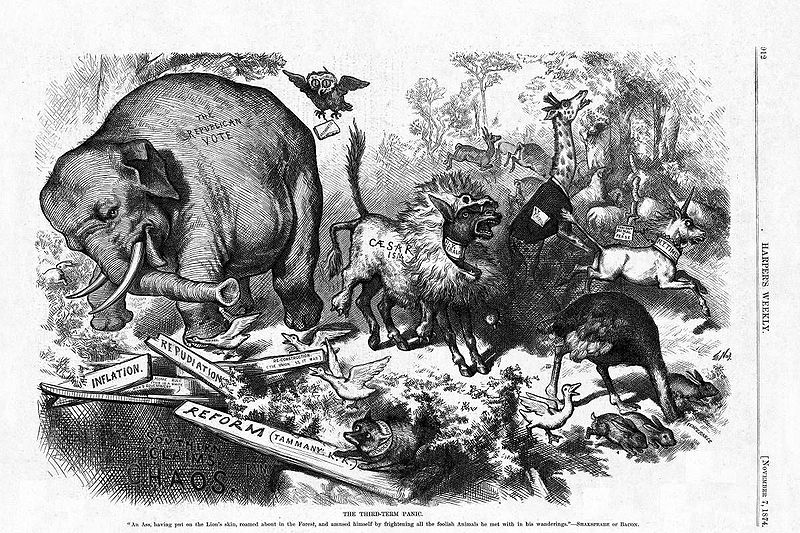
“The Third-Term Panic”, by Thomas Nast, originally published in Harper’s Magazine on 7 November 1874.

A braying ass, in a lion’s coat, and “N.Y. Herald” collar, frightening animals in the forest: a giraffe (“N. Y. Tribune”), a unicorn (“N. Y. Times”), and an owl (“N. Y. World”); an ostrich, its head buried, represents “Temperance”. An elephant, “The Republican Vote”, stands near broken planks (Inflation, Repudiation, Home Rule, and Re-construction). Under the elephant, a pit labeled “Southern Claims. Chaos. Rum.” A fox (“Democratic Party”) has its forepaws on the plank “Reform. (Tammany. K.K.)” The title refers to U.S. Grant’s possible bid for a third presidential term. This possibility was criticized by New York Herald owner and editor James Gordon Bennett, Jr.
Image and caption via Wikimedia Commons.

The 19th century political caricaturist and editorial cartoonist Thomas Nast (1840-1902) is famous for identifying Republicans as elephants and Democrats as donkeys. He also created the Tammany tiger, and Santa Claus as we know him today.

Mr. Nast was a handsome and clever fellow, a Bavarian immigrant, to whom we all owe a great deal, but I have long thought that more animals need to be added to America’s political menagerie, none of them as wholesome and savory as elephants and donkeys. Lampreys are eel-like fish, sort of vertebrate leeches or underwater vampires, that attach themselves to larger fish with their circular, tooth-lined mouths, hitching a free ride, punching a hole through the legitimate fish’s flesh, and feeding on its blood. They look and feel (I am informed) slimy and disgusting. The freedom movement needs a cartoonist (I can think of one or two) capable of rendering a cartoon lamprey in all of its horrifying malevolence.

What party would be represented by a lamprey? Well, it has gone by several names, and it’s filled with familiar and despicable figures. Alaska Senator Lisa Murkowski, described as “to the left of all Republicans, except Susan Collins, and … Democrat Senator Joe Manchin” is a lamprey, riding along on the Republican party, parasitically sucking its lifeblood, never contributing anything to advance its progress. She voted with Obama a stunning 72.3% of the time. I could say Murkowski is a “never-Trumper”, but she was a lamprey long before the Donald ever came along. My wife Cathy, first made aware of Murkowski’s malevolent role in American politics, exclaimed, “Alaskans! What the hell is wrong with you?”

Another well-known lamprey is Willard “Mitt” Romney, who viciously opposes all of Trump’s undertakings, foreign and domestic, and whose father George was a leader of the cabal in 1964 who betrayed fellow-Republican Presidential candidate Barry Goldwater and helped Democrats and the media stab him in the back, electing that murderous gangster Lyndon Baines Johnson. George Romney would have called Barry a “deplorable” if the term had been current back then, for the same reasons the political elites despise President Trump today. They believe only they are fit to determine how to live your life. The delusion seems to be hereditary.

Frederick the Great – A First Glance

Filed under: Germany, History, Military — Tags: , , , , , , — Nicholas @ 04:00

Military History not Visualized
Published 22 May 2018

» patreon – https://www.patreon.com/mhv

Frederick the Great – Friedrich der Große – is a very controversial figure. Regarded by many as one of the great field commanders of his time, enlightened, strict, aggressive and militaristic. For a long time he was the example and icon of the Prussian general staff. What were his characteristics, traits, his background and his views on various military issues? After all, he wrote about the principles of war and other aspects.

»» SUPPORT MHV ««
» patreon – https://www.patreon.com/mhv
» paypal donation – https://www.paypal.com/cgi-bin/webscr…
» Book Wishlist https://www.amazon.de/gp/registry/wis…

»» MERCHANDISE – SPOILS OF WAR ««
» shop – https://www.redbubble.com/people/mhvi…

»» SOCIAL MEDIA ««
» minds.com – https://www.minds.com/militaryhistory…
» twitter – https://twitter.com/MilHiVisualized
» twitch – https://www.twitch.tv/militaryhistory…
» RallyPoint – https://www.rallypoint.com/organizati…

Military History for Adults is a support channel to Military History Visualized with a focus personal accounts, answering questions that arose on the main channel and showcasing events like visiting museums, using equipment or military hardware.

» SOURCES «

Showalter, Dennis: Frederick the Great. A Military History. Frontline Books: London, 2016.

Militärgeschichtliches Forschungsamt (Hrsg.): Friedrich der Große und das Militärwesen seiner Zeit. Vorträge zur Militärgeschichte – Band 8. E. S. Mittler & Sohn: Herford – Bonn, 1987.

Clark, Christopher: The Iron Kingdom. The Rise and Downfall of Prussia 1600-1947. Penguin Books: London, 2007.

Citino, Robert M.: The German Way of War. From the Thirty Years’ War to the Third Reich. University Press of Kansas: USA, 2005.

Militärgeschichtliches Forschungsamt (Hrsg.): Deutsche Militärgeschichte 1648-1939 in sechs Bänden – Band 6. Bernard & Graefe Verlag; München, 1983.

Browing, Peter: The Changing Nature of Warfare. The Development of Land Warfare from 1792 to 1945. Cambridge University Press: Cambridge, UK, 2002.

Margiotta, Franklin D.: (Executive Editor): Brassey’s Encyclopedia of Military History and Biography. Brassey’s, Inc.: USA, 1994.

» CREDITS & SPECIAL THX «
Song: Ethan Meixsell – “Demilitarized Zone”

Was it actually a “Plandemic”?

Filed under: Books, Britain, Government, Health — Tags: , , , , — Nicholas @ 03:00

Sean Gabb recently published a collection of essays written during the lockdown for Wuhan Coronavirus. This excerpt is from the introduction to “Plandemic” or The Hand of God?:

My general argument is that the Coronavirus Panic should be divided under two headings. The first is the Virus itself as a medical fact and the immediate responses. The second is a set of changes already evident and sometimes advanced before the March of 2020, but that have now been greatly accelerated. Of these, the second is by far the more important. The first, even so, is of interest in its own right.

The Virus has not been all that we were told it would be. Last March, much of the world was ordered into indefinite lockdown on the grounds that we faced the greatest pandemic since the Spanish Flu of a century ago. For weeks in my own country, the BBC filled the television screens with statements by scared, sweating politicians, and lifted all restraint from its own hyperventilating staff. Now, as I write in the middle of September, we can be sure that it killed no more people than a seasonal influenza, and that most of its victims were very old or had been already weakened by some other condition. We can be sure it killed no more than seasonal influenza. Given the questionable definition of Coronavirus deaths, it may have killed many fewer.

I know that pandemic infections often come in several waves, and second waves can be more deadly than the first. But the second wave we are now said to be entering is evidenced by infections rather than deaths, and these infections are counted and published in ways more questionable than the counting and publishing of the earlier alleged deaths. I do not know what will have happened by Christmas. I suspect, however, that nothing much will have happened.

I have no fixed idea of what caused the panic. I am told that the Coronavirus was a bioweapon that escaped from a government laboratory. If it was, I can imagine that political leaders all across the world were taken aside by their own scientists, who were working on something similar, and told of the coming apocalypse. I lack the scientific understanding to judge the truth of this claim. But, if true, it would explain the panic. It would also justify the panic, so far as no one might have known for sure how infectious and how deadly this bioweapon was.

I am more inclined, though, to believe that the panic was a universal hysteria just waiting to be realised. The world at the beginning of this year was in a similar moral state to the world in 1914. There had been a generation of rising prosperity and of rising discontent. Some groups had benefitted out of proportion to their numbers and believed merit. If only relatively, others had fallen behind. Some believed the progress had not been fast enough, and that it could be hastened by various institutional changes, others that it was bad in its effects, and that it should be at least slowed. In 1914, all these discordant energies were channelled – both by deliberate policy and by popular enthusiasm – into a catastrophic war. This year, they found their outlet in the Coronavirus. Since I am making the same point, I might as well quote Marx:

    Hegel remarks somewhere that all great world-historic facts and personages appear, so to speak, twice. He forgot to add: the first time as tragedy, the second time as farce.

I will only add that, on the real stage of world affairs, farce is always preferable to tragedy. Facemasks are better than gasmasks. Better the statistical mirage of last spring than the genuine casualties of Verdun and the Somme.

Light Fifty: the Barrett M82A1

Filed under: History, Military, USA, Weapons — Tags: , — Nicholas @ 02:00

Forgotten Weapons
Published 10 Aug 2016

Sold for $6,900.

The story of the development of the Barrett M82 .50 BMG semiauto rifle is really a neat story — much more interesting than most people probably expect, and reminiscent of many firearms development stories of the 1800s. Ronnie Barrett was working as a photographer in the late 70s, and became interested (perhaps obsessed?) with the idea of a semiauto .50 caliber rifle after a photo session with a Vietnam War jungle patrol boat (which was armed with a pair of M2 .50 caliber machine guns). At the time, the only civilian options for the .50 BMG cartridge were conversions of WWII antitank rifles like the Boys and PTRD.

Barrett, with basically no formal engineering background, sketched up a design and approached some machine shops for advice and assistance. He started working in his garage, and after a couple years had a functioning prototype completed. He sold the rifles commercially at gun shows and through publications like Shotgun News until making his first military sale in 1989, to the Swedish government. The following year he received an order from the US military, and sales took off from there.

Contrary to common expectation, the Barrett M82A1 is not really a “sniper” rifle — as a semiautomatic design with a recoil-operated action it’s potential accuracy is much less than that of a bolt action precision rifle — and this is amplified by the lack of a precision .50 BMG cartridge in US military service. In practice, the M82A1 will shoot about 3 MOA with normal ball ammunition, and about 1.5-2 MOA with good handloads. It is used primarily as an EOD rifle to detonate heavy-walled unexploded shells at a safe distance, and as an anti-material rifle to attack light vehicles and infrastructure at a long distance. These are relatively large targets, which require the large payload of a .50 BMG projectile but not the extreme accuracy of a true “sniper’s” rifle.

QotD: Robin DiAngelo’s theory of “White Fragility”

Filed under: Books, Media, Politics, Quotations, USA — Tags: , , , , — Nicholas @ 01:00

Throughout White Fragility DiAngelo tries to convince readers of two things. First, DiAngelo argues that white people are inescapably racist, writing, “All white people are invested in and collude with racism,” and that “The white collective fundamentally hates blackness for what it reminds us of: that we are capable and guilty of perpetrating immeasurable harm and that our gains come through the subjugation of others.”

Second, DiAngelo argues that any white person who does not admit to their own racism is blinded by their “white fragility.” In DiAngelo’s words, because white people are, “Socialized into a deeply internalized sense of superiority that we either are unaware of or can never admit to ourselves, we become highly fragile in conversations about race.” This fragility purportedly explains why, “people who identify as white are so difficult in conversations regarding race.”

It’s not difficult to see why the theory of white fragility might catch on. Race is a sensitive subject that many people of all races are uncomfortable discussing. Furthermore, white people publicly accused of racism risk social ostracization and professional ruin. The idea that some white people may be defensive when accused of racism is not surprising. But though some white people may exhibit a degree of what DiAngelo calls fragility, her grandiose theory as applied to all or even most white people has two fatal flaws.

First, DiAngelo’s theory of white fragility is unfalsifiable. It is impossible for someone to prove that they are not fragile, just as it is impossible for someone to prove they are not possessed by a demon. One could play mad libs with racial groups and nouns — “Asian Insecurity,” “Black Hostility,” etc. — and there would be no way for members of those groups to prove they are not insecure or hostile.

More insidiously, DiAngelo frames her theory of white fragility such that any conceivable reaction a white person has when discussing race is purportedly evidence of fragility, and any denial of her theory is interpreted as proof of its validity. For example, DiAngelo writes that,

    The mere suggestion that being white has meaning often triggers a range of defensive responses. These include emotions such as anger, fear, guilt, and behaviors such as argumentation, silence, and withdrawal from the stress-inducing situation. These responses work to reinstate white equilibrium as they repel the challenge, return our racial comfort, and maintain our dominance within the racial hierarchy. I conceptualize this process as white fragility. Though white fragility is triggered by discomfort and anxiety, it is born of superiority and entitlement.

In other words, if DiAngelo accuses you of racism or fragility and you disagree with her in any way — through argument, silence, or withdrawal — your reaction is considered proof of your fragility. DiAngelo leaves white readers with only two options. Either acknowledge your fragility, which proves DiAngelo’s theory, or deny your fragility, which according to DiAngelo, also proves her theory. This is a logical fallacy known as a Kafkatrap. If our legal system worked this way, no person accused of a crime would ever be acquitted because their denial would prove their guilt.

David Edward Burke, “The Intellectual Fraud of Robin DiAngelo’s White Fragility“, The Logical Liberal, 2020-06-13.

September 28, 2020

I made this Cabinet, and you can too

Filed under: Tools, Woodworking — Tags: , , , , — Nicholas @ 06:00

Matt Estlea
Published 20 Sep 2020

Want to learn how to make this yourself? Visit my FREE Online Woodworking School here:
https://mattestlea.com/school/school-cabinet/

No sign-up or information required. It’s literally all there waiting for you!
_________________________________________________________________

Support what I do by becoming a Patron! This will help fund new tools, equipment and cover my overheads. Meaning I can continue to bring you regular, high quality, free content. Thank you so much for your support! https://www.patreon.com/mattestlea

Don’t want to commit to a monthly direct debit but still want to help out? That’s fine!
You can make a one time donation here: www.mattestlea.com/donate
You can donate us biscuits here: www.mattestlea.com/wishlist
_________________________________________________________________
BUY THE WOODWORKING BIBLE HERE:
www.mattestlea.com/the-woodworkers-manual
_________________________________________________________________

SOCIAL MEDIA
Instagram: www.instagram.com/mattestlea
Twitter: www.twitter.com/mattestlea
Patreon: www.patreon.com/mattestlea
Pinterest: www.pinterest.com/mattestlea
LinkedIn: www.linkedin.com/in/matt-estlea-b6414b11a/
_________________________________________________________________
See what tools I use here: www.mattestlea.com/equipment
My Website: www.mattestlea.com
_________________________________________________________________

My name is Matt Estlea, I’m a 24 year old Woodworker from Basingstoke in England and my aim is to make your woodworking less s***.

I come from 5 years tuition at Rycotewood Furniture Centre with a further 1 year working as an Artist in Residence at the Sylva Foundation. I now teach City and Guilds Furniture Making at Rycotewood as of September 2018.

If you’re interested in studying at Rycotewood, view their courses here:
www.mattestlea.com/rycotewood

I also had 5 years of experience working at Axminster Tools and Machinery where I helped customers with purchasing tools, demonstrated in stores and events, and gained extensive knowledge about a variety of tools and brands. I discontinued this at the start of 2019 to focus solely on video creation and teaching.

During the week, I film woodworking projects, tutorials, reviews and a viewer favourite ‘Tool Duel’ where I compare two competitive manufacturers tools against one another to find out which is best. I also have a Free Online Woodworking School which you should definitely check out!

www.mattestlea.com/school

I like to have a laugh and my videos are quite fast paced BUT you will learn a lot, I assure you.

Lets go make a mess.

The Elgin Marbles as oversized bargaining chips

Filed under: Britain, Europe, Greece, History, Politics, USA — Tags: , , , , — Nicholas @ 05:00

Michael Curtis on the renewed demands that the British government return the Elgin Marbles to Athens:

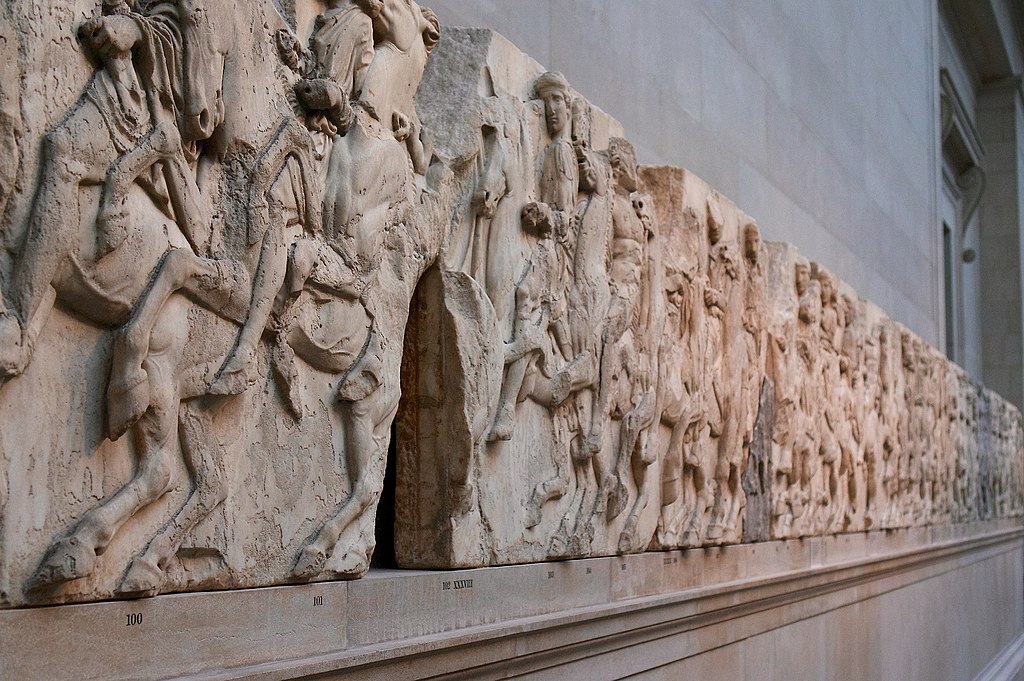
Some of the sculptures in the Elgin Marbles collection on display in the Duveen Gallery of the British Museum.
Photo by Paul Hudson via Wikimedia Commons.

The internecine wars in Washington, D.C., continue over government funding, a coronavirus relief bill, government shutdown, but on September 9, 2020 one form of political truce between Republicans and Democrats on foreign affairs was announced. Eighteen members of the U.S. Congress, bilateral members of the Congressional Caucus on Hellenic issues, including the chairs of the House Oversight and Rules committees, and Foreign Affairs subcommittee on issues relating to Europe, had written a letter to British Prime Minister Boris Johnson.

It informed him, in case he didn’t know, that the Elgin marbles, EM, had been the source of controversy among allies for many decades. The letter urged the British government, already saddled by labyrinth Brexit discussions, to negotiate with the Greek government in earnest over the return of the Elgin marbles to Greece by 2021, the 200th anniversary of the modern Greek nation. The eighteen Congress people joined other Americans intruding in British affairs. On September 16, 2020 both Joe Biden and Nancy Pelosi said there can be no US-UK trade deal if Brexit negotiations undermined the 1998 Good Friday peace agreement. However, the letter of the Congress group has raised the problem of the restitution of cultural objects taken from their country of origin.

Prime Minister Johnson does not need reminding that it was Thomas Bruce, Earl Elgin, British Ambassador to the Ottoman Empire, which included Greece, who took the marbles from the Parthenon in Athens, 1801-1805. The Parthenon, the central building of the Acropolis of Athens. was built around 488 B.C. to honor a goddess called Athena, and was at different times a Christian church and a mosque. The pillars and sculptures of the Parthenon were made of marble.

Elgin, with a passion for classical antiquities, made the case that the art works in the temples of Greece, then under Ottoman control would be destroyed because of Turkish indifference. Some had been destroyed in 1687 when the Venetians attacked Athens. The Sublime Porte granted Elgin’s request to take away pieces of stone with old inscriptions or figures. Perhaps this was gratitude for British action in blocking the advance of Napoleon in Egypt. Elgin took pediment sculptur friezes, metopes, and fragmented pieces from the walls of the Parthenon, and brought them to Britain. In 1816 he sold the sculptures to the British government which then sent them to the British Museum where they have remained.

Though the letter by the 18 members of Congress might be considered impertinent, it contained no threat of any kind but attempted to spark action on a disputed issue which has emotional appeal and symbolic importance, the presence of the Elgin marbles in the British Museum. In recent years the issue has been raised by officials of the European Union as well as by celebrated private citizens such as the actor George Clooney and his wife, and co-stars Bill Murray and Matt Damon, who while working on the 2014 film The Monuments Men, about art stolen by the Nazis, thought return of the Elgin marbles to Greece was the “right thing” to do.

What Happened After The Bronze Age Collapse?

Filed under: Economics, Greece, History, Middle East — Tags: , , , , — Nicholas @ 04:00

Epimetheus
Published 17 Jun 2020

What Happened After The Bronze Age Collapse?

This video covers the period of time from the Bronze Age collapse through the Near Eastern dark age and to the first Iron Age empire.

This video is sponsored by my Patrons over on Patreon
https://www.patreon.com/Epimetheus1776

From the comments:

Epimetheus
3 months ago
Additional info some might find interesting:

Although the Arameans emerged from arid Southern Syria (in a similar manner to the earlier Amorites, taking advantage of a power vacuum) it is debated whether or not they were originally from there, with some believing they came from the Zagros mountains to Syria, before re-entering Mesopotamia. Others believe they were related to the Amorites, essentially they were the Amorites that stayed behind. There is also some debate if Ahlamu (also from the same region) is a synonym for Aramean or if it was a more broad generic term for the nomads, outlaws and ruffians of the region. (For example the Suteans, Chaldeans and Arameans may have all been considered Ahlamu) It is also interesting that many fugitives from authority in previous centuries found refuge in the frontier Ahlamu regions of the south.

All of that more or less got cut out of the video, and I thought some of you would find interesting.

It’s been a while since these stickers occupied pride of place on every Prius bumper, hasn’t it?

Filed under: China, History, Politics, USA — Tags: , , — Nicholas @ 03:00

Arthur Chrenkoff wonders “Whatever happened to ‘Free Tibet’?”

With its heyday probably twenty years ago, it used to be a major cause celebre for artists and activists, with bumper stickers adorning countless cars, including – proverbially – the early Priuses. It was mostly a thing of the left (certainly in Australia it was largely associated with the Greens) and the hippies and New Agers enchanted by the wit and wisdom of the Dalai Lama, spruiking his version of Buddhism from exile. This probably scared many people off, which is a pity because the question of Tibetan independence shouldn’t be judged on the merits of its incense burning Western supporters.

So what happened? Tibet is certainly still not free – if anything the things have gotten worse on the rooftop of the world – but the campaign has largely dropped out of the public consciousness. I don’t quite know the answer myself. Maybe some political causes, like fashion trends, have limited life spans. Maybe the left has learned to stop worrying and live with China as one of the few viable alternatives to the “Western neoliberal world order”. Maybe China has become too rich and powerful to hope that candle-lit vigils for Lhasa will do any good.

So what’s been happening in Tibet lately, just out of interest?

Fixing a “Not so Perfect” Mitered Joint

Filed under: Tools, Woodworking — Tags: , , , — Nicholas @ 02:00

William Ng
Published 26 Dec 2011

Making miter joints are never easy, especially on long cuts. Here is a simple technique that can cover up a multitude of sins. it will also take some of the stress out of cutting perfect miters. This technique saved me a few time when I was making miters for Pantry cabinets and Home Theaters where the length of cuts are close to 8 feet.

QotD: The proper role of men, according to the SCUM Manifesto

Filed under: Books, Media, Politics, Quotations — Tags: , , , — Nicholas @ 01:00

Prior to the institution of automation, to the replacement of males by machines, the male should be of use to the female, wait on her, cater to her slightest whim, obey her every command, be totally subservient to her, exist in perfect obedience to her will, as opposed to the completely warped, degenerate situation we have now of men, not only existing at all, cluttering up the world with their ignominious presence, but being pandered to and groveled before by the mass of females, millions of women piously worshiping the Golden Calf, the dog leading the master on a leash, when in fact the male, short of being a drag queen, is least miserable when his dogginess is recognized — no unrealistic emotional demands are made of him and the completely together female is calling the shots. Rational men want to be squashed, stepped on, crushed and crunched, treated as the curs, the filth that they are, have their repulsiveness confirmed.

Valerie Solanas, SCUM Manifesto, 1967.

September 27, 2020

Dividing Up The Middle East – The Creation of Lebanon I THE GREAT WAR 1920

The Great War
Published 26 Sep 2020

Sign up for Curiosity Stream and get Nebula bundled in: https://curiositystream.com/thegreatwar

In the summer of 1920 it became clear that the many different voices and local opinions on the future of the former Ottoman provinces were going to be mostly ignored. France and Britain had their own ideas for the new mandate states in the region.

» SUPPORT THE CHANNEL
Patreon: https://www.patreon.com/thegreatwar

» OUR PODCAST
https://realtimehistory.net/podcast – interviews with World War 1 historians and background info for the show.

» BUY OUR SOURCES IN OUR AMAZON STORES
https://realtimehistory.net/amazon *
*Buying via this link supports The Great War (Affiliate-Link)

» SOURCES
Sicker, Martin. The Middle East in the Twentieth Century (Greenwood Publishing, 2001)

Gontaut-Biron, Roger. Comment la France s’est installée en Syrie (Paris: Plon, 1922). https://archive.org/details/commentla…

Cornwallis, K. Notes on the Middle-East No.4. 1920. File 756/1917 Pt 2-3 “ARAB BULLETIN Nos 66-114” [‎374r] (756/834), British Library: India Office Records and Private Papers, IOR/L/PS/10/658.

Miller, David Hunter. My Diary. At the Conference of Paris. Vol 4. (New York, 1924). https://archive.org/details/MyDiaryAt…

D’Andurain, J. “Gouraud, Henri” in: 1914-1918-online. International Encyclopedia of the First World War, ed. by Ute Daniel, Peter Gatrell, Oliver Janz, Heather Jones, Jennifer Keene, Alan Kramer, and Bill Nasson, issued by Freie Universität Berlin, Berlin 2014-10-08. DOI: 10.15463/ie1418.10303. https://encyclopedia.1914-1918-online…

Naamany, B. “A hundred years since Sykes-Picot, maps’ reading”. General Secretariat of the Arab League. Tunis. Tunisia. 2018. http://nna-leb.gov.lb/en/show-news/98…

Meouchy, N. “Les temps et les territoires de la révolte du Nord (1919-1921).” In: Alep et ses territoires: Fabrique et politique d’une ville (1868-2011). (Beyrouth – Damas: Presses de l’Ifpo, 2014).

Raymond, André. “III – La Syrie, du Royaume arabe à l’indépendance (1914-1946)”. In La Syrie d’aujourd’hui. Aix-en-Provence: Institut de recherches et d’études sur les mondes arabes et musulmans, 1980. (pp. 55-85)

Kouyoumdjian, O. “Le Liban à la veille et au début de la Grande Guerre: Mémoires d’un gouverneur, 1913-1915″. Revue D’histoire Arménienne Contemporaine. Paris: Centre d’histoire arménienne contemporaine. 2003.

Government of New Zealand, Ministry for Culture and Heritage. “Anzac troops take revenge on Arab civilians at Surafend” https://nzhistory.govt.nz/page/anzac-….

Ministère de la Guerre. Etat-major des armées. Service historique. Les armées françaises dans la Grande guerre. Tome IX. 9, 1, ANNEXES. Imprimerie Nationale. Paris. France. 1935.

Australian Imperial Force unit war diaries. 1914-1918 War. Light Horse. Item number: 10/3/47. Title : 3rd Australian Light Horse Brigade. December 1918. AWM4 Class 10 – Light Horse. https://www.awm.gov.au/collection/C13…

» MORE THE GREAT WAR
Website: https://realtimehistory.net
Instagram: https://instagram.com/the_great_war
Twitter: https://twitter.com/WW1_Series
Reddit: https://reddit.com/r/TheGreatWarChannel

»CREDITS
Presented by: Jesse Alexander
Written by: Jesse Alexander
Director: Toni Steller & Florian Wittig
Director of Photography: Toni Steller
Sound: Toni Steller
Editing: Toni Steller
Motion Design: Philipp Appelt
Mixing, Mastering & Sound Design: http://above-zero.com
Maps: Daniel Kogosov (https://www.patreon.com/Zalezsky)
Research by: Jesse Alexander
Fact checking: Florian Wittig

Channel Design: Alexander Clark
Original Logo: David van Stephold

Contains licensed material by getty images
All rights reserved – Real Time History GmbH 2020

“It is a Chestertonian paradox which Chesterton himself never wrote: a government changing the nature of the state successfully and without opposition because nobody can believe what they are seeing, and so everybody politely ignores it.”

In The Critic, Peter Hitchens on the many civil institutions that have been seriously wounded — not so much by the Wuhan Coronavirus, but by government responses to it:

David Icke about to speak at Piers Corbyn’s 20 August anti-masking demonstration in Trafalgar Square.
Screencap from YouTube video – https://www.youtube.com/watch?v=DOZQ58uTWdw

The long retreat of law, reason and freedom has now turned into a rout. It was caused by many things: the mob hysteria which flowered after the death of Princess Diana; the evisceration of education; the spread of intolerant speech codes designed to impose a single opinion on the academy and journalism; the incessant state-sponsored panics over terror; the collapse and decay of institutions and traditions.

These have all at last flowed together into a single force, and we seem powerless against it. Absurdly, the moment at which they have achieved maximum power is accidental, a wild, out of-proportion panic response to a real but limited epidemic.

Outside total war and its obscenities, we have not seen what we are living through now. To list the constitutional events of the last few months is to ask the complacent chattering classes of Britain what it reminds them of: the neutering of parliament into a rubber stamp controlled by the executive; the death of political pluralism; the introduction of government by decree; the disappearance of the last traces of an independent civil service; the silence in the face of these events of media and courts; the subjection of the police to state edicts rather than to law.

[…]

Documents of this kind are not supposed to get out. In better times than these, with active and critical media, this particular passage — with its clear implication that it was the task of the state to scare us into compliance — might have led to the fall of the government. As it is, you will struggle to find mentions of it in the British national press. They are there, but they are hard to find and not on any daily front pages. This is not because of censorship or because of any kind of collective action.

It is because most people, having lived all their lives in relaxed freedom, are quite unable to believe what is in front of their eyes. It is a Chestertonian paradox which Chesterton himself never wrote: a government changing the nature of the state successfully and without opposition because nobody can believe what they are seeing, and so everybody politely ignores it.

This could not have happened, in my view, 60 years ago. Rigorous education, especially of the elite, had at that time created a significant class of people who knew how to think, and how to assess evidence. There would always have been someone, whether it was a Tam Dalyell or a Churchill, to point out the true direction of events and warn against them, prominently. Much of the press would have given this dissent house room, rather than obediently conforming (in order to #ProtectOurNHS). But in the intervening years such rigorous schooling has been replaced by an egalitarian education system which teaches its students what to think, not how to think. Criticism of the past is obligatory, but any cold-eyed assessment of the present — in which new ideas benevolently rule — is disliked and ignored.

As well as this, there have been the various spasms of panic and emotion which convulsed the country after the Cold War ended. These were profound attacks on reason. They were also attacks on limited government and the rule of law, which rest largely on the power of reason. Most people quite like being afraid of something, and many dislike freedom and the responsibility that comes with it. The honest among us all admit it.

Once, before Charles Darwin, Ypres and the Somme, the Christian religion answered those needs. The Fear of the Lord was the Beginning of Wisdom, and the devoted service of Christ was perfect freedom. Faith offered eternal life and helped people to accept temporal death as normal. This belief helped to sustain earthly liberty because, as Edmund Burke pointed out, the man who truly fears God will fear nothing else. No despot can get very far if there are such men around in any number.

Free from the Nazi Occupation – but for how long can it last? WW2 – 109 – September 26, 1941

Filed under: China, Germany, History, Japan, Military, Russia, WW2 — Tags: , , , , , — Nicholas @ 04:00

World War Two
Published 26 Sep 2020

In former Yugoslavia, the Republic of Uzice breaks free from the German occupation, even as the Germans are mopping up the masses of shattered Soviet Armies after last week’s capture of Kiev. In the north, it really looks as if Leningrad will hold out for the time being, and German troops from both north and south converge on the center for the coming drive on Moscow.

Join us on Patreon: https://www.patreon.com/TimeGhostHistory
Or join The TimeGhost Army directly at: https://timeghost.tv

Follow WW2 day by day on Instagram @ww2_day_by_day –https://www.instagram.com/ww2_day_by_day
Between 2 Wars: https://www.youtube.com/playlist?list…
Source list: http://bit.ly/WW2sources

Written and Hosted by: Indy Neidell
Director: Astrid Deinhard
Producers: Astrid Deinhard and Spartacus Olsson
Executive Producers: Astrid Deinhard, Indy Neidell, Spartacus Olsson, Bodo Rittenauer
Creative Producer: Joram Appel
Post-Production Director: Wieke Kapteijns
Research by: Indy Neidell
Edited by: Iryna Dulka
Sound design: Marek Kamiński
Map animations: Eastory (https://www.youtube.com/c/eastory)

Colorizations by:
– Olga Shirnina, a.k.a. Klimbim – https://klimbim2014.wordpress.com/
– Julius Jääskeläinen – https://www.facebook.com/JJcolorization/
– Norman Stewart – https://oldtimesincolor.blogspot.com/
– Carlos Ortega Pereira, BlauColorizations – https://www.instagram.com/blaucolorizations
– Mikołaj Uchman
– Jaris Almazani (Artistic Man) – https://instagram.com/artistic.man?ig…

Sources:
– Bundesarchiv, CC-BY-SA 3.0: Bild_146-2005-0176, Bild_183-J21813,
– Narodowe Archiwum Cyfrowe

Archive by Screenocean/Reuters https://www.screenocean.com.

A TimeGhost chronological documentary produced by OnLion Entertainment GmbH.

Homelessness in Los Angeles

In Quillette, Amy Alkon talks about the homeless crisis in LA, particularly her own immediate experience with a couple who “camped out” in front of her house.

Throughout [Los Angeles Mayor Eric] Garcetti’s seven years as Mayor, Los Angeles has witnessed a shocking explosion of homelessness. When he took office in 2013, the city had about 23,000 residents classified as homeless, two thirds of whom were unsheltered, living on the streets. By mid-2019, the figure was about 36,000, and three-quarters of them were living on the streets. Currently, there are 41,000 homeless. Garcetti’s pet plan to alleviate the homelessness crisis was the construction of permanent supportive housing. In 2016, compassionate voters approved $1.2 billion in new spending to fund these units. Three years later, only 72 apartments had been built, at a cost of about $690,000 apiece. Meanwhile, an El Salvador-based company has come up with nifty $4,000 3D-printed houses that look like great places to live and can be put up in a single day.

There’s also been a failure to admit that housing alone isn’t the solution. As urban-policy researcher Christopher Rufo explains, only about 20 percent of the homeless population are people down on their luck, who just need housing and a few supportive services to get back on their feet. Approximately 75 percent of the unsheltered homeless have substance-abuse disorders and 78 percent have mental-health disorders. Many have both.

As a bleeding-heart libertarian, I feel personally compelled to try to help people who are struggling. I do this by volunteering as a mediator, doing free dispute resolution to provide “access to justice” to people who can’t afford court. And since about 2009, I personally have given support to one of those easily helpable 20 percent Rufo refers to, getting him paying work and a bank account, and storing his stuff in my garage. He is a good man and a hard worker — sober for many years — who simply seems to have issues in the “front-office” organizational parts of his brain that help most of us get our act together to, say, pay bills on time. He just needs somebody to back him up on the bureaucratic aspects of life. I’m happy to say he now has a roof over his head. He lives in a motel across the country, and all I still do for him is provide him with a permanent address. I receive his Veterans Administration and Social Security mail at my house, which I mail to him with smiley faces and hearts on the envelopes, colored in with pink and orange highlighter.

This success story would not be possible for most homeless people, the nearly 80 percent who are addicted and/or mentally ill. As Rufo writes:

    Progressives have rallied around the slogan “Housing First,” but haven’t confronted the deeper question: And then what? It’s important to understand that, even on Skid Row, approximately 70 percent of the poor, addicted, disabled, and mentally ill residents are already housed in the neighborhood’s dense network of permanent supportive-housing units, nonprofit developments, emergency shelters, Section 8 apartments, and single room-occupancy hotels.

    When I toured the area with Richard Copley, a former homeless addict who now works security at the Midnight Mission, he explained that when he was in the depths of his methamphetamine addiction, he had a hotel room but chose to spend the night in his tent on the streets to be “closer to the action.” Copley now lives … at the Ward Hotel — which he calls the “mental ward” — where he says there are frequent fights and drugs are available at all hours of the day. The truth is that homelessness is not primarily a housing problem but a human one. Mayors, developers, and service providers want to cut ribbons in front of new residential towers, but the real challenge is not just to build new apartment units but to rebuild the human beings who live inside them.

The situation is especially tragic for those who are so mentally ill that they cannot take care of themselves, and are often a danger to both themselves and others. And I sometimes wonder which movie star or other famous person needs to be stabbed or bludgeoned before politicians take meaningful action.

It’s fashionable in progressive circles to demonize law enforcement, but Rufo explains that in 2006, then-L.A. police chief Bill Bratton implemented a “Broken Windows” policing initiative on Skid Row. It led to a 42 percent reduction in felonies, a 50 percent reduction in deaths by overdose, and a 75 percent reduction in homicides. The overall homeless population was reduced from 1,876 people to 700 — a huge success. Activists filed lawsuits and ran publicity campaigns, slowly killing Bratton’s program, on the grounds that it “criminalizes homelessness.” As a libertarian, I’m opposed to drug laws and forced behavior — but only to a point. It is not compassion to leave people to be victimized by criminals simply because they are unhoused, nor is leaving mentally and physically disabled people strewn across the streets amidst piles of garbage a form of freedom.

Mayor Garcetti, in lieu of admitting the real challenges — the first step to taking meaningful action to alleviate the homelessness crisis — has simply ignored the human results of his failed policy. As a result, whole sections of the city, including formerly livable streets in my beloved Venice, have been turned into Skid Row by the Sea.

« Newer PostsOlder Posts »

Powered by WordPress