Forgotten Weapons
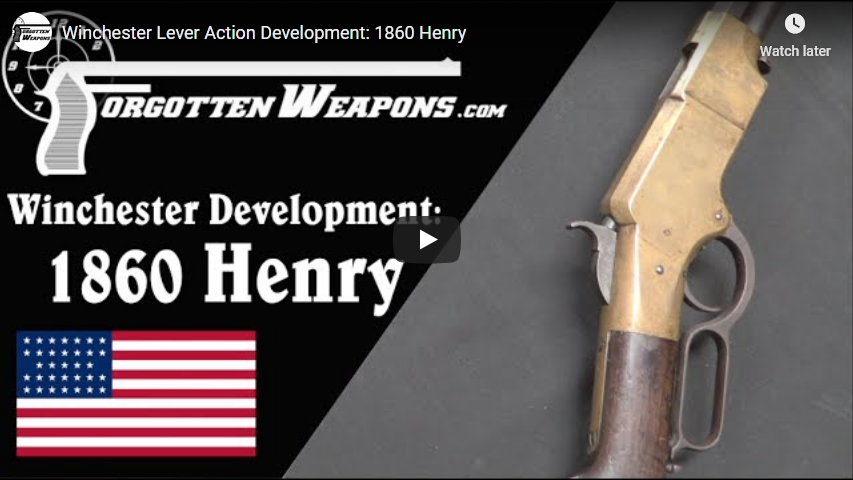
Published 5 Jun 2017The Henry Repeating Rifle was a truly revolutionary development in firearms technology. It was not the first repeating rifle, but it was the best of a emerging class of new arms, reliable in function and very fast to shoot (much faster than the contemporary Spencers). The Henry used a simple toggle lock locking system, with a single throw of its lever performing all the elements necessary to reload and recock the action.
The Henry’s quick action was coupled with a 15-round magazine, more than double what the Spencer offered. It fired the .44 Henry rimfire cartridge, which threw a 216 grain bullet at about 1125 feet per second (this would change to 200 grains at 1200 fps within a few years). This was substantially less powerful than a heavy muzzleloader charge, but the volume of fire more than made up for it. Within 200 yards, the Henry could produce a devastating volume of fire.
The Henry was only produced for about 5 years (1862 – 1866), with about 12,000 manufactured in total. The Henry was made almost exclusively in a standard rifle pattern, with a 24 inch barrel. Some were later cut down into carbines, though. While the US military rejected the Henry for a variety of reasons, nearly all of the guns produced before the end of the war did actually see military service, with state units or individuals who supplied their own arms. In the few engagements where Henry rifles were present in substantial numbers, they proved to be a significant force multiplier.
Cool Forgotten Weapons merchandise! http://shop.bbtv.com/collections/forg…
http://www.patreon.com/ForgottenWeapons
If you enjoy Forgotten Weapons, check out its sister channel, InRangeTV! http://www.youtube.com/InRangeTVShow
October 2, 2020
Winchester Lever Action Development: 1860 Henry
QotD: Price “gouging” in emergencies
Consider price fixing on goods as necessary as water. During the Texas floods of last year, the price of water rose to heights of $99 per case, from the average of $5 per case. The cruelty of a store owner to do this during a time of emergency offends us all, but to people that think empathetically, it’s especially offensive. This was counterbalanced by Puerto Rico that had strict price controls on water.
In spite of the fact that per capita, there were more emergency responders sent to Puerto Rico and more funds sent to Puerto Rico than Texas, their problem persisted while the Texans very quickly received aid. The answer to the question why is: because of price fixing.
The free market, in seeing the price jump recognized the shortage of supply and responded quickly supplying Texans with an abundance of water cases because of the excessive profit margins – the increased supply eventually caused market competition and the price quickly dwindled to a more reasonable price.
Meanwhile, the market ignored Puerto Rico because the market was asked to ignore them by their own leaders through price fixing. Texans received water, quickly, and at reasonable prices, while Puerto Ricans didn’t.
If water is selling for $99/case, by the end of the day someone will have airlifted water into the region at $50/case, and the next morning water will be selling for $30/case. This will go on for a day or so, and the water crisis is quickly resolved. This was never permitted to happen in Puerto Rico.
Brandon Kirby, “Why Women Generally Aren’t Libertarian”, Being Libertarian, 2018-06-27.
October 1, 2020
Supreme Court Shenanigans!
English lead and the European markets of the 1600s
In the latest Age of Invention newsletter, Anton Howes considers the meteoric rise in lead production in England and Wales from the dissolution of the monasteries under Henry VIII to the Thirty Years’ War in Europe:

The well-preserved ruins of Fountains Abbey, a Cistercian monastery near Ripon in North Yorkshire. Founded in 1132 and dissolved by order of King Henry VIII in 1539. It is now owned by the Royal Trust as part of Studley Royal Park, a UNESCO World Heritage Site.
Photo by Admiralgary via Wikimedia Commons.
In the early sixteenth century, England was a minor producer of the stuff. It was widespread and cheap enough to be used for roofing buildings (unlike much of the rest of Europe, where copper was preferred), but the country never produced more than a few hundred tons per year. It didn’t really need to. Like stone in [the game] Dawn of Man, you could amass a stockpile and not worry too much about any leaky bucket problems [where stockpiles need to be replenished due to wastage or other “drains”]. The lead in roofs could always be recycled, and hardly any more was needed for pipes or cisterns. The vast majority of the demand came from Germany, and then the New World, where it was used to extract silver from copper ore. Even this dissipated in the mid-sixteenth century, when the New World silver mines began to switch to using mercury instead.
Yet by 1600, England was producing about 3,000 tons of lead a year, up from just 300 in the 1560s. By 1700, it was producing two thirds of Europe’s lead — a whopping 20,000 tons a year. How?
Unlike copper or iron, there is no evidence that lead mining or processing techniques were imported. If anything, they seem to have emerged from the Mendips, in Somerset, where production costs fell with the introduction of furnace smelting in the 1540s. As well as raising the extraction rates from the ore coming up from the mines, the new furnaces allowed previously unusable ores — found in the easily-accessible waste tips of old mining camps — to be smelted after some simple sifting. Unfortunately, we don’t have a clear idea of who was responsible for the innovation.
Yet the source of England’s supremacy was really, at first, religious. Following the dissolution of the monasteries by Henry VIII in the 1530s, the melting down of their roofs dumped some 12,000 tons of lead onto England’s markets — at least a year’s worth of Europe’s entire output. Although the immediate effect was to annihilate England’s own lead industry, the medium-term effect was to send the other European producers into disarray. By the 1580s, once the stockpile had depleted, England’s lead producers were among the only ones left standing. The sale of monastic lead ensured that the English retained a foothold in foreign markets, while the cost-saving innovations then gave them the competitive edge. These factors explain, at least, England’s eventual hold over the European lead market.
But there was yet another phenomenon responsible for the industry’s massively increased scale: the development of hand-held firearms. Gunpowder technology was of course centuries old, but cannon had largely fired balls made of stone or cast iron. Muskets and pistols, however, used bullets made of lead. With the proliferation of the weapons over the course of the seventeenth century, lead thus acquired a major leaky bucket problem. Bullets were too costly to recycle, leading to an estimated fifth of Europe’s annual production of lead disappearing every year — a wastage that only increased as armies grew, weapons’ rate of fire improved, and the continent experienced extraordinary violence. Europe lost an estimated fifth of its population to the Thirty Years’ War, and England itself succumbed to civil strife.
England’s lead industry thus had to drastically increase its production just to maintain Europe’s stock of lead, let alone increase it. It was from soldiers entering the fray, to trade bullets across sodden fields, that it owed its extraordinary success.

Historical Breakdown of A Bridge Too Far – Planning and Failure of Market Garden I RHINELAND 45
The Great War
Published 30 Sep 2020Support our brand new World War 2 documentary about The Battle of the Rhineland (not to be released on YouTube): https://realtimehistory.net/rhineland45
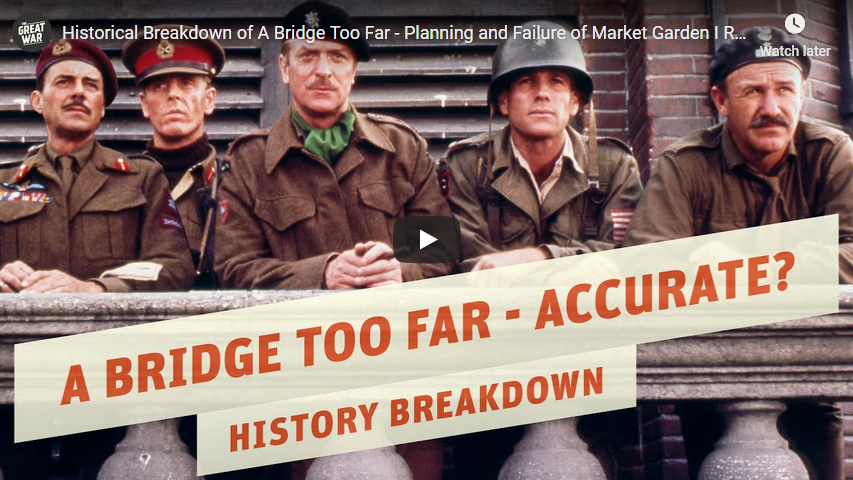
After last year’s Downfall video (with over 1 million views!) we thought we look at another classic WW2 movie and give you a breakdown about the historical figures and background. Our pick this time: A Bridge Too Far.
» SUPPORT THE CHANNEL
Patreon: https://www.patreon.com/thegreatwar» OUR PODCAST
https://realtimehistory.net/podcast – interviews with World War 1 historians and background info for the show.» BUY OUR SOURCES IN OUR AMAZON STORES
https://realtimehistory.net/amazon *
*Buying via this link supports The Great War (Affiliate-Link)» SOURCES
A. Beevor, Arnhem: The Battle for the Bridges (2018)
B. Horrocks, Escape to Action (1960)
R. Neillands, The Battle for the Rhine 1944 (2005)
Builder, Bankes, Nordin, Command Concepts (1999)
www.pegasusarchive.org
www.nam.ac.uk/explore/market-garden
www.iwm.org.uk/history/the-story-of-operation-market-garden-in-photos» MORE THE GREAT WAR
Website: https://realtimehistory.net
Instagram: https://instagram.com/the_great_war
Twitter: https://twitter.com/WW1_Series
Reddit: https://reddit.com/r/TheGreatWarChannel»CREDITS
Presented by: Jesse Alexander
Written by: Jesse Alexander
Director: Toni Steller & Florian Wittig
Director of Photography: Toni Steller
Sound: Toni Steller
Editing: Toni Steller
Motion Design: Philipp Appelt
Mixing, Mastering & Sound Design: http://above-zero.com
Maps: Daniel Kogosov (https://www.patreon.com/Zalezsky)
Research by: Matthew Moss
Fact checking: Florian WittigChannel Design: Alexander Clark
Original Logo: David van StepholdContains licensed material by getty images
All rights reserved – Real Time History GmbH 2020
From the comments:
The Great War
6 hours ago
Support our brand new World War 2 documentary about The Battle of the Rhineland (not to be released on YouTube): https://realtimehistory.net/rhineland45 **We know that some of you don’t like the fact that we upload non-Great War content once in a while. But here are a few fun facts: Last year’s video about THAT scene from Downfall has been one of our most successful videos ever produced. It helped us spreading the word about our crowdfunding campaign last year and it also brought new subscribers to The Great War that hadn’t heard about it. And in the cut-throat world of the YouTube attention economy this is really important for our continued existence. Another “fun” fact: Both this video and the Downfall video were both claimed for copyright violation even though they clearly fall under fair use. We disputed and lost and now there is nothing we can do about the fact that someone else is earning money through our work. Just one of the reasons why it’s increasingly frustrating working with YouTube and why we are exploring other avenues for The Great War and our other projects.
Tank Revolutionary: Fuller’s Diary | The Tank Museum
The Tank Museum
Published 5 Jun 2020J.F.C. Fuller has been described as a satanist, Nazi and bigot. Director Richard Smith, explores this highly controversial character, who was pivotal to the story of armoured warfare, using Fuller’s personal diary.
Support the work of The Tank Museum on Patreon: ► https://www.patreon.com/tankmuseum
Visit The Tank Museum SHOP & become a Friend: ► https://tankmuseumshop.org/Twitter: ► https://twitter.com/TankMuseum
Instagram: ► https://www.instagram.com/tankmuseum/
Tiger Tank Blog: ► http://blog.tiger-tank.com/
Tank 100 First World War Centenary Blog: ► http://tank100.com/
QotD: Even so-called “Keynesians” fail to follow Keynes
The thing about deficit spending is that you should only be doing it when you need to be doing it. No, this isn’t a rejection of that Keynesian idea or ideal, it’s the point of it.
When wages are flatlining, when the economy needs that bolus of extra demand then, OK, go borrow and spend. Or, in the MMT world, print money and spend. But once you’ve delivered that bolus and the economy has recovered then you must be able to stop that spending – whether delivered by borrowing or printing. That is, a permanent increase in spending is not Keynesian demand management, only a temporary one is.
Tim Worstall, “The Guardian‘s Absurd View Of NHS Funding”, Continental Telegraph, 2018-06-15.
September 30, 2020
How to make sense of rough-sawn lumber
Stumpy Nubs
Published 17 Jun 2019When you use this link to visit our sponsor, you support us►
MyWoodCutters: https://mywoodcutters.com/
The lumber pencil I use► https://amzn.to/31E9dmQ
Subscribe (free) to Stumpy Nubs Woodworking Journal e-Magazine► http://www.stumpynubs.com/subscribe.htmlFollow us on social media►
Instagram: https://www.instagram.com/stumpynubs/
Twitter: https://twitter.com/StumpyNubs
America First – Patriots or Nazis? – WW2 Special
World War Two
Published 29 Sep 2020In 1941, the question of whether America should join the European War still isn’t settled. Different groups whip up opposition to it, and those such as the America First Committee seem suspiciously sympathetic to Hitler’s message and cause.
Join us on Patreon: https://www.patreon.com/TimeGhostHistory
Or join The TimeGhost Army directly at: https://timeghost.tvFollow WW2 day by day on Instagram @ww2_day_by_day – https://www.instagram.com/ww2_day_by_day
Between 2 Wars: https://www.youtube.com/playlist?list…
Source list: http://bit.ly/WW2sourcesHosted by: Indy Neidell
Written by: Francis van Berkel and Indy Neidell
Director: Astrid Deinhard
Producers: Astrid Deinhard and Spartacus Olsson
Executive Producers: Astrid Deinhard, Indy Neidell, Spartacus Olsson, Bodo Rittenauer
Creative Producer: Joram Appel
Post-Production Director: Wieke Kapteijns
Research by: James Newman
Edited by: Miki Cackowski
Sound design: Marek Kamiński
Map animations: Eastory (https://www.youtube.com/c/eastory)Colorizations by:
Daniel Weiss
Norman Stewart – https://oldtimesincolor.blogspot.com/Sources:
from the Noun Project: people by ProSymbolsSoundtracks from the Epidemic Sound:
Reynard Seidel – “Deflection”
Johannes Bornlof – “The Inspector 4”
Philip Ayers – “Trapped in a Maze”
Johannes Bornlof – “Deviation In Time”
Phoenix Tail – “At the Front”Archive by Screenocean/Reuters https://www.screenocean.com.
A TimeGhost chronological documentary produced by OnLion Entertainment GmbH.
New Orleans History 101
Atun-Shei Films
Published 2 Apr 2019A brief crash course in the history of the city, from the founding in 1718 to the 20th century.
Support Atun-Shei Films on Patreon ► https://www.patreon.com/atunsheifilms
#NewOrleans #Louisiana #AmericanHistory
Watch our film ALIEN, BABY! free with Prime ► http://a.co/d/3QjqOWv
Reddit ► https://www.reddit.com/r/atunsheifilms
Twitter ► https://twitter.com/alienbabymovie
Instagram ► https://www.instagram.com/atunsheifilms
Merch ► https://atun-sheifilms.bandcamp.com
QotD: Victimhood culture
In their newly released book, The Rise of Victimhood Culture: Microaggressions, Safe Spaces, and the New Culture Wars, the moral sociologists Bradley Campbell and Jason Manning describe the three main moral cultures that exist today, which they give the shorthand labels of dignity, honor, and victimhood. A dignity culture, which has been the dominant moral culture of Western middle classes for some time, has a set of moral values that promotes the idea of moral equality and was crystallized in Martin Luther King Jr.’s vision that people ought to be judged according to the content of their character, not the color of their skin.
Victimhood culture departs from dignity culture in several important ways. Moral worth is in large part defined by the color of one’s skin, or at least one’s membership in a fixed identity group: i.e., women, people of color, LGBTIQ, Muslims, or indigenous peoples. Such groups are sacred, and a lack of deference to them is seen as a sign of deviance. The reverse is true for those who belong to groups that are considered historical oppressors: whites, males, straight people, Zionists. Anyone belonging to an “oppressor” group is stained by their privilege, or “whiteness,” and is cast onto the moral scrapheap.
Claire Lehmann, “The Evils of Cultural Appropriation”, Tablet, 2018-06-11.
September 29, 2020
Modern Classics Summarized: 1984
Overly Sarcastic Productions
Published 24 Feb 2017It’s the mother of all dystopias! Long before YA dystopia rose to power, before the age of Young Attractive Heroes who Rebel Against The State and Also Find Love, there was just Winston Smith — a middle-aged man in poor health who Rebelled Against The State and Also Found Love. It just ended much less prettily for him.
1984 codified most of the modern dystopia tropes — absolute control of the media, black-bagging people who spoke out, and a lot of popular terms like “doublethink”, “big brother”, and “thought police”. Unfortunately, a lot of those terms got stripped of context and thrown around for the sake of Extra Edge, and as a result they get used a little haphazardly. And there’s nothing Red hates more than misused terminology, so here’s the video outlining the ORIGINAL meaning of 1984!
PATREON: www.patreon.com/user?u=4664797
MERCH LINKS:
Shirts – https://overlysarcasticproducts.threa…
All the other stuff – http://www.cafepress.com/OverlySarcas…Find us on Twitter @OSPYouTube!