
… Canada’s governing class is not popular. For years now, all across the country Canadians have defiantly hoisted the black flag of Fuck Trudeau as precursor to their intent to start slitting political throats the next time they’re allowed to vote. Such vulgarity is unheard of in Canadian politics. It takes a great deal for Canadians to be impolite.
However, this widespread dissatisfaction has so far failed to coalesce into any meaningful populist insurgency opposing the Laurentian elite. Until recently, the leader of Canada’s Conservative Party, Pierre Poilievre, was coasting towards an easy electoral landslide on the back of this simmering popular anger, with his primary and indeed only selling point being that he is not Justin Trudeau. That is not to say that he is terribly different from Justin Trudeau. For American readers, Poilievre can be best described as vaguely reminiscent of Pete Buttigieg, with politics a hair to the right of the left of the right of Buttigieg’s left.
On a policy level the Conservatives are practically identical to the liberals; indeed, on immigration, after the LPC was forced by overwhelming weight of public opinion to slightly reduce the rate at which they lavished student visas and temporary foreign worker visas on their clients, Poilievre’s Conservatives essentially allowed the Liberals to outflank them to the right on the immigration issue, despite mass deportations being a very clear electoral winner.
Only very recently did Poilievre finally pledge to reduce immigration to “only” a quarter of a million a year … still a far cry from the clear necessity to reverse the flood that Trudeau and the rest of his World Economic Forum Young Global Leader alumni unleashed on the country.
John Carter, “Maple Maidan”, Postcards From Barsoom, 2025-02-15.
April 21, 2025
Bonus QotD: Pierre Poilievre
ZB47: A Truly Weird Czech SMG
Forgotten Weapons
Published 23 Dec 2024The ZB47 was developed at Brno as a contender for Czech military submachine gun adoption in the late 1940s. The Czech Army had technically adopted a submachine gun prior to World War Two (the vz.38; video on that is coming a bit later) but production did not begin before the arrival of German troops. After the war, the army was eager to add a submachine gun to its arsenal, and the vz.38 was no longer a practical option as it was chambered for the 9x17mm cartridge.
The ZB-47 is chambered for 9x19mm Parabellum, fired from an open bolt, uses a simple blowback action, and does not have a semiautomatic setting — just full auto. In its infantry configuration, it has a fixed wooden stock with a thumbhole design and a 72-round (!) magazine fitted almost horizontally under the stock and barrel. A unique feed system pushes cartridges vertically up out of the magazine feed lips into a pair of feed ramps that pitch the round 90 degrees forward and into the chamber. The system is closest to that of the FN P90, although the cartridge rotating element on the ZB is built into the gun, not the magazine. The paratrooper variant of the gun has a collapsing metal stock, which shortened the overall length and also restricts its capacity to a 30-round magazine when the stock is closed. Rate of fire was reportedly a blistering 1200 rpm.
One challenge of this very long straight magazine was the slight taper of the standard 9x19mm cartridge case. In 30-round magazines this is not really an issue, but by 72 rounds the taper adds up to enough to cause problems stacking cartridges. Brno attempted to solve this by making a truly cylindrical version of 9×19, but the Czech military was (rightly) not convinced of its benefits and rejected it.
In the 1947 field trials, eight Czech units were given examples of the ZB47 and other competitors. Five of those units actually reported favorably on the ZB; it looks like a very awkward gun to handle but actually isn’t in practice. However, the Army deemed it to have too many drawbacks, including the magazine reliability, poor accuracy, and bring judged too fragile. One more set of trials would take place the next year and ultimately the CZ model 23 was adopted. In total, just 62 examples of the ZB-47 were produced.
Many thanks to the VHU — the Czech Military History Institute – for giving me access to these two fantastic prototypes to film for you. The Army Museum Žižkov is a part of the Institute, and they have a three-story museum full of cool exhibits open to the public in Prague. If you have a chance to visit, it’s definitely worth the time! You can find all of their details (including their aviation and armor museums) here:
QotD: Thomas Hobbes’ view of the “state of nature” in Leviathan
The idea of “natural rights” was nothing new, of course. It goes back to at least Aristotle; Thomism and the whole medieval Scholastic schmear is incomprehensible without it. But Aristotle lived in a pre-Christian world, and Aquinas in a monolithically Catholic one. Both would find the idea of two sets of believers going to the hilt at each other over different versions of the same god incomprehensible. But that was the reality in Hobbes’s day, and it was real enough to reduce parts of Germany to cannibalism — the best modern estimates put casualties from the Thirty Years’ War at World War I levels proportional to population. That simply couldn’t go on, especially with the infidel Turk hammering at the gates.
Thus Hobbes decided to write God out of the picture. There’s lots of debate over Hobbes’s personal religious beliefs, if any; ranging from “he was a sincere, if somewhat unorthodox, Anglican” to “he was a raging atheist”. It doesn’t matter for our purposes. All we need to know is: because appeal to Scripture couldn’t end in anything but more bloodshed, perforce political legitimacy must be secularized, and the old concept of “natural rights” seemed to be the answer. Do we have rights just by virtue of being human, and if so, what are they?
Thus the “state of nature”. Hobbes was always quite clear that this was a thought experiment, not a statement about historical anthropology. His employer, the Cavendish family, the Earls (later Dukes) of Devonshire, were investors in the Virginia Company, and we believe Hobbes acted on their behalf in some capacity with the Company. So he knew better than anyone that the North American Indians weren’t in the state of nature (as he semi-jokingly suggested in Leviathan). Only semi-jokingly, though, because […] it was a real question back in the 1500s just what authority, if any, the conquistadores had to overthrow the native regimes in New Spain. Cortes and the boys might’ve laughed when the Requirimiento was read out, but they nonetheless felt compelled to do it, to legally cover their monarchs’ asses.
From the perspective of post-Hobbes political philosophy, it’s an easy answer. Montezuma was legitimately ruler of the Aztecs, as they, the Aztecs, had gotten out of the state of nature the way everyone else does: Via the “social contract” (recall that Hobbes himself doesn’t use this term). But since international relations remain in the state of nature, by definition, that’s all the justification the Spaniards would’ve needed. That Fernando and Isabella would’ve cheerfully burnt Hobbes at the stake is ironic, Alanis-level at least, but they were practical people; they’d be happy to use his arguments
Severian, “Range Finding III: Natural Law”, Founding Questions, 2021-11-23.
April 20, 2025
The formal end of the League of Nations, 18 April, 1946
Norman Stewart reposted the text of an article in the Louisville, Kentucky Courier-Journal of 19 April, 1946 to mark the demise of the League of Nations:

Building A of the Palace of Nations in Geneva, now an office of the United Nations.
Photo by Mourad Ben Abdallah via Wikimedia Commons.
League of Nations dies, willing its assets to U.N.
GENEVA (AP, April 18) – The League of Nations, created to preserve peace after a world cataclysm, expired tonight and willed to the United Nations its physical assets in the hope that the new organization might succeed where the League had failed.
It had lived 26 years.
Delegates from 34 nations, outnumbered by spectators in the galleries, witnessed the death of first major peace organization of the 20th century.
Quietly, the delegates answered “Yes” to a roll call on a motion providing that “with effect from the day following the close of the present session of the Assembly, the League of Nations shall cease to exist except for the sole purpose of the liquidation of its affairs”.
Last session ends
At 5:43 p.m., Carl J. Hambro of Norway, president of the Assembly, pounded his gavel and solemnly announced: “I declare the 21st and last session of the General Assembly of the League of Nations closed”.
Thus ended the life of the peace organization conceived largely by President Wilson, but never joined by the United States.
Its legal existence dated from the entry into force of the Treaty of Versailles on January 10, 1920.
The nostalgic formalities of terminating the League were interrupted only with a problem that is the heritage of the century’s second great peace effort – the United Nations.
Egyptian objects
Mahmoud Mohamed Aldarwiche, the Egyptian delegate, abstained from voting on a resolution that pointed out that present League members with mandated territories have declared they will continue to administer these countries as mandates until they are placed under trusteeship of the United Nations.
“It is the view of my government,” said Aldarwiche, “that mandates have terminated with the dissolution of the League of Nations, and that insofar as Palestine is concerned there should be no question of putting it under trusteeship.”
Egypt feels, he added, that Palestine has reached a stage “where it should no longer continue under mandate of trusteeship. Her development is not behind that of Syria, Lebanon, Iraq or Transjordan, who have won independence”.
Treaties turned over
Hambro told Aldarwiche the United Nations probably would discuss the matter in September.
One of the League’s final acts was to turn over to the United Nations thousands of treaty texts.
In physical assets the United Nations will inherit property valued at $11,700,000. These include the League palace, other real estate and the League’s stock of paper, furniture, typewriters and similar equipment.
The League confirmed Sean Lester of Ireland as secretary-general as from 1940 and Seymour Jacklin of South Africa as treasurer from 1944. They will continue to serve until the last of the League’s affairs are liquidated.
Did Britain Bomb The Wrong Targets in WW2? – Out of the Foxholes Live
World War Two
Published 19 Apr 2025Today Indy and Sparty answer questions on the French colonies, Pykrete and iceberg aircraft carriers Japan’s invasion of India, and they talk about Britain’s misguided strategic bombing strategy.
(more…)
The essence of (most) modern western governments
Chris Bray on the paradox of how many western governments manage the alchemy of being both omnipresent and yet absent simultaneously:
Adding to my last post about covering language that masks the massive expansion of government behind performative language about limiting government: The most Los Angeles thing I have ever seen happened behind the Yoshinoya Beef Bowl.
See the alley between the Yoshinoya and the pharmacy? As I drove by on Wilshire, two extremely alert LAPD officers on motorcycles were sitting at the edge of that parking lot, postures tight and poised for action, urgently scanning the street. It was like watching a gunfighter movie, in the scene when the camera closes in on the gunfighter’s eyes, watching his opponent for the draw. These dudes were ready. If you did 38 in the 30 MPH zone, then brother, you were dead-ass done, nailed up in the trophy case.
Also, no more than thirty feet away from them, a little gaggle of filthy human zombies was passing a glass pipe around the circle, throwing up clouds of smoke, at the top end of an alley wall-to-wall full of open drug use and not terribly subtle drug dealing (and probably the prostitution that pays for the drugs, but I didn’t wander into the alley to look). But California made the possession and use of heroin, meth, and cocaine a misdemeanor, and the DA at the time was very proud that he wouldn’t allow his office to file most misdemeanor cases, because misdemeanors are lifestyle crimes that punish people for being poor, or for being “individuals experiencing homelessness”. So that alley full of people Hunter Bidening all day out in the open weren’t doing anything that could lead to prosecution, but your expired registration tags would bring down an immediate police response in you happened to roll by them.
Grand Guignol human depravity and ruin: no big deal. Minor traffic offenses: front and center.
This is Blue Zone governance, full stop, the thing people describe as anarcho-tyranny. Common San Francisco business owner experience: Police don’t intervene in the constant vandalism and tagging that degrades business property, but the highly alert army of code enforcement officers fine business owners for failing to clean up the damage that the city hasn’t prevented.
I forget who recently suggested this on I-still-call-it-Twitter, but go to Yelp and read some reviews for gas stations in Oakland:


Using Paul’s Sharpening System | Paul Sellers
Paul Sellers
Published 13 Dec 2024Want to make this system? Here’s how: • Making Paul’s Sharpening System | Pau…
I have been sharpening edge tools for sixty years and every single day of my life, and the fastest way to get the surgically sharp edge comes when you master freehand sharpening.
This video gets you started, and you will see how easy and quick it is to sharpen your edge tools once you take the first step, following this simple how-to.
(more…)
QotD: “Hate speech”
This is why they balk and protest when the words free speech are used against them. They detest the idea that they are enemies of liberty. But of course that is precisely what they are. Just consider that nonsensical chant “Hate speech is not free speech”. There are two profound moral problems with this idiotic tautology. The first is that, actually, even genuinely hateful speech, including racist gibberish and misogynistic blather, should be free speech. By its very definition freedom of speech should extend to all speech, even speech we detest. And secondly, “hate speech” has become a slippery, amorphous category that now covers not only foul old nonsense like Holocaust denial, but also trans-sceptical feminism, criticism of Islam, opposition to mass immigration, and so on. “Hate speech” really means thoughtcrime. It is an utterly ideological category used by the cultural and intellectual elites to demonise and censor ideas, beliefs and moral convictions they disapprove of. The war on “hate speech” is the new war on heresy, on free-thinking, on minority opinion, on challenging beliefs. It is blatant censorship.
The illiberal liberals’ conflation of genuine hatred with moral opinion, all of which then gets cynically collapsed under the name of “hate speech”, was beautifully captured in an exchange on the BBC’s Politics Live yesterday. Pushing back against the FSU’s Inaya Folarin Iman, Baroness Kennedy arrogantly predicted that the FSU would be embraced by “racists … people who hate homosexuals, who hate trans people, [and] people … who have hostile views towards Islam”. Hold on. One of these things is not like the others. What is wrong with having hostile views on Islam? Is hostility towards a powerful world religion now a form of “hate speech”? Yes, it is. Kennedy’s conflation of criticism of Islam with racism and homophobia perfectly encapsulated the way in which “hate speech” is now used to police not only genuinely hateful ideas, but also blasphemy against religious ideas. Even that key freedom human beings fought so hard for – the right to mock gods and prophets and religious ideology – is now threatened by the censorious ideology of “hate speech”.
Brendan O’Neill, “Why we must win the fight for free speech”, Spiked, 2020-02-26.
April 19, 2025
Dambusters – Part 2 – The Countdown to the Raid
HardThrasher
Published 17 Apr 2025The speed with which a theory had to be put into practice, and the opening phase of the raid itself.
(more…)
Notes on the English debate
In the National Post, Chris Selley explains the apparent utility of having Bloc Québécois leader Yves-François Blanchet included in the English-language leaders’ debate:

Bloc Québécois leader Yves-François Blanchet, 8 November, 2023.
Screencapture from a TVA Nouvelles video via Wikimedia Commons.
Wednesday evening’s French-language leaders’ debate kicked off with a video montage that mentioned President Donald Trump roughly 175 times. (I exaggerate somewhat.) Thursday evening’s English-language leaders’ debate was much less focused specifically on Trump, to an almost bizarre extent. When moderator Steve Paikin offered each leader a chance to ask a question of an opponent, Liberal Leader Mark Carney chose to ask Conservative Leader Pierre Poilievre about the security-clearance drama.
Carney’s campaign clearly believes Poilievre’s Achilles’ heel is Trump. One has to wonder how many Canadians even know the basics of the security-clearance issue. It was a baffling decision.
Ultimately, though, leaving Trump aside was a benefit. One of Carney or Poilievre will be prime minister in a month, and they essentially agree that Trump is too unpredictable to strategize against with any confidence from our current position as a semi-deadbeat country. (Again, I paraphrase.)
The only thing we can really do is focus on our own affairs in ways that would make us more prosperous, safe, happy and independent in every sense. In the long term: diversify our trade partners in every sector, including natural resources; improve border security, not to satisfy Trump’s fentanyl obsession but to prevent the northbound flow of illegal firearms (and because borders are supposed to be secure by definition); rebuild the military, not because Trump demands it but out of respect to our existing commitment to NATO and our self-styled reputation as An Important Country; fix health care; make housing affordable; get a handle on our own opioid crisis; fix our broken justice system. All that jazz.
You might think in a debate on those big national issues Bloc Québécois Leader Yves-François Blanchet would be extraneous on the stage. I saw plenty of people reacting in real time in that vein: Why is this man here? But in fact Blanchet served a very useful purpose: He was the voice of comfy Canadian inertia; the voice of Quebec continuing to plod along in its own way under Canada’s protective umbrella (ludicrous sovereignty-referendum threats notwithstanding).
Blanchet embodied how Canada might very plausibly abandon the opportunity that Trump’s kick in our rear end, however unjustified, offered us to live up to the greatness Canadian politicians always ascribe — often dubiously — to this country.
“The building of (new) pipelines will take at least 10 to 14 years. Mr. Trump will be 90 years old, not president … and somebody of course less terrible will be there before you can even dream of having oil through (a new) pipeline,” Blanchet said, kiboshing (as ever) the notion of any new pipeline running through Quebec.
At Rigid Thinking, Damian Penny tries to explain Jagmeet Singh’s performance as the designated interrupter:
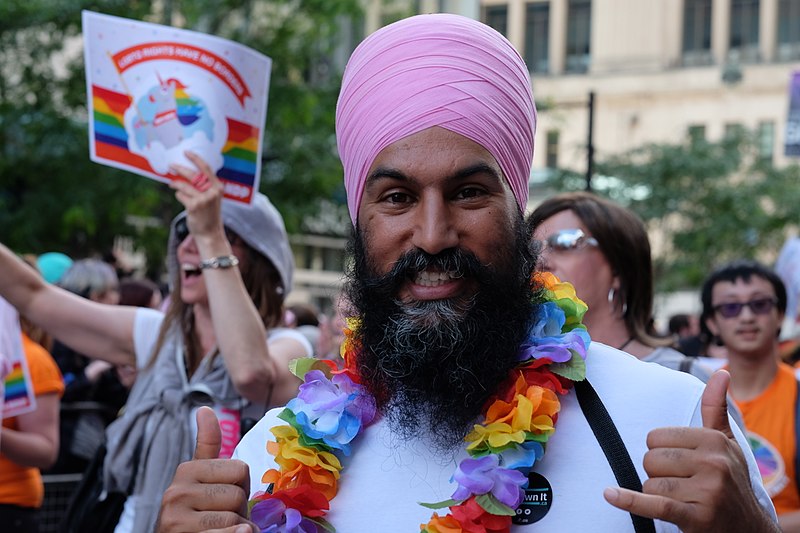
Federal NDP leader Jagmeet Singh taking part in a Pride Parade in June 2017 (during the leadership campaign).
Photo via Wikimedia.
I didn’t see the entire English-language, federal leaders debate on Thursday night, but from what I did see each of the leaders accomplished exactly what they set out to do:
- Pierre Poilievre went on offence against the liberals and tried to show that, despite their new leader, it’s the same bunch that have been running the country for the past decade.
- Mark Carney portrayed himself as much more measured and serious than either his main opponent or his predecessor.
- The Bloc guy showed that his only concern is Quebec and by the way everything comes down to immigration.
- And the NDP’s Jagmeet Singh did everything he had to do to lock down that cushy patronage appointment he’ll receive should Carney be elected Prime Minister on April 28.
There was far more cross talk and interruptions during Thursday’s English debate compared to the French parlay the night before. Singh in particular seemed prone to interrupt his opponents.
Poilievre was the main target of Singh’s interjections — so much so that at one point Carney told the NDP leader to let his Conservative rival finish his point.
When Poilievre criticized the industrial carbon tax, Singh jumped in and accused the Conservatives of wanting to let everyone pollute. Poilievre spoke about border issues and Singh accused the former Conservative government of cutting border officers.
Poilievre at one point tried to make an appeal to voters: “The question that Canadians have to ask…”
“Why vote for Conservatives?” Singh jumped in before Poilievre could finish.
As of this writing, the venerable NDP is polling about as well in Canada as Marjorie Taylor Greene, and their only real shot at even maintaining major party status is to peel off voters from the Liberals, since no one even considering voting Conservative will vote for Singh’s party.
The Line‘s election Bullshit Bulletin overflowed with bullshit from the debates, including some Mark Carney blarney about pipelines:

Mark Carney had quite a few howlers during Thursday’s debate, one of which was aptly called out by Blanchet (hey, we like the guy, we just don’t think he should be in the debate). Carney wants to portray himself as strongly pro-pipeline, while still respecting Quebec’s ability to effectively veto national projects. That’s bullshit — and Carney should stop pretending otherwise.
Carney has been out of the country in recent years, so he may be unaware of how things are actually working. To sum up the last 10 years of internecine battles on this point: Pipelines absolutely fall under federal jurisdiction to approve or disapprove. However, provinces can hold up or significantly delay certain aspects of the process, either through legal challenges, or through sandbagging local permitting processes. The big lesson of the last 10 years is that absolute jackshit can actually get built when provincial governments try to encroach on federal authority to stall projects that fall under the national interest. Duties for First Nations consultation add another complicating step. Lastly, this country couldn’t build a goddamn supermarket (and Singh might try to stop it, even if we could) if conditions veer into the quasi-spiritual realm of “social license” — because nobody really knows what that means, or how the bar for “social license” can be cleared when any project at all is even remotely contested or controversial.
Add Bill C-69 to the mix, and what we’re facing is a regulatory quagmire in which the Liberals have made the approvals process practically impossible, and pissed everybody off while doing it. It’s worse than that almost nothing is getting built; the situation is now such a disaster that major projects are no longer even being seriously proposed. Even CEOs of Canadian companies know that their best return on investment is energy projects outside of Canada (see The Line Podcast episode from a week ago and our dispatch last Sunday for discussion of this).
In short, Blanchet is correct, here. A pipeline filled with Alberta oil is not getting through Quebec if Quebec gets a veto. Either we’re in a Confederation in which a federal government has the final say over these things, or Quebec has already separated, and that’s the end of it.
There was also an excellent dissection of the Liberal Party’s endless games with Canadian firearm laws, but it was too long to sensibly excerpt, but if you have any interest or curiosity about why so many Canadian gun owners are pissed off with the feds, it’s worth reading in full.
Downfall: The Battle of Berlin 1945
Real Time History
Published 6 Dec 2024April 1945. After nearly six years of war, the Red Army stands massed on the banks of the Oder River in eastern Germany. The Nazi capital and Hitler’s bunker are just 60km away, but the Nazi Party and the Wehrmacht are preparing to fight to the bitter end in the final struggle of WW2 in Europe – the Battle for Berlin.
(more…)
QotD: Allied air and sea operations won WWII
The Allies won the war by using air power to destroy the German and Japanese capacity both to produce military equipment and to transport it to the battlefield. By 1944-45, the Germans and Japanese could not use their economies to arm and supply their armies on the battlefield, leading to their inevitable defeat.
In the European war, American and British airpower: (a) directly destroyed a significant amount of productive capacity, (b) rendered remaining capacity far less efficient, (c) made it impossible for the Germans to defeat western ground forces, and (d) compelled the Germans to waste tremendous resources on air defense and exorbitant, ultimately ineffective vengeance weapons.
In the Pacific, the United States used carrier-based airpower, submarines, and bomber-deployed mines to isolate Japan from the resources of the empire it conquered in 1941-42. American bombers also directly destroyed factories and transportation systems, leading to similar levels of economic dysfunction as in Germany.
Anonymous, “Your Book Review: How the War Was Won“, Astral Codex Ten, 2024-08-09.
April 18, 2025
How a grinder can change your woodworking
Rex Krueger
Published 16 Apr 2025
Notes on the French debate
Paul Wells jotted down some notes in his Substack Chat after the leaders’ debate last night:

A few notes on last night’s post-election scrum fiasco, when reporters from Rebel News and Juno News got most of the questions. Some of the commentary this morning about this, from people who think it was a disaster (I think it’s unfortunate but not quite a disaster), is alarmingly superficial.
So here are some thoughts, threaded.
1. The debate commission didn’t just take it into their fool heads to invite these alt-right news organizations. They tried hard to block them in 2021, got hauled into court, and lost big. Remembering this very recent news event should, it seems to me, be a basic requirement for your pundit’s license. https://globalnews.ca/news/8174634/rebel-news-election-debates-court-challenge/
My first thought was that it’s apparently ok for Mr. Singh to refuse to engage with certain media, but if Mr. Poilievre remarks on CBC bias, he’s the enemy.
2. I’m not fond of Ezra, but in declaring that Rebel News had five divisions, he was engaging in not entirely unfunny satire about the way the CBC shows up with French and English radio and TV to every event. You may not like the joke! But it was clearly, to some extent, obvious satire about an obvious target.
3. I remain astonished that any political leader shows up for scrums after any debate. They just talked for two hours! The only possible newsworthy outcome from a scrum afterwards is, you walk all over the message you prepped for weeks to deliver. We had scrums after our 2015 Maclean’s debate. Stephen Harper just didn’t show up for them. That’s an option! Carney has worked hard since January to control and limit access to his regal person, and then he wanders into a scrum after what would be, for any anglophone, an exhausting two hours in French, as though somebody told him it was where he could get a sandwich? People are weird.
Once upon a time — at least in theory — one of the functions of the mainstream media was to help keep our political leaders under observation for the voters. That fantasy has long since vanished in Canada, as almost all the surviving mainstream media outfits are slavering propagandists, lickspittles, and fart-catchers for the Liberal Party and especially for its leader-of-the-moment. In The Line, a media outlet that isn’t directly funded by the federal government, Andrew MacDougall offers a parable about the Canadian media:
My eldest daughter is nine. Her little sister is five. The little one adores her big sister and believes everything she says.
I, on the other hand, am 49. My eldest often tries to convince me of things. But I am a skeptic when it comes to the things my children tell me, as any good parent should be. And because I push back on the eldest’s arguments, she often comes back moments later with much sharper ones. Sometimes I even change my mind.
Yes, this is a parable about the media and its role in public life, including during this federal election. And yes, we can debate the mechanics of media — who gets access, how many questions, and so on — but this is to both bury the lede and miss the story. There is much more at stake than whether the Toronto Star or the Globe gets a question at a tightly-managed press event.
What’s at stake is whether anyone in power will ever again have a parent to satisfy. Or whether those in power will be nine-year-olds, forever seeking the smoke blown up their asses by the five-year-olds in their life.
The ability to act like a nine-year-old in power is an entirely new phenomenon. In the Before Times, when a politician (or corporate leader) used to have to exchange credible arguments with a member of the media in return for access to the distribution network of their publication or broadcast, serious conversations were par for the course. It wasn’t perfect, no, but it was an adult time. There was no point rocking up to the microphone with a wild ad hominem attack, or armed with a list of faulty facts, because it wouldn’t have passed muster. There was no rolling 24/7 coverage, and easily discredited arguments wouldn’t have made the cut in what was then limited news real estate. Now, thanks to social media, there is an infinite and constantly updating canvas. You don’t even need a credit card, let alone an argument, in order to access and speak to your audience — and then tell them any damn thing you want, no matter its level of adherence to the truth.
It wasn’t supposed to be this way. In their pre-algorithmic infancy, the major social media platforms promised access and connection. In this more gentle, less attention-hogging iteration, the major benefit of the social media platforms and other owned channels was that they allowed you to go — unfiltered — to your intended audiences. A clean message, straight to the target voter. What politician wouldn’t want that? How could that be a bad thing? Well, other than the fact that politicians and other people in positions of power have been known to lie and try to cover up bad things.
SIG P320 Flux Legion / Flux Raider: The Best Pistol-PDW System Yet
Forgotten Weapons
Published 18 Dec 2024The Flux Raider is a chassis system designed to turn the SIG P320 into a very compact PDW. The design concept began as a desire to improve the practical accuracy of a handgun by adding a collapsing stock while keeping the weapon holsterable. Flux’ first product, circa 2019, was a spring-loaded stock that could be attached to the back of a Glock pistol. This had some clear shortcomings, and it led to development of the MP17 in 2020. This was a SIG chassis, something made feasible by the use of a serialized fire control group in the P320 pistol. The MP17 used the same basic stock design as the original Flux brace, but added an optics mount and a space to store a space magazine.
Less than 400 MP17s were built before the design was refined into the Flux Raider, and the manufacturing changed from printing to molded polymer. Of particular significance was the choice of polymer compounds to use, as the typical glass-reinforced nylon is not rigid enough to keep a good optics zero. By opting for a much more rigid material (albeit a much more expensive one), Flux was able to remove the metal reinforcing in the chassis, lightening the system while still retaining an optics mount stable enough to hold zero under adverse conditions. The spare magazine system was also significantly improved in the Raider, and an ambidextrous manual safety added.
Today, Flux has partnered with SIG to produce the P320 Flux Legion. I am excited to see where Flux and SIG take the design from here!
[Published a day later, here’s Ian’s range trip with the P320 Flux Legion Raider.]
(more…)


