
HardThrasher
Published 26 Sep 2025Part 1 of a 2 Part Series covering Bomber Command in 1943 — this is the background and build up, the aircraft, the founding of pathfidner force and the mechanics behind the mass use of incendiaries
References from the video below
i Battle of the Beams, Tom Whipple, Penguin, 2003, p.209
ii The Battle of the Beams, Whipple, Penguin, 2003, p.213
iii The Bombing War, Overy, Penguin, 2012, p.345
iv The Pathfinders, Will Iredale, Penguin, 2021, p.116 and on
v The Bombing War, Overy, Penguin, 2012, p.238
vi See Caliban Rising’s excellent video on statistical deaths for Bomber Command
vii B12/36, The British Aircraft Specifications File, Meekcoms & Morgan, Air-Britain, 1994, p.228
viii The Bombing War, Overy, Penguin, 2012, p.290-91
ix The Pathfinders, Will Iredale, Penguin, 2021 p.74
x Proceedings of the Royal Air Force Historical Society, Issue No 6, Sept 1989, p.22
xi The Pathfinders, Iredale, Penguin, 2021, p.75
xii The Pathfinders, Iredale, Penguin, 2021, 2021 p.79
xiii https://en.wikipedia.org/wiki/Wilfrid… – yes, yes I know, a Wiki reference.
xiv Interview 1977 for the RAF Centre for Air Power Studies (CASPS) – • RAF CASPS Historic Interview | Group Capta…
xv Pathfinder, Goodall, 1988 pp. 102, 158, 205email – hardthrasher@gmail.com
Merch – https://hardthrasher-shop.fourthwall.com
Patreon – patreon.com/LordHardThrasher
September 29, 2025
Bomber Command 1943 – Reap What You Sow – The Bomber War Episode 6.
September 28, 2025
North Africa Episode 1: Hitler’s Hand Forced
World War Two
Published 27 Sept 2025As Italy’s war effort collapses across Greece and North Africa, Hitler is forced to intervene. This episode explains why German troops are sent to Africa in early 1941 and sets the stage for Rommel’s arrival and the birth of the Desert War. The North African campaign begins not with a plan — but with a crisis.
(more…)
S-Boats – Guide 438
Drachinifel
Published 3 May 2025The S-Boats, fast attack craft of the Kriegsmarine, are today’s subject.
(more…)
September 23, 2025
Beretta Model 1934: Italy’s Unassuming Workhorse Service Pistol
Forgotten Weapons
Published 16 May 2025The Beretta Model 34 was basically the final iteration of a design by Tullio Marengoni that began all the way back in 1915. That pistol was updated in the early 1920s, and that one was updated in 1931. The Model 1931 was converted to .380 ACP (aka 9mm Short) as the Model 1932, which became the Model 1934 with the addition of a hammer half-cock notch and steel grip panel backing. Police and military contracts began in 1935, with the Italian Army formally adopting it in 1936 and purchasing nearly 400,000 of them by 1940. It would ultimately see service with basically all the armed elements of the Italian military and civil security services as well as foreign nations including Germany, Romania, and Finland. As a souvenir for British or American troops, the Model 1934 was also a prized piece.
Essentially, the Model 1934 is compact, simple, durable, and reliable. It is an excellent military pistol; easy to carry unobtrusively but dependable when called upon. After World War Two it stayed in production until 1980, despite introduction of many other more modern options by Beretta. Today a bunch of the pistols have become available on the US collector’s market. Thanks to Royal Tiger Imports for sending this example for me to film!
Beretta Model 1934 serial numbers and dates (source: “1915-1985 Settant’ Anni di Pistole Beretta“):
1934 – 1942 – from about 500073 to 999996
1934 – 1942 – from 1 to about 40000
1943 – 1945 – from F00001 to F99997
1943 – 1945 – from G00001 to G57486
1943 – 1945 – from 0001AA to 9997AA
1943 – 1945 – from 0001BB to 9971BB
1946 – 1949 – from C00001 to C99998
1949 – 1954 – from D00001 to D99999
1954 – 1967 – from E00001 to E95760
1967 – 1973 – from F50001 to F61693
1970 – 1975 – from G00007 to G49620
1972 – 1974 – from H00001 to H25000
1971 – 1980 – from T 1 to T 10217Other pistols in the Beretta development series:
Modle 1915: • Beretta 1915: the First of the Berett…
Model 1923: • Beretta Model 1923
Model 1931: • Beretta Model 1931
Trials Model 1934: • Military Trials Beretta 34 – Can You …
(more…)
September 21, 2025
Why Didn’t Hitler Invade Switzerland? – OOTF Community Questions
World War Two
Published 20 Sept 2025In this Out of the Foxholes Q&A, Indy and Sparty dive into some of the most intriguing questions about World War Two. Why didn’t Hitler invade Switzerland, what was going through the minds of the German High Command as defeat loomed, and why didn’t the Germans use the Vichy French Army in Operation Barbarossa? Three questions that shed light on the strategies, choices, and mysteries of the war.
(more…)
September 20, 2025
Dutch Navy Luger: From World War One to the End of Neutrality
Forgotten Weapons
Published 12 May 2025The Dutch Navy first acquired Luger pistols in 1918 specifically for its aviators. They had 12 German P04 Lugers taken from a German submarine stranded in the (neutral) Netherlands, and 28 more were purchased from DWM in 1918 to round out the 40 guns needed to equip the Naval Air Service. The pistol was formally adopted as Automatische Pistool Nr.1. In 1928, the Dutch Army adopted the 1906 New Model Luger for its own service, and the Navy decided to update its revolvers at the same time. The Navy opted not to get grip safeties, and so took a copy of the German P08 model instead of what the Army had. The first order was placed in 1928 through BKIW in Germany, and deliveries would run until 1939 with a total of 2654 delivered before German invaded in May 1940.
Dutch Army Luger trials:
• Politicians Ruin Everything: Dutch Lu…Dutch East Indies Lugers:
• Lugers for the Dutch East Indies Army
(more…)
September 18, 2025
“The British fleet is strong and at the ready” (1939)
British Pathé
Published 12 Nov 2020GAUMONT BRITISH NEWSREEL (REUTERS)
Comprehensive documentary of the Royal Navy in the lead up to war
Full Description:
SLATE INFORMATION: Britain’s Navy Ready for Any Challenge, The Combined Fleets Filmed by Gaumont-British News
Comprehensive documentary of the British fleet and their preparedness for action including shots of numerous ships at sea and at anchor, sailors on deck, aircraft on deck, ship’s guns, officers in quarters, destroyers, aircraft flying off deck and landing on water
Archive: Reuters
Archive managed by: British Pathé
September 14, 2025
September 10, 2025
Space Nazis! Evil Empires and Historical Memory
Feral Historian
Published 30 Jun 2022A brief look at the echo of Nazi Germany and its impact on American sci-fi, with a focus on Star Wars because it’s endured for nearly half a century.
September 7, 2025
The BEF and the German Sichelschnitt of May, 1940
Dr. Robert Lyman rebuts the common-since-the-1950s adulation of the Wehrmacht‘s attacks of May-June, 1940 through the Low Countries that drove the British Expeditionary Force off the continent and destroyed the flower of the French army prior to the surrender of France in June:
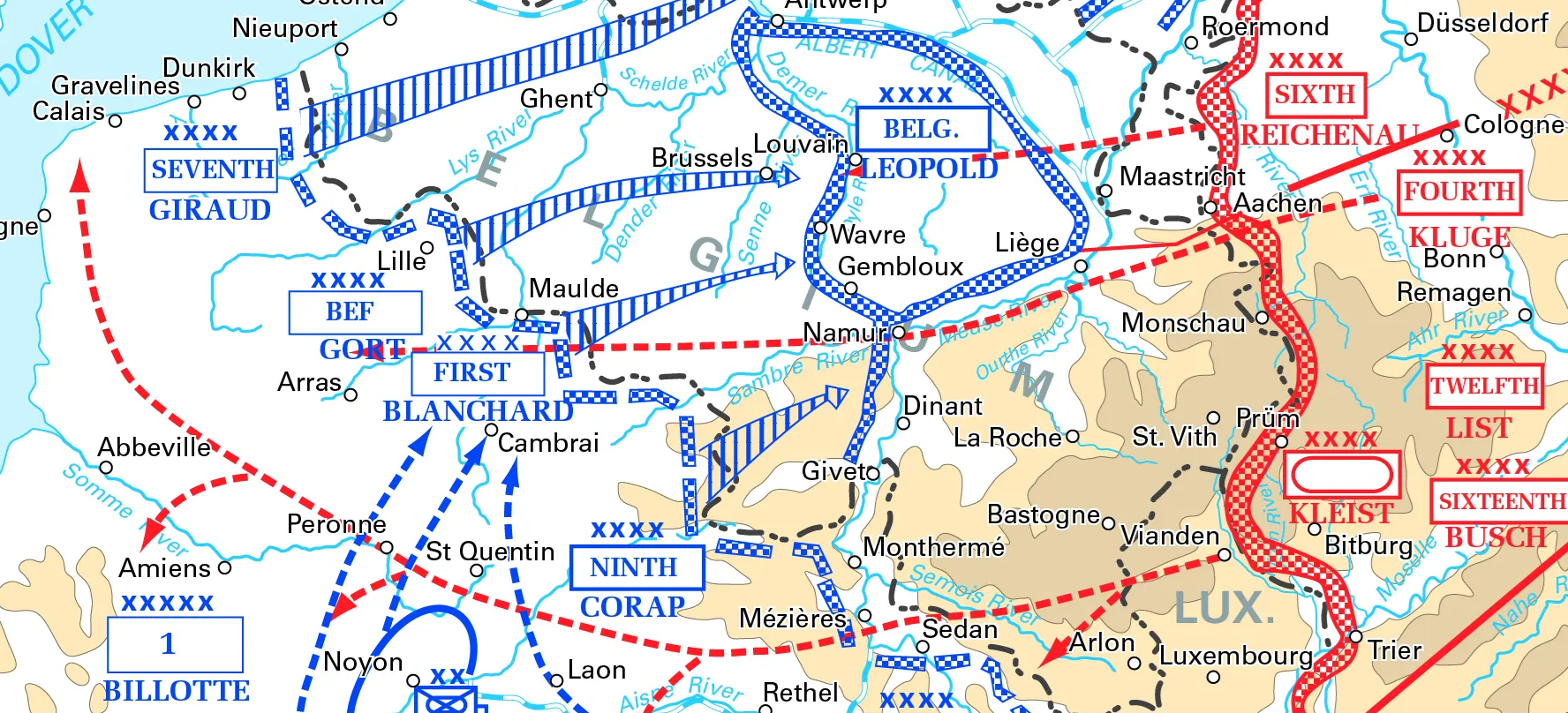
Detail from the West Point Military Atlas map of the “Campaign in the West, Disposition and Opposing Forces, 1940”
Full map.
The world has largely remembered Sichelschnitt as a brilliant German operation of war, but it was one that was fundamentally enabled by Allied ineptitude. Indeed, Blitzkrieg wasn’t particularly new, innovative or even a warfighting doctrine. It is best described, in the context of France 1940, as an event. It was simply the way that the Wehrmacht exerted its tactical and operational superiority over its more pedestrian enemies in 1940. In fact, it was the 1940 extension of what the German Army had first demonstrated in Flanders in March 1918, this time with tanks and Stukas. It was the Panzerwaffe (“tank force”) – combined with a tactical air force – which in 1940 would create the breakthrough that Ludendorff had been unable to achieve in 1918. Where it was applied, by Army Group A, it concentrated fast-moving armoured vanguards co-ordinated with tactical air power, such as 400 Ju 87 Stuka dive-bombers, to so overwhelm the enemy in both time and space that they were unable to respond quickly enough to the changing and challenging battlefield. In 1940 the panzer came into its own, the sound of clattering tracks on French cobblestones a new feature in the sound of battle and a key element in how France remembers its defeat in 1940.
It wasn’t the type of tank in the German inventory which mattered, but the way in which these tanks were employed. Only about 10 per cent of the army comprised tanks, the remainder relying on horse and wagons and the raw, painful feet of the marching infantry. Of the 2,539 tanks the Wehrmacht deployed in 1940, only 916, or 36 per cent were battleworthy, the remainder being clattering tin cans with machine guns (the obsolete Panzer Mark Is and Mark IIs). The only modern tanks were 683 Panzer Mark IIIs and Czech T38 tanks armed with a 37mm gun, and 278 of the larger Mark IVs with a short 75mm gun. But it was enough. The German operational strategy was to use this mass of armour not to fight a large confrontational tank battle, but to achieve breakthrough and breakout, bursting through the enemy’s linear defences. It was surprise and shock action that so discomforted the Allies, who had lazily and, given what we know of British failure to understand 1918, ignorantly assumed that the war would progress against a 1914 rather than a 1918 pattern. The armoured vanguard would surge through the outer skin of the enemy defences, concentrating heavy effort in one place, before driving hard into the heart of enemy territory. With an enemy intent on fighting a linear battle, the rear areas, behind this outer crust, would be weakly defended and full of rear-echelon, administrative and supply troops managing the lines of communication up to the front, not expecting to have to fight. It was by driving hard and fast behind the enemy front line, breaking the cycle of Allied battlefield decision-making, that Blitzkrieg was to achieve its psychological effect.
In contrast the Allies remained concerned about retaining the integrity of their defensive lines. The diaries of Major General Henry Pownall, for instance, are replete with concerns as the days spun past about the widening frontages on one defensive line or another. British concern was misplaced. It was to spread the ever-decreasing butter of the British infantry across ever-widening stretches of French and Belgian bread, without realising that the Germans were concerned not with rolling up a front line, but with driving hard to the rear. By so doing they would take risks with their flanks, but the discombobulatory effect on the enemy was considered to far outweigh any worry about the risk of counter- attack from an increasingly battered and disorganised enemy. Of course this operational concept was risky, but the risks taken were carefully calculated given what the German General Staff knew about British and French tactical doctrine, or the lack of it.
These German tactics were psychologically disconcerting for those not trained to expect them. As was demonstrated on the Meuse, artillery would batter a position in co-ordination with armoured columns bypassing fixed defences and attacking those it needed to clear from the flanks and the rear. The infantry accompanying the advancing armour – Panzergrenadiers (mechanised infantry) – arrived in tandem with the Stukas, which could drop their bombs from a screaming dive. Each Stuka seemed to those at the receiving end to be diving directly at them, personally. For untrained troops it was a terrifying experience. The panzers would sweep on while the truck-borne infantry would turn up to deal with survivors of this storm of fire and movement. By this time, of course, the disorientated French and British would now consider themselves cut off, behind their front line, with no prospect of being relieved. Surrender or a disorganised escape to the rear would seem to be a more sensible option than the forlorn hope of continued resistance when the surrounding fields were dotted with the grey-green uniforms and coal-scuttle helmets of their enemy. The psychological effect of Blitzkrieg was considerable. This wasn’t how their fathers had told them war was fought. How did the Germans manage to discomfort them on the battlefield so comprehensively? Were they inadequate soldiers, unable to meet the standards of campaigning set by the previous generation? Or was it that their tactics were simply not able to cope with the shock of a comprehensive assault by German infantry, armour and air power all descending on them at once? This was the battlefield that the British had entirely dominated, by virtue of their tactical innovations, in 1918. It was now Germany’s turn, a direct result of the failure of the British Army to develop its doctrine and approaches to warfighting at the end of the Great War. Brave men in 1940 did their duty, but against a battle-winning concept of their enemy, they were out-thought rather than out-fought. And critically, when an army thinks it is beaten, it is indeed beaten.
How Did Göring Get the Cyanide? OOTF Community Questions
World War Two
Published 6 Sept 2025In this episode of Out of the Foxholes, we dive into your community questions about World War II. How did Hermann Göring manage to get the cyanide capsule that ended his life at Nuremberg? What role did Slovakia really play in 1939? Why didn’t the Allies invade the Balkans instead of France, and why didn’t Japan use its submarines like Germany did?
(more…)
Up on the Mountain: a History of the Ski Cap
HatHistorian
Published 1 May 2025The ski cap, sometimes also called by its german name of Bergmütze, is a visored cap with ear flaps secured to the front by buttons or a buckle. Allegedly descended from eastern bashlyks worn by Russian soldiers, it was popular in the alpine regions of Germanic countries. First adopted by the AUstro-Hungarian Empire as a field cap, it was infamously worn by the Wehrmacht during WWII. It continues to be used as a field or dress cap by German, Austrian, and Hungarian armed forces, and civilian versions can be found around Central and Eastern Europe.
(more…)
September 6, 2025
New Evidence on the loss of HMS Hood!
Drachinifel
Published 5 Sept 2025Today we take a look at a heretofore unpublished account from a sailor who saw the destruction of HMS Hood, and take a look at what this might tell us about the incident.
(more…)
September 4, 2025
Mussolini’s Blunder: Greece and North Africa 1940
Real Time History
Published 4 Apr 2025Hitler’s victories in 1940 present a historic opportunity to Italian dictator Benito Mussolini to expand the Italian Empire. Instead, Italy suffers a series of humiliating disasters in Greece and North Africa. So why did Mussolini declare war on the Allies at this moment, and could Germany be ultimately responsible for the Italian fiasco?
(more…)
QotD: The development of the “halftrack” during the interwar period
The period between WWI and WWII – the “interwar” period – was a period of broad experimentation with tank design and so by the time we get to WWII there are a number of sub-groupings of tanks. Tanks could be defined by weight or by function. The main issue in both cases was the essential tradeoff between speed, firepower and armor: the heavier you made the armor and the gun the heavier and thus slower the tank was. The British thus divided their tank designs between “cruiser tanks” which were faster but lighter and intended to replace cavalry while the “infantry tanks” were intended to do the role that WWI tanks largely had in supporting infantry advances. Other armies divided their tanks between “light”, “medium”, and “heavy” tanks (along with the often designed but rarely deployed “super heavy” tanks).
What drove the differences in tank development between countries were differences between how each of those countries imagined using their tanks, that is differences in tank doctrine. Now we should be clear here that there were some fundamental commonalities between the major schools of tank thinking: in just about all cases tanks were supposed to support infantry in the offensive by providing armor and direct fire support, including knocking out enemy tanks. Where doctrine differed is exactly how that would be accomplished: France’s doctrine of “Methodical Battle” generally envisaged tanks moving at the speed of mostly foot infantry and being distributed fairly evenly throughout primarily infantry formations. That led to tanks that were fairly slow with limited range but heavily armored, often with just a one-man turret (which was a terrible idea, but the doctrine reasoned you wouldn’t need more in a slow-moving combat environment). Of course this worked poorly in the event.
More successful maneuver warfare doctrines recognized that the tank needed infantry to perform its intended function (it has to have infantry to support) but that tanks could now move fast enough and coordinate well enough (with radios) that any supporting arms like infantry or artillery needed to move a lot faster than walking speed to keep up. Both German “maneuver warfare” (Bewegungskrieg) and Soviet “Deep Operations” (or “Deep Battle”) doctrine saw the value in concentrating their tanks into powerful striking formations that could punch hard and move fast. But tanks alone are very vulnerable and in any event to attack effectively they need things like artillery support or anti-air protection. So it was necessary to find ways to allow those arms to keep up with the tanks (and indeed, a “Panzer divsion” is not only or even mostly made up of tanks!).
At the most basic level, one could simply put the infantry on trucks or other converted unarmored civilian vehicles, making “motorized” infantry, but […] part of the design of tanks is to allow them to go places that conventional civilian vehicles designed for roads cannot and in any event an unarmored truck is a large, vulnerable tempting target on the battlefield.
The result is the steady emergence of what are sometimes jokingly called “battle taxis” – specialized armored vehicles designed to allow the infantry to keep up with the tanks so that they can continue to be mutually supporting, while being more off-road capable and less vulnerable than a truck. In WWII, these sorts of vehicles were often “half-tracks” – semi-armored, open-topped vehicles with tires on the front wheels and tracks for the back wheels, though the British “Universal Carrier” was fully tracked. Crucially, while these half-tracks might mount a heavy machine gun for defense, providing fire support was not their job; being open-topped made them particularly vulnerable to air-bursting shells and while they were less vulnerable to fire than a truck, they weren’t invulnerable by any means. The intended use was to deposit infantry at the edge of the combat area, which they’d then move through on foot, not to drive straight through the fight.
The particular vulnerability of the open-top design led to the emergence of fully-enclosed armored personnel carriers almost immediately after WWII in the form of vehicles like the M75 Armored Infantry Vehicle (though the later M113 APC was eventually to be far more common) and the Soviet BTRs (“Bronetransporter” or “armored transport”), beginning with the BTR-40; Soviet BTRs tended to be wheeled whereas American APCs tend to be tracked, something that also goes for their IFVs (discussed below). These vehicles often look to a journalist or the lay observer like a tank, but they do not function like tanks. The M113 APC, for instance, has just about 1.7 inches of aluminum-alloy armor, compared to the almost four inches of much heavier steel armor on the contemporary M60 “Patton” tank. So while these vehicles are armored, they are not intended to stick in the fight and are vulnerable to much lighter munitions than contemporary tank would be.
At the same time, it wasn’t just the infantry that needed to be able to keep up: these powerful striking units (German Panzer divisions, Soviet mechanized corps or US armored divisions, etc.) needed to be able to also bring their heavy weaponry with them. At the start of WWII, artillery, anti-tank guns and anti-air artillery remained almost entirely “towed” artillery – that is, it was pulled into position by a truck (or frequently in this period still by horses) and emplaced (“unlimbered”) to be fired. Such systems couldn’t really keep up with the tanks they needed to support and so we see those weapons also get mechanized into self-propelled artillery and anti-air (and for some armies, tank destroyers, although the tank eventually usurps this role entirely).
Self-propelled platforms proved to have another advantage that became a lot more important over time: they could fire and then immediately reposition. Whereas a conventional howitzer has to be towed into position, unlimbered, set up, loaded, fired, then limbered again before it can move, something like the M7 Priest can drive itself into position, fire almost immediately and then immediately move. This maneuver, called “shoot-and-scoot” (or, more boringly, “fire-and-displace”) enables artillery to avoid counter-battery fire (when an army tries to shut down enemy artillery by returning fire with its own artillery). As artillery got more accurate and especially with the advent of anti-artillery radars, being able to shoot-and-scoot became essential.
Now while self-propelled platforms were tracked (indeed, often using the same chassis as the tanks they supported), they’re not tanks. They’re designed primarily for indirect fire (there is, of course, a sidebar to be written here on German “assault guns” – Sturmgeschütz – and their awkward place in this typology, but let’s keep it simple), that is firing at a high arc from long range where the shell practically falls on the target and thus are expected to be operating well behind the lines. Consequently, their armor is generally much thinner because they’re not designed to be tanks, but to play the same role that towed artillery (or anti-air, or rocket artillery, etc.) would have, only with more mobility.
So by the end of WWII, we have both tanks of various weight-classes, along with a number of tank-like objects (APCs, self-propelled artillery and anti-air) which are not tanks but are instead meant to allow their various arms to keep up with the tanks as part of a combined arms package.
Bret Devereaux, “Collections: When is a ‘Tank’ Not a Tank?”, A Collection of Unmitigated Pedantry, 2022-05-06.


