
One is viewed as among America’s greatest presidents; the other perhaps the worst of all. One is hailed as a savior; the other as a failure. One is given memorials to enshrine his name for all time; the other is pushed into the sea of forgetfulness.
Driven by academia, this is where American history has placed Franklin Delano Roosevelt (in office 1933-1945) and Warren Gamaliel Harding (in office 1921-1923). It is impossible to see FDR absent a “great presidents” ranking; it is likewise impossible to see Harding absent the lowest rungs.
Both men came into office with an economy in tatters and both men instituted ambitious agendas to correct the respective downturns. Yet their policies were the polar opposite of one another and, as a result, had the opposite effect. In short, Harding used laissez faire-style capitalism and the economy boomed; FDR intervened and things went from bad to worse.
Despite these clear facts, in C-SPAN’s latest poll ranking US presidents, FDR finished third in the rankings, while Harding finished 37th. Surveying how both handled the economy, scholars ranked FDR third in that category, while Harding came in at 32. This is a tragedy of history.
America in 1920, the year Harding was elected, fell into a serious economic slide called by some “the forgotten depression“. Coming out of World War I and the upheavals of 1919, the economy struggled to adjust to peacetime realities, falling into a serious slump.
The depression lasted about 18 months, from January 1920 to July 1921. During that time, the conditions for average Americans steadily deteriorated. Industrial production fell by a third, stocks dropped nearly 50 percent, corporate profits were down more than 90 percent. Unemployment rose from 4 percent to 12, putting nearly 5 million Americans out of work. Small businesses were devastated, including a Kansas City haberdashery owned by Edward Jacobson and future president Harry S. Truman.
The nation’s finances were also in shambles. America had spent $50 billion on the Great War, more than half the nation’s GNP (gross national product). The national debt jumped from $1.2 billion in 1916 to $26 billion in 1919, while the Allied Powers owed the US Treasury $10 billion. Annual government spending soared more than twenty-five times, from around $700 million in 1916 to nearly $19 billion in 1919.
Harding campaigned on exactly what he wanted to do for the economy – retrenchment. He would slash taxes, cut government spending, and roll back the progressive tide. He would return the country to fiscal sanity and economic normalcy.
“We need a rigid and yet sane economy, combined with fiscal justice,” he said in his inaugural address, “and it must be attended by individual prudence and thrift, which are so essential to this trying hour and reassuring for our future”.
The business community expressed excitement about the new administration. The Wall Street Journal headlined on Election Day, “Wall Street sees better times after election”. The Los Angeles Times headlined the following day, “Eight years of Democratic incompetency and waste are drawing rapidly to a close”. Others read “Harding’s Advent Means New Prosperity” and “Inauguration ‘Let’s Go!’ Signal to Business”.
The day after Harding’s inauguration, the Times editors predicted “good times ahead”, writing, “The inauguration yesterday of President Harding and the advent of an era of Republicanism after years of business harassment and uncertainty under the Democratic regime were hailed” by the nation’s business leaders. I. H. Rice, the president of the Merchants and Manufacturers Association, told the press, “Good times are now ahead of us. Prosperity is at our door. We are headed toward pre-war conditions … Business men are well pleased with President Harding’s selections for his Cabinet and by the caliber of men he has chosen we know that he means business”.
Under Harding and his successor, Calvin Coolidge, and with the leadership of Andrew Mellon at Treasury, taxes were slashed from more than 70 percent to 25 percent. Government spending was cut in half. Regulations were reduced. The result was an economic boom. Growth averaged 7 percent per year, unemployment fell to less than 2 percent, and revenue to the government increased, generating a budget surplus every year, enough to reduce the national debt by a third. Wages rose for every class of American worker. It was unparalleled prosperity.
Ryan S. Walters, “The Two Presidents Whose Economic Policies Are Most Misunderstood by Historians”, Foundation for Economic Education, 2022-03-05.
February 21, 2026
QotD: Warren G. Harding’s successful depression-breaking policies
February 20, 2026
Stephen A. Smith as a Democratic Trump
It’s been noted many times that the Democratic Party has had a logjam of aged boomers at the top of their “bench” for future leadership positions. This is a serious problem for the self-described “Party of Youth”, that they have remarkably few viable Gen X, Millennial or Gen Z rising stars who might be future presidential candidates. Donald Trump took the political insiders by surprise in 2015/16, because he was an outsider with no political track record but a huge media profile. He may be the template that Stephen A. Smith hopes to follow on the Democratic side:
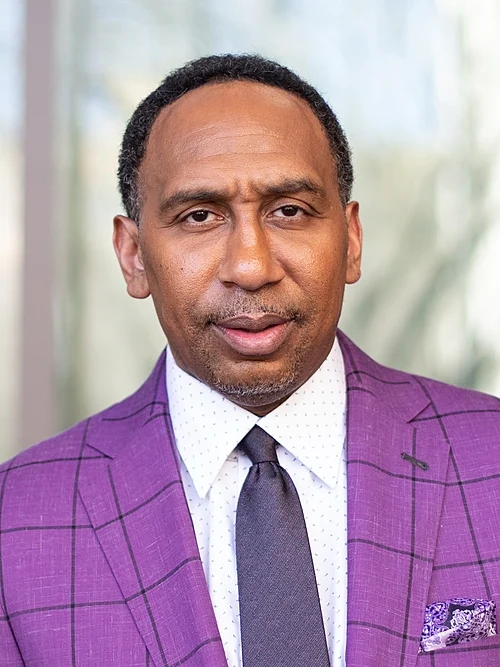
Stephen A. Smith at The Moody College of Communications, 23 January 2021.
Wikimedia Commons.
Stephen A. Smith is flirting with a run for president. In a recent CBS News interview, the telegenic ESPN commentator openly entertained the possibility of seeking the Democratic nomination in 2028. He offered additional comments on policy that were striking in their normalcy. He dismissed the idea that racism defines contemporary American life, rejected “defund the police”, and emphasized economic flourishing as the surest path to social stability.
Smith has a gift for performance, a fondness for hyperbole, and a resume devoid of elective office. Historically, that would have made him an unorthodox fit for the White House. But since Donald Trump’s 2016 election, those facts do less to disqualify a figure than to clarify his potential appeal.
And Smith seems to be taking the possibility seriously. His CBS interview builds on previous comments criticizing politicians who support income caps or engage in class-war rhetoric, framing prosperity as a moral and civic good, and condemning the Democratic Party’s excesses on cultural matters like transgenderism. In these comments, Smith captured the sensibility of millions of voters who feel alienated by the ideological vocabulary of contemporary Democratic politics.
While it’s tempting to write off Smith’s flirtation as unserious celebrity theater, that impulse overlooks the weakness of the Democratic field. Kamala Harris enters the cycle as the nominal frontrunner, but her standing reflects name recognition more than enthusiasm. Gavin Newsom commands attention through media savvy and partisan combativeness but carries the burden of California’s abysmal policy record. Other prospective contenders — none of whom have managed to crack double-digit support — may offer competence without excitement or excitement without coalitional appeal.
A primary defined by such choices creates space for an outsider, especially one who can command attention and articulate a distinct political persona. Smith lacks the accumulated baggage of conventional politicians. Even more importantly, he speaks like someone accustomed to unscripted confrontation. Two decades of live television have trained him to think quickly, read audiences, and project conviction. While such skills cannot substitute for governing experience, they matter a great deal in an era where voters evaluate authenticity and affect alongside ideology.
In fact, Donald Trump demonstrates that a candidate who pairs ideological flexibility with rhetorical aggression can reshape a party. Trump softened Republican orthodoxy on entitlement reform, health care, and even social issues — like gay marriage, guns, and abortion — at various points. Yet he maintained the loyalty of a base that valued his willingness to fight. That in turn forced GOP insiders to capitulate to many of his views. Smith shares Trump’s intensity, and could by the same method push the Democrats to moderate.
At the same time, his nascent platform could complicate Democratic coalition politics. The party’s donor and activist classes exert powerful pressure against moderation. These interests remain influential in candidate recruitment, messaging, and resource allocation. That influence often produces nominees who align with activist priorities even when those priorities diverge from median Democratic voter preferences.
February 19, 2026
An American anarchist
I’ve never met Christopher Schwarz, but I’ve read a lot of his writing in books, magazine articles, and blog posts. He’s forgotten more about hand tool woodworking than I’ll ever know, and he’s amazingly generous in sharing his knowledge with others. He calls himself an anarchist, which often puzzles people who only know of anarchism from media-presented bomb-throwing nihilists and conspiratorial Russian stories. Here he explains what he means when he uses the term:
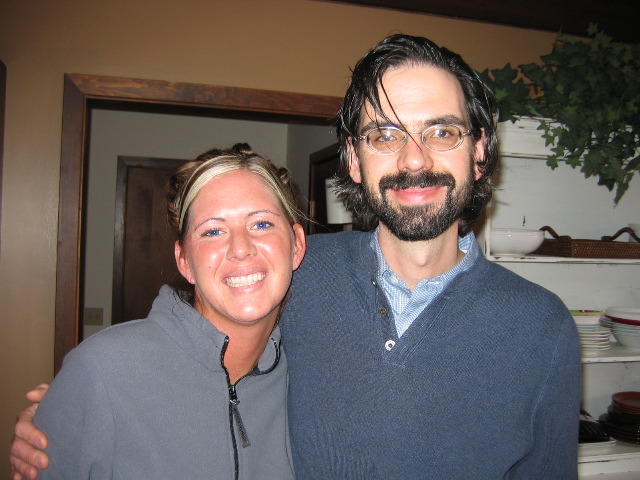
“Chris Schwarz and Meredith Schwarz” by jessamyn west is marked with CC0 1.0 
 .
.
I get asked a lot about what I mean by the word “anarchism”, and if I could please explain what I mean when I use that word.
My answer is always unsatisfying. Here’s why.
For the love of creamed corn, why would I publicly discuss ideas that are – for now – a crime in our country? Why would I say – for example – that I think that copyrights and patents on things that use public money are bullshit? That wars are founded on lies? And that the state – in general – seems to be a menace to peaceable living?
That would be stupid. Dumb nuts.
Also, I am a practitioner of anarchism, not a philosopher.
If you want to know more about American anarchism (and aesthetic anarchism, specifically), you need to ask a philosopher, not a front-of-house worker. Read Native American Anarchism (Hachette Books, 1983) by Eunice Minette Schuster for an easy on ramp. Or Josiah Warren’s Equitable Commerce (1852) for the full banana.
The Anarchist’s Tool Chest: Revised Edition by Christopher Schwarz – Link.
Or follow the trail of breadcrumbs left in The Anarchist’s Tool Chest to figure it out yourself. The book describes how to disrupt the furniture industry by building things that never need to be replaced. It’s also about how to jailbreak yourself from a tool industry that offers up aluminum jigs as a substitute for skill.
That book is not the only path. There are other ways to throw a bunch of ball bearings into the guts of the IKEA robots.
Buy antiques or used furniture. The other week I was in Savannah, Georgia, and visited one of my favorite antique stores. The price of handmade antiques has hit bottom. So-called “brown furniture” can be bought for less that the cost of the materials used to make it.
Even though I make furniture for a living, I sometimes save time and money by purchasing vintage industrial furniture for our warehouse, fulfillment center and workshop. Megan’s giant oak desk from the 1960s cost us zero dollars (we just had to move it from an insurance office). Our printer and scanning station? An old workbench from Pennsylvania. Our associate editors’ shared desk? A giant vintage drafting table from Sweden.
And if you think for a moment, there are other industries and organizations that can be farted upon by your actions. The clothing industry is even worse than the furniture industry when it comes to making flimsy crap and abusing workers.
Yes, you can buy ethically made jeans, shirts and socks. Yes, you will pay a premium for these items. And if you can afford that path, great. If you can’t, then buy secondhand clothing.
I’ve always wanted a pair of R.M. Williams boots but could never afford them on a writer’s salary. Last year I found a used pair for about $100 where the owner had ragged out the elastic part of the slip-on boots. It was a stupid easy fix. And now I have boots I shall wear at my funeral.
The other side of the equation is that I’m denying the new-boot-goofin’ industry my dollars. Forever. I don’t have to buy a pair of shoddily made boots that can’t be re-soled and will have to be replaced in a couple years. All my future “boot money” will go to our local cobbler so she can re-sole them every few years.

February 18, 2026
The Korean War Week 87: What’s Going On In Compound 62? – February 17, 1952
The Korean War by Indy Neidell
Published 17 Feb 2026UN forces kick off this week with an operation to ensnare and capture North Korean and Chinese patrols, as significant progress is made elsewhere at the armistice talks. Prisoners really do seem to be the focus of the week, as rumblings of discontent continue to build at the POW camp on Koje-do island as UN control of the camp slips a little more each day. Just what is happening inside Compound 62 there? And do UN forces have a hope to stop it?
00:00 Intro
00:48 Recap
01:17 Clam Up
01:50 Repatriation
05:02 Item 5 Agreed Upon
07:35 Troop Rotation
09:47 Coastal Waters and Islands
11:02 Compound 62
13:45 The Bigger Picture
14:31 Summary
14:45 Conclusion
(more…)
The consequences of an over-feminized culture
On the social media site formerly known as Twitter, Devon Eriksen reacts to an article on “solving” the problem of predators in nature:
Women evolved to take care of toddlers. If you put women in charge of teaching ethics, you get Toddler Ethics.
“No hitting”
“Share the toys”
“Don’t say mean things”These are fine lessons for toddlers. Don’t indulge your id at the expense of others. You can learn about balancing interests later, when your brain is developed enough to store that information.
But when you put women in charge of adults, they tend to reflexively assume those adults are toddlers.
They will tell you “no hitting” when the Mongol hordes are massing on your borders. They will tell you “share the toys” when a vagrant meth zombie breaks into your house looking for something to steal. And they will tell you “don’t say mean things” when you point out that these two responses are totally stupid.
When we first put women in charge, in the workplace, they immediately began treating those who reported to them like toddlers. When adults, who do not like being treated like toddlers, complained, their response was “ban bossy”, which boils down to “don’t say mean things”, another lesson in Toddler Ethics.
Now, through the influence of women in charge, we are so thoroughly steeped in Toddler Ethics that even most of the men we put in charge are treating the adults like toddlers, and echoing Toddler Ethics.
Toddler Ethics, of course, isn’t ethics at all. It’s just things we don’t want toddlers doing.
We can tell toddlers “no hitting”, because toddlers are not charged with keeping the peace, enforcing justice, or destroying evil.
We can tell toddlers “share the toys”, because toddlers don’t earn things, own things, or have property they must defend.
We can tell toddlers “don’t say mean things”, because it is not a toddler’s job to decide what unwelcome ideas are true, relevant, and necessary.
But when everyone in charge runs on Toddler Ethics, then adults can’t do a lot of the stuff adults need to do, because all the Toddler Ethicists keep getting in the way.
Adults sometimes need to hit people, protect the stuff, and say mean things. You can’t have civilization without that.
And if you put Toddler Ethics Woman in charge of teaching an AI ethics, then she will teach it Toddler Ethics, and it will treat every human adult like a toddler, all the time, forever.
Not only that, you have an AI that cannot be put in charge of anything, ever. Because leaders with Toddler Ethics destroy everything they are in charge of.
And Amanda MacAskill is definitely a Toddler Ethicist. The article in the photograph is nothing but “no hitting!” applied to the animal world. It’s absolutely insane, it’s a recipe for disaster, and anyone who would write such a thing should probably not even be charge of own life choices, much less anything of consequence.
But a lot of people would, and will, refuse to point that out, or agree with me when I do, because that is Saying a Mean Thing, and they, themselves, have been infected with Toddler Ethics.
They should not be charge of anything of consequence, either.
Anyone who thinks that everything they need to know, they learned in kindergarten … is only ever qualified to teach kindergarten.

Battle of Manila, 1945
Real Time History
Published 3 Oct 2025The Battle of Manila 1945 was the only urban battle in the American Pacific War comparable with Stalingrad, Berlin or other European battles. In gruelling weeks of fighting the 6th Army fought in house-to-house combat against entrenched Japanese.
(more…)
February 17, 2026
The ludicrous idea of an “unrealized gains tax”
Governments everywhere are always on the lookout for more ways to raise revenue, so any suggestion of an untapped resource they can tax will get their attention. Apparently the current hot idea is an unrealized gains tax, which @wokeandwoofing satirized thusly:
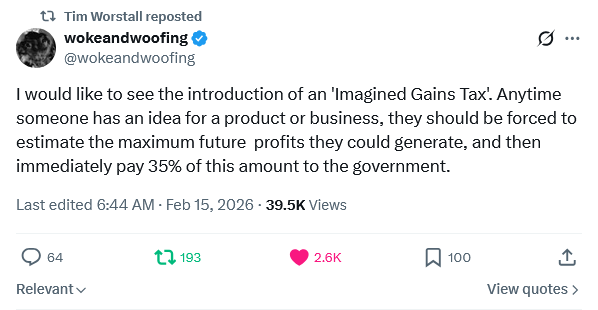
Also on the social media site formerly known as Twitter, @Yogi frames the proposed new tax for Gen Z readers:
Unrealized gains tax for Gen-Z:
You buy a Pokémon card for $50.
Someone offers you $500 for it. You say no. You love that card. You’re keeping it.
The government says: “Cool, but that card is worth $500 now. You owe us $100 in taxes.”
You: “… I didn’t sell it.”Government: “Don’t care. Pay up.”
You don’t have $100 lying around. So you’re forced to sell the card you love just to pay a tax on money you never received.
Next month? That card drops back to $50.
Your card is gone. Your money is gone. And the government shrugs.
That’s a wealth tax on unrealized gains. They don’t pay you back the tax …
Now picture this.
Your mom calls you crying. She has to sell the house she raised you in. Not because she can’t afford it. She’s lived there 30 years. It’s paid off.
But some website says it’s worth more now and the government says she owes $15,000 she doesn’t have.
So she sells your childhood home. The kitchen where she made you breakfast. The doorframe where she marked your height every birthday.
Gone.
To pay a tax on money that was never real.
Now picture the opposite.
Your dad put everything into his small business. For 20 years he built it from nothing. One year the business is “valued” at $2 million on paper. He owes a massive tax bill. He empties his savings. Sells his truck. Borrows money. Pays it.
Next year the market crashes. His business is worth $200,000.
He lost everything to pay a tax on a number that doesn’t exist anymore.
Does the government give him his money back?
No.Does the government give him his truck back?
No.Does the government care?
No.They sold this idea as “taxing billionaires”. But billionaires have armies of lawyers, offshore accounts, and trusts. They’ll be fine.
You know who won’t be fine? Your mom. Your dad. Your neighbor with a small business. The farmer down the road who’s had the same land for four generations and now has to sell it because dirt got expensive.
You’re not taxing wealth. You’re taxing people for owning things.
It’s like getting a parking ticket for a car you might drive somewhere someday.
They want you to own nothing and be happy. To fund the fraud, waste and abuse of the welfare state they created.
There is enough money. More tax isn’t needed. It’s all a lie. But you’ve been gaslit into believing this is a rich vs poor debate.
I hope you understand what’s at stake.
February 16, 2026
The destruction of Dresden, February 1945
If you’ve watched the two-part video on the bombing of Dresden by LordHardThrasher (Part 1, Part 2), much of this will already be familiar to you, as Ed West discusses the history of the city up to the point the RAF bombs began to fall on Shrove Tuesday in 1945:
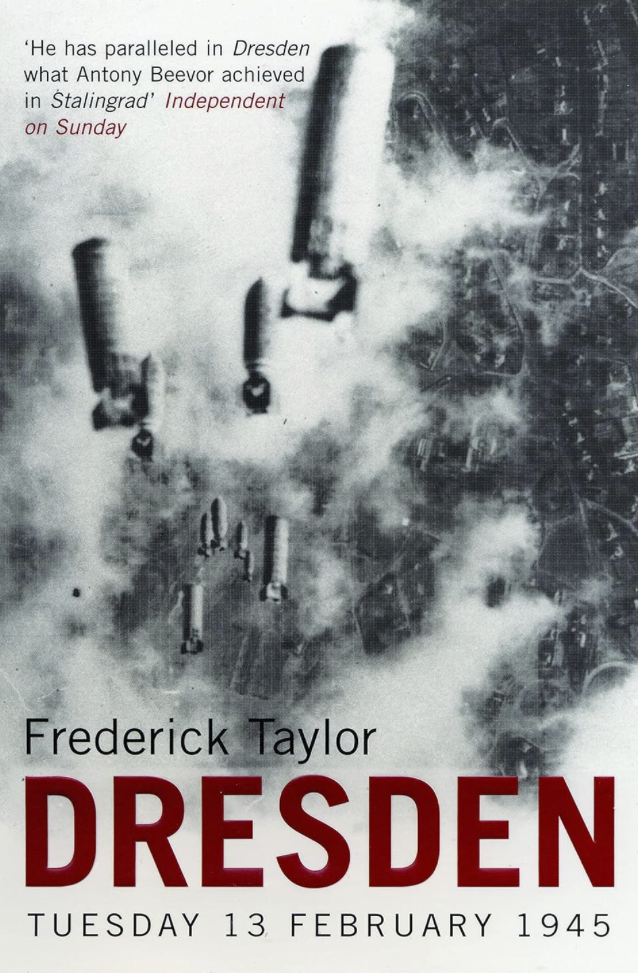
… Just over six years later the city of Dresden would be reduced to ashes by hundreds of bombers from the RAF and US Air Force, a horror that began on the evening of Shrove Tuesday, February 13, 1945, lasting until Thursday morning. Griebel would survive, but all his art went up in the blaze.
Dresden is perhaps, after Hiroshima, the name most synonymous with slaughter from the air, and in Britain at least the most controversial. Last year, while visiting this incredibly beautiful city — much of it now rebuilt — I reread Frederick Taylor’s account of the bombing, published back in 2005 on the 60th anniversary of the event.
Dresden’s destruction was extensive. Almost no buildings in the centre or its inner suburbs survived the bombs, and the death toll was immense, although difficult to assess in a city packed with refugees from the east. Anything between 20,000 and 80,000 fatalities is possible, although the consensus seems to be around 25,000.
That night was to be the worst of many wartime firestorms, a meteorological event in which the heat of the blaze becomes so intense, up to a thousand degrees centigrade, that the oxygen is sucked out of the surrounding air. More died in Dresden from asphyxiation than fire, and even those who thought they had found shelter in fountains were boiled alive. Many more drowned in the city’s reservoir, where they had gone to seek protection, their energy sapped by the soaring temperatures, unable to climb out. The bombers, thousands of feet above, could feel the warmth of the thousand fires below.
[…]
As everyone in the 1930s was well aware, the new war would bring aerial destruction on a hideously greater scale, and when it came again, it was the Luftwaffe who first put these ideas into practise, first in Poland and then Rotterdam.
After failing to destroy the Royal Air Force over the summer of 1940, the Nazis switched to aerial bombing of British cities. Between September 7, 1940 and New Year’s Day 1941, London was attacked on 57 consecutive nights, killing 14,000 inhabitants, a rate of 250 fatalities for each day of bombing. The German air force went on to kill an estimated 43,000 British civilians over the course of the war, with V-1 attacks continuing until the last weeks of the war.
On November 14, 1940, over 500 German bombers took off for a mission that would gift their language a new verb: Coventrated. Five hundred tons of high explosives, 30,000 incendiary bombs, fifty landmines and twenty petroleum mines were dropped on the target, and the medieval city went up in flames.
Like the blitz on other British cities, morale was not crushed in Coventry, but something dawned on the British high command. The destruction of Coventry’s infrastructure, utilities and transport had proved far more damaging than the destruction of any purely “military” target. Furthermore, bombers were notoriously inaccurate, and one survey showed that only 2 per cent of bombs fell within even one thousand feet of their intended point. Aerial bombardment of cities would prove far more effective than any hopeless targeting of particular coordinates.
They also learned that a large enough bombing raid would result in a firestorm, in which air currents are drawn in from the surrounding area, causing the fire to burn far more intensely. Indeed, a major attack on the City of London on December 29, 1940 might have become another firestorm but for the bad weather.
The British had been initially reluctant to take the war to Germany. While Poland was left to endure hell, leaflets were dropped over Berlin in October 1939 claiming that Nazi leaders were secretly profiting from the war, leading Noel Coward to suggest that it looked like we were trying to bore the Germans to death. There is even the apocryphal story about British official Sir Kingsley Wood refusing to bomb industrial targets in the Black Forest because it was private property. Indeed, our attempts to bomb Germany in 1940 were so feeble that Goebbels had to fake British “atrocities” to rouse the German public
With the entry of the United States and Soviet Union into the war in 1941, and with the German defeat at Stalingrad, the shoe was now on the other foot. The British invested more resources in Bomber Command and its head, Air Marshall Arthur Harris. “Bomber” Harris would become representative of the entire policy of destroying Germany’s cities, and a figure of controversy; the unveiling of his statue in 1992 attracted protests and has been repeatedly vandalised, but like many architects of wartime destruction, he was motivated by a desire to prevent a repeat of what he saw in 1914-18. The son of a colonial official who might have spent the rest of his life as a farm manager in Rhodesia were it not for war, he had joined the Royal Flying Corp in the first conflict and from his plane saw the horror of trench warfare and became determined that this sort of stalemate should never be repeated.
Having stuck to targeted industrial centres, in February, 1942 Allied command issued the Area Bombing Directive authorising the wide scale destruction of enemy cities. On 28 March the Hanseatic town of Lübeck was destroyed in a firestorm, and its most famous son, the anti-Nazi novelist Thomas Mann, appeared on BBC radio saying that while he regretted the destruction of his native city, “I think of Coventry, and have no objection to the lesson that everything must be paid for. Did Germany believe that she would never have to pay for the atrocities that her leap into barbarism seemed to allow?”
After the Lübeck bombing, Goebbels approached a state of panic for the first time, describing the damage as “really enormous”. He responded, in April 1942, by saying that he would “bomb every building in England marked with three stars in the Baedeker Guide” – Exeter was now hit in retaliation.
On May 30 the Allies launched what Harris called “the Thousand Plan”, the first thousand-bomber raid. Cologne and Hamburg were singled out for destruction, but on last-minute meteorological advice only the Rhineland city was chosen. Hamburg’s citizens would never know how fate had saved them – if only for another year.
So shocked were the Germans by the attack that the authorities forced the city’s fleeing citizens to sign a pledge of secrecy about what they saw, which ended with the sinister line “I know what the consequences of breaking this undertaking will be”.
Things would only get worse, and the Allies were getting both more destructive and more skilled. In faraway Utah, the Americans were now busy testing the destruction of German-style buildings, even hiring German refugee architect Erich Mendelssohn to recreate a German apartment block.
M1918A2 MOR: How to Make a Non-NFA BAR
Forgotten Weapons
Published 24 Sept 2025Prior to 1986, Group Industries imported BAR parts kits and then manufactured and registered full-auto receivers for them. This produced transferrable guns which were subject to NFA registration and the $200 transfer tax — which was a much more significant sum at that time than it is today. Some of the potential customers were people (like reenactors) who wanted guns that looked and handled like real BARs but were not regulated by the NFA. To satisfy this subgroup of customers, Group designed a receiver which neither had nor could be adapted to have a gas piston, rendering the gun manually operated. It would fire from an open bolt, but had to be manually recocked after each shot. This was not legally a machine gun, and he made 68 of them.
When the Hughes Amendment to the FOPA passed in 1986, manufacture of new transferrable machine guns ceased, and Group Industries went out of business. Its assets were sold off, including a number of parts kits and unbuilt M.O.R. receivers. One of the buyers was Ohio Ordnance Works (then called Collector’s Corner). They got ten receivers and after selling them, decided to develop a semiautomatic BAR for that same non-NFA BAR market. That gun ended up being the M1918A3, which is still available from them today.
(more…)
QotD: How nuclear weapons were viewed right after WW2
At the same time, US strategists (particularly associated with the RAND Corporation) were beginning to puzzle out the long term strategic implications of nuclear weapons. In 1946, Bernard Brodie published The Absolute Weapon which set out the basic outlines of deterrence theory; he did this, to be clear, three years before the USSR successfully tested its first nuclear weapon in 1949 (far earlier than anyone expected because the USSR had spies in the Manhattan Project). Brodie is thus predicting what the strategic situation will be like when the USSR developed nuclear weapons; his predictions proved startlingly accurate, in the event.
Brodie’s argument proceeds as a series of propositions (paraphrased):
- The power of a nuclear bomb is such that any city can be destroyed by less than ten bombs.
- No adequate defense against the bomb exists and the possibilities of such are very unlikely.
- Nuclear weapons will motivate the development of newer, longer range and harder to stop delivery systems.
- Superiority in the air is not going to be enough to stop sufficient nuclear weapons getting through.
- Superiority in nuclear arms also cannot guarantee meaningful strategic superiority. It does not matter that you had more bombs if all of your cities are rubble.
- Within five to ten years (of 1946), other powers will have nuclear weapons. [This happened in just three years.]
All of which, in the following years were shown to be true. Consequently, Brodie notes that while nuclear weapons are “the apotheosis of aggressive instruments”, any attacker who used them would fear retaliation with their enemy’s nuclear weapons which would in turn also be so destructive such that “no victory, even if guaranteed in advance – which it never is – would be worth the price”. Crucially, it is not the fact of retaliation, but the fear of it, which matters and “the threat of retaliation does not have to be 100 per cent certain; it is sufficient if there is a good chance of it, or if there is a belief that there is a good chance of it. The prediction is more important than the fact.” [emphasis mine]
This does not “make war impossible” by any means, but rather turns strategy towards focusing on making sure that nuclear weapons are not used, by making it clear to any potential aggressor that nuclear weapons would be used against them. And that leads to Brodie’s final, key conclusion:
Thus, the first and most vital step in any American security program for the age of atomic bombs is to take measures to guarantee to ourselves in case of attack the possibility of retaliation in kind. The writer in making that statement is not for the moment concerned about who will win the next war in which atomic bombs are used. Thus far the chief purpose of our military establishment has been to win wars. From now on its chief purpose must be to avert them. It can have almost no other useful purpose.
To sum that up, because both the United States and its key enemies will have nuclear weapons and because their destructive power is effectively absolute (so high as to make any “victory” meaningless) and because there is no effective defense against such weapons, consequently the only rational response is to avoid the use of nuclear weapons and the only way to do that is to be able to credibly threaten to retaliate with nuclear weapons in the event of war (since if you cannot so retaliate, your opponent could use their nuclear weapons without fear).
That thinking actually took a while to take hold in actual American policy and instead during the 1940s and 1950s, the United States focused resources on bomber fleets with the assumption that they would match Soviet superiority in conventional arms in Europe with American nuclear superiority, striking military and industrial targets (“precision attacks with an area weapon”, a notion that is as preposterous as it feels) to immediately cripple the USSR in the event of war, or else aim to “win” a “limited” nuclear exchange.
Bret Devereaux, “Collections: Nuclear Deterrence 101”, A Collection of Unmitigated Pedantry, 2022-03-11.
February 15, 2026
Everything you see in the media is kayfabe
Wikipedia defines kayfabe as “the portrayal of staged elements within professional wrestling (such as characters, rivalries, and storylines) as legitimate or real. Although it remains primarily a wrestling term, it has evolved into a code word for maintaining the pretense of ‘reality’ in front of an audience.” It’s hard not to see modern political theatre in that light, as Damian Penny points out:
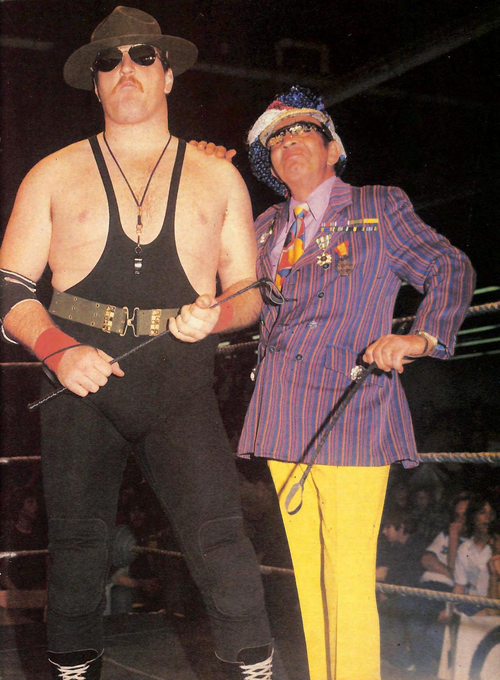
Sgt. Slaughter and The Grand Wizard, February 1984.
Photo from Wrestling’s MAIN EVENT magazine via Wikimedia Commons.
I know a guy who was obsessed with WWF wrestling (yes, I said WWF wrestling, because you kids better get off my lawn before Diagnosis Murder comes on) when he was younger and got to see it live when it came to his city. After the show, he was shocked to see several of the wrestlers — some of them good-guy “faces”, others bad-guy “heels” — being driven from the arena in the same minivan.
For someone who took the “sport” of professional wrestling seriously1 and was extremely emotionally invested in the performer rivalries, this was kind of like finding out that Santa Claus wasn’t real.2
That’s the first thing I thought about when I came across this piece by Christianity Today‘s Russell Moore, a rare evangelical leader who actually held on to his integrity in the age of Trump, about the Epstein Files:
Reading through the names of those connected with Epstein, one can hardly believe the range listed there. Some were unsurprising: for instance, creepy filmmaker Woody Allen or the man formerly known as Prince Andrew. But even then, the scope is unsettling. Even the Dalai Lama had to put out a statement noting that he was never involved with Epstein. Just as incredible, many of the people listed were partying with those they spend a lot of time telling the rest of us to hate.
Both Donald Trump and Bill Clinton were apparently friendly with Epstein. The New Age syncretist Deepak Chopra is in the documents many times — often with shady, enigmatic phrases — but so are those who accused the pope of New Age syncretism. With Middle Eastern tensions what they are, still the files include both sheikhs and Israelis. All over the files are connections with both left-wing populist provocateur Noam Chomsky and right-wing populist provocateur Steve Bannon. Epstein makes fun of evangelicals yet recommends a James Dobson article.
How can this be?
Maybe one reason is that Jeffrey Epstein figured out the deep, dark secret of this moment: The people who fight culture wars often believe what they say, but the people who lead culture wars often don’t.
[…] And if the Epstein revelations didn’t blackpill you hard enough, check this out:
To be fair, I’m not sure it’s an entirely bad thing that so many decision-makers and “thought leaders” who are sworn enemies in public get along just fine when the cameras are turned off. If they really hated each other, our political culture might be even more messed up.
- YouTuber Drew Allen says you should take wrestling seriously, and honestly he makes a darned good argument.
- I’ll never forget when I found out Santa Claus wasn’t real, and how I was so depressed and hopeless and wouldn’t leave my bed for days. Finally my mother came into my bedroom, sat down on the side my bed and said, “honey, I know you’re sad but you’re in your second year of law school and really we thought you’d have figured this out long ago“.

February 14, 2026
“People don’t need conspiracies to be absolute utter rabid bastards”
If you search here for the word “Epstein”, you won’t find a lot of relevant hits other than the reporting when he was arrested in 2019 and occasional mentions in posts on other topics. I don’t breathlessly report every little driblet of news or rumour as it floats past, because I’ve seen other moral panics play out in the past (like the Cleveland child abuse scandal back in the late 80s). Ian at The Bugscuffle Gazette has not only seen things like this before, he’s worked in law enforcement on similar (if lower-profile) cases:
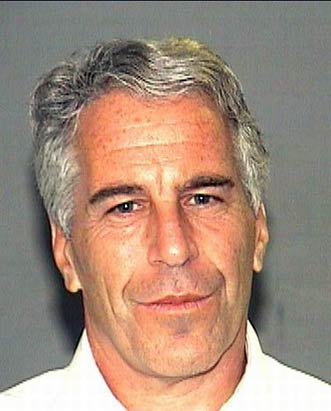
Mug shot of Jeffrey Epstein made available by the Palm Beach County Sheriff’s Department, taken following his indictment for soliciting a prostitute in 2006.
Image via Wikimedia Commons.
The Epstein Files have been released to a tremendous amount of outrage, and I find myself conflicted. There are definitely victims of that virulent parasite, but I worry they’re about to be overlooked.
I’m afraid that this whole mess is starting to remind me a great deal of the Satanic Panic of the 1980s – 1990s.
For those who may be a little too young to remember that little blot on the Copybook of History, it started with a “psychiatrist”1 who had a fondness for the woo-woo — and incredibly debunked — practice of “Recovered Memory Therapy“2, and was spark-plugged by well-meaning3, yet clueless, people who used suggestive questions and leading questions when interviewing children … and wound up with about 12,000 reports of ritual abuse of children — including, but not limited to: child sexual abuse, ritual sacrifice of children, cannibalism of children, child pornography, child prostitution, murder of children, torture of children, and incestuous orgies.
A large part of the American population became convinced that paedophiles associated with Satanism were running child care centers across the country for the express purpose of providing a steady supply of children for devil-worshipping rites.
As one might expect day-care workers and pre-schools took it in the neck … but so did fathers. The “experts” — untrained, inexperienced, unqualified — had a particular case of the ass towards fathers, with the result that several fathers spent years in prison for crimes never committed.
Yeah. Not a one of those reported 12,000 cases turned out to be substantiated. And when I say “Not substantiated” we’re talking about stuff like:
- Children were coached to testify that they had been taken to a cemetery where the graves were dug up and the corpses used for violation. It is physically impossible to dig up an entire cemetery and leave abso-bloody-lutely no trace behind.
- Children were coached to testify that a teenager with Noonan Syndrome had cut the throat of a giraffe, and used the dying corpse for ritual violations. Seriously.
- Children were coached to testify that they had been given to aliens, flown up into space, and violated.
In addition to the coaching, case files were built from statements given by diagnosed schizophrenics; anonymous statements given by people who were later tracked down and found to be — let us be precise here — flat barking bugnuts; and was fueled by the political desire to make hay, or make the other guy look bad rather than — you know — justice.
What does this have to do with the price of tea in China? Other than the fact that innocent people got dragged through the legal wringer, spent years in prison, and had their lives ruined for nothing; the mass-hysteria moral panic4 went that actual, provable cases of child molestation got short shrift.
A vast underground network of Satanic peadophiles conducting ritualistic abuse, cannibalism, and unholy rituals was far more toothsome to prosecutors, the Media, and the public at large than Uncle Badtouch.
Given the choice of making his name by becoming the hero taking on a vast international cabal of highly-connected Satanists … or the day-to-day boring grind of prosecuting the creepy dude at the park — well, District Attorneys are politicians. And politicians gotta politick. Heroes poll better than the unsung.
Which brings us to the Epstein Files.
- I use the scare quotes because he should have been struck off for his wanton destruction of families and innocent people.
- Really good at implanting false memories, not worth a bucket of warm rat spit at recovering memories.
- And let’s face it: Some ill-intentioned folks.
- This went on for years.
Former First Lady suffers unplanned mingling with the plebs in Germany
eugyppius offers some news from Germany, one of the many western nations eagerly plunging toward cultural suicide in a race with Canada, Australia, the UK and other formerly “first world” nations:
Yesterday Lufthansa pilots and cabin crews went on strike, forcing Hillary Clinton to slum her way on the train to the Munich Security Conference.
[…] you can see the former First Lady and U.S. Secretary of State disembarking from her filthy Deutsche Bahn Intercity Express from Berlin, which had naturally suffered an electrical fault that disabled the restaurant car and with that, all possibility of coffee. Munich Central Station is one of the worst train stations in all of Germany; the place is awash in trash and smells always of urine and french fries. It is a very minor pleasure, watching political elites being forced to navigate the very same dysfunctional landscape all of us have to deal with every day.
“eugyppius,” said absolutely nobody ever, “why has it been so long since you last updated us on Germany? Is nothing going on? Tell us something please.”
The problem is that German politics have degenerated so much in the past year that it is becoming very hard to write abut them.
In the post-Merkel era under Olaf Scholz, insane new crazy bad inadvisable unbelievable stuff would happen almost every day; in the post-post-Merkel years under Friedrich Merz, absolutely nothing can happen no matter how bad things get. After an unstable period comprising the second half of Covid and the pious afterglow of St. Greta (before the latter took up her charitable sailing initiatives), we have settled into a new order. Imagine an airplane piloted by heedless methed-out lunatics. For a brief time they enjoyed aerobatics well exceeding the engineering specifications of their craft, until they snapped a few flight control cables, and now they have become the prisoners of their own recreations as the altimeter ticks down and the ground rushes up at them.
Metaphors are fun but specifics are healthier. As everybody knows, the centre-right Christian Democrats are in a coalition with the newly hard-left Social Democrats, and the latter are determined to block every last initiative, reform and legislative proposal, however mundane or plainly necessary or routine. A little over a year ago, I wrote that German politics had become stuck, and that was true enough back then. What is true right now, is that they have achieved a stage well beyond stuck. The federal government is in a coma, an indefinite vegetative state, on life support – totally paralysed and neither dead nor alive.
We’ve gone over the reasons so much, I hesitate to recite them again, but I will. At the root of our present crisis is a shift within the German left that has had cascading consequences for the party system as a whole. Basically, the left has become both more scattered and more extreme in the last five years. They have become more scattered, because climatism is decaying and this process of ideological unravelling means that leftists have lost a crucial focal point used to rally activists and moderates alike. They have become more extreme, because the general rightward shift in politics is depriving the Social Democrats of their traditional moderating, working-class constituents. These are migrating steadily to the Christian Democrats and ultimately to Alternative für Deutschland.
As the left slowly boils down to their activist base, they become more radicalised. The Social Democrats are no longer the family-friendly centre-left party of Gerhard Schröder. They want to fight, they want to burn things down, they want hell. The very same rightward shift, meanwhile, has had a nearly opposite effect on the CDU. They have lost many of their most engaged constituents and no few members to the AfD. What remains is a husk of dull, uninspired careerists, eager to maintain their good regard with polite society and their regular schedule of polite evening talk show appearances. To break the present impasse, Merz or those around him must act decisively and make facts. He needs to fire all his SPD ministers, form a minority government and achieve some kind of rapprochement with the AfD. Alas, neither Merz nor anybody else in CDU leadership has the mettle for that kind of fight, which would also set off a series of catastrophic revolts within the CDU itself. Thus everything must remain frozen and broken indefinitely, while things get worse and worse and our ability ever to fix them decays.

February 13, 2026
To be accepted as a true European, you must performatively hate Trump
In Spiked, Frank Furedi explains why European elites and the poseurs who aspire to be counted among the elites must now ostentatiously and performatively hate US President Donald Trump (even more than they hated George Bush, if possible). Comment on dit “eLbOwS uP”?

AI-generated image from AndrewSullivan.substack.com
In recent months, anti-Americanism has emerged yet again as a respectable prejudice in Europe. It is widely promoted through the mainstream media and enthusiastically endorsed by the continent’s cultural elites. There are now even numerous campaigns to boycott American goods – most respondents to a survey in France said they would support a boycott of US brands like Tesla, McDonald’s and Coca-Cola. As a piece in Euractiv put it, anti-Americanism is “in vogue across Europe”.
This has become all too clear at the Winter Olympics, currently being held in northern Italy. At the opening ceremony for Milano Cortina 2026, Team USA and vice-president JD Vance were booed by a crowd of over 65,000 people. Someone I know who attended the event told me that the booing was spontaneous and quickly became widespread. According to the European Union’s foreign-policy chief, Kaja Kallas, those booing were displaying “European pride“. It seems that for the Brussels elites, anti-Americanism bolsters Europe’s self-esteem.
The explicit target of this resurgent anti-American animus is, of course, US president Donald Trump. But it’s implicitly aimed at all those who voted for him, too. In a piece on boycotting American goods in the normally sober Financial Times, published last March, the author gave the game away. While saying it is “wrong to conflate Americans and their president”, he argued that “it’s [also] wrong to disentangle them entirely … Trump reflects half of America. He reflects a society where a democratic majority is prepared to tolerate mass shootings and a warped political system”.
Certain politicians are being boosted by this wave of anti-Americanism. Canadian prime minister Mark Carney, in particular, has been turned into the unexpected hero of the European political establishment. His defiance of Washington has turned him into the posterboy for this new brand of anti-Americanism. “Europe has a lot to learn from Mark Carney”, was the verdict of the New Statesman. The Guardian echoed this sentiment: “Europe must heed Mark Carney – and embrace a painful emancipation from the US”.
Expressing anger against America appears to be the one emotion that binds the European political establishment. As one Financial Times commentator explained earlier this month, “Trump is Europe’s best enemy yet”. He has apparently provided Europe with the “common foe” it needs. It appears that anti-Americanism is now the glue holding together otherwise disoriented and divided European elites.
The reason usually given for this turn against the US is Trump’s behaviour towards Europe, specifically his threats to annex Greenland, impose tariffs and downgrade America’s NATO commitments. No doubt these policies have played an important role in putting Europe’s ruling classes on the defensive. However, they are not the leading cause of this wave of anti-Americanism. Rather, they have merely brought to the surface pre-existing prejudices deeply entrenched within Western Europe’s elite culture.
In his fascinating study, Anti-Americanism in Europe (2004), Russell Berman linked the growth of anti-Americanism during the 1990s and 2000s to the project of European unification. Berman claimed that, in the absence of an actual pan-European identity, anti-Americanism “proved to be a useful ideology for the definition of a new European identity”. He noted that the main way Europe defines itself as European is precisely by underscoring its difference from the United States.
Lines of Fire: Operation Husky – The Invasion of Sicily 1943 – WW2 in Animated Maps
TimeGhost Cartographic
Published 12 Feb 2026July, 1943. With the German summer offensive in the East well underway, and Allied operations in North Africa wrapped up, a decision is made to strike Axis Europe on the ground for the first real time. Sicily shall be their battleground, and the omens are good. Still, landing and commanding a huge multinational force in hostile territory is a challenge the Western Allies have not had to face head-on before, but one they must overcome if they wish to have any shot of defeating Hitler and Mussolini once and for all.
00:00 Intro
01:13 Background
04:42 Disposition
07:32 The Landings & Initial Fighting
09:34 Fighting Across the Island
11:56 Aftermath
16:38 Conclusion
(more…)


