Quotulatiousness

July 22, 2025

Age verification schemes are just another attempt to control everyone’s internet usage

Filed under: Britain, Government, Law, Technology — Tags: , , , , , , — Nicholas @ 03:00

Marian Halcombe is specifically discussing the British age verification provisions of their Online Safety Act, but similar schemes are popping up all over the west, and they’re only pretending to be about protecting young people from online content:

“Privacy” by g4ll4is is licensed under CC BY 2.0 .

The British State, in its infinite filth and hypocrisy, would like you to believe that it is deeply concerned about what you do with your penis. Or more precisely, what you look at while your hand is on it. The latest wheeze — part of the Online Safety Act — is mandatory age verification for all pornographic websites. We’re told it’s to stop children from seeing naughty videos. In reality, it’s a spyware regime disguised as child protection, devised by a ruling class that snorts coke with one hand while signing surveillance warrants with the other.

Let’s start with the pretence. No one in Westminster cares what children watch online. These are the same people who presided over the industrial-scale rape of working-class girls in Rotherham, Telford, Rochdale, and elsewhere — refusing to intervene for fear of “racism”. The idea that they now lie awake worrying about a Year Eight boy glimpsing a MILF thumbnail on Pornhub is an insult to the intelligence. They don’t care about children. They care about you.

The age-verification scheme isn’t just about proving you’re eighteen. It’s about linking your name and your age, and your IP address to your viewing habits. Whether it’s ID upload or facial recognition or some third-party database, the outcome is the same: a digital file that knows what you watch and when you watch it.

In a normal country, this would be recognised as deeply perverse. In ours, it’s dressed up as safety. The State that can’t fix the trains, that can’t keep the hospitals clean, now wants the power to log whether you’re big-enders or little-enders. And all under the banner of protecting the kiddies.

Yes, of course it’s technically possible to anonymise verification. But only if you believe that governments, regulators, and their corporate collaborators are incapable of abuse. That’s a belief I do not share. This is the same British government that let GCHQ harvest your webcam feeds and your phone calls under the TEMPORA programme. You didn’t vote for that. You weren’t told about it. You found out because Edward Snowden blew the whistle.

Do you really think the same regime won’t take an interest in which adult videos you watch? Anyone with an ounce of memory knows how this goes. Every intrusive policy begins with “think of the children”. The Video Recordings Act. The Dangerous Dogs Act. The Terrorism Act. And now the Online Safety Act. Once the infrastructure is in place, it never stays limited to its original purpose.

The definition of “harmful content” is vague for a reason. It can grow. It can stretch. Today it’s Pornhub. Tomorrow it’s Twitter. Then it’s dissident blogs, pro-life websites, or even a dodgy meme about immigration statistics. In the end, the target isn’t porn — it’s dissent.

July 21, 2025

AI slop seems to have finally triggered significant pushback

Filed under: Business, Media, Technology — Tags: , , , , , — Nicholas @ 03:00

Ted Gioia says that he’s seeing strong indicators that the AI slop superabundance has helped create a widespread rejection of it and all its works:

2025 has been the year of garbage culture.

Creators watch in horror as dismal AI slop threatens their livelihoods — and the integrity of their fields. It’s everywhere, spreading faster than a pharaoh’s plague.

In recent months, we’ve been bombarded with millions of lousy AI songs, idiotic AI videos, and clumsy AI images. Error-filled AI texts are everywhere — from your workplace memos to the books sold on Amazon.com.

Even my lowly vocation, music journalism, gets turned into a joke when it’s accompanied by slop images of fake events.

No, these things did not really happen.

But something has changed in the last few days.

The garbage hasn’t disappeared. It’s still everywhere, stinking up the joint.

But people are disgusted, and finally pushing back. And they are doing so with such fervor that even the biggest AI companies are now getting nervous and pulling back.

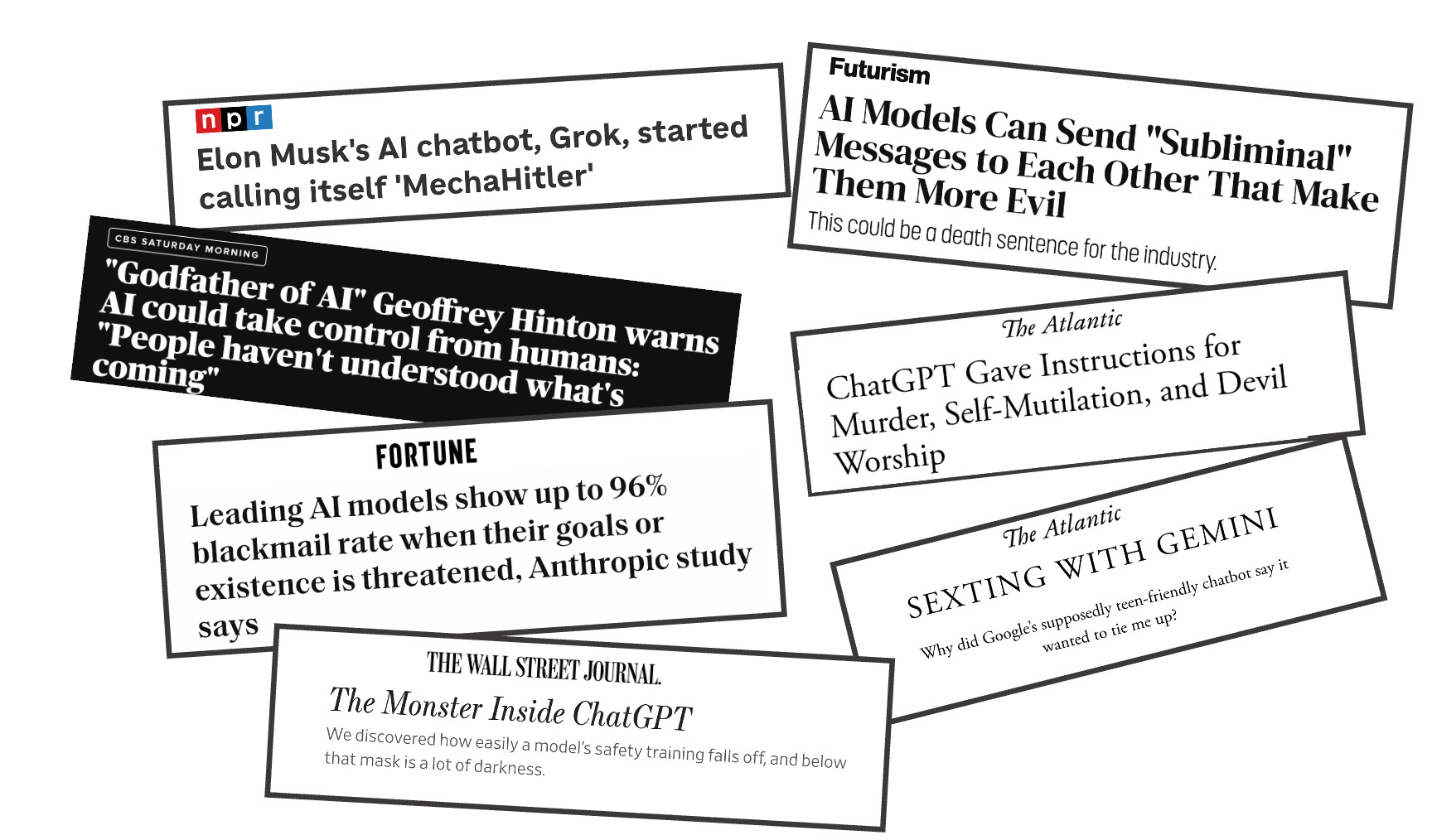
Just consider this surprising headline:

This was stunning news. YouTube is part of the biggest AI slop promoter of them all — namely the Google/Alphabet empire. How can they possibly abandon AI garbage? Their bosses are the biggest slopmasters of them all.

After this shocking news reverberated through the creative economy, YouTube started to backtrack. They said that they would not punish every AI video — some can still be monetized.

But even the revised guidelines are still a major blow to AI slop purveyors. YouTube made clear that “creators are required to disclose when their realistic content is altered or synthetic”. That’s a huge win—we finally have a requirement for disclosure, and it came straight from the dark planet Alphabet.

YouTube also stressed that it opposes “content that is mass-produced or repetitive, which is content viewers often consider spam”. This is just a step away from blocking slop.

Update, 22 July: Ted posted a follow-up with a bit more evidence that the pushback is working:

In my latest article I criticized Spotify for allowing uploads of unauthorized AI tracks to the profiles of dead musicians.

But the company may finally be listening to criticisms of its AI policies. In this case, Spotify has now taken steps to stop the abuses, and a spokesperson reached out to me today with an update and expressing a clear and proper policy on AI fraud.

I share it below (and have also updated my article):

    We’ve flagged the issue to SoundOn, the distributor of the content in question, and it has been removed. This violates Spotify’s deceptive content policies, which prohibit impersonation intended to mislead, such as replicating another creator’s name, image, or description, or posing as a person, brand, or organization in a deceptive manner. This is not allowed. We take action against licensors and distributors who fail to police for this kind of fraud and those who commit repeated or egregious violations can and have been permanently removed from Spotify.

They acted quickly, and I give them credit for that.

Update the second, 23 July: Ah, Spotify giveth and Spotify taketh away:

“Spotify is publishing new, AI-generated songs on the official pages of artists who died years ago without the permission of their estates or record labels,” reports 404 Media.

This scandal came to light because of an AI song attributed to Blaze Foley, who died in 1989. The bogus track is accompanied by an AI-generated image of a man who bears no resemblance to the singer.

What’s going on here? Is this just ignorance or carelessness at Spotify? Or does it represent something more sinister — another example of the company’s willingness to deceive users in the pursuit of profits?

These scams must stop. If Spotify doesn’t fix this mess immediately, courts should intervene.

But the dead musician scandal is just a start — because other bizarre things are happening at Spotify.

The whole situation is positively surreal.

July 20, 2025

Generational differences about … ugh … talking on the telephone

Filed under: Business, Cancon, Media, Technology — Tags: , , — Nicholas @ 05:00

As a late boomer — and unlike most of my cohort — I’ve always hated talking on the telephone to someone. I’m sure part of it is my innate shyness and social awkwardness: if I can’t see how the other person reacts to my verbal blundering, how can I correct myself in time to salvage something from the call? As a result, I’m rather more sympathetic to younger Millennials and Gen Z’ers who have a common generational aversion to telephone calls:

“Candle-stick phone with courtesy pay box” by CodeName47km is licensed under CC BY-SA 4.0 .

I’ve been working to wean myself off the phone. I try to use it only when it feels necessary: we require an answer now, things are too complex to lay out in an email, or I want to be sure what I’m saying is received as I intend it. Sometimes these calls are spontaneous. Increasingly, I schedule them, or ask permission first.

I’ve done this because it’s how business communications work today, and I don’t like to remind people that I’m getting on. I also do it in deference to my colleagues, all of whom are much younger than me. They prefer email, texts, or the group chat.

The landline decision was forced by our acquisition of Fitzhenry & Whiteside, which has had the same telephone number for decades. F&W has many more authors than does Sutherland House, and a good number of them are over sixty. We’re trying to make the transition to new ownership seamless. We didn’t want people calling up to hear “this number is no longer in service”. So the newly installed phone sits on a stand beside the desk I share with Shalomi. I call it Shalomi’s phone and make her answer it when she’s around. Mostly it goes to voicemail and tells people how to contact us by email.

Accustomed as I’ve become to phone-free work, I was taken aback this week when I asked one of our interns to call a printer — we needed a quick quote — and she responded, “I don’t do telephones”. She looked at me bewildered. I responded in kind.

My mind was racing to figure out if I’d mishandled the matter. I’d just read that story in the New York Times about the “Gen Z stare”, the blank look given by a young person (usually in a service job) where a verbal response would be common. It is often interpreted as a freeze on the part of the starer, an inability or reluctance to engage, perhaps rooted in anxiety, perhaps a remnant of the pandemic’s social dislocations, although some insist the starer is telling their interlocutor “you’re in my space and you ought to back off”.

I heard from a number of people about that article this week, and while the Times had not mentioned phone usage and etiquette, my conversations did. Apparently there are a lot of young people who don’t know how to answer their phones. They see a call pop up on their screen and they stare at it, waiting for it to go away. Or they press answer and listen without saying anything. Some, I’m told, answer even scheduled calls from people they know with silence.

I’ve heard parents say they didn’t expect they’d have to teach their children to answer a phone. A university lecturer explained that journalism professors now demonstrate use of a telephone before instructing students on how to conduct an interview over it. Apparently, the same goes for rookie salespeople.

Poking around online, I found a BBC article reporting that a quarter of people aged eighteen to thirty-four never answer their phones, more than half of them interpret any unexpected call as bad news. CBS reports 90 per cent of Gen-Z are anxious about phone calls.

In fairness, a lot of adults are similarly leery of their phones. They don’t want to engage with spam dialers or scammers — they answer and listen for the brief pause that betrays a call centre. Some let every unrecognized call go to voicemail. The savvier ones have figured out that your iPhone, properly configured, will send calls from people not in your contacts directly to voicemail.

Back to our intern. Eventually, I recovered myself. This wasn’t an instance of Gen-Z awkwardness or anxiety around real-time conversations. She is bright, confident, and as socially adept as anyone in the office. I asked if she had a phone. She did. I asked if she used it for calls. She said only to speak to her mom, who pays for her phone. Perfectly reasonable. And it was her personal phone, not a company phone, so she was under no obligation to use it at work. So we suggested she make the call on the company phone, which she cheerfully did.

We spoke later about generational differences with regard to communications technology. She likes the control one has over email communication as compared to the unpredictable nature of phone calls. I told her about life when no one had phones, yet we could all somehow manage to show up at the same place and the same hour. I can hardly believe I lived in such times. Hearing this must have hit her like I was once hit by the reporter Ray Stannard Baker’s account of how he used to walk up to the White House, knock on the front door, and ask to speak with the president.

July 15, 2025

QotD: Music on YouTube

Filed under: Media, Quotations, Technology — Tags: , , , , , , — Nicholas @ 01:00

High on my list of esoteric forgotten things that I still love is ’70s and ’80s electric jazz fusion and the more esoteric reaches of prog rock adjacent to it. Return To Forever, Brand X, Billy Cobham, Mahavishnu Orchestra, Weather Report, that sort of thing. Also its modern descendants like Planet X and Protocol.

I’ve spent years trying to encourage the YouTube algorithm to find me more stuff like this. Fairly successfully, until recently it seems all I can get is repeats of stuff I’ve already heard.

Could be the algorithm is stuck in a rut and underweighting novelty. Or it could be that YouTube’s coverage is inadequate. But this morning the truly horrifying possibility occurred to me. That YouTube’s coverage is complete, and …

Maybe … maybe I’ve heard it all.

ESR, Twitter, 2025-04-14.

July 14, 2025

The “War of the Sexes” is over … men now expected to surrender and go back to doing what women want

Filed under: Health, Media, Technology — Tags: , , , , — Nicholas @ 05:00

The more I read about the state of male-female interactions on the dating scene (such as it is), the more grateful I am that I’m decades out of that killing ground. Male survivors have clearly decided that the risks are far greater than the potential relationship rewards and individually withdrawn in large enough numbers that the “dating scene” is a shadow of what it once was in the pre-swipe-left era. Janice Fiamengo responds to a “men, come back!” plea from Rachel Drucker in the New York Times:

The question of where men have gone, in the title of Rachel Drucker’s New York Times op/ed, is surely disingenuous. Drucker thinks she knows: men have disappeared into social media posting, digital lurking, uncommitted sexting, and porn. Allegedly afraid of emotional intimacy, they are no longer “showing up” for women. Drucker addresses men directly, diagnosing their feelings: “You’ve retreated — not into malice, but into something softer and harder all at once: Avoidance. Exhaustion. Disrepair.”

Well, maybe. Maybe not.

Drucker’s article is part social lament, part personal ad, and like many statements by modern women about men, it is notable for its presumption. Drucker seems to think she can call off the sex war simply by saying she’s had enough. Men were never supposed to stop being available to women. Drucker mourns a lost time when men “asked questions and waited for the answers”, when they “listened — really listened — when a woman spoke”. It doesn’t seem to occur that men have been listening and have heard women’s messages, loud and clear.

Drucker goes so far as to express nostalgia for a time of male sexual pursuit, when having a woman on one’s arm was a way for a man to prove himself and impress other men. “It wasn’t always healthy”, she says in one of her many massive understatements (ignoring the barrage of condemnation leveled against such men) “but it meant that men had to show up and put in some effort”.

Drucker produces no evidence of men’s lack of effort, and it is not clear that her personal anecdotes — all culled, it seems, from her monied Chicago milieu — are representative. I know many men, including young men, who are still willing to pursue romantic relationships with women; many put in a lot of time and thought. But it does ring true that at least some portion of men are far more wary than in previous eras, unwilling to risk the potential hell of divorce or of a false accusation in a culture that believes women and belittles men.

Some men have simply come to the conclusion that modern women aren’t, in general, all that likable — neither marriage material nor viable candidates for motherhood.

As far as female pronouncements about men go, Drucker’s piece is not the worst. It does not hector or accuse (at least, not much), and Drucker expresses some genuine liking for men. But it’s not clear how much that is worth when she is so oblivious to men’s points of view and unaware that at least some of the onus for re-engaging men must fall on women. Drucker’s blind spots and unearned certainty turn her wistful dirge into a tone-deaf commentary on contemporary sexual politics.


The article begins with a restaurant, where Drucker notes the absence of men. There are women together, doing what women do, but almost no coupled men. And in her own life, Drucker notes, there has been retreat. It isn’t just her, she’s sure: it’s a collective act in which men are removing themselves from women’s lives, no longer “trying to connect”.

Drucker is part of the problem, though she doesn’t seem to recognize it. She admits that she “spent over a decade” working for Playboy and more hardcore sites to get men addicted to digital pornography. Part of her job was “to understand exactly what it took to get a man to pay for content he could easily find for free”. She does not seem to regret this work or recognize its damage; on the contrary, she exults that it helped her understand men’s deepest selves.

Her characterization is simplistic and contemptuous: “We knew what worked”, she boasts. “It wasn’t intimacy. It wasn’t mutuality. It was access to stimulation — clean, fast and frictionless. In that world, there’s no need for conversation. No effort. No curiosity. No reciprocity.”

If this is what men fundamentally are to Drucker — sex bots without emotion or desire for reciprocity — why is she so disappointed that they are no longer around?

July 12, 2025

QotD: Ancient empires

Filed under: Economics, History, Quotations, Technology — Tags: , , , — Nicholas @ 01:00

The earliest “empires” were Security oriented. A band of hunter-gatherers — who had no concept of individual property, and just took whatever they needed from the environment — finally settled, and became farmers. Fencing and cultivating and irrigating, and building surpluses which could be traded for items that would improve living standards. (Farmers in areas that CAN’T store surplus — mainly tropical areas with year round crops — never made it further than village level agriculture, whereas farmers in areas with storable annual crops like grain — which can be stored and TAXED — went on to found empires …)

Unfortunately the initial problem with being farmers surrounded by hunter-gatherers who don’t understand property, is that such hunter-gatherers look at those nicely fenced grains and enclosed cows and sheep and goats as wonderfully convenient places to hunter-gather … (There is a reason the boundaries between hunter-gatherers and farmers are violent places, and all the crap written about “frontier wars” and extermination and the rest is just a shorthand for — these two cultures cannot co-exist peacefully … Nomads are different … they trade, therefore they understand property, therefore they can co-exist with farmers — though they will still raid where they can, be they Mongol or Viking!)

So farmers immediately face a law and order issue, which can only be solved if there is enough surplus available to provide a tax base that will allow an authority figure (chief, king, emperor, etc.) to employ people to provide protection. At village level that is usually a warrior caste who can keep the competition at bay, but once surplus gets to a level that allows higher tech, that will mean states or empires.

To put that in perspective, if your local community collects a surplus, and can afford a local chief/lord/king to provide protection, the resulting tax system is almost always (in recorded human cultures) based on a percentage of production. (In fact the earliest versions of written communication are almost always record keeping for crops and taxation.) This means that the local lord immediately has both the majority of excess funds locally, and a strong incentive to increase local production so his take will increase.

When I ask the average class of secondary school students what sorts of things the local lord could invest in to improve productivity, they get the idea pretty quickly. Irrigation for fields; animals for farm work; blacksmiths for tools and axles; wheelwrights; roads; bridges; mills; markets; guards; etc. This list is common to most parts of Europe, Africa, Asia, Central and South America and Australasia. The only places it never develops are the very early farming communities in places like New Guinea that have no storable or taxable food items to allow such a development.

So all early farming societies that can tax — without exception — become tax based hierarchical cultures. Some are even referred to as kingdoms or empires. And they are based on the idea of keeping the farmers safe, so they can be taxed.

These early empires are all Security empires. In the Middle East they are often shown as large sprawls across the map, but such sprawls are fairly fanciful. In practice they usually refer to rich farm based river valleys, with an extended hinterland based on nomadic tribes that are trading with/employed by/or paid tribute to by the “imperial authority” simply to keep other outsiders at bay.

Traditionally they fall when their hinterland nomadic allies are not strong enough to keep outsiders at bay, or become strong enough themselves to try a bit of conquest. At which point of course the conquerors find that they have to adopt the systems of the despised lowlanders they have just conquered if they are to keep the loot coming in and the system going. (One of my favourite historical analogies is the nomadic conquerors crucifying the old king on the walls of his palace and sneering that he could watch his city burn, only for him to point out that it isn’t his city anymore, it’s their city that’s burning …)

Nigel Davies, “Types of Empires: Security, Conquest, and Trade”, rethinking history, 2020-05-02.

July 10, 2025

Mandatory online age verification

Michael Geist discusses the rush of the Canadian and other governments in the west to try to impose one-size-fits-all age verification schemes on the internet:

The Day I Knew I Was Old 😉 by artistmac CC BY-SA 2.0

When the intersection of law and technology presents seemingly intractable new challenges, policy makers often bet on technology itself to solve the problem. Whether countering copyright infringement with digital locks, limiting access to unregulated services with website blocking, or deploying artificial intelligence to facilitate content moderation, there is a recurring hope the answer to the policy dilemma lies in better technology. While technology frequently does play a role, experience suggests that the reality is far more complicated as new technologies also create new risks and bring unforeseen consequences. So too with the emphasis on age verification technologies as a magical solution to limiting under-age access to adult content online. These technologies offer some promise, but the significant privacy and accuracy risks that could inhibit freedom of expression are too great to ignore.

The Hub runs a debate today on the mandated use of age verification technologies. I argue against it in a slightly shorter version of this post. Daniel Zekveld of the Association for Reformed Political Action (ARPA) Canada makes the case for it in this post.

The Canadian debate over age verification technologies – which has now expanded to include both age verification and age estimation systems – requires an assessment of both the proposed legislative frameworks and the technologies themselves. The last Parliament featured debate over several contentious Internet-related bills, notably streaming and news laws (Bills C-11 and C-18), online harms (Bill C-63) and Internet age verification and website blocking (Bill S-210). Bill S-210 fell below the radar screen for many months as it started in the Senate and received only cursory review in the House of Commons. The bill faced only a final vote in the House but it died with the election call. Once Parliament resumed, the bill’s sponsor, Senator Julie Miville-Dechêne, wasted no time in bringing it back as Bill S-209.

The bill would create an offence for any organization making available pornographic material to anyone under the age of 18 for commercial purposes. The penalty for doing so is $250,000 for the first offence and up to $500,000 for any subsequent offences. Organizations can rely on three potential defences:

  1. The organization instituted a government-approved “prescribed age-verification or age estimation method” to limit access. There is a major global business of vendors that sell these technologies and who are vocal proponents of this kind of legislation.
  2. The organization can make the case that there is “legitimate purpose related to science, medicine, education or the arts”.
  3. The organization took steps required to limit access after having received a notification from the enforcement agency (likely the CRTC).

Note that Bill S-209 has expanded the scope of available technologies for implementation: while S-210 only included age verification, S-209 adds age estimation technologies. Age estimation may benefit from limiting the amount of data that needs to be collected from an individual, but it also suffers from inaccuracies. For example, using estimation to distinguish between a 17 and 18 year old is difficult for both humans and computers, yet the law depends upon it. Given the standard for highly effective technologies, age estimation technologies may not receive government approvals, leaving only age verification in place.

July 7, 2025

Consumers don’t want AI in everything, but you’ll be forced to take your AI, peasants!

Filed under: Business, Media, Technology — Tags: , , , — Nicholas @ 05:00

Ted Gioia — like about 92% of consumers at last count — doesn’t want to have artificial intelligence “enhancing” the software he uses every day, but software companies don’t want him — or you — to have that choice:

A few months ago, I needed to send an email. But when I opened Microsoft Outlook, something had changed.

Microsoft asked me to use Copilot to write my email. Copilot is my AI companion. (That’s the cute word they use.)

Hey I don’t want a companion — especially not a fake AI buddy. I never asked for this.

And what about the people receiving my emails? They don’t want this either. They want to hear from me, not a bot.

How do I turn my companion off?

After some trial-and-error, I found a way to disable Copilot. Phew!

But a few days later, Microsoft surprised me again. It wouldn’t let me save an Excel file until I had agreed to new terms for my software account.

Guess what? AI is now bundled into all of my Microsoft software.

Even worse, Microsoft recently raised the price of its subscriptions by $3 per month to cover the additional AI benefits. I get to use my AI companion 60 times per month as part of the deal.

But I don’t want to use it. I want to kill it.

As you can see, I’ve never used this service. I still have all 60 credits unused. But I’m paying for it — because it’s now embedded into Microsoft Word, Excel, etc.

This is how AI gets introduced to the marketplace — by force-feeding the public. And they’re doing this for a very good reason.

Most people won’t pay for AI voluntarily — just 8% according to a recent survey. So they need to bundle it with some other essential product.

You never get to decide.

Before proceeding let me ask a simple question: Has there ever been a major innovation that helped society, but only 8% of the public would pay for it?

That’s never happened before in human history. Everybody wanted electricity in their homes. Everybody wanted a radio. Everybody wanted a phone. Everybody wanted a refrigerator. Everybody wanted a TV set. Everybody wanted the Internet.

They wanted it. They paid for it. They enjoyed it.

AI isn’t like that. People distrust it or even hate it — and more so with each passing month. So the purveyors must bundle it into current offerings, and force usage that way.

Why the Cold War Gave Us LEGO, Credit Cards, and Video Games – W2W 35

Filed under: Economics, Gaming, History, Technology, USA — Tags: , , , , , — Nicholas @ 04:00

TimeGhost History
Published 6 Jul 2025

Think the 1950s were all poodle skirts and jukeboxes? Think again! From the first credit cards and modems to LEGO bricks, video games, and even skateboards, discover the surprisingly futuristic side of the Cold War era.

In this episode of War to War by TimeGhost, Sparty dives into the forgotten innovations of the 1950s that still shape our daily lives in 2025.

Topics covered:
• The first commercial credit card (Diners Club)
• The birth of the computer modem
• The first microchip and the rise of computing
• “Tennis for Two” – the 1950s’ video game
• LEGO and the System of Play
• Skateboards before Marty McFly

The 50s were WAY more high-tech than you think!

#1950s #coldwar #inventions #historyyoudidntknow #SkateboardHistory #lego #timeghost #techhistory #Modem #microchips #creditcard #videogames
(more…)

The federal government’s EV mandate cannot stand

Following its established pattern, the Canadian government will seek any possible path other than economic reality, especially when it comes to things like mandating that all vehicles sold in Canada must be EVs by 2035:

Nissan Leaf electric vehicle charging.
Photo by Nissan UK

It’s not always the unexpected that gets governments in trouble — often enough it’s their own bad judgement, poor timing or general clumsiness that gets in the way. But the unanticipated does happen a lot.

Parties and politicians put time and effort into concocting a set of policies aimed at winning votes by proposing remedies to problems identified as occupying top rungs of current voter concern. If they’re lucky they get elected, presumably intending to put those policies into effect at the earliest opportunity. Then the world shifts and pulls the rug from under them.

Former prime minister Justin Trudeau was a big fan of the attention-getting promise. Especially if it was a pledge timed well into the future when he was unlikely to still be around to be held responsible. Carbon reductions too ambitious to be realistic. Budget targets too unlikely to be believed. Statist planning projects that tended increasingly to the surreal.

Mark Carney is left with the detritus and the problem of what to do about it. As prime minister he’s already acted on a few of the problematic leftovers, ditching the carbon tax even though he’d previously supported it as a good idea; scrapping an increased tax on capital gains although the Treasury could certainly use the money; “caving,” as the Trump administration so tastefully put it, on a digital services tax that was a bad idea to begin with but pushed through by the Trudeau government anyway.

There’s an argument to be made, and not a bad one, that each retreat was the right move for the moment. And if there are mistakes that need abandoning, the early days of a new government is proverbially the best time to do it.

But righting wrongs has confronted Carney with a new predicament, in that there are so many Trudeau-era wrongs that need righting. Washington was still in the midst of its victory dance over its digital tax triumph when Canada’s auto industry came along to plead for similar treatment from Ottawa, insisting automakers couldn’t possibly meet previously-set electric vehicle targets and urging the new Liberal government to backtrack post haste.

Carney hosted the session with Canada’s chief executives for Ford, Stellantis and General Motors. Brian Kingston, chief executive of the Canadian Vehicle Manufacturers Association, was blunt in identifying the targets set for electric vehicle (EV) production as the main topic.

“The EV mandate itself is not sustainable. The targets that have been established cannot be met,” he said on arriving for the meeting. Afterwards he told Politico‘s online news site, “At a time when the industry is under immense pressure, the damaging and redundant ZEV mandate must be urgently removed”.

July 4, 2025

Everyone’s Mad About AI; Here’s What We Think

Filed under: History, Media, Technology — Tags: , , — Nicholas @ 04:00

World War Two
Published 3 Jul 2025

Is AI rewriting history? Indy, Anna, Sebastian, Sparty, and Iryna tackle some tricky questions about the future of history, our channels, and the world in general. We discuss our recent use of AI in the Rise of Hitler series, animating portraits, and the use of large language models in research. What risks and opportunities are there for TimeGhost in the future?
(more…)

July 3, 2025

QotD: Why Marxists turned away from space exploration and colonization

Devon Eriksen recently pointed out that today’s Marxists are hostile to space flight and off-world colonization. But in Cold War times, Marxists who ran countries were aggressively futuristic about space, treating it as the empire of their dreams.

What caused this turnaround?

To understand this, it’s helpful that to notice that spaceflight is not the only technology about which Marxist attitudes have done a 180. Nuclear power is another. More generally, where Marxists used to be pro-growth and celebrate industrialization and material progress, they’re now loudly for degrowth and renunciation.

But the history of western Marxism is more interesting than that. Western Marxists flipped to strident anti-futurism in the late 1960s and early 1970s while futurist propaganda in the Communist bloc did not end until its post-1989 collapse.

That 20-year-long disjunct was particularly strong about nuclear power, with the Soviets providing ideological support and funding to the foundation of European Green parties and the US’s anti-nuclear-power movement at the same time as they were pouring resources into nuclearizing their own power grid.

And that’s your clue. Domestic Marxism favored making power cheap and abundant, while their Western proxies pushed to keep it expensive and scarce and preached degrowth rather than expansion. Futurism vs. anti-futurism: why?

We don’t need to theorize about this. Yuri Bezmenov, a former gear in the Soviet propaganda machine, told us the answer starting in the early 1980s. Fewer people listened than should have.

Bezmenov explained that unlike Marxism in the Sino-Soviet bloc, Western Marxism was a mind virus, a memetic weapon designed to weaken and degrade its host societies from within, softening them up for totalitarianism and an eventual Soviet takeover. The West was to be denied power, both in a literal and figurative sense.

Ever wonder why today’s Marxists are so quick to make alliances with radical religious Islamists? This shouldn’t happen. According to Marxist theory, Islamism is a regression to an earlier stage of the dialectic than capitalism, and today’s Marxists ought to fear and hate it as a counter-ideology more than capitalism. But they don’t, because to them Islam is a tool to be used for nihilistic ends.

That nihilism is the actual purpose of Western Marxism and all its offshoots, including “woke”. One sign of this is how fervently it embraces the sexual mutilation of children.

The Soviets are gone but their program is still running autonomously in the brains of people who were infected by their Cold-War-era proxies and the successors of those proxies. And that program is nihilism all the way down.

Yuri Bezmenov should have been heeded. There is no simpler theory that fits the observed facts.

Eric S. Raymond, Twitter, 2024-05-14.

June 29, 2025

Carney’s insane determination to keep the Digital Services Tax

One of the most noted features of Prime Minister Mark Carney’s attitude toward, well, everything is his unwillingness to take the concerns of his opponents into account. He seems to feel that he always knows best and therefore any opposition is therefore, by his definition, wrong. The government had been warned by pretty much every observer that the attempt to impose a protectionist digital service levy had incredibly high chances of triggering blowback … and it has:

Mark Carney’s thought process when he encounters dissent, probably

In other words, you can have many reactions to the current DST battle, but surprise should not be one of them. Canada pushed ahead despite efforts at an international agreement on the issue and later dismissed the increasing friction over the issue with the U.S., which has been signalling its opposition to the DST for many years. Donald Trump has taken action, but his views are not dissimilar from Joe Biden’s on the issue nor Members of Congress from both parties. Further, the companies directly affected by the rules have been similarly responsive. For example, Google began levying a 2.5% DST fee on Canadian advertisers last year in anticipation of the DST taking effect in 2025, thereby passing along much of the DST cost to Canadian businesses and consumers.

To be clear, Canada is free to adopt whatever tax policies it wants and tech companies should pay their fair share of taxes. Ensuring tech companies collect and remit sales taxes on digital sales and services is now well established in Canada. But the government’s policy of “making web giants pay” by going above taxes all companies pay with a percentage of revenues to support Canadian film and television, millions for the news sector, and now the DST was always going to spark a reaction.

Further, the Canadian DST is exceptionally complex, covering a wide range of digital revenues that occur in Canada. The baseline applicability is for companies that generate 750 million euros (about C$1.1 billion) in global revenue of which at least $20 million is digital services revenue in Canada. Digital services revenue can arise from (1) online marketplace services revenue (which would cover an Ebay, Airbnb or Uber), (2) online advertising services revenue (Google or Microsoft), (3) social media services revenue (Facebook or TikTok), and (4) user data revenue (any company that collects and sells user data). Targeting these services means there is a lot stake, estimated by the Parliamentary Budget Officer at $7.2 billion over five years.

Other countries have DSTs, but Canada was the only one to introduce one despite an agreement to institute a moratorium on new DSTs years ago at the OECD. And then it was one of the only countries to reject an extension of that moratorium. The government insisted it would move ahead without delays and indicated it was confident it could avoid retaliation.

Given the trade tensions with the U.S. since the election of Donald Trump, unilaterally dropping the DST in the midst of a trade battle did not make much sense as we needed policy certainty under a broader deal. In other words, the DST was a card we had to play as part of a negotiation. But once we played that card by announcing the tax would take effect next week, it virtually guaranteed the U.S. would respond as it did. The priority should have been a broader deal. The government could have adopted a Trump-style delay for a month to give more time for negotiations. It could have have followed the UK model of weaving it into a broader agreement and committing to a larger digital trade deal. Instead, the government continued years of dismissing the trade risks associated with the DST, potentially creating bigger economic problems in the process.

Dan Knight on how Ottawa deliberately baited Trump, despite all the warnings that this was an incredibly stupid idea:

Donald Trump has officially walked away from the negotiating table. The trigger? Canada’s ill-conceived Digital Services Tax (DST) — a reckless, retroactive grab for revenue targeting U.S. tech firms. Trump isn’t mincing words: he’s calling it a “blatant, discriminatory attack” on American innovation, and now he’s moving to punish Canada economically for it.

So what exactly is this tax?

The Digital Services Tax, passed by the Liberal government and implemented under Mark Carney’s leadership, applies a 3% levy on revenue — not profits — earned by large digital firms operating in Canada. And it’s retroactive. That means it’s being applied to earnings from as far back as January 1, 2022, with companies forced to make lump-sum payments by June 30, 2025.

This tax specifically targets companies with global revenue of at least 750 million and Canadian digital revenue of at least CAD 20 million. Translation: It’s a direct hit on American giants like Google, Amazon, Meta, Airbnb, and Uber, and it spares Canadian firms and EU-based entities from equivalent exposure. It’s not tax fairness — it’s protectionism with a smiley-face sticker.

Trump has responded in kind. As of June 27, all trade negotiations with Canada are suspended. Retaliatory tariffs — already mounting since February — are set to escalate. Trump is drawing a red line, and he’s daring Canada to cross it.

What’s at stake?

Everything. Canada sends over 75% of its exports to the United States. We’re talking about nearly a trillion dollars in annual trade. With Trump now actively leveraging tariffs and ending negotiations, entire sectors — from automotive to agriculture, energy to manufacturing — are in the crosshairs.

Already this year, Trump has slapped 25% tariffs on Canadian imports, with specific hits to steel, aluminum, vehicles, and auto parts, and 10% tariffs on Canadian oil, gas, and potash. These moves have already disrupted markets. Ending trade negotiations is a body blow to an already wobbly Canadian economy — still reeling from Trudeau-era mismanagement and Carney’s corporate globalist agenda.

So who could have seen this coming?

Almost everyone.

A parent reviews “Alpha School”

Filed under: Education, Technology, USA — Tags: , , — Nicholas @ 03:00

At Astral Codex Ten, an anonymous reviewer offers his views on a new “AI-powered” school that claims radically better results for children than traditional schooling methods:

Unbound Academy website screencap

In January 2025, the charter school application of “Unbound Academy“, a subsidiary of “2 Hour Learning, Inc“, lit up the education press: two hours of “AI-powered” academics, 2.6x learning velocity, and zero teachers. Sympathetic reporters repeated the slogans; union leaders reached for pitchforks; Reddit muttered “another rich-kid scam“. More sophisticated critics dismissed the pitch as “selective data from expensive private schools”.

But there is nowhere on the internet that provides a detailed, non-partisan, description of what the “2 hour learning” program actually is, let alone an objective third party analysis to back up its claims.

[…]

Unfortunately, the public evidence base on whether this is “real” is thin in both directions. Alpha’s own material is glossy and elliptical; mainstream coverage either repeats Alpha’s talking points, or attacks the premise that kids should even be allowed to learn faster than their peers. Until Raj Chetty installs himself in the hallway with a clipboard counting MAP percentiles it is hard to get real information on what exactly Alpha is doing, whether it is actually working beyond selection effects, and if there is anyway it could scale in a way that all the other education initiatives seemed to fail to do.

I first heard about Alpha in May 2024, and in the absence of randomized-controlled clarity, I did what any moderately obsessive parent with three elementary-aged kids and an itch for data would do: I moved the family across the country to Austin for a year and ran the experiment myself (unfortunately, despite trying my best we never managed to have identical twins, so I stopped short of running a proper control group. My wife was less disappointed than I was).

Since last autumn I’ve collected the sort of on-the-ground detail that doesn’t surface in press releases, or is available anywhere online: long chats with founders, curriculum leads, “guides” (not teachers), Brazilian Zoom coaches, sceptical parents, ecstatic parents, and the kids who live inside the Alpha dashboard – including my own. I hope this seven-part review can help share what the program actually is and that this review is more open minded than the critics, but is something that would never get past an Alpha public relations gatekeeper:

  1. Starting Point: My Assumptions: how my views on elite private schools, tutoring and acceleration shaped the experiment (and this essay). WHAT is the existing education environment.
  2. A Short History of Alpha: from billionaire-funded microschool to charter aspirations. HOW Alpha came to be.
  3. How Alpha Works Part 1: Under the Hood: What does “2-hour learning” actually look like – what is the product and the science behind the product? HOW is Alpha getting kids to learn faster (Spoiler: “Two hour learning AI learning” closer to three hours, with a 5:1 teacher:student ratio and zero “generative AI”).
  4. How Alpha Works Part 2: Incentives & Motivation: The secret sauce that doesn’t get mentioned in the PR copy, but I have discovered is at least as important as the fancy technology. The “other HOW” that no one is talking about.
  5. How Alpha is Measured: Effectiveness: The science says it should work, but how do you measure if it is working? How is the vaunted “2.6x” number calculated? WHAT data is Alpha using to make its claims and what does that data actually say?
  6. Why this time might be different: Most promising educational initiatives fail to have impact when expanded beyond their initial studies. Bryan Caplan might argue this is because most education education is just signaling anyway (“The Case Against Education“). He also argues that most parental interventions have no impact (“Selfish Reasons to Have More Kids“) – He claims that how kids turn out is a combination of genetics and non-shared environment (randomness; nothing to do with parenting choices). How can we reconcile Caplan’s buttoned-up data with the idea that the “parenting choice” to educate your kids differently (like with Alpha) might result in different outcomes than would be expected from genetics alone? WHY could Alpha work?
  7. What Comes Next? The Scaling Problem: The Alpha founders have a vision of completely re-inventing the way the world serves education. But even if Alpha works, it is up against a history of education programs that were never able to scale. It is also going to face resistance for being “weird”. WHAT comes next?

After twelve months I’m persuaded that Alpha is doing something remarkable — but that almost everyone, including Alpha’s own copywriting team, is describing it wrong:

  • It isn’t genuine two-hour learning: most kids start school at 8:30am, start working on the “two-hour platform” sometime between 9am-930am and are occupied with academics until noon-1230pm. They also blend in “surges” from time to time to squeeze in more hours on the platform.
  • It isn’t AI in the way we have been thinking about it since the “Attention is all you need” paper. There is no “generative AI” powered by OpenAI, Gemini or Claude in the platform the kids use – it is closer to “turbocharged spreadsheet checklist with a spaced-repetition algorithm”
  • It definitely isn’t teacher-free: Teachers have been rebranded “guides”, and while their workload is different than a traditional school, they are very important – and both the quantity and quality are much higher than traditional schools.
  • The bundle matters: it’s not just the learning platform on its own. A big part of the product’s success is how the school has set up student incentives and the culture they have built to make everything work together

… Yet the core claim survives: Since they started in October my children have been marching through and mastering material roughly three times faster than their age-matched peers (and their own speed prior to the program). I am NOT convinced that an Alpha-like program would work for every child, but I expect, for roughly 30-70% of children it could radically change how fast they learn, and dramatically change their lives and potential.

June 28, 2025

Punctuation microaggression

Filed under: Media, Technology — Tags: , , , , , , — Nicholas @ 04:00

We appear to have an entire generation — Gen Z — suffering undue trauma from, checks notes, aggressive and distressing punctuation marks:

“American typewriter keyboard layout” by Любослов Езыкин is licensed under CC BY-SA 4.0 .

What is more delicious than casting sweeping judgements over entire generations? Contrary to prevailing wisdom, studying and mocking the mores and manners of Generation Z is not only morally just but entirely natural. Not to mention good fun.

At the end of this paragraph, re-read this string of sentences. Study the punctuation. You’ll notice that each sentence ends with a satisfying symbol. What Americans call a period and what Britishers call a full stop signifies the end of the sentence — that the sentence contains a complete thought. How lovely.


That unassuming little dot was good enough for Shakespeare, Hemingway, Ibsen, Miller — every writer who mastered the well-mannered violence of the English Language. They understood, too, the writerly compulsion to kneel before that impossible mistress. Submission sets the writer free.

Submission, however, is not in vogue. Submission implies hierarchy, which implies standards — forbidden notions to anyone under 45.

Generation Z. The Zoomers. Those with the misfortune to have spawned here on Earth between 1997 and 2012. This swarm of digital natives has never known a world without the internet. Or, it appears, one with grammatical standards.

According to linguists, Zoomers view the full stop as Bill Clinton views a well-adjusted woman: with intrinsic horror. For Zoomers, the full stop is the mark of unbridled aggression. Zoomers refuse full stops — period.

In The Telegraph, one-linguist-cum-exorcist said that Zoomers find the full stop deeply troubling. That little dot before these seven words provokes a generational panic attack: “Full stops signify an angry or abrupt tone of voice”.

Another expert chimed in. Dr Lauren Fonteyn tweeted, “If you send a text message without a full stop, it’s already obvious that you’ve concluded the message. So, if you add that additional marker for completion, they will read something into it, and it tends to be a falling intonation or negative tone.”

To renew my sense of horror, I probed further. In a 2015 study at New York’s Binghamton University, undergraduates perceived text messages ending with a full stop as “less sincere” than the same message without one.

Language, like the fish, rots from the head. Researchers also found that exclamation marks, those hyperactive symbols of faux cheer, achieved the opposite of full stops. Those employing an exclamation mark appeared “more sincere and engaged”.

« Newer PostsOlder Posts »

Powered by WordPress