
Like many terrible ideas, postmodernism started with a question. The wreckage left over from the Second World War, the incomprehensible scale of the slaughter, the industrialised genocide, the atom bombs – all this brought about by the most advanced nations on earth, the ones that considered themselves civilised. How could the same cultures that brought us the Enlightenment, human rights, individual liberty and the scientific revolution also give us Auschwitz, slavery and the brutal repression of colonised people? As the second half of the century got underway, intellectuals were naturally inclined to question the West’s founding principles and what they saw as the illusion of progress. It was time to interrogate its assumptions, take apart its certainties, and puncture its claim to hold universal values.
Leading the way were the French intellectuals, who in the 1960s and 70s questioned the deepest of those assumptions, beginning with truth itself. Was there really such a thing as “objective truth”, or was it simply an invention of the powerful, something declared rather than discovered? Was “progress” a description of reality or just the story told by whoever won? These are serious questions from which they could make fair observations. They were right to point out that institutions serve their own interests, and grand narratives play a defining role in our understanding and interpretation of the world. The trouble is that the same intellectuals didn’t try to place the answers intelligibly within the larger story of our lives. Postmodernism made interrogating power the overriding intellectual move and the answer to its own question.
Postmodernism doesn’t lend itself to a simple explanation, which is appropriate, as we shall see. However, dig beneath the deliberately impenetrable jargon, and the core claims are as follows. There is no objective truth, only competing narratives. What we think of as “knowledge” is just something the powerful tell us is the case. Language doesn’t describe reality but constructs it. Science, reason, and universal liberalism are inventions of Western minds, specifically male ones, while the Enlightenment idea of the individual with supposed natural rights is just another concept made up by those most likely to benefit from it.
There’s an obvious paradox at the outset. In what sense is it true to say there’s no such thing as objective truth? The question is meaningless because the premise is nonsensical. As Roger Scruton put it, “A writer who says that there are no truths, or that all truth is ‘merely relative’, is asking you not to believe him. So don’t.”
Despite the obvious contradiction, it’s an idea that has been pushed aggressively by campus authoritarians for decades. No narrative deserves authority, they say, while demanding intellectual obedience to a narrative of their own.
Frederick Alexander, “Postmodernism: The Idea That Ate Itself”, The Gadfly, 2026-04-03.
August 14, 2026
QotD: Postmodernism’s origins
August 13, 2026
QotD: Marx was right about “class consciousness”
Marx called religion “the opiate of the masses” for a reason — by dulling their pain, it prevented them from realizing their true class position, thus achieving class consciousness, thus sparking The Revolution. What religion really does, of course, is satisfy a deep yearning in the human soul. There is more to life than shit, shoes, and bread. Karl Marx didn’t want to hear that, because his religious yearning was satisfied by his substitute god, Dialectical Materialism, and the half-assed (but very real) ceremonial it produced. Again, there’s a reason every Leftwinger practically from the French Revolution looked like [this]
I don’t know how you say “fake and gay” in Russian, but every single thing in that photograph is fake and gay. A pose. An affectation. And as with their look, so with their behavior. Leftwingers are, and always have been, famously boorish. They have no idea how longshoremen actually act, but they sure think they know, and so that’s how they act — like the worst caricature of a crude, illiterate, drunken longshoreman.
(I don’t know any longshoremen either, but I do know some folks who make a living from the sweat of their brows, and they’d turn Lenin’s head around for him if he came to their neighborhood and started acting like that. The Laboring Masses might indeed be “rude mechanicals” in Shakespeare’s sense — meaning, without too much formal education — but they’re surely not rude in the behavioral sense, because in their world, running your mouth gets you punched in it).
Dressing and acting like that is, quite literally, a religious ceremony for them … and ceremonial can only take place in a designated space, a liminal space that the community respects. A priest can indeed hold a mass on a street corner, but only if the passersby have enough residual respect for the institution of religion not to beat and rob the worshipers while their backs are turned.
The intelligentsia never understood that consciously. They sure as hell understood it unconsciously, though, which is why they immediately self-segregated — getting “sent down to the countryside, to reconnect with the laboring masses” was one of the worst punishments Mao’s boys could dish out to one of their mandarins, and again, there’s a reason for that. The upshot is, the intelligentsia, the Apparat, the Cloud People, whatever you want to call them, are the only ones who developed “class consciousness” in the Marxist-Leninist revolutionary sense …
… and their class consciousness is entirely oppositional. They are not us. That’s their sole criterion for virtue. Whatever we like, they dislike. Whatever we do, they must not do; and whatever we eschew, they must embrace.
Severian, “On Losing the Cold War”, Founding Questions, 2022-07-02.
August 12, 2026
QotD: The art of admitting our mistakes
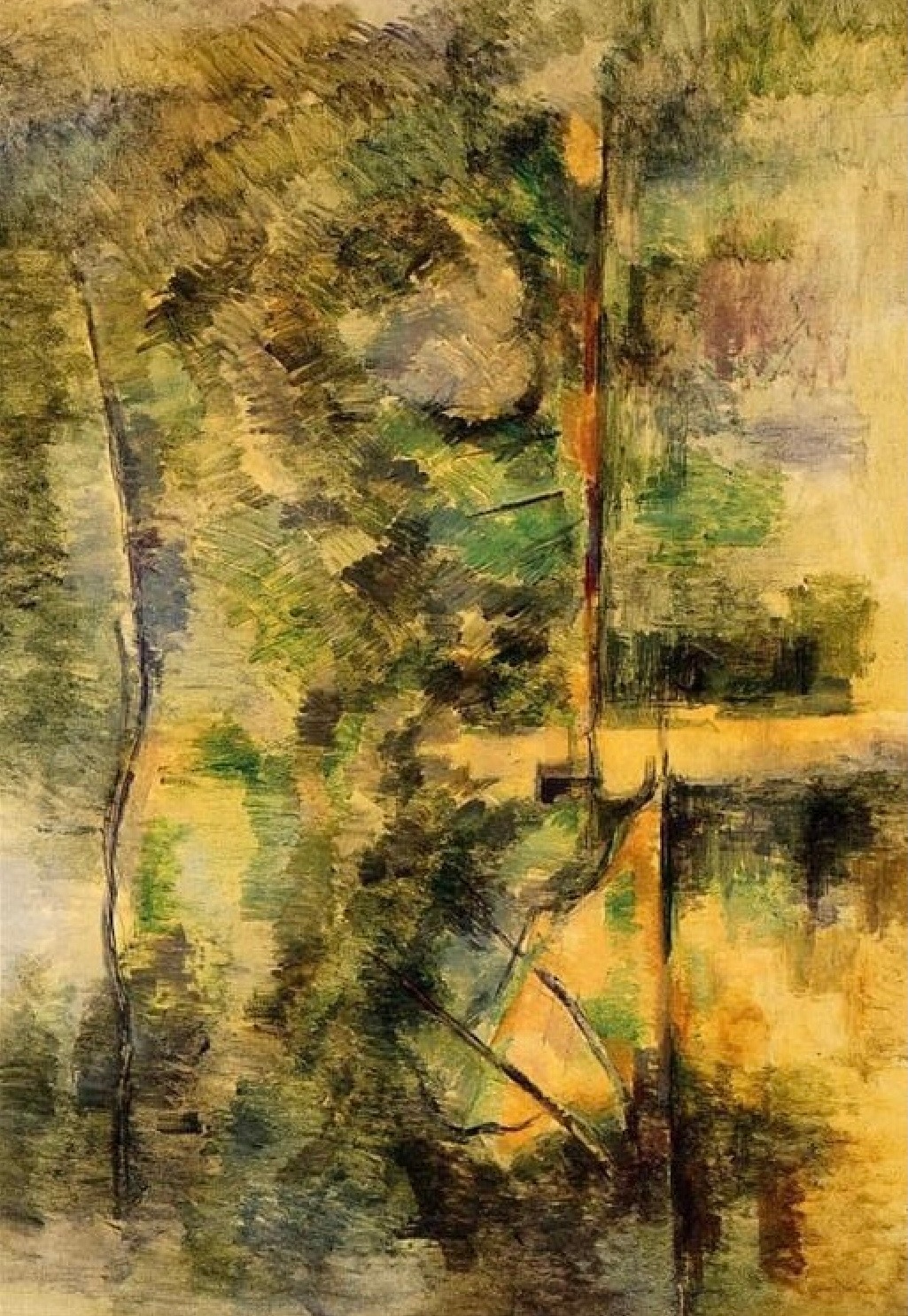
The painting below by Paul Cézanne demands our consideration. It cannot be passively observed. The glassy patch of water in the lower right-hand corner is where the painting – “Reflections in the Water” – gets its name. Our eyes are naturally drawn to the thick tree on the bank whose ghost is captured on the surface of the pond where the foliage gives way, but really it is the slim sapling, unreflected, unbroken, rising boldly along the canvas’s left edge, that is the true subject of this piece. It is a triumph of subtlety and nerve.
Except that I’m wrong. I’ve been looking at the painting on its side and forming a completely inaccurate impression. Oh well. I’m probably not the first. There is an unconfirmed story that this painting by Cézanne was hung sideways for thirty-one years in London’s National Gallery. The origin of this gossip is from the economist Oswald Toynbee Falk (1879–1972), who lays the blame at the feet of one of its trustees, John Hugh Smith, exactly the kind of person who would in those days have had a hand in such decisions. I can find no corroboration of the story, but I do hope it’s true.
Of course, an establishment as prestigious as the National Gallery would be unlikely to admit to such a galloping blunder. And anyway, as I’ve said, the sideways version has much to recommend it. If there’s a moral to this story, it’s surely that once we commit to an error of thinking for too long it can be mortifying to correct ourselves, particularly if public humiliation is to be the outcome.
It strikes me that the culture war is largely characterised by groups of intelligent people investing in delusional ideas with such gusto that to backtrack would be a kind of social death. One might sooner teach a mule to moonwalk than persuade a celebrity who has championed gender identity ideology to admit that human beings cannot change sex. After demonising women for insisting on single-sex spaces, making excuses for the medicalisation of healthy children, and encouraging the dismantling of gay rights – all in the name of progress – it must be tremendously difficult to admit that it was all for nothing.
For many, the response to being corrected is simply to deny there was any mistake at all and to double down. This is certainly the position of the Green Party, whose representatives are now wholeheartedly wedded to the absurd proposition that human beings have an innate gendered soul that can be misaligned from their body. Their supporters are even congratulating them for their doggedness in the face of reason and evidence, so there is no incentive to course-correct.
Andrew Doyle, “The art of admitting our mistakes” ($), Andrew Doyle, 2026-05-08.
August 11, 2026
QotD: The long lead-up to the invasion of Iraq
The Americans kicked Iraq out of Kuwait quickly and easily, and then … hesitated about what to do next. Nobody wanted to keep Saddam around (remarkably, when you have outlived your usefulness, people suddenly start to notice all of your human rights abuses), but nobody wanted to march into Baghdad and topple him either. There was some wishful thinking that the Kuwait defeat would cause Saddam’s regime to collapse, but most US foreign policy thinkers just shrugged their shoulders and figured better Saddam than chaos and a Vietnam-style quagmire. One especially perceptive official put it this way to a PBS journalist:
I felt there was a real danger here that you could get bogged down in a long drawn out conflict … and then you’ve got to worry about what comes after. And then you have to accept the responsibility for what happens in Iraq, accept more responsibility for what happens in the region. It would have been an all-US operation, I don’t think any of our allies would have been with us, maybe Britain, but nobody else. And you’re going to take a lot more American casualties if you’re gonna go much around in Iraq for weeks on end trying to run Saddam Hussein to ground and capture Baghdad and so forth and I don’t think it would have been worth it.
That official’s name was Dick Cheney.
So Saddam was left in place, and throughout the ’90s American policymakers seethed about it. There was no official policy that said we were going to overthrow him, but prominent politicians like Al Gore were out there writing op-eds saying that Saddam must be toppled and his government dismantled. This produced what Mazarr calls “destructive ambiguity” — everybody knew that everybody else knew that the real policy was to get rid of the guy, but since this was an unofficial position it went through none of the usual policymaking channels and was never formally debated. It also left a lot of room for freelancing.
For example, CIA clandestine operative Bob Baer (whose memoir is a terrifically fun read, by the way) began organizing a coup in 1995, not because he was directly ordered to do so but because he thought it was what his supervisors wanted. Even the strategy of the coup points towards this ambiguity — rather than straightforwardly overthrowing the government, it aimed to spark a rebellion that would gain some momentum but not enough to win, so that when Saddam moved to crush it the US would be pulled in and forced to act.1 Think for a moment about what an odd plan this is, and how it only makes sense if you believe the US secretly wants to invade while officially pretending not to.
The leader of this rebellion was supposed to be Ahmed Chalabi, one of the more fascinating characters in this story. Chalabi was a dapper, cosmopolitan, and erudite bank manager who got exiled from Iraq for gross financial corruption. He promptly reinvented himself as a freedom fighter, rented beautiful houses stocked with fine art in several major cities, and set about ingratiating himself with Western elites. He also began organizing his fellow emigrés and exiles into an effective political lobbying force. Unsurprisingly given his educated and aristocratic manner, he was extremely good at the lobbying part, and soon placed a special focus on the United States, wining and dining congressmen and writing op-eds for major newspapers. Soon he managed to convince the CIA that there were thousands of resistance fighters back in Iraq ready to follow him into battle.
He was good at convincing, but they also wanted to be convinced. Chalabi and his fellow emigrés were charming, cultured, westernized intellectuals who at least pretended to be pro-democracy. It was oh-so-tempting to believe that everybody in Iraq was like that, when in fact they were completely unrepresentative. As a rule of thumb, when a country has a revolution or a civil war or other social breakdown, the ones who make it out are the ones bright enough to see it coming and rich or well-connected enough to escape. Whether it’s the Russian Revolution, the Lebanese Civil War, or whatever you call what’s happening in South Africa, the people who leave are not a random subset — they’re the creme-de-la-creme. Unfortunately the US government somehow couldn’t figure this out in the case of Iraq. They met the emigrés, and were impressed by them, and decided that Iraq really was a civilized and cosmopolitan place under the surface, when in fact the society that created the emigrés had been destroyed decades earlier.
The emigrés represent one pole of the Baptists-and-bootleggers coalition that emerged in the ’90s to advocate for the overthrow of Saddam’s regime. The other is exemplified by Paul Wolfowitz, a soft-spoken academic who bounced between senior government positions and jobs at think tanks. Wolfowitz was a humanitarian in the most sincere sense. Much of his extended family had been killed in the Holocaust. The plight of oppressed peoples was not an abstraction for him, and he dedicated his life and career to the proposition that the United States should use all available means to end tyranny and oppression wherever they existed.
Wolfowitz is commonly described as a fanatical neoconservative, and he is, but I think it’s important to demystify that term. Too often it gets used as a catchall for “people we don’t like”, but at least when it comes to foreign policy the neoconservatives fit squarely within the American mainstream. With the notable exception of Donald Trump, every American president of the past few decades has had essentially the same foreign policy, driven by essentially the same core ideas: (1) Americans are the good guys, (2) it’s the job of the good guys to right wrongs wherever they are happening, (3) freedom and democracy are the non-negotiable inheritance of everybody on planet earth. These ideas drive the neoconservatives, yes, but they also drive Samantha Power and Susan Rice, not to mention Hillary Clinton and Barack Obama.
If you are an American, it may not be apparent to you how weird these ideas seem to the rest of the world. If I were to characterize how previous empires — and America’s current rivals — think about the world, it would be more like: (1) every country has core interests and peripheral interests, (2) you should not interfere in another country’s core interests if you can help it, (3) different peoples and cultures are adapted to different forms of government, and this diversity makes life spicy and interesting. Perhaps most shocking to Americans: most countries do not self-identify as “the good guys”, instead they think of themselves as a people with a history and a set of territorial claims.2
Mazarr describes this peculiar American quality as “the missionary impulse”, and notes that while it comes from a well-intentioned place, it “can produce a theological and absolutist conception of America’s responsibility as well as a romantic conviction that America can renovate other societies at will”. Or, to put it in blunter words, it makes us do insane things like invade and occupy a culturally alien country on the other side of the world, and stand there in blinkered incomprehension when people don’t like it. Perhaps the most damning thing about this missionary impulse is the way it provides a self-excusing justification for recklessness: since America is definitionally the good guys, all the horrible consequences of America’s dumb decisions must be somebody else’s fault, and anyway we meant well so you can’t really blame us.3 It’s like a speeding driver who hits and kills pedestrians over and over again, and when confronted gets huffy and points out he’s on his way to feed people at a soup kitchen.
Why is our national character like this? It’s one of those eternal questions. Maybe it’s because we were settled by various strains of fanatical Protestants, or because our ethnos was born during the Enlightenment, or some other “genetic” factor. Alternatively, it could be something about our historical development, or perhaps the large oceans that have always insulated us from most of the negative consequences of our decisions. Or maybe it’s just inevitable that whoever the current world empire is will feel this way, a consequence of our “unipolar moment”.4 Whatever the cause, it’s been a frequent source of misunderstanding between American and foreign diplomats, and few more so than Iraq’s.
The inability of the Iraqi regime, and of Saddam Hussein in particular, to “get” America or its motivations is a recurring bit of comic relief in Mazarr’s book, and one of the first big episodes of it occurs here in the mid ‘90s. This was the time when the Iraqis completely shut down their WMD programs and destroyed every trace of them. But even while halting their nuclear, chemical and biological weapons projects, they continued to loudly insist that they were operational. This appears to have been done out of fear that they would lose prestige if they admitted to backing down. Saddam also really wanted the Iranians to think that he still had chemical weapons out of fear that they’d invade if he didn’t, and he figured that US intelligence would obviously figure out that the programs had been stopped, so they didn’t have to come out and say it themselves.
I remember when I was a kid watching Dr. Strangelove, and laughing at the part where the Soviets built a doomsday device without telling anybody, completely defeating the purpose of having a doomsday device. Then I got older, and learned that no actually, in real life the Soviets built a doomsday device, and then didn’t tell anybody, because they apparently assumed that its psychological effect would be more powerful if America found out about it from its spies (naturally, we didn’t find out until after the Cold War was over). Saddam’s mistake was a weird inverse of this, destroying all his doomsday weapons and then just assuming we’d figure it out. I guess the moral of the story is that in real life, these too-clever-by-half schemes where you double-bluff your opponent are rarely worth it.5
Anyway, Saddam destroyed all of his WMD, and then kicked out the UN inspectors so as to maintain the charade that he still had them. At the same time that all of this was happening, the sanctions regime that the US had imposed was clearly falling apart. European and Asian businessmen were swarming all over Baghdad, trying to get things in place for when foreign investment inevitably flooded back into the country. All of this contributed to an ambient sense that something had to be done; the attempt to kick the can down the road was failing. By the late ’90s, the Clintons had already convinced themselves that a rematch with Saddam was inevitable, but they didn’t have time to act on it before their term was up and a new sheriff rolled into town.
John Psmith, “REVIEW: Leap of Faith, by Michael J. Mazarr”, Mr. and Mrs. Psmith’s Bookshelf, 2025-06-30.
- Yes, this was exactly Strelkov’s strategy in the Ukrainian civil war. And for similar reasons — the Russian government as an official body was dithering and indecisive, but a large faction within it wanted to act.
- My north star here is, as always, my former coworker from Bulgaria.
- Graham Greene did an exquisite job skewering this attitude in his novel The Quiet American. One character says of the titular American: “I never knew a man who had better motives for all the trouble he caused”.
- Did the Romans feel this way? Did the Chinese? I don’t actually know, but I think there’s something distinctive about the American imperial attitude. It really does come down to our belief that we’re bombing you for your own good (or overthrowing your government for your own good, or whatever). My sense is that past hegemons have been a bit more honest.
- Then again, Gaddafi did what Saddam arguably should have done, and look what that got him. I guess the real lesson is just not to make too much trouble until your nukes really work.
August 10, 2026
QotD: Cleopatra’s relationship with Egypt and her Egyptian subjects
The factors usually pointed at to demonstrate Cleopatra’s attachment to Egypt are that she learned the language, engaged with Egyptian religion and represented herself in Egyptian fashion in royal artwork and commemoration meant for consumption in Egypt. And that’s true, she did those things! But the context often missing from using that as a clear indicator of Cleopatra’s cultural “Egyptianness” is that, apart from learning the language, those were common things for Ptolemaic rulers to do, despite the fact that the dynasty maintained a pronounced ethnic hierarchy in Egypt and aren’t generally regarded as being particularly attached to its people or culture. Nevertheless, there’s not nothing here in the sense that Cleopatra showed – or at least wanted to show – more than the normal Ptolemaic attachment to Egypt as a place and the Egyptians as people, which is to say almost any at all.
Let’s start with languages, because I think this fact can be presented in a somewhat distorted way. The language of the Ptolemaic court was Greek, initially Macedonian Greek (the Macedonians had a pronounced accent), though Plutarch notes that some of the later Ptolemies had lost their Macedonian accent (Plut. Ant. 27.3-4). Cleopatra, by contrast, was the first of the Ptolemies to bother to learn Egyptian (which should tell you something about the character of Ptolemaic rule; imagine if King Charles was the first English king since George I and kings from the House of Hanover to bother to learn English). The problem with this fact is that it is incomplete, presenting Cleopatra as a Greek-speaker who learned the language of her people out of sincere devotion, but that’s not what Plutarch says. Plutarch says:
She could turn [her voice] easily to whichever language she wished and she conversed with few barbarians entirely through an interpreter, and she gave her decisions herself to most of them, including Ethiopians, Troglodytes, Hebrews, Arabians, Syrians, Medes and Parthians. She is said to have learned the languages of many others also, although the kings before her did not undertake to learn the Egyptian language, even though some of them had abandoned the Macedonian dialect.1
So let’s unpack that. This isn’t a native speaker of Greek who learned just the language of her subjects, but a spectacularly skilled linguist who learned a lot of different languages, quite regardless of if she ruled the people in question. Running through the list, she evidently learned Ethiopian, the language of the people on her southern border, the speech of the Troglodytae, the people who lived on the coast of the Red Sea (a hinterland of her kingdom). The “language of the Hebrews” here is probably Aramaic rather than Hebrew (which would also cover much of Syria), while the language of the Medes and Parthians might mean both Old Persian and the Parthian language. To which we must add Egyptian, implied by that last sentence; it also seems fairly clear Cleopatra knew at least some Latin.2 This is part of why I find arguments that use Cleopatra’s knowledge of Egyptian as strong proof either for her Egyptian ancestry or deep attachment to Egypt less than fully compelling; she was surely not Parthian and did not have a deep attachment to Parthia, but she learned their language too. Again, there’s not nothing here, but it’s not a slam dunk either.
What of Cleopatra’s role in Egyptian religion? The recent Netflix miniseries makes quite a fuss about how Cleopatra’s first action as queen – that we know of, because this is simply the first moment she is visible in the sources to us at all – is to partake in a religious festival installing a new sacred bull in a shrine at Hermonthis, close to Thebes in Upper Egypt and how this was indicative of a deep love of Egyptian religion. And it may well have been, but it’s also worth noting that Ptolemaic rulers had been taking part in Egyptian religion for a long time. Most of the massive temple complex at Philae, for instance – even farther from Alexandria than Hermonthis, I might add – was built in the Ptolemaic period, with major expansions by Ptolemy II and III. Even more relevantly to our subject, this was a [devotion] to Isis; Cleopatra was not the first Ptolemy by any means to claim that goddess for the dynasty.3
Nor had this even been a new practice for the Ptolemies. Alexander was presumably crowned pharaoh in Memphis in the traditional manner, visited the oracle of Amun at Siwa and dedicated a major set of construction works in the temple of Amun at Thebes. The Ptolemies followed this model. Ptolemy II went to Mendes to personally conduct the ritual of the process of the Ram of Mendes and then extended the temple, he presided over the inauguration of a temple at Pithom, and so on.4 And on it went with Ptolemy III and on down the line (indeed, becoming a bit more pronounced as we move into the later Ptolemies, beginning with Ptolemy V Epiphanes, potentially as a result of the increasing weakness of the Ptolemaic dynasty both internally and abroad). Ptolemaic kings were regularly in and out of Memphis, the religious capital of Egypt, building new Egyptian temples, attending Egyptian religious rituals and so on. The reason is that the job of Pharaoh was as much (if not more) a religious job as it was a political one and it was a job that only the Pharaoh could conduct. And the idea that a Ptolemaic pharaoh with a legitimacy problem might consecrate some temples to help fix that wasn’t new either; Ptolemy VIII Physcon is out doing that thing in the mid-second century. Consequently, involvement in Egyptian religion was a requirement of the position, quite apart from the question of how much the holder of that position cared.
Cleopatra, like any Ptolemaic ruler, engaged in this sort of building, though it seems striking how much of her building program was composed of Hellenistic structures in Alexandria, even as Duanne Roller admits, “the queen was not a major builder”.5 She restored the gymnasium of Alexandria, made major repairs to the Lighthouse, built a new precinct in honor of Julius Caesar called the Kaisareion, and apparently built a monumental tomb for herself, also in Alexandria. Examples of her building outside of Alexandria are fairly thin: the completion of a temple at Dendera begun by Ptolemy XII, extensions to the temple at Hermonthis (where she visited early in her reign), never entirely finished and a temple to Isis in Ptolemais Hermiou in Upper Egypt. Cleopatra could hardly be accounted the great renovator of Egyptian religion or religious sites.
Likewise the assertion that Cleopatra represented herself in Egyptian artwork in Egyptian style and dress; that too was true of all of the Ptolemaic rulers from the very beginning. Indeed, Cleopatra’s self-representation as Isis was very much not new, but in fact the normal way Ptolemaic queens were represented (to match Ptolemaic kings being represented as Osiris). Here, for instance, is Ptolemy II Philadelphos (r. 284-246) with his queen Arsinoe II represented in Egyptian style on a relief now in the British Museum.
Like all Ptolemaic rulers before her, Cleopatra presented herself in an Egyptian form, conforming to Egyptian style, in Egyptian contexts. And, like all of the Ptolemaic rulers before her, she presented herself in a Hellenistic form in Alexandria and on her coinage. While you will see people point to various busts and frescos as being images of Cleopatra, it is only her coins where we can say for certain that an effort was made to capture her likeness (her Egyptian portraiture, though labeled, follows Egyptian stylistics, not her actual likeness); we have no idea if, for instance, later Roman artists had any information about what she actually looked like or if the busts we suppose to be of her actually are. Be wary also of Greek and Roman frescos showing fair-skinned women reported to be Cleopatra; almost all women in Greek and Roman fresco are shown as fair-skinned; it’s a standard artistic convention. Coins, of course, record no skin color and neither do our sources for Cleopatra; anyone who thinks they can tell you what color her skin was is unduly certain.6
Now this isn’t to say Cleopatra is doing nothing new. She does seem to have been somewhat more involved in Egyptian religion than her predecessors, though the exact degree to which this is true is hard to see because we don’t have anything like a full accounting of their actions; if it is a difference it is a different in quantity, not kind. Certainly her building program wasn’t anywhere close to the scale of the early Ptolemies, but perhaps she took more direct personal involvement. Once again, the unknowns here are formidable. Dorothy J. Thompson in the the Cambridge Ancient History7 takes this, along with Cleopatra switching her regnal name from “philopator” (“loves-father”) to “philopatris” (“loves-homeland”8) to be indicative of a clear effort by Cleopatra to be, “indeed queen of Egypt”, particularly in the context of dynastic struggles with her brothers: outflanking them by getting the favor of the people.
The problem with this narrative is the timing: Cleopatra makes that switch in titles in 36/5 BC, which is to say in year 16 of her 21 year reign, eight or nine years after her last serious competition for the throne, her youngest brother, had died. Instead, Bingen9 argues that the homeland Cleopatra is professing love for is the greater Macedonian empire – the empire of Alexander – which she may have seemed in 36 on the verge of reclaiming.10 Antonius was just about to give her (through her children) sweeping portions of Roman Syria, Cilicia, Cyrenaica and Armenia; he would also give them titles to Medea and Parthia, which he didn’t control (though perhaps in 36 he hoped to) but would represent collectively the whole of the old Seleucid Empire near its height. Bingen notes the other change to Cleopatra’s titulature at this point was rather than just being “the goddess who loves her father” she becomes “the young goddess who loves her father and her country”; the added νεωτέρα (“young”) perhaps being intended as a link to Cleopatra Thea, Seleucid queen-consort of Syria from 150 to 126 BC and Cleopatra’s own great-grand-aunt. Cleopatra, after all, was about to achieve the long Ptolemaic dream of controlling all of Syria.
Strikingly the sources do not tell us that Cleopatra was seen as any more distinctively Egyptian than her father or that she had some groundswell of popular support in Egypt. Indeed, Cassius Dio implies the opposite (Cass. Dio 42.34-6) that the Egyptians favored Ptolemy XIII in the succession dispute and it was only the force of Caesar’s arms that turned the issue to Cleopatra. Of course we have to be somewhat skeptical of this account too: Dio is marinating in a literary tradition that is very hostile to Cleopatra and also makes no effort to distinguish between the Alexandrians and the rest of Egypt, two very distinct groups. In any case it is clear that Cleopatra achieved no groundswell of support in Egypt in those early years: she had to raise her army in Syria and in the event it wasn’t the stronger force as she and Caesar spent the winter of 48/7 besieged in Alexandria by Ptolemy XIII’s then larger army (Caesar had not brought his full field army), until the arrival of an army out of Roman Syria led by a collection of Caesar’s allies tipped the balance. Julius Caesar was never a particularly cautious commander, so if he looked at whatever force Cleopatra still had and said, “we need to wait for reinforcements”, it could not, at that point, have been very substantial. Afterwards, Caesar would leave four legions in Egypt to secure Cleopatra’s rule, which seems not to indicate her great popularity or any great faith in her ability to hold the kingdom. After 44, she’s able to rule without direct support, but of course after 44, she and her children are the only dynastic options left, her brothers and sisters all being dead (some at her hand). Finally, when Octavian comes for her, there is no major effort by anyone to stop him militarily. If Cleopatra had the love of the Egyptian people at that point, we sure don’t see it.
In my view then, it seems like an argument can be made that Cleopatra had a fairly modest propaganda effort towards presenting herself as more in touch with Egyptian religion, but the extent and quality was at most only a modest improvement over the previous Ptolemies and apart from keeping her on the throne (with Roman backing), it doesn’t seem to have achieved much.
Bret Devereaux, “Collections: On the Reign of Cleopatra”, A Collection of Unmitigated Pedantry, 2023-05-26.
- Trans. from Jones (2006).
- On this, see Roller (2010), 48-9.
- On this sanctuary and its inscriptions, see J. Bingen (2007), 31-43.
- On this, see Hölbl (2001), 77-90.
- op. cit. 108.
- Though, contra Netflix, we can say something about her hair. I was rather confused when one of their talking heads posited that he liked to imagine Cleopatra with hair like his – his hair was very tightly curly and indeed that is how the Netflix documentary opted to do Cleopatra’s hair. We can see her hair on her coins and it is wavy, pulled together into a bun in Hellenistic style with short draping curls (loose, not tight) and a Hellenistic diadem. I think it is pretty fair to suppose this is how Cleopatra actually wore her hair – or at least, how she wanted people to think she wore her hair.
- The second edition of the Cambridge Ancient History; in this case CAH2 IX, 320-1.
- Literally “loves her fatherland”. To save myself some audio pain in the future, I often hear “philopator” pronounced with the emphasis on the second syllable (phi-LOPE-a-tor), but the accent is on the alpha, phi-lo-PA-tor, because that o is an omega, a long-vowel, so the accent can fall no further back.
- op. cit., 58-62 and 76-79.
- Bingen argues that in an Egyptian context, it would have been clear that Cleopatra’s patris was, in fact, Makedon – the most prestigious and useful possible patris to have in Ptolemaic Egypt.
August 9, 2026
QotD: Spoilers — threat or menace?
It turns out this may not be control freakery. How wonderful to think that I have been waiting years for science to rebrand my worst qualities as skills. Apparently, people who like spoilers are just trying to regulate their emotional response. We are not monsters, but only putting on a cardigan before the storm.
Those who hate spoilers also want control, but theirs is driven by a desire to preserve suspense. They want to receive information in the sequence designed by the storyteller. My own spoiler-seeking is also a form of control, although it works differently. I want the major facts early, so I can relax into the texture of the story rather than sit there like a meerkat scanning the horizon for emotional catastrophe.
So we are all control freaks, just wearing different cardigans.
Spoiler alerts began as a civilized courtesy. If someone on a bus was halfway through a book, it was not considered the done thing to lean across and announce the ending like a deranged town crier. There were rules. Perhaps not that many. But there were some.
Now the spoiler alert has become a moral siren. One can’t discuss a film, television show, podcast, documentary, memoir, cake reveal, or episode of Bluey without issuing a warning so elaborate that it requires its own stationery. People now approach plot discussion like bomb disposal experts. One innocent mention of a character’s demise, and the online village square bursts into flames. On “The Good Ship Murder” Facebook page, for instance, someone posts, “Can’t believe they killed Pierce”, and within seconds the spoiler militia descends.
Admins should delete this spoiler.
People might not have seen it yet.
Can’t believe you’ve posted a spoiler…You can almost hear the sirens. Somewhere, a moderator is reaching for a lukewarm tea and wondering how a cozy murder show has turned into the fall of Saigon.
Nicole James, “Tell Me Who Dies So I Can Relax”, The Freeman, 2026-05-07.
August 8, 2026
QotD: Why more men than women love videogames
Autumn Christian @teachrobotslove
I love video games. I met my husband because he hired me to QA for a Sims game. I was a game designer for companies like Zynga and EA. I was a writer on State of Decay 2.
And I still have never loved games like I’ve seen the way men love games. I was surrounded by men who would eagerly work on min-max spreadsheets during their lunch break. One designer had a cabinet full of games that he would replay over and over again to study the levels. They’d go home from making games to play more games.
Honestly, it’s a big reason I quit game design. I didn’t have that obsessive, compulsive desire to play games in a way that superseded everything else in my life. Lots of women play videogames. I’ve never seen one consumed by them as their life falls apart around them.
Autumn is right. Even women who love video games don’t become obsessed with them the way men do. I know why, and I think it reveals a tremendously important difference between male-typical and female-typical psychology.
Men. Want. Power.
Men want to be able to do things. To shape the world. To impose their will on reality. To win.
Video games are a fast, reliable superstimulus for that urge. With only a handful of exceptions, the good ones are designed to both excite the desire for agency and power, and to satisfy it.
If you doubt me, ask yourself why many men fixate harder on video games than they do on pornography. It’s very telling that this is even possible.
Women don’t work that way. I could go off on a long tear about why, but the evolutionary-biology reasons are so obvious that I don’t think I need to. If it’s not obvious, ask an LLM “why do men seek power and agency the way women seek love and social validation”. You’ll get an earful.
Of course this also explains the well-known phenomenon of women getting the ick when men play video games.
It’s not just that men doing this are chasing a goal women don’t really understand or identify with. To them, a game-obsessed man is dropping out of the real-world contest, wasting the traits and energy that would otherwise make him attractive on a pursuit that is both literally and figuratively sterile.
I don’t have a fix for the problems this mismatch creates, nor am I judging either men or women about this — instincts are what instincts are and I don’t waste any time arguing with the law of gravity either.
But understanding what’s going on increases the chances that we can make choices that aren’t doomed to fail.
ESR, The social media site formerly known as Twitter, 2026-05-07.
August 7, 2026
QotD: A provisional taxonomy of “stupid smart guys”
If we assume this is a universal mental process, I suggest, then saying someone has a low-normal IQ does not mean he’s always going to do stupid things. He has those three-B flashes too. It might take a while for him to cotton to something that seems obvious, but cotton he will, in three-B fashion.
Moreover, Jaynes is good on the complexity of unconscious tasks. The mechanical parts of driving, once learned, are completely unconscious. Try teaching someone to drive and you’ll see it right away. You’ll find yourself literally side-seat driving — your foot pushing down on an imaginary brake, unconsciously. And you never really forget those unconscious patterns, either. You may not have ridden a bike in 30 years, but you could go out and do it right now. Same way with swimming, or the manual of arms — if you’ve been through Basic, a guy with the proper tone of voice can have you twirling around like a marionette, even if you got out of uniform decades ago.
The actual low IQ guys might be the most dangerous cogs in the machine.
The Dunning-Krugerrand. That’s Larry Correia’s phrase, and it’s great. This is the person who believes he’s way smarter and more competent than he actually is. Which on the one hand, they all do. But on the other hand, there are levels above D-K, so please hold fire for now.
The Artiste. It’s been my great … fortune, actually, to have been around a lot of Media people in my youth. I dated a gal who did production work for one of the big tv news programs in a fairly large city, so I saw the video side of it, at least, from close range. The on-camera bobbleheads are all Ron Burgundy, of course, but the production people are usually quite bright … but in a very odd way. They have what I came to think of as “the artist’s eye”. They naturally see everything in terms of camera angles and visual presentation, and training develops this to a very high degree.
This leads to wildly divergent takes on things. You or I see the police approaching a stopped car with their guns drawn, or firemen pulling up in front of a burning building, and we think something like “Damn, crime is out of control!” or “I hope everyone’s ok.” News people — video people, at least — think “What a shot!” They frame the visuals first, then start processing the propositional content … if they ever do. The longer they work in “news”, the more the propositional content — “the cops are arresting a bad guy”; “there are real people in real danger in that burning building” — drops away.
Same thing, I imagine, with the folks on the verbal end. They have a novelist’s sense of pace, structure, and so on. Is what they’re writing true? Of course not! At one point about 30 years ago they felt the need to justify this, and created a whole new category of writing: “creative nonfiction“, aka lies, aka “the news”. The “creative nonfiction” people will tell you, in Wiki’s words, that it “uses literary styles and techniques to create factually accurate narratives”. Emphasis mine, because like the cameraman who ends up exclusively focusing on the shot and never thinks about the life behind the shot, so the writer of “creative nonfiction” gets caught up in the creative part, and just kinda forgets the “nonfiction” part.
Medicalization. Not a category of people, but a technique. We say smart people tend to be spergy, and stupid smart people tend to be really spergy, but that’s mistaking effect for cause. They’re not very good at reading people, and have no social savvy, but that’s because they don’t practice — because they don’t need to practice. They medicalize their deficiencies. Instead of acknowledging a weakness in their game, they attribute it to a pathology.
Severian, “The Stupid Smart Guy”, Founding Questions, 2022-07-13.
August 6, 2026
QotD: John Nicholson, a Muslim saint who really hated India
[…]
[The First Anglo-Afghan War (1838-1842)] began with the British efforts to replace Afghan Emir Dost Muhammad with a more pliant leader, which in a pattern seen from the days of Alexander onward, involved an invasion, an attempt at a pacification, followed by a grim and growing awareness that the place is full of some of the most brutal and fractious people on Earth and is simply ungovernable, which terminates in a costly retreat, the country itself returning to its customary barbarism, efforts to change it having had all the effect of flinging an encyclopedia into a chimp enclosure. For the British, this meant early success, then an overwinter occupation in which their position deteriorated, then a mass uprising, whereupon they negotiated with the locals for a peaceful exit upon surrendering their arms. The retreating British were of course betrayed and massacred. One man made it out.
Nicholson, serving as an adjutant officer with a native regiment, had earlier been taken prisoner, and endured horrific conditions as such. He watched as his Hindu soldiers refused — to a man — to convert to Islam, and were executed one after the other. After having been released, he discovered that his younger brother Alexander had been murdered and mutilated by the Afghans while retreating with the rest of the army. The entire effort had been a great traumatic waste.
One might expect that Nicholson would hate the Afghans and perhaps revise upward his estimation of the brave Indian soldiers who had served under him. But while he did indeed revile the Pashtun tribesmen (“the most vicious and bloodthirsty race in existence”) he actually seems to have disliked them slightly less than the Hindus, perhaps on the grounds that no one that eager to kill Indians can be all bad. Indeed, he seems to have learned there some harsh lessons concerning what it would take to actually accomplish anything in the subcontinent, doctrines he would apply fastidiously and thoroughly. In many ways, he went a bit more native than he would have cared to admit.
After the war, Nicholson was promoted and given a series of administrative jobs, where he became well-acquainted with the chaotic political situation in the Punjab region. Mostly under the control of the Sikh Empire, the area had long been contested ground between that new faith and Islamic invasions from the Mughals to the southeast and the Afghans through the Khyber Pass to the west, not to mention restive Hindu Rajputs and Marathas to the south. The unstable (then and now) region of Kashmir lay to the north, and the whole of the region was plagued by innumerable bandits and warlords. The BEIC ruled through direct administration, client kings, and various alliances, the latter two of which its political officers (“politicals”) had to interact with on a regular basis. It was very much a situation out of George R. R. Martin’s fever dreams, constant betrayals, perversions of every kind, and even a Ramsey Bolton-esque Sikh despot who flayed men alive for amusement.
Nicholson was in charge of the Bannu area, where he rapidly made a name for himself as a local administrator. The whole of the Bannu was infested with bandits of all kinds, from jihadis to Hindu cultists to normal brigands, and the people lived in constant fear of their depredations. Nicholson had no real interest in bettering lives, but he had even less interest in allowing any Indian, anywhere, to challenge his authority. So he set about fixing the problem as only he could.
Nicholson arrested and executed scores of bandits, rapidly processing them through his very efficient court system. The idea of impartially dispensing justice without respect to person or affiliation was quite new to the area, but Nicholson made sure the locals adjusted quickly, tolerating not even the slightest hint of disrespect from anyone, no matter who he was. When a local Muslim leader casually spit on the ground in front of him, Nicholson made him kneel and lick it up. Anyone who failed to display prompt obedience to his commands he had flogged immediately, and was the bane of servants, who were often the causal recipients of hurled cups and dishes. He was a very hands-on leader, not the least hesitant to get them dirty in a quite literal sense. At one point, when his local police were unwilling to pursue a dangerous gang leader, Nicholson rode alone to the man’s village, approached him on the street, and killed him with his sword after the suspect failed to submit to arrest. Nicholson kept his severed head on his desk pour encourager les autres.
Interestingly, such draconian brutality seems to have actually made Nicholson popular. He was harsh, unyielding, and wholly indifferent to their culture, but that very indifference made him unassailable to anything but his sense of duty. He was unbribable, as the people of India had absolutely nothing he wanted, and his complete contempt for their social norms meant that Hindu, Muslim, or Sikh, Brahmin or outcast, Aryan or Dravidian, all got the exact same treatment, prompt and thorough. His mad fearlessness meant that he was similarly immune to threats. Criminals, whoever they were, received savage punishment, but the law-abiding were left in peace; Nicholson had no desire to “improve” them or their society like his contemporary Macaulay. In a real sense, for the first time, the diverse people of the area were free, under Nicholson’s rule, to live as they wished without the violent misery that had previously characterized the region. It was a multicultural success story, festooned with the occasional decapitated head.
This being India, the people expressed their feelings towards him in particular ways. A body of wild Pashtun raiders, admiring Nicholson’s capacity for ruthless violence and his grim charisma, attached themselves to him as a personal guard, fedaykin to his Muad’Dib, serving without pay and loyal only to him. In a theologically fecund area with a strong tradition of syncretism and cults of personality, Nicholson naturally became the object of worship for a group of fanatical devotees. He in turn naturally despised this, having his worshipers flogged as public nuisances, but this only served to increase their devotion to their inscrutable, violent deity. In some parts of India, the Cult of Nikal Seyn survived as a Shia devotional movement, with Nicholson cast as a Muslim saint bringing justice to a war torn land. The last member died in 2004.
Librarian of Celaeno, “The Man Who Hated India”, The Library of Celaeno, 2026-05-04.
August 5, 2026
QotD: “This is why English spelling is a disaster”
And somewhere in that collision of accents and dialects, something shifted. Literally. The vowels started moving.
Between roughly 1400 and 1700 every single long vowel in the English language changed how it was pronounced. It’s called the Great Vowel Shift. Before it happened, English vowels worked the way vowels work in Italian or Spanish. The letters did what they looked like they should do. “Bite” was pronounced “beet”. “House” was pronounced “hoos”. “Name” was pronounced “nahm”. “Knight” was pronounced “k-nicht” with a guttural sound at the end like you were clearing your throat. English was phonetic. The spelling matched the sounds. It made SENSE.
And then it didn’t.
All the long vowels began migrating upward in the mouth. The tongue positions shifted higher and higher over the course of about 300 years. And the vowels that were already at the top had nowhere left to go so they broke apart into two sounds. “Ee” became “eye”. “Oo” became “ow”. A 300-year linguistic pileup that nobody voted on and nobody agreed to. It just happened. And it happened during the worst possible window of time.
William Caxton brought the printing press to England in 1476. One of the most important technological developments in the history of communication. And it arrived RIGHT IN THE MIDDLE of the Great Vowel Shift.
Caxton started standardizing English spelling based on how words sounded at that exact moment. Printers needed consistency. They needed to pick a spelling and commit. So they did. But the sounds kept changing after the spelling was already locked in. The vowels were still moving. The consonants were still dropping. And the printed page couldn’t keep up.
We had ONE CHANCE to get English spelling right and we fumbled it at the worst possible moment.
This is why English spelling is a disaster. It’s not random. It’s not lazy. It’s a snapshot of a language mid-transformation that got frozen in place by a new technology and was never corrected. Every word you have ever misspelled, every silent letter that made you feel stupid, every time you stared at “knight” and thought why is there a K in this. You used to pronounce that K. You used to pronounce that GH. Those sounds died 500 years ago and the letters are still standing there like gravestones. English spelling is full of ghosts.
That’s why “food” and “good” and “blood” are spelled almost identically but sound completely different. In Chaucer’s time around the 1390s they all rhymed. In Shakespeare’s time around the 1600s they still rhymed but with a different vowel. And then sometime after that they each went their own separate way and the spelling just stood there watching like it had given up entirely.
And HERE IS THE THING. Other languages went through similar vowel shifts. German had nearly identical changes happen to its long vowels around the same period. And German just updated its spelling. They adjusted the orthography to match the new pronunciation. Like reasonable people. English looked at the same problem and said no. We’re going to keep the old spelling. Everyone will simply have to deal with it. Every person who has ever stared at “though” and “through” and “thorough” and “thought” and wondered why four words that look almost identical are all pronounced differently? Collateral damage. Five hundred years of collateral damage and we just accepted it.
Ok so that’s the vowels. That’s the background. Now we get to the accents and this is where I lost my mind.
The single biggest difference between standard American English and standard British English today is something called rhoticity. This is a real linguistics term even though it sounds completely made up. Rhotic speakers pronounce the R sound in words like “hard” and “car”. Non-rhotic speakers drop it. “Hard” becomes “hahd”. “Car” becomes “cah”. That one feature is doing like 80 percent of the work when your brain hears someone speak and categorizes them as British or American.
Here’s what nobody told you.
In 1776 everybody was rhotic. Americans AND the British. Both sides of the Atlantic pronounced their Rs. The fancy non-rhotic accent that we now think of as THE British accent, the one you hear in your head when someone says “British accent”, the one every villain in every movie has? That accent did not exist yet. It developed in the late 18th and early 19th centuries when the upper classes in southern England started dropping their Rs as a prestige marker. A fashion statement. And then it spread downward through society and outward through the Empire.
The accent we associate with the British Empire is actually newer than the American Revolution.
I need to say that again because it didn’t land the first time I heard it either.
The accent that we think of as “British” is newer than the country that broke away from Britain. Americans didn’t lose the British accent. The British lost the British accent. Americans are the ones who kept it.
Emma, “The Plague That Broke English (And Why the Founding Fathers Didn’t Sound British)”, Past Life, Present Cleavage, 2026-04-03.
August 4, 2026
QotD: Limits to tactical flexibility in Roman Republican armies
And therein lies the rub: just as the commander doesn’t have a multitude of points where he can intervene in the battle but rather a limited set of key decision points, so too he does not have an infinite set of potential orders he (or his subordinates) might give at any given moment. Instead, the commander (or his subordinates) has a McDonald’s menu worth of options he can employ. He can order anything on the menu and expect the unit to respond accordingly but he cannot order anything not on the menu, nor can he order an altered version of a menu item (no Big Mac without cheese; Sir, this is not a Wendy’s).
Now generals could and did use drilling in the early stages of the campaign to add one or two “menu items” to their drill so as to be prepared for this or that problem. Indeed the general preparing some sort of surprise of this sort and then deploying it against an enemy is a standard topos of effective ancient generalship (although in many cases we may doubt the purported gimmick was actually used (e.g. Dionysius 20.1.6, Dio 10.5)). But that is the thing: such extra “menu items” have to be prepared in advance and often well in advance of the battle. Caesar, for instance, anticipating war elephants drills his troops in anti-war-elephant tactics before the Battle of Thapsus (46 BC, Caes. Bel. Afr. 84). Alexander’s phalanx seems to have been drilled to respond to scythed chariots as well (Arr. Anab. 3.13.5-6).
That said the bulk of the menu was likely to remain constant. After all these “menu items”, while they have simple names are often actually fairly complex to do and train when you are dealing with units of dozens or hundreds. Turning back to our example of Company, Right Wheel! we can get a sense of the complexity of training that maneuver by the way they did it. The “right guide” (the man on the extreme right) adopts a set pace (nine inch steps) while the “left guide” moves at the normal regulated speed (note this requires training your soldiers not only to step in time but to step at standard lengths) and every soldier in the middle regulates his motion by maintaining elbow contact with the man to his side. That’s a good method to get the result, but it isn’t an obvious or simple method: the fellow training the company to do this needs to already know how to do this.
Now in the modern period with mass printing, you could print drill manuals that had all of the commands and instructions on how to do them, but in the pre-modern period that kind of mass printing isn’t an option (and our military texts almost never go into this kind of granular detail) so your officers have to learn to train the behavior by observing it and participating in it themselves. Which means in turn a great deal of your “package” is set before the army is even mustered at the beginning of the campaign season because you are relying on a package of culturally embedded knowledge about how armies ought to function. And if your culture doesn’t have that tradition, inventing it from scratch is going to be hard and take time; and by “time” I mean “decades”. Effective drill for volley fire (the “countermarch”), for instance, answered a need that had existed for most of the 16th century, but the embryonic ideas for it only started emerging in the 1570s, the actionable plan on how to do it in 1594 and it was only then finally deployed in a major battle in 1600 at Nieuwpoort.
However, the time available for that kind of training is limited. Remember that drill works by repeating the same set of actions over and over again until they become almost instinctive. That takes a lot of time and repetition! That both means it is going to be difficult to find space for new “menu items” (especially with green troops that still need to learn the basics) but also that synchronized discipline itself is expensive. Our ancient sources stress how Roman levels of synchronized discipline required diligent and continuous drilling to create and maintain.
Doing that in turn would demand keeping the soldiers in question under arms for training for long periods when they were not fighting. In the Middle Republic this seems to have been accomplished through rolling recruitment: Rome was essentially always at war and always raising armies so there were always a goodly number of veterans to train and “break in” the truly green new recruits in any given draft (though again – and I owe this notion to Michael Taylor – there are some signs that the less intense conflict of the mid-second-century leads to some dulling of the Roman edge). As we transition through the Late Republic into the Early Empire, that is replaced by the slow professionalization of the Roman army, culminating in the force of long-service professionals created by Augustus. Being mobilized in peacetime, professional soldiers could be drilled extensively (assuming their cultural values are going to let them drill you; also be wary here of assuming standing forces of “military settlers” are professional in this way).
But all of that is extraordinarily expensive. Keeping those soldiers under arms, after all, means that they need to be fed, clothed and paid. Even in a system like the Middle Roman Republic where soldiers provided their own kit out of their own wealth (because Roman soldiers in the Middle Republic were recruited from the modestly well-to-do smallholding class), by drafting those men you have removed them from that economic activity. The expense of doing this would have been in most cases enormous and of course those are resources that could be deployed to any number of other uses, including simply raising a larger army of less disciplined, well trained troops. For, say, a Greek polis given the choice between having 450 men under arms all year round and excellently trained or having 5,000 hoplites under arms only in the one month where there is a battle to fight the clear answer is the latter. A lot of things need to line up before producing armies with high levels of synchronized discipline makes sense: the state needs a lot of resources, year-round security challenges and a tactical system which is effective and demands this kind of investment. So while developing synchronized discipline offered an army a degree of greater control and flexibility, it was prohibitively expensive.
Bret Devereaux, “Collections: Total Generalship: Commanding Pre-Modern Armies, Part IIIa”, A Collection of Unmitigated Pedantry, 2022-06-17.
August 3, 2026
QotD: The Hellenistic Age
When I was a child first getting interested in ancient history, the books I read followed a smooth narrative process. The story of the Greeks began with Athenian democracy and the victories at Marathon, Salamis, and Plataea that saved Western civilization from Persian conquest. Then there was the Athenian maritime empire, and its tremendous cultural achievements: the Parthenon, Socratic philosophy, the plays of Sophocles, Euripides, and Aristophanes. There was the Peloponnesian War and Thucydides’s chronicling of it. And then, in a tremendous climax, there were the awesome conquests of Alexander the Great, who destroyed the most powerful empire on Earth and conquered the known world by the age of 33, only to die young and have his empire swiftly broken up after his death.
… And then the story would promptly lurch 700 miles to the northwest and start over. Greeks? What Greeks? Now I was reading about the rise of a different city, Rome, and the achievements of its great republic. Instead of the Assembly and the ostracism, there was the Senate and the consuls. I would read about the Samnite Wars, the Punic Wars, the Gallic Wars, and finally the great civil wars that transformed Rome from a republic into the empire that men still think about a few times a week. In this story, the Greeks appear again, but only as enemies for Rome first to easily defeat, then be culturally influenced by. This fusion of Greek and Roman culture leads to European Christianity, the Renaissance, the cultural canon — in a word, the West itself.
Kid me didn’t think too much about it at the time. But as I grew, I and many others finally had a thought intrude: Wait a minute, what the heck was going on in Alexander’s old empire before the Romans got there?
And if you’re like me, asking that question is how you wind up reading Alexander to Actium.
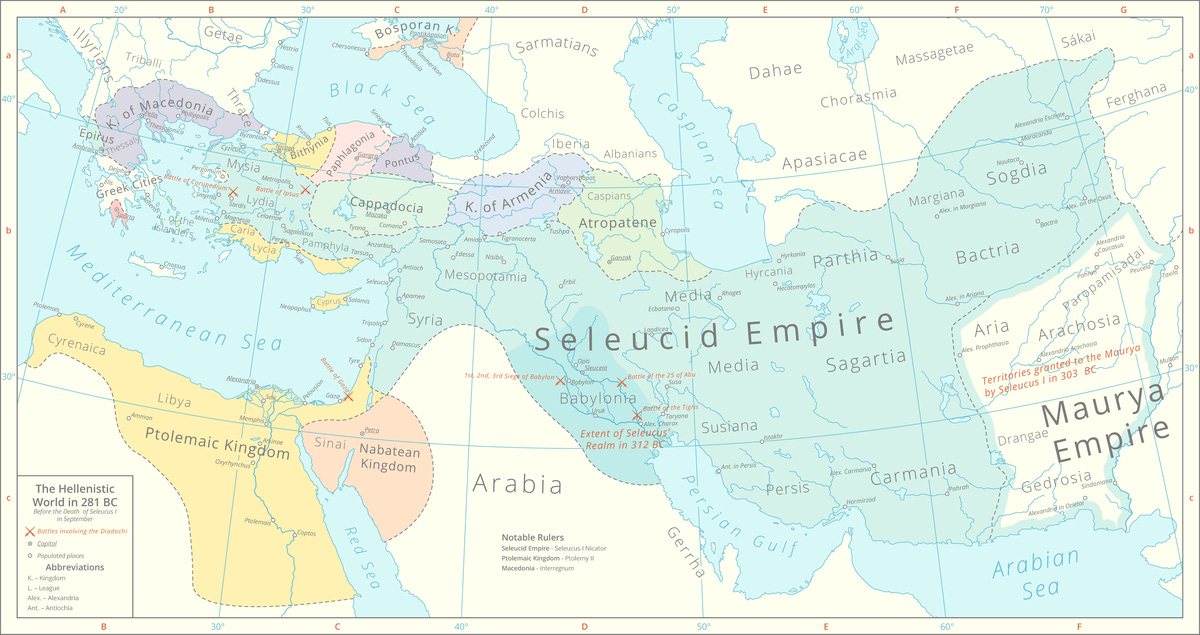
Alexander to Actium is classicist Peter Green’s gargantuan tome covering the period historians now call the Hellenistic era, the 293-year span following the death of Alexander the Great during which his vast but short-lived empire was divided up and ruled by ethnically Macedonian and Greek elites who left the stamp of Hellenic culture all across the eastern Mediterranean. The era begins with Alexander’s generals (the Diadochi, “Successors”) waging an epic forty years of war as funeral games for their dead master before finally settling into a more stable system with three great kingdoms centered on Macedon, Egypt, and Syria (plus lesser monarchies like Pergamon and Bactria). These kingdoms battled one another and Rome for another quarter-millennium, gradually losing land and power before they were extinguished, one by one. The last Hellenistic kingdom, Ptolemaic Egypt, made it until 30 B.C., when the legendary Cleopatra1 committed suicide and her realm became the personal possession of Octavian, the future Caesar Augustus. Long after their destruction, the Hellenistic legacy lingers most in religion: the Christian New Testament was written not in the Hebrew or Aramaic of Judea or the Latin of the Roman Empire, but in the koine Greek that had become the lingua franca of the educated eastern Mediterranean.
The ebb and flow of this 300-year historical epic is one that really deserves a trashy big-budget TV adaptation or three. The sordid acts of the Successors and their successors are so spectacular they could easily be made into a hybrid of HBO’s Rome and a popular show about dragons that shall remain nameless. I’m a little shocked one hasn’t been made already. To give just a small set of anecdotes from Green’s work:
- After an attempted army revolt following Alexander’s death, the general Perdiccas holds a “purification” ceremony for the army, which consists of rebel leaders being publicly trampled to death by elephants.
- Antigonus One-Eye, the man who came closest to reuniting Alexander’s empire, was very tall, very wide, very old, and had a very good nickname. Huge in size and huge in ambition, he dies fighting in battle at over 80 years old at Ipsus, a battle featuring 25,000 cavalry, 120 scythed chariots, and almost 600 elephants.
- Olympias, Alexander the Great’s mother, is so vindictive that when Philip II dies, she has a rival wife and her infant daughter roasted to death on a charcoal brazier even though they pose zero dynastic threat. When her own end comes during Macedon’s multiple civil wars, the soldiers of Cassander refuse to kill Alexander’s mother – so she is instead stoned to death by the families of those she had killed during past purges.
- Seleucus I, founder of the Syria-based Seleucid Empire, is happily married to his second wife Stratonice when he notices his son, Antiochus, is deeply enamored with her. No worry: Seleucus simply divorces Stratonice and has her marry Antiochus. This is actually a happy ending and works out for everyone, surprisingly.
- Lysimachus, king of Thrace, is happily married to his third wife, Arsinoe, when she tricks him into having his son by a first marriage executed so her own son can succeed. This sparks a war that kills Lysimachus and destroys his kingdom, somewhat botching the whole succession thing. But no worries: Arsinoe escapes to Egypt and makes out just fine by marrying its pharaoh – her brother.
- Cassander, king of Macedon, gets so irate at clever jabs from the wily Athenian politician Demades that he finally snaps and personally chops both Demades and his son to pieces while screaming insults at them.
- For about a decade during the various successor wars, Athens is ruled by a literal philosopher-king, the thirty-something Macedonian puppet Demetrius of Phaleron. One of his agenda items is building a gigantic mechanical snail to crawl through the streets of Athens leaving a realistic trail of slime behind; this is apparently some artful way of shaming the Athenians for being sluggish in standing up for Greek freedom.
- After Demetrius the Philosopher King is overthrown (by a different Demetrius, long story) the new tyrant takes advantage of divine honors granted to him to house his hoes in apartments at the back of the Parthenon. He tries to seduce a teenaged boy who instead commits suicide by jumping into a tub of boiling-hot water, and another time waives a fine against a prominent Athenian citizen in return for taking his son as a catamite. When you are legally a god, they let you do it.
- Aratus is a quite successful Greek general with the unfortunate problem of getting uncontrollable diarrhea before every battle.
- Escaped slave and rebel Drimakos defies authorities on Chios so successfully they simply reach a treaty with him: As long as he doesn’t steal too much and only accepts new slaves into his army who were severely abused by their masters (while sending the rest back), they’ll leave him alone. Drimakos lives to a ripe old age, then has his boy lover kill him and take his head in to claim a reward. Later, Drimakos’s spirit would supposedly appear to Chians in their dreams to warn of plots by their slaves.
- To show off their power, the Ptolemies commission a grand procession through Alexandria whose centerpiece is “a gaudily painted gold phallus, almost two hundred feet long … and tied up, like some exotic Christmas present, with gold ribbons and bows”. Green reasonably wonders how this mighty phallus was able to negotiate corners.
- The later Ptolemies could win some kind of ghastly award for their spectacular decadence. Ptolemy VIII Physcon (“the Obese”), who resembles a 2nd century BC Baron Harkonnen, seizes power after the death of his brother (also named Ptolemy) by marrying Cleopatra, who is also their sister. He then has her son, his nephew (also named Ptolemy), murdered during the wedding feast, then proceeds to seduce and marry his pubescent niece (also named Cleopatra). A decade later, riots forced Physcon and his niece-wife into exile, and his sister-wife proclaims her son by Physcon (another Ptolemy) as pharaoh, but the heir is apparently in Cyrene at the time, allowing Physcon to capture his unsuspecting son and send his dismembered corpse to the sister-wife as a birthday present. Meanwhile, the sister-wife’s daughter by her first brother (named Cleopatra, of course) gets married off to a Seleucid king and uses her sons as a series of puppets. The first puppet, Seleucus V, proves troublesome, so his mother murders him by using him for archery practice. The second puppet, Antiochus VIII, is more canny, and when his mother tries to murder him with a cup of poisoned wine, he notices something is up and forces her to drink the fatal cup herself. Antiochus VIII then fights a long civil war against his half-brother and cousin Antiochus IX, who is not a puppet but instead has the private hobby of playing with literal giant puppets. Got all that?
If learning the above is your idea of fun, then Alexander to Actium is a rich feast, enlivened throughout with Green’s flare for delicious details and legends that are possibly fanciful but too remarkable to leave out.
Blake Neff, “GUEST REVIEW: Alexander to Actium, by Peter Green”, Mr. and Mrs. Psmith’s Bookshelf, 2025-10-20.
- The Seventh, it turns out.
August 2, 2026
QotD: Churchill’s views on India
On the other hand, Churchill repeatedly voiced his admiration for the gallantry of Indian troops, noting in his war memoirs: “The unsurpassed bravery of Indian soldiers and officers, both Moslem and Hindu, shine for ever in the annals of war. Upwards of two and a half million Indians volunteered to serve in the forces … The response of the Indian peoples, no less than the conduct of their soldiers, makes a glorious final page in the story of our Indian Empire.”
Despite his fears about Indian independence, Churchill’s views noticeably mellowed over the years. On 5 February 1942, Churchill proposed in cabinet to visit India to make its Congress leaders an offer of postwar independence, in return for their supporting the war effort. But instead the war cabinet sent its senior Labour minister, Sir Stafford Cripps, known for his friendship with Congress leaders. When the Cripps mission failed to meet their demand for immediate independence, Congress launched the Quit India movement of civil disobedience against the Raj and resolved to offer only passive resistance to the Japanese invasion.
On being informed of this in September 1942, an apoplectic Churchill exclaimed to Amery: “I hate Indians. They are a beastly people with a beastly religion.” He was referring to Hinduism, rather than Islam, given loyal support for the war effort from the Muslim League. Churchill saw Gandhi’s decision to launch the Quit India movement in the middle of the war as a stab in the back when Britain most needed and deserved loyal support.
He also (like many Indian liberals and socialists) saw Gandhi’s political fasts as a form of emotional blackmail. And he was appalled, as were many Congressmen, by extreme nationalists such as the Bengali leader Subhas Chandra Bose joining hands with Hitler and the Japanese, a fact not calculated to endear Bengalis in general to Churchill.
Churchill’s abusive comments about Gandhi, Indians and Bengalis need to be seen in that context. They also need to be seen in the context of his penchant for making outrageous comments that he didn’t really mean in order to shock or tease.
Zareer Masani, “Churchill and the genocide myth”, The Critic, 2020-12-06.
August 1, 2026
QotD: The “tiers” of US post-secondary education
Level two is your SPLACs [Small Private Liberal Arts College (the denizens of a SPLAC are of course Splackavellies, in honor of the stupidest song of the 1990s, which is an amazingly high bar)]. The Ivy League schools are SPLACs, and the rest of them are their lesser (sometimes extremely lesser) imitators. You don’t need to publish squat to get tenure at Yale or Harvard if you bring something else [visible diversity, for example] to the table.
The third level is the junior college level. They call themselves “community colleges” in most cases — can’t use junior, it’s able-ist or age-ist or some shit-ist — but you know what I mean. Lots of kids do their first two years at one, getting all the BS “liberal arts” requirements out of the way before they transfer to Ohio State (etc.) to do their major classwork, so lots of History (etc.) profs work at JuCos. (This is the way to do it if you feel you must go to college for some reason, which 90% of the time you mustn’t).
I’ve done time at all three, because of academia’s worst-kept secret: Something like 75% of ALL classes, nationwide, at all levels and in all disciplines, are taught by non-tenure track faculty. Lots of these instructors are grad students, who will theoretically go on to get tenure-track jobs, but there’s a vast floating pool of scab labor known as “adjunct professors”, and I was one of those — a guy with a PhD who isn’t on the tenure track …
… and now never will be, because “adjunct professor” is like “sex worker” — yeah, it’s theoretically just a job now, but good luck getting hired to do anything else once it’s on your resume.
In my case that was by choice, as I loved my field, I loved teaching, but I did NOT love all the rest of the shit that goes along with university employment, and since I had (and have) an ad libitum gig that pays the bills I could follow my bliss, as they said back in the Sixties (I’m told). And since all eggheads are tech-illiterate I was able to do a lot of “online ed”, too. Which is the easiest money you’ll ever make as a professor (yep, I was one of those guys, not University of Phoenix but similar, and y’all, I have stories … oh, how I have stories. Everything you think about “online ed” is true, in spades. If you’re a few credits shy of that AA degree and just need a rubber stamp, then by all means go that route. If not, the University of YouTube has you covered).
Severian, “Friday Mailbag”, Founding Questions, 2022-07-01.
July 31, 2026
QotD: Cuisine on campaign
Supposing, for a moment, a bit of imagination on the part of quartermasters and cooks, and a semi-intelligent rationing authority, a war might be conducted with a bit of style. There could be rivalry between regimental kitchens, or between the galleys in Her Majesty’s fleet. Food could be made a powerful inducement in the recruitment drives.
There are some little sparks like this, in history. In the Crimean War, Florence Nightingale, that extraordinary lantern-bearing angel, procured the voluntary help of Alexis Soyer, the leading London hotel chef of the day, to advise her on the organization of field hospital kitchens. These quickly became the place to eat — almost worth getting wounded. M. Soyer applied his very broad mind to analyzing the limitations of field cookery, then turning each limitation into a strength. (I recommend his Culinary Campaign in the Crimea, 1857.)
Morale is not a small thing in the conduct of war. A hot meal served in defiance of logistics in the cold wet of a hideous trench, comes to remind us of victory, in the very face of the enemy.
David Warren, “Non-idlers”, Essays in Idleness, 2020-11-11.


