
The first thing to note is that when we talk of “Roman roads”, we almost always mean the viae publicae, roads built by public officials (Initially censors who let out the contracts to build such public works, although later roadways get named after the consuls and praetors who constructed them as the Romans build more of them) and was maintained by the state. But of course these major state highways existed within a wider network of local roads (a via vinciales or actus, pl. actus – everybody loves the Fourth Declension! It’s a step in the right direction) which might or might not be private (a privatum iter). That distinction is important, because it wasn’t that all Roman roads were of the high quality we tend to think of – the roads we’re thinking of were prestige projects undertaken by the state, but a whole [mess] of private lanes and dirt paths existed too.
That said, for the major viae publicae, the combination of archaeologically preserved examples and a few references in literary sources gives us a good sense of what “best practices” for Roman road construction were. To start with, obstructions were cleared and then a trench was dug where the road would go. The trench was then filled with three packed layers: a stone layer, then a gravel layer and finally a sand or cement layer. On this was placed the surface of stone blocks, cambered so that rainwater drained to the sides of the road. The stone surface was then held in place by an umbo (literally a “knob” or “swelling”, the same word is used for shield bosses) on the edges of the road. Within a town, the umbo might in turn border a stone sidewalk, but out in the countryside, that wasn’t present.
On the one hand, we know that the high-quality construction of Roman paved roads impressed in the ancient world; Dionysius of Halicarnassus proclaims them one of Rome’s three most magnificent works (alongside aqueducts and sewers, Dion. Hal. Ant. Rom. 3.67.5; note also in this vein Strabo 5.3.8; Plin. HN 36.125). On the other hand, we also know that not all Roman roads were built to the same high standard. While we know that various Roman legislation spelled out required road widths, for instance, the actual width of Roman roads varied widely. And while we’re here, I should note, the story you have heard that modern roadway width or standard railway gauge being based on Roman road width (or, heaven help us, Roman “war chariots”, a thing the Romans did not have) is rather wrong. Nor were they always well-constructed or maintained; Julian, for instance, bemoans a poorly maintained road in a letter to Libanius in 363.
Also, if I may stop a moment, one thing I hear frequently said about Roman roads is that their survival serves as some sort of indictment on modern road construction, “they don’t build them like they used to!” There are a few layered bad assumptions here. The first, of course, is survivorship bias; that road outside of Chalcis that Julian complained was sinking into a swamp probably isn’t available for us to see and similarly badly maintained or poorly constructed Roman roads are simply gone or only visible with archaeological methods and so unavailable for comparison. At the same time, modern roads are asked to do things which ancient roads were not; I do not suspect many Roman roads would last very long if hundreds of 20-ton (or more) trucks were rumbling over it daily. Indeed, preserved Roman roads outside of the cities often have deep ruts worn several inches deep in the stone from the passage of carts (carts and other vehicles were generally banned inside of Roman cities; city streets were for pedestrians). Finally we know that Roman roads, just like modern ones, required maintenance and reconstruction fairly regularly in the period of their use; Laurence (op. cit., 66) has a neat table of inscribed milestones on the Via Appia, for instance, referring to repair or reconstruction, with sections of the roadway repaired in stages from 97 to 110AD.
Nevertheless, the generally high quality of Roman roads, as noted, was recognized in antiquity and is still apparent in their survival today. In contrast to many unpaved sections of Persian royal roads, for instance, Roman viae publicae were paved as a matter of course and standard widths (c. 3.5m wide; the oldest Roman laws, the Twelve Tables, set a minimum width on straights of c. 2.4m though as noted this was not always followed) were fairly generous. And they tended to be well-engineered, with relatively flat surfaces (which are often quite a bit less flat today due to ground shifting as well as the erosion of concrete between paving stones) and straight lines, though the notion that all Roman roads were ruler-straight is, of course, wrong (though some are!). In particular, the Roman system of road construction, while it demanded considerable up-front labor costs, was seemingly designed to keep long-term maintenance demands low. This was a style of road building which accepted big up-front costs in exchange for lower long-term maintenance, which of course demands a lot of initial state capacity to manage the costs and labor demands (something Rome’s successors would mostly lack).
So as roads go, the Roman ones were uncommonly good (albeit with a wider degree of variation than is often appreciated), but the marvel of the Roman roads is not that they had a few good, paved roads – states had been building paved roads for some time, as noted above – but that they had a massive system of them. Scale, more than quality, was the Roman achievement here, though the quality was also quite high.
Bret Devereaux, “Collections: Roman Roads”, A Collection of Unmitigated Pedantry, 2023-06-02.
August 28, 2026
QotD: Roman roads
August 27, 2026
QotD: Useless and irritating computer tricks
Stop trying to grab my attention, dammit!
No, I do not want windows to fade in and out, or riffle like a deck of cards, distort into a crescent while they get sucked into the dock, or whatever other cute effect some UX designer thought up this week. Just no.
I’m sitting at my machine to work on something. I’m concentrating. I’m a human with a Mark I meat-brain, so my flow state is fragile. When I tell my interface to do a state change, I want it to go fast and clean, not razzle-dazzle at me in a way that risks breaking my concentration.
Actionable advice for people designing desktop environments: I get it about the eye candy, it’s marketing. All I’m saying is, have a freaking OFF switch? Give me a way to shut all that distracting shit right down.
Cosmic Desktop, which I’ve truly loved ever since I started using the alpha, doesn’t have animations. The roadmap mutters about adding them in a future release. I’m going to be very sad if they are mandatory.
To sharpen the point about distraction, let me talk about a fancy new-school desktop-environment hack that I do like; the ability to set a translucency level on terminal windows and docks and things.
I tried setting translucency on my terminal background. At first, it looked pretty over the deep-sky astronomical photograph that Cosmic uses as a default background (and which matches my taste — I’ve been using a collection of similar deep sky photographs as backgrounds for many years). But it got old after about five minutes; when I’m reading text, and my eyes trip over a detail in the background, that’s distracting.
On the other hand, I really like being able to set translucency on my application dock. I can mouse up and pop up the dock to select an application without losing visual continuity with whatever is going on under the translucency. That is anti-distractive.
I want my whole environment to be anti-distractive. Pretty is nice when I have the bandwidth to notice it on my own (yes, Cosmic I do like your default dark mode with neon-blue piping), but the moment an interface design tugs on my sleeve to say “look how cool I am!”, that’s when I reach for my revolver.
ESR, The social media site formerly known as Twitter, 2026-05-19.
August 26, 2026
QotD: Putting US power generation in perspective
John Robson, “Tidbits”, Robson on Climate Nonsense, 2026-05-24.
August 25, 2026
Rome’s annona civilis
In the late Roman Republic, the rapid increase among the urban poor in Rome itself eventually led to the Senate introducing food relief for the very poorest Roman citizens, the Annona civilis. It should be no surprise to anyone who’s been paying attention that giving away free stuff attracts people happy to accept free stuff:
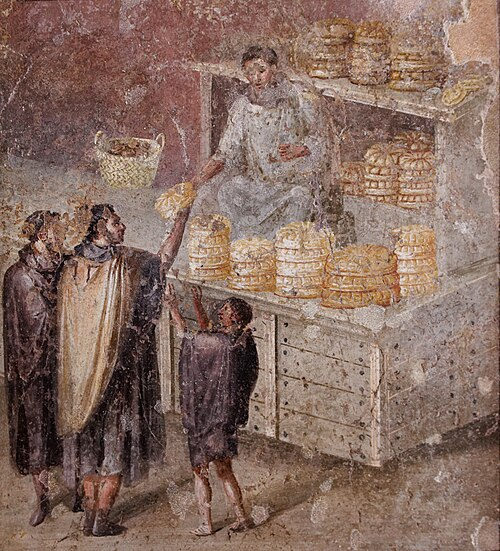
Rome handed out free grain to 40,000 citizens in 73 BC. By 46 BC, Julius Caesar found 320,000 people lining up for their monthly ration. That eight-fold expansion happened in under three decades, and it shows you how welfare states actually grow.
No Roman senator stood up and announced a plan to addict a third of the city to government bread. It happened incrementally, through political competition. Each magistrate who wanted votes expanded eligibility. Each expansion normalized the next one. The citizen who once considered the dole shameful eventually expected it, then demanded it, then organized politically to protect it.
This is the core mechanism free market thinkers have identified across every era: once you create a transfer program, you create a constituency for that program. Recipients vote. Administrators build careers. Grain merchants who supply the state develop a stake in keeping the contracts flowing. The political economy locks in.
Caesar, to his credit, actually cut the rolls back to 150,000 through verification audits. It was one of his more economically coherent moves, though the Senate still murdered him. His successors quietly let the numbers climb again.
What did the dole require? Massive grain imports from Sicily, Sardinia, and Egypt, organized through state logistics at state expense, funded by taxation and conquest. When the conquest revenue dried up, the obligation remained. Rome had written a check against future military success, and future military success eventually failed to arrive.
The lesson is not complicated. Distribute a benefit and you distribute dependency. Distribute dependency and you distribute political power to whoever controls the distribution. The grain dole didn’t weaken Rome overnight, but it made every subsequent reform politically impossible.
The simple-but-not-easy-fix is to only allow people not accepting the free stuff to vote. You can imagine just how well that would go down in an election campaign at any level, can’t you?
QotD: “… and called it macaroni”
I don’t know whether you need much in the way of background, but since some of you seem to enjoy the “inside baseball” stuff … History, as an academic discipline, has always suffered from a “source base” problem. We deal with artifacts; more specifically with documents. If it ain’t written down … see what I mean? This is why whoever-it-was wasn’t wrong when he said that History is just the biographies of Great Men. It’s the biographies of the best-documented men, anyway. I’m exaggerating for effect, obviously, but you see what I mean.
So when, in the Seventies, we had the “cultural turn“, a whole new series of techniques had to be developed to expand the source base. Some of those were good and necessary. Others … well, Wiki quotes Frederic Jameson, one of the most prominent early-90s obfuscators (Indie band name?):
The very sphere of culture itself has expanded, becoming coterminous with market society in such a way that the cultural is no longer limited to its earlier, traditional or experimental forms, but it is consumed throughout daily life itself, in shopping, in professional activities, in the various often televisual forms of leisure, in production for the market and in the consumption of those market products, indeed in the most secret folds and corners of the quotidian. Social space is now completely saturated with the image of culture.
Translated from the PoMo, it’s your standard, tiresome stuff about “critique”. Culture just IS Capitalism, which IS Consumerism, blah blah blah, you know the drill. It’s tedious, but it’s not entirely wrong — what people “consume” (in the egghead sense, not the biomechanical sense) can give us important clues about their world. So long as you avoid the teleological temptation (didn’t they tour with EVC?) of attributing everything to “Capitalism”, you can do good work.
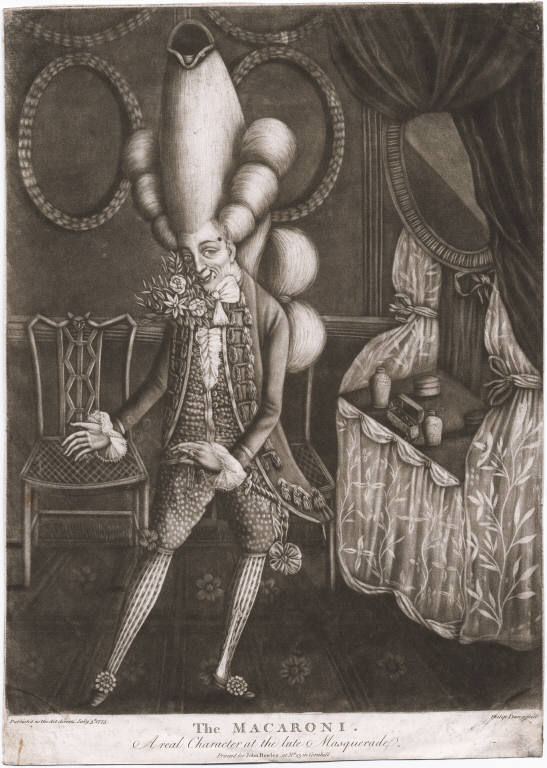
The “problem” with recent history is that the “centers of cultural production” do seem to be identifiable, and so are their motives. They are “Madison Avenue” and “to make money”, respectively, and so it’s easy — and profitable!! — to do the tiresome PoMo CultMarx thing. The further back into The Past you go, though … well, consider this:
As you can see from the caption, that style is called “macaroni” — like from the old song “Yankee Doodle,” which the Colonials appropriated in an early example of “owning the insult.” Wiki sez:
Stereotypically, men in the macaroni subculture dressed, spoke, and behaved in an unusually epicene and androgynous manner. The term “macaroni” pejoratively referred to a man who “exceeded the ordinary bounds of fashion” in terms of high-end clothing, fastidious eating, and gambling. He mixed Continental affectations with his British nature …
… The macaronis became seen in stereotyped terms in Britain, being seen as a symbol of inappropriate bourgeois excess, effeminacy, and possible homosexuality – which was then legally viewed as sodomy. At the time, homosexuality was frowned upon, and was even punishable by death. Many modern critics view the macaroni as representing a general change in 18th-century British society such as political change, class consciousness, new nationalisms, commodification, and consumer capitalism.
You see the typical “critical” blah blah blah there at the end, and it’s not wrong, just tedious, predictable, and tediously predictable. It’s also much harder to find a “purpose” for this behavior. It’s easy to do for the modern analogue of the macaroni, the hipster […] which Wiki documents extensively, because of course they do, it’s right there underneath “macaroni”. But the whole “culture industry” thing wasn’t there yet in the 18th century, so it might actually be down to an individual person. It’d be theoretically possible to find “the first macaroni” — it was the Marquis de Whatever, and he decided to dress like that because reasons, and all the best people decided to copy him, also because reasons, and that’s pretty much all your “cultural turn” can do, because that’s the only documentation we have.
Since we here are not bound by the canons of scholarship, however, we can speculate. I want to focus on this bit about macaronis:
In the 18th century, wealthy young British men traditionally took a trip around Europe upon their coming of age, known as the Grand Tour. Italy was a key destination of these tours. During their trip, many developed a taste for maccaroni, a type of pasta little known in Britain then, and so they were said to belong to the Macaroni Club, founded in 1764 by those returning from the Grand Tour. They would refer to anything that was fashionable or à la mode as “very maccaroni”.
That’s Information Velocity, preindustrial-style. They had to go there personally — or, at the very least, have access to the in-house journals of those who did:
The song “Yankee Doodle” from the time of the American Revolutionary War mentions a man who “stuck a feather in his hat and called it macaroni”. Dr. Richard Shuckburgh was a British surgeon and also the author of the song’s lyrics; the joke which he was making was that the Yankees were naive and unsophisticated enough to believe that a feather in the hat was a sufficient mark of a macaroni.
In America, only a select few persons would have access to that kind of thing, because only a few would move in those circles.
Go back a bit further, and cultural trends are far less traceable, but “centers of cultural production” are much easier to find, in one specific sense: They’re monasteries. And there you have a group which speaks a common language — extremely rare in the Middle Ages — is literate (ditto), and has something close to, if not caloric surplus, then at least “chronic caloric sufficiency”, I guess we’ll have to call it. Monks worked hard in the Middle Ages, by our standards, but not as hard as the peasantry. They were well-fed, or at least consistently fed, in a way the peasantry weren’t.
In other words, whatever Information Velocity existed in the Middle Ages, they had it. They made a virtue out of circulating books, and all those books were in a common tongue. Since they also produced books — indeed, were pretty much the only ones who did — they were also, by definition, au courant with whatever the high fashions were, because they illustrated the books that were such a crucial part of the aristocracy’s gift-giving culture.
Severian, “Monastic Vices”, Founding Questions, 2026-01-13.
August 24, 2026
QotD: The difference between “book smart” and “street smart”
Joca @jocadbz
Translated from Portuguese
How many geniuses have you heard about in recent years? They all had very superior IQs and were supposedly going to change the world
Know what happened? Nothing. Nothing ever happensWe hear a lot of people go on about the difference between “book smart” and “street smart”.
But psychologists who test and study intelligence know there’s no such thing. Smart is smart. So is this all just a way of coping with envy of higher IQs?
No. We’ve all met that guy who is clearly very intelligent, but can’t seem to accomplish anything outside a cloistered academic environment.
But we always seem to find him in a academic environment, don’t we?
“Book smart” is an incorrect name for a person who is intelligent, but has been mentally and psychologically harmed by an educational system, to the point where he can’t actually use that intelligence properly for tasks outside that environment.
Ironically, the more a child is obviously intelligent, the more the education system conspires to destroy him … because everyone with a “degree in education”, almost without exception, is either actually stupid, or is himself the end product of this same sort of mental mutilation.
Here’s how it works.
There are two types of intelligence tasks: answer tasks and result tasks.
A result task is graded by the reaction of the environment to your work. Either your software runs, or it doesn’t. Either your rockets fly, or they don’t. Customers buy millions of your product, or none.
You have unlimited tries unless you run out of money, but there’s no partial credit, and you can’t talk the universe into accepting your answer if it doesn’t.
Result tasks typically require a lot of work, are data-intensive, and have lots of sub-problems, because the ones that didn’t are already solved.
Result tasks are why we care about smart at all. Because smart people are the ones who can do this. And every human advancement or achievement ever was a result task.
Answer tasks are quite different. They are artificial problems created by a human being for another human being, whose goal is to produce the known answer.
Tasks like this have useful features. They can be tightly calibrated for appropriate difficulty. They are easy to grade. They can be used to teach particular subjects or skills.
But there are certain things they don’t teach.
How to do the boring parts that don’t impress anyone with how talented you are.
How to fail and try again.
How to change the question instead of answering it, because the question itself was wrong.
How to absorb from others what they had to learn the hard way, instead of reinventing the wheel.
How to deal with problems that have no solutions, only tradeoffs.
How to work with others and pass the ball.
How not to adapt instead of freezing when the universe gives the exam before the lesson.
How to substitute the adequate you can afford for the ideal you can’t.
How to prioritize what is needful over what is elegant or cool.
Without this learning, and other similar lessons, the talent child turns into an adult with an unbalanced intellectual development, like a bodybuilder who skipped far too many leg days.
You’ll find a lot of men like this in academia because it provides them with a sheltered, tightly controlled environment, where the problems are abstract if not utterly fake, and the persuasiveness of a solution trumps its workability.
They tend to scorn achievers, especially achievers with modest academic credentials or none, and this invites scorn in turn from people with real jobs.
But really what they are is victims. Entire campuses and networks full of what was potential greatness, crippled in it youth by bureaucracies that claim to serve it.
Homeschool your children.
Give them projects, not puzzles.
Teach them to build things.
Devon Eriksen, the social media site formerly known as Twitter, 2026-05-05.
August 23, 2026
QotD: “I found a million dollar baby in a five and ten cent store”
I once asked a friend in the French music biz how the song went over there. I hummed him the tune and he sang me the French lyrics and, although I can’t recall any of them, I remember they were entirely different from the English words. It’s not just the five-and-ten that’s hard to translate or the million dollar baby. But the concept of finding the latter inside the former is also very American. There are a ton of Mitteleuropean operettas in which the prince or duke or count wanders into the streets in disguise and falls in love with a serving wench, but the serving wench usually turns out to be a Countess or Margravine or some such also wandering around in disguise. Even the British are prone to this syndrome (Spring In Park Lane, etc). But in an American song the shop girl is a genuine shop girl, and she’s still a million dollar baby. That’s what makes it American.
In the Sixties, by the way, you could have found a future billion dollar baby in a five and ten cent store: Sam Walton, founder of Wal-Mart, got his start in retail as a franchisee at a Ben Franklin’s, founded in 1920 by the Butler brothers, who’d been in the five-and-dime business since the 1870s. I’m not saying “I Found a Million Dollar Greeter in the Big Box Store at the Strip Mall on the Edge of Town” would be as big a hit, but there is an historical continuity from the Butlers to Wal-Mart.
Mark Steyn, “I Found a Million Dollar Baby (in a Five and Ten Cent Store)”, Steyn Online, 2020-10-25.
August 22, 2026
QotD: Fortified towns in the Middle Ages
Nevertheless, the larger size of the area being defended makes it harder to deploy concentric defense-in-depth solutions. There are also transit considerations: towns are, after all, economic centers, typically sitting at the junction points of many different local and regional routes, which means they tend to need lots of entry-points to facilitate all of that travel and trade and in turn that means lots of potentially vulnerable gatehouses. Meanwhile, internally, the desire for residents to move around the town freely and general land-use considerations make subdividing towns into walled districts (very common in video-games for memory-management and loading reasons) very difficult and as a result very rare. You can see this, for instance, looking back at the period city-maps from the Lonely Cities series: a good number of cities have either a citadel or a section of the town which is walled but also outside of the main circuit (often separated by a river), but full concentric styles of defense or multiple cell-like walled districts don’t really occur. There are exceptions, but they are relatively rare: most cities have a single primary circuit of walls, which, if they are breached generally give access to the main area of the town.
In Europe, the most complete and formidable set of city walls were without question the Theodosian Walls built to defend Constantinople during the reign of Theodosius II (r. 402-450). The Theodosian Walls stood for the whole Middle Ages but they really reflect the culmination of the ancient system of city wall fortifications, the ultimate answer to the kind of “big army” playbook the Assyrians (and Romans) employed. So I want to both talk about the defense system but also note points where its method diverges from the walls of later medieval towns.
The Theodosian Walls had to cover some 5.7km and had nine gates; both numbers should immediately make clear that you needed quite a few people to man these defenses effectively. This was in particular a factor for town defense: most of the defenders are going to be citizens of the town called up to defend it in an emergency, rather than a standing guard. As far as I can tell, this seems to have made towns somewhat more vulnerable to surprise “hasty assaults”, if the attacker could force a gate along a long circuit before the defenders knew where the attack was coming. Of course that problem is intensified by the fact that this is a single-point-of-failure system: the loss of one gate against a superior foe generally meant the loss of the town.
The Theodosian Walls are unusual in that they are a set of triple walls. The main fighting position was on the inner wall; in front of this was the peribolos, a low, flat, unobstructed gap, after which was the lower outer wall, a secondary forward fighting platform. The towers of the inner wall project out into the peribolos for exactly the same reason castle towers project: defenders on those towers can fire, unobstructed, down the peribolos, meaning that an attacker can find no safety here. The crenellation of the outer wall likewise only faced out, so attackers who seized the outer wall would have no cover from defenders fighting from the inner wall. Next, after another gap was a simple low forward wall, little more than a stone breastwork about 1.5m high. Finally, the low wall stood at the inner edge of a large moat, some 20m wide and 10m deep, because no good defensive system is complete without a ditch.
That low wall is a kind of what we call an “outwork”. This particular kind of outwork is a product of the ancient world and uncommon in medieval fortifications to my knowledge; it was a response to the increasing use of torsion catapults during the Hellenistic period. While it did offer a position for defenders to use to sally out (for instance to destroy enemy siege engines), the primary purpose was to prevent enemy catapults from being able to direct fire at the base of the main wall and its towers. Even if knocked down, such an outwork’s rubble would obstruct direct fire on the curtain wall or the towers. This idea – using an outwork to physically block lines of fire on the curtain wall – is going to come back a bit later.
In contrast, most later medieval town wall circuits generally only have a single curtain wall, supported by a moat. As with castles, the wall is supported by projecting towers which can direct fire along its length and hardened gatehouses. Where cities sometimes do employ defense-in-depth it is with a “citadel” – a hardened fallback position either inside the city or (more often) built in to the wall circuit; essentially a complete castle built into the city wall. The role of the citadel is important for thinking about what these defenses are intended to achieve: defenders who have lost the main area of the city but have held out in the citadel are unlikely to be in a position to recapture the city or even to seriously threaten to do so. But the citadel has important negotiating power. Even a small number of surviving defenders can likely hold a citadel (with its stockpile of supplies) for a long time; taking such a citadel by storm poses all of the problems of storming a castle, with the added disadvantage of having to do so through city streets. Consequently, defenders holed up in the citadel are in a good position to negotiate for terms: perhaps being able to march out unharmed in exchange for turning over the citadel, or else negotiate less onerous terms for the city in general (alternately, they might try to hold out until a friendly relief army could arrive).
And that brings the focus to something important about almost all medieval siegecraft: the siege and negotiations generally proceeded side-by-side. By raising the cost of a siege (either a blockade or a storming assault), the defender could improve their bargaining position, even if they were always going to have to surrender. Meanwhile the attacker, by very visibly preparing for a deliberate assault could signal to the defenders their resolve and thus attempt to encourage surrender. As far as I can tell, far more fortified medieval towns and castles surrendered than were ever taken by storm and so consequently a lot of this fortification work is as much about shifting bargaining positions in the event of an attack as it is resisting an attack.
Bret Devereaux, “Collections: Fortification, Part III: Castling”, A Collection of Unmitigated Pedantry, 2021-12-10.
August 21, 2026
QotD: The Amish
The basic organizational unit of Amish society — after the extended family, which is vital and often includes three generations under one roof — is the “church district”, a community of twenty-five to forty families who live within a short buggy-ride of one another. The leaders of the district are chosen by lot from among the married men, and each is governed by an Ordnung, an unwritten set of rules laying down expectations for behavior. It’s this Ordnung that contains the restrictions on technology and lifestyle that we typically associate with the Amish, covering everything from what color you can paint your barn (one group insists on red because white would be too worldly) to whether you can use mechanical milking machines. The church revisits their Ordnung every six months or so to see if it needs updating — one group had originally approved walkie-talkies for communication while hunting, but then discovered boys were using them to flirt with girls and decided to ban them. Church districts with similar Ordnungs are “in fellowship”, and a cluster of districts in full fellowship with one another are an “affiliation”. (A “settlement”, like the Holmes County Settlement, is a cluster of geographically contiguous districts regardless of affiliation.)
Importantly, few of these restrictions are based on the idea that the banned technology or behavior is wrong in and of itself: for instance, every Ordnung forbids a baptized Amish adult to own a car, but boys from some Amish families have cars for a while in their teens and all but the most conservative affiliations will pay someone else to drive them if they need to go farther than their buggy can take them. Or to put it another way, nobody thinks the English are bad people for driving cars — they just think we’re not Amish.
So if an Ordnung mostly isn’t meant to keep you from doing intrinsically evil things, like murder and adultery and blasphemy, what is it for? How do you decide what to allow? What are you optimizing for when you design it?
Two things, mainly, though they’re not neatly separated. The first and most important role of the Ordnung is engendering the virtue the Amish call Gelassenheit. There’s not a perfect English translation for the German,1 but Hurst and McConnell describe it as a spirit of “selflessness, humility, or meekness”, a subordination of self to community. Amish scholar2 Donald Kraybill wrote that Gelassenheit is meant to develop a “yielded self” that “stands in contrast to the bold, aggressive individualism of modern [English] culture”. Thinking too highly of yourself, or trying to outdo others, are failures of Gelassenheit, but they’re hard to avoid when you have to market your personal #brand or compete in the marketplace. Unmechanized agriculture, on the other hand, was very good at nurturing Gelassenheit: a farmer is necessarily aware of his dependence on natural forces beyond his control, which keeps him humble. Nowadays the Amish worry that shifts way from their traditional lifestyle will “foster the notion that the worker controls his or her work and life”, which might “breed an attitude of self-sufficiency, even arrogance” that is antithetical to their values.
The concern for Gelassenheit shows up particularly in Amish approaches to childrearing. Where English society values self-expression, intellectual curiosity, and individual accomplishment, Amish parents rank obedience and self-control as the most desirable qualities in children. (More than half of the parents the authors surveyed put “being interested in how and why things happen” at the bottom of their list.) They also report that teachers at Amish schools tend to be “preoccupied (to our eyes) with minor aspects of misbehavior that signaled nonparticipation in the group or lack of obedience to authority”. All of this carries through into the workplace, too: the Amish generally think white collar workers are “out to make the big bucks” and that their jobs are be difficult or impossible to undertake with a “meek spirit”. So if you can’t farm (and increasingly you can’t), the Amish think your work should be something near home that uses your hands, allows your family to participate, and contributes directly to your community. No arguments here that building dashboards to give executives deeper insight into critical business functions leads to the more efficient allocation of global capital and lifts all boats; they want you to make food or furniture or something.
The Ordnung‘s second goal is to separate believers from the broader world. This is partly a legacy of the Anabaptist experience of persecution, partly a response to Biblical passages like Romans 12:2’s warning not to “be conformed to this world”, and partly a protective measure against a world that isn’t interested in Gelassenheit, but the dualism between Amish and “English” is a vital part of what it means to be Amish. Of course, it’s impossible to clearly differentiate between things that promote a particular mindset/virtue and things that mark you out as different: the distinctive Amish “plain dress“, for instance, both limits opportunities for vanity and marks out the wearer as, well, kind of a weirdo. (There’s sometimes also a sub-goal of separation from other Amish affiliations — one Amish man is quoted saying, “The only reason the Old Order doesn’t have rubber wheels [on their buggies] is because the New Order did it first”.)
Jane Psmith, “REVIEW: An Amish Paradox, by Charles E. Hurst and David L. McConnell”, Mr. and Mrs. Psmith’s Bookshelf, 2025-12-15.
- And they mean something different by it than Heidegger does!
- Okay, this one is a Mennonite scholar of the Amish.
August 20, 2026
QotD: George Bernard Shaw’s role as Stalin’s useful idiot
Shaw toured Ukraine during the height of the Holodomor, when Soviet grain requisitions had stripped peasants of every scrap of food. Conservative estimates put the death toll at 3.5 million Ukrainians. Shaw saw the empty villages, the skeletal survivors, the mass graves. Then he signed a public letter praising Stalin’s “remarkable progress” and told Western journalists that reports of famine were capitalist propaganda.
Why would an intelligent man become Stalin’s useful idiot? Shaw believed in central planning with religious fervor. He thought brilliant intellectuals like himself could design society better than millions of individuals making their own choices. When confronted with central planning’s inevitable result (mass death), he chose to lie rather than admit his ideology killed people. Shaw preferred beautiful theory to ugly facts.
Shaw deliberately used his celebrity status to give Stalin cover while Ukrainian children died of starvation. He returned to Britain and spent years defending Soviet policies, even as refugee testimonies and photographic evidence exposed the genocide. The man who wrote about moral awakening in Pygmalion had abandoned his own moral compass entirely.
Free market economists warned that socialist calculation was impossible, that without prices and property rights, economies would collapse into chaos and death. Shaw dismissed these warnings as bourgeois nonsense while standing ankle-deep in their vindication.
Handre, The social media site formerly known as Twitter, 2026-05-13.
Update, 21 August: Welcome, Instapundit readers! Have a look around at some of my other posts you may find of interest. I send out a daily summary of posts here through my Substack – https://substack.com/@nicholasrusson that you can subscribe to if you’d like to be informed of new posts in the future.
August 19, 2026
QotD: The Kwantung Army was the tail wagging the Japanese Imperial dog
The Lytton Commission was commissioned by the League of Nations to investigate the Mukden Incident, which was one of those false flags the Kwantung Army was fond of. They used it to seize Manchuria — technically a province of China — and set up a puppet government they called “Manchukuo” (under the Qing Emperor who was deposed in 1911 — who was 5 at the time — thus giving it a veneer of historical legitimacy). The Lytton Commission concluded that the Mukden Incident was indeed a false flag; that Japan was the aggressor; and that Manchukuo was a puppet state that should be dissolved, with Manchuria returning to Chinese sovereignty.
That’s bad, because if you’re Japan and you do any of that, you’ve now knuckled under to not just the West, but the worst hypocrites of them all (“Lytton” was Victor Bulwer-Lytton, the 2nd Earl of Lytton, formerly governor of Bengal and Viceroy of India, and oh, by the way, how exactly did Britain come to rule in India? The shit they pulled makes the Mukden Incident look like very small beer indeed). And it’s bad from the Chinese side, too, because now you’ve basically tied their hands in any peace negotiations — they can’t conclude any kind of honorable peace without getting Manchuria back, and as should be obvious from the above, you must pry Mantetsu from Japan’s cold, dead hands.
Still, Japan might’ve disciplined guys like Ishiwara … but how? You can’t cashier him; the Army would go insane. You can’t really transfer him — as much trouble as he’s causing in Manchuria, if you bring him home you might well have another February 26 Incident, and it might work this time. You certainly can’t execute him, because a) you’d have to take his entire faction with him, which would decimate your officer corps, and b) perhaps more importantly, the seizure of Manchuria was pretty popular. Mantetsu’s Media boys hadn’t been sitting on their hands during all of this, of course, and the Army’s Media people had been going nuts too.
In the end, the Japanese pretty much had no choice: They gave the League of Nations the finger. Which of course emboldened the KA even more, such that they cooked up an even faker and gayer false flag, the Marco Polo Bridge Incident, and WWII was on.
Severian, “Slipping the Leash”, Founding Questions, 2022-08-27.
August 18, 2026
QotD: A quick heuristic for evaluating public figures
InfantryDort @infantrydort
The amount of trust I have in a person is directly proportional to how many legacy media hit pieces they attract.
My first thought was: good heuristic for evaluating public figures!
My second thought was: No, wait. Sometimes the legacy media attacks genuinely bad people.
My third thought was: … but this happens surprisingly seldom. Why is that? A few seconds of thought reveal the answer.
When you’re policing an orthodoxy (and the legacy media definitely sees its job as policing an orthodoxy) the most dangerous person isn’t the one whose beliefs are radically different from the orthodoxy, but the deviant whose position is just close enough to attract converts from within the orthodox mass.
Heretics get burned more often than do unbelievers.
So yes, InfantryDort is right. Probabilistically, trusting public figures that the media constantly does hit pieces on is unlikely to tangle you up with the genuinely evil and crazy, and much more likely to point you at truth-seekers.
ESR, The social media site formerly known as Twitter, 2026-05-15.
August 17, 2026
QotD: The real reason that MilSpec stuff sucks
@Fat_Electrician was talking about super cars and why they don’t generally work as well as, say, a regular car. Super cars break down a lot. Some are worse than others. His point, apparently from Jay Leno, is that a Ferrari has much less actual engineering in it than, say, a Dodge minivan. Why?
Because there are thousand more engineers working on the minivan and tens of thousands more background hours of engineering. The minivan comes from a long history of similar vehicles with much more engineering in the actual design.
So, think about a military vehicle. Say the Humvee. It’s not that it’s designed to fail, it’s that there is much much less engineering in it. Ditto any military equipment. Thus, it’s much more likely to break down, just like a Ferrari.
I was thinking about this in light of the current series I’m working on not to mention any milSF. The current series the main character is leading a group that works with a mix of civilian small freighter starships and military warships. The civilian ships, even the old ones, are relatively maintenance free vs the military ships. Why?
1. There’s way more engineering in the civilian ships because the companies sell more of them and can spend more on engineering.
2. There’s a lineage of what works and what doesn’t.
3. Civilian companies cannot spend enormous sums on maintenance.But it’s mostly the first one.
I’m not even sure I’m going to insert a discussion of it in the book. It’s the sort of thing I occasionally insert just because my readers sometimes find stuff like that interesting. But mostly I thought you might.
MilSpec sucks because there’s not as much of it as civilian.
John Ringo, The social media site formerly known as Twitter, 2026-05-07.
August 16, 2026
QotD: The “Marian reforms” were not a thing
- Cohorts: Experimented with before Marius, especially in Spain. Marius uses cohorts, but there’s no evidence he systematized or standardized this or was particularly new or unusual in doing so. Probably the actual breakpoint here is the Social War.
- Poor Volunteers Instead of Conscripted Assidui: Marius does not represent a break in the normal function of the Roman dilectus but a continuation of the Roman tradition of taking volunteers or dipping into the capite censi in a crisis. The traditional Roman conscription system functions for decades after Marius and a full professional army doesn’t emerge until Augustus.
- Discharge bonuses or land as a regular feature of Roman service: Once again, this isn’t Marius but Imperator Caesar Augustus who does this. Rewarding soldiers with loot and using conquered lands to form colonies wasn’t new and Marius doesn’t standardize it, Augustus does.
- No More equites and velites: No reason in the source to suppose Marius does this and plenty of reasons to suppose he doesn’t. Both velites and equites seem to continue at least a little bit into the first century. Fully replacing these roles with auxilia is once again a job for our man, Imperator Caesar Augustus, divi filius, pater patriae, reformer of armies, gestae of res, and all the rest.
- State-Supplied Equipment: No evidence in the sources. This shift is happening but is not associated with Marius. In any event, the conformity of imperial pay records with Polybius’ system of deductions for the second century BC suggests no major, clean break in the system.
- A New Sort of Pilum: No evidence, probably didn’t exist, made up by Plutarch or his sources. Roman pilum design is shifting, but not in the ways Plutarch suggests. If a Marian pilum did exist, the idea didn’t stick.
- Aquila Standards: Eagle standards pre-date Marius and non-eagle standards post-date him, but this may be one thing he actually does do, amplifying the importance of the eagle as the primary standard of the legion.
- The sarcina and furca and making Roman soldiers carry things: By no means new to Marius. This is a topos of Roman commanders before and after Marius. There is no reason to suppose he was unusual in this regard.
So the Marian reforms … were not a thing. Functionally none of what is described as happening in them was new or unique to Marius. Indeed, the most substantial reforms are either things that were already changing (and which Marius seems to have had little role in) or things which had not yet changed but which would, under Augustus. Indeed, one of the problems with the assumption of a Marian reform is that it takes a whole lot of changes which were more likely a package of reforms under Augustus and pulls them forward in time to Marius, doing some damage to our understanding of both figures.
But Augustus makes much more sense as the figure doing many of those organizational changes. For one we have sources actually telling us he did them, from the standardization of military service (Dio 54.25.6), the creation of retirement bonuses and the aerarium militare to fund them (Dio 54.25.6 again, but also Res Gestae 17), and the radical expansion and formalization of the auxilia as part of the Roman army (Tac. Ann. 4.5). The one thing missing is citizenship-for-service, which we can see emerging under Tiberius, the next emperor immediately after Augustus. And it makes sense because Augustus is, by necessity, doing a bunch of other things with the legions too. He’s instituting a whole new command structure, with dedicated legionary commanders (the legatus legionis) serving under his own provincial commanders (legati Augusti) with imperial procuratores handling the former role of the quaestors. Also, the legions get their citizen cavalry (though a quite small detachment of it) back too.
So instead of thinking, “Marian reforms” – which were, I must stress, not a thing – you ought to be thinking about a period of tactical, organizational and institutional change beginning in the second century, accelerating in the first century and then finally being instituted as a comprehensive set of reforms and formalization by Augustus, not by Marius, which codified a lot of change that had already happened over that long period. A long process with a punctuation mark at the end rather than a singular moment of reform associated with a singular Roman general.
Alright. Now one of you go and fix the Wikipedia entry.
Bret Devereaux, “Collections: The Marian Reforms Weren’t a Thing”, A Collection of Unmitigated Pedantry, 2023-06-30.
August 15, 2026
QotD: “The progressive is a walking paradox”
If I loudly claim to love vanilla ice cream, yet every time I return from the Mr Whippy van I’m holding a choc-ice, my revealed preference is evidently for chocolate — not vanilla.
Thus the truth of a person’s preferences is revealed through their actual choices and behaviour, not by what they claim to prefer.
It’s unfortunate we can’t simply listen to their words, but they are so oriented toward the external, the aesthetic, and the performative (“Theater Kid Progressivism”) that we must instead look at their proximal behaviours — where they actually choose to live and raise their families, for example, to extrapolate backwards their true feelings on mass migration and its consequences.
This is the lens through which we should try to understand our Progressive class.
The bitterest irony, the irony of ironies, is this: progressives, especially those who voted for it, self-evidently do not feel at home in the societies they helped create.
If they were genuine believers, they would live contentedly amidst their new friends.
Instead, they scuttle off into the countryside, the leafy suburbs, or gated enclaves, abandoning the very demographic transformation they imposed on others.
It is often said that if liberals didn’t have double standards they wouldn’t have any at all, but while this is very funny (and true), there’s more to it.
It reveals a profound non-confluence between their stated attitudes and their actual behaviours, indicative of extreme cognitive distortion.
They protest performatively that open borders and rapid demographic change are a universal good, even moral imperatives and (admittedly less often nowadays) sources of strength.
Yet when it comes to their most intimate revealed preference — where they opt to live and raise their families — they consistently prioritise homogeneity, good schools, and cultural familiarity.
They lobby and vote without end for policies that maximise immigration into lower- and middle class neighbourhoods, then abandon those very communities for pastures anew, safely insulated by postcodes and house prices.
Their revealed preference is that do not want to live in the Canada (or Britain, or America, or Europe) they are busily helping to construct.
They enjoy the vibes, the moral status, the Instagram aesthetics, while quietly falling back to the leafy, high-trust environments their grandparents took for granted.
Progressives love to speak of taboos (indeed if there is a pastime more alluring and intoxicating to the progressive than “breaking taboos”, I am yet to come across it, but I digress) yet is the greatest taboo of all right in front of us after all, carrying a basket of organic fruit and veg from Waitrose?
To interrupt the Progressive in the midst of his communal dream state, to turn our collective eye away from the brave new world they are building for us and to instead look inwards, to look the Liberal cuckoo directly in the eye and put words to the disparity between their words and their actions …
The subject of lawful and legal deportations is increasingly mainstream, yet what of urban renewal and rewilding by means of progressive importations?
The Progressive is a walking paradox, he is both the centre of attention and the ghost at the feast all at once.
Æthelstan, The social media site formerly known as Twitter, 2026-05-14.


