Quotulatiousness

October 8, 2025

Sentenced for their role in the largest peaceful demonstration in Canadian history

Filed under: Cancon, Government, Law, Liberty, Media, Politics — Tags: , , , — Nicholas @ 05:00

The longest “mischief” trial in Canadian history finally concluded on Tuesday with Chris Barber and Tamara Lich receiving much lighter sentences than the crown had asked for, but in my opinion, far harsher than justice demanded:
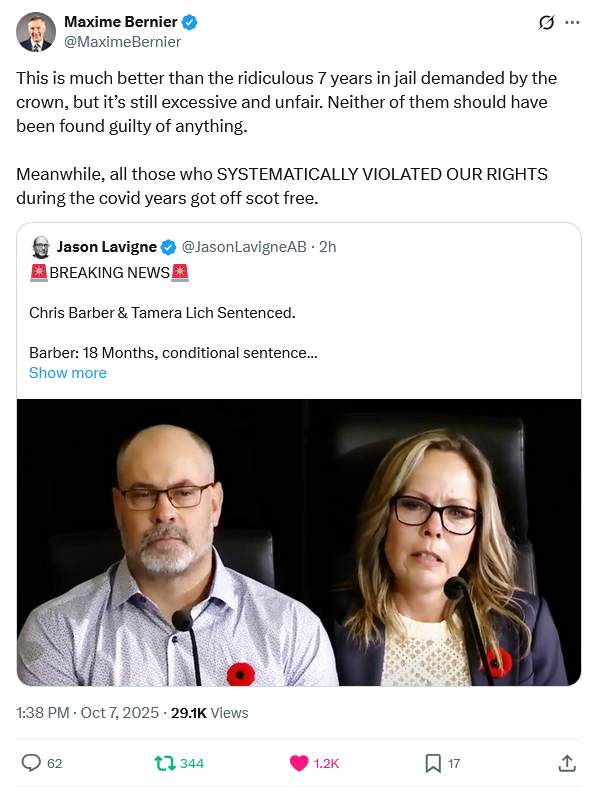
One of the readers at Small Dead Animals got a clanker to summarize this: “Regarding the convictions of Tamara Lich and Chris Barber, compare their trials and sentences to leftwing protesters who have openly and violently broken laws in Canada.”

In comparison, left-wing protesters in Canada involved in violent or disruptive actions — such as anti-pipeline blockades (often tied to environmental and Indigenous rights causes) or Black Lives Matter (BLM) demonstrations against racism and police violence — have typically faced shorter trials and lighter sentences for similar or more destructive offenses. These cases often involve civil disobedience escalating to property damage, blockades, or clashes with police, but convictions emphasize non-violent intent or police misconduct, leading to minimal incarceration.

Overall, Lich and Barber’s cases drew unusually aggressive prosecution (e.g., multi-year sentences sought) despite no violence, contrasting with lighter outcomes for left-wing actions involving property destruction or direct confrontations. This disparity has fueled debates on selective enforcement, though courts in both contexts prioritize deterrence while considering protest motivations.

Unlike a lot of clanker slop, that is pretty fair. More reactions on the social media site formerly known as Twitter:
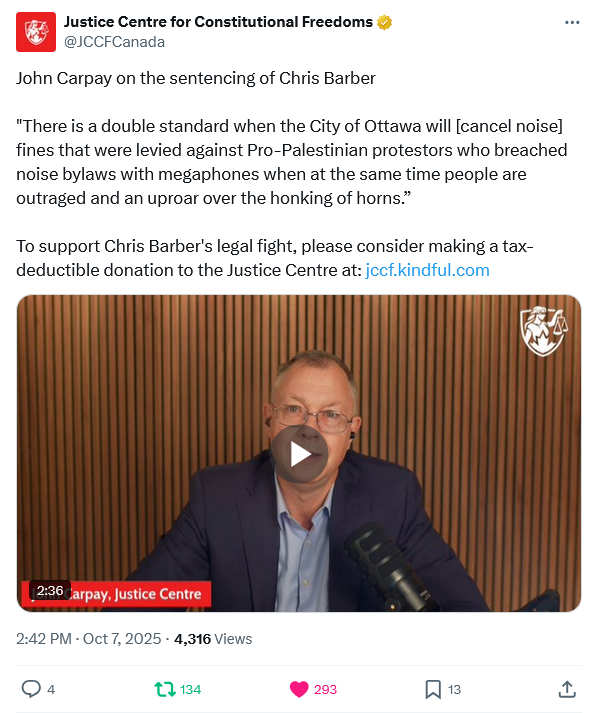
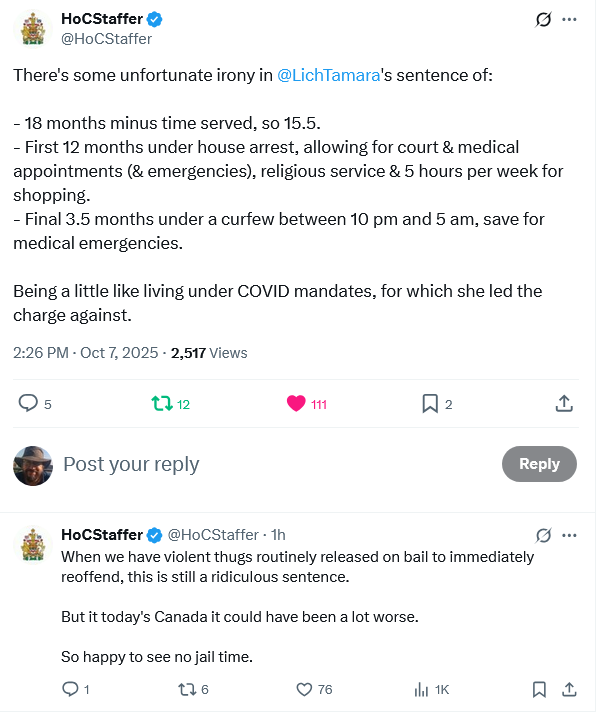
In the Toronto Sun, Joe Warmington accurately calls it a “show trial of sorts”:

Even though this is far better than making these two go to prison or jail, these are still stiff sentencing considering neither were violent during the Convoy and both worked with police to tone things down during the three week protest that came to an end when the Trudeau government invoked the Emergencies Act.

But this was a show trial of sorts, and Lich and Barber were political prisoners. Remember, both of these people have had the hardship of waiting 1,328 days through the longest mischief trial in Canadian history to get to this point. They had their bank accounts frozen during the convoy, Lich lost her job and Barber’s business is at risk of going under. A hearing is scheduled for next month in an effort to seize his famous “Big Red” truck.

It’s also lost on few that so many criminals with far more serious crimes have received far less in terms of length of trial, effort of the Crown and sentencing.

These are certainly stiffer sentences than some parliamentarians have received. For example, in 2021, Former Liberal Kitchener South-Hespeler MP Marwan Tabbara was handed a conditional discharge and put on probation for three years after his guilty plea was entered for two charges of assault on a man and a woman in Guelph. He also pleaded guilty to the amended charge of “unlawfully” being “in a dwelling” or home.

Conservative Sen. Patrick Brazeau was given an absolute discharge in 2015 on his guilty plea to assault and narcotics counts, which allowed him not to serve time or gain a criminal record. But while they did avoid jail time, Lich and Barber did get the book thrown at them harder than most.

Update, 9 October: Welcome, Instapundit readers! Please do have a look around at some of my other posts you may find of interest. I send out a daily summary of posts here through my Substack – https://substack.com/@nicholasrusson that you can subscribe to if you’d like to be informed of new posts in the future.
October 7, 2025

Antifa and the “propaganda of the deed”

Filed under: Politics, Quotations, USA — Tags: , , , , — Nicholas @ 11:30

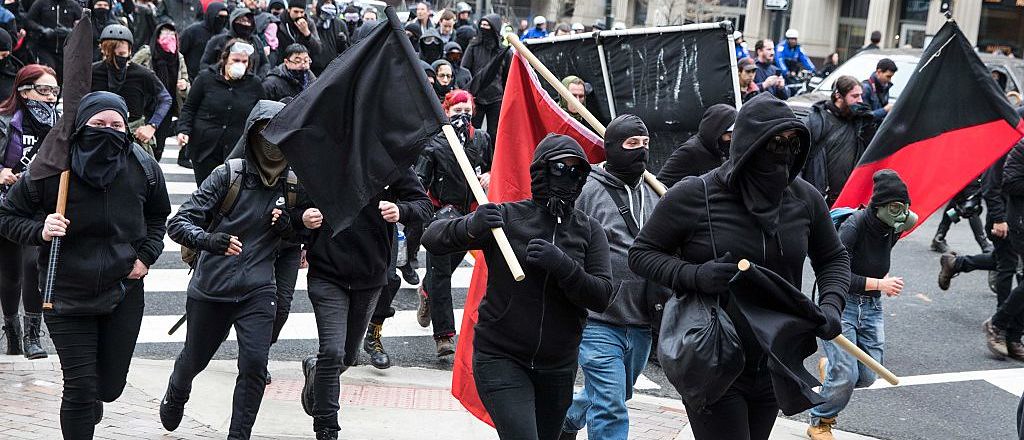
On the social media site formerly known as Twitter, ESR examines the irrational behaviour of Antifa as an inheritance from their chosen historical models:

“antifa 8973ag” by cantfightthetendies is licensed under CC BY 2.0

An important concept for understanding why the behavior of Antifa is not strategically rational is “propaganda of the deed”.

This is a concept with a long pedigree in left-anarchist theory, transmitted to Antifa via its minority “black flag” left anarchist faction

19th-century romantic anarchists viewed the state and capitalism as powerful illusions that could be shattered by bold, exemplary acts, thereby proving their vulnerability and offering hope to the oppressed. These deeds were intended to ignite the spirit of revolt by alerting the masses to the possibility of revolution, much like a spark that could set off a larger fire — thus, the emphasis on symbolic targets over objectively effective ones.

This kind of political communication could be effective if a majority of society, or at least a critical minority, are seething cauldrons of resentment just begging to be triggered against their oppressors. It also assumes that the revolutionary rage of the masses can, once unleashed, be effectively directed against Antifa’s enemies.

Both assumptions are highly questionable, but the important thing to understand for purposes of predicting Antifa’s behavior is that (a) Antifa behaves as though it still believes them, and (b) Antifa’s aboveground allies don’t have the capacity to restrain its behavior in detail.

The Gramscian infiltrators in the U.S.’s institutions need to keep their links to overt terrorism deniable, so they manage it mostly by raising or lowering the temperature of public propaganda. For example, when a Democratic politician says “Abolish ICE”, describes government actions as “fascism”, or wishes death on the children of a political opponent, this is raising the temperature. The effect, the intended effect, is to license increased propaganda of the deed by Antifa.

Reminder: unceasing damnation of conservatives as fascists and Nazis constituted instructions to stochastic terrorists like Tyler Robinson that the time had come to do something like shooting Charlie Kirk through the neck.

One problem with this is that because of Antifa’s psychology and doctrine, raising the temperature is easy, but lowering it is hard. Thus, it’s not a process the Gramscians want to start unless they believe either that they have escalation dominance over their opponents, or their political position is deteriorating so rapidly that they’ll never get a better chance to induce a legitimacy collapse.

It is out of scope for this essay to analyze to what extent those conditions are true. The point is, we are in a situation where the limited control Antifa’s aboveground allies can exert is all directed towards escalation, and Antifa’s belief in “propaganda of the deed” makes this very difficult to reverse.

Antifa has probably lost sight of the fact that escalating to insurrectionary violence is premature — it doesn’t have an army or a sufficiently powerful and nearby state sponsor for that.

Thus, absent serious degradation of Antifa’s capacity by law enforcement, expect increasing violence. Including, but not limited to, the deliberate murders of law enforcement personnel and opposing politicians.

Big management shake-up at Cracker Barrel’s corporate HQ

Filed under: Business, Media, Politics, USA — Tags: , , , , , — Nicholas @ 05:00

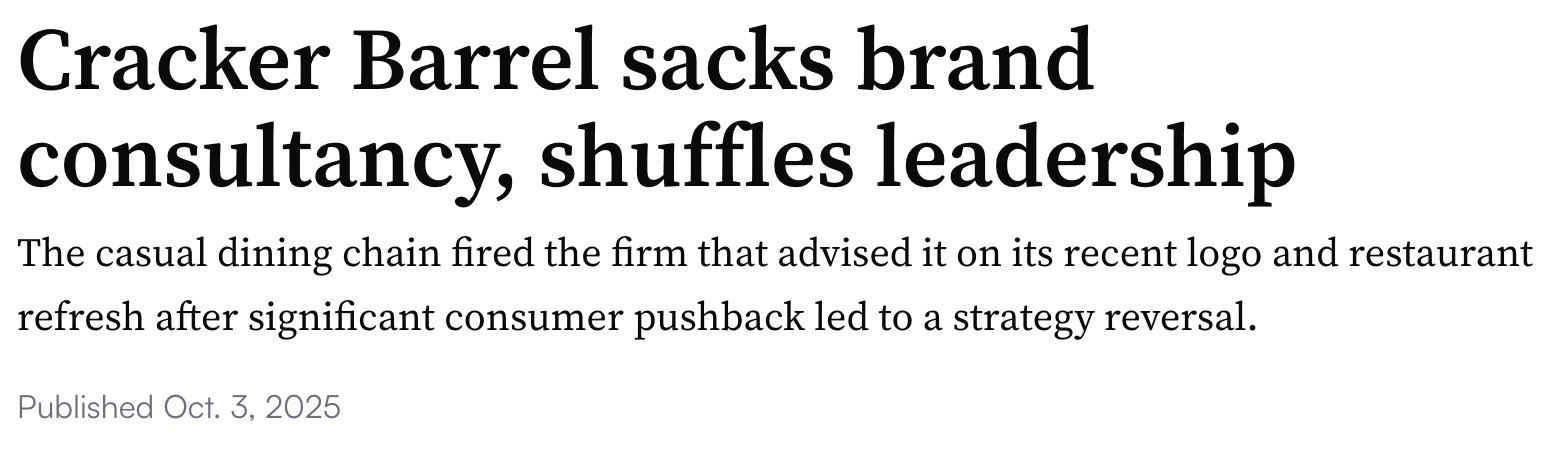
Back in August, the US chain restaurant field saw a corporation decide that doing what their customers wanted was actually a pretty good strategy … after they’d tried the opposite and nearly gone the way of Bud Light:

Last week was the Red Wedding for Cracker Barrel.

Some senior people who were in the headquarters office last Monday weren’t there anymore as the weekend drew near, some old managers from an earlier corporate culture came back to rewind the clock, and the branding consultant that advised on the now-fatally-wounded rebranding effort was sent packing. The new logo departed. The redesigned stores were acknowledged as a failure and an embarrassment.

[…]

See what they said about the redesign? “We won’t continue with it”. The whole thing collapsed, a $700 million rebrand that slammed into a concrete wall and exploded.

It remains to be seen how much the rebranding of the rebranding will matter, and this is what Cracker Barrel stock looks like in the last month:

Now, a reminder: The New York Times columnist David French explained, just over a month ago, that the controversy over Cracker Barrel’s rebranding was an absurd fake crisis ginned up by right-wing idiots who were just pretending that something had gone wrong at the company. Along with the Sydney Sweeney thing, he concluded that we were watching some “completely frivolous and meaningless cultural disputes,” examples of the way “right-wing media both mobilizes its base and bends political reality”. If you believed that the Cracker Barrel rebranding was poorly done and would alienate the company’s customers, you were falling for an invented reality that was completely meaningless and frivolous.

Then Cracker Barrel fired a bunch of managers and its rebranding consultant, abandoned the rebranding, and apologized profusely, while its stock plummeted.

If you listened to David French, if you trusted the op-ed pages of the New York Times to explain the world to you, your understanding of the most basic outline of factual reality was flipped over, turned precisely upside down. He was only wrong about literally every single detail, completely missing what was happening, what it meant, and what would happen in the near future as a result of it. To listen to this idiot is to abuse your own mind, trapping yourself in the confines of an absurd house of ideological mirrors. He is inevitably wrong, completely wrong, reliably wrong to the point of absolute and unyielding madness.

QotD: “That wasn’t real communism …”

Filed under: History, Politics, Quotations — Tags: , , , — Nicholas @ 01:00

Leftism has always been a ridiculously reductive creed, but the One Thing all Leftism reduces to has undergone a radical shift. For Marx, of course, the One Thing was that thesis-antithesis-synthesis Hegelian schmear. Hegel’s ontology claims that the universe is talking to itself. Literally. That thesis-antithesis-synthesis thing, summarized by the untranslatable German word Aufheben (“self-transcendence”; something like that), is literally a debate the World Spirit (or whatever) is having with itself.

All Karl Marx did was bring that down to the material level — it’s not the world spirit having a debate with itself, it’s the world, the material object. Both the debate and its conclusion are made manifest in History, capital-H, which is why Marx was one of a long line of gurus who claimed to make History into a hard science. That “wrong side of History” stuff the Left is always going on about? That’s why they use that phrase so much, and why it has such emotional resonance for them. If you’re a Dialectical Materialist, being against Socialism is like being against gravity. What could possibly be the point? You’re just being perverse, comrade, and on some level you must know that …

Alas, History isn’t a hard science. There are patterns, of course, any fool can see that, but those patterns are the intersection of human nature and emergent behavior. The proof is in the writings of Karl Marx himself — every prediction the man ever made was not just wrong, but ludicrously so, and after getting burned a few times he admitted in his letters to writing in such a way that he could never be “proven” wrong. See also: The complete history of the Soviet Union, 1917-1991, and as a side note, you can tell the intellectual caliber of Socialism’s defenders by the fact that they trot out the excuse “That wasn’t real Communism; real Communism has never been tried.” Ah, so Lenin — he of Marxism-Leninism — wasn’t a true Communist. They’ll shoot you for saying that in, say, China, but do please go on …

Severian, “Power”, Founding Questions, 2022-02-02.

Update, 8 October: Welcome, Instapundit readers! Please do have a look around at some of my other posts you may find of interest. I send out a daily summary of posts here through my Substack – https://substack.com/@nicholasrusson that you can subscribe to if you’d like to be informed of new posts in the future.

October 6, 2025

“[Starmer’s] love of football feels like something an alien would simulate, trying to blend in with our ways”

Filed under: Britain, Media, Politics — Tags: , , , , , , — Nicholas @ 05:00

Britain’s current prime minister, Sir Keir Starmer, is not having even the echo of a political honeymoon despite the utter collapse of the Conservatives in the last general election. Andrew Sullivan, who knew Starmer in school, thinks that Starmer’s plight is a useful illustration of what might have happened in the last US federal election if Kamala Harris had won:

The other day I sat, slack-jawed, reading Kamala Harris’ book — which was not easy to do with my eyeballs permanently rolled into the back of my head. (On one issue that killed her campaign, trans policy, she still hasn’t got the slightest clue what she’s talking about.) At one point, I even tried to imagine what America would be like today if this woke lawyer had actually won last year.

Then it occurred to me that we already kind of know. We actually have a pretty good test case of exactly that: a center-left lawyer-politician coming to power last year after a massive immigration wave had discredited and ousted the previous incumbent. Enter Keir Starmer, my high school frenemy, and now prime minister.

But unlike Harris, Starmer has at least shown signs of understanding his problem: he kicked the far-left Corbynites out of the party, called out anti-semitism, and in his big speech to his party’s annual conference this week, spoke proudly of flying the Union Jack, saying “we placed too much faith in globalization”. In office, he backed Israel’s war against Hamas strongly for a year-and-a-half, followed the science by banning puberty blockers and sex changes for kids, tightened immigration rules a bit, and pursued deregulation of the private sector, especially housing.

So how is he doing?

In one recent poll, his approval rating is 18 percent, with 61 percent disapproving. His government, just a year old, is polling around 19 percent. And in his first year in office, the new anti-immigration Reform Party has doubled its support from 15 to around 31 percent. The Tories — who gave Brits a massive wave of non-white, non-European immigration after Brexit — are at a historic low of 15 percent. Boris may have done what no leftist could: destroy the most successful political party in the West.

This, to put it mildly, is an earthquake. A party barely a year old is almost more popular than the Tories and Labour combined. On paper, Starmer still has four years to right the ship. But in reality, a prime minister who is loathed by four out of five Brits is like Wile E Coyote five feet off the cliff edge. To get a flavor of the general public’s view of Keir, check out this hilarious profile. Money quote:

    Then there is the voice — a cornucopia for sketch writers. We could fill pages with descriptions of the thing — an expiring corncrake, a Dalek suffering stasis of the lower bowel, a fart in a coffin, etc. His love of football feels like something an alien would simulate, trying to blend in with our ways — “I follow the game like any other carbon-based life form”.

The fart in a coffin did his best this week — and survived. Critically, he acknowledged the centrality of mass immigration to the national discourse, the way it has undermined a sense of common culture, undercut wages, begun to replace Christianity with Islam, required ever higher levels of censorship, killed Jews, and turned the cities my grandparents knew into something they wouldn’t even recognize as British.

No vote was ever taken on this policy of making London 40 percent foreign-born, a place where English is now often not heard at all — and even where it is, is almost always in a foreign accent. But the minute anyone ever proffered the slightest objection to mass migration (around a million migrants a year for the past four years), the charge of “hate” and “racism” was instantaneous and deafening.

Elite right and left were as one, defying the public for decade after decade. The hangover, especially after Boris’ brutal betrayal, is now here. (For a single glimpse, think of yesterday when a British citizen named Jihad attacked a synagogue, with two dead, and a flash mob of Hamas supporters swarmed Downing Street.)

Update, 7 October: Welcome, Instapundit readers! Please do have a look around at some of my other posts you may find of interest. I send out a daily summary of posts here through my Substack – https://substack.com/@nicholasrusson that you can subscribe to if you’d like to be informed of new posts in the future.
“Hate speech” bans work perfectly to eliminate mean words and mean thoughts … and the rivers will run uphill

Filed under: Cancon, Government, History, Law, Liberty, Media, Politics — Tags: , , , — Nicholas @ 03:00

I have to assume that the headline captures the mentality of the people who call for more “hate speech” legislation, because the real world evidence clearly fails to support the notion. Many well-meaning people want the government to have the power to suppress speech they don’t like, never thinking that a different government could use the same laws to quash opinions they support. In the National Post, Chris Selley argues that the last way to achieve reconciliation with First Nations would be to ban “residential school denial”:

Two years ago, I ruefully predicted that Canada’s new law purporting to outlaw Holocaust denial would likely lead to a law purporting to outlaw “denying” the impact of the residential school system. That hasn’t happened yet, but we are well on our way.

The Liberals recently announced plans to table legislation that would purportedly outlaw displaying the Nazi or Hamas flags or symbols of other hate movements, and that has only intensified calls for that law outlawing “residential school denialism”, or indeed denying Canada’s “genocide” against Indigenous peoples.

“What is the difference between Holocaust Denialism and Residential School Denialism? I suggest there is no difference at all,” author Michelle Good wrote in the Toronto Star Tuesday on the occasion of the National Day for Truth and Reconciliation. “The inclusion of Holocaust Denialism in the criminal code is obviously to prevent the denial of the Jewish genocide of World War II. Therefore, after clearly illustrating that the residential school system was genocidal in nature and intent, it is difficult to find any reason whatever that Residential School Denialism should not be criminalized as well.”

I say these two new and proposed new laws would “purportedly outlaw” atrocity-denialism and hate symbols because they aren’t outright bans on the speech in question. Rather, to fall foul of them, you have to use your argument, flag or symbol to “wilfully promote hatred” against the group in question. It was and is already illegal to wilfully promote hatred against a religious or ethnic group — albeit with some huge caveats, more on which in a moment.

At some point in the future, should the Liberals remain in power — and perhaps even if they don’t — the government is likely to knuckle under to the calls for censorship of certain residential-school opinions. It’s just not worth the political blowback to object, or so one can imagine a backroom strategist reasoning. They would probably introduce the new law just in time for the National Day for Truth and Reconciliation. If police are willing to enforce these laws, there’s little reason to believe Crown prosecutors would be interested in pursuing the cases. That, in turn, would only frustrate the people who see value in this censorship, and would likely lead to ever-stronger laws … that themselves likely wouldn’t be enforced.

This is not good lawmaking, and it’s a chilling argument when the simple act of pointing out how many bodies have actually been discovered on former residential school sites is widely considered a form of “denialism”.

QotD: Britain’s immigration crisis

Filed under: Britain, Government, Media, Politics, Quotations — Tags: , , — Nicholas @ 01:00

One of the consequences of massive, indiscriminate immigration – equivalent to the entire population of Sheffield, every year – is that it radically alters the general mood of those on whom this demographic transformation is being imposed. One might, for instance, aspire to the role of gracious host, as it were, of making newcomers feel welcome. But this ideal presupposes an immigration policy that is limited and selective, and in which newcomers have good reason to feel lucky – and grateful.

The graciousness of the locals, the ideal, depends on the notion that the host country is regarded as something special, a desirable thing, something worthy of respect.

But massive, indiscriminate immigration undermines that ideal. If seemingly anyone can walk in and demand goodies, any ill-mannered flotsam of the world, and if they can do so with no discernible sense of gratitude, or any expectation of such, and with no apparent regard for the norms and values of the host society, as if they were unimportant, then the indigenous population may feel they have little reason to be gracious. Indeed, being gracious may be something of a struggle.

I realise that even the idea that the locals might dare to think in such terms – of being the gracious host – is, for some, anathema, a basis for tutting and scolding. But the sense that the value of one’s society – one’s home – is being pissed away, sold off cheap, is not a promising basis for coexistence.

And yet here we are.

Doubtless there are progressives who would regard the “gracious host” attitude as wickedly hierarchical and “othering”, or even racist. But I suspect it’s how quite a few people process a sudden influx of newcomers, regardless of the gasping of lefties. I suspect that something along those lines is a necessary precondition of any subsequent coexistence. A social lubricant.

And were I to relocate to, say, South Korea, I think I would feel much like a guest – and feel a corresponding obligation to be on my best behaviour. Possibly on an indefinite basis. I very much doubt I’d feel entitled to disregard queueing norms, or to, quite literally, shit on the doorsteps of the indigenous.

But hey, maybe that’s just me.

David Thompson, Explaining Civilisation”, Thompson, Blog, 2025-07-01.

October 5, 2025

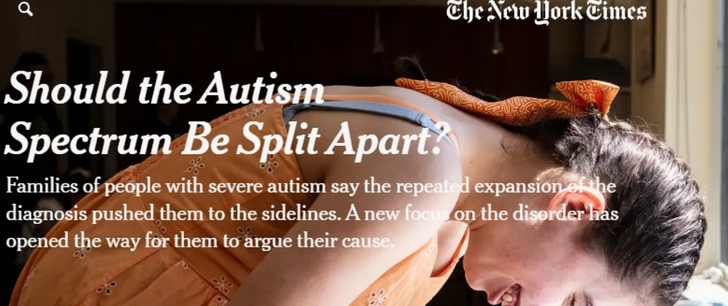
The New York Times finally decides that there’s a case for “splitting the Autism spectrum”

Filed under: Health, Media, Politics — Tags: , — Nicholas @ 03:00

Freddie deBoer on the stereotyped way that the “Gray Lady” — the New York Times — once again lets the independent media do all the serious work to investigate an issue before “the Grey Lady squats down on that issue and says ‘this is mine now'”:

You may groan! You may say, “Again?” You may roll your eyes. But I’m going to talk about this one more time, and then I think I’m done. But I’ve always been right about all of this, and it needs to be said.

The Times has once again parachuted into a conversation that has been going on for decades, planted its flag, and declared itself the discoverer of new territory. Yesterday they published a piece on autism, neurodiversity, RFK Jr., and whether the autism spectrum should be split up — split back up, that is, to reflect on the massive differences between those with profound autism and those for whom “neurodiversity” is mostly a social badge, a tidbit to be displayed on a Bumble profile. (The answer is yes, of course the spectrum should be split up again, for reasons I’ve written about at great length.) That issue, unusually raw, will bubble on, as it sits at a genuinely uncomfortable intersection of liberal identity norms, online culture, and the genuinely debilitating reality of severe autism. In terms of progressive discourse rules, the plight of the severely autistic and their loved ones is truly a problem from hell: those rules insist that you can’t ever question someone’s diagnosis, no matter how dubious; they demand that you acquiesce to claims made from a position of disability, no matter if they cut directly against the claims made by others from their own position of disability; they have long ago lost sight of any distinction between identity and disorder; and they’re governed by a selective and incoherent vision of standpoint theory that insists that only the autistic can speak out about autism – which perversely empowers the least-afflicted and silences the interests of the most-afflicted, as the most-afflicted literally cannot speak for themselves. You know my rap on all this.

In meta terms, though? This tendency of the NYT to helicopter in to long-simmering debates and bless them with the paper’s attention, and in so doing anoint those debates as worthy of attention by grownups, is only the latest example in an old, ugly dynamic. The little people in independent media ask difficult questions and engage in rancorous debates and stick their necks out in the service of ideas, which is what the media is supposed to do. Then, once the heavy lifting is done, the Grey Lady squats down on that issue and says “this is mine now”. The paper’s consolidation of both prestige and financial security — its status as both far and away the most prestigious publication in world media and maybe literally the only financially healthy newspaper left in the United States — has all manner of pernicious, perverse consequences in an industry that can only function when people within it are engaged in debates with real stakes and real hurt feelings. Again, nothing you haven’t already heard from me. But when there is only one endpoint for the ambitious to aspire to, there’s an inherent and unavoidable silence about that endpoint’s myriad failings. The Times, for its part, has walled off criticism within its own pages with its “we don’t do media criticism” rule, a profoundly self-interested and cynical policy that helps them evade ever having to justify their own widely-criticized practices. And for all manner of complex reasons, the broader world of stodgy old media, dying though it may be, still holds all the cards when it comes to defining debates that involve institutional stakeholders, as the debate about autism’s future certainly does.

I don’t begrudge any writer for wanting to weigh in on these issues — God knows they matter and need more attention — but what’s striking about the Times‘s coverage is how effortlessly it erases the long history of people already fighting these battles, and the richness of the debate that preceded them. Whole archives of independent writing, analysis, and advocacy disappear when the Paper of Record decides that a question now exists. Until then, the issue is marginal, unserious, relegated to the sidelines; afterward, it’s real, it’s official, it’s legitimate … and therefore too important to be left up to those of us in the cheap seats. This is the paradox, you see; no issue that independent media concerns itself with can be considered truly serious, and no issue that they (eventually) deign to be truly serious is something that they trust the independent media to engage with responsibly. Quite a little trap, there. And when the grownups in the room walk in, we’re meant to feel blessed by their presence, happy to have our pet issues taken seriously. Everyone else who’s been in the trenches for years is supposed to be grateful for their newfound recognition.

October 4, 2025

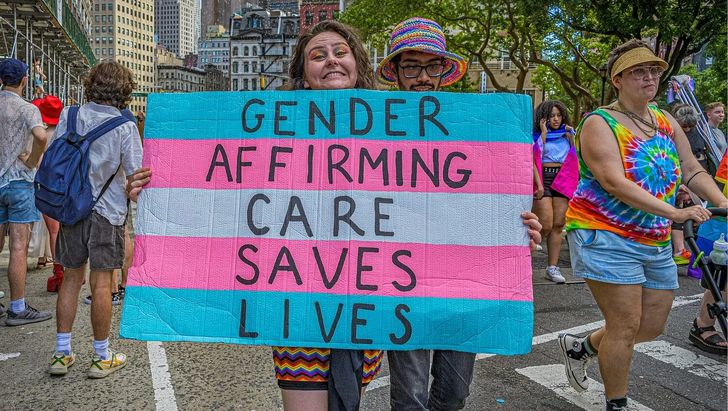
Rapid onset gender dysphoria (ROGD)

Filed under: Cancon, Health, Media, Politics — Tags: , , , , , , — Nicholas @ 05:00

At Woke Watch Canada, Igor Stravinsky tells the story of “Jane and John”, a distressing tale of rapid onset gender dysphoria:

Image via the Boston Medical Center

In Ontario elementary schools, students are taught that whether you’re a boy or a girl is not determined by your physical body. Kids are encouraged to “explore their identity”. You may have a girl’s body. But how do you feel about it?

These kinds of discussions are going on because schools have accepted what rational people call “gender ideology”, but I prefer the term “gender mythology” because an ideology usually has to do with political systems. In my view the idea that a person’s sex is unrelated to their physical body, that they have a kind of soul sex, if you will, is clearly a myth.

[…]

Jane and John

This is a true story. The names have been changed to protect the privacy of this person.

Jane was a happy, clever, talented, and expressive girl who always wanted to help others. She displayed precocious empathy and enjoyed teaching younger kids various skills. Jane became socially conscious at an early age and was bothered by the fact that she enjoyed a middle-class, Western quality of life while so many others were clearly struggling. As an elementary student, she canvassed her neighbourhood collecting donations for disadvantaged kids. She came to identify with groups she saw as persecuted or oppressed.

Her school was very racially diverse, but she did not observe much racial discrimination. What she did notice was a fair bit of homophobia. She quickly took every opportunity to be an ally to the LGBT cause. In her middle school, there was an LGBT club, which she joined. Jane would often arrive home from school in an angry state because another student had said something that upset her, like, “being gay is a sin”, for example.

Jane’s parents were progressives who made it clear that she would be loved and accepted if she were a lesbian. Jane laughed at that and replied that she “dreamed about boys”.

Jane was a high achiever who was active in athletics and music. At 16, she became a vegan. She was in most ways a typical high school student, but her allyship with LGBT people gradually moved towards activism.

At university she quickly gravitated towards Indigenous and Gender Studies. Her close friends were all LGBT people. Her best friend was a transwoman (a man who identified as a woman). Jane came out as “bisexual” but her main romantic relationship was with a man.

Then, abruptly at the age of 20, she announced to her parents that she was to be called “John” and that she was going to transition to male.

By her own admission, Jane had been perfectly happy as a girl/woman for 20 years- “until I wasn’t”. This does not fit the Gender Mythology narrative. There is simply no way you can reasonably argue that she had, at this late age, suddenly realized what she truly was. She herself did not even claim that. So, what happened?

[…]

It was pretty obvious to me that Jane’s “transition”, like [trans-race activist Rachel] Dolezal, was the result of a combination of personal qualities and social influences. All the stars aligned to point her in that direction. She desperately wanted to be part of the community she had connected with and was tired of just being an ally. Claiming to be bisexual did not really cement her position as an insider. But becoming trans was her ticket.

Due to the extreme nature of taking on that identity — lifelong drug regimens and a number of surgeries, all of which presented serious health risks, going down that road reflected a true commitment and not only made her a part of the LGBT tribe but catapulted her to the top of the hierarchy.

What Jane experienced is known as Rapid Onset Gender Dysphoria (ROGD) and was first identified by the physician/researcher Lisa Littman. Learn more about it here. If you want to get a 2SLGBTQ++ (plus whatever other letters and numbers they’re using now — I can’t keep up) activist spitting mad mention ROGD. The phenomenon proves beyond a reasonable doubt that gender dysphoria can be induced in vulnerable people by social circumstances and aligns well with the research and clinical practice of Dr. Kenneth Zucker from the Centre for Addiction and Mental Health (CAMH) in Toronto.

Zucker ran the clinic for some 20 years and was pushed out due to his refusal to accept “affirmative care” as the only acceptable treatment for gender dysphoria. Zucker found that about 80% of kids would eventually grow out of their dysphoria and thus did not believe in affirming kids’ identities but rather focused on helping them cope with their condition.

Since affirmative care (an oxymoron!) has been adopted, we thus know that 80% of the kids who have been put on the road to gender transitions (and most carry through to the end) would have seen their gender dysphoria dissipate naturally over time. But once the first step — puberty blocking drugs, is taken, kids almost always go on to cross sex hormones and many continue with various surgeries.

Gender clinics do not do follow up nor do they support de-transitioning, but it is clear that the number of young people out there who have seriously harmed themselves through “affirmation” treatments is significant, and more harm is being done day by day as long as affirmative care remains the standard treatment for gender dysphoria.

What did poor Liverpool do to deserve “the worst speech in modern British political history”?

In The Conservative Woman, Sean Walsh wonders why his home city of Liverpool was chosen to be the site of a modern political crime-against-humanity in the form of a Two-Tier Keir speech to the Labour faithful:

LIVERPOOL happens to be my city of birth, and my family is generational CIA (Catholic, Irish, Alcoholic). I get back there when I can, usually for funerals family reunions. I can confirm that if you don’t mention Thatcher, the Sun, any Manchester band, the Wirral, or ask a native to pronounce the word “chicken”, you will be made to feel more than welcome as a visitor there. Scousers are rightly celebrated for a quick, if chippy, wit and unique sense of humour. Not least by ourselves.

Hopefully that last quality will help the city survive this week’s invasion by activist lawyers, Islington familiars, boilerplate career MPs, lanyard fetishists, lobbyists, and the process algorithm who was slush-funded to the Labour leadership.

For years Liverpool dodged hosting the Labour conference and was probably resentful at the snub. Now its rejuvenated docklands are the go-to venue for this annual festival of enforced fun/confected joyfulness. It’s probably resentful at that as well.

I’m not sure British politics has seen a speech as bad as the one the Prime Minister gave to this year’s wake gathering. And before you mention Enoch Powell and “rivers of blood”, that speech was “bad” only in the minds of those who never read it or were unable or unwilling to appreciate the deep truths Powell was advancing behind the veil of metaphor.

The Prime Minister was vindictive and politically maladroit in equal measure. Powell, a genuine member of the British working class, was a trained classicist who thought, spoke and wrote in the languages and metaphors of the ancient world. Powell’s lack of condescension and unwillingness to dumb down created room for bad faith and mischievous interpretation.

Starmer, who thinks and speaks the language of the petty bureaucrat, has no such defence. Where Powell made his predictions in poetry (which have proven correct, let’s not forget), Starmer rams home his malevolence in bullet points and crass soundbites.

I make this unhappy comparison partly to draw attention to the decades-long decline in the culture of political speechcraft, which TCW recently wrote about, and to affirm that even by the standards of today Starmer was awful.

We expect our political speeches to be unlovely now. Starmer’s went beyond that and managed to be offensive and yet boring all at once. As I said, the Prime Minister is an algorithm, and there are three things you can say about algorithms: they lack memory, have no sense of humour, and are unaware that they are, well, an algorithm.

On his Substack, Christopher Gage offers “A forward-thinking manifesto to deliver change for stakeholders”. That’s just the sort of bafflegab progressive thinkers think the general public wants to hear, apparently:

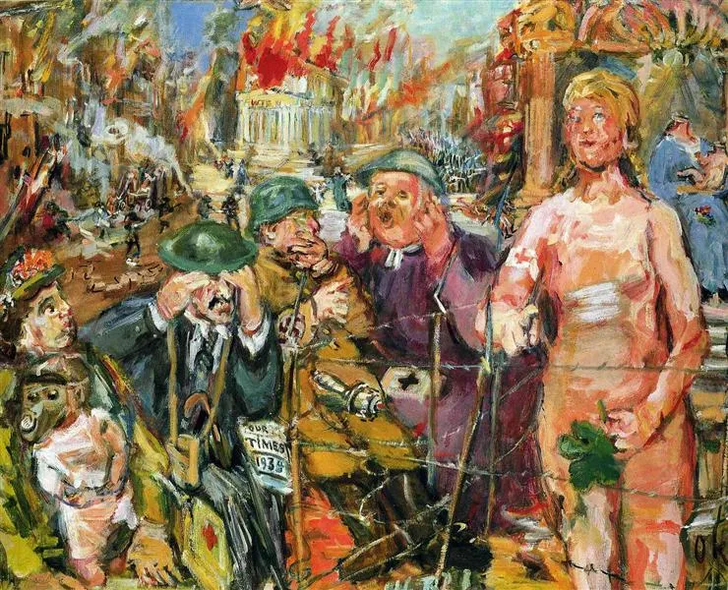
Alice in Wonderland by Oskar Kokoschka (1942)

This year’s Labour Party conference kicked off in the idiosyncratic style befitting its more excitable, green-haired cohort: confusion, contradiction, and faux contrition.

On Sunday, Sir Keir Starmer, our accidental prime minister, condemned Reform’s plan to deport migrants as “racist and immoral”. By Tuesday, it was Labour policy.

Politicians will say anything to keep suckling on the erect nipples of eternal power. And Labour politicians, despite their holier-than-thou affectations, are no different. They’ve seen the polls. Reform has led with room to spare in the last one hundred.

Labour has changed its spots. Starmer’s new Home Secretary, the combative and admirable Shabana Mahmood, is one foot on planet earth, at least.

At the conference, Mahmood warned the Guardian-reading element that they “won’t like the things I do”. She duly unveiled plans to ensure migrants “earn the right” to stay here: speak English, pay their way, and don’t expect their family to follow.

These once radioactive proposals are now common sense — two-thirds support immigration restrictions, whilst one-half wants not only the door welded shut but for many recent arrivals to be ushered politely through it. If Labour wants to win another election, they’d better listen to Wetherspoon Man over Performative Male.


As the week spluttered on, Starmer opted in to opting out to opting in to opting out. But Labour is listening. Nigel Farage, the Wetherspoon Man high priest, must feel his pockets lightened this week. Just glance at the swathes of Labour members waving the Union Jack, faces stretched incredulously like those masks from The Purge.

One impression emerges from this blancmange of bodily fluids: Farage has won the argument. Labour loves Britain, mate. Britain, big tits, Stella Artois, and XL Bullies.

Starmer even took it to Boris Johnson, onetime prime minister and two-time shagger of the year. The epithet “Boriswave” leapt from Starmer’s tongue with pace-sticked regularity. According to the prime minister, letting in four million people in two years — the Boriswave in Twitter slang — is an affliction so terrible that to reverse it would be, erm, even worse.

To be fair, such logic is not so much witless as it is anti-sense. And anti-sense has defined the Labour Party since I was spermatozoa.

One thing is clear. The Labour party, which presides over the sputtering, worn-out appendage known as Great Britain, needs some dire advice.

Here are a few proposals, the wholesale adoption of which would solve every problem befalling broken Britain.

October 3, 2025

Women and credit card access … another “just so” story

Filed under: Business, Government, History, Media, Politics, USA — Tags: , , , , , — Nicholas @ 04:00

Janice Fiamengo debunks a common “just so” story about women only gaining the right to hold a credit card in the 1970s:

A few years ago, I started hearing that women, before feminism, couldn’t have their own credit cards. Or they couldn’t get one without a man’s signature. Or married women couldn’t have one in their own name. Divorced women, apparently, couldn’t get credit at all. Men conspired to keep women powerless and dependent.

THANK THE GODDESS FOR FEMINISM!

Just last June, on the podcast Diary of a CEO (in an episode viewed by nearly two million people), three feminists debating feminism agreed that, in the words of one of the panelists, “None of us could get a credit card a few decades ago … We couldn’t have anything …” (see 1:50:37).

Before correcting herself, in fact, the panelist had started to say, “None of us could get a credit card a couple of decades ago …”

The statement struck me with the full force of the ludicrous. I started school in 1970. My teachers were nearly all women, at least half of them unmarried. They certainly seemed to live full, normal lives in obeisance to no man. They were paid a salary; they had bank accounts; they owned cars; they bought things and went on vacations.

My mother had worked in an insurance office for years both before and after she married my father in 1956. She had purchased appliances and paid her own rent, helped my father buy his first commercial fishing boat, and handled all the household expenses when my dad was away fishing for months every summer.

My friends’ mothers were similarly active and self-determining. Were all these women actually hobbled by the patriarchy, cut off from the economy?

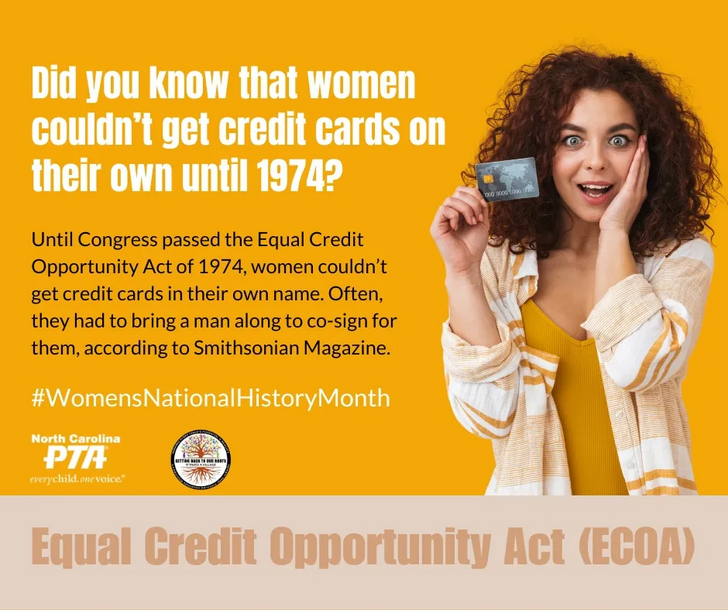
Received knowledge would have us believe so. Last year, The Globe and Mail published a paid advertisement for Women’s History Month titled “50 Years Ago: Women Got the Right to Have Credit Cards”. Written by a financial services company seeking to drum up business, the article repeated the popular story that women in North America could not get their own credit cards until 1974.

Credit cards were one of the growth areas for banks and other financial service companies in the 1960s and 70s … from something only relatively wealthy travellers and business executives used, they expanded to become widely used by ordinary consumers for all kinds of purchases. Consumers benefitted from access to useful financial tools, while banks enjoyed the profits from the widespread use of credit cards. So where did the idea that they were male-only come from?

The reality is that from the 1950s on, credit cards were a new invention being aggressively marketed to both men and women. Advertising from the era shows how keen credit card companies were to target female customers, how eager to tap into women’s spending power.

Originally introduced as a convenience for travelers on business, credit cards began to expand their purview in the late 1950s. Bank Americard (later Visa) became the first consumer credit card in 1958. A network of banks formed the Interbank Card Association, originally named Master Charge (later Mastercard), in 1966.

Yet we are somehow to believe that half the population was deliberately excluded from this new consumer venture for no other reason than that they were female?

“It wasn’t until 1974 that women were allowed to open a credit card under their own name,” the Globe article states emphatically. “Before 1974, if women wanted to open a credit card, they would be asked a bunch of intrusive questions, like if they were married or whether they planned to have children. If a woman was married, she could (hopefully) get a credit card with her husband. But single, divorced, or widowed women weren’t allowed to get a credit card of their own — they had to have a man cosign for the credit application.”

The explanation is dramatic and incoherent, undoing its own logic from the beginning. It backtracks to allege that women were in fact “allowed” to have a credit card so long as they answered “a bunch of intrusive questions” or found a co-signer. Even this lesser claim is false, but it is rather different from the prior assertion about women “not having the right” to a card.

At a time when many married women either did not work outside the home or worked only part-time and on a temporary basis, there would have been nothing unreasonable about a woman’s husband co-signing her credit card application. Many married women were happy to purchase what they wanted on the assurance that their husbands would pay the bill when it came in, and credit card issuers saw joint accounts as a way of ensuring payment.

Update, 4 October: Welcome, Instapundit readers! Please have a look around at some of my other posts you may find of interest. I send out a daily summary of posts here through my Substack – https://substack.com/@nicholasrusson that you can subscribe to if you’d like to be informed of new posts in the future.

QotD: The role of the True Believer

Filed under: History, Politics, Quotations — Tags: , — Nicholas @ 01:00

    Anon @Greynxgga69

    Abolish The Family.
    Abolish Religion.
    Abolish Wage Labour.
    Abolish Money.
    Abolish Work.
    Abolish Commodity Production.
    Abolish the State.
    Abolish Class.
    Abolish Private Property.
    Abolish the Nation.
    Abolish Patriarchy.
    Abolish Gender.
    Abolish Town and Country.

The True Believers imagine they will live in Utopia after the Revolution.

They will instead be sent to the gulag, or lined up against the wall and shot.

Why?

Because the function of the True Believer is to make the Revolution. And the purpose of the Revolution is to replace The Regime.

Once the Revolution is made, and The Regime has been replaced, no further Revolutions are wanted. Therefore the True Believer serves no purpose.

He is a liability, because he has been promised Utopia, and Utopia is hard, even perhaps impossible, to deliver. If he does not receive the promised Utopia, he is apt to make Revolution again.

The Regime does not want this. It does not wish to be replaced in the same fashion that it replaced The Regime. So the True Believer must be disposed of. He must be replaced with the Opportunist.

The Opportunist can be relied upon, because he does not want Utopia. He wants to have more than his comrades. So long as he receives more than his comrades, he will serve The Regime.

As above, so below.

As before, so after.

Meet the New Boss. Same as the Old Boss.

Devon Eriksen, The social media site formerly known as Twitter , 2025-07-01.

October 2, 2025

The signature politics of the unaccountable classes

Filed under: Media, Politics — Tags: , , , , — Nicholas @ 05:00

On his substack, Lorenzo Warby considers the origins of what we now call “woke” politics and how they became the predominant set of beliefs of the people who can’t be held accountable:

Western civilisation, over the last two centuries, has gone through the Emancipation Sequence whereby — taking the Anglosphere pattern — free people voted to liberate slaves, Christians to get rid of exclusions on Jews, Protestants to get rid of exclusions on Catholics, whites to get rid of exclusions on blacks, men to get rid of exclusions on women, straights to get rid of exclusions on gays and lesbians. We live in free societies of mass prosperity, yet we have highly motivated political networks that think nothing of casting our societies as marked by layers of oppression.

Yes, this is based on a monstrous (and self-serving) inflation of the concept of oppression. It also functions to channel the rage of downwardly mobile children of Western elites.

More important still, it is the signature politics of the unaccountable classes, of those paid to turn up — as distinct from the accountable classes whose income depends directly on their performance. The dominant politics of the unaccountable classes has acquired a name: it is woke politics, the politics of wokery or of being woke.

The technical name for wokery is Critical Constructivism. It is the popularisation of Critical Theory. I have labelled it Post-Enlightenment Progressivism, as it rests on critiques of The Enlightenment, and rejection of Enlightenment values, while orienting itself towards an imagined future — one where it is no longer true, as Marx and Engels wrote in The Communist Manifesto (1848), that society is based:

    on the antagonism of oppressing and oppressed classes.

That is, of oppression as they define it.

Wokery is the currently dominant form of left-progressivism. Political scientist Eric Kaufmann defines “wokery” as:

    making sacred of historically marginalised race, gender and sexual minorities.

That is how the Oppressor/Oppressed template that Critical Theory takes from Marxism is popularised in a post civil rights world, using any differences in outcomes between groups as markers of oppression. The Oppressor/Oppressed template requires oppression to be pervasive in contemporary societies, hence psychologist Steven Pinker’s observation about progressives hating progress.1

What wokery also is, is lazy self-righteousness. The self-righteousness is obvious and pervasive. These folk really do act as if they own morality; as if they can withhold the moral grace of their presence from the wicked, from wrongthinkers; as if wrongthinkers are purveyors of moral pollution. This has much to do with the dwindling of the culture of public debate.

But it is also lazy, in that it massively economises on the use of information and intellectual effort. Much of the appeal of “wokery” comes from how remarkably little accurate knowledge it demands. All one has to do is to master the lingo, the linguistic signalling, involved; the pre-set talking points; which terms of moral abuse apply and when; and be willing to engage in any required level of rationalisation and mental gymnastics. Once you do so, the moralised status game of lazy self-righteousness is open for you, with approved positions lined up for one to adopt, all based on semblances of knowing.

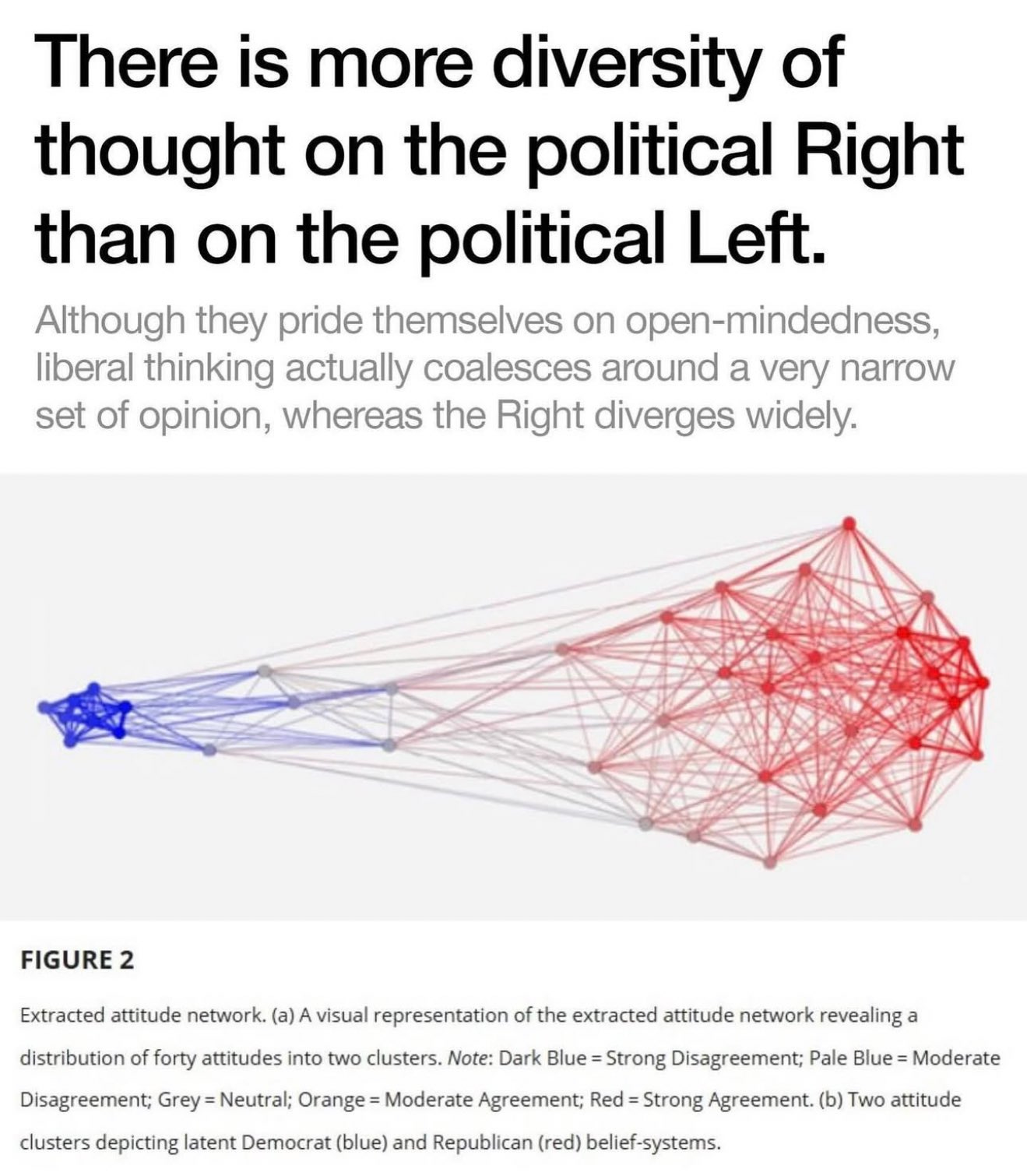
This dynamic has much to do with why one side of US politics is far more conformist in its political opinions than the other.

The underlying blank slate views about humans means you don’t have to accept any constraints from evolutionary biology. If we are all blank slates, if there are no inherent differences between groups, then all inequalities between groups can be classed as malicious — as signs of oppression — so you do not have to bother exploring differences in traits, cultures, life-strategies, etc.

Lazy self-righteousness does not require any thinking about successful and unsuccessful life strategies, about what makes things work, or not work. It does not require much in the way of statistical or mathematical understanding. The most mathematical it gets is whether social outcomes are proportional to a group’s population share or not.

If a group is doing better than average, they are oppressors. If they are doing worse, they are oppressed. Viewing society through the oppressed/oppressor mindset always ends up looking for (and finding) kulaks.

It is a simple metric to adopt, with the self-righteous status game built-in of opposing oppression and supporting the marginalised. No further intellectual effort is required.


  1. Pinker’s observation that populism is a phenomenon of older voters has not worn well. Also, it is a sign how reflexive future-orientated judgements have become, that the voters with the most experience of the EU were most likely to vote against it in the 2016 Brexit referendum passes people by.

The ritual humiliation of ordinary Canadians through “land acknowledgements”

Filed under: Cancon, Government, History, Politics — Tags: , , — Nicholas @ 03:00

On the social media site formerly known as Twitter, Tom Marazzo explains his objections to the ever-expanding use of “land acknowledgements”:

Let me break this down clearly so you can better understand why these mandated Land Acknowledgements are offensive to me.

They imply inherited guilt
A Land Acknowledgement usually frames the land I live and work on as “stolen”. Even if it does not say the words directly, the message is that I am benefiting from a theft. I served my country for 25 years, I have paid my taxes, raised my family responsibly, and built a life honestly. It cuts against my sense of fairness and justice to be told I must carry guilt for actions taken by people hundreds of years ago. I will not accept accountability for the past when I had no part in it.

They ignore my contribution
I have invested decades of service in the military, in my education, in my community, and in my family. These acknowledgements do not recognize those sacrifices, nor those of my ancestors who also built and defended this country. Instead, they imply my very presence is illegitimate. That denies the legitimacy of my life’s work and my family’s role in helping build this nation.

They make reconciliation into a ritual of shame
A healthy society should face the past with honesty. But what I see is not dialogue or shared responsibility. It is a scripted performance that demands I accept a label like “colonizer”, whether or not it reflects who I am. Rather than bringing people together, it divides by assigning one group permanent guilt and another permanent victimhood. That is not reconciliation. It is coerced shame.

They erase complexity
History in Canada is complicated. Many settlers and Indigenous peoples lived, worked, and fought together. There were injustices, but also cooperation, intermarriage, and shared struggles. Long before Europeans arrived, Indigenous groups also fought among themselves, sometimes brutally, with violence and cruelty toward rival tribes. No group in history is free from wrongdoing. Yet the Land Acknowledgement format reduces this reality to a one-sided story of “oppressors vs. oppressed”, which is neither fair nor accurate.

They are being mandated
Perhaps the strongest reason I find them offensive is that these acknowledgements are not voluntary. They are imposed in workplaces, schools, and public events as if they were civic duties or loyalty oaths. Refusing to participate often brings social or professional penalties. That strips away personal agency and turns what could have been a gesture of respect into a forced confession.

So my reaction is not irrational. These acknowledgements conflict with my principles of fairness, personal responsibility, and earned legitimacy. They demand I accept guilt I do not bear, while ignoring the contributions my family and I have made. They also erase the truth that no people, Indigenous or otherwise, lived without conflict or wrongdoing in the past.

The first time I encountered a “land acknowledgement” in person was at my son’s university graduation ceremony. I assumed, as the university had a major First Nations study program, that this was something only done there … but now it’s hard to find any public gathering in Canada that doesn’t have the opening cultural cringe and ritual humiliation ceremony to start the event.

October 1, 2025

“Sean Fraser, the current minister of justice and attorney general, has made two major mistakes of late”

If you’re at all interested in Canadian affairs, you should subscribe to The Line … even a free subscription will definitely provide you with some excellent non-propagandistic coverage of what is happening in the dysfunctional dominion. For instance, last weekend’s weekly post from the editors included this segment about Sean Fraser, who is perhaps the worst of Mark Carney’s cabinet (and that takes some doing):

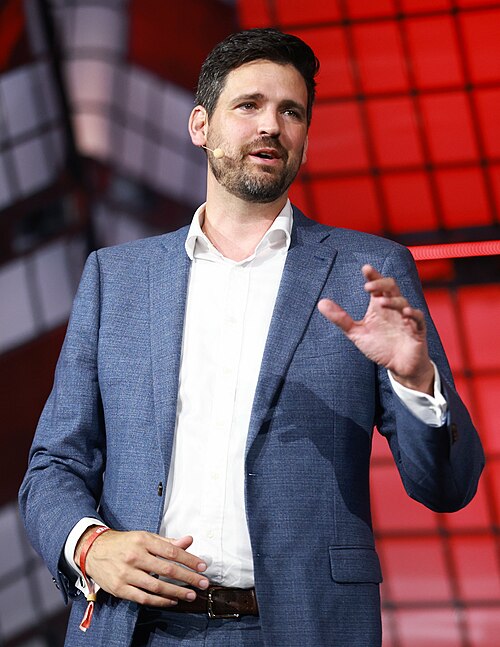
Sean Fraser, as Minister of Immigration, Refugees & Citizenship, during day one of Collision 2023 at Enercare Centre in Toronto, Canada.
Photo by Vaughn Ridley via Wikimedia Commons

We at The Line contend that Sean Fraser, the current minister of justice and attorney general, has made two major mistakes of late.

The first was in deciding not to rescind his decision to spend more time with his friends and family when it became clear that Justin Trudeau was no longer an anchor on his electoral chances. After failing to fix Canada’s housing problem and proving himself integral to blowing apart a pan-partisan consensus on immigration that was once the envy of the world, the man had a real opportunity to leave office on a high note. But, no.

Instead, after hitching his bloated baggage to Mark Carney’s trunk, Fraser decided that Canada needed more of him.

And so, as justice minister, instead of addressing petty stuff like, oh, bail reform, or fixing prisons, or getting crime under control, he turned his attention to … Section 33 of the Charter of Rights and Freedoms. The notwithstanding clause.

You may recall that Quebec’s contentious Bill 21 — which prohibits public-service employees in positions of authority, and teachers, from wearing religious symbols while on the job — is currently before the Supreme Court of Canada. Despite numerous mixed rulings on the law, Quebec moved forward with its stance on secularism by invoking Section 33, which allows parliaments to temporarily override judicial rulings.

Section 33 was placed in the Charter for precisely this kind of situation; one in which the courts and parliament disagree about governance. As we still live in a democracy, and are still nominally governed by representatives we elect, the clause was always a bit of a compromise gesture intended to preserve parliamentary supremacy after granting the courts broad powers to basically reinterpret law according to an expansive and ever-expanding understanding of both their jurisdiction, and of the concept of “rights” writ large.

Section 33, nonetheless, has maintained a heavy odour about it, which has generally limited its application, especially outside Quebec. Among the Sean Fraser set, and the largely Liberal collection of lawyers who will insist that the Supreme Court isn’t remotely political, and how dare we entertain the thought, Section 33 was only ever intended as a symbolic right.

But as the definitely-not-political Supreme Court has edged ever deeper into the territory of override and governance, so too have provincial parliaments responded with a very not-symbolic application of the clause.

We do think there’s some blame to be placed at everyone’s door, here. But we also never really took much issue with Section 33. That’s because, at heart, we at The Line believe in, well, democracy. We believe that the people we elect should be able to decide our laws; and we believe that while the Supreme Court of Canada serves as an important check on Parliamentary power, that power doesn’t and should never override the will of the people.

And that’s basically where we part ways with Fraser and many of his — dare we say it? — Laurentian Consensus ilk. Because the unstated critique of the use of Section 33 is basically always the same: these people dislike the application of the clause because they think politics is icky, and that politicians fundamentally cannot be trusted.

In other words, these people don’t actually want a democracy.

They want a technocracy. One in which the smartest and ablest individuals (as defined by them, of course) are the ones who actually get to set the rules and guardrails for society writ large. One in which parliament really is as theatrical, symbolic and pointless as it often regards itself.

There’s an obvious illogical inconsistency here — Fraser and his colleagues are politicians. We aren’t sure if this desire to go out and limit the ability of he and his fellow parliamentarians to do the best jobs they can for the citizens reflects mere self-loathing, or a particular brand of Liberal blindspot, one that leads them to believe that they alone among politicians are exempt from anything as crass political considerations and/or motivations. Those moral failures are apparently for the other guys. But in any case, we have an elected official making the case that unelected courts should have the ability to override legislators, and that the legislators should have no recourse. However Fraser rationalizes this to himself, it’s where we are.

We think the people who have issues with Section 33 are generally not being honest with themselves in that regard; we also think that their instinctual aversion to politics (or their exemption of themselves from it) tends to make them naive. If you vest all the real power of governance in a “non-partisan” Supreme Court, what you’ll get is not a dispassionate government, but rather a heavily politicized Supreme Court. We need only look at what has happened in the U.S. over the past 30 years to see how that pans out in the long run.

Look, we at The Line don’t like Bill 21. It’s a bad law. It needlessly tramples on minority rights. But there’s a very obvious way to get that law repealed that doesn’t involve flirting with a full-blown constitutional crisis in the midst of, you know, all of the other crises going on right now.

Elect a government that will repeal that law.

That’s what democracies do.

To me, one of the most puzzling things about the Carney government’s recent actions is the overall incoherence of them. They are going ahead with one of the worst policies inherited from the Trudeau years with the “gun buyback” program that the minister responsible has openly admitted is almost completely a sop to voters in Quebec. Okay, that makes cynical sense as the Liberal vote is about as “efficient” as it possibly can be so losing just a few seats in Quebec would make it impossible for the Liberals to get re-elected. Fine. Scummy as hell, but fine. Yet the challenge to Section 33 is guaranteed to piss off far more Quebec voters — and stir up controversy across the country to boot — and you’re going to stage a pitched battle against pretty much all the provinces before the Supreme Court? Are you sure about that?

« Newer Posts — Older Posts »

Powered by WordPress