Empires can turn to becoming conquest empires on any scale only with the development of technologies that can overcome sheer numbers.
Specifically, metal.
Soft metals are not for conquest empire. Gold, silver, copper, tin, etc, may be used for plates or posts or jewellery or skin scrapers, but they are not war fighting metals. Even the lightest leather armour or layers of feather padding makes them practically valueless for war fighting. Metal only becomes an imperial material when it can be made hard enough for combat purposes.
The first such metal is Bronze, which is made by combining different metals in compounds. Copper compounded with enough tin (usually 5-10 percent) makes Bronze. Bronze can make armour and weapons and even axles and bearings. But copper (mined in mountains) and tin (usually from swamps) and the charcoal needed to melt them (from forests) combined in sufficient quantities for mass production (cities supported by taxed farmers), require extensive trade routes, and probably a stable currency of some sort. But once these elements can be combined, empires can give up on mere Security, and enter Conquest.
All the early Sumerian, Egyptian, Hittite, Persian, Greek, Roman, Indian and Chinese empires that we now scrawl across maps with lines to show how they conquered the territories of other empires are based on this simple concept. The Hittites with their Bronze, Egyptians with their chariots, and Romans with their Steel: being only different developments from the same basic “metal technology” roots.
Yet this is where motive becomes uncertain. All these empires got into conquest, but in many cases they did it either to continue their security (by pushing the dangerous boundaries ever further), or to protect the trade that made their system work. Conquest for the sake of conquest was certainly an element — particularly with rulers like Alexander the Great — but the original reason why Phillip of Macedon and his predecessors had developed the world’s most efficient fighting machine had more to do with constant threats from Persians and Greeks and other “barbarians” than with any desire to get into the conquest game itself. Sometimes things done for security lead to expanded boundaries for security, which then lead to expanding further for conquest. (Often because the system developed for paying those fighting for security requires conquest to pay them off … see Julius and many later Caesars!)
Nigel Davies, “Types of Empires: Security, Conquest, and Trade”, rethinking history, 2020-05-02.
June 4, 2025
QotD: Conquest empires
June 3, 2025
Ukraine’s strategic strikes against Russian airbases
CDR Salamander on the lessons to be learned from the latest dramatic turn in the Russo-Ukrainian war with Ukraine carefully avoiding letting their American supporters know about the attack before it went in:
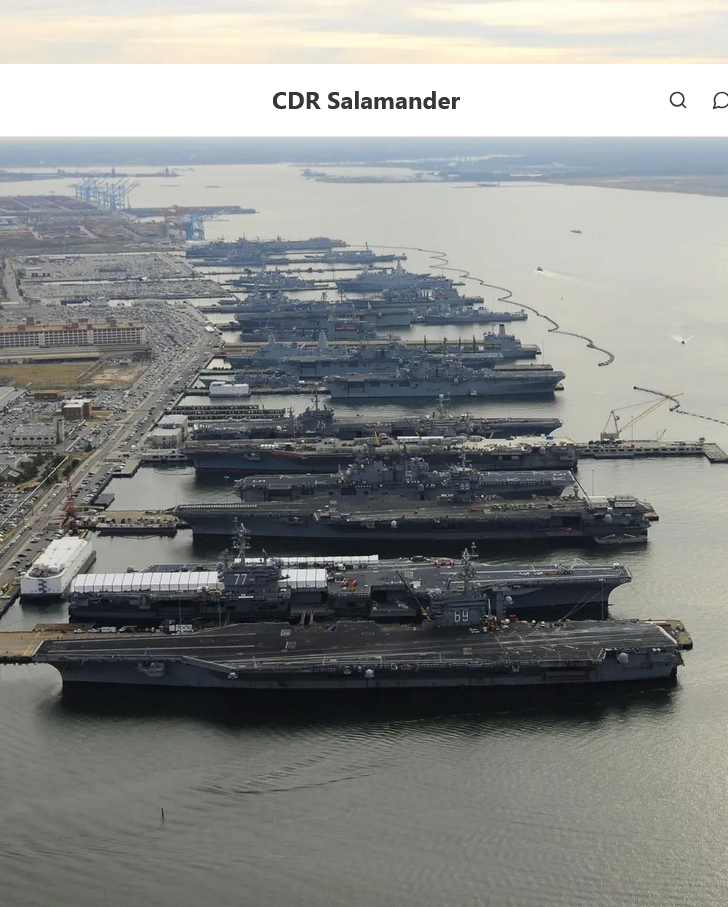
[This] picture from 2012 of Norfolk is what I want you to think about.
We talked about the superbly executed Ukrainian attack on Russian bomber bases for most of yesterday’s Midrats, and what keeps coming to mind for me is not the details of that attack, but the stark warning it is giving us.
The threat of drone strikes isn’t a new warning, but in my mind it intersect almost perfectly with the self-inflicted vulnerability of the US Navy’s fleet — its concentration.
The growing utility of attack drones isn’t an insight that is unique to the Russo-Ukrainian War. The topic has come up here and on Midrats for almost two decades. We’re not alone. Heck, broad thinking people like our friend Matt Hipple was pondering it over at CIMSEC thirteen years ago a few months before the picture at the top of the post was made.
I’ll tie in the picture a bit, but let’s take a moment to give the Ukrainians credit where credit is due. They executed precision strikes against the RUS bomber fleet across the entire two-thirds of the Euro-Asian landmass.
We will find out more details, a dozen or 40+ high-demand/low-density strategic bombers were taken off the battle line. RUS is not building any more of them. As missile carriers, they have been a cornerstone of the city terrors for most of the last four years. You would be hard-pressed to find a more honorable, or legitimate target.
Streiff over at Red State has a good summary with what we think we know as of Sunday afternoon:
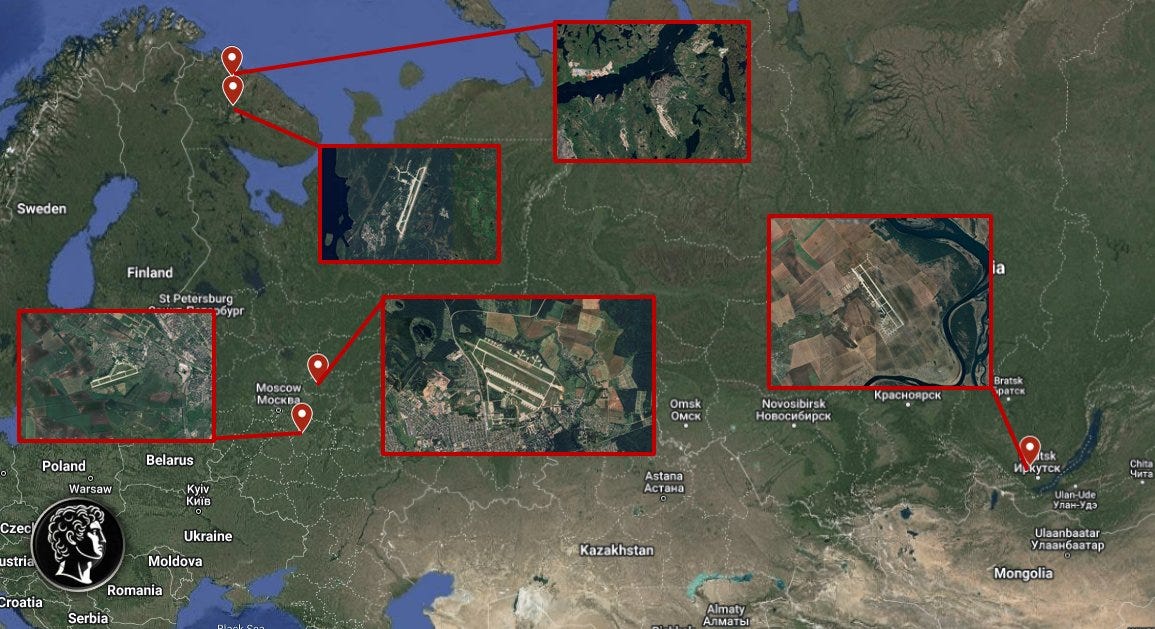
The airbases are the home to Russia’s fleet of Tu-22, Tu-95M, and Tu-160 nuclear-capable strategic bombers as well as AS-50 battle management aircraft. They were located from the Siberian Far East to the Arctic Circle. The furthest target, Belaya Airbase in Irkutsk, is over 2700 miles from Ukraine.
Reports indicate that at least 41 aircraft were hit. The unofficial tally indicates 24 Tu-22, 8 Tu-95MS, and 5 Tu-16 were hit. MiG-31 fighters and Il-76 transports were also hit. To put this in context, open-source data says Russia’s bomber inventory is about 58 Tu-22, 47 Tu-95MS, and 15 Tu-160. These planes are the ones used to launch most of the missiles fired at Ukrainian cities.
By any standard, this was a devastating attack. Nearly half of the Tu-22, a quarter of the Tu-95MS, and a third of the Tu-160 fleet, representing just over 30 percent of Russia’s strategic bomber force, were damaged or destroyed in one attack. When you consider the operational readiness rate, Russia probably has less than 50 aircraft capable of flying … on the bright side, they have plenty of aircraft to cannibalize for parts. The Tu-22 and Tu-95MS production lines are closed, and the Tu-160 production is one, yes, one per year. For all intents and purposes, this represents a permanent decrease in the size of the Russian strategic bomber fleet.
Before we discuss what the USA needs to take away, let’s look at the top-4 primary and second-order effects this will have on the Russian Federation.
First Order Effects
- Fewer raiding assets to use against UKR.
- The weakest leg of their nuclear triad (bombers are dual use) is even weaker.
- PSYOP defeat as RUS now know even their most valuable weapons, stationed deep into RUS rear, are vulnerable.
- Paranoia elevated into an already paranoid national psyche under duress of year four of a grinding war.
Second Order Effects
- Inefficiencies in both civilian logistics and manpower are the natural response to every tractor-trailer being a weapons delivery vehicle at range … and the need to defend important bases as a result, sinks into an already stressed nation.
- Loss of face. RUS launched a war of choice against nation 1/4th its size and much weaker than it from any measure, and four years on, still has only made marginal progress. Now that nation proved it can operate with impunity anywhere inside RUS. The “R” in BRICS is not impressing its friends.
- It shouldn’t, but this is going to get the nuclear autists the jitters. All theory, but yes, UKR took out one-third or more of the fully mission capable nuclear capable bombers that form one leg — but as mentioned above the weakest leg — of RUS’s nuclear deterrence. Those who work in the theory-dominated nuclear world will have all their gauges twitching, yes, but in the end analysis, it won’t matter.
- UKR morale just got a big boost. Wars of attrition usually last until one side or the other loses either the material ability or the will to fight. At least from the “will” line of operation, that decisive point just shifted to the right.
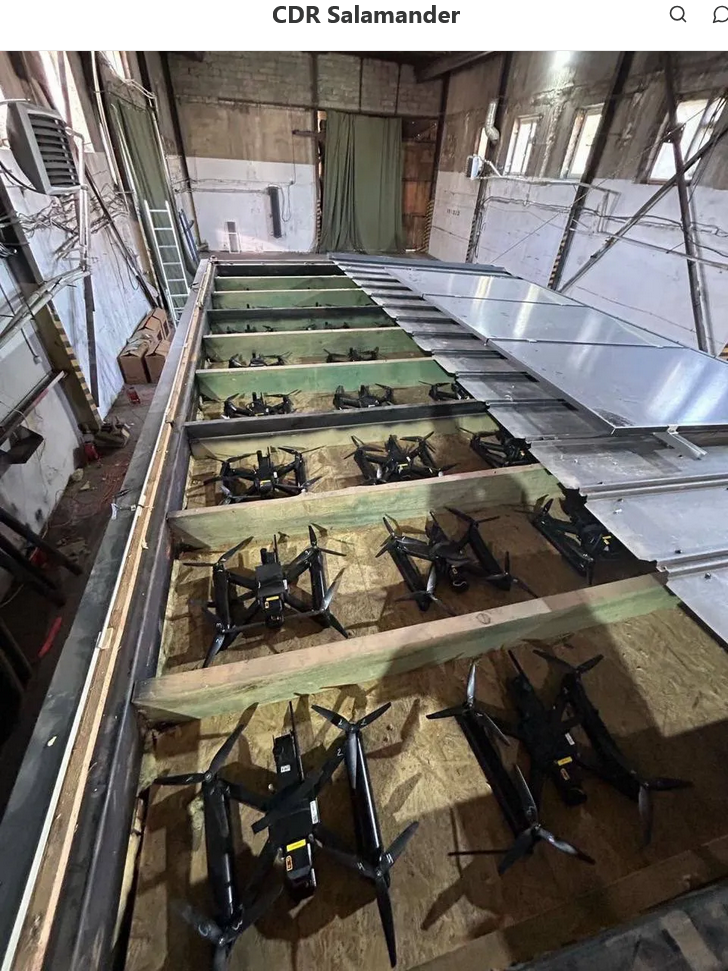
Simply a superb operation. How do you defend against weapons like this disguised in a trailer’s false roof?
Exercise Tiger: The WW2 Cover-Up Before D Day
The History Chap
Published 23 May 2024Exercise Tiger 1944, was a large-scale dress rehearsal for the D-Day landings, off the Slapton Sands in England, that went horribly wrong. Over 700 US servicemen were killed, more than were killed on Utah beach on D-Day itself! With D-Day imminent, Allied Supreme Commander, General Dwight Eisenhower, ordered the disaster to be hushed up.
Following a friendly fire incident on Slapton Sands on the 27th April 1944, a convoy carrying US troops was attacked in the early hours of the 28th by German E-Boats. In what is called the Battle of Lyme Bay, two ships in the convoy were sunk resulting in the loss of over 700 US servicemen. Whilst rumours suggest that there were many casualties resulting from the friendly fire on Slapton Sands, the US Army has always remained tight-lipped. To this day, the mystery remains as to what extent the casualty figures were covered up.
In the 1980’s, a Sherman tank was raised from the seabed. It now stands at the end of Slapton Sands (near the village of Torcross) as a memorial to the young men who died 6 weeks before D-Day during Exercise Tiger.
Chapters
0:00 Intro
0:42 D-Day 1944
1:40 Slapton Sands
2:30 Civilian Evacuation
3:22 Military Build-up
4:58 Exercise Tiger
6:07 Live Fire Disaster
7:37 Convoy T-4
9:15 Spotted by Germans
10:03 E-boat attack
11:41 Battle of Lyme Bay
14:06 Casualty Figures
14:43 D-Day Compromised?
15:37 Cover-up?
17:00 D-Day Success
18:08 Exercise Tiger Remembered
(more…)
June 2, 2025
Fighting at Yenangyaung, 17-19 April 1942
Dr. Robert Lyman on the battle at Yenangyaung between 17-19 April 1942 early in the Burma campaign:
… the Yenangyaung battle is a fascinating one, with its own small degree of controversy, I decided to lay it out in this post. A mystery of the battle is the differing accounts of the Chinese attacks on the 19th April. In the British accounts (including Bill Slim’s in Defeat into Victory) the Chinese are blamed for failing to attack in the morning as they had promised, adding further jeopardy to the fate of the encircled 1st Burma Division. But was this true? The Japanese, Chinese and American accounts differ, so I thought I’d lay out the story to allow you, dear reader, to come to your own conclusion.
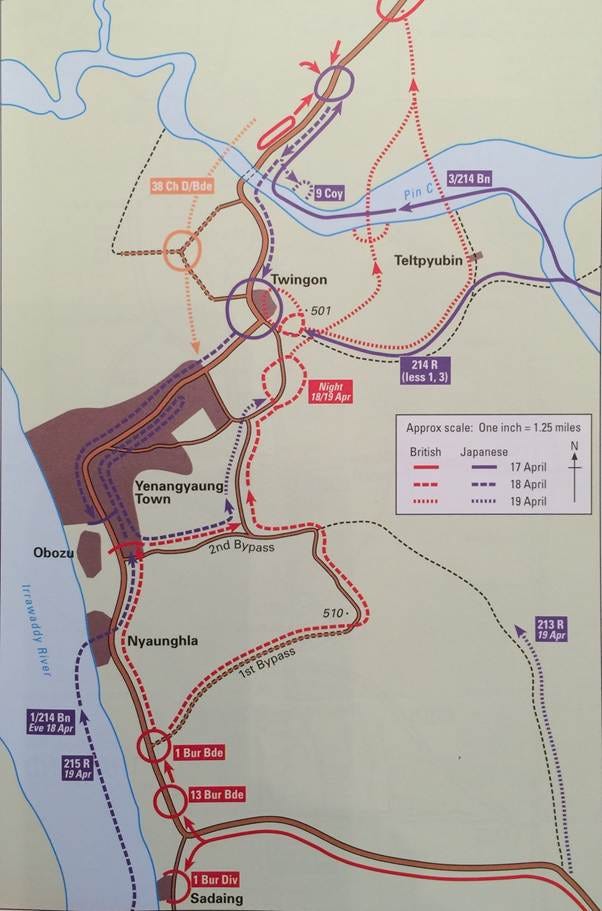
The fabulous map of Yenangyaung produced by the late Ian Lyall Grant.
The scrap at Yenangyaung was the final Corps-sized battle before the order to evacuate Burma Corps was given in early May. The Japanese had pushed out of Rangoon in mid-March, driving up the Irrawaddy on the left and against Toungoo on the right. Allied plans for the defence of Burma were inadequate, both Chinese (on the right) and Slim’s Burcorps (on the left) effectively fighting separate battles. Attempts by General Harold Alexander, the Army Commander, to control the battle and constrain the advancing Japanese ultimately came to naught. Alexander, Slim and Lieutenant General Joe Stilwell, nominally commanding the Chinese 5th Army, tried every trick in the tactical rule book to bring a halt to the relentless Japanese advance, and to destroy them in battle. After a month of fighting in which the Chinese were pushed out of Toungoo, the British lost control of Prome and an attempt to consolidate a defensive line across the country failed, the Japanese moved up the Irrawaddy in an attempt to turn the British flank, breaking in at the oilfield town of Yenangyaung on 17 April. At the time Slim’s Burma Corps was attempting to withdraw to the north from Allamyo. The Japanese infiltration into Yenangyaung cut the British in half. The 1st Burma Division was now cut off in Yenangyaung. The battle by the already weakened division (amounting to probably no more than 4,000 troops) into the Yenangyaung pocket over the period 17 and 19 April proved to be the severest trial yet faced by British troops in the short Burma campaign, the pressure applied by the Japanese exacerbated by the intense heat and the lack of water.
It was critical that Slim defeated this Japanese infiltration, rescue the 1st Burma Division from encirclement and retain the integrity of his Corps. If Yenangyaung were lost the Japanese would be free to sweep north to threaten Mandalay. It was crucial therefore that the divisional commander – Major General Bruce Scott – held on for as long as he could. But Slim had no reserve. The only hope of relief lay in assistance from the Chinese far to his right. He concluded that if he could engineer a attack into the pocket by the Chinese, across the Pin Chaung, combined with a breakout attack by 1st Burma Division, they might have a chance of escape. Nothing else looked likely to succeed.
When asked, Stilwell agreed to Alexander’s request for help to be provided to Slim, and gave him Lieutenant General Sun Lijen’s 38th Division – responsible for the defence of Mandalay – for the task. Chiang Kai-shek had given Sun responsibility for defending Mandalay. At midnight on 16 April Sun received an order from General Lo Cho-yin, “to dispatch his 113th Regiment to Kyaukpadaung, there to be commanded by the British General Slim …” Sun’s friend, Dr Ho Yungchi, recorded that by 3 a.m. he had arrived at Lo’s HQ at Pyawbe to discuss the order. Lo explained that the British were in serious trouble “in the oil town of Yenangyaung and had sent repeated requests for help”. By 6.30 a.m. it was agreed that Sun would personally take command of the 113th Regiment, while the two remaining regiments stayed to defend Mandalay. Sun and 1,121 men of 113th Regiment (commanded by Colonel Liu Fang-wu) arrived at Kyaukpadaung on the morning of 17 April.
Slim recalled: “The situation was not encouraging, and I was greatly relieved to hear that 113 Regiment of the Chinese 38th Division was just arriving at Kyaukpadaung. I dashed off in my jeep to meet their commander and give him his orders … this was the first time I had had Chinese troops under me … I got to like all, or almost all, my Chinese very much. They are a likeable people and as soldiers they have in a high degree the fighting man’s basic qualities – courage, endurance, cheerfulness, and an eye for country.”1
At Yenangyaung, Slim’s plan was for Sun’s 38th Division to attack from the north on the morning of 18th April while the 1st Burma Division, within the pocket, fought its way out. As Slim and Sun Lijen talked, discussing the details of the attack planned for the following morning Slim decided that he would place the Stuart tanks of the 7th Armoured Brigade directly under Sun’s command. It was only a move a man confident in the capabilities of his allies could make. Slim commented that “I was impressed by Sun and it was essential to gain his confidence. His division had no artillery or tanks of its own, and I was therefore arranging that all the artillery we had this side of the Pin Chaung and all available tanks should support his attack.” The commander of the British armoured brigade – Brigadier John Anstice – accepted this arrangement and according to Slim “he and Sun got on famously together”. What’s more, the soldiers worked well together too, Slim recording that the “gunners and tank crews, as is the way of British soldiers, soon got on good terms with their new comrades, and, in spite of language difficulties of an extreme kind, co-operation was, I was assured by both sides, not only close but mostly friendly.”2 Accordingly, at 6.15 a.m. on 18 April, Major Mark Rudkin of 2nd Royal Tank Regiment (2RTR) reported as instructed by Anstice to 38th Division HQ:
There was little activity except for the cooking of breakfast and it seemed most unlikely that the attack could start on time. I asked the British liaison officer with the Chinese what was happening and he informed me that as the Chinese realized that they would not be ready to attack at 0630 hours, they had put their watches back one hour, so that officially they were still attacking at 0630 though the time would in reality be 0730. They had, therefore, not lost “face” by being late.
The plan was that a troop of tanks would follow the leading troops of the leading Chinese battalion and give what support it could. Another troop was to follow the leading infantry battalion and assist the leading troop if required. The tanks would be almost entirely road bound owing to the going off the road.
At 0730 the assaulting Chinese moved forward off the ridge on a front of about four hundred yards, the leading troop keeping very close behind on the road. On foot near the tanks was a Chinese interpreter who carried out liaison between the tanks and infantry.
After advancing about half a mile the leading tank was hit by a Japanese 75-mm gun situated on the road just north of the Pin Chaung which was firing straight up 300 yards of road. The tank was disabled but there were no casualties.
The Chinese advance continued and by afternoon had almost reached the line of the ford on the Pin Chaung which was still held by the enemy. The Chinese had had heavy casualties, especially amongst officers, as it was the custom for Chinese officers to lead, whatever their rank. It was finally decided to hold positions about half a mile north of the crossing and continue the attack next day.3
With the first attack a failure, the Japanese retained their grip on both the ford and the village of Twingon. The situation for the surrounded remnants of the 1st Burma Division was desperate; the Japanese close to achieving a complete victory. Slim and Sun then worked through a plan for another attempt to be made the following morning, 19th April. This day also began badly, however. The Chinese attack was scheduled to begin at 7 a.m. British accounts subsequently recorded that a Chinese attack did not materialise at this time. Slim subsequently recorded in Defeat into Victory that the failure to attack must have been a function of the administrative difficulties faced by the Chinese. He wrote that with the Chinese “lack of signalling equipment, of means of evacuating wounded and of replenishing ammunition, and their paucity of trained junior leaders it was not surprising that to sort themselves out, reform, and start a fresh attack took time”.4 Slim was invariably impressed with what he saw of the Chinese soldier in action, but considered their support and command functions to be shockingly poor and a source of constant frustration to themselves, and to all who had occasion to operate with them.
Slim, and most other British published accounts, including the Indian and British Official Histories, record that the attack finally went in at 3 p.m., when Colonel Liu’s 113th Regiment successfully captured the ford and penetrated into Yenangyaung.5 “When the Chinese did attack they went in splendidly” wrote Slim in admiration. “They were thrilled at the tank and artillery support they were getting and showed real dash. They took Twingon, rescuing some two hundred of our prisoners and wounded. Next day, 20th April, the 38th Division attacked again and with tanks penetrated into Yenangyaung itself, repulsing a Japanese counter-attack. The fighting was severe and the Chinese acquitted themselves well, inflicting heavy losses, vouched for by our own officers.”
1. Slim, Defeat into Victory (1956), p. 63.
2. Ibid., p. 65.
3. Bryan Perrett, Tank Tracks to Rangoon: The Story of British Armour in Burma (London: Robert Hale, 1978)
4. Slim, op. cit., p. 70.
5. Bisheshwar Prasad (ed,) The Retreat from Burma 1941 – 42 (Calcutta, Combined Inter-Service Historical Section, 1954), p. 296.
June 1, 2025
Panzers Attack! – Ten Days in Sedan
World War Two
Published 31 May 2025May 10, 1940. A new kind of warfare comes to the fore as a German Panzer Group rumbles through the Ardennes towards Sedan. Heinz Guderian has one goal in mind — Get to the Meuse! If he can manage that, then the Battle of France may be over before it even begins. Can the Allies hold back the armoured armada?
Chapters
01:05 German Forces
04:13 Blitzkrieg Theory, Applied
07:37 The Advance Begins
14:50 The Allied Plan
17:59 A Tight Schedule
20:57 Summary
21:16 Conclusion
(more…)
Praga I: A Blow-Forward Bullpup Semi-Auto-Selectable Vickers Gun
Forgotten Weapons
Published 15 Jan 2025The Praga I was the first machine gun design from noted Czech arms designed Vaclav Holek. Three examples were made for Czech military testing in 1922, but they were not acceptable. Instead, this design served as the first stepping stone to the eventual development of the ZB-26, perhaps the best of the interwar light machine guns.
Mechanically, the Praga I is largely based on the Vickers/Maxim system except with a locking wedge instead of a toggle joint. It also uses a forward-moving gas trap sort of action instead of recoil operation like the Maxim/Vickers. The fire control mechanism is essentially a Vickers lock, just built into the receiver of the gun instead of in a moving bolt or lock. It is a truly fascinating system!
Many thanks to the VHU — the Czech Military History Institute — for giving me access to this fantastic prototype to film for you. The Army Museum Žižkov is a part of the Institute, and they have a three-story museum full of cool exhibits open to the public in Prague. If you have a chance to visit, it’s definitely worth the time! You can find all of their details (including their aviation and armor museums) here:
May 30, 2025
Was Germany Really Starved Into Surrender in WW1?
The Great War
Published 10 Jan 2025From 1914 to 1919, Allied warships in the Atlantic and Mediterranean controlled maritime trade to and from the Central Powers – stopping shipments of weapons and raw materials, but also food, from reaching their enemies. At the same time, hundreds of thousands of German civilians died of hunger-related causes. Often, these deaths and even the outcome of the war are attributed to the naval blockade – but did the British really starve Germany into surrender in WW1?
(more…)
QotD: “Have fun storming the castle!”
Clifford Rogers has already laid out a pretty lay-person accessible account of the medieval siege playbook (in Soldiers’ Lives Through History: The Middle Ages (2007), 111-143; the book is pricey, so consider your local library), so I won’t re-invent the wheel here but merely note some general features. Rogers distinguishes between hasty assaults using mostly ladders launched as soon as possible as a gamble with a small number of troops to try to avoid a long siege, and deliberate assaults made after considerable preparation, often using towers, sapping, moveable shelters designed to resist arrow fire and possibly even catapults. We’ve already discussed hasty assaults here, so let’s focus on deliberate assaults.
While sapping (tunneling under and collapsing fortifications) remained in use, apart from filling in ditches, the mole-and-ramp style assaults of the ancient world are far less common, precisely because most armies (due to the aforementioned fragmentation combined with the increasing importance in warfare of a fairly small mounted elite) lacked both the organizational capacity and the raw numbers to do them. The nature of these armies as retinues of retinues also made coordination between army elements difficult. The Siege of Antioch (1097-8) [during] the First Crusade is instructive; though the siege lasted nine months, the crusaders struggled to even effectively blockade the city until a shipment of siege materials (lumber, mostly) arrived in March of 1098 (five months after the beginning of the siege). Meanwhile, coordinating so that part of the army guarded the exits of the city (to prevent raids by the garrison) while the other part of the army foraged supplies had proved mostly too difficult, leading to bitter supply shortages among the crusaders. Even with materials delivered to them, the crusaders used them to build a pair of fortified towers blocking exits from the city, rather than the sort of elaborate sapping and ramps; the city was taken not by assault but by treachery – a very common outcome to a siege! – when Bohemond of Taranto bribed a guard within the city to let the crusaders sneak a small force in. All of this despite the fact that the crusader army was uncommonly large by medieval European standards, numbering perhaps 45,000.
Crucially, in both hasty and deliberate assaults, the emphasis for the small army toolkit tends to be on escalade (going over the walls) using ladders or moveable wooden towers, rather than the complex systems of earthworks favored by the “big army” siege system or breaching – a task which medieval (or ancient!) artillery was generally not capable of. The latter, of course, is a much more certain method of assault – give a Roman army a few months and almost any fortress could be taken with near certainty – but it was a much more demanding method in terms of the required labor and coordination. Thwarting escalade is mostly a question of the height of defenses (because a taller wall requires a taller ladder, tower or ramp) and good fields of fire for the defenders (particularly the ability to fire at attackers directly up against the wall, since that’s where the ladders are likely to be).
The other major threat to castle walls (apart from the ever-present threat of sapping) was catapults, but I want to deal with those next time for reasons that I suspect will make sense then. For now it is worth simply noting that catapults, even the mighty trebuchets of the 14th century were generally used to degrade defenses (smashing towers, destroying crenellation, damaging gatehouses) rather than to produce breaches. They could in some cases do that, but only with tremendous effort and a lot of time (and sometimes not even then). Consequently, for most castles the greatest threat remained escalade, followed by treachery or starvation, followed by sapping, followed by artillery.
Bret Devereaux, “Collections: Fortification, Part III: Castling”, A Collection of Unmitigated Pedantry, 2021-12-10.
May 29, 2025
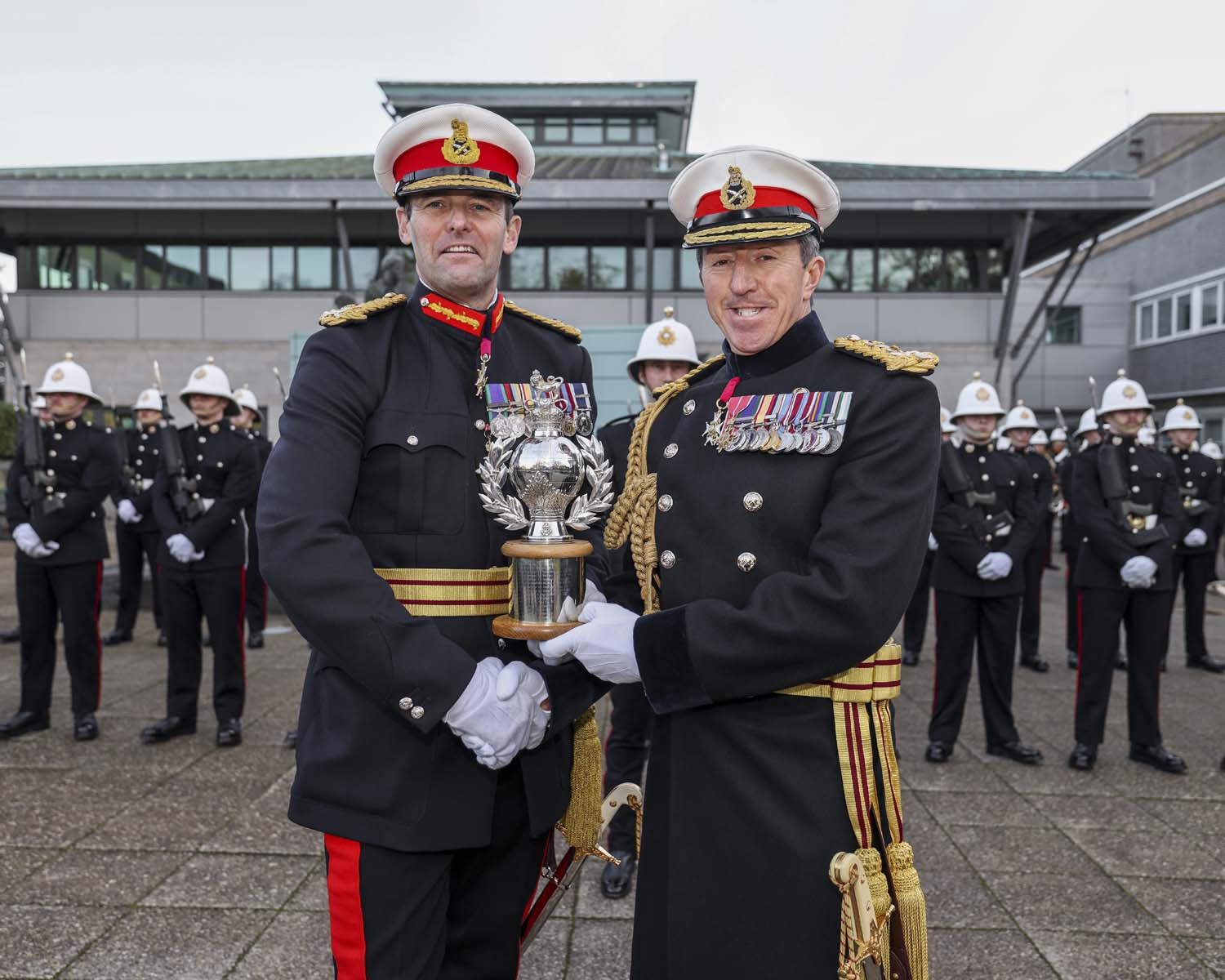
Now that a Royal Marine general is head of the Royal Navy, is he the “First Land Lord”?
Sir Humphrey on the appointment of Royal Marine General Sir Gwyn Jenkins as the top flag officer of the Royal Navy — the first RM general officer to hold this position:
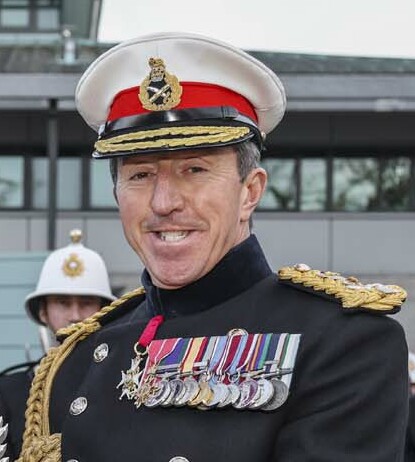
Vice Chief of the Defence Staff, General Sir Gwyn Jenkins in Lympstone, 2022.
Photo credit – LPhot Barry Swainsbury – https://www.royalnavy.mod.uk/-/media/royal-navy-responsive/images/news/new/221128-new-commandant-general-royal-marines-appointed/2.jpg, OGL 3, Link
General Sir Gwyn Jenkins has taken over as the professional head of the Royal Navy, the first Royal Marine to occupy the role of “First Sea Lord and Chief of the Naval Staff”. This is a move which is to be warmly welcomed, although the General will have many challenges ahead of him during his tenure.
While most have welcomed the move, there has been some mild hysteria on social media at the idea of a General heading the Royal Navy – what madness is this? The argument seems to be that apparently because Royal Marines haven’t commanded ships, they are somehow not able to lead the Royal Navy. Such an argument is fatuous nonsense.
The RN is a surprisingly tribal organisation of roughly 30,000 people, with its regular personnel broadly divided into four fighting arms – the Surface Fleet, the Submarine Service, the Fleet Air Arm and the Royal Marines. The surface fleet is the closest to being a “generalist” branch, although in its own way it is intensely tribal with different branches, organisations and structures. The Submariners and the FAA are unsurprisingly a bit of a closed shop, due to their missions, role and locations – it is not quite a “private navy”, but it would be rare for many personnel to serve at both Faslane supporting submarines and then to Culdrose or Yeovilton supporting aircraft. It is better to think of these fighting arms as smaller versions of the RN, each with its own culture, ethos and experience, and very different ways of bringing the fight to the enemy.
There have been First Sea Lords from the Surface Fleet, Submarine Service and FAA – no one has questioned the ability of an admiral who may have spent large parts of their career within a tribal part of the Service to lead all of it appropriately. Yet some seem to think that the General is somehow unable to do this due to his Royal Marines past. This makes very little sense – surely if this were true, how could any 1SL lead the Royal Marines effectively given they have, to the authors knowledge, never held a green beret?
The role of the 1st Sea Lord is not to stride the bridge in battle and fight wars against the enemy. He (and hopefully soon She) is the professional head of a complex organisation, employing tens of thousands of service personnel, reservists, civil servants and contractors on every continent. There are Royal Navy personnel based around the globe, from the Arctic to the Antarctic, and from the depths of the ocean to the skies far above. This role is about leadership, delivering the Government of the day’s desired defence policy outcomes, setting strategic direction for the Service and ensuring that it can deliver on its responsibilities.
The role of 1SL is part CEO, part diplomat, part public engagement and orator, and part politician. They need to be able to set a vision but accept their ability to deliver it is limited due to the time taken for naval procurement – while HMS VENTURER was rolled out of the yard today (27 May) some 10 years after the Type 31 was conceived, there have been no less than five permanent 1SL incumbents in this time. The post holder is also ultimately responsible for the delivery of operations, including the Deterrent, to the Prime Minister, and in providing advice to No10 on naval military matters.
Q&A: The Falklands War of 1982
Forgotten Weapons
Published 3 Jan 2025Since I spent a couple weeks hiking across the Falklands and then visiting battlefields (and penguins), it seems reasonable to do a Q&A video about the place and the 1982 war there between Argentina and the UK. All the questions were provided by Forgotten Weapons Patrons.
01:38 – How did the FAL perform, seeing as both sides used it?
03:43 – Effectiveness of light and heavy weapons in the war
08:49 – Would the British have been better off Yomping with AR15s, like the SAS used?
10:09 – Is there much local animosity to Argentina today?
12:21 – Local food and adult beverages
15:31 – What do people do for fun on the Falklands?
17:52 – Oldest small arm in service during the war?
20:18 – Military equipment wreckage on the islands
22:06 – Value of full powered rifle round in the FI terrain?
24:31 – Minefields
25:44 – Interaction of weapons with different effective ranges
28:46 – Did Exocet spur development of CIWS?
31:00 – What has been done to defend the islands against another invasion?
33:51 – Issues with an army designed to fight the USSR in Europe deploying to the South Atlantic?
35:30 – Weirdest weapon used in the conflict?
36:29 – Field modifications of small arms and unique kit
38:20 – Were British vehicle at risk of damage there?
39:40 – Engagement ranges
40:23 – Relevancy of bayonet fighting
41:28 – Unique equipment used by the Falkland Islands Defense Force
43:27 – American view of the Falklands War today
44:41 – Which Yomp route did we take?
45:01 – Did we visit Ajax Bay or the cemetery?
46:00 – Reality vs my expectations of the islands
46:57 – How would the war go if it happened today instead of in 1982?
48:25 – Did British soldiers use Argentine FALs?
(more…)
May 28, 2025
The Korean War Week 49 – Race to Trap 70,000 Soldiers – May 27, 1951
The Korean War by Indy Neidell
Published 27 May 2025The Chinese Spring Offensive continues this week, but comes to its end — it has cost the Communist forces tens of thousands of men, but even as it ends, the UN counteroffensive begins — and costs them tens of thousands more! And in Washington the MacArthur hearings continue, and it is obvious by now to all and sundry that General Douglas MacArthur had been very much out of line and President Truman was within his authority for firing him.
Chapters
00:00 Intro
00:41 Recap
01:12 More PVA and KPA Attacks
03:41 The Counterattack Begins
07:14 Advances Everywhere
13:07 NSC 48/5
17:45 End of the Hearings?
19:05 Summary
19:18 Conclusion
(more…)
Masters of the Air – The Bomber War Episode 4 – 8th Air Force 1942-1943
HardThrasher
Published 6 Jan 2024If you’d like to be a cool kid, then become a Patreon or if you’d like to email me send a message to lordhardthrasher@gmail.com
0:00 Intro
4:30 We’re Going to North Africa 1st
8:36 But you’re not doing it properly
16:16 Play it Again Ira
22:30 Mid 1943 – The Crisis Begins
26:53 The Black Summer
28:03 Operation Tidal Wave
34:21 Into The Valley of Death – Schweinfurt
41:34 What Now?
48:37 Survivors Club
(more…)
May 27, 2025
The Revolution is Crushed – Greek Civil War Part 3 – W2W 30
TimeGhost History
Published 26 May 2025The Greek Civil War ends in 1949 — in fire, blood, and betrayal. This episode explores how the Communist Democratic Army was defeated, why Yugoslavia and Tito cut off support, and how American-backed government forces brought the conflict to a brutal conclusion.
This is the final part of our Greek Civil War trilogy in War 2 War — TimeGhost’s Cold War series following the battles that refused to end even after WW2.
(more…)
May 25, 2025
Rommel’s Dark Secrets in North Africa – WW2 Fireside Chat
World War Two
Published 24 May 2025Indy and Sparty handle your questions on the German intervention in North Africa. Why did Rommel make such an impact so quickly? What was the war like for the local populations? How deeply involved was Rommel in the persecution of North African Jews?
(more…)
When NATO “stopped being an effective military alliance” and instead “became a kind of social club”
In UnHerd, Edward Luttwak says that Europe (however you might prefer to define it) needs a new Great Power:
All through European history, the intervals of peace, during which reconstruction and progress overcame the ravages of war, were secured by a temporary equilibrium between the Great Powers of the day.
It is obvious that there was no such equilibrium on 23 February 2022, when Russian columns started rolling towards Kyiv, and Russian President Vladimir Putin had just described Ukraine not merely as Russian, but as the homeland of the very first Russian state: Kievan Rus’.
[…]
But when the moment came, and Russian tanks rolled into Ukraine, there was no cohesive and determined power ready to respond quickly and effectively. Nato had done just that several times during the Cold War, by promptly reinforcing threatened allies with thousands of air-lifted troops from the so-called “Allied Command Europe Mobile Force”.
That, however, was the old, pre-enlargement Nato, which was still a veritable military alliance of countries capable of defending themselves, and help weaker allies in trouble, and whose chronically weak Mediterranean member states, with the most resplendent uniforms and least combat strength, had no Russian troops on their borders.
But once very deserving yet utterly indefensible countries such as Estonia were included in Nato — along with Poland, which mustered just 42,000 combat soldiers out of its population of 33 million a mere three months before Putin’s full-scale invasion began — it stopped being an effective military alliance.
Instead, it became a kind of social club. The Nato calendar is full of meetings at the “Supreme Allied Headquarters” in Mons in Belgium, where all manner of military and related issues are addressed often very professionally and quite freely — except that nobody is allowed to mention, however politely, even the most glaring military shortcomings of fellow allies, which undermine important war plans.
The highpoint of the Nato calendar is the splendid summits with all flags flying, in which the arrival of new countries is greatly celebrated, regardless of their ability to actually defend themselves. Both heads of state and heads of government are invited to those gatherings on the premise that there is strength in numbers, with no concerns about the inherent difficulty of reaching any agreements in such a vast crowd.
In the last summit, held in Washington DC in July 2024, Biden’s confusion of President Zelensky with Putin added a touch of humour to otherwise gloomy proceedings: nobody in attendance offered any suggestions on how to end the war in Ukraine.
What proves that Nato is no longer a genuine military alliance was that nothing was done in the last pre-war days before Putin’s invasion finally began. The satellite intelligence that revealed Russian forces on the move also showed that they were already in assault formations. But even then, five days remained to fly fighter-bomber squadrons to forward bases.
Yet even inaction would have been better than what actually happened. Instead of ordering the rapid deployment of tactical airpower to bases in Germany, Italy and the United Kingdom, the Biden administration instead evacuated US diplomats from Kyiv, starting a panic that induced the evacuation of some 20 other diplomatic missions.