
Forgotten Weapons
Published 13 Jan 2025D-K Productions is a collaboration between the German company Sport System Dittrich (SSD) and an American partner. SSD has been making reproductions of German World War Two small arms for something like 20 years — including Sturmgewehrs. Their guns are really good recreations of the 1940s originals, but there have long been issues importing them into the US. This was solved at last by forming a US company and doing the receiver manufacturing here in the States. While the company has plans to offer a whole bunch of different models, the one currently available is the BD-44, a copy of the standard production model of MP-44/StG-44.
I was really impressed by the use of not-finish-machined forgings for parts like the stacking rod and gas block, correctly duplicating the original German production. The stampings look good, and the handling matches the original guns (don’t expect it to be AR-level ergonomic!). The gut “feel” of the gun is an excellent match for an original MP-44. The 8×33 chambering and use of original magazines (alongside new-production magazines made by D-K) is the correct choice, of course.
I did not like the mismatch between the magazine well and magazine stops, and I did have a couple malfunctions in the two magazines I ran through it so far. Note that the gun I have at the range is my second one; the first one (which is what you see on the table) had consistent feed problems and D-K replaced it when I sent it back to them.
Whether the gun is worth the steep asking price is a personal decision, naturally. Hopefully this video gives you the information necessary to make your decision if you were considering getting one!
(more…)
May 25, 2025
BD-44: The New Semiauto Sturmgewehr from D-K Productions
QotD: Cancellation of the Avro Arrow and destruction of the prototypes
On Friday, February 20, 1959, 14,000 employees were immediately fired and sent home, after a project they had been working on since 1953, was abruptly cancelled. That project was the military, supersonic, advanced interceptor, the Avro Arrow. The company they worked for, A.V. Roe Canada Limited, had come into being just after the war, with the express purpose of designing and building both commercial and military aircraft in Canada. Its subsidiaries included Avro, responsible for developing and building the platform and Orenda, for developing the engines.
The first project of this new company was the C-102 Jetliner, the first commercial inter-city jet to fly in North America in 1949, and the second [civilian] jet to fly in the world, behind the trans-oceanic British Comet. After being test flown successfully for three years and with potential orders pending, the Jetliner project was cancelled, allegedly in favour of committing all company resources to the development of the military sub-sonic CF-100. The Arrow was to be the successor to the latter, designed to intercept and destroy if need be, incoming supersonic bombers coming across the North Pole, from the then Soviet Union.
The Arrow was a sleek, twin engine, delta winged aircraft embodying many advanced features such as fly-by-wire controls, titanium and magnesium alloys for light weight and resistance to frictional heat, transistorized electronics and an advanced engine, the Iroquois. While some other aircraft may have included some of these advanced features, what made the Arrow unique was that all of them were built into this one singular aircraft.
Adding insult to injury, the five flying preproduction aircraft, including all technical documentation, tooling and jigs and fixtures and others in various stages of assembly, were ordered destroyed. Why was a project being hailed by aviation experts around the world, suddenly cancelled? In the absence of clear facts and in the presence of rumour and innuendo, debates have raged back and forth as to the reasons, sparking a series of myths and misconceptions about the entire affair.
In 1988, the late Canadian historian, Professor Desmond Morton, lamented the fact that he could not obtain any government archival documents on the Arrow, assuming they even existed. Out of interest, I decided to try my own hand in this endeavour. Since then I have uncovered and have had declassified thousands upon thousands of records including many Secret and Top Secret, ranging from memos, reports both scientific and financial, to minutes of meetings and letters. The list includes some from the United States and Great Britain as well.
Those documents which I deemed more critical, I have either quoted from or have reproduced in my books, with full references. Following is a discussion of some of the myths and misconceptions that the documents have helped clarify.
Arrow Destruction
Perhaps one of the most enduring myths is that the destruction of the completed Arrows and all else, was ordered by Prime Minister John Diefenbaker, due to his hatred of the President of A.V. Roe, Crawford Gordon. Alternatively, it has been argued that it was Gordon who had everything destroyed as a spite against the Prime Minister. Neither account is true.
The government records from the Department of National Defence clearly show the order to destroy came from the Minister of National Defence, George R. Pearkes, after receiving that recommendation from Hugh Campbell, Chief of the Air Staff, and after conferring with numerous others including the Deputy Minister of National Defence and the Minister of the Department of Defence Production. The documents contain the signatures of those involved, all of whom would later deny publicly having any knowledge of the destruction, leaving the Prime Minister to be subsequently vilified for it. In fact, the paper trail ends with Minister Pearkes. The matter was not discussed with the Prime Minister at all.
Even today, when the Department decides to dispose of something – it does not matter if it is an aircraft, a tank, a ship or some other equipment – there is no need to seek approval or even advise the Prime Minister as to the manner of its disposal. In fact, all departments dispose of their equipment through an arm of the government. At the time it was called Crown Assets Disposal, but today it is renamed GC Surplus. The name may change yet again.
Palmiro Campagna, “The Avro Arrow: Exploding the Myths and Misconceptions”, Dominion Review, 2025-02-20.
May 23, 2025
Yasukuni-jinja, Japan’s most controversial historical site
Nigel Biggar on the Yasukuni-jinja in the Imperial Gardens in Toyko, where the Japanese shrine to their war dead also celebrates fourteen convicted WW2 war criminals:
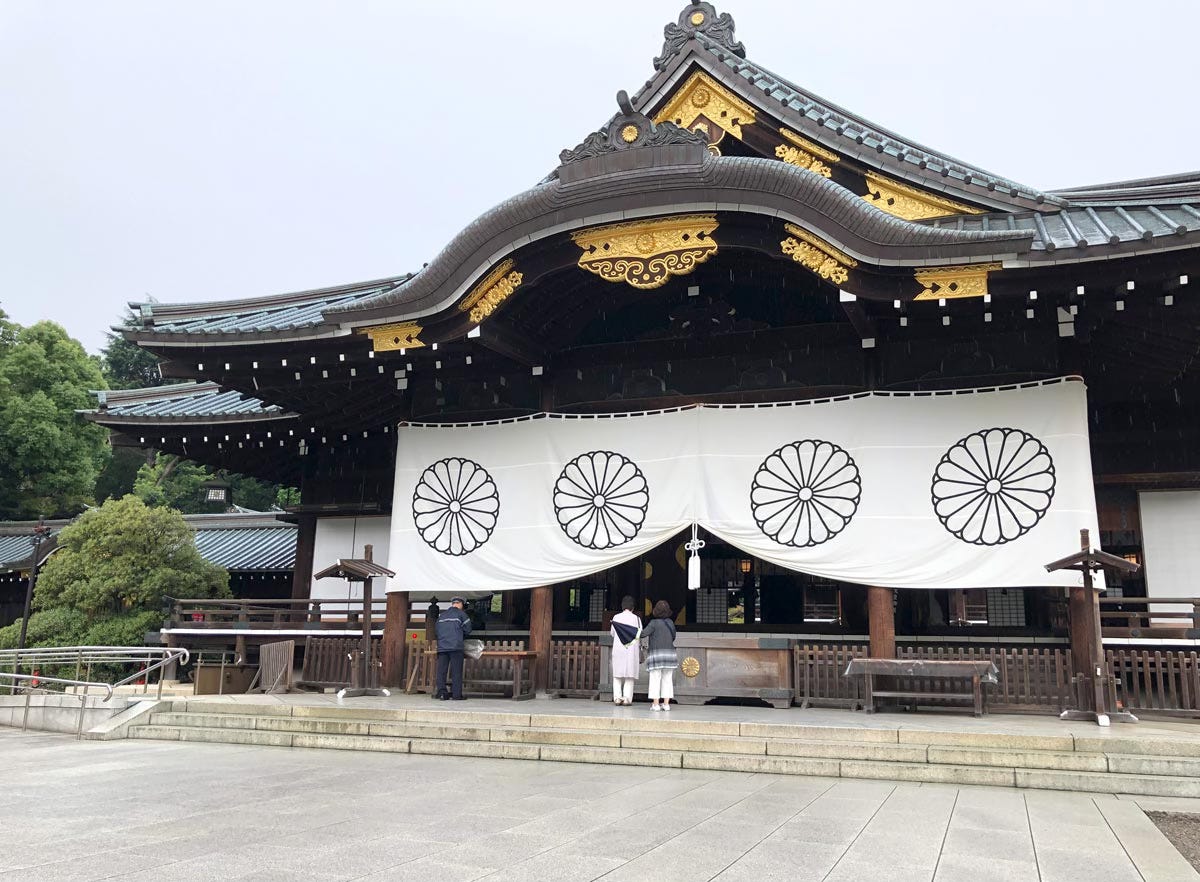
The Yasukuni Shrine in the Imperial Gardens, Tokyo.
Photo by Pierre Hazan
If ever you find yourself in the centre of Tokyo, make your way to the north-west corner of the Imperial Gardens, and turn left. A few minutes will bring you to the Yasukuni-jinja, Japan’s most controversial site. This is the national shrine to the war-dead, whose two and half million resident “glorious souls” include fourteen Class A war criminals.
A hundred yards to the right of the main shrine stands a museum, the Yushukan. Upon entering it, a visitor finds himself immediately face to face with a locomotive.
Now, when an Anglo-Saxon puts together Japan, Second World War, and locomotive, he arrives at one thing only: the “Burma Railway”. This is the railway that was hacked through the Burmese jungle partly by Allied prisoners-of-war, who were treated as slave labour and perished in their thousands. Over 12,000 Westerners died — about one in five — alongside perhaps 90,000 Asians.
So our Anglo-Saxon visitor beholds the locomotive with a mixture of disbelief, rising horror, and curiosity. He approaches the machine, looking for an explanatory text. Finding it, he learns that this locomotive is one of ninety that ran along the Burma Railway. He also learns the name of the military unit responsible for the railway’s construction. But of the Allied prisoners, the slave-labour, and the number of their deaths he learns nothing at all.
The Burma Railway wasn’t Auschwitz, either in genocidal intent or in murderous scale. But it was similar in its cruel contempt for human life. So the experience of confronting this Tokyo locomotive is analogous to stepping into a museum in Berlin and being confronted by one of the trains that shipped Jews to Auschwitz, and then reading an explanation that omits any mention of its cargo or the nature of its destination. If there were such a museum in Berlin, I’d have found it.
When our Anglo-Saxon ventures deeper into the Yushukan, he eventually discovers the exhibition on the 1930s and World War Two in the Far East. And here he learns that Japan’s imperial expansion was in fact a war of liberation, waged on behalf of subjugated Asian peoples, against Western colonial domination. And he learns that, even though Japan lost the war militarily, she won it politically, since the example of her early victories over the French in Vietnam, the Americans at Pearl Harbor, and the British at Singapore helped to inspire anti-colonial movements worldwide and so succeeded in ridding the world of European empires.
He also learns that what is known outside Japan as “the Rape of Nanking” (1937-8) is referred to demurely in the museum as “the Chinese incident”. And that whereas the “Rape of Nanking” is reckoned to have involved the indiscriminate massacre by Japanese troops of about 300,000 Chinese civilians, “the Chinese incident” only involved the severe treatment of Chinese troops who had violated the laws of war by disguising themselves in civilian clothes.
May 22, 2025
Landstad 1900: A True Semiautomatic Revolver
Forgotten Weapons
Published 3 Jul 2024The Landstad Model 1900 is a magazine-fed, semiautomatic revolver designed by Norwegian Halvard Folkestad Landstad, who lived in Kristiana (now called Oslo). He designed the gun on his own dime, and presented it to military trials in 1901, which it failed miserably. The gun has a six-round detachable box magazine of 7.5mm Nagant cartridges, a two-chamber cylinder, and a simple blowback action. Its firing cycle is to chamber a round from the magazine into the bottom cylinder chamber by manually cycling the action. The trigger is a long double-action type which rotates the cylinder 180 degrees so the cartridge is in line with the barrel and releases the striker to fire the round. Upon firing, the bolt cycles open, extracting and ejecting the empty case, rechecking the striker, and chambering a new round from the magazine into the bottom of the cylinder.
The purpose of this overly complex system was to provide a semiauto action which did not ever leave a live cartridge under the striker, in the name of safety. Only one example was made, and its bolt broke after just 5 or 6 rounds fired. It was repaired almost immediately, but the Norwegian military had was not interested in further development, and nothing more came of the program. A few years later in 1908 Norway would institute a more serious semiauto pistol trials program which led to adoption of the Kongsberg 1914 (a slightly modified Colt 1911).
Thanks to Jan for allowing me to disassemble and film this one-of-a-kind piece for you!
(more…)
May 21, 2025
The Korean War Week 48 – Cut Off. Outnumbered. Doomed – May 20, 1951
The Korean War by Indy Neidell
Published 20 May 2025The Chinese Spring Offensive reignites, and it does so with a vengeance, kicking straight into high gear, and also totally surprising the UN forces by hitting them heavily much further east than they had ever expected — in the high Taebacks. Units find themselves, cut off, sandwiched, or broken … although a redeployment means that already by the end of the week, a UN counterattack is in the cards.
Chapters
00:00 Intro
00:50 Recap
01:28 The Offensive Begins
07:39 Van Fleet Reorganizes
11:03 ROK 3rd Corps Breaks
12:55 A Counteroffensive
14:13 The Joint Chiefs Speak
16:31 Summary
16:46 Conclusion
(more…)
The Butt Report – Nadir of the RAF – The Bomber War Episode 3
HardThrasher
Published 15 Dec 2023As the powers that be on YT have decided that this video is Evil and naughty they’ve removed the ads — which, like, is great from your point of view but a bit shite from mine. So if you wanted to it’d be awesome if you’d consider either hitting the Super Thanks button or consider becoming a super cool kid and joining my Pateron.
If you’d like to email me send a message to lordhardthrasher@gmail.com
In this episode, the Butt Report, what happened next and the arrival of Bomber Harris. Despite this being more than 50 minutes, I’ve skipped some detail e.g. The Singleton Report which basically said “eh – bit difficult this bombing thing” nor Tizard’s rubbishing of Cherwell’s Memorandum, nor really the detail of the Cherwell Memorandum. You’ll live. However if you want more on the subject then I recommend the Official History of Bomber Command to get more into the civil service fire fights.
(more…)
May 20, 2025
The Battle of Aquino
Canadian Tank Museum
Published 13 Jan 2025You may know about AQUINO Tank Weekend at our Museum, but what was the Battle of Aquino? When did it take place? What happened to the Ontario Regiment RCAC during that action?
Enjoy this short documentary with our Curator Sam Richardson as he gives you a detailed look at the situation in May 1944 during the Italian campaign of the Second World War. Learn more about the soldiers that took part, the battle that took place and why it remains important to our Regiment and our Museum.
(more…)
May 18, 2025
Why it Sucked to be an Italian Prisoner in North Africa – WW2 Fireside Chat
World War Two
Published 17 May 2025Today, Indy and Sparty tackle some questions on the North African theatre. Why did the Italians think invading was a good idea in the first place? Was Allied treatment of Axis POWs a war crime? How did Italian and Allied tanks stack up?
(more…)
The FAL for British Troop Trials in 1954: X8E1 & X8E2
Forgotten Weapons
Published 21 Feb 2020The NATO rifle trials of the early 1950s eventually chose the 7.62mm x 51mm cartridge, and the British and Belgians agreed on the FAL rifle to shoot it (and they thought the US would as well, but that’s another story). The British government formally accepted the FAL for troop trials, and in 1954 an order for 4,000 X8E1 rifles (with iron sights) and 1,000 X8E2 rifles (with SUIT 1x optical sights) was placed. These rifles were mechanically the same as what would be finalized as the L1A1 rifle, but they include a number of differing features. Both models had 3-position selector switches allowing automatic fire, and they also had manual forward assists on the bolt handles. The iron sights had top covers with integrated stripper clip guides, as there was concern that troops would have to manually reload their magazines, and stripper clips would speed this process up.
(more…)
May 17, 2025
Battle of the Atlantic, 1939-1940
Real Time History
Published 3 Jan 2025In the summer of 1940, Great Britain is under attack in the air and at sea. German U-Boat wolf packs prowl the Atlantic and sink over a million tons of shipping. German skippers call this the “happy time” — but was the German Navy actually that successful early in the Battle of the Atlantic?
(more…)
May 15, 2025
Inventing “American Bushido“
Secretary of Defense Rock identifies where this new military cult came from:
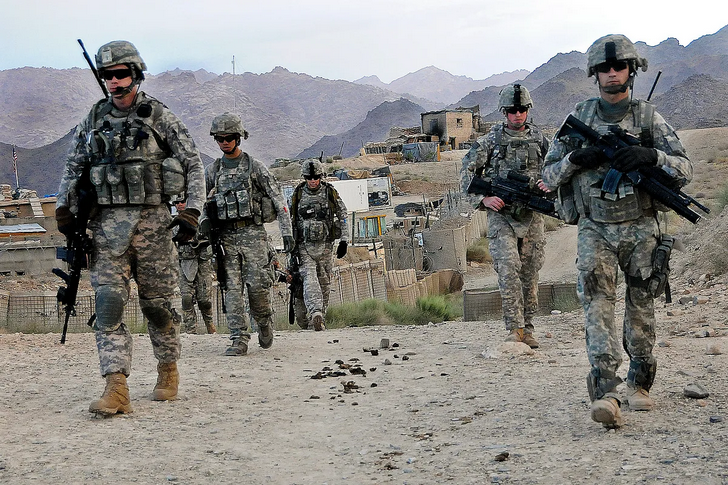
In the decades since the end of the Cold War, the United States military has undergone a cultural transformation — not merely in terms of technology, doctrine, or geopolitical posture, but in its self-conception. What has emerged is a new martial identity, one that fuses an idealized warrior code with fetishized notions of lethality and tactical superiority. This identity, what might be termed an “American Bushido“, is not merely a rhetorical or symbolic phenomenon. It is an ideological formation with material consequences for how wars are planned, how personnel are trained and selected, and how national security strategy is interpreted through the narrow prism of combat prowess. At its core, this American Bushido enshrines tactical skill and lethal capacity as ends in themselves, rather than as tools in service of coherent political objectives. But has also branched out more broadly into American society in unhealthy ways, corroding civic culture. This elevation of the warrior ethos risks distorting strategic judgment, encouraging a professional military caste isolated from civilian oversight, and glorifying violence as the central expression of national power at home and abroad.
The concept of Bushido, the feudal Japanese code of honor among the samurai, was historically a synthesis of martial discipline, spiritual rectitude, and absolute loyalty.1 In the twentieth century, however, Imperial Japan weaponized Bushido as state propaganda stripping it of nuance and repurposing it to justify fanatical nationalism, unquestioning obedience, and mass sacrifice in the service of empire leaving a trail of destruction and war crimes that rivaled Nazi Germany in World War II.2 On the tactical level, that meant banzai charges into machine gun fire and kamikaze missions that turned pilots into human-guided cruise missiles. On the strategic level, that meant one decisive battle that would single-handedly win the war in an era of mass mobilization. In the American context, however, Bushido has been appropriated and reimagined as a branding tool and cultural phenomenon: a way to market military service as a modern warrior whose path translates to all walks of life, stripped of its philosophical depth but saturated with over-the-top aggression.
[…]
In this context, the move toward an AVF, formalized by President Nixon in 1973 and championed by the Gates Commission in 1970, was seen as a political necessity and a strategic recalibration.3 The commission drew a sharp analogy between military service and public infrastructure, framing the draft as a form of taxation in service of national needs. As they put it, “It can expropriate the required tools and compel construction men and others to work until the job is finished or it can purchase the goods and manpower necessary to complete the job.”4 In this view, conscription was not a moral aberration but a practical mechanism through which the state could marshal resources, including human labor, to fulfill collective obligations.5 But this collective obligation had been pushed to the brink, and an all-volunteer force offered a path to professionalize the force, improve quality and morale, and insulate the military from the social upheavals tearing through the nation. Voluntarism was framed as a means of restoring legitimacy and operational effectiveness, ensuring that those who served did so by choice, not coercion. In many ways, voluntarism was a return to the American tradition but did so embracing the concept of the professional soldier and not the citizen soldier. While this shift solved many short-term problems, it also began a long-term process of separating the military from the broader public, contributing to the rise of a distinct warrior class and the cultural isolation of the armed forces from civilian society.
The development of the AVF worked about as one could expect through the 1980s, eventually culminating in the 100-hour war in the Persian Gulf, a campaign that showcased overwhelming American technological and tactical superiority with just 63 American dead.6 In the aftermath, President George H. W. Bush famously proclaimed, “By God, we’ve kicked the Vietnam syndrome once and for all!“7 But while the battlefield triumph seemed to bury the ghosts of Vietnam, the underlying mentality never truly died; it was only displaced. What had definitively died was the draft, and with it, the citizen-soldier model that had once anchored the American military to broader society. In its place emerged an increasingly professionalized force, insulated from the public and shaped by the lessons and traumas of a war that continued to cast a long shadow over American strategy, civil-military relations, and the political appetite for sustained conflict.
GWOT has accelerated American Bushido
The U.S. military’s post-9/11 transformation unwittingly accelerated this. Terms like “warfighter”, “operator”, and “lethality” replaced earlier bureaucratic or strategic vocabulary. Secretary of Defense Jim Mattis, nicknamed “Mad Dog” and revered for his battle-hardened persona, became the symbolic vanguard of this transformation. Phrases such as “unleash lethality” began appearing in speeches, documents, and strategic vision statements.8 Underlying all of this was a single premise: that the decisive instrument of American power was the warrior, and that the ultimate measure of military effectiveness is the capacity to kill.9
There is no doubt that tactical excellence is a prerequisite for military success, and nobody has done it better than the modern American military. But the rise of American Bushido has elevated tactical proficiency to the level of doctrine itself, often at the expense of strategic clarity. This phenomenon is not unique to the U.S., but it is particularly acute within a military-industrial ecosystem flush with funding, prestige, and cultural deference. The result has been a proliferation of elite units, special operations forces, and kinetic capabilities, often deployed with great fanfare but little discernible strategic gain, as given by the recent two-billion-dollar campaign attempting to pound the Houthis into submission in Yemen from the air.
[…]
Even still, it’s a bizarre framing because there never was a “warrior ethos” in the American tradition to nostalgically return to, at least not in the mythologized sense currently being invoked. The foundational ideal of national defense was not the professional warrior, but the citizen-soldier: an ordinary individual who took up arms out of civic duty, served for a finite period, and then returned to civilian life. Soldiering, in this tradition, was a temporary obligation, not a permanent identity. It was a job — necessary and honorable, but not meant to confer moral superiority or define a lifelong caste. Only a small number of officers and NCOs were considered to be professionals who led a variety of militia and volunteers in American conflicts.
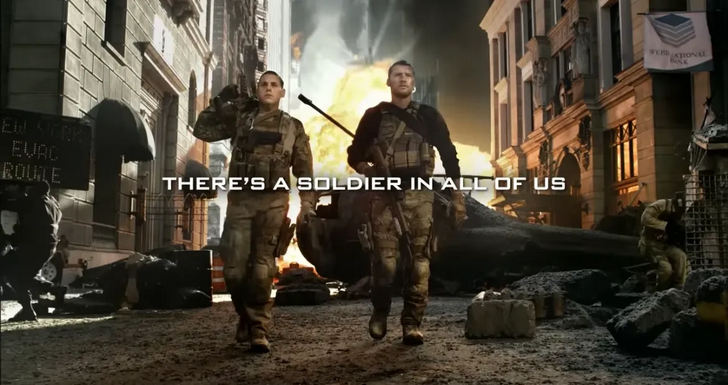
One might mistake the famous Call of Duty tagline “there’s a soldier in all of us”, as a manifestation of American Bushido. But in truth, it gestures toward the opposite. The commercial depicts ordinary people stepping briefly into a role demanded by extraordinary circumstances, the very ethos of the citizen-soldier tradition. However stylized or commercialized, the message remains: soldiering is not a sacred vocation reserved for an elite few, but a responsibility that can emerge from within the ordinary citizen. In that sense, there is a soldier in all of us.
1. See Inazō Nitobe, Bushido: The Soul of Japan (1900), Cameron Hurst, “Death, Honor, and Loyalty: The Bushidō Ideal”. Philosophy East and West 40, no. 4 (1990): 511–27. Tasuke Kawakami, “BUSHIDŌ IN ITS FORMATIVE PERIOD”. The Annals of the Hitotsubashi Academy 3, no. 1 (1952): 65–83, Karl F. Friday, “Bushidō or Bull? A Medieval Historian’s Perspective on the Imperial Army and the Japanese Warrior Tradition”. The History Teacher 27, no. 3 (1994): 339–49, and Stephen Turnbull, The Samurai and the Sacred (Osprey Publishing: Oxford, 1999).
2. For Bushido in the Imperial Japanese context, see John W. Dower, War Without Mercy: Race & Power in the Pacific War (Pantheon Books: New York, 1986), Edward J. Drea, Japan’s Imperial Army: Its Rise and Fall (University Press of Kansas: Lawrence, 2016, S. C. M. Paine, The Japanese Empire: Grand Strategy from the Meiji Restoration to the Pacific War (Cambridge University Press: Cambridge, 2017) The Wars for Asia, 1911–1949, (Cambridge University Press: Cambridge, 2012), and Robert Edgerton, Warriors Of The Rising Sun: A History Of The Japanese Military (Basic Books: New York, 1999).
3. Thomas S. Gates, The Report of the President’s Commission on an All-Volunteer Armed Force (Washington, DC: U.S. Government Printing Office, 1970).
4. Ibid., 23.
5. Milton Friedman, the 1976 Nobel Prize-winning economist, played a pivotal role on the Commission, where his influential intellectual arguments helped overcome the significant institutional resistance.
6. For scholarship on the military’s post-Vietnam recovery and AVF transition, see James F. Dunnigan, Raymond M. Macedonia, Getting It Right: American Military Reforms After Vietnam to the Gulf War and Beyond (William Morrow & Co: New York, 1993) and Suzanne C. Nielsen Lieutenant Colonel, An Army Transformed: The U.S. Army’s Post-Vietnam Recovery and the Dynamics of Change in Military Organizations (US Army War College Press: Carlisle, 2010).
7. Quoted from Maureen Dowd, “After the War: White House Memo; War Introduces a Tougher Bush to Nation”, New York Times, March 2, 1991.
8. U.S. Department of Defense, Summary of the 2018 National Defense Strategy of the United States of America (Washington, DC: DoD, 2018), 1.
9. The emphasis on the warrior ethos was set in motion in part because the events of March 23, 2003, when an 18-vehicle convoy from the 507th Maintenance Company took a wrong turn and was ambushed by insurgents in Nasiriyah, southern Iraq. See Vernon Loeb, “Army Plans Steps to Heighten ‘Warrior Ethos'”, Washington Post, September 8, 2003.
May 14, 2025
The Korean War Week 47 – MacArthur’s Big Lie Exposed – May 13, 1951
The Korean War by Indy Neidell
Published 13 May 2025The MacArthur Hearings continue in Washington, and George Marshall is adamant that what Mac says about the January 12th proposal is just plain not true. There’s still a war going on in the field, although this week is really a week of deployments, as 8th Army moves north to reoccupy former lines, even as reports come in of the Chinese massing for a possible attack.
Chapters
00:00 Intro
00:43 Recap
01:18 McMahon and MacArthur
06:28 Day Two
08:28 George Marshall’s Turn
12:20 Van Fleet Plans and Deploys
17:03 Summary
17:11 Conclusion
(more…)
Carney’s new cabinet – remarkably similar to Trudeau’s cabinets
Prime Minister Mark Carney talked as if he was initiating a new era in Canadian politics, but when it came to nominating his first cabinet, it’s plus ça change, plus c’est la même chose with most of the same cast of incompetents, crooks, lickspittles, and fart-catchers. Justin Trudeau would feel right at home:

Prime Minister Mark Carney promised change, a new way of doing things at speeds never before seen. Yet to help him do this, he is relying on the same old, tired, incompetent ministers who got us into the mess we’re currently in.
The Liberals will trumpet the large number of new faces in Carney’s 28-member cabinet — there are 15 MPs who have never served before.
But the top tier of ministers — the ones sitting in the front row at the swearing-in ceremony on Tuesday — were all former Trudeau acolytes, cabinet ministers now committed to rescuing us from a crisis of their own making.
In the front row was Sean Fraser, our new justice minister and attorney general, and the man who, under former prime minister Justin Trudeau, was responsible for immigration and then housing, two files he spectacularly failed at. If we want to know how bad Fraser was in those jobs, we need only look to Carney’s election platform.
“The last time we faced a housing crisis at such a broad scale was after the Second World War”, read the platform. This crisis “has left younger generations facing rents, down payments and mortgage payments so high that it turned housing into a barrier to opportunity instead of a cornerstone of opportunity”.
What about Fraser’s record at immigration? According to the Liberal platform, the Trudeau government let immigration “grow at a rapid and unsustainable pace”.
In December, when Liberal fortunes were in the toilet, Fraser announced that, for family reasons, he was quitting politics. Strangely, after the party witnessed a reversal in the polls, he announced he was returning.
In Carney’s eyes, Fraser’s blundering on two key files qualifies him to become justice minister. The only thing worse than Fraser as a cabinet minister may be Carney’s judgment.
Also in the front row was Chrystia Freeland, who served as deputy prime minister and finance minister under Trudeau and is now returning to cabinet as minister of transportation and internal trade.
Freeland’s record is best summed up, again, by the Liberal platform: “Business investment in Canada has dropped from 14 per cent of GDP in 2014 to 11 per cent in 2024, undermining long-term economic growth”.
Meanwhile, long-time Trudeau lieutenant Mélanie Joly, whose reign at foreign affairs was about as successful as Fraser was at housing and immigration, moves to industry.
Well, if we’re stuck with Carney’s retreads, at least we can laugh about ’em. Through the tears:

Noah has some faint praise for the new minister of National Defence and the new Secretary of State for Defence Procurement:
Welp it’s official. Bill Blair is out.
I cant say that it’s overly shocking. I don’t think anyone truly expected Blair to be MND by the end of today. While I will give Blair some credit for holding the fort, most of you already know I wasn’t his biggest fan.
He was a great placeholder who was able to smoothly roll out the plans left to him. He also did have several good public showings, such as his efforts in Korea last year. I will give credit where it is due.
However, he was also uninspiring, too passive in his role, and while I have no doubt he took it seriously, was never going to be a great long-term option. He had long overstayed his welcome […] Now he’s out completely from cabinet and in his place we have not one but two new ministers on the defence profile!
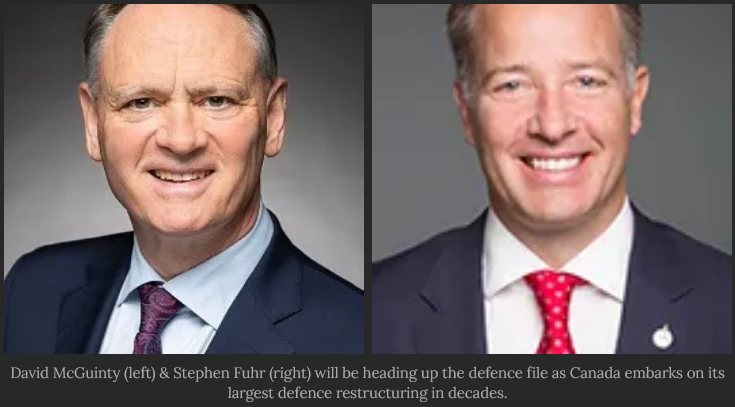
David McGuinty, best known for his eight-year stint as Chair of the National Security and Intelligence Committee has taken the reigns as the new Minister of National Defence While Kelowna MP and veteran Stephen Fuhr will take on a new role as Secretary of State for Defence Procurement.
In this role Fuhr will work under McGuinty specifically to tackle the file of Defence Procurement ahead of the establishment of the DPA. He is one of eight new secretaries of state that will operate on a “junior” level in cabinet.
Now McGuinty wouldn’t have been my first pick. I will openly admit that, but it is hard [not] to argue that he is the most prepared for the role, and likely the best we have available.
McGuinty previously held the NSICOP chair from 2017 all the way until December when he was appointed Minister of Public Safety. He has a background in International Development before becoming a parliamentarian, including stints with UNICEF.
He isn’t coming into this without a background on the current security climate we’re facing. He certainly can’t be said to be ill-prepared to take the role at a time when CAF and the DND are at one of their most pivotal moments in restructuring.
The Bomber Mafia & The Norden Bombsight – What The Heck Happened? The Bomber War Episode 2
HardThrasher
Published 28 Oct 2023Selected Internet Sources
Target for Today (1944) – Target For Today (1944)
https://www.navsea.navy.mil/Home/Warf… – LTE Thompson, first lead scientist at Dahlgren
https://www.amazon.co.uk/Scientist-Ex… – Donald Jacobs
The Fairey Battle – Light Bomber, Hea…
https://en.m.wikipedia.org/wiki/Point…
https://en.m.wikipedia.org/wiki/Butt_…
https://en.m.wikipedia.org/wiki/Area_…
https://en.m.wikipedia.org/wiki/Casab…
https://discovery.nationalarchives.go… – Western War Plan W5a and W6Selected Bibliography
America’s Pursuit of Precision Bombing 1910-1945 – McFarland et al.
Dresden – Sinclair McKay
Dresden; Tuesday … – Fredrick Taylor
Absolute War – The Firebombing of Tokyo – Chris Bellamy
Black Snow –
Bomber Command – Max Hastings
Bomber Command’s War Against Germany, An Official History – Nobel Franklin et al.
The Bomber Mafia – Malcolm Gladwell
Undaunted and Through Adversity (Vol 1 &2) – Ben Kite
United States Strategic Bombing Survey (European War) (USSBS) Sept 1945 – Var. – https://collections.nlm.nih.gov/catal…
America’s Pursuit of Precision Bombing 1910-1945, McFarland
Big Week – James Holland
May 13, 2025
Mao Wins the Civil War – Chinese Civil War Part 4 – W2W 28
TimeGhost History
Published 12 May 2025By early 1949, Chiang Kai Shek’s Kuomintang is falling apart. Hundreds of thousands of Nationalist troops surrender as city after city fall to Mao Zedong. Beijing falls without a fight and the Communists cross the Yangtze. Chiang’s final plan is escape and he moves tons of gold and his best troops to Taiwan. Meanwhile, Mao declares victory and the birth of the People’s Republic of China.
(more…)


