
Battle Guide
Published 2 May 2025On 19th August 1942, as dawn was breaking along the coast of occupied France, a force of just over 6,000 men stormed the beaches around the port town of Dieppe in the first major allied strike against Hitler’s Atlantic Wall. Within a matter of minutes hundreds lay dead or wounded, washed up against seawalls, hung on wire entanglements or incinerated in the burning landing craft. Over 60% of the mainly Canadian assault force were killed, wounded or captured by the end of the day, and the Dieppe Raid has, for the allies, gone down as one of the most infamous days of the Second World War.
(more…)
August 19, 2025
Dieppe 1942: The Failed Raid That Shaped D-Day
Comments Off on Dieppe 1942: The Failed Raid That Shaped D-Day
Operation Jubilee: Canada’s Devastating WWII Loss
WarsofTheWorld
Published 17 Jun 2023By 1942, the war was no longer another great European conflict. It was now a firmly global affair enveloping all of the world’s great powers as the Allies squared off against the tyranny and aggression of the Axis nations. Against such colossal forces, no one country could stand alone and events that affected one combatant would ultimately have consequences for the other further down the road.
To that end, while the western Allies and the Soviet Union were effectively fighting separate wars against the same enemy, there needed to be cooperation between the two fronts in order to squeeze the life out of Nazi Germany and insure victory against Fascism. However, the relationship was often a strained one as both Allied power blocks were suspicious of the other’s intentions once the war was over.
Thus, we come to the subject of today’s episode and a story of the war that is still the subject of much debate today. It was an operation with no specific military objective other than to experiment with conducting division-sized amphibious landings against a fortified beach and as a gesture to the Soviet Union who were starting to feel abandoned by their Allies. It is an operation that has become seared into the hearts and minds of the Canadian people for the sacrifice they were asked to make for it.
0:00 Introduction
3:26 A Red Request
7:50 Planning and Preparation
13:32 Operation Rutter – A False Start
18:10 Reviving Rutter
24:02 Operation Jubilee
35:52 A Necessary Lesson?
(more…)
Comments Off on Operation Jubilee: Canada’s Devastating WWII Loss
QotD: The fall of France: mass and defeat in detail
A reason to be cautious about anticipating attrition as the shape of future war is the danger of a “defeat in detail”. By failing to match mass against mass, your enemy has the chance to utterly destroy a part of your force. This offers the chance not only to shift the balance of force, but to subsequently overwhelm other elements caught off-guard by the initial defeat. In this way, one force may defeat another of comparable or even superior strength without the bloody cost typical of the clash of mass meeting mass. Prioritizing preparations for attritional struggle may allow your enemy to gain the seemingly small advantages that cascade into a defeat in detail.
As mentioned, for Clausewitz, the defeat of Prussia in the war of the Fourth Coalition was the template, but the more contemporary archetype is the Fall of France in WW2. French command and control was oriented towards a lengthy war of attrition and proved unable to react quickly enough to the German breakthrough at Sedan. Counterattacks were therefore only undertaken on the local level and without coordination. Despite German vulnerability, they were able to defeat the piecemeal commitment of superior forces and ultimately collapse Allied defenses.
The initial German breakthrough was made possible by local air superiority, enabled by the same principle. This was achieved despite an overall superiority by the Allies in aircraft (even when counting only modern planes) because the Allies kept many planes in reserve, anticipating a long war. By the time they realized the significance of the German concentration, the Germans had been able to move forward anti-aircraft guns and it was too late to destroy the bridgeheads over the Meuse (despite the desperate kamikaze-like efforts of a stricken bomber).
The case of France in 1940 gives a clear example of why a defeat in detail has been so feared. French strategy was premised on winning a lengthy war — the initial battle was assumed to be no more conclusive than the Battle of Frontiers had been in 1914 [Wiki]. The exact error of the French is unlikely to be replicated, but the nature of the mistake remains a universal peril. Dismissing the likelihood of an early decision and preparing for a “later” that never comes is the reciprocal mistake of assuming an early decision is inevitable (which can be identified with the “Cult of the Offensive” that preceded WWI).
Kiran Pfitzner, “In Defense of Taiwan: Attrition or Annihilation”, Dead Carl and You, 2025-05-14.
Comments Off on QotD: The fall of France: mass and defeat in detail
August 18, 2025
Confederate Morse Carbine: Centerfire Cartridges Ahead of Their Time
Forgotten Weapons
Published 23 Oct 2017George Morse of Baton Rouge patented a design for a remarkably modern centerfire cartridge and breechloading rifle action in 1856 and 1858, using a standard percussion cap as a primer. This was coupled with a gutta percha washer for sealing and a rolled brass cartridge body that was strong and robust — easily reloaded, if somewhat complex to manufacture.
After positive trials by the Army and Navy, Morse received a contract to make first complete guns and then a royalty contract for the conversion of existing muskets to his system. Work began at the Harper’s Ferry Arsenal, but money ran out with only 60 conversion completed. When the Civil War broke out, Morse chose to side with the Confederacy, and the tooling for his conversions was taken from the captured Armory to be put to use. He initially set up in Nashville, but the city fell to the Union in 1862, and he was forced to relocate to Atlanta and the Greenville South Carolina. It was in Greenville that Morse was finally able to manufacture guns in quantity, and he built approximately a thousand brass-framed single shot cartridge carbines for the South Carolina state militia.
Unfortunately for the Confederacy, the infrastructure to supply a modern type of cartridge ammunition really did not exist in the South, and this crippled any chance of Morse’s carbines becoming a significant factor in the war. The best technology in the world is still of no use if ammunition cannot be provided!
This Morse carbine is of the third type, using a sliding latch on the breechblock to hold the action closed when firing. Two previous versions used different and less secure systems, but this third type was introduced around serial number 350 and would comprise the remaining 2/3rds of the production run.
Cool Forgotten Weapons merch! http://shop.bbtv.com/collections/forg…
Comments Off on Confederate Morse Carbine: Centerfire Cartridges Ahead of Their Time
August 17, 2025
Battle of Norway, 1940
Real Time History
Published 7 Mar 2025The Battle of Norway in Spring 1940 cemented the reputation of the daring and invincible German war machine under Adolf Hitler. But while Denmark and Norway were successfully occupied by Germany, the campaign came at a heavy cost. This was especially true for the German Kriegsmarine which lost a significant amount of warships including the Blücher — losses that essentially crippled them for the remainder of the war.
(more…)
Comments Off on Battle of Norway, 1940
QotD: The benefits of using auxilia units to the Roman Empire
The most obvious of these is manpower. Especially with a long-service professional army, capable and qualified recruits are in limited supply. The size of the Roman army during the imperial period ranged from around 300,000 to around 500,000, but in 14 AD (the year of Augustus‘ death) there were only 4,937,000 Roman citizens (Res Gestae 8.11), a figure which probably (a word I am using to gloss over one of the most technical and complex arguments in the field) includes women and children. Needless to say, keeping something close to a fifth of the adult male citizen population under arms continually, forever was simply never going to be feasible. After his victory in 31 BC at Actium, Octavian (soon to be Augustus) had acted quickly to pare down the legions, disbanding some, merging others, until he reached a strength of just 28 (25 after the three legions lost in 9 AD were not replaced). It was a necessary move, as the massive armies that had been raised during the fever-pitch climax of the civil wars simply could not be kept under arms indefinitely, nor could a short-term service conscript army be expected to garrison the hundreds of miles of Roman limes (“frontier, border”) in perpetuity.
Harnessing the manpower of the provinces was simply the necessary solution – so necessary that almost every empire does it. By their very nature, empires consist of a core which rules over a much larger subject region, typically with far greater population; securing all of that territory almost always requires larger forces than the core’s population is able or willing to provide, leading to the recruitment of auxiliaries of all kinds. But whereas many imperial auxiliaries, as noted above, turn out to be potential dangers or weaknesses, Rome’s auxilia seem to have been fairly robustly “bought in” on the system, allowing Rome to access motivated, loyal, cohesive and highly effective manpower, quite literally doubling the amount of military force at their disposal. Which in turn mattered a great deal because the combat role of the auxilia was significant, in stark contrast to many other imperial armies which might use auxiliaries only in subsidiary roles.
The auxilia also served to supply many of the combat arms the Romans themselves weren’t particularly good at. The Romans had always performed very well as heavy infantry and combat engineers, but only passably as light infantry and truly poorly as shock cavalry; they generally hadn’t deployed meaningful numbers of their own missile cavalry or archers at all. We’ve already talked a lot about how social institutions and civilian culture can be important foundational elements for certain kinds of warfare, and this is no less true with the Romans. But by recruiting from subject peoples whose societies did value and practice the kinds of warfare the Romans were, frankly, bad at, the Roman skill-set could be diversified. And early on, this is exactly what we see the auxilia being used for (along with also providing supplemental heavy infantry), with sagitarii (archers), funditores (slingers), exploratores (scouts) and cavalry (light, heavy and missile), giving the Romans access to a combined arms fighting force with considerable flexibility. And the system clearly works – even accounting for exaggerated victories, it is clear that Roman armies, stretched over so long a frontier, were both routinely outnumbered but also routinely victorious anyway.
As Ian Haynes notes, the ethnic distinctiveness of various auxilia units does not seem to have lasted forever, though in some cases distinctive dress, equipment and fighting styles lasted longer. Most auxilia were posted far from their regions of origin and their units couldn’t rely on access to recruits from their “homeland” to sustain their numbers over the long haul (although some number of recruits would almost certainly come from the military families of veterans settled near the forts). But that didn’t mean the loss of the expertise and distinctive fighting styles of the auxilia. Rather skills, weapons and systems which worked tended to get diffused through the Roman army (particularly in the auxilia, but it is hard not to notice that eventually the spatha replaces the gladius as the sword of the legions). As Ovid quips, Fas est et ab hoste doceri, “It is right to learn, even from the enemy” (Met. 4.428); the Romans do that a lot. The long-service professional nature of these units presumably made a lot of this possible, with individual cohortes and alae becoming their own pockets of living tradition in the practice of various kinds of fighting and acclimating new recruits to it. Consequently, not only did the Roman army get access to these fighting-styles, because the auxilia were actually integrated into the military system rather than merely attached to it, they also got the opportunity to adopt or imitate the elements of the fighting styles that worked.
Finally, the auxilia system also minted new Romans. We’ve already mentioned that auxilia veterans received Roman citizenship on retirement, but that wasn’t the extent of it. We can see in inscriptions that the degree of cultural fluency that soldiers in the auxilia gained with Roman culture was high; they often adopted Roman or Romanized names and seem to have basically always learned Latin (presumably because their Roman officers wouldn’t have spoken their language). While some units of the auxilia kept distinctive national dress as a sort of uniform, most of the auxilia seem to have adopted a style of dress that, while distinct from the legions, was generally in keeping with the Roman tradition of military dress (which was not quite the same as Roman civilian dress). They also partook of the Roman military diet (Roman soldiers kept a similar diet all over the empire, even if that meant shipping thousands of amphora of olive-oil and sour wine to northern England) which would have given them a diet in common with many work-a-day Romans too. Once retired, auxilia soldiers tended to settle where they served (rather than returning to their “home” provinces), which meant settling in frontier provinces where their citizenship set them apart as distinctively Roman, wherever they may have come from.
Exactly how many auxilia would have retired like this requires a degree of number crunching. Given a 20-year tour of service and zero mortality, we might expect around 7,500 men to pass through the auxilia each year. But of course, mortality wasn’t zero and so we have to expect that of our c. 20-year-old recruits, some number are going to die before retirement. Using some model life tables (following B. Frier, “Demography” in CAH^2 XI (2000)), we should figure that very roughly one third of our recruits will have died before reaching discharge. We then we need to adjust our recruitment figures to retain the same total strength and we get something like 9,000 new recruits each year to keep a strength of c. 150,000 with mortality counted for and 20 year tours. That gives us roughly 6,000 auxilia living to retirement each year. That may seem a small number, but that gradual accretion matters when it runs for decades and centuries and the newly enfranchised family units (recall that the citizenship grant covers children and sort-of-kind-of his spouse1) tend to settle on the frontiers, which is a really handy place to have communities of citizens. If we assume that these new citizen families mostly reproduced themselves (or more correctly that they went extinct or split with multiple children at roughly the same rate with no natural population growth), then we’d expect this process to produce perhaps something like 1.5 million new citizen households up until the Constitutio Antoniniana. Being very back of the envelope then, we might – once we account for women and children descendants of those soldiers – assume that on the eve of the general grant of citizenship in 212, there were perhaps 4 million Romans whose citizenship status was a product of service in the auxilia somewhere in their history; perhaps representing something like 7% of the entire population (including non-free persons). Were we to assume larger households (which seems wise, given that retired auxiliaries are probably more likely than average to be in an economic position to have a larger family), that figure would be even higher.
That is a very meaningful number of new Romans. And those figures don’t account for some of the other ways Roman citizenship tended to expand through communities both through manumission but also the political networks citizenship created (your Latin-speaking former-auxiliary citizen neighbors are a lot more likely to be able to help intercede to get you citizenship or get your community recognized as a municipia with that attendant citizenship grant). And not only are those new Romans by legal status, but new Romans who have, by dint of military training and discipline, absorbed quite a lot of Roman culture. As best we can tell, they tended to view the Roman Empire as their polity, rather than as a foreign or oppressive entity. They were “bought in” as it were. Again, this does not seem to have been the Roman intent, but rather an opportunistic, self-serving response to the need to maintain the loyalty of these troops; citizenship was, after all, a free benefit the emperor might bestow at no cost to the treasury (since citizens who lived outside of Italy still owed taxes) or himself.
Of course that fits the auxilia in to a later pattern in the provinces which becomes perhaps most apparent as the Roman Empire begins to collapse …
Bret Devereaux, “Collections: The Queen’s Latin or Who Were the Romans, Part V: Saving and Losing and Empire”, A Collection of Unmitigated Pedantry, 2021-07-30.
- Note on the coverage of the spouse. The grant of citizenship covered any biological children of the discharged auxiliary but did not extend citizenship to his wife. It did however, give an auxiliary the right to contract a lawful marriage with effectively any free woman, including non-citizens and the children resulting from such a union would be citizens themselves. Consequently, it extended one of the core privileges of citizenship to the non-citizen wife of a discharged auxiliary: the right to bear citizen children. Since the wife would be part of the retired auxiliary’s household (and then later, if he predeceased her, potentially in the household of her male citizen children) she’d be legally covered in many cases because a legal action against her would generally be an action against her husband/child. Given that a number of the rights of citizens simply didn’t apply to women in the Roman world (e.g. office holding), this system left the wife of a retired auxiliary with many, but not all, of the privileges of citizenship, so long as her husband and her marriage survived. That said, the legal status remained vested in her husband or her children, which made it more than a little precarious. One of these days, we can talk more about the structure of the Roman familia.
Comments Off on QotD: The benefits of using auxilia units to the Roman Empire
August 16, 2025
The First Poison Gas Attack of WW1: 2nd Battle of Ypres 1915
The Great War
Published 15 Aug 2025By April 1915, the Western Front was mired in trench warfare. Germany’s new Chief of Staff, General Erich von Falkenhayn, didn’t think his army could break the deadlock, and Germany needed to help struggling Austro-Hungarian forces in the East. Before the Germans turned against Russia though, they decided to attack in the West to keep the Allies off balance. They chose to strike at the vulnerable Ypres Salient – and they would support the coming offensive with a weapon their enemies had never seen.
(more…)
Comments Off on The First Poison Gas Attack of WW1: 2nd Battle of Ypres 1915
Stocked FN Model 1903
Forgotten Weapons
Published 26 Aug 2015The FN Model 1903 was a Belgian-made scaled-up version of John Browning’s model 1903 pocket hammerless pistol. The pocket hammerless was made in .32 ACP and .380 calibers for (primarily) the civilian market in the US by Colt, and the FN model was chambered for the more powerful 9x20mm Browning Long cartridge, with military and police contracts in mind. The most common source of the FN pistols in the US is from the Swedish contract for the guns, but they were sold to a number of other nations as well.
This example is from the Russian contract, which included shoulder stocks with the pistols. Many military automatic pistols from this time were offered with the option of combination holster/stock units, which could be used to provide improved accuracy to the shooter. The stock for the FN 1903 is a bit different than most, in that it requires the use of an extended 10-round magazine instead of the standard flush-fit 7-rounder. As with most such original guns, these have been specifically exempted from NFA regulation in the US.
Comments Off on Stocked FN Model 1903
August 15, 2025
The Royal Canadian Navy should go for the GLAAM
At True North Strategic Review, Noah returns to a familiar topic when discussing the Royal Canadian Navy’s current and future needs, in this case he recommends that the RCN goes for the GLAAM:

Photo from True North Strategic Review
One thing I neglected to fully discuss during that piece, and one that always comes back to me time and time again, is the Global Logistics, Aviation, Amphibious, Medical Support Platform from Davies, aka GLAAM.
This is quite funny, as I have had somewhat of a monopoly on the GLAAM subject, which is probably why it keeps coming back to me. I think I’m one of the few who ever brings it up, and probably the one who does most frequently.
Maybe that’s why it always surprises people when I don’t throw my support behind it. In fact, historically, like most larger vessel proposals, I have been fairly unsupportive of talks of acquisition. As I stated in my Support Ship post, I believe priorities are needed elsewhere, on getting more important things done, and given the River-class, subs, and CDC are a decade out, there is little pressing need for anything beyond the two JSS in the immediate term.
At least not to the point of urgency. I would rather see CPSP fully funded along with CDC before any talks of new vessels like GLAAM. I have always made that clear. That remains my overall position now.
However, in the last few months, I’ve been surprised to see just how much universal support the proposal has, both from the average online reader and those in the navy. There is a fairly broad love for GLAAM, even among those who would rather have JSS — there is always some love to be thrown its way, even as an “if only x and x allowed it” conversation piece.
And let it be known, I don’t dislike GLAAM at all. I think it’s cool. I think it’s unique and has capabilities I like. Even if it didn’t make it into my initial assessment, I focused on vessels a lot smaller like the Vard 7 313, that doesn’t mean we can’t acknowledge GLAAM and its potential.
So. What is GLAAM?
First, what is GLAAM? For those unaware, GLAAM is a proposal from Davies Shipyard for, essentially, a Multi-Functional Support Ship. One could even call it a Joint Support Ship! In fact, looking at GLAAM you can see a lot of what was originally demanded from the Joint Support Ship in its first proposals with the Afloat Logistics Support Capability (ALSC).
Of course, ALSC would evolve into the JSS project and over time drop the amphibious, RO/RO, and vast majority of HADR capabilities. Of course, that’s another conversation for another day, but a lot of GLAAM, at least to me, reminds me of that concept—and then some.
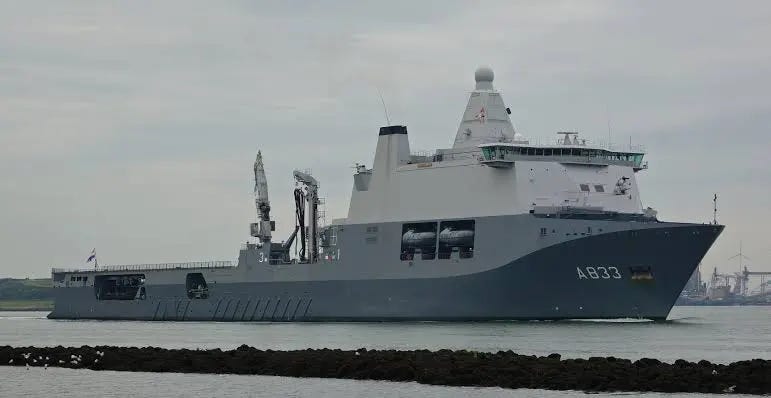
Visually and capability-wise, she is very similar to the HNLMS Karel Doorman. In fact, you could almost call them sisters. They share many design features and capabilities that take a step above the traditional Landing Platform Dock we see in other navies.
“HNLMS Karel Doorman, which GLAAM shares a striking resemblance to.”
Photo and caption from True North Strategic Review
Comments Off on The Royal Canadian Navy should go for the GLAAM
The pen that ended WWII: Inside Field Marshal Slim’s hidden collection
BFBS Forces News
Published 14 Aug 2025Ahead of VJ Day — go behind the scenes for a rare glimpse into the private collection of Field Marshal Slim’s wartime artefacts.
In this exclusive film, Tim Cooper visits Viscount Slim — grandson of the legendary Second World War commander — for an intimate look at a treasure trove of historical items. From a razor-sharp Japanese sword surrendered in 1945, to the pen that signed peace, and even the stark telegram announcing Britain’s entry into war, each item tells a powerful story.
(more…)
August 14, 2025
D-Day’s Flat Pack Ports OR Lord HT Gets Cross with The Fat Electrician
HardThrasher
Published 13 Aug 2025In which we use the @the_fat_electrician as an excuse to talk about the Mulberry Harbours, make a specific threat to a building in the United States and get to oogle at giant bits of floating concrete.
Primary Source – Codename Mulberry – Guy Hartcup, Pen & Sword Military. Kindle Edition 2014 (org. 1977)
(more…)
Comments Off on D-Day’s Flat Pack Ports OR Lord HT Gets Cross with The Fat Electrician
“Just war” theory and nuclear weapons practice
On Substack, Nigel Biggar discusses the postwar argument about whether the use of nuclear weapons against Japan was justified or not:
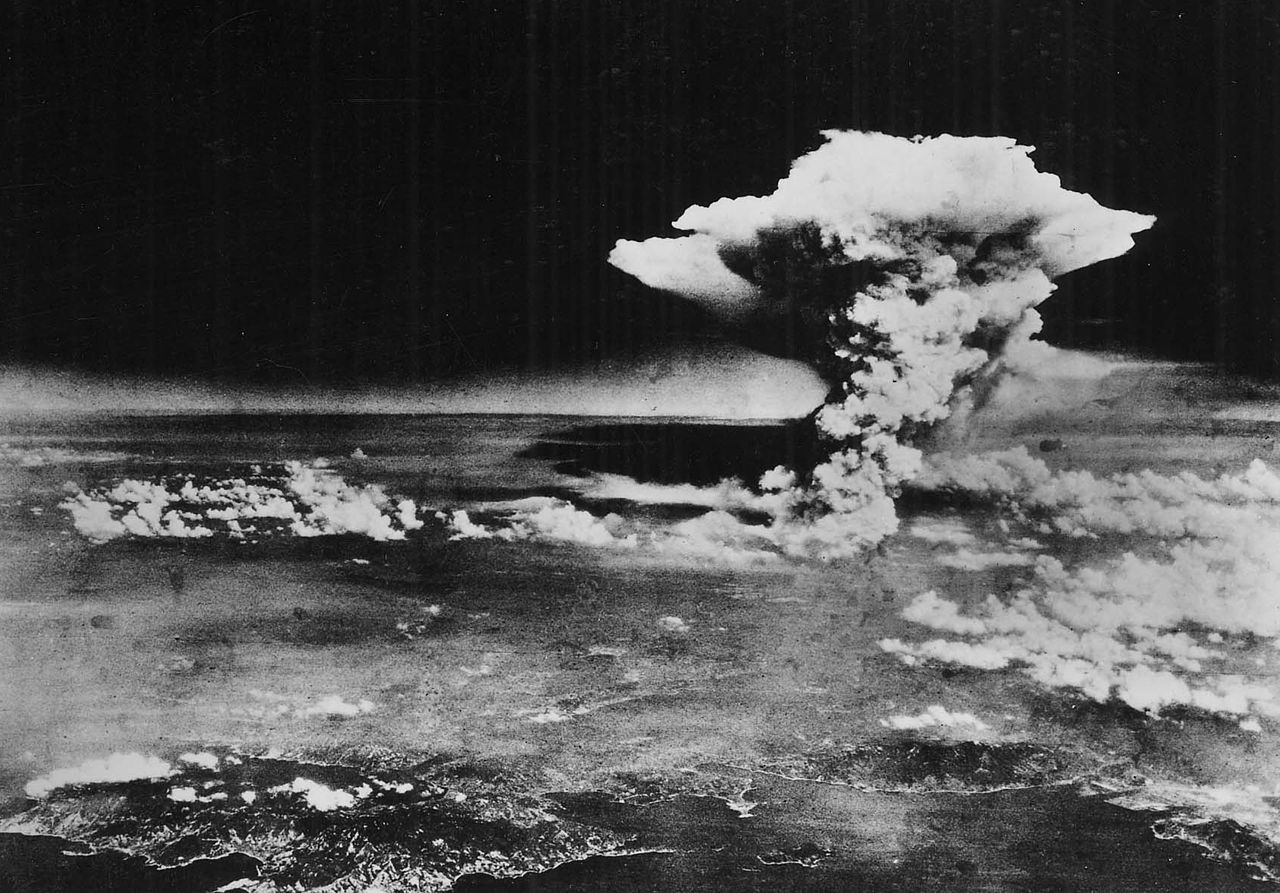
Atomic cloud over Hiroshima, taken from “Enola Gay” flying over Matsuyama, Shikoku, 6 August, 1945.
US Army Air Force photo via Wikimedia Commons.
For pacifists, Christian or otherwise, the answer is clear: since any deliberate killing is wrong, the dropping of atomic bombs on Hiroshima and Nagasaki on 6 and 9 August 1945 was wrong about two hundred thousand times over.
But that clear answer generates further questions whose answers aren’t so obvious. If killing is always wrong, then the United States should never have gone to war against Imperial Japan and therefore its ally, Hitler’s Germany. What, then, would have stopped the triumph of brutally racist Japanese imperialism in Asia and massively murderous Nazism in Europe? The noble witness of innocent non-violence?
Unfortunately, the historical evidence is that the kind of people who ran the slave-labour camps in Burma, and the likes of Dachau in Germany and Auschwitz in Poland, were not at all shamed by the face of vulnerable innocence; on the contrary, it excited their lust for domination and they fed upon it.
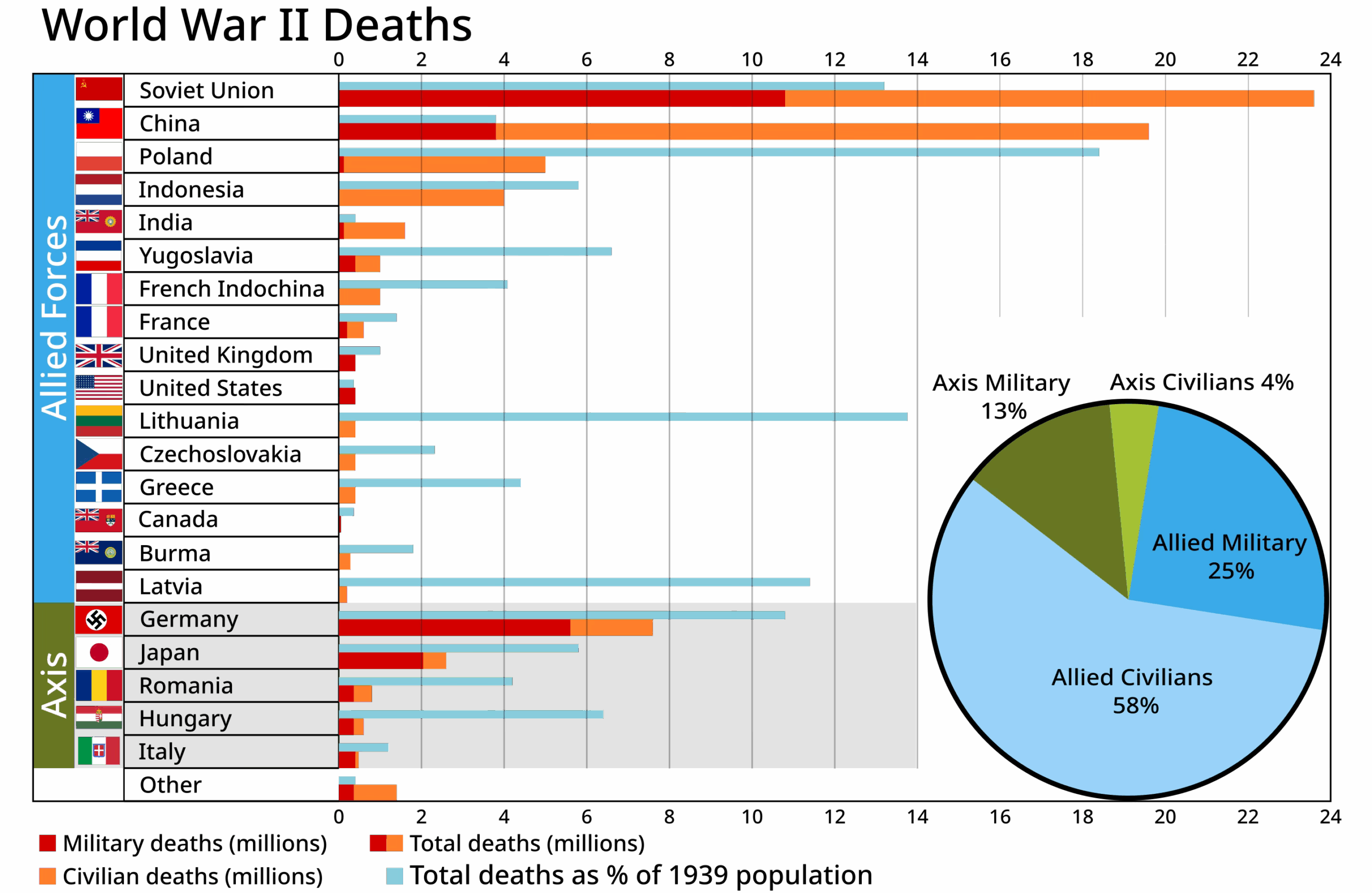
On the other hand, those who think that war can sometimes be justified, might judge that the mass killing of civilians by the atomic bombs was, simply by its massive extent, indiscriminate and therefore unjust. But there are two problems here. The first is that the vast majority of people, certainly in the UK and the USA, regard the war against Hitler and his allies as morally justified, notwithstanding the fact that that cost between 60 and 80 million deaths, well over half of them civilian.
Image credit – Wikipedia
And the second problem is that the ethical tradition of “just war” thinking doesn’t say that we may not kill civilians, even on a massive scale; it only says that we may not kill them intentionally. If a military objective can’t be achieved except by risking the possible or probable deaths of civilians, then it may still be attempted, provided that the objective is sufficiently important, militarily, and that all reasonable measures are taken to avoid or minimise the side-effect of civilian casualties. The reason for this permissiveness is that in most circumstances just war would be impossible to prosecute otherwise.
So, for the “just war” proponent, if the intention in dropping the atomic bombs on Japan was to destroy vital military or military-related targets, and if there was no more discriminate way of achieving that end, then the bombing was morally justified. It was deeply, deeply tragic—but nevertheless just.
Comments Off on “Just war” theory and nuclear weapons practice
August 13, 2025
The Korean War Week 60: Neutral Zone Violations and the 38th Parallel Standoff – August 12, 1951
The Korean War by Indy Neidell
Published 12 Aug 2025UN Commander Matt Ridgway is extremely frustrated by the Communist delegation’s unyielding stance on the 38th Parallel at the Kaesong peace talks. Chinese violations of the neutral zone highlight the fact that the war still goes on, though, as do the preparations for a UN offensive soon to be launched, to really reignite the active war in a big way.
Chapters
00:00 Hook
00:50 Recap
01:15 Ridgway’s Frustration
05:01 Neutral Zone Violations
08:57 Van Fleet’s Plans
12:28 Conclusion
13:50 Call to Action
(more…)
Comments Off on The Korean War Week 60: Neutral Zone Violations and the 38th Parallel Standoff – August 12, 1951
August 12, 2025
German-Soviet Invasion of Poland 1939
Real Time History
Published 8 Aug 2025Germany and the Soviet Union both regarded the Polish state as a creation of the post-WW1 system, and both had claims on Polish territory. In the summer of 1939, Adolf Hitler decided to invade Poland in a fait acompli against the Allies. In a secret agreement between Germany and the Soviet Union they agreed on dividing up the Polish state and Eastern Europe.
(more…)
Comments Off on German-Soviet Invasion of Poland 1939


