
The earliest castle designs we see in Europe during the Middle Ages are wooden “motte and bailey” castles which emerge first during the 10th century and make their way to Britain after 1066. In the initial basic form, the core structure (the “keep”, which is typically the fortified house itself) is placed on a motte, a hill (usually artificial) with a flattened top. The keep itself is constructed as a tall, wooden tower, with the height offering advantages both as a fighting position and for observation of the surrounding area. The motte is then enclosed by a wooden palisade (often two, one at the base of the motte and another at the crest) and surrounded by a ditch (the moat, which would be filled with water if it could be connected to a river or stream, but could also be left “dry” and still serve its purpose), the dirt of which was used to build up the motte in the first place.
But as noted, the personal manor home of a significant noble (the rank in this case is often a “castellan”, literally the keeper of a castle, so entrusted by one of the more powerful nobles who holds sway over a larger territory; the castellan has the job of holding the castle and administering the countryside around it) is also an administrative center, managing the extraction of agricultural surplus from the countryside and also a military base, housing the physical infrastructure for that noble’s retinue, which again is the fundamental building block of larger armies. Which means that it is going to need more structures to house those functions: stables for horses, storehouses for food, possibly food processing facilities (bakeries, mills) and living space both for retainers (be they administrators or military retainers) and for the small army of servants such a household expects. Those structures (to the degree they can’t exist in the keep) are put in the bailey, a wider enclosed part of the settlement constructed at the base of the motte. As with the motte, the bailey is typically enclosed only by a wooden palisade; naturally that means the most valuable things (the physical treasury, the lord’s family) go in the keep on the motte, while the more space-demanding but less valuable things go in the bailey. There is a lot of room for variation in this basic type, but for now the simple version will serve.
The resulting fortification seems almost paradoxically vulnerable. The bailey, after all, is protected only by a ditch and a wooden palisade which a determined work-party could breach with just iron axes and an afternoon to kill. The core defensive motte with its keep adds perhaps only one more palisade and a steep climb. But in fact, these relatively modest defenses have greatly increased the cost of attacking this settlement. The motte and bailey castle, at least in its early wooden form, won’t stand up to a determined assault by a large and well-coordinated enemy, but that isn’t its purpose. Instead, the purpose of the motte and bailey castle is to raise the cost of an assault such that a potential opponent must bring a significant force and make a careful, well-planned assault; this the motte and bailey accomplishes quite well, which explains the long durability of the basic design, with stone versions of the motte and bailey persisting into the 15th century.
The quick mounted raid is now impossible; precisely because it will take a solid afternoon to breach the defenses, there is little hope of surprising the defenders. At the same time, the ditches will make any such work party vulnerable to missile fire (arrows, yes, but also javelins or just large rocks) from the palisade. And most of all, taking the place now demands you coordinate a work party, with some of your attackers splitting up to suppress the defenders, some making sure to block the exits so the defenders don’t rush out and attack your work party directly, and still more of your attackers in the work party itself. These very basic defenses have suddenly taken you from a position where a bit of surprise and rough numerical parity was enough to contemplate an assault to a position where you need several times as many attackers (for each of those divisions needs to be large enough to confidently win against the defenders if assailed).
Perhaps most importantly, the basic structure of this defense demands that you do this multiple times in sequence. We’ve already discussed the value of defense-in-depth, but in brief, every attack is at its strongest in the moment after it jumps off: everyone is alive, in the right positions, at the right time, coordinated and at least in theory clear on their objectives. Every movement and action beyond this point diminishes the power of the effort as coordination breaks down, attackers are killed and things break; this is what Clausewitz terms (drink!) friction – the unpredictable interaction of probabilities takes their toll on any plan, no matter how carefully designed. This is, by the by, more true in real warfare, where coordination is limited by communications technology, than it is in film or video games, where armies appear to mostly communicate by some form of instantaneous telepathy (it is amazing just how many clever sounding movie or game assault plans fall apart once you imagine trying to coordinate them with nothing more than shouting, or even a radio). As more and more things turn out unexpectedly or have to be improvised, the plan slowly shakes apart until eventually all of the momentum is lost.
The basic structure of a motte and bailey castle exploits this feature of warfare, forcing an attacker to overcome a series of obstacles in sequence, all while in contact with the enemy. Recall that this is a defense which really doesn’t envisage enemy artillery (because armies with lots of effective siege artillery were not common in the often small-scale warfare of the period; that’s not to say they didn’t exist, but if your motte and bailey castle forces the enemy to only attack with a big, expensive army that can build catapults, it has done its job, not the least because most possible enemies won’t have that capability at all), so an attacker is going to have to breach each layer in sequence while in contact with the defense and to pierce them all more or less “in one go”. Consequently, taking the castle by storm means crossing (and probably filling in) at least one deep ditch, breaching a palisade under fire, then moving up a steep hill under fire, then breaching another palisade, at the end of all of which, the attacker must arrive at the keep with enough force and cohesion to take it. All of that is going to take a substantial attack and a lot of coordination and most potential attackers, the defender may hope, will lack either the resources or the determination to go through so much effort, especially as they are likely to have to do it multiple times: being entirely wooden, motte and bailey castles were fairly cheap and so a large territory could have quite a lot of them (note on the Bayeux Tapestry how William has to take several such castles in order to capture Conan II of Britanny). Each motte and bailey castle thus raises the cost of trying to seize control of the territory; collectively they make that cost prohibitive.
Of course our principle of “antagonistic co-evolution” is not done and the vulnerabilities of a wooden motte and bailey castle are fairly clear and easy to exploit. For one, the wooden palisade is mostly a blocking element, rather than a fighting position; attackers that reach the wall can actually use it as cover while tearing it down or setting it on fire. The entire setup, being made of wood, is vulnerable to fire but also to any kind of even-quite-modest catapult. And quite naturally, any military leader (which is to say, the military aristocracy which was emerging at the very same time as these castles) is going to want to build the kind of capabilities which will allow for successful castle assaults because, as we’ve already noted, castles function more or less as the “nails” on the map which hold down the canvas of revenue extraction and military power.
Which in turn means evolving castle design to resist the methods by which a motte and bailey castle might fall. The most immediate change is in building material: wooden walls can only be so high, so thick and so resistant to fire. Stone, though far more expensive, offers advantages on all three fronts. And so, already in the late 10th century, we start to see stone keeps and gatehouses (supporting still wooden palisades); full stone castles would soon follow.
As an aside, one solution to this problem which doesn’t much appear in the Middle Ages but was very well-used in Iron Age Europe was what the Romans called the murus Gallicus, a hybrid wood-and-stone wall system. Gallic hillforts (called oppida) were built on hills, as the name suggests; their outer walls could be built by using earth fill to construct what was essentially a retaining wall, faced in stone, with transverse reinforcing wood beams every few feet. That created, in turn, a vertical stone surface, supported by the hillside itself, on which could be additionally built a wooden palisade for added height. The result was a very formidable fortification, assuming one had the hill to work with initially. You couldn’t knock it over or really undermine it effectively and the stone face was nearly vertical; the height of the hill meant that effective escalade meant coming up with a mole, tower or ladder taller than the hill (a thing, naturally, that the Romans ended up doing). That this style of fortification didn’t really reemerge in the Middle Ages speaks to the degree of path dependence in fortification design. Because fortification design tends to be evolutionary, it is possible in similar conditions to get very different responses as different designers try to meet the same threats by modifying different preexisting systems of fortification.
Bret Devereaux, “Collections: Fortification, Part III: Castling”, A Collection of Unmitigated Pedantry, 2021-12-10.
August 29, 2025
QotD: The early “Motte and Bailey” castles
August 28, 2025
History of Britain VII: Fall of Roman Britain
Thersites the Historian
Published 23 Feb 2025After its efflorescence during the 2nd Century, Roman Britain entered steep decline during the 3rd Century and the benefits of Roman civilization had all but vanished by the time that the Romans withdrew their forces and support.
QotD: The rise and fall of the chariot in combat
The classic chariot was driver and archer or spearmen. A friend describes them as being like a pilot and a navigator (or bomb-aimer) on a bombing run. The pilot/charioteer concentrates on getting the pair of you where you need to be (or not to be). The archer/spearmen/navigator/bomb-aimer concentrates on killing the enemy.
The most famous driver/warrior pairing in myth and literature is Krishna and Prince Arjuna in the Mahabharata and, specifically, the Bhagavad Gita. (Normally, the driver serves the warrior, but if your driver is an incarnation of Vishnu, things work differently.) The warriors of the Iliad are also chariot-driving warriors — hence scenes such as Achilles dragging Hector‘s dead body behind his chariot. Chariots were a major element in Chinese warfare up to the Warring States period. New Kingdom Egypt was very much a chariot empire, as were their great rivals, the Hittites.
Once recurve bows able to match chariot archery from horseback arrived, chariots largely disappeared from combat in the major Eurasian civilisations. This began to occur around the time of the Assyrians — who were a transitional case using both chariots and cavalry — about a thousand years before the invention of the stirrup and even longer before the stirrup’s arrival in the Mediterranean world. Lancers — the heavily armoured version of which was the cataphract — then developed as a way of dealing with horse archers.
Lorenzo Warby, “Stirrups, a rant”, Lorenzo from Oz, 2025-02-28.
August 27, 2025
The Korean War Week 62: Chinese Break Off Peace Talks! But Whose Fault Is It? – August 26, 1951
The Korean War by Indy Neidell
Published 26 Aug 2025The Chinese claim that American bombers have attacked the Kaesong conference area and break off the peace talks. The UN delegation smells a set up. Meanwhile, the Battle of Bloody Ridge is in full swing and earning its name, as the casualties mount on both sides.
Chapters
00:41 Recap
01:11 A ROK Success
01:47 Bloody Ridge
06:17 Soviet Reinforcements
07:08 Operation Strangle
11:06 Summary
11:45 Conclusion
13:37 Call to Action
(more…)
M1922 BAR Cavalry Light Machine Gun
Forgotten Weapons
Published 21 Apr 2025After World War One, there was a lot of tinkering with the BAR by the US military. It was recognized as being a very good platform, but the original M1918 configuration left a lot to be desired. It was deemed too heavy to use effectively from the shoulder, but also not really well suited to sustained fire. In an effort to optimize it for use as a dynamic support weapon by a small squad, the Infantry & Cavalry Board requested a model with a heavier barrel and lightweight bipod in 1920. Six experimental examples were made form existing BARs, and the design was formalized two years later as the Model 1922.
This pattern of BAR has a heavy finned barrel to give it more sustained fire capacity and a folding bipod and rear monopod for more accurate use prone. The Board also experimented with larger magazines, and ended up recommending a 30-round size — although this was never put into production. In total, 500 of the Model 1922 guns were made, all converted from existing BARs. Experimentation continued slowly, and eventually in 1937 a lighter pattern was adopted as the M1918A1. The Model 1922 was formally declared obsolete in April 1941, and virtually all of them were rebuilt to the new M1918A2 pattern for use in World War Two. Surviving examples like this one are extremely rare — this is the only known example in private hands.
(more…)
August 26, 2025
When Jagdpanther Fought Churchill
The Tank Museum
Published 18 Apr 2025Jagdpanther vs Churchill. Tank destroyer vs tank. New technology vs proven veteran. Who will emerge victorious?
It’s 6pm on 30th July 1944. Outnumbered 6 to 1, a platoon of 3 German Jagdpanthers is about to go into action for the first time. Facing them will be a squadron of 18 British Churchill tanks. Within 5 minutes, 11 tanks will be knocked out.
The Jagdpanther is the latest German armoured vehicle to arrive in Normandy. With a devastating gun, and a heavily armoured superstructure, this tank hunter is quick, reliable and deadly.
The Churchill has been fighting with Allied armies in North Africa, Italy and on the Eastern Front. The early marks struggled with a range of issues, but by 1944 it is an essential part of the British and Canadian tank force.
It’s during Operation Bluecoat where these two machines would come face-to-face for the very first time. The Churchills of S Squadron, 3rd Battalion, Scots Guards, have captured Hill 226 – a strategically important area to the south of Caumont. They are preparing for a German counterattack, but their infantry is yet to arrive – leaving their left flank dangerously exposed. And a platoon of Jagdpanthers is ready to take full advantage of their vulnerable state …
00:00 | Introduction
00:35 | The Jagdpanther
02:38 | The Churchill
05:43 | Operation Bluecoat
07:46 | A Turkey Shoot?
12:25 | Aftermath
17:40 | Roll of Honour
(more…)
August 25, 2025
Vietnam 1950: Giáp Crushes France on Route Coloniale 4 – W2W 41
TimeGhost History
Published 24 Aug 2025Viet Minh forces shift to the offensive, attacking French troops up and down the country. As guerilla war reigns in the southern half of Vietnam, more organised attacks begin in the north up near Hanoi. France cycles through multiple new commanders, trying to stem the tide. But do they truly have a hope of turning this around? Or are they just delaying the inevitable?
(more…)
The Sharpest Pen of the Edwardian Age | Who Was Saki?
Vault of Lost Tales
Published 5 Apr 2025Delve into the razor-sharp world of Saki in this engaging author talk exploring his chillingly clever short story, “The Open Window”. Discover the man behind the pen name — H.H. Munro — and uncover how his biting satire, Edwardian upbringing, and darkly humorous worldview shaped this unforgettable tale. Perfect for fans of classic literature, Oscar Wilde-style wit, and unsettling plot twists, this literary deep dive offers historical context, thematic insights, and just enough spookiness to keep you on edge. Whether you’re a student, a short story lover, or just curious about the mind that created one of literature’s most deviously satisfying endings, this talk is your open invitation.
“Saki”, the wickedly sharp pen name of Hector Hugh Munro, masked a man whose wit could slice through Edwardian society like a silver butter knife through scandal.
Born in 1870 in British Burma and raised in England, Munro brought an acerbic wit to the drawing rooms of empire, crafting tales that balanced dry humor, social critique, and sudden, often shocking twists. Writing under the name “Saki”, he produced short stories that mocked the pretensions of the upper class, exposed the darkness beneath genteel facades, and made readers laugh — sometimes uncomfortably. His life, marked by loss, repressed identity, and service in World War I, ended tragically in 1916 on the battlefield, but his stories continue to delight and disturb to this day.
(more…)
August 24, 2025
This is Westland Helicopters (1960s)
British Helicopters History
Published 17 Jan 2020Major rationalisation of the UK aircraft industry occurred during the 1960s. With the acquisition of Bristol Helicopters, Fairey Aviation and Saunders-Roe, Westland Helicopters transformed itself into Britain’s only helicopter maker with plants at Yeovil, Weston-super-Mare, Eastleigh, and Hayes, producing helicopters for all roles.
August 23, 2025
T-55: 70 Years Old. Still in Service
The Tank Museum
Published 22 Aug 2025No tank in history has been produced in the quantities that the T-55 and its relatives have. Some sources suggest as many as 100,000 have been built since 1946, this tank is still seeing service across the globe. So how come this 80-year-old tank is still in service in 2025?
When looking at its predecessor, the T-34, the move to the T-55 looks like a massive leap in design. But there is a clear evolutionary progression – there is just a missing link. The T-44 laid the groundwork for future Soviet tank design – pioneering torsion bar suspension and a transverse engine.
It was soon decided that the T-44 would require a new 100mm gun to replace the 85mm. This new model would be called the T-54. While NATO classes both the T-54 and 55 as the same vehicle, the T-55 is a substantially better tank. A comprehensive series of upgrades made this an effective force on the battlefield.The T-55 would prove popular with forces around the world. It would even go head-to-head against itself in the Iran-Iraq War of the 1980s. Eventually the T-55 would become outdated as NATO technology became more and more advanced. But it is still in service in the conflict in Ukraine – why?
The Russian army, despite the stereotype of having unending stockpiles of weaponry, have been struggling to keep up with the astounding loss rate the Ukrainians have been able to inflict on them. This has resulted in older and older vehicles being dragged out of those large storage depots across Russia, mainly being used as mobile, protected artillery.
The T-55 has endured partly due to its sheer numbers, availability and upgradability. Its performance on the battlefield has varied, but its basic but effective design has proven itself again and again throughout the decades. It is worth reiterating how remarkable it that a vehicle conceived at the end of the Second World War is still even a consideration for armies 80 years on.
In this video, historian James Donaldson explores the history of the most-produced tank in history – the T-55. This Soviet design has its roots in the iconic T-34, evolving through the years to become an effective fighting machine that was sold around the world. Despite manufacturing ending in the 1980s, this tank is still a feature on the battlefield, with both sides making use of T-55s in the current conflict in Ukraine. It may not be engaging in tank-on-tank combat as initially intended, but the T-55 is still providing a useful, effective and relatively cheap addition to the arsenal of many armies in the 21st Century.
00:00 | Introduction
00:43 | The Missing Link
02:31 | Making the T-55
05:24 | Upgrades
08:34 | A Numbers Game
12:51 | In Action
16:41 | T-55 Today
(more…)
August 22, 2025
Resolved – This country’s youth will not fight to defend this country
On Tuesday, John Robson discussed the results of a recent Angus Reid survey that, among other things, indicated that Canadians are at least as anti-military as they’ve been since the first Trudeau government:
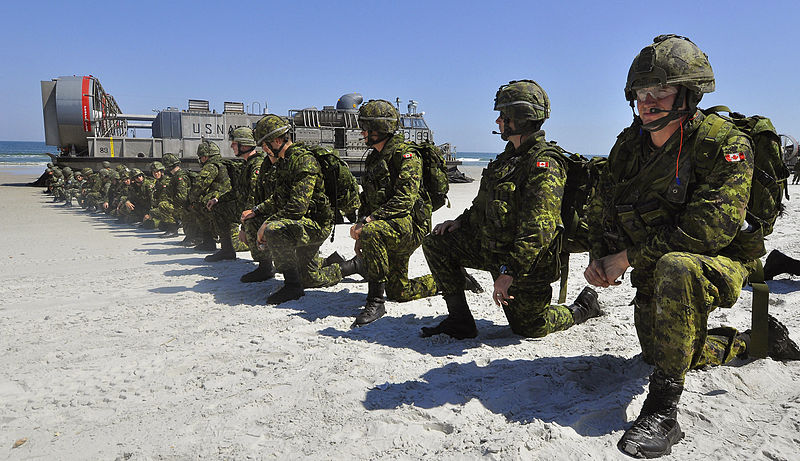
Canadian soldiers set a perimeter position after disembarking a U.S. Navy landing craft during a simulated amphibious landing, 24 April 2009.
U.S. Coast Guard photo by Petty Officer Seth Johnson via Wikimedia Commons.
The National Post reports an Angus Reid survey finding that a significant majority of us favour compulsory voluntary service by the youth of today. Which might sound like a bracingly traditional Jordan Peterson clean-your-room, stand-up-straight, shoulders-back attitude until you read the fine print, which would risk making Peterson ill if he weren’t already. Because it turns out we want to conscript them to work in health care so we get stuff we didn’t pay for, not to defend the country because if ye break faith and so on.
According to the survey, 74 per cent of respondents want young people to have to give a year of their lives to bolstering our failing, structurally unsound socialized medical system. Respondents were also in favour of mandatory service in support of the environment (73 per cent), “youth services” (72 per cent), whatever it might be, and “civil protection” (70 per cent). But when it comes to (ugh) national defence, just 43 per cent supported it, with 44 per cent opposed.
Spending on comfort while barbarians undermine the city walls lacks prudence as well as dignity. As I observed in a long-ago graduate-school debate about American national security, it didn’t matter how wonderfully progressive the Dutch social welfare system was in 1940 when the Nazis came calling. And we too seem to have our priorities backward.
If I might confuse the government by discussing principles of political economy, there are good reasons why national defence is considered a binding duty on those able to contribute to it. First is the “free rider” problem that everyone benefits from successful protection of the community, especially, at least in a narrow and hedonistic sense, if you send some other chump to die for your freedom while you recline comfortably at home.
Second is the moral consideration that, as John Stuart Mill famously if uncharacteristically put it, “War is an ugly thing, but not the ugliest of things: the decayed and degraded state of moral and patriotic feeling which thinks that nothing is worth a war, is much worse”. Which comes from, yes, his “Principles of Political Economy”.
Mill was no warmonger. As he immediately continued, “When a people are used as mere human instruments for firing cannon or thrusting bayonets, in the service and for the selfish purposes of a master, such war degrades a people”.
But not all wars are like Russian President Vladimir Putin’s invasion of Ukraine, let alone Hamas’s attack on Israel. As the anything-but-bellicose Mill added, “A war to protect other human beings against tyrannical injustice; a war to give victory to their own ideas of right and good, and which is their own war, carried on for an honest purpose by their free choice — is often the means of their regeneration”.
August 21, 2025
Six Reasons Operation Market Garden FAILED
The Tank Museum
Published 3 April 2025Operation Market Garden failed because the tanks of XXX Corps did not reach the Paras in Arnhem in time. Many historians have argued that the British armoured column “let the side down”. But is this actually true?
We reckon there are six reasons why the operation was a total disaster. It was a poor plan from the get-go, relying on a rate of advance that would outmatch the German invasion of France in 1940. Bad weather prevented the deployment of badly-needed reinforcements, and the terrain Guards Armoured were expected to traverse – a single road with impassable conditions on either side – significantly hampered the efforts of the tank crews.
Poor intelligence also meant that the British column was not prepared for resistance from a retreating and desperate German Army. It was a combination of all these factors that caused Market Garden to unravel completely.
Despite the complications, many acts of valour were carried out by both the airborne and armoured divisions, including the legendary assault across the Waal by the US 82nd Airborne.
So, join us as we explore these six reasons why Operation Market Garden failed and decide for yourself whether XXX Corps could have done anymore.
00:00 | Introduction
02:23 | #1 – A Bad Plan
06:22 | #2 – Poor Intelligence
07:51 | #3 – Difficult Terrain
11:27 | #4 – Determined Resistance
13:45 | #5 – Bad Weather
14:38 | #6 – Loss of Surprise
19:45 | What Went Wrong?
(more…)
August 20, 2025
The Korean War Week 61: The South Koreans Strike as Ceasefire Talks Stall – August 19, 1951
The Korean War by Indy Neidell
Published 19 Aug 2025After two months of inactivity, 8th Army begins new offensive operations this week, and it is the South Korean forces doing the fighting. Meanwhile, the Kaesong peace talks are ever more threatened by continuing neutral zone violations.
Chapters
00:00 Hook
00:48 Recap
01:13 Neutral Zone Violations
02:17 The UN Defense System
06:59 The ROK Attacks
10:38 Summer Diseases
12:48 Summary
13:33 Conclusion
15:20 Call to Action
(more…)
UK vz.59 Czech Universal Machine Gun: History and Mechanics
Forgotten Weapons
Published 21 Mar 2018In 1952, Czechoslovakia adopted a whole new family of small arms, including the vz.52 pistol, vz.52 rifle, and vz.52 light machine gun. The rifle and LMG were both chambered in the Czech 7.62x45mm cartridge, and both would be adapted to the Soviet standard 7.62x39mm a few years later, in 1957. Very shortly thereafter, the Czechs would also introduce a heavier universal machine gun version in 7.62x54mmR under the designation UK vz.59 (universal machine gun model 59).
The UK 59 was basically a scaled up sibling of the vz.52 and vz.52/57 machine guns, although it fed from a belt only, where its smaller predecessors had allowed either belt or magazine feed. It used a pivoting locking block system much like the Walther P38 and Beretta pistols, in conjunction with a long stroke gas piston much like that of the vz.26 light machine gun.
The weapon did not see much interest outside of Czechoslovakia, although it does remain in service in that region in the modernized 7.62x51mm iteration.
Thanks to Marstar for letting me examine and shoot their UK vz.59!


