
The fall of the Roman Empire in the West (please, right now, just mentally add the phrase “in the west” next to every “the fall of Rome” and similar phrase here and elsewhere) is complicated. I don’t mean it is complicated in its causes or effects (though it is that too), I mean it is complicated in its raw events: the who, what, where and when of it. Most students are taught a fairly simple version of this because most of what they need to actually learn is the cause and the effects and so the actual “fall” part is a sort of black box where Huns, Vandals, Goths, plague, climate and economic decline go in and political fragmentation, more economic decline and the European Middle Ages come out. The fall itself ends up feeling like an event rather than a process because it is compressed down to a single point, the black box where all of the causes become all of the effects. That is, frankly, a defensible way to teach the topic at a survey level (where it might get at most a lecture or two either at the end of a Roman History survey or the beginning of a Medieval History survey) and it is honestly more or less how I teach it.
But if you want to actually try to say something intelligent about the whole thing, you need to grapple with what actually happened, rather than the classroom black-box model designed for teaching efficiency rather than detail. We are … not going to do that today … though I will have some bibliography here for those who want to. The key thing here is that the “Fall of Rome” (in the West) is not an event, but a century long process from 376 to 476. Roman power (in the West) contracts for a lot of that, but it expands in periods as well, particularly under the leadership of Aetius (433-454) and Majorian (457-461); there are points where it would have really looked like the Romans might actually be able to recover. Even in 476 it was not obvious to anyone that Roman rule had actually ended; Odoacer, who had just deposed what was to be the last Roman emperor in the west promptly offered the crown to Zeno, the Roman emperor in the East (there is argument about his sincerity but James O’Donnell argues – very well, though I disagree on some key points – that this represented a real opportunity for Rome to rise from defeat in a new form yet again).
Glancing even further back historically, this wasn’t even the first time the Roman Empire had been on the brink of collapse. Beginning in 238, the Roman Empire had suffered a long series of crippling civil wars and succession crises collectively known as the Crisis of the Third Century (238-284). At one point, the empire was de facto split into three, with one emperor in Britain and Gaul, another in Italy, and the client kingdom of Palmyra essentially running the Eastern half of the empire under their queen Zenobia. Empires do not usually survive those kinds of catastrophes, but the Roman Empire survived the Crisis, recovered all of its territory (save Dacia) and even enjoyed a period of relative peace afterwards, before trouble started up again.
The reason that empires do not generally survive those kinds of catastrophes is that generally when empires weaken, they find that they contain all sorts of people who have been waiting, sometimes patiently, sometimes less so, for any opportunity to break away. The rather sudden collapse of the (Neo-)Assyrian Empire (911-609 BC) is a good case study. After having conquered much of the Near East, the Assyrians fell into a series of succession wars beginning in 627; their Mesopotamian subjects smelled blood and revolted in 625. That was almost under control by 620 when the Medes and Persians, external vassals of the Assyrians, smelled blood too and invaded, allying with the rebelling Babylonians in 616. Assyria was effectively gone by 612 with the loss and destruction of Ninevah; they had gone from the largest empire in the world at that time or at any point prior to non-existent in 15 years. While the Assyrian collapse is remarkable for its speed and finality, the overall process is much the same in most cases; once imperial power begins to wane, revolt suddenly looks more possible and so the downward slope of collapse can be very steep indeed (one might equally use the case study of decolonization after WWII as an example: each newly independent country increased the pressure on all of the rest).
Yet there is no great rush to the doors for Rome. Instead, as Guy Halsall puts it in Barbarian Migrations and the Roman West (2007), “The West did not drift hopelessly towards its inevitable fate. It went down kicking, gouging and screaming”. Among the kicked and gouged of course were Attila and his Huns. Fought to a draw at the Battle of the Catalaunian Plains, his empire disintegrated after his death two years later under pressure from both Germanic tribes and the Eastern Roman Empire (and the standard tendency for Steppe empires to fragment); of his three sons, Ellac was killed by revolting Germanic peoples who had been subject to the Huns, Dengizich by the (Eastern) Romans (we’re told his head was put on display in Constantinople) and the last, Ernak just disappears in our narrative after the death of Dengizich. The Romans, it turns out, did eventually get down to business to defeat the Huns. But the Romans doing all of that kicking, gouging and screaming were not the handful of old families from the early days of the Repulic; most of those hard-fighting Romans were people who in 14 AD would have been provincials. And indeed, the Roman Empire would survive, in the East, where Rome wasn’t, making for a Roman Empire that by 476 consisted effectively entirely of “provincial” Romans.
Instead what we see are essentially three sets of actions by provincial elites who in any other empire would have been leading the charge for the exits. There were the kickers, gougers and screamers, as Halsall notes. There were also, as Ralph Mathisen, Roman Aristocrats in Barbarian Gaul (1993) has noted, elites who – seeing the writing on the wall – made no effort to hasten the collapse of the empire but instead retreated into their estates, their books and their letters; these fellows often end up married into and advising the new “barbarian” kings who set up in the old Roman provinces (which in turn contributes quite a bit to the preservation and continued influence of Roman law and culture in the various fragmented successor states of the early Middle Ages). Finally, there were elites so confident that the empire would survive – because it always had! – that they mostly focused on improving their position within the empire, even at the cost of weakening it, not because they wanted out, but because “out” was inconceivable to them; both Halsall and also James O’Donnell, The Ruin of the Roman Empire (2009) document many of these. If I may continue my analogy, when the exit door was yawning wide open, almost no one walked through; some tried to put out the burning building they were in, others were content to be at the center of the ruins. But no one actually left.
During the Crisis of the Third Century, that set of responses had been crucial for the empire’s survival and for brief moments in the 400s, it looked like they might even have saved it again. For all of the things that brought the Roman Empire down, it is striking that “internal revolts” of long-ruled peoples weren’t one of them. And that speaks to the power of Rome’s effective (if, again, largely unintentional) management of diversity. The Roman willingness to incorporate conquered peoples into the core citizen body and into “Roman-ness” meant that even by 238 to the extent that the residents of the Empire could even imagine its collapse, they saw that potentiality as a disaster, rather than as a liberation. That gave the empire tremendous resiliency in the face of disaster, such that it took a century of unremitting bad luck to bring it down and even then, it only managed to take down half of it.
(As an aside, those provincial Romans were correct in the judgement that the collapse of the empire would mean disaster. The running argument about the fall of the Roman Empire is generally between the “decline and fall” perspective, which presents the collapse of the Roman Empire as a Bad Thing and the “change and continuity” perspective, which both stresses continuity after the collapse but also tends to try minimize the negative impacts of it, even to the point of suggesting that the average Roman peasant might have been better off in the absence of heavy Roman taxes. That latter view is particularly common among many medievalists, who are understandably quite tired of the unfairly poor reputation their period gets. This is an argument that for some time lived in the airy space of narrative and perspective where both sides could put an argument out. Unfortunately for some of the change-and-continuity arguments about living standards, archaeology has a tendency to give us data that is somewhat less malleable. That archaeological data shows, with a high degree of consistency, that while there is certainly some continuity between the Late Antique and the early Middle Ages the fall of Rome (in the West) killed lots of people (precipitous declines in population in societies without reliable birth control; probably this is mostly food scarcity, not direct warfare) and that living standards also declined to a degree that the results are archaeologically visible. As Brian Ward-Perkins notes in The Fall of Rome and the End of Civilization (2005), the collapse causes cows to shrink, speaking to sudden scarcity of winter fodder (which in turn likely speaks to a general reduction in available nutrition). Some areas were worse hit than others; Robin Flemming, Britain After Rome (2010) notes, for instance, that in post-Roman Britain, pot-making technology was lost (because ceramic production had been focused in cities which had been largely depopulated out of existence). The fall of Rome might have been good for some people, but the evidence is, I think, at this point inescapable that it was quite bad for most people. Especially, one assumes, all of the people who got depopulated.)
Bret Devereaux, “Collections: The Queen’s Latin or Who Were the Romans, Part V: Saving and Losing and Empire”, A Collection of Unmitigated Pedantry, 2021-07-30.
September 10, 2025
QotD: “The [western Roman Empire] did not drift hopelessly towards its inevitable fate. It went down kicking, gouging and screaming”
September 9, 2025
MG38: Colt’s Interwar Water-Cooled Machine Gun
Forgotten Weapons
Published 7 May 2025After World War One, Colt was the sole owner of license to produce Browning machine guns. With production tooling well established from the war, the company set about looking for international sales. The water cooled .30 caliber (the M1917 in US service, essentially) was designated the Model 1919 Automatic Machine Gun. In 1931, it was renamed the MG38, although basically the same gun as in 1919. It had a few distinctions from the US military pattern, including:
- Manual safety on the backplate
- Self-contained recoil spring
- Large water fill and drain fittings, identical to the ones used on Colt’s .50 caliber guns
- Slightly different top cover latch
Colt offered the guns with lots of options and features, including a variety of calibers (basically any modern rifle cartridge of the time), flash hiders, lightened anti-aircraft bolts, and spade grips (guns sold with spade grips were designated MG38B). From 1919 until commercial production ceased in January 1942, Colt had sold 2,720 water-cooled Brownings in total. Most went to South America in 7.65mm, with Argentina being the single biggest buyer.
Full video on the Browning M1917:
• Browning M1917: America’s World War O…
(more…)
September 7, 2025
The BEF and the German Sichelschnitt of May, 1940
Dr. Robert Lyman rebuts the common-since-the-1950s adulation of the Wehrmacht‘s attacks of May-June, 1940 through the Low Countries that drove the British Expeditionary Force off the continent and destroyed the flower of the French army prior to the surrender of France in June:
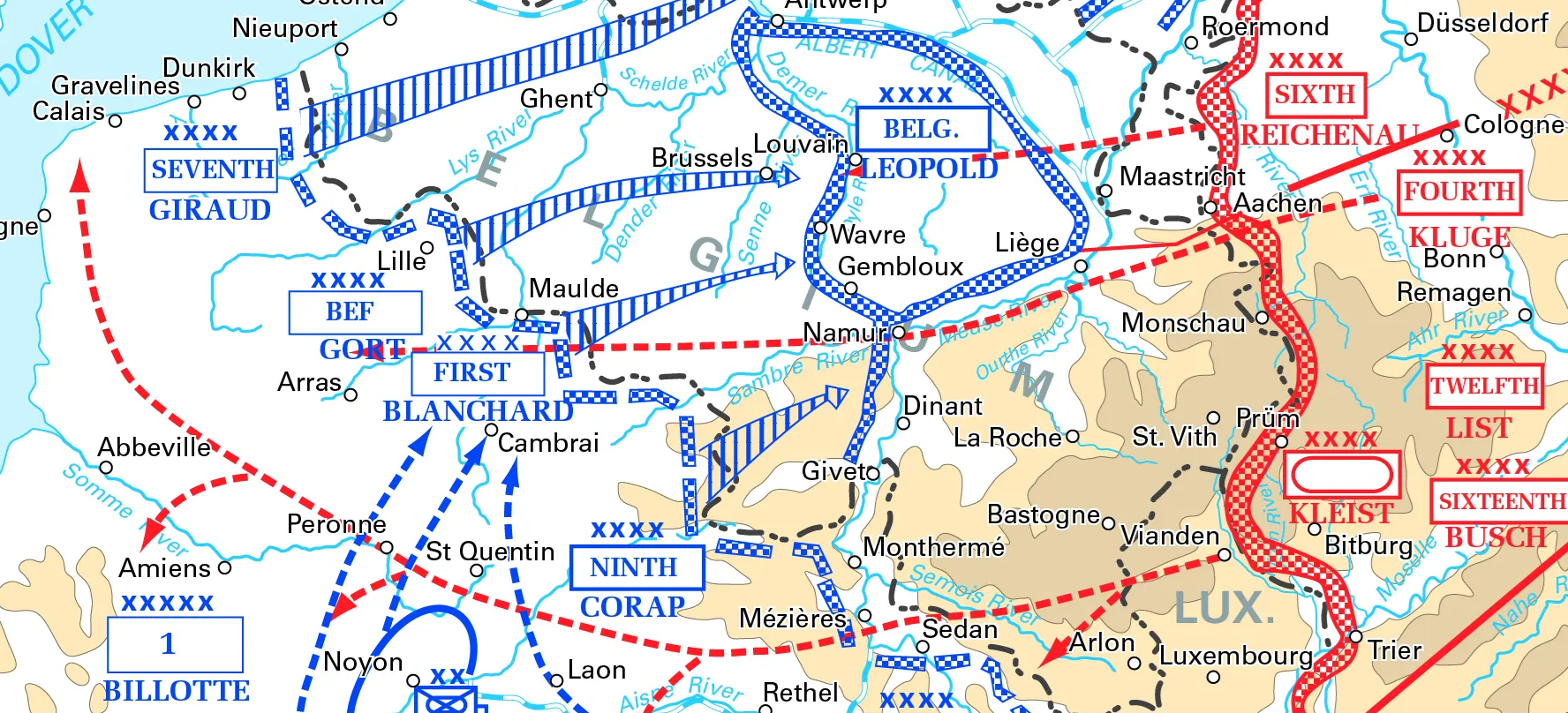
Detail from the West Point Military Atlas map of the “Campaign in the West, Disposition and Opposing Forces, 1940”
Full map.
The world has largely remembered Sichelschnitt as a brilliant German operation of war, but it was one that was fundamentally enabled by Allied ineptitude. Indeed, Blitzkrieg wasn’t particularly new, innovative or even a warfighting doctrine. It is best described, in the context of France 1940, as an event. It was simply the way that the Wehrmacht exerted its tactical and operational superiority over its more pedestrian enemies in 1940. In fact, it was the 1940 extension of what the German Army had first demonstrated in Flanders in March 1918, this time with tanks and Stukas. It was the Panzerwaffe (“tank force”) – combined with a tactical air force – which in 1940 would create the breakthrough that Ludendorff had been unable to achieve in 1918. Where it was applied, by Army Group A, it concentrated fast-moving armoured vanguards co-ordinated with tactical air power, such as 400 Ju 87 Stuka dive-bombers, to so overwhelm the enemy in both time and space that they were unable to respond quickly enough to the changing and challenging battlefield. In 1940 the panzer came into its own, the sound of clattering tracks on French cobblestones a new feature in the sound of battle and a key element in how France remembers its defeat in 1940.
It wasn’t the type of tank in the German inventory which mattered, but the way in which these tanks were employed. Only about 10 per cent of the army comprised tanks, the remainder relying on horse and wagons and the raw, painful feet of the marching infantry. Of the 2,539 tanks the Wehrmacht deployed in 1940, only 916, or 36 per cent were battleworthy, the remainder being clattering tin cans with machine guns (the obsolete Panzer Mark Is and Mark IIs). The only modern tanks were 683 Panzer Mark IIIs and Czech T38 tanks armed with a 37mm gun, and 278 of the larger Mark IVs with a short 75mm gun. But it was enough. The German operational strategy was to use this mass of armour not to fight a large confrontational tank battle, but to achieve breakthrough and breakout, bursting through the enemy’s linear defences. It was surprise and shock action that so discomforted the Allies, who had lazily and, given what we know of British failure to understand 1918, ignorantly assumed that the war would progress against a 1914 rather than a 1918 pattern. The armoured vanguard would surge through the outer skin of the enemy defences, concentrating heavy effort in one place, before driving hard into the heart of enemy territory. With an enemy intent on fighting a linear battle, the rear areas, behind this outer crust, would be weakly defended and full of rear-echelon, administrative and supply troops managing the lines of communication up to the front, not expecting to have to fight. It was by driving hard and fast behind the enemy front line, breaking the cycle of Allied battlefield decision-making, that Blitzkrieg was to achieve its psychological effect.
In contrast the Allies remained concerned about retaining the integrity of their defensive lines. The diaries of Major General Henry Pownall, for instance, are replete with concerns as the days spun past about the widening frontages on one defensive line or another. British concern was misplaced. It was to spread the ever-decreasing butter of the British infantry across ever-widening stretches of French and Belgian bread, without realising that the Germans were concerned not with rolling up a front line, but with driving hard to the rear. By so doing they would take risks with their flanks, but the discombobulatory effect on the enemy was considered to far outweigh any worry about the risk of counter- attack from an increasingly battered and disorganised enemy. Of course this operational concept was risky, but the risks taken were carefully calculated given what the German General Staff knew about British and French tactical doctrine, or the lack of it.
These German tactics were psychologically disconcerting for those not trained to expect them. As was demonstrated on the Meuse, artillery would batter a position in co-ordination with armoured columns bypassing fixed defences and attacking those it needed to clear from the flanks and the rear. The infantry accompanying the advancing armour – Panzergrenadiers (mechanised infantry) – arrived in tandem with the Stukas, which could drop their bombs from a screaming dive. Each Stuka seemed to those at the receiving end to be diving directly at them, personally. For untrained troops it was a terrifying experience. The panzers would sweep on while the truck-borne infantry would turn up to deal with survivors of this storm of fire and movement. By this time, of course, the disorientated French and British would now consider themselves cut off, behind their front line, with no prospect of being relieved. Surrender or a disorganised escape to the rear would seem to be a more sensible option than the forlorn hope of continued resistance when the surrounding fields were dotted with the grey-green uniforms and coal-scuttle helmets of their enemy. The psychological effect of Blitzkrieg was considerable. This wasn’t how their fathers had told them war was fought. How did the Germans manage to discomfort them on the battlefield so comprehensively? Were they inadequate soldiers, unable to meet the standards of campaigning set by the previous generation? Or was it that their tactics were simply not able to cope with the shock of a comprehensive assault by German infantry, armour and air power all descending on them at once? This was the battlefield that the British had entirely dominated, by virtue of their tactical innovations, in 1918. It was now Germany’s turn, a direct result of the failure of the British Army to develop its doctrine and approaches to warfighting at the end of the Great War. Brave men in 1940 did their duty, but against a battle-winning concept of their enemy, they were out-thought rather than out-fought. And critically, when an army thinks it is beaten, it is indeed beaten.
How Did Göring Get the Cyanide? OOTF Community Questions
World War Two
Published 6 Sept 2025In this episode of Out of the Foxholes, we dive into your community questions about World War II. How did Hermann Göring manage to get the cyanide capsule that ended his life at Nuremberg? What role did Slovakia really play in 1939? Why didn’t the Allies invade the Balkans instead of France, and why didn’t Japan use its submarines like Germany did?
(more…)
Up on the Mountain: a History of the Ski Cap
HatHistorian
Published 1 May 2025The ski cap, sometimes also called by its german name of Bergmütze, is a visored cap with ear flaps secured to the front by buttons or a buckle. Allegedly descended from eastern bashlyks worn by Russian soldiers, it was popular in the alpine regions of Germanic countries. First adopted by the AUstro-Hungarian Empire as a field cap, it was infamously worn by the Wehrmacht during WWII. It continues to be used as a field or dress cap by German, Austrian, and Hungarian armed forces, and civilian versions can be found around Central and Eastern Europe.
(more…)
September 6, 2025
New Evidence on the loss of HMS Hood!
Drachinifel
Published 5 Sept 2025Today we take a look at a heretofore unpublished account from a sailor who saw the destruction of HMS Hood, and take a look at what this might tell us about the incident.
(more…)
Unique British Crankfire .58 Morse Manual Machine Gun
Forgotten Weapons
Published 30 Apr 2025This is a really interesting piece with a mostly unknown origin. It was manufactured in the UK (the barrel was deemed Enfield-made by former Royal Armouries curator Herb Woodend) and is chambered for the .58 Morse centerfire cartridge. The date of production is unknown. It uses a gravity-feed magazine and fires via hand crank. Turning the crank cycles the bolt forward and back, not completely unlike a Maxim gun but without the automatic operation. It came out of a small Canadian museum in the 1950s, but its provenance before that is unknown.
(more…)
September 4, 2025
Mussolini’s Blunder: Greece and North Africa 1940
Real Time History
Published 4 Apr 2025Hitler’s victories in 1940 present a historic opportunity to Italian dictator Benito Mussolini to expand the Italian Empire. Instead, Italy suffers a series of humiliating disasters in Greece and North Africa. So why did Mussolini declare war on the Allies at this moment, and could Germany be ultimately responsible for the Italian fiasco?
(more…)
QotD: The development of the “halftrack” during the interwar period
What drove the differences in tank development between countries were differences between how each of those countries imagined using their tanks, that is differences in tank doctrine. Now we should be clear here that there were some fundamental commonalities between the major schools of tank thinking: in just about all cases tanks were supposed to support infantry in the offensive by providing armor and direct fire support, including knocking out enemy tanks. Where doctrine differed is exactly how that would be accomplished: France’s doctrine of “Methodical Battle” generally envisaged tanks moving at the speed of mostly foot infantry and being distributed fairly evenly throughout primarily infantry formations. That led to tanks that were fairly slow with limited range but heavily armored, often with just a one-man turret (which was a terrible idea, but the doctrine reasoned you wouldn’t need more in a slow-moving combat environment). Of course this worked poorly in the event.
More successful maneuver warfare doctrines recognized that the tank needed infantry to perform its intended function (it has to have infantry to support) but that tanks could now move fast enough and coordinate well enough (with radios) that any supporting arms like infantry or artillery needed to move a lot faster than walking speed to keep up. Both German “maneuver warfare” (Bewegungskrieg) and Soviet “Deep Operations” (or “Deep Battle”) doctrine saw the value in concentrating their tanks into powerful striking formations that could punch hard and move fast. But tanks alone are very vulnerable and in any event to attack effectively they need things like artillery support or anti-air protection. So it was necessary to find ways to allow those arms to keep up with the tanks (and indeed, a “Panzer divsion” is not only or even mostly made up of tanks!).
At the most basic level, one could simply put the infantry on trucks or other converted unarmored civilian vehicles, making “motorized” infantry, but […] part of the design of tanks is to allow them to go places that conventional civilian vehicles designed for roads cannot and in any event an unarmored truck is a large, vulnerable tempting target on the battlefield.
The result is the steady emergence of what are sometimes jokingly called “battle taxis” – specialized armored vehicles designed to allow the infantry to keep up with the tanks so that they can continue to be mutually supporting, while being more off-road capable and less vulnerable than a truck. In WWII, these sorts of vehicles were often “half-tracks” – semi-armored, open-topped vehicles with tires on the front wheels and tracks for the back wheels, though the British “Universal Carrier” was fully tracked. Crucially, while these half-tracks might mount a heavy machine gun for defense, providing fire support was not their job; being open-topped made them particularly vulnerable to air-bursting shells and while they were less vulnerable to fire than a truck, they weren’t invulnerable by any means. The intended use was to deposit infantry at the edge of the combat area, which they’d then move through on foot, not to drive straight through the fight.
The particular vulnerability of the open-top design led to the emergence of fully-enclosed armored personnel carriers almost immediately after WWII in the form of vehicles like the M75 Armored Infantry Vehicle (though the later M113 APC was eventually to be far more common) and the Soviet BTRs (“Bronetransporter” or “armored transport”), beginning with the BTR-40; Soviet BTRs tended to be wheeled whereas American APCs tend to be tracked, something that also goes for their IFVs (discussed below). These vehicles often look to a journalist or the lay observer like a tank, but they do not function like tanks. The M113 APC, for instance, has just about 1.7 inches of aluminum-alloy armor, compared to the almost four inches of much heavier steel armor on the contemporary M60 “Patton” tank. So while these vehicles are armored, they are not intended to stick in the fight and are vulnerable to much lighter munitions than contemporary tank would be.
At the same time, it wasn’t just the infantry that needed to be able to keep up: these powerful striking units (German Panzer divisions, Soviet mechanized corps or US armored divisions, etc.) needed to be able to also bring their heavy weaponry with them. At the start of WWII, artillery, anti-tank guns and anti-air artillery remained almost entirely “towed” artillery – that is, it was pulled into position by a truck (or frequently in this period still by horses) and emplaced (“unlimbered”) to be fired. Such systems couldn’t really keep up with the tanks they needed to support and so we see those weapons also get mechanized into self-propelled artillery and anti-air (and for some armies, tank destroyers, although the tank eventually usurps this role entirely).
Self-propelled platforms proved to have another advantage that became a lot more important over time: they could fire and then immediately reposition. Whereas a conventional howitzer has to be towed into position, unlimbered, set up, loaded, fired, then limbered again before it can move, something like the M7 Priest can drive itself into position, fire almost immediately and then immediately move. This maneuver, called “shoot-and-scoot” (or, more boringly, “fire-and-displace”) enables artillery to avoid counter-battery fire (when an army tries to shut down enemy artillery by returning fire with its own artillery). As artillery got more accurate and especially with the advent of anti-artillery radars, being able to shoot-and-scoot became essential.
Now while self-propelled platforms were tracked (indeed, often using the same chassis as the tanks they supported), they’re not tanks. They’re designed primarily for indirect fire (there is, of course, a sidebar to be written here on German “assault guns” – Sturmgeschütz – and their awkward place in this typology, but let’s keep it simple), that is firing at a high arc from long range where the shell practically falls on the target and thus are expected to be operating well behind the lines. Consequently, their armor is generally much thinner because they’re not designed to be tanks, but to play the same role that towed artillery (or anti-air, or rocket artillery, etc.) would have, only with more mobility.
So by the end of WWII, we have both tanks of various weight-classes, along with a number of tank-like objects (APCs, self-propelled artillery and anti-air) which are not tanks but are instead meant to allow their various arms to keep up with the tanks as part of a combined arms package.
Bret Devereaux, “Collections: When is a ‘Tank’ Not a Tank?”, A Collection of Unmitigated Pedantry, 2022-05-06.
September 3, 2025
The Korean War Week 63: The Battle of Bloody Ridge – September 2, 1951
The Korean War by Indy Neidell
Published 2 Sep 2025The South Koreans have won their fight northeast of the Punchbowl, but not that far away the Battle of Bloody Ridge is earning its name, with casualties rising into the thousands for both sides.
Chapters
00:41 Recap
01:11 A ROK Success
01:47 Bloody Ridge
06:17 Soviet Reinforcements
07:08 Operation Strangle
11:06 Summary
11:45 Conclusion
13:37 Call to Action
(more…)
German Occupation FN High Power Pistols
Forgotten Weapons
Published 28 Apr 2025When Germany occupied Belgium in the summer of 1940, the took over the FN factory complex and ordered production of the High Power pistol to continue. It was put into German service as the Pistole 640(b), and nearly 325,000 of them were made between 1940 and 1944. The first ones were simply assembled from finished Belgian contact parts, and included all the features like shoulder stock slots and 500m tangent rear sights. As the war continued, however, production was simplified. The stock slots disappeared first, then the tangent sights, then the wooden grips (replaced by bakelite) and eventually even the magazine safety was omitted. Resistance among Belgian factory workers increased as well, with deliberate sabotage in the form of incorrect heat treating, errors in fine tolerance parts, and sometimes even spending lots of time to give a very fine surface finish instead of making more pistols.
These are a particularly popular subject of collecting, and there are a lot of nuances of the production and inspection marks that are worth understanding if you want to take them seriously. I highly recommend Anthony Vanderlinden’s 2-volume book FN Browning Pistols for very good detail on these, as well as other FN handguns: https://amzn.to/42Bc541
(more…)
September 2, 2025
2 September, 1945 marked the formal end to the Second World War
On The Conservative Woman, Henry Getley notes the 80th anniversary of the formal surrender of Japan to the United Nations forces represented by Douglas MacArthur on board the battleship USS Missouri:
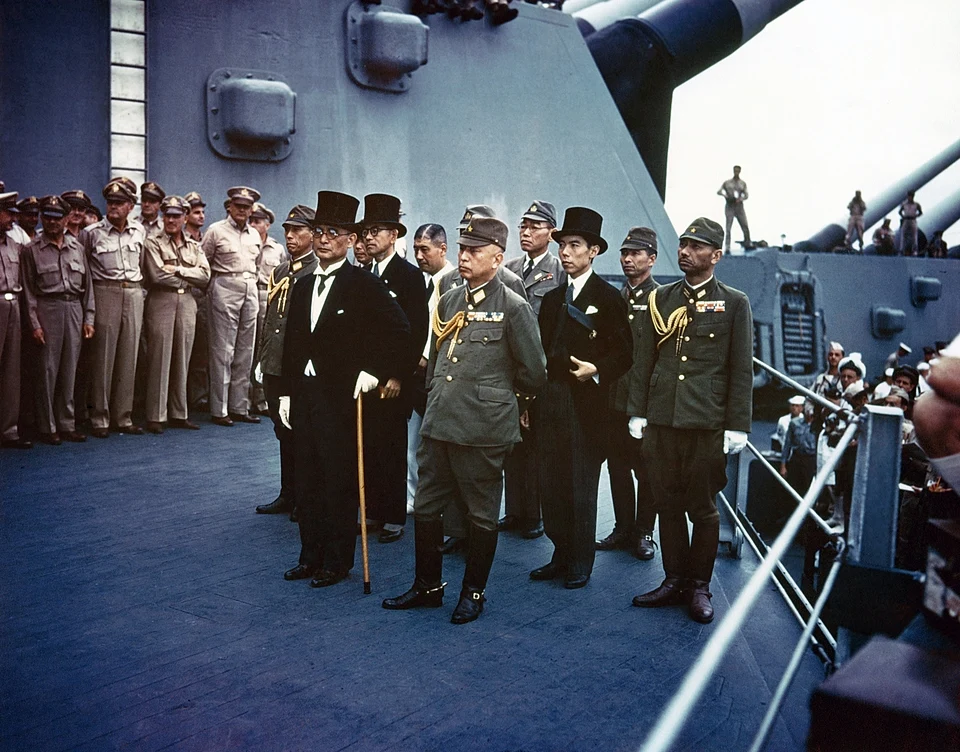
Representatives of the Japanese government on the deck of USS Missouri before signing the surrender documents, 2 September 1945.
Naval Historical Center Photo # USA C-2719 via Wikimedia Commons
ON September 2, 1945 – 80 years ago today – General Douglas MacArthur, Supreme Commander for the Allied Powers, accepted Japan’s formal surrender in a ceremony aboard the US battleship Missouri in Tokyo Bay. Then with the words “These proceedings are closed”, he brought the Second World War to an end.
That final sentence, broadcast worldwide by radio, came five years and 364 days after the global conflict started. Germany invaded Poland on September 1, 1939, but Britain – followed by France – did not declare war on Germany until September 3.
Six years later, on his enforced retirement, MacArthur told the US Congress: “I still remember the refrain of one of the most popular barrack ballads which proclaimed most proudly that ‘old soldiers never die, they just fade away'”.
Now, with the 80th anniversary of the war’s end, Britain’s old soldiers, sailors, marines and airmen have indeed faded away. At the war’s peak, 3.5 million men served in the Army, 1.2 million in the RAF and almost one million in the Royal Navy. Today, fewer than 8,000 veterans of those fighting forces are thought to be left. Most will be 98 or older.
It’s a striking thought for those of us who were brought up in the immediate post-war years. As I recalled in an earlier TCW blog, back in those days almost everyone’s father, uncle or brother had served in the military in some capacity.
The men we kids saw going to work in the offices, shops and factories of Civvy Street were the unsung heroes of the River Plate, Dunkirk, the Battle of Britain, the Battle of the Atlantic, the Arctic Convoys, the Western Desert, Italy, Normandy, Arnhem, the Rhine, Imphal, Kohima, the jungles of Malaya and Burma and many other battles large and small.
Being interested in military history, I was lucky enough to have become friends with several veterans of the Second World War, all sadly no longer with us. They were without exception the finest of men – modest, generous, good-humoured, gentlemanly. All had been at the sharp end in battle, but the last thing any of them would have called himself was a hero. They shared their memories with me reluctantly, anxious not to be thought they were “shooting a line” – that is, exaggerating or boasting. I was honoured and humbled to have known them.
Their passing reminded me that while the war was obviously seared into the very being of those who had experienced it, we of the first post-war generation inherited a lot of what you might call its folk memories and thus it loomed large in our perceptions.
August 31, 2025
Military-Issue Colt Model 1839 Paterson Revolving Rifle
Forgotten Weapons
Published 23 Apr 2025The first rifle made in Sam Colt’s Paterson NJ factory was the 1837 “ring lever” rifle. These were rather fragile and underpowered and while they were used successfully in the First Seminole War, they needed improvement. Colt set about doing this with his 1839 pattern, which was more robust and more powerful. It had six chambers of .525″, with much greater powder capacity than the first Colt revolving rifles. A total of about 950 were made before the Paterson company failed in 1842, and nearly 700 of those were military sales. The US War Department bought 360 (including this example), the Republic of Texas bought 300, and the State of Rhode Island bought 46 — the rest were sold to private companies or individuals. Despite its improvements, though, the 1839 revolving rifle was still not a mature design and was not successful enough to keep Colt in business.
Colt 1837 Ring-Lever Rifle: Sam Colt’s Paterson No1 Model Carbine
Colt 1847 Walker Revolver: 1847 Walker Revolver: the Texas Behemoth
(more…)
August 30, 2025
HBO’s Rome – Ep 9 “Utica” and Ep 10 “Triumph” – History and Story
Adrian Goldsworthy. Historian and Novelist
Published 26 Mar 2025This time we look at Episode 9, which begins with the aftermath of the Battle of Thapsus in 46 BC and also Episode 10 which focuses on Caesar’s Triumph — one rather than the four he celebrated over the course of several weeks in 46 BC. There is less history and more character-driven elements in these two episodes, so to make the video the same sort of length as the others in the series, I have combined the two.
00:00 Episode 9 “Utica”
19:48 Episode 10 “Triumph”
August 29, 2025
The dangers of joining the online hive mind of social media
At The Freeman, Nicole James discusses the experience of being immersed in a social media swarm or hive mind phenomenon:

Ever noticed how your social media feed doesn’t sound like “independent thought” so much as a stadium of people chanting, “Yaasss, queen!” in matching sequins? One minute you’re scrolling idly, the next you’ve been recruited into a sect with better lighting filters and the odd ironic dog meme. All it takes is clicking on one video of a dachshund in a raincoat, and suddenly you’ve been ordained High Priest of Sausage Dogs, condemned to a lifetime of puddle-splash reels and algorithmic sermonizing. That’s the hive mind. It’s the Internet’s favorite parlor trick, turning ordinary humans into synchronized swimmers thrashing about in a soup so murky it makes the Hudson on a hot July afternoon look like Perrier.
Bees and ants nailed this millennia ago: buzzing, working in lockstep, worshipping a terrifying queen—basically the Kardashians of the insect world. But instead of honey, humanity now churns out TikTok dances, Reddit debates about whether Die Hard was a Christmas movie (it wasn’t), and Facebook is where your uncle accidentally joins a cult.
Yet this collective buzz can tip into something darker. Collaboration can harden into groupthink, flattening individuality like a raccoon on the New Jersey Turnpike.
Cristina Dovan, a life coach based in the UK, calls the hive mind “group decision-making where individuals meld into one big throbbing consciousness”. Which sounds noble, and also like the worst hangover imaginable.
Collective intelligence can shine. Wikipedia (on a good day), Reddit’s problem-solving posters, Kaggle competitions, GitHub fixes. It’s a brainstorming session without the burnt office coffee and stale biscuits.
But history, and the Internet, remind us there’s a darker wing.
Psychologist Irving Janis, who coined “groupthink,” pointed to the Bay of Pigs invasion as Exhibit A.
Let’s return to 1961 where JFK is young, popular, and surrounded by Very Serious Men in suits. The CIA pitches a plan to topple Fidel Castro that went roughly like this:
- Train a ragtag bunch of Cuban exiles.
- Drop them on a swampy stretch of coastline actually called the Bay of Pigs (because nothing says “stealth” like announcing your arrival in Pork Bay).
- Hope the Cuban people spontaneously rise and overthrow Castro, preferably in a neat anti-communist conga line.
Everyone in the room knew it sounded dodgy. The beaches were wrong, the surprise was nonexistent, Castro’s army was enormous and very much awake. But instead of saying, “Excuse me, Mr. President, this is bananas”, the advisors all nodded along as if they were trapped in a corporate retreat exercise called Let’s Pretend We’re Bold Visionaries.
The result? A fiasco. Castro’s forces crushed the invaders in three days flat. America looked ridiculous, Kennedy was humiliated, and “Bay of Pigs” became shorthand for “the world’s worst team-building activity”. In short, a textbook case of groupthink, or as we’d call it today, “watching as your drunk mate climbs onto the shed roof, yells that he can backflip, and you cheer instead of calling an ambulance”.


