
World War Two
Published 20 Sept 2025In this Out of the Foxholes Q&A, Indy and Sparty dive into some of the most intriguing questions about World War Two. Why didn’t Hitler invade Switzerland, what was going through the minds of the German High Command as defeat loomed, and why didn’t the Germans use the Vichy French Army in Operation Barbarossa? Three questions that shed light on the strategies, choices, and mysteries of the war.
(more…)
September 21, 2025
Why Didn’t Hitler Invade Switzerland? – OOTF Community Questions
Comments Off on Why Didn’t Hitler Invade Switzerland? – OOTF Community Questions
Chatham Dockyard – Half a millennium of supporting the Royal Navy
Drachinifel
Published 16 Feb 2022Today we take an overview look at the history of Chatham Royal Dockyard and some of what you can find today at in its preserved premises!
Visit the dockyard – https://thedockyard.co.uk/
(more…)
Comments Off on Chatham Dockyard – Half a millennium of supporting the Royal Navy
September 20, 2025
Dutch Navy Luger: From World War One to the End of Neutrality
Forgotten Weapons
Published 12 May 2025The Dutch Navy first acquired Luger pistols in 1918 specifically for its aviators. They had 12 German P04 Lugers taken from a German submarine stranded in the (neutral) Netherlands, and 28 more were purchased from DWM in 1918 to round out the 40 guns needed to equip the Naval Air Service. The pistol was formally adopted as Automatische Pistool Nr.1. In 1928, the Dutch Army adopted the 1906 New Model Luger for its own service, and the Navy decided to update its revolvers at the same time. The Navy opted not to get grip safeties, and so took a copy of the German P08 model instead of what the Army had. The first order was placed in 1928 through BKIW in Germany, and deliveries would run until 1939 with a total of 2654 delivered before German invaded in May 1940.
Dutch Army Luger trials:
• Politicians Ruin Everything: Dutch Lu…Dutch East Indies Lugers:
• Lugers for the Dutch East Indies Army
(more…)
Comments Off on Dutch Navy Luger: From World War One to the End of Neutrality
September 18, 2025
“The British fleet is strong and at the ready” (1939)
British Pathé
Published 12 Nov 2020GAUMONT BRITISH NEWSREEL (REUTERS)
Comprehensive documentary of the Royal Navy in the lead up to war
Full Description:
SLATE INFORMATION: Britain’s Navy Ready for Any Challenge, The Combined Fleets Filmed by Gaumont-British News
Comprehensive documentary of the British fleet and their preparedness for action including shots of numerous ships at sea and at anchor, sailors on deck, aircraft on deck, ship’s guns, officers in quarters, destroyers, aircraft flying off deck and landing on water
Archive: Reuters
Archive managed by: British Pathé
Comments Off on “The British fleet is strong and at the ready” (1939)
September 17, 2025
The Korean War Week 65: Another Bloody Ridge Begins? – September 16, 1951
The Korean War by Indy Neidell
Published 16 Sep 2025Bloody Ridge is barely over, but orders have come for the UN forces to already attack the next ridge to the north, and UN planes violating the Kaesong neutral zone sabotage Matt Ridgway’s plans for conquest.
Chapters
00:00 Hook
00:49 Recap
01:27 Van Fleet’s Planning
08:44 The War and the Conference
14:28 Summary
14:46 Conclusion
15:20 Call to Action
(more…)
Comments Off on The Korean War Week 65: Another Bloody Ridge Begins? – September 16, 1951
“It would be a grave error to scrap NORAD”
J.L. Granatstein makes the case that abandoning NORAD in a fit of pique over the antics of the Bad Orange Man would be worse for Canadian national defence interests and might not even be noticed in Washington DC:
There are beginning murmurings that Canada should get out of the North American Aerospace Defence agreement (NORAD). Given the Trump administration’s hostile tone — its 51st state suggestions, its tariffs, and its growing concerns with Arctic defence — the United States has become a difficult partner and a threat to Canadian sovereignty. But would this be a sensible decision for Ottawa to make?
Not at all. In the first place, NORAD is a joint alliance to defend North America against Russian, Chinese, or other potential attackers. Canada provides aircraft, radars, personnel, and expertise to this role that serves our national interests. It would be a grave error to scrap NORAD and to take on the role of defending our part of North America on our own. It would also be hugely expensive.
The problem, however, is that the Trump administration is right: Canada is, in fact, not doing enough today to defend our portion of North America and protect our sovereignty in the region.
The Royal Canadian Air Force has 1980s vintage CF-18s flying patrols and occasional larger surveillance aircraft monitoring traffic in Arctic waters; there are snowmobile and ATV patrols of Canadian Rangers armed with rifles; and a few army exercises in the north each year. The Royal Canadian Navy has a half dozen new Arctic Offshore Patrol Vessels that have limited utility in Arctic waters and are very lightly armed, and the Canadian Coast Guard (CCG) has only one 66-year-old icebreaker capable of clearing thick ice. The CCG is now under the authority of the Department of National Defence, but its members, unlike those in the Canadian Armed Forces, are unionized, and its vessels are unarmed. This could be a problem in a conflict.
Yes, Ottawa has promised to do more. The Trudeau government agreed to the $38.6 billion NORAD Modernization Plan, which includes the new Northern Approaches Surveillance System featuring the Arctic Over-the-Horizon Radar and a Polar Over-the-Horizon Radar, enhancing early warning and threat tracking from the North for air and maritime threats. These systems will not be fully operational until the 2040s.
There’s more, but it’s behind the paywall.
Comments Off on “It would be a grave error to scrap NORAD”
QotD: Indecision
For those who’ve seen Band of Brothers, there’s a very telling conversation between Carville and Winters, as the sergeant complains about his platoon commander, Lt. Dyke:
“It’s not that he makes bad decisions; it’s that he doesn’t make any decisions at all.”
Any time you see that situation in a manager, any manager, it is a flashing neon sign of incompetence.
One of the reasons why Marxists make such poor managers is that if they are presented with a situation which cannot be addressed by Party doctrine, they are largely indecisive. Even worse, if that doctrine runs counter to good management, they will use that as the underpinning for their indecisiveness. We saw this a lot under Obama, who was pathetically underqualified as a manager, having had no executive experience in his entire life before becoming POTUS. More often than not, when faced with a decision, he simply froze and allowed events to dictate the outcome, even if that outcome was inimical to the interests of the country he was supposed to be governing. (And to prove my point above, his Marxist doctrine held that the United States was a malignant force in world affairs, so allowing harm to befall the country was — to his mind — actually the proper thing to do as it “corrected” or atoned for America’s past sins.)
Kim du Toit, “Failure”, Splendid Isolation, 2020-06-04.
September 16, 2025
Fenian Needham Conversion: Just the Thing for Invading Canada
Forgotten Weapons
Published 10 May 2025The Fenian Brotherhood was formed in the US in 1858, a partner organization to the Irish Republican Brotherhood. The groups were militant organizations looking to procure Irish independence from the British, and they found significant support among the Irish-American immigrant community. In November 1865 they purchased some 7500 1861- and 1863-pattern muskets left over from Civil War production, and used them to invade Canada in April 1866. The idea was to capture the country and then trade it to the British in exchange for Irish independence … but the invasion went quite badly. The Fenians briefly held Fort Erie, but were pushed out after a few hours and largely arrested by American forces.
The Fenians’ muskets were confiscated, but all returned by the end of 1866 in exchange for promised Irish-American support of embattled President Johnson. By 1868, the group was making plans for another attempt at conquering Canada. This time they would have better arms — they obtained a disused locomotive factory in Trenton NJ and set up the Pioneer Arms Works to convert 5,020 muskets into centerfire Needham Conversion breechloaders. These were given chambers that could fire standard .58 centerfire ammunition, or the .577 Snider ammunition that the Fenians expected to be able to procure once in Canada. Most of the guns also had their stocks cut, to allow them to be packed in shorter crates for transit. These usually have a distinctive “V” cut in the stock, which was spliced back together before use.
When the second invasion came in April 1870, it was again a failure. Only 800-1000 men turned out of the 5,000+ expected. They were scattered among several different muster points on the border, and the Canadians were once again aware of their plans. The most substantial fight was at a place called Eccles Hill, where the Missisiquoi Home Guard was ready and waiting for them with good Ballard rifles. Upon crossing the border, the Fenians were soundly defeated.
This second time, the guns were confiscated and not returned. Instead, the Watervliet Arsenal sold them as surplus in 1871. They were purchased by Schuyler, Hartley & Graham for commercial resale, and thanks to that several hundred remain in collector hands today.
(more…)
Comments Off on Fenian Needham Conversion: Just the Thing for Invading Canada
September 15, 2025
HBO’s Rome – Ep 11 “The Spoils” – History and Story
Adrian Goldsworthy. Historian and Novelist
Published 23 Apr 2025This time we look at episode 11 — and only this episode as there is more to talk about when it comes to the historical background. Some of the plot doesn’t fit too well to the actual history, but there are some nice details that crop up and make it worthwhile. In the main, I get excited about a coin and a court.
Comments Off on HBO’s Rome – Ep 11 “The Spoils” – History and Story
September 14, 2025
“When must we kill them?”
On the social media platform previously known as Twitter, Tom Kratman provides an excerpt from The Care and Feeding of Your Right Wing Death Squad:
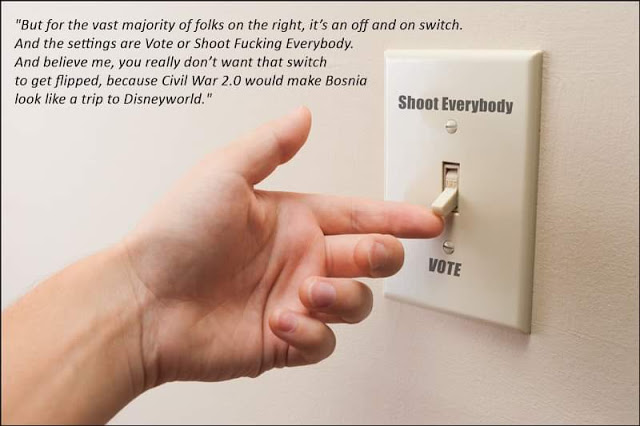
Reposting this seems apropos:
The Care and Feeding of Your Right Wing Death Squad, Chapter 32 Copyright © 2025, Tom Kratman, Harry Kitchener
“When must we kill them?”
That question was asked recently by a leftist student, one Nicholas Decker, from George Mason University. It’s a very interesting question, and one that most, and perhaps all, hard leftists in the United States are contemplating. Indeed, we see now, from an NCRI / Rutgers survey, that something over half of leftists believe that assassinating Trump would be justified, and nearly half think the same thing about Musk.
Note, here, that this was of all people identifying as left of center. I would suggest that this means that almost nobody who is slightly left of center would agree with that and nearly everybody who is far left of center agrees with that. And if we needed any more proof, just contemplate the number of would be groupies moistening their panties over murderer Luigi Mangione, as pointed out by former New York Times reporter Taylor Lorenz.
Why do they think so or why are they wondering about it? It’s actually more understandable than most on the right and perhaps even many on the left would understand. They’re wondering about it because, with the destruction of the Deep State, with so many billionaires turning against the left and – horrrors! – no longer letting the left wing narrative control online and legacy media political discourse, with no prospect of the kind of money being shunted from the taxpayer, through the Federal Government, to left wing NGOs to help swing elections, they do not really think there is any serious prospect of the left ever winning a national election again or, at least, not in their lifetimes. And they may be right about that.
With James Carville telling the Democrats to give the boot to the gender and woke ideologues, the identity politics losers, the little boy penis choppers and little girl breast destroyers and vagina removers; they see themselves being marginalized, losing their influence, and losing their dream, forever. And this seems fairly likely. With no possibility, once Trump gets finished deporting all the illegals, of turning just enough of those illegals into client voters to swing elections just enough for control, they think that leftism will be hopeless in the United States. And they’re probably right about that. With the Communist factories of higher education being broken to the will of the right, with Gramsci’s / Rudi Dutschke’s “Long March Through the Institutions” being walked back, and quickly, they’re thinking about it and wondering about it because leftism is dead in the United States, a corpse just awaiting burial.
So, though the point of this entire exercise in the Right Wing Death Squad has been to convince the left to chill out, FFS, it seems that certain key point bear repeating.
1. Urban Guerilla movements invariably succeed in creating the kind of oppressive government that they believe will infuriate the people and lead to a general uprising. Those governments then proceed to exterminate the Urban Guerillas and all their supporters, and do so to general popular applause.
2. The armed forces, barring some political generals and morally cowardly colonels, hate you and everything about you. Posse Comitatus is only a law, not something in the constitution that would require going through the difficult process of amendment. Change the law – and do but note who has control of the House, the Senate, and the Supreme Court (so that constitutional grounds could not be manufactured to create an objection to getting rid of the law) – and the military would be very happy to round you all up. And you’re completely, incompetently, incapable of resisting this.
3. Moreover, though you have a few people with some military experience and training, the key word there is “few”. Yes, yes, I know that, since Vietnam, the left has been obsessed with the inner city black cannon fodder meme, but it wasn’t true then and it isn’t true now. Conversely, the white working class and conservative populations at large – to the limited extent these categories may differ – are replete with people with a lot of military training and experience and they hate you, too. They also have most of the guns. Your side has fairly few, in comparison, and little skill in using what you do have, alone or in groups.
4. You also fundamentally misunderstand the difference between your approach to violence – as a rheostat to be turned up or down, to suit – with the right’s – which is an on-off switch marked “peace and good feelings” on the one hand, and “kill every one of them” on the other.
You know all those terrible things you and your pals like to say about right wing, especially but not always white, Americans? Well, we know you don’t really believe those things because if you did you would be afraid ever to leave your mom’s basement. But you really ought to try to grasp this; sometimes those things are true.
Although our purpose with this project has been to try to get you to save yourselves, still, one cannot help but look forward to the prospect of young Mr. Decker finding this out.
So, if you were to succeed in killing the president, you will get Vance. Vance will have a mandate, in that case, to obliterate you. If he fails to carry out that mandate then genuine Right Wing Death Squads will take up the slack. No trial, no due process at all; they will proceed to obliterate you and every safe harbor and supporter you have, and often in creatively disgusting ways.
Amusingly enough, your only safety, in such a case, would be in being sent to some variant on El Salvador’s CECOT. I could see the population of El Salvador roughly doubling in the course of a few years as millions of American leftists find out just how grim a Latin American prison can be.
But, seriously, why would they or anybody waste the money when you could as easily just become an unfortunate statistic? Were I betting on it, I’d bet that few of you see a flight – or even half a flight – to El Salvador, but that many of you would have a long last moment staring down into a ditch you had just been forced to dig while a man with a pistol walks up behind you.
So the answer to young Mr. Decker’s question, “When must we kill them?” is “When you want to die.”
Comments Off on “When must we kill them?”
September 13, 2025
QotD: The Peter Principle in football, the military, and life in general
Is that true in other jobs where you need a combo of a certain physique, a certain IQ, and a certain attitude? The military, say, or the police? Would the average platoon sergeant be a better lieutenant than the average lieutenant? (I’m seriously asking, even though I know that the average corporal’s opinion of the average butterbar lieutenant and vice versa makes the town-gown split in college look like a friendly rivalry). What about the best NCO — would he make a good general? How about the best patrolman vs. the best detective?
And of course this is complicated by the outliers. SWAT guys generally don’t become police chiefs, Special Forces guys don’t become generals (that McChrystal bastard being an unfortunate exception), and so on, but those are extreme outliers, like quarterbacks — physical freaks with fast-firing heads; they don’t want desk jobs, I imagine.
The reason I’m rambling on about this (other than “I’m jet lagged and I have the flu”) is that our whole society seems to have fucked up its competence sorting mechanism, and that flaw seems to be structural. You don’t want a coach who never played, or a general who never fought, but at the same time there’s fuck-all relationship between “being good at playing / fighting” and “being good at coaching / strategizing” that I can see. The same applies in all bureaucracies, of course, we call it the “Peter Principle” — the guy who was good at answering phones in the call center might or might not be any good at supervising the call center, but there’s only one way to find out …
… or is there? Football is interesting in that there’s only one metric for success, and it’s easy for everyone to see. There’s absolutely zero question that So-and-So was a good player, in the same way that there’s zero question So-and-So was a good coach. You can always find nerds and lawyers to niggle around the edges — oh, So-and-So is overrated, and here’s my charts and graphs to prove it — but we all know what that’s worth. Figuring out a better way to sort talent in a binary system like football would go a long way to help us figure out how to fix our society’s fucked-up competence sorting mechanism.
Severian, “Friday Etc.”, Founding Questions, 2022-02-04.
September 12, 2025
QotD: Modern riot-control gear
I’ve hinted already at my severe disenchantment with the riot control manual. Most of the following will tend to indicate some of why. Note that this is pretty military specific, but you all ought to know what’s happening, what should happen, and what isn’t happening with regards to riot control.
Head: Protection of the head involves also protection of the face, neck, and, especially, the eyes. The standard military issue Kevlar helmet is adequate for protecting the head from blunt force trauma and even some bullets . It does nothing for the face. There are shields that attach to the helmets to protect the face and which usually reach down enough for neck guard. However, after a cursory search or three for what’s on offer now, as with the old style ones I discussed previously, they can be blurred and ruined with solvents. Yes, this would seem to include polycarbonate as well; that’s how pieces of Lexan are glued together, actually. It’s a problem. Neither can I find a face shield that is glass over Lexan, though they may exist.
Moreover, while there are masks – nicely intimidating motorcycle rider masks, for example – that are black and which could have relatively cheap replaceable clear eyepieces made, they are close fitting, hence would interfere with donning the protective mask when it comes time to use RCA or when smoke from burning buildings gets to be a bit much. The only solution I can see is twofold: 1) Have a ready supply of extra face shields on hand, and 2) make the immediate penalty for attacking a mask with solvents a reasonably severe beating with some kicks and stomping.
Special Tip #1: If you’re using your issued helmets, troops and commanders, turn the camouflage band around so the rioters can’t see your name. This is for two reasons. One is to prevent personal retaliation against your men or their families. The other is to send a message the rioters will understand very clearly because they’re using anonymity for the same purpose, to stay out of court. In other words, the message you send is, “Get close enough to this soldier or policeman for him to hurt you and he will, all the more readily because you can’t identify him for civil suit or criminal complaint.
Chest: The current issue torso armor seems adequate for most threats it will encounter in riot control, but, at thirty-three pounds, strikes me as awfully heavy for an activity that is already about as physically intense as a battlefield, if not even more so. With an E-SAPI plate in front, that runs nearly to forty pounds, which is simply too damned much. There is room for some minor weight savings, as will be shown below, under “Protective Mask.”
There are lighter and quite likely better armor suites coming along or already on hand for the special operations folks, but if they are not available for a unit tasked for riot control, I’ll have to say, “Suck it up; wear the vests you have; keep about ten percent of your force in reserve, unarmored but ready and drilled to suit up in a hurry, to relieve people who become exhausted from the weight and heat retention.
Special Tip #2: You want the armor not only to protect your men, but also to protect them enough to keep them from losing their tempers and running wild. When they hurt somebody, it needs to be because the commander wants that somebody hurt, that the mission is advanced by that somebody being hurt, and not because of a breakdown in discipline.
Armament: For a number of reasons, I recommend against using bayoneted rifles. The downsides are numerous, so I’ll limit myself to a few. 1) They require both hands; this means that the riot controller cannot use a shield. 2) The act of fixing bayonets, all on its own, constitutes deadly force. Yeah, just fixing them. So you won’t be allowed to do it. 3) That means you end up with this bullshit:
https://en.wikipedia.org/wiki/Flower_Power_(photograph)
Instead, use batons. However, for that I have no less than two tips.
Special Tip #3: Grease the last eighteen inches or so of the batons with something non-water soluble, like Vaseline. No, this is not as an aid to anally raping the rioters with the batons, however tempting that may come to seem. Rather, it is to keep the rioters from snatching your batons away, which snatching encourages them to no end. If you don’t have petroleum jelly handy, thicker rifle lubricant, like LSA, can work, but spread it very thinly, so it doesn’t run.
Special Tip #4: Drive finishing nails into the ends of your batons and snip them off to leave about an inch sticking out. No need to sharpen the part sticking out; it’s sharp enough to penetrate and leave a painful puncture wound, whether directed at arms or torsos or thighs or groins (ouch!).
Shields: There are any number of makers of perfectly serviceable riot control shields, some of which are, although frightfully heavy, bullet proof. If you need bullet proof shields, I would suggest that you’re way past the point of suppressing a riot and already involved in a civil war. In that case, shoot back accordingly.
Assuming for discussion’s sake, however, that we aren’t quite at that point yet, the shields are extremely useful. They deflect rocks and bags of shit. They can cause a Molotov to go off somewhere other than on the riot controller or at his feet. They are, themselves, offensive weapons. As Suetonius said, just before kicking Boudicca’s Britannic ass: “Knock them down with your shields, then finish them off with your swords”.
The world being as it is, however, full of iniquity and injustice, when Battalion X of the YYth division gets alerted for riot control, the shields will probably not be available. A careful search by J4 will show that “They are either in Iraq or were left behind on Johnson Island, lest Greenpeace show up some day. Or maybe they were turned into a reef for some endangered fish. Who knows?” Hence, make your own. The example below was made by one of the handier troops of B-3/5 Infantry, Panama Canal Zone, in 1983. It’s just half inch plywood, 19 by 24 inches, though they can be cut larger to fit the larger troops, with arm straps cut from condemned nylon webbing and bolted on. The almost horizontal piece is one shoulder strap from the harness of nylon load bearing equipment, stapled on and serving as a shock pad for the arm. Yes, if you actually have to make something like these do not forget the shock pad. I’d recommend not painting them with unit insignia. We were, at the time, on testosterone overload and wanted people to know who was kicking their butts.
Note, a larger shield doesn’t necessarily protect more, it just moves more slowly to protect what needs protection. These shields are very light and, given the geometry of the matter, able to be moved very quickly indeed to protect any exposed part of the body, to include the thighs and crotch. Speaking of the …
Crotch: Move your/have the troops move their protective mask and carrier from the left hip to right in front of the family jewels. It won’t slow down donning the mask appreciably and it will save a little weight while providing adequate crotch coverage.
Tom Kratman, Twitter, 2025-06-09.
Comments Off on QotD: Modern riot-control gear
September 11, 2025
The CH-148 Cyclone helicopter – the navy’s flying lemon
Over at Noah’s True North Strategic Review, a question came up about the Cyclone helicopters in Royal Canadian Navy service and whether the navy would include Cyclone landing pads on the upcoming Canadian Continental Defence Corvette design:
Q6. Any updates on the Cyclone helicopter and its replacement? I’ve read that the class is grounded and it’s already an orphan. Has it rolled into NTACS?
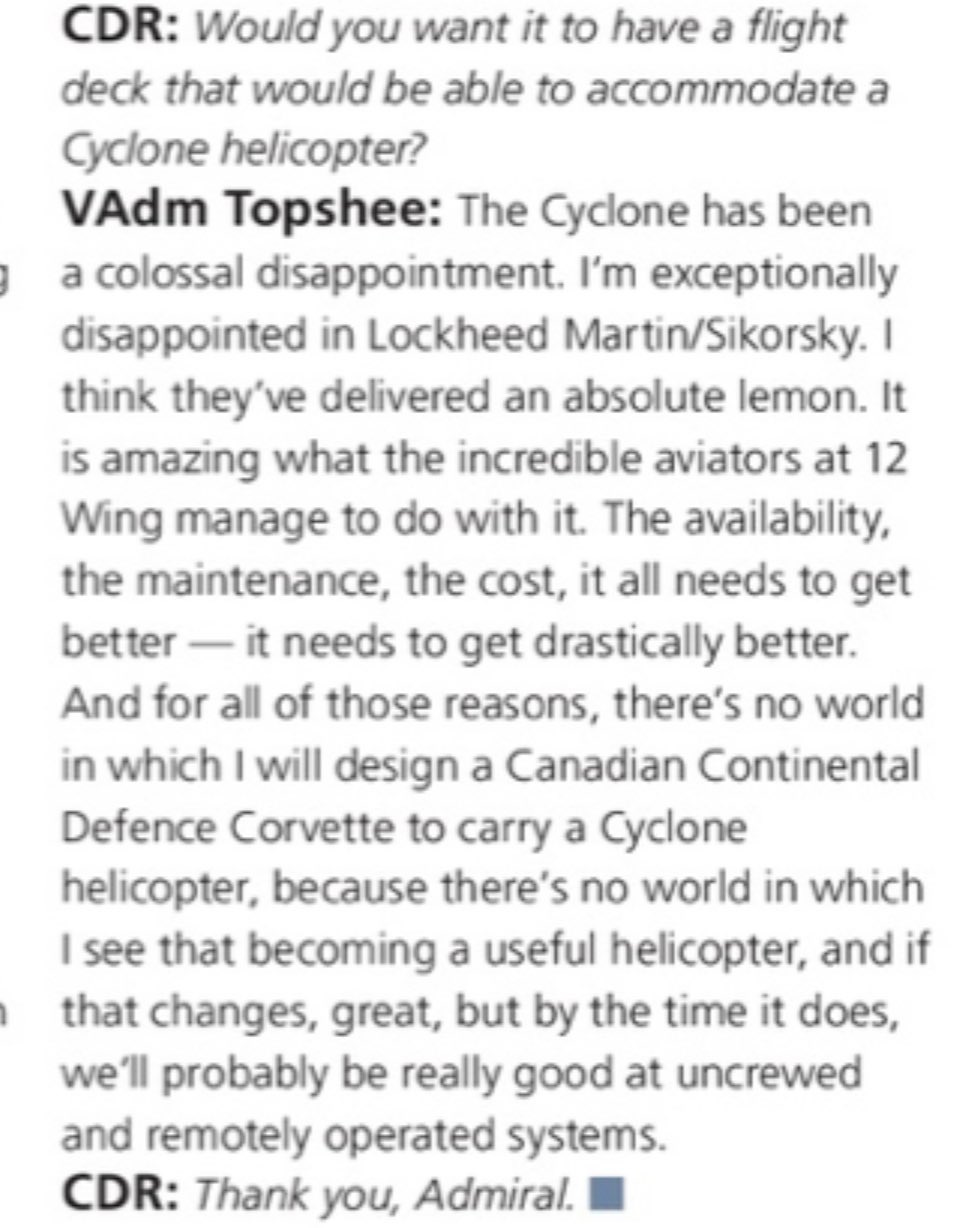
You probably heard our favorite Vice-Admiral absolutely tearing them apart lol. The fleet was grounded due to parts issues, a long-standing problem with the Cyclone fleet. In fact everything about the Cyclone is a problem.
I’ll let Mr. Topshee explain:
So yeah, the fleet was grounded or should I say the majority of the fleet is still grounded. Not all of them anymore, but still the majority last I heard like two weeks ago?
Of course even before the grounding the fleet was in bad shape. Nearly half haven’t flown this year, and again the majority is still grounded. Link 11 deprecated back in January/February? Lockorsky is asking ~$20,000,000 an aircraft to upgrade to Link 16, and even then it will take about two/three years to get the entire fleet upgrades.
And it ain’t like Link 16 is some optional capability. It is quite literally the standard. You can’t do much without it.
This isn’t counting other capabilities set to deprecate or in need of upgrading on the way to Block 2.1 … All to support, yes, an orphan fleet that we are paying tooth and nail to keep going.
And it isn’t like Lockheed is winning here. They reported a $570 million loss on the Cyclone this year. Quite literally no one is winning here. We are all suffering to keep these birds flying, lord forbid if we try to keep them going into the 2040s as planned.
Cyclone isn’t a new helicopter. It’s a product of 1990s requirements, from a contract signed twenty years ago. It still has yet to reach its final Block 2.1 state. I get why it’s frustrating to everyone. I’m glad Topshee said the quiet part out loud. Call them what they are.
I’m of course missing things, I know. I wont go into the entire history and issues with the fleet (yet) but I will say that I truly believe there is no fixing them by this stage. The navy has been using modified Hammerheads to fill the gaps and future UAS will likely take some role.
Unmanned systems aren’t at the level though to fully replace the capabilities a maritime helicopter like the Cyclone brings to the table. The loss of the fleet is a loss of capabilities. Eventually something has to give.
I don’t wanna go to into the Cyclone right now, as I’m currently working on something for it. However there are a lot of issues, more than the public knows.
As for NTACS? There is no plans to include the Cyclone. At least not right now. The NTACS team went back to the drawing board over the summer to hammer out what they want. We’ll see what comes of it.

Pre-delivery Sikorsky CH-148 Cyclone helicopter, 4 April, 2012.
Photo by Gerry Metzler via Wikimedia Commons.
Comments Off on The CH-148 Cyclone helicopter – the navy’s flying lemon
September 10, 2025
The Korean War Week 64: Inexperienced UN Recruits Face Disaster – September 9, 1951
The Korean War by Indy Neidell
Published 9 Sep 2025The Battle of Bloody Ridge comes to its end, having very much earned its name. One issue the UN is really having though, is with replacement troops. They don’t have the training or experience that the war requires. And yet, a new offensive to test them further is just around the corner.
Chapters
00:00 Intro
00:53 Recap
01:22 Problems With New Troops
04:36 Company C Attacks
06:09 Operation Talons
07:32 Operation Minden
08:19 Flying Aces
08:57 San Francisco Conference
14:13 Summary
14:28 Conclusion
(more…)
Comments Off on The Korean War Week 64: Inexperienced UN Recruits Face Disaster – September 9, 1951


