
Drachinifel
Published 12 Oct 2022Today we take a look at the battle that decided if Rome was to be a Republic or an Empire, and also examine why its incredibly hard to work out just exactly what happened between the start and the end!
Sources:
https://www.amazon.co.uk/Battle-Actiu…
https://www.amazon.co.uk/Actium-31-BC…
https://www.amazon.co.uk/War-That-Mad…
https://www.amazon.co.uk/Roman-Histor…
http://eprints.nottingham.ac.uk/10452/
(more…)
October 1, 2025
The Battle of Actium – We can at least agree ships were involved!
Comments Off on The Battle of Actium – We can at least agree ships were involved!
QotD: The Indian Mutiny of 1857
The causes of the Indian Mutiny of 1857 are many and varied — there’s a whole separate wiki article on it — but the one “everyone knows” is the cartridge to the Enfield rifle. The Enfield was a muzzle loader. The soldier had to tear the cartridge with his teeth in order to load it. The cartridges were greased with a mixture of cow fat and lard. That was the rumor, anyway, and since Indian soldiers (called “sepoys”) were primarily Hindu and Muslim, biting the cartridge would violate everyone’s ritual purity.
This is a near-perfect synecdoche for the Raj’s problems. British Army officers weren’t stupid — lots of them commented on the issue. But they were isolated. For one thing, lots of them weren’t regular army — they were attached to the East India Company army, a separate formation, and within the Company’s army were different formations with different service requirements. And the army — whichever army — was deeply isolated from the civilian administration. For one thing, India’s huge, and there were never more than about 200,000 British in the whole place. The army was mostly on the frontier; the Government hung around primarily in a few big cities: Bombay, Calcutta, the summer capital at Simla (way up in the Himalayas).
So stop me if this sounds familiar: The civilian administration didn’t really know anything about the group upon which their peace, their security, their very lives depended. Actively despised them, in fact — oh, those wogs and their silly customs. But also look at it from the bottom up: What could the civilian administration really have done, with the best will and deepest knowledge in the world? […]
What could the leadership really have done at that point? Send a select group of brahmins and imams to tour the grease factory? The rumor would be that the British set up a Potemkin factory just for them; the real factory was using cow and pig fat. Reissue the old rifle? Recall that they already changed their drill — a pretty big deal in any army; a huge deal in a mid-19th century one — and that just added to the paranoia. Anyone who has ever been on the Internet knows how these things work once they get started: Evidence of an evil conspiracy is evidence of an evil conspiracy, but no evidence of an evil conspiracy is even more evidence of an evil conspiracy!
The root cause of the Mutiny, in other words, wasn’t political or economic (despite what Karl Marx said). It wasn’t even “cultural” in a lot of senses, and you can tell by the actions of the mutineers — or, rather, the non-actions. They simply had no idea what to do. They had no leadership (though some of them tried to install one of the remaining Mughal rulers in Delhi as an expedient; there’s a great book about it). The “Mutiny” was really just generalized beefing and score-settling on a continent-wide scale. They all had grief with the British, of course, and that was a convenient rallying cry. Once the British were gone — and see above, there were never very many of them — the guys down south quickly realized they had nothing in common with the guys up north. Ditto the guys on the east coast, the west coast, the hill country, the jungles …
Again, stop me if this sounds familiar: Stuffing a bunch of alien groups together inside artificial boundaries under a capricious, purposefully out-of-touch “government” that obviously hates every single one of those alien groups more than each one of the groups hates all the others, is kind of a bad idea. With the exception, of course, of that capricious government’s goon squad, the one group they obviously favor because that group can be counted on to knock heads on all the other groups whenever the government lets them off the chain (I’m talking about the Sikhs, obviously).
It doesn’t matter, in other words, what the rifle cartridges were greased with, or if they were greased at all. In this historical timeline, the precipitating cause of the Sepoy Rebellion was “the Enfield Rifle”. In the next timeline over, it’s something else — something equally minor — but the rebellion still happens, at pretty much the same time and in pretty much the same way.
In other words: It’s not that the British were alien to their subjects. Most groups in most places have been ruled by aliens, and trust me, the brahmin caste is far, far more alien to the castes below it than the British were to all of them combined. Nor was it that the British were high-handed administrators, as incompetent as they were arrogant. They were actually pretty good administrators, all things considered — “government competence” is always one of life’s lower bars, but the Raj cleared it easily. The guys running the “princely states” that made up the majority of the “British” Raj were every bit as alien to “their” people as the British, and in general spectacularly incompetent too.
Severian, “The Ruling Caste”, Founding Questions, 2022-03-09.
Comments Off on QotD: The Indian Mutiny of 1857
September 30, 2025
Stamm-Saurer Model 1913 Long-Recoil Prototype Rifle
Forgotten Weapons
Published 21 May 2025Hans Stamm developed a series of firearms in Switzerland in the early 1900s, and today we are looking at a second-pattern Model 1913 semiauto rifle. This was developed while Stamm was working for the Saurer company, where he headed its small arms division. Stamm’s Model 1907 straight pull rifle failed to win military adoption, and so in 1910 he began working on a quite complex long recoil system. The first prototype was finished in 1912, and by 1913 another seven examples were made.
These are sent to the Swiss and Belgian militaries for consideration, but neither are interested — and the outbreak of World War One ends possibilities for other adoption.
Previous Stamm designs:
1902 Gas-Operated Semiauto: • Stamm-Zeller 1902: A Swiss Straight-P…
1907 Straight-Pull: • Stamm-Saurer Model 1907: A New Swiss …Many thanks to the Swiss Shooting Museum in Bern for giving me access to these two very rare rifles to film for you! The museum is free to the public, and definitely worth visiting if you are in Bern — although it is closed for renovation until autumn 2025:
https://www.schuetzenmuseum.ch/en/
(more…)
Comments Off on Stamm-Saurer Model 1913 Long-Recoil Prototype Rifle
September 29, 2025
Bomber Command 1943 – Reap What You Sow – The Bomber War Episode 6.
HardThrasher
Published 26 Sep 2025Part 1 of a 2 Part Series covering Bomber Command in 1943 — this is the background and build up, the aircraft, the founding of pathfidner force and the mechanics behind the mass use of incendiaries
References from the video below
i Battle of the Beams, Tom Whipple, Penguin, 2003, p.209
ii The Battle of the Beams, Whipple, Penguin, 2003, p.213
iii The Bombing War, Overy, Penguin, 2012, p.345
iv The Pathfinders, Will Iredale, Penguin, 2021, p.116 and on
v The Bombing War, Overy, Penguin, 2012, p.238
vi See Caliban Rising’s excellent video on statistical deaths for Bomber Command
vii B12/36, The British Aircraft Specifications File, Meekcoms & Morgan, Air-Britain, 1994, p.228
viii The Bombing War, Overy, Penguin, 2012, p.290-91
ix The Pathfinders, Will Iredale, Penguin, 2021 p.74
x Proceedings of the Royal Air Force Historical Society, Issue No 6, Sept 1989, p.22
xi The Pathfinders, Iredale, Penguin, 2021, p.75
xii The Pathfinders, Iredale, Penguin, 2021, 2021 p.79
xiii https://en.wikipedia.org/wiki/Wilfrid… – yes, yes I know, a Wiki reference.
xiv Interview 1977 for the RAF Centre for Air Power Studies (CASPS) – • RAF CASPS Historic Interview | Group Capta…
xv Pathfinder, Goodall, 1988 pp. 102, 158, 205email – hardthrasher@gmail.com
Merch – https://hardthrasher-shop.fourthwall.com
Patreon – patreon.com/LordHardThrasher
Comments Off on Bomber Command 1943 – Reap What You Sow – The Bomber War Episode 6.
The Galactic Empire and a (Revised) Generic Model of “Fascism”
Feral Historian
Published 29 Sept 2023While we can classify significantly different regimes as “communist” based on their key similarities, we don’t have the same taxonomy for “fascism” as a political category. The term is either used so broadly it becomes meaningless, or defined so narrowly that it’s only relevant to Mussolini’s Italian Fascism.
But we can identify three key factors that, when all are present together, result in a system we can define as “fascist” in a sense that’s both historically based and general enough to be useful for analysis. In addition to laying out a simple model defining fascism, this video also dives into some history of Fascism and National Socialism, mixed with the kind of sci-fi analysis you’ve come to expect here.
00:00 Intro
00:35 Palp, Dolf, and Communists
04:05 Old Republic vs Weimar Republic
04:55 Party and State
08:57 Three-Point “Fascist Minimum”
09:24 “Third Way” Economics
15:12 Totalitarianism
19:19 Unifying Myth
22:53 Umberto Eco
24:46 Franco
26:25 Closing Miscellany🔹 Patreon | patreon.com/FeralHistorian
🔹 Ko-Fi | ko-fi.com/feralhistorian
Comments Off on The Galactic Empire and a (Revised) Generic Model of “Fascism”
September 28, 2025
North Africa Episode 1: Hitler’s Hand Forced
World War Two
Published 27 Sept 2025As Italy’s war effort collapses across Greece and North Africa, Hitler is forced to intervene. This episode explains why German troops are sent to Africa in early 1941 and sets the stage for Rommel’s arrival and the birth of the Desert War. The North African campaign begins not with a plan — but with a crisis.
(more…)
Comments Off on North Africa Episode 1: Hitler’s Hand Forced
S-Boats – Guide 438
Drachinifel
Published 3 May 2025The S-Boats, fast attack craft of the Kriegsmarine, are today’s subject.
(more…)
Comments Off on S-Boats – Guide 438
QotD: Pre-modern armies on friendly territory
But first, we need to talk about the lay of the land. As we’ve discussed, the pre-industrial countryside is not just a uniform blanket of farms; instead settlements are “nucleated” – farms cluster in villages and villages “orbit” (in a sense) towns (which may “orbit” yet larger towns), which usually administer those villages. The road and path system that the locals themselves have created will in turn connect fields to village centers, one village to the next and all of the villages to the town. This makes everything easier on our army which is also using those roads and paths to move – even if the paths are rudimentary, without modern location-finding data, armies use paths and settlements to know where they are. The main body of the army, with its large train of wagons, supplies and troops is going to generally move along major roads (which typically connect towns with other towns) but smaller detachments can move along the pathways between smaller settlements. That means what we have access to is not a vast field of possible maneuver but a spider’s web of pathways which meet and cross at settlements.
Moving through this pathway network, in friendly territory the army can lean on the likely compliance of the local population and the local administrative apparatus, which makes everything easier. Moreover, with control of the area, the army can send out messengers and riders who move faster than the army on its direction of march, making arrangements in advance for what the army needs, drawing supplies from the populace and (maybe) making arrangements to pay them either at the time or in the future. Doing so in hostile territory is much trickier as those messengers would be vulnerable and might reveal the army’s location and direction of march, things it might really rather want to conceal. So assuming the populace and local administration are “friendly”, how do we manage the complexity of getting the food and other supplies they have into the hands of the army?
The simplest method was some form of “billeting”, in use in various forms through antiquity to the early modern, though it seems particularly prominent in the Middle Ages and the first two centuries of the early modern period. Clifford Rogers (Soldiers’ Lives through History: The Middle Ages (2007), 76-78) provides a good “standard practices” overview of the process for a medieval European army. Once drawn up the army was organized into smaller units (often called “banners” because they marched behind a banner); we’ll come back to this again when we talk about marching speeds but it also matters here. Each banner would assign one of its horsemen as a “harbinger” who would ride ahead of the army (supervised by the king or commander’s marshals), ideally a full day ahead. These harbingers (because there might be quite a few of these fellows) also acted as a limited cavalry screen. They would both designate where the army would camp next (with the marshals marking out specific encampments) and make arrangements for food and housing.
In practice “arrangements” here meant frequently that the soldiers, when they arrived the following day were quartered in the homes of the local civilians, often densely packed into small towns or farming villages. If they had the means the locals might try to provide the army a market to buy food and supplies; more often the locals who had soldiers quartered on them were often expected to feed and resupply those soldiers. Notionally this was often supposed the be compensated and notionally kings issued dire warnings against soldiers taking more than they were allowed or abusing the locals. Rogers (op. cit.) is, I think, unusually sanguine in assuming these repeated regulations meant the knights and soldiers were often restrained; in an early modern or Roman context we tend to view the same sort of repeated promulgation of the same laws to mean that abuses were common despite repeated efforts by the central government to stamp them out. In practice reimbursements seem to have often been at best incomplete, where they happened at all and abuses were common.
Certainly as we see these practices more clearly in the early modern period, having soldiers quartered on your village could be economically devastating (see Parker, op. cit. 79-81); having to feed a half-dozen soldiers for a few days plus marching provisions could easily tip a small peasant household into shortage. And we should also be pretty clear-eyed here about what it would mean for a local population to have a large body of armed men (many in the hot-headed years of their youth) functionally turned loose on an unarmed civilian population and told that they could demand to be given whatever they needed; far more disciplined and better controlled armies still left a trail of theft and rape behind them as they moved. Nevertheless, this solution was simple and so for armies with very limited administrative capacity and rulers anxious to shift the burden of military activity away from their own coffers, billeting remained an attractive solution. It was still common enough in the 1700s to have been a major complaint by British colonists in North America, the bulk of whom upon achieving their independence promptly wrote an amendment in their constitution effectively banning the practice (the third amendment for the curious).
A better option for a town or city was instead to establish a market outside the town and arrange for the army to resupply and camp there and not in the town itself, with only small groups of soldiers permitted inside the walls at any given time. Needless to say, it is typically only fortified towns that really have the bargaining power to pull this off. The provision of a market for the gathering mass of crusaders outside of Constantinople in 1097 was a key diplomatic sticking point, with Alexios Komnenos I (the Byzantine Emperor) using his control over both the market and passage over the straits to Asia Minor as bargaining chips to get concessions out of the Crusaders. Likewise towns in Roman provinces seem to have fairly regularly paid exorbitant sums to avoid having armies quartered on them, as Cicero documents in his time in Cilicia (e.g. Cic. Ad Att. 5.21), sometimes in cash and other times in kind (e.g. Plut. Luc. 29.8). It speaks to how destructive billeted soldiers could be that towns that could went to extraordinary lengths to keep even friendly armies outside of the town walls.
Armies might also rely on local contractors to provide supplies, especially if they were going to operate in the region at some length. We’ve already mentioned the Army of Flanders’ pan de munición, provided by contractors. There’s also some evidence for the use of private contractors in supporting Roman armies, though the trend in current scholarship (particularly Erdkamp but also Roth op. cit.) has tended to stress the limited and often marginal role of such contractors. Given the evidence I think Erdkamp has it right here; contractors for supplies existed in the Roman world, but were fairly small supplements to a system (detailed below) that mostly ran on taxation and requisition; most of what we see in the Roman world are just normal sutlers selling luxury foods to soldiers who want to spice up their rations.
As armies grow larger and more complex in the early modern period, we see an effort to move away from destructive “billeting”, often hindered by the weak administrative apparatus of the state and limited financial resources; armies won’t move into permanent barracks on the regular in Europe until the early 1700s. One solution was to take those market towns and their lodgings and turn them from an ad hoc response to a permanent network, as Spain did along the “Spanish Road”, a network of routes taken by Spanish troops traveling overland from the Mediterranean coast in Savoy to the Low Countries during the Eighty Years War.
The way this worked was: To avoid having their reinforcements pillage their way across their own lands or alienate key friends on the way to the Eighty Years War (1568-1648) in the Low Countries, the Spanish government established a standard system for the supply of troops en route – key market towns were designated as étapes or “staples”, standard stop-over and stockpile points. These tended to be key trade towns on the roads (indeed as I understand it étape in this sense originally meant “market town”) which already had some of the infrastructure required. These étapes would then be directed in advance of a movement of troops to stockpile provisions and prepare lodgings for a specific number of advancing soldiers and paid (in theory) in advance. Householders who incurred costs (typically lodgings, sometimes food) could present receipts (billets de logement) to their local tax collector which would count against future liability.
Yet the system here is incomplete and it is striking that when given the opportunity of setting up étapes in Spain itself the crown declined, citing the cost and administrative burden of organization. The greater diplomatic difficulties and consequent stronger bargaining position of communities on the Spanish Road may have a lot to do with the different decisions. The real impetus for the structure of the étapes on the Spanish road was diplomatic: the route was a patchwork, with some territories controlled by the Spanish crown, some by the friendly German Habsburgs and others by the various small statelets of the Holy Roman Empire, any of whom if sufficiently offended might refuse Spanish reinforcements transit (the Holy Roman Emperor could shut the whole route down himself). Consequently the disruption that Spanish troops caused on the route had to be limited for the route to be sustainable at all.
States with a bit more administrative capacity, on the other hand, generally tried to avoid billeting at all, even in regularized form. We’ll see this again when talking about army movement, but control is a key concern in campaigns. Soldiers, after all, are not automatons and so keeping an army together and moving towards a single objective is difficult. Soldiers get bored, wander off, decide to steal or break things (or people) and so on. It is easier to keep an eye on soldiers if they are all in a central camp or barracks and keeping an eye on everyone in turn makes it a lot easier to ensure that everyone shows up promptly to muster in the morning with the minimum of hassle. So if a general can, he really would want to keep everyone out of towns and villages and in a regular marching camp. Doing so demands yet more discipline because of course the soldiers would rather sleep in houses than in tents, but it has substantial advantages.
But an army that can lean on the local administrative capacity can simply demand that local administrative apparatus, whatever its form, coordinate the collection and transport of supplies (over short distances) to the army, enabling the army to camp out in a field and get its grain DoorDashed to it. Thus the Romans, when in friendly territory, for instance first identify the local government – usually a town but it could also be a tribal government in non-state regions – and then requisition food from that government, transmitting their demands in advance and letting that local administration figure out the details of getting the required food to the required place. That lets Roman armies camp in their fortified camps away from civilian centers, with attendant advantages for discipline; and indeed, Roman armies typically avoid permanent or even temporary bases in towns, instead using the threat of billeting to get the supplies they needed to stay in regular camps and later permanent forts.
While the elites who run these local systems of government could provide such requisitions themselves (and might in extremis to avoid retaliation by their superiors; the Romans interpret failure to provide requested supplies as “rebellion” and respond accordingly), in practice they’re going to pass along as much of the costs as they can to the little guy. In some cases, requisition demands are so intense we hear of towns having to buy or import grain to meet the demands of passing armies; Athens had to do this in 171 during the Third Macedonian War to avoid the wrath of Rome (Liv. 43.6.1-4). Caesar likewise relied heavily on food supplies contributed by either allied or recently defeated communities in Gaul (Caesar, BG 1.16, 1.23, 1.40, 1.37, 2.3, 3.7, 5.20, 6.44; he does this a lot) to supplement regular foraging operations. Those sources of supply in turn influence his campaigning, as Caesar is forced to move where the grain is in order to resupply (e.g. Caes. BG 1.23). And I want to be clear even these systems of requisition could mean real hardship on a population as a large army could easily eat all of the surplus grain in a province and then some.
The exact structure of that requisition could vary; in some cases it was a extraordinary tax (which is to say, it was just seized), but in many cases it was organized as a forced sale (often at below market prices) or even rebated against future tax obligations. In the Roman Empire we know that in many provinces, initially ad hoc systems of food requisition from conquered or “allied” (read: subordinated) communities were first regularized so that the demands were set at a steady amount, then monetized as military operations moved further away, until eventually being formalized as a taxation system. Thus the primary Roman tax system of the imperial period grew not out of the tax system the Romans had in Italy (which was mostly dismantled in the second century as the tremendous wealth of the provinces made it unnecessary) but as a regularization of systems of requisition and extortion meant to support armies. The Romans also took advantage of the Mediterranean (where naval transport could break the tyranny of the wagon equation) to ship food from one theater to another (so long as operations were fairly close to coastal ports); this was in the Republic coordinated by the Senate which could direct Roman officials (typically governors of some sort) or non-Italian allies in one region to obtain supplies by whatever means and send them another active military theater (Plb. 1.52.5-8, Liv. 25.15.4-5, 27.3.9, 31.19.2-4, 32.27.2, 36.3-4), in some cases even establishing transit depots which could support operations in a large naval theater (e.g. Chios, Liv. 37.27.1). In particular, grain taxed in Sicily was frequently redirected to support Roman military operations across the Mediterranean.
All of this of course assumes that the army enjoys either the use of the local administrative system or the compliance of the local population. But of course in enemy territory – which is where your army wants to go – you cannot rely on that.
Bret Devereaux, “Collections: Logistics, How Did They Do It, Part II: Foraging”, A Collection of Unmitigated Pedantry, 2022-07-29.
Comments Off on QotD: Pre-modern armies on friendly territory
September 27, 2025
NATO – the alliance of paper tigers?
In UnHerd, Edward Luttwak suggests that despite President Trump calling the Russians “paper tigers”, the non-US members of the NATO alliance could more appropriately be described that way:
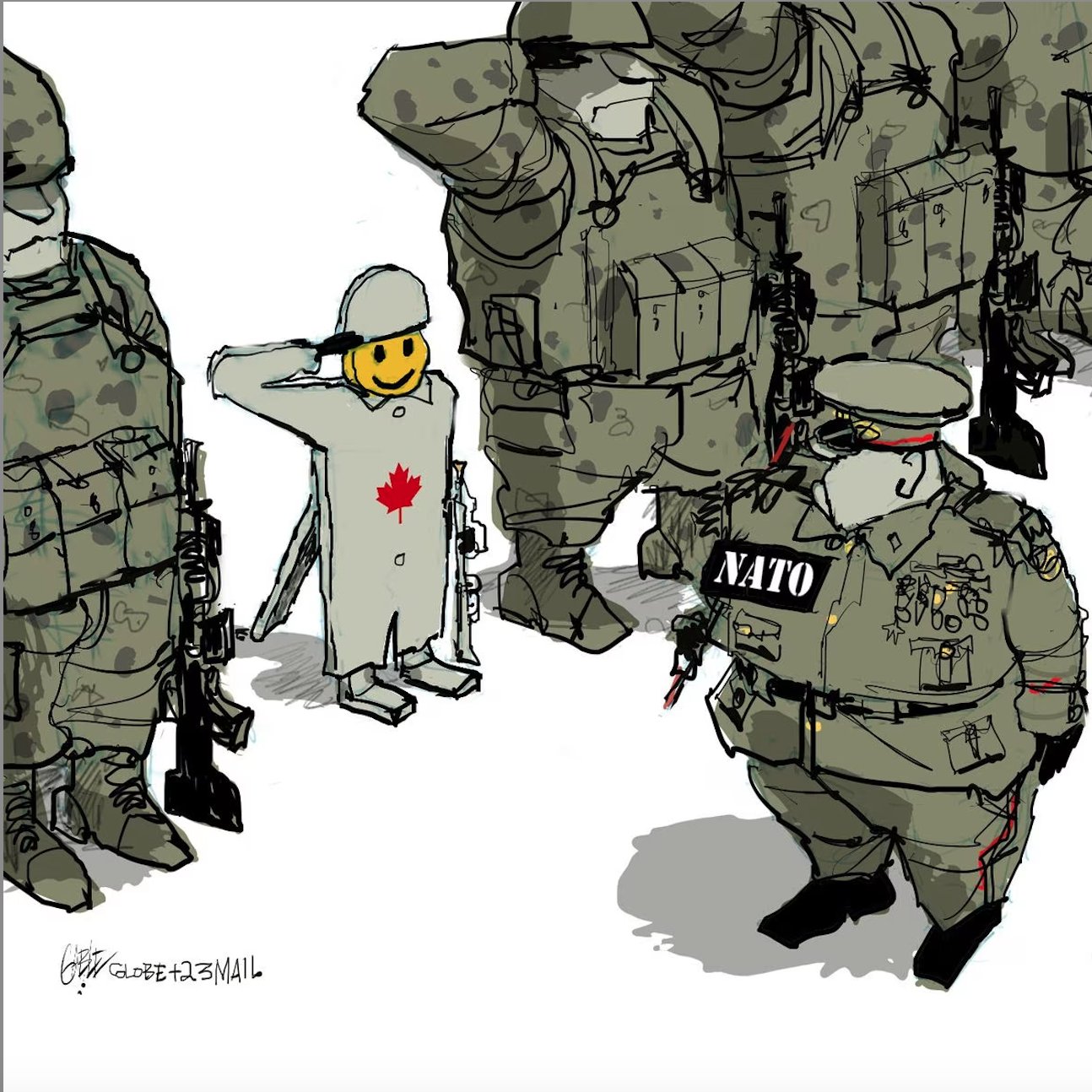
It’s been an open secret for decades that Canada’s NATO contributions are more rhetoric than reality, but it’s true of many of the European NATO allies, too.
… simply raising defence spending will not turn Europe’s states into genuinely effective military powers. For one thing, the GDP criterion is much too vague to mean much. Finland, for instance, spends only 2.4% of its GDP on defence and yet can mobilise some 250,000 determined soldiers. Other Nato members, which spend much more than the Finns, obtain far less for their money.
Moreover, focusing on GDP instead of force requirements — so many battalions, artillery regiments, fighter squadrons — is nothing but an invitation to cheat, an opportunity lustily taken up across the continent. The latest Spanish submarine, for instance, is not imported for €1 billion or so from Thyssen-Krupp, which supplies navies around the world with competent, well-proven submarines. Instead, it was proudly designed and built at the Navantia state-owned Spanish shipyard: for €3.8 billion, roughly the cost of a much bigger French nuclear-powered submarine. As a feeble justification for that absurdly high cost, Spain’s defence minister cited a supposedly advanced air-recirculation system — so greatly advanced, in fact, that it is not actually ready, and will not be installed even in the submarine’s next iteration.
Soon, though, Italy will outdo Spain’s platinum submarine: by including a new bridge to Sicily, set to cost some €13.5 billion, into its 2% of GDP Nato spending quota. The government’s excuse is that some 3,000 Italian troops may need to cross the Strait of Messina were the Italian army ever to be fully mobilised. But it would be much cheaper to fly them individually, each trooper in his own luxurious private jet. Even without the bridge, meanwhile, Italy’s cheating on the 2% target is bad enough. Most notably, much of the Italian Navy’s spending goes towards warships made by Italy’s state-owned Fincantieri shipyard. But there is not enough money for the fuel and maintenance expenses to operate more than half of them, meaning another industrial subsidy is camouflaged as defence spending. All the while, Italy refuses to increase its defence budget beyond the very modest target of 2% — which it has yet to meet.
As for Germany, three and half years since the start of the Ukraine war, with ever more ambitious rearmament plans loudly promised, the total number of personnel in uniform has actually slightly decreased. And, aside from beginning a multi-billion euro purchase on an Israeli missile-defence system, nothing much has happened. Despite its high demand in Ukraine, even the battle tank, that German specialty, is being produced in very, very small numbers: so low that the annual output could be lost in a morning of combat. In May 2023, indeed, a meagre 18 Leopard tanks were ordered to replace older models lost in Ukraine. The expected delivery date? Between 2025 and 2026! Then, in July, Germany purchased a further 105 advanced Leopard 2A8s. That is the number needed to equip a single brigade, the German force stationed in Lithuania — and they are expected to arrive in 2030!
The sad truth, then, is that Germany has yet to start working in earnest to correct the extreme neglect inflicted on its armed forces during the long Merkel premiership, when she kept saying that “even if we had the money we would not know how to spend it”. All the while, German helicopters lacked rotors and tanks lacked engines. The exceedingly slow recovery of the German army is especially frustrating because Nato is not actually short of air or naval forces. What it lacks are ground forces, soldiers more simply, or rather soldiers actually willing to fight. Having added Estonia, Latvia and Lithuania to the alliance, tiny countries with outsized defence needs, the alliance faces a severe troop deficit across the entire Baltic sector. The troops so far sent by Nato allies, such as visiting Alpini battalions from Italy, cannot improve the maths.
Update, 30 September: Welcome, Instapundit readers! Please do have a look around at some of my other posts you may find of interest. I send out a daily summary of posts here through my Substack – https://substack.com/@nicholasrusson that you can subscribe to if you’d like to be informed of new posts in the future.
AK4: Sweden’s Beefed-Up Take on the G3
Forgotten Weapons
Published 19 May 2025When Sweden decided to replace its bolt action Mausers and Ljungman semiautomatic in the 1960s, it had four main choices to pick from. One was the domestic GRAM-63, a modernized version of the Ljungman, the FAL and the G3. They ended up choosing the G3, but not without a number of changes.
Mechanically, the Swedes insisted on a longer service lifespan of the rifle than H&K rated it for. To this end, the Swedish model got a heavier recoil buffer, extending its life to 15,000 rounds. There were also changes to the stock, sights, bayonet attachment, and bolt carrier as well as the use of a clip-on rubber case deflector.
The initial batch of Swedish AK4 rifles was purchased directly from H&K, while domestic licensed production was set up at (eventually) both the star-owned Carl Gustaf factory and also the Husqvarna company.
Thanks to the Supply Battalion of the Estonian Defense Forces Support Command for giving me access to film this surprisingly hard-to-find rifle!
(more…)
Comments Off on AK4: Sweden’s Beefed-Up Take on the G3
September 24, 2025
The Korean War Week 66: The Hell of Heartbreak Ridge – September 23, 1951
The Korean War by Indy Neidell
Published 23 Sep 2025The Korean War reaches one of its bloodiest battles as UN forces clash with North Korean defenders on Heartbreak Ridge. The US 2nd Division suffers heavy losses, with entire companies wiped out to the last man. At the same time, the Marines introduce a revolutionary new tactic in modern warfare — transporting troops via helicopter right to the front lines during battle. Meanwhile, UN Commander Matt Ridgway refuses to resume peace talks in Kaesong, sparking further tension with the Communist side. As the battle rages, the question remains: can there be peace in Korea, or only more heartbreak?
Chapters
00:00 Hook
00:43 Recap
01:14 Heartbreak Ridge
04:02 To The Last Man
06:06 What Ridgway Wants
08:00 Effects of the Treaty
10:13 New Strategy
11:29 Supply by Helicopter
12:31 Summary
12:45 Conclusion
15:34 Call to Action
(more…)
Comments Off on The Korean War Week 66: The Hell of Heartbreak Ridge – September 23, 1951
September 23, 2025
Beretta Model 1934: Italy’s Unassuming Workhorse Service Pistol
Forgotten Weapons
Published 16 May 2025The Beretta Model 34 was basically the final iteration of a design by Tullio Marengoni that began all the way back in 1915. That pistol was updated in the early 1920s, and that one was updated in 1931. The Model 1931 was converted to .380 ACP (aka 9mm Short) as the Model 1932, which became the Model 1934 with the addition of a hammer half-cock notch and steel grip panel backing. Police and military contracts began in 1935, with the Italian Army formally adopting it in 1936 and purchasing nearly 400,000 of them by 1940. It would ultimately see service with basically all the armed elements of the Italian military and civil security services as well as foreign nations including Germany, Romania, and Finland. As a souvenir for British or American troops, the Model 1934 was also a prized piece.
Essentially, the Model 1934 is compact, simple, durable, and reliable. It is an excellent military pistol; easy to carry unobtrusively but dependable when called upon. After World War Two it stayed in production until 1980, despite introduction of many other more modern options by Beretta. Today a bunch of the pistols have become available on the US collector’s market. Thanks to Royal Tiger Imports for sending this example for me to film!
Beretta Model 1934 serial numbers and dates (source: “1915-1985 Settant’ Anni di Pistole Beretta“):
1934 – 1942 – from about 500073 to 999996
1934 – 1942 – from 1 to about 40000
1943 – 1945 – from F00001 to F99997
1943 – 1945 – from G00001 to G57486
1943 – 1945 – from 0001AA to 9997AA
1943 – 1945 – from 0001BB to 9971BB
1946 – 1949 – from C00001 to C99998
1949 – 1954 – from D00001 to D99999
1954 – 1967 – from E00001 to E95760
1967 – 1973 – from F50001 to F61693
1970 – 1975 – from G00007 to G49620
1972 – 1974 – from H00001 to H25000
1971 – 1980 – from T 1 to T 10217Other pistols in the Beretta development series:
Modle 1915: • Beretta 1915: the First of the Berett…
Model 1923: • Beretta Model 1923
Model 1931: • Beretta Model 1931
Trials Model 1934: • Military Trials Beretta 34 – Can You …
(more…)
Comments Off on Beretta Model 1934: Italy’s Unassuming Workhorse Service Pistol
September 22, 2025
Dien Bien Phu: The Battle that Ended French Indochina – W2W 45
TimeGhost History
Published 21 Sept 2025The First Indochina War reaches its climax at Dien Bien Phu. In late 1953 the French parachute into the valley, build a fortress under Christian de Castries, and plan to smash the Viet Minh with artillery and air power. Võ Nguyên Giáp answers with a siege: anti-air guns on the surrounding hills, trenches creeping forward, and relentless assaults on strongpoints Beatrice, Gabrielle, and Isabelle.
After weeks of bombardment and failed resupply, the fortress collapses in May 1954. At Geneva, the great powers draw the ceasefire lines: Vietnam is divided (North–South), and the Indochina War ends.
#DienBienPhu #IndochinaWar #Vietnam #ColdWar #Geneva1954 #VoNguyenGiap #FrenchIndochina
(more…)
Comments Off on Dien Bien Phu: The Battle that Ended French Indochina – W2W 45
HBO’s Rome – Ep 12 “Kalends of February” – History and Story
Adrian Goldsworthy. Historian and Novelist
Published 30 Apr 2025Today, we look at the final episode of Season One, which deals with the last days of the conspiracy against Julius Caesar and his murder on the Ides of March — not that the date gets a mention. There is quite a lot of soap-opera stuff in this one, the culmination of character arcs, so less time for politics.
One day, we may do Season Two, but for the moment, that’s all folks!
Comments Off on HBO’s Rome – Ep 12 “Kalends of February” – History and Story
QotD: Tactical combat on the pre-modern battlefield
In a fight, after all, a combatant is extremely vulnerable to attacks from behind or in their peripheral vision, especially if they are focused forward on the foe in front of them. A confused melee would thus produce extreme casualties and produce them extremely quickly. But fighters want to survive their combats and their leaders would like not only to win the battle but to have an army at the end of it. Remember: the purpose of the battle is to deliver a siege: if you win the battle but with only a pathetic handful of survivors, you haven’t really won much of anything.
The battle line is the obvious solution: each fighter is only responsible for a few feet of frontage directly in front of them, a small enough area that they can focus on it visually and direct whatever shield or armor or weapons they have towards it, giving them a greater margin of safety. Adding depth to the formation (that is, increasing the number of ranks, that is a row of fighters right to left) both secures each fighter against the possibility of being flanked due to the death of the fellows to their right or left (as now they’ll just be replaced by the next rank moving up) and adds a morale reinforcement which we’ll come back to […] But now you have a formation that consists essentially of a large number of files (that is, a single row of fighters front-to-back) which need to move together to create that unbroken, mutually supporting front line so that no one is being attacked from many sides at once. Again, all of this is before we start adding fighting styles like pike-formations or shield-walls that are designed to excel in this environment (and fare poorly out of it).
As an aside, this is one dynamic that I find games like Mount and Blade or the Total War series that simulate individual soldiers struggle to get quite right. In most games the line of formation either remains almost perfectly rigid (think units on “pike phalanx” in Rome: Total War) or units the moment they come into contact form rough blobs of models all pushing forward. But actually you are going to have men in the rear ranks trying to keep their relative position to the front ranks so the formation neither holds rigidly steady nor dissolves but is going to almost flex and bend (and if you are lucky, not tear or break). This is only an aside though because we’re not well informed about these sorts of dynamics, so it is hard to speak about them in-depth.
But to fight this way now means that all of your soldiers (really here we are talking about infantry; cavalry must also be coordinated but in different ways and because they are often composed of elites that coordination may be produced through different training methods) need to move in the same direction at the same speed in order to retain that front line where they can support each other. Again, we are not yet to something like a shield-wall or a sarisa-phalanx which demands tight coordination; even in a rough skirmish line you need to get everyone moving together just to maintain that unbroken front. A break in the front, after all, would be dangerous: enemies filtering into it uncontrolled could then flank and defeat individually the members of the broader line (two-on-one contests in melee combat typically end in seconds and are very lopsided), causing collapse.
Now the good news is that if all you need an army to do is form up in a rough line a few ranks deep and then move more or less forward, the coordination demands are not insurmountable. We’ve already discussed using marching formations to create the line of battle so all you need is a way to regulate speed (since forward is a fairly easy direction for everyone). It isn’t quite ideal for everyone to simply self-regulate their speed by looking around (at least not for a contact infantry line; for missile-skirmish troops moving in a “cloud” rather than a line they can absolutely do that) because that will produce a lot of stagger-start-stopping and accordioning which at best will slow you down and at worst will eventually turn your neat line into a rough crowd – one easily defeated if it is opposed by a line of infantry in good order. Keeping everyone in the same speed can be handled with music: the regular beat regulates the footsteps. That can be a marching song or it can be an instrument (ideally one easy to hear).
We’ve talked about armies – or components of armies – like this. I’ve described hoplite phalanxes through much of the classical periods, for instance, as essentially unguided missiles for this reason: the general hits “go” and the line moves forward. Likewise a shield-wall formation like the early English fyrd doesn’t need to do complex maneuvers. And for many armies, that was enough: a body of infantry which either held a position or moved forward in a single line, in some cases with a body of aristocratic cavalry which might be capable of more complex maneuvers (that the aristocrats had trained in since a young age). And you can see, if your culture has armies like this, why the general might be focused on either leading the cavalry in particular or else being the motivating “warrior-hero” general – such an army isn’t capable of much command once the advance starts in any event. They haven’t trained or prepared for it.
Bret Devereaux, “Collections: Total Generalship: Commanding Pre-Modern Armies, Part IIIa”, A Collection of Unmitigated Pedantry, 2022-06-17.
Comments Off on QotD: Tactical combat on the pre-modern battlefield


