
Forgotten Weapons
Published 31 Mar 2025The Israeli Negev machine gun had a rather long development cycle, beginning in 1985 but not seeing final completion and issue until 1997. Once on the market, it proved to be a pretty successful weapon, used by the Israeli military and also a number of export client around the world. In 2012, IMI released an improved newer version, the Negev 7. This was made exclusively as a 7.62mm NATO caliber gun, as opposed to the original Negev which was only made in 5.56mm NATO.
(more…)
August 12, 2025
Negev 7: Israeli Scales up to a 7.62 NATO Machine Gun
Comments Off on Negev 7: Israeli Scales up to a 7.62 NATO Machine Gun
August 11, 2025
Speed vs Armour: The Unexpected History of Fast Tanks
The Tank Museum
Published 21 Mar 2025Would you rather go to war in a tank that was quick but lightly armoured – or heavily armoured but slow?
The concept of fast tanks has existed since the First World War, but making a tank fast is easier said than done. You can increase the speed, but only by compromising the other two sides of The Iron Triangle.
Whilst a good power to weigh ratio is key to making a tank go fast, there are other factors that need to be considered. J Walter Christie pioneered the innovative helicoil spring suspension system – an invention that allowed tanks to cope with travelling at high speeds across country. Although not picked up by the US Army, the brilliance of Christie’s suspension was recognised by the Soviets and soon made an appearance on the BT-Series of tanks – and most effectively on the T-34.
Back in the UK, the newly mechanised cavalry was making use of some brand-new Cruiser tanks. Whilst these were fast vehicles, this was coming at the cost of effective protection. Some military thinkers advocated for the concept of “speed as armour” but results were mixed – with the Crusader and Cromwell both proving to be capable tanks.
After the war, the British Army finally moved on from “speed as armour” and settled on sacrificing a bit of speed for the sake of better protection. This was incorporated first into the concept of Universal Tanks and remains a fixture in the modern Main Battle Tank.
So, we’ll ask again. Would you rather go to war in a tank that was quick but lightly armoured – or heavily armoured but slow?
00:00 | Introduction
00:51 | What Makes it a Fast Tank?
02:39 | What is a Fast Tank For?
04:39 | Suspension of Disbelief
06:34 | Speedy Soviets
08:29 | Cruisers Replace Cavalry
11:20 | The Second Wave
13:19 | Cruising in Europe
19:08 | One Tank to Do It All
(more…)
Comments Off on Speed vs Armour: The Unexpected History of Fast Tanks
August 10, 2025
QotD: The “generations” of warfare
Warfare is fundamentally about breaking the enemy’s will to fight. This can be done with violence, or without it – before the fight even starts, through raw intimidation. Working from this understanding, military theorists have divided the history of warfare into five generations.
First Generation Warfare, abbreviated 1GW, was war as it was waged from the dawn of civilization up through roughly the Civil War. This style of conflict involved massed line infantry, equipped with spears, pikes, swords, or line-of-sight ranged weapons such as longbows, crossbows, or muskets. The basic tactic was to draw up two large groups of armed men, bring them into close contact, and have them hack at one another until one side grew demoralized by the slaughter, at which point their line would break and the real slaughter could begin.
Industrial or Second Generation Warfare (2GW) brought rifled firearms, machine-guns, and indirect artillery. Men could now be killed at a great distance, without ever seeing the enemy. Camouflage, concealment, and cover became the keys to victory. Its heyday was roughly from the Civil War to the Great War.
Mechanized warfare or 3GW arrived with the internal combustion engine and powered flight. Tactics now depended on speed and manoeuvrability. It dawned with the Second World War and reached its apogee with the invasion of Iraq.
Mechanized warfare created an overwhelming advantage for large industrial states. Small states and non-state actors responded with 4GW, which can be thought of as televisual warfare – combat via propaganda. This is war as fought with cameras and media distribution networks. It is guerrilla warfare via weaponized morality: using the enemy’s own military actions against it by showing the consequences of war for one’s civilian population to the enemy civilian population. Bait the enemy into killing babies, then ask them how many more babies they’re willing to murder. Think Vietnam, Afghanistan, Iraq.
The response to 4GW is 5GW – warfare by psyop, utilizing misinformation and sentiment engineering. Its characteristic weapons platform is the social network. Where 4GW seeks to use the enemy’s own morality against it, 5GW seeks to change that morality, to transform the enemy’s inner nature, getting the enemy to attack themselves for you, to surrender with open arms and smiles on their faces … ideally, without the enemy even realizing that they’re under attack.
John Carter, “Political Conflict in the Age of Psychic Warfare”, Postcards From Barsoom, 2024-03-01.
Comments Off on QotD: The “generations” of warfare
August 9, 2025
Erma EMP36: External Form Factor of the MP40
Forgotten Weapons
Published 26 Mar 2025The German military began looking for a new submachine gun design in secret in the mid 1930s. There is basically no surviving documentation, but the main contenders appear to have featured: Hugo Schmeisser’s MK-36,II and Erma’s EMP-36. Today we are taking a look at one of two known examples of the Erma design at the VHU in Prague. Designed by Heinrich Vollmer, this is a plain blowback open bolt system chambered for 9x19mm. It is massively more complicated than such a simple design has any right to be, though. Elements like the tiny set screw holding together the recoil spring assembly and the detachable bolt face are, frankly, nutty to include in a prospective military design.
However, Vollmer’s design had a number of external design features that were deemed very desirably by the German military. The pistol grip and very compact underfolding stock were both admirable, and the muzzle rest system was also of interest (in a simplified form). Ultimately, the result of testing of the Erma and Schmeisser prototypes was a combination of their features into a hybrid design. The Erma provided the external form factor, and the Schmeisser contributed the internal mechanics for the MP38 and in turn MP40.
(more…)
Comments Off on Erma EMP36: External Form Factor of the MP40
August 8, 2025
Debunking the idea that Japan was about to surrender anyway
Dr. Robert Lyman on the common misunderstanding of Japan’s situation in July and August of 1945 — no, they weren’t “on the brink of surrender so atomic bombing was unjustified” … instead, they were intending to make the assault on the Home Islands the biggest bloodbath ever:
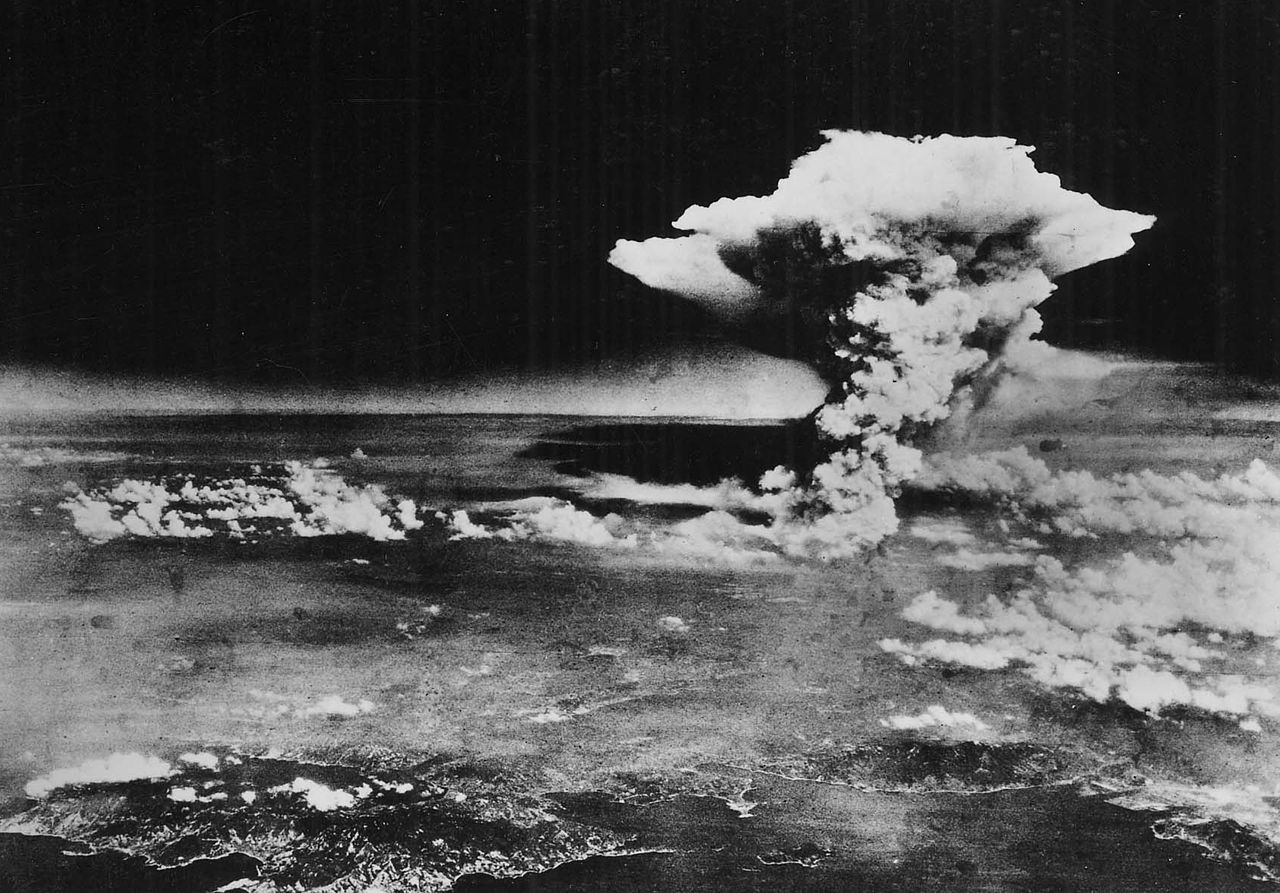
Atomic cloud over Hiroshima, taken from “Enola Gay” flying over Matsuyama, Shikoku, 6 August, 1945.
US Army Air Force photo via Wikimedia Commons.
It’s the anniversary of Hiroshima again today. I wasn’t going to write anything to mark the event (more coming next week on VJ Day), but I’ve been triggered already by nonsense on the radio which suggests that the atomic bombs on Hiroshima and Nagasaki were unnecessary, because Japan was about to surrender.
Nonsense. There is not a shred of real evidence to support this idea. In fact, the evidence that Japan wanted to keep on fighting is irrefutable. And yet this lie persists, despite the deluge of scholarly work demonstrating Japan’s commitment to the ritual suicide of its entire nation right until the end, when Hirohito pulled the plug. If you are in any doubt about the facts of the case, as opposed to the propaganda, read Toland’s Rising Sun (1970), Frank’s Downfall (2001), Spector’s In The Ruins of Empire (2007), Pike’s Hirohito’s War and, more recently, Stewart Binn’s Japan’s War (2025). All are excellent, clear, analytical and well researched. There are lots more, too.
Why does this canard keep on popping up? Is it because people don’t read? Or is it that they just don’t want to believe in the necessity of such a dramatic event to force Japan to surrender and thus bring about an end to the greatest man-made tragedy the world has ever suffered? The origins of this wishful myth in fact derives from hard right nationalist propaganda in post-war Japan (driven by Admiral Suzuki himself), quickly lapped up by the gullible and wishful thinkers in the West. Its one of the most enduring of the Hiroshima and Nagasaki myths, in part because it seems palatable to many, and because it is inherently anti-American.
What is the real story? In short, the Allies tried hard to persuade Japan to surrender. They demonstrated unequivocally to Japan that it was going to lose the war by defeating its armies and by beginning the long, slow and painful crawl towards the Japanese home islands. All the books I’ve mentioned note the extreme chaos of Japanese decision-making before and during the war. Who really was in charge? Who could one talk to, to secure a commitment to negotiate? In any case, the chaotic government under Koiso which replaced that of General Tojo following the fall to the Americans of Saipan in 1944, made not a single effort to engage with the Allies to seek terms. This government also collapsed on 5 April 1945. The replacement prime minister was Admiral Suzuki, and it was from this man that the myth seems to have arisen, after the war, that Japan was considering surrender and that the A-bombs were unnecessary. This is not true. During his entire time as Prime Minister he resolutely refused to do anything but continue to fight, unless the ending of the war could be secured on Japan’s terms. There were some initiatives to persuade the Suzuki government to surrender, but none of them amounted to much, because they didn’t engage directly with the government in Tokyo, and they didn’t derive from the Allied powers. The evidence that peace-feelers were being put out by various sources (such as the Vatican) in 1944 and 1945 is evidence only that the Japanese government ignored them. None were taken seriously in Tokyo.
Indeed, throughout the period of the Suzuki government, the war parties were dominant. In early June the military Supreme Command submitted a paper entitled The Fundamental Policy to be Followed Henceforth in the Conduct of the War, in which it demanded that the government confirmed that Japan would fight to the very last Japanese in an act of national suicide leading to the “honourable death of the hundred million”:
With a faith born of eternal loyalty as our inspiration, we shall – thanks to the advantages of our terrain and the unity of our nation, prosecute the war to the bitter end in order to uphold our national essence, protect the Imperial land and achieve our goals of conquest.
The proposition was passed, not unanimously, but overwhelmingly nonetheless.
There were some in the government – interestingly including Tojo himself – who saw that this was self-defeating, and that Japan must negotiate to secure acceptable peace terms. Naively, it was hoped that this would enable it to retain parts of its empire. Suzuki was part of this group who thought that Japan could negotiate favourable terms to end the war, in the form of a negotiated settlement such as that had brought about the end of the Russo-Japanese war in 1905, but when he suggested this in parliament on 13 June he was shouted down by the war mongers. Hirohito then endorsed an approach to the Soviets in late June. Bizarrely – though Moscow was neutral in the Far Eastern war at this point – Tokyo’s emissaries suggested that the USSR and Japan join forces to rule the world. It was yet more evidence of how Tokyo fundamentally misunderstood the world, and its enemies, and the way the war would have to end: complete and utter surrender by Japan.
Moscow, of course, scorned these “negotiations” as meaningless.
Comments Off on Debunking the idea that Japan was about to surrender anyway
August 7, 2025
The Arctic, strategically speaking
CDR Salamander suggests we tilt our globes (you have a globe on your desk, don’t you?) 90 degrees and consider the Arctic Ocean:
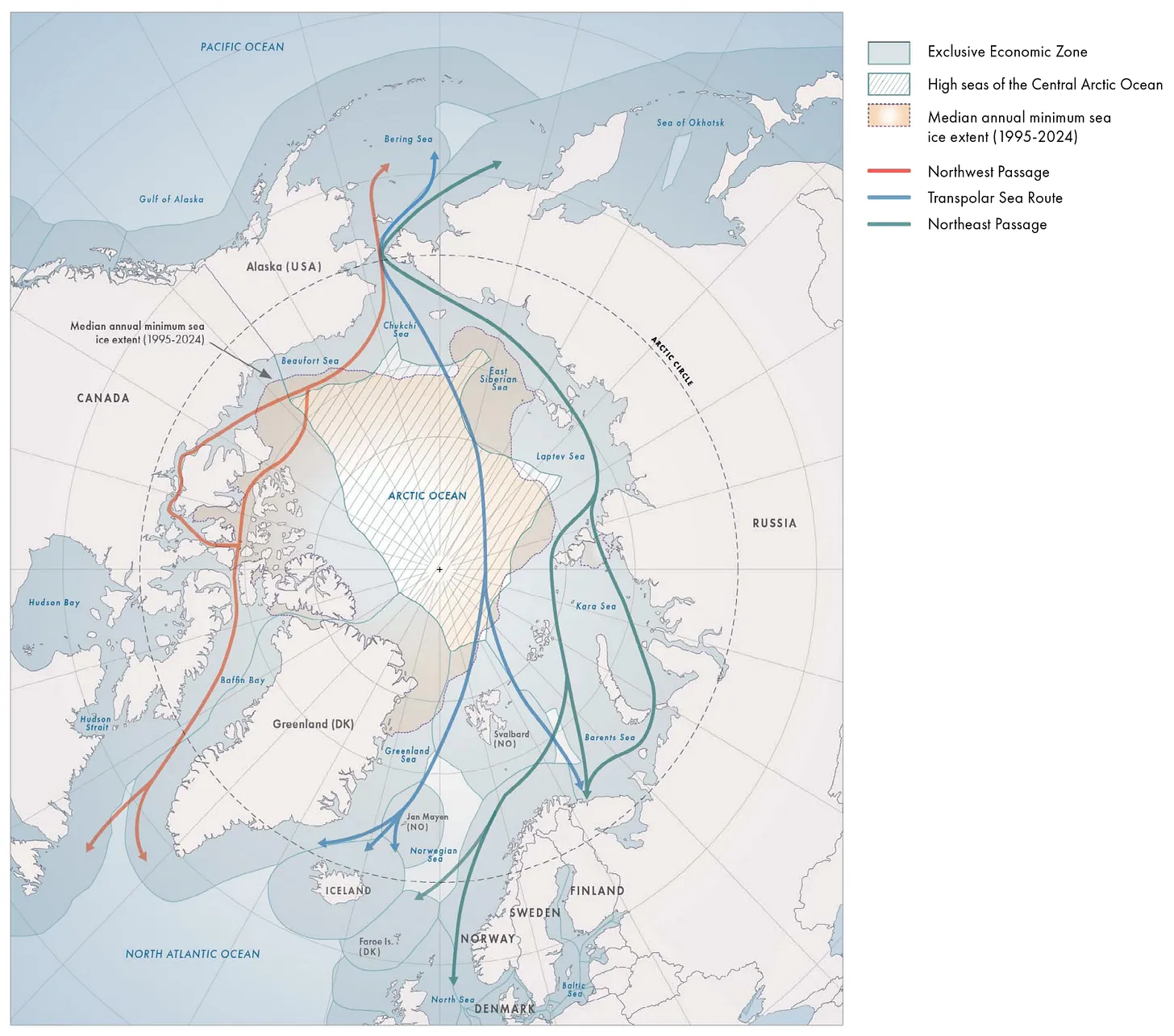
First things first, as it is the focus of the report, let’s go to the chart room and properly define the, “Central Arctic Ocean”.
There it is, the horizontally shaded bit outside everyone’s EEZ.
The chart comes from the report in question by RAND: The Future of Maritime Presence in the Central Arctic Ocean.
Before we dive in — and the Front Porch knows exactly where I am going here — I need to point out again what we see at the very top where all the red, green, and blue lines intersect. You can’t miss it, and it should have you screaming to whatever direction The Pentagon is from where you sit.
Yes kiddies, that is the Bering Strait, half of which is ours, and the other side is Russia. As you move from the Arctic into the greater Pacific or from the Pacific to the Arctic, you have to pass through that strait, and before it the American Aleutian Islands.
As we’ve covered here before, we have criminally avoided leveraging the blessings of the geography bequeathed to our nation, that of controlling both the inner and outer gates to the Arctic Ocean from the Pacific.
I should not have to explain to you the importance of the Arctic shores of Alaska to anyone. Challengers to the security of our resources in the north, both old and new, are back on the scene. We are a decade late in building a base at Nome and reactivating Adak. I covered that in a previous Substack linked in the prior sentence. Read it and come back if you need to catch up.
A weakness of much of the RAND report is, it is mostly based on stale talking points about immediate climate change in the Arctic, and questionably alarmist assumptions about the Arctic climate for the rest of the century, which seem more suited to the first Obama Administration, but put this to the side.
Should the climate in the Arctic mid-century trend towards the more ice or less, the simple facts remain — the competition in the Arctic is only increasing and the time to act on this new reality is now.
Comments Off on The Arctic, strategically speaking
August 6, 2025
The Korean War Week 59 – Who’s Really Running the Korean War? – August 5, 1951
The Korean War by Indy Neidell
Published 5 Aug 2025The Kaesong peace talks keep dragging on, and where any demarcation line should be drawn continues to the biggest obstacle to progress. The war continues, though, and plans for new offensives and blockades are being hashed out. But who exactly are the forces fighting this war? This week we take a closer look at the Communist forces and the American chain of command.
Chapters
00:00 Hook
00:37 Intro
00:50 Recap
01:11 The 38th Parallel Issue
02:51 War Without Victory
04:58 US Chain of Command
09:21 Plans and Alternatives
10:58 UN Air Power
13:19 The Communist Forces
18:28 Summary
18:49 Conclusion
19:45 CTA
(more…)
Comments Off on The Korean War Week 59 – Who’s Really Running the Korean War? – August 5, 1951
Schmeisser MK-36,II – The Mechanics of the MP40
Forgotten Weapons
Published 24 Mar 2025The German military began looking for a new submachine gun design in secret in the mid 1930s. There is basically no surviving documentation, but the main contenders appear to have featured: Hugo Schmeisser’s MK-36,II and Erma’s EMP-36. Today we are taking a look at the two known examples of the Schmeisser design at the British Royal Armouries. It is a simple blowback design with a full wooden stock, and chambered for 9x19mm (although the second example, made for Hungarian trials, is in 9x25mm). It does have a quite strange magazine safety, which prevents the bolt from opening if a magazine is not present — the purpose of this is a mystery to me.
The Schmeisser gun was simple and effective mechanically (expect for that weird safety), and it ultimately contributed its magazine, bolt, and fire control system to the MP38 and MP40 design. In exchange, the Haenel company that Schmeisser works for was one of the two initial MP38 manufacturers.
Many thanks to the Royal Armouries for allowing me to film and disassemble this unique prototype! The NFC collection there — perhaps the best military small arms collection in Western Europe — is available by appointment to researchers: https://royalarmouries.org/research/n…
You can browse the various Armouries collections online here:
https://royalarmouries.org/collection/
(more…)
Comments Off on Schmeisser MK-36,II – The Mechanics of the MP40
August 5, 2025
Origin of the China-Taiwan Conflict: Chinese Civil War 1945-1949
Real Time History
Published 21 Feb 2025With the Japanese surrender in September 1945, the Second World War comes to an end. But for China there won’t be peace right away because the nationalists under Chiang Kai-Shek and the communists under Mao Zedong still haven’t resolved their struggle and so the Chinese Civil War will flare up once again.
Chapters:
00:00 Japanese Surrender
03:44 Opposing Forces
07:33 KMT Offensives
12:18 CCP vs KMT Strategy
14.45 CCP Counterattack
19:19 Civilian Experience
23:23 CCP Huaihai Campaign
26:30 Final CCP Offensives
29:31 KMT Escape to Taiwan
31:59 Why did the Communists Win?
36:07 The United States and Taiwan
(more…)
Comments Off on Origin of the China-Taiwan Conflict: Chinese Civil War 1945-1949
QotD: Fighting a Middle Republic Legion
As you approach the velites, they scatter back to their lines and now the first real trial comes: when you are about twenty meters out from the enemy line, a storm of those heavy pila come in, thick and all at once. Each one masses around 1.3kg (just short of three pounds) so even if the tip doesn’t bite, one of these things clanging off of armor or a shield is going to hurt, the impacts stagger men near you as you struggle to keep formation (and for a Hellenistic army, get and keep those sarisa-points down). The impact of the massed volley, especially against close-order infantry with tight fighting-width, is going to be chaotic as some men are killed, others disabled, still more suddenly staggered. The volley is followed almost immediately by the on-rush of the hastati. These guys don’t have a long spear for keeping you at a distance, they’re all brandishing swords and aim to get in close, using their large body-shields to absorb any blows you might throw while they get right up in your face, where their swords can stab and slash viciously over or under your shield. These hastati are aggressive and they’re probably better armored than you are.
And of course an engagement in contact like this is unpredictable. Perhaps in some areas, your lines push forward, whereas in other places it bends back. For large maneuver units (like taxeis!) this can be a real problem, but Roman maniples are small, so one maniple can advance if it finds the opportunity while others hold position or are even forced back (we actually see a general give, essentially, an “advance at your own discretion” order at Pydna, Plut. Aem. 20.8).
After a short and terrifying experience – these moments of shock combat probably didn’t last all that long, perhaps as little as just a few minutes – the hastati fall back. The front of your line is already physically and mentally exhausted. Many men are wounded and certainly some have been killed or disabled. I don’t want to oversell the casualties aspect of this: armies don’t annihilate each other in stand-up engagements (instead more casualties happen in pursuit), but wounds and exhaustion matter. Latin has this phrase, of being confectus vulneribus, “exhausted by wounds” or perhaps “worn down by wounds” (Liv. 24.26.14, 31.17.11, Caes. BGall. 5.45) to describe how the accumulation of a lot of little wounds can sap soldiers of their ability to resist effectively, even if no one wound is lethal. And just as important, all of the emotional impetus of your initial attack is spent. And there’s a decent chance that, as you try to breath, you still have these light velites‘ javelins (the hasta velitaris) thudding into your line every few seconds, because – again – they carry seven of them. They’re not out.
And then, as you are getting your bearings, trying desperately to catch your breath, the principes come up. They’re not physically tired or emotionally exhausted, but eager (like you were a half an hour ago when you advanced), they’ve been waiting all this time. Worse yet, these are probably the most combat-effective soldiers the Romans have, in the prime of their life, with years of combat experience. Now the second volley of pila comes in, creating yet more chaos. And then more angry, heavily armored Romans, behind their big shields, stabbing and cutting with their deadly gladii.
Now the men at the back of your single line may be relatively fresh, but you have no real way to get them to the front, so the wrath of the principes falls on men who are already exhausted, already wounded, already tired and already out of fight. Your line isn’t advancing so stridently; the men in the back, if the formation is deep, don’t know why the advance is slowed, why the line seems to be wavering, only that it seems to be wavering. And meanwhile, everyone is hoping that, at any moment, the victorious cavalry on the flanks is going to show up and win the battle, but they can’t see it anywhere in the confusion. Maybe your cavalry has won and is moments away – or perhaps Antiochus III charged it off the field again and no help is coming. Or perhaps the enemy cavalry has tied it up or worse yet, the Romans’ highly skilled Numidian allies might have mastered the flanks. You have no idea, you only know that help isn’t here, you are tired and more Romans are upon you. And somewhere, the thin thread of human courage snaps, either from the exhausted men in front or the confused men behind and the formation begins to collapse.
As the collective defense of lapped shields or serried pikes gives way, the Romans are now truly in their element: their large shields function just fine in individual combat and their versatile swords do as well. Lead by their centurions, the principes, with practiced and experienced skill, are finding the gaps, cutting as they go. As the formation crumbles, the velites can pursue – lightly armored, but well enough armed, backed up by the equites if there are any left.
You can see thus how this is a formation designed to wear down an enemy’s main battle line. It isn’t that the Romans are set massively deeper than a Hellenistic army, either. Assuming a base-3 set of file-depths (which seems to me the most likely), the Roman ranks are probably six, six and three men deep (hastati, principes, triarii), for a total depth over each file of 15, one less than the normal Macedonian formation. And with the wider fighting intervals the Romans use, they won’t normally have much of a problem matching the fighting width of the enemy army, unless substantially outnumbered (as, for instance, at Magnesia).
It’s not the Roman formation is deeper, it’s that its successive battle lines avoid exposing the entire army to exhaustion, attrition and friction all at once. In effect, it uses the same principles as defense-in-depth, exploiting the effect of friction on the enemy line to wear it down, but does so on the offensive. I don’t think it is an accident that when the Romans do lose, it tends to be because this model battle was spoiled in some way, either because the army was ambushed, enveloped, something disrupted the triplex acies or because the enemy was able to carry the field with just the momentum of the first charge – the Roman lines essentially failing like a building undergoing controlled demolition, as each floor pancakes the next without slowing.
But an army that isn’t able to decisively win the battle either at the first onset or somewhere else on the line is going to find itself in quite a lot of trouble as the Romans almost inevitably sandpaper away the morale and stamina of the main line of resistance until it collapses.
Now many of you may already be realizing that this kind of force is going to present a Hellenistic army with a lot of problems, both because it is set up for a different kind of fight than they are, but also because it may end up matching much heavier troops against the lighter parts of a Hellenistic army. But before we jump into battles, we need to zoom up to the upper levels of military analysis – operations and strategy – and talk about the advantages the Romans have there.
Because if all the Romans had was an edge in their tactical system, we might expect them to win battles but sometimes lose wars. Instead, while the Romans sometimes lose battles, they seemingly always win the war.
Bret Devereaux, “Collections: Phalanx’s Twilight, Legion’s Triumph, Part IIa: How a Legion Fights”, A Collection of Unmitigated Pedantry, 2024-02-09.
Comments Off on QotD: Fighting a Middle Republic Legion
August 4, 2025
Day Ten – German Victory in the Battle of France – Ten Days in Sedan
World War Two
Published 3 Aug 2025May 19, 1940. Ten days into Fall Gelb, Guderian’s panzers thunder toward the Channel, poised to slam a steel ring around nearly half a million Allied troops. In Paris, Paul Reynaud ousts Daladier and Gamelin, calling back Marshal Pétain and General Weygand as France’s last throw of the dice. The pocket is almost shut, yet the story is far from over. Is there time for one more twist? Keep watching as we follow the fight to its end and discuss the aftermath of this campaign.
(more…)
Comments Off on Day Ten – German Victory in the Battle of France – Ten Days in Sedan
August 3, 2025
ZB37: Czechoslovakia’s Super-Heavy Machine Gun
Forgotten Weapons
Published 12 Mar 2025The ZB37 began in 1930 as a design by none other than classic Czech arms designer Vaclav Holek. The Czechoslovakian military was still using the Schwarzlose heavy MG, and wanted something to replace it. To fill all the roles intended, there would eventually be three different models of the ZB37 — one for infantry, one for fortresses, and one for vehicle mounting.
Note that the factory designation for this gun at Brno began as the ZB50, and iterated to the final version being the ZB50. However, it was identified by the military as the ZB37 (for 1937, the year of adoption).
After a series of redesigns, an early version of the gun is finally adopted in 1935 as the ZB35. A series of improvements leads to the final ZB37 model. About 500 of the early ZB35s were produced, and most of these were used to fill export sale contracts. By the time World War Two begins, the Czechoslovak military has about 5,000 of the guns in its possession.
Interestingly, the gun uses a hybrid recoil and gas operating system, with a tilting bolt. It has two rates of fire that can be chosen, and uses the rear spade grips as the charging handle. It is belt fed, using continuous 100- and 200-round metallic belts and chambered for the 8x57mm Mauser cartridge.
During the war, both German and British forces made substantial use of the ZB37. The Germans purchased ongoing production from Brno, and the British had actually purchased a production license before the war began. For the British, the gun was called the BESA and used in several armored vehicles (still in 8mm Mauser) — with about 57,000 being made during the war. A number of export sales were also made, including Romania, Persia, China, and several others. In 1946 another 3,000 were ordered and manufactured for fortress use in the Czech Republic, serving until the end of Communist control of the country.
Thanks to Sellier & Bellot for giving me access to this example to film for you!
(more…)
Comments Off on ZB37: Czechoslovakia’s Super-Heavy Machine Gun
August 2, 2025
The Bloody Battle of Cannae | Animated(ish) Episode
The Rest Is History
Published 5 Jun 2025This is the final episode of our series on Hannibal, which is the second season on Carthage, the whole series is here: Rome Vs Cathage
Part 1 of our series on Hannibal is here: Hannibal: The Rise of Rome’s Greatest Nemesis
How did the Battle of Cannae — one of the most important battles of all time for Ancient Rome, with a whole Empire at stake, and a reputation that had reverberated across the centuries — in 216 BC, unfold? What brilliant tactics did Hannibal adopt in order to overcome the Roman killing machine, with its vast numbers and relentless soldiers? Why did so many men die in such horrific circumstances? And, what would be the outcome of that bloody, totemic day, for the future of both Carthage and Rome?
Join Tom and Dominic for the climax of their epic journey through the rise of Hannibal, and his world-shaking war against Rome, in one of the deadliest rivalries of all time.
00:00 Context to the battle
08:30 Prelude to the battle and their plans of attack
37:28 The battle
(more…)
Comments Off on The Bloody Battle of Cannae | Animated(ish) Episode
August 1, 2025
The sad saga of the CH-148 Cyclone helicopters in Canadian service
In the National Post, Tom Lawson and Gaëlle Rivard Piché argue for the Canadian government to learn from long and bitter past experiences while they “reconsider” the F-35 purchase for the RCAF … specifically the mind-numbing and depressing saga of obtaining helicopters for the Canadian Armed Forces. First, a quick recap of the helicopter story from a post back in 2012:

Pre-delivery Sikorsky CH-148 Cyclone helicopter, 4 April, 2012.
Photo by Gerry Metzler via Wikimedia Commons.
- In 1963, the CH-124 Sea King helicopter (a variant of the US Navy S-61 model) entered service with the Royal Canadian Navy.
- In 1983, the [Pierre] Trudeau government started a process to replace the Sea Kings. That process never got far enough for a replacement helicopter to be ordered.
- In 1985, the Mulroney government started a new process to find a replacement for the Sea Kings.
- In 1992, the Mulroney government placed an order for 50 EH-101 Cormorant helicopters (for both naval and search-and-rescue operations).
- In 1993, the Campbell government reduced the order from 50 to 43, theoretically saving $1.4B.
- In 1993, the new Chrétien government cancelled the “Cadillac” helicopters as being far too expensive and started a new process to identify the right helicopters to buy. The government had to pay nearly $500 million in cancellation penalties.
- In 1998, having split the plan into separate orders for naval and SAR helicopters, the government ended up buying 15 Cormorant SAR helicopters anyway — and the per-unit prices had risen in the intervening time.
- In 2004, the Martin government placed an order with Sikorsky for 28 CH-148 Cyclone helicopters to be delivered starting in 2008 (after very carefully arranging the specifications to exclude the Cormorant from the competition).
- Now, in 2012, we may still have another five years to wait for the delivery of the Cyclones.
A few data points in addition to that list:
- In 2009, the government granted Sikorsky two more years to begin deliveries … and waived the penalty fees for late delivery.
- In 2011, the government announced it would impose late delivery fines on Sikorsky.
- In 2012, Sikorsky announced the delay of the first batch of “interim” helicopters until 2013.
- In 2015, the first six helicopters were delivered so RCAF crews could begin training, with two more later in the year.
- In 2018, the first operational deployment of a Cyclone had the helicopter embarked on HMCS Ville de Quebec as part of Operation Reassurance.
- In 2021, 19 of the 23 helicopters delivered were taken out of service for cracks in the tail assemblies.
- In January 2025, the 27th helicopter was delivered to the RCAF.
Based on this lengthy and expensive process, Lawson and Piché write:
In 1992, the Progressive Conservative government signed a $4.8-billion contract with a European consortium to replace the aging Sea King helicopters deployed aboard Royal Canadian Navy (RCN) ships. For purely political reasons, when the Liberals came to power the following year, they cancelled the deal — incurring $500 million in termination penalties — and set out to find a more politically acceptable solution. That search dragged on for over a decade, culminating in a 2004 contract with Sikorsky to procure 28 CH-148 Cyclone helicopters.
What the government failed to realize — or chose to overlook — was that Sikorsky was not offering a ready-made military platform. Instead, it proposed to adapt its civilian S-92 model into a maritime helicopter fit for military use, with the hope of replicating the global success of its venerable Sea King.
But developmental issues plagued the project from the outset. The original delivery schedule of 2009 slipped repeatedly, prompting then-minister of national defence Peter MacKay to call the procurement “the worst in the history of Canada”. By 2014, the program was on the brink of cancellation. Only a tense meeting between senior ministers and Sikorsky’s president salvaged the deal, leading to a revised agreement that saw the Cyclone finally enter operational service in 2018.
Yet the challenges did not end there. The Cyclone has consistently posted poor serviceability rates. A crash that cost the lives of six Canadian Armed Forces members in early 2020 was linked to inadequate documentation and flawed software. More recently, the fleet has again been largely grounded — this time due to a shortage of spare parts. The Commander of the RCN has voiced public frustration over the shortage of deployable helicopters, even threatening to replace them with drones if necessary.
To be fair, Sikorsky is not solely to blame. It offered an attractive idea: a modern fly-by-wire maritime helicopter based on a successful civilian platform. The government accepted, underestimating the complexity of the transformation. The key lesson here — one that directly applies to the current fighter jet debate — is that there is enormous risk in buying aircraft, like the Cyclone, that exist in limited numbers worldwide.
The best path forward with the Cyclone may now be to phase out the fleet and absorb the sunk costs. A more reliable option could be the MH-60 Seahawk, also made by Sikorsky. Unlike the Cyclone, the Seahawk is a proven design, with nearly 1,000 units in active service with the U.S., Australian and some NATO navies. While it would be politically awkward to cancel a Sikorsky platform only to purchase another from the same manufacturer, pragmatism must prevail. Perhaps a deal could be struck to return the Cyclones for parts, recouping some value through the civilian S-92 supply chain.
Comments Off on The sad saga of the CH-148 Cyclone helicopters in Canadian service


