
The Korean War by Indy Neidell
Published 28 Oct 2025Big news! The peace talks resume after over two months hiatus, now in a village called Panmunjom. Also, UN Commander Matt Ridgway also gives a rare press conference, and he implies that for all his talk about punishment and prevention, those pilots who violated neutral zone air space and killed civilians receive at best a slap on the wrist. Speaking of civilians, a Marine operation is launched to deprive the enemy of civilian dwellings during the coming winter — Operation Houseburner.
Chapters
00:00 Intro
00:41 Recap
01:00 Panmunjom
03:27 Peace Talks Begin
08:35 The Neutral Zone
10:03 Ridgway’s Press Conference
11:42 Houseburner
12:22 Summary
12:30 Conclusion
(more…)
October 29, 2025
The Korean War Week 71: The Panmunjom Peace Talks! – October 28, 1951
Comments Off on The Korean War Week 71: The Panmunjom Peace Talks! – October 28, 1951
October 28, 2025
The End of European Superpowers? The Suez Crisis – W2W 050
TimeGhost History
Published 26 Oct 2025Egypt nationalizes the Suez Canal, Israel strikes under a secret Sèvres pact, and Britain and France launch Operation Musketeer, only to meet U.S. and UN pressure that forces a ceasefire at midnight.
UN peacekeeping is born, Nasser’s stature soars, and Eden’s government collapses as Suez ends the illusion of old imperial power.
(more…)
Comments Off on The End of European Superpowers? The Suez Crisis – W2W 050
AR-1 “Parasniper” – The First Armalite
Forgotten Weapons
Published 11 Jun 2025The first rifle produced by Armalite began in 1952 as a project between the brothers-in-law, Charles Dorchester and George Sullivan (no relation to later Armalite engineer L. James Sullivan). Sullivan is the chief patent attorney for the Lockheed Aircraft Company, and the two have the idea to produce an ultra-light rifle using aircraft industry materials like fiberglass and aluminum. They create a company called SF Projects and get to work using Remington actions. They fit aluminum (and then later aluminum/steel composite) barrels and foam-filled stocks and the result is a rifle that weighs less than 6 pounds with a 4x scope fitted. The first ones are chambered in .257 Roberts, but this shortly gives way to the new .308 Winchester cartridge.
Sullivan and Dorchester make a connection with Richard Boutelle, who is very much a “gun guy” himself and also head of the Fairchild aircraft company. The idea of the rifle appeals to Boutelle, and Fairchild was looking to diversify its operations – and so Fairchild agrees to buy SF Projects, renaming it the Armalite Division of Fairchild.
The idea of the rifle was for civilian hunters who want a gun that is light to carry for long distances and also military specialists like airborne troops who need lightweight gear. The Army tests the AR-1 in 1955 and finds some fairly serious problems with it. There are reliability issues, and also accuracy shortfalls. When the composite barrel heats up, differential stresses cause the point of impact to shift. This foreshadows the catastrophic failure of a composite barrel in AR-10 testing, but that is a story for another video. Ultimately after two rounds of testing the Army rejects the rifle, and that is pretty much the end of it. Armalite moves its focus to other projects, namely combining aircraft industry materials with the self-loading rifle of their other designer, Eugene Stoner. That, of course, will become the AR-10.
Since I know folks will ask, the AR projects between 1 and 10 were thus:
AR3: Stoner-type rifle in hunting configuration
AR5: Air Force survival rifle
AR9: Shotgun
The designations 2, 4, 6, 7, and 8 were set aside to drawing board projects that never materialized.
(more…)
Comments Off on AR-1 “Parasniper” – The First Armalite
QotD: Pyrrhus after his bloody defeat of the Romans at Heraclea
What comes next, of course, is that Pyrrhus seemingly fails to capitalize on his victory – but I think in reality the opportunity to capitalize in the way that most folks imagine wasn’t really there.
On Pyrrhus’ side, his army had been bloodied, but was mostly intact and was almost immediately bolstered by the arrival of his Italian allies, including the Lucanians and Samnites, along with the Tarantines. On the Roman side, Laevinius’ army was battered, but still extant; he fell back to Roman-controlled Campania, eventually taking up a position at Capua, the chief city of that region. Pyrrhus then marched north, entering Campania, bypassing the Roman force at Capua (which had been reinforced with two legions pulled from Etruria) and entering Latium, apparently getting within about 60 kilometers (c. 37 miles) of Rome (Plut. Pyrrh. 17.5). And here the question students as is why not take Rome?
And there is an easy answer: because he couldn’t.
The first thing to remember here is the natural of the human-created terrain Pyrrhus has to operate in: functionally all of the cities of any significant size in third-century Italy were likely to be fortified and their populations – thanks to Rome’s recruitment system – experienced and armed. Consequently, if the locals didn’t voluntarily switch sides, Pyrrhus would have been forced to take their settlements either by siege or storm. Pyrrhus might well have hoped that the Campanians would go over to him, but here the problem is the human geography of Italy: his army is full of Samnites, whose emnity with the Campanians is what started the Samnite wars. This is a feature of Rome’s alliance system noted by M.P. Fronda in Between Rome and Carthage (2010): because Rome extended its alliance system by intervening in local rivalries, both sets of new “allies” had long-standing grudges against the other, which makes it hard to dismantle Rome’s alliance network, since any allies you peel away will push others closer to Rome.
In the case of Campania, Capua might have felt strong enough to try their luck without Rome, but that’s why Laevinius was sitting on it with a large army. But the other Campanian cities (of which there were about a dozen) might well fear exposure to Samnite raiding without Rome’s protection. Meanwhile, the Latins – the people of Latium, the region immediately to Rome’s south (technically Rome is in Latium, on its edge) – seem to have been pretty profoundly uninterested in siding against Rome either at this juncture or later when Hannibal tries to dismantle Rome’s alliance system.
So after Heraclea, Pyrrhus has fairly limited options: he can start the slow process of reducing the cities of Campania one by one to open the logistics necessary to permit him to operate long-term in Latium or he can conduct a lightning raid through Roman territory to try to maximize the psychological effect of his victory and perhaps get a favorable peace. He opts for the second choice and when the Romans opt not to take the deal – though they do consider it – he has to pull back to southern Italy (where he focuses on consolidating control, pushing out the last few Roman positions there).
Why not attack Rome directly? Well, Rome itself was fortified, of course. Moreover, the Romans had raised a fresh levy of troops for its defense (Plut. Pyrrh. 18.1), while dispatching Tiberius Corucanius with his army to reinforce Laevinius in Capua. So as Pyrrhus enters Latium, he has a well-defended fortified city in front of him and a Roman army of, conservatively, 30,000 men (Corucanius’ 20,000 men, plus whatever was left of Laevinius’ army) behind him. I don’t usually quote movie tactics, but Ridley Scott’s Saladin has the right wisdom for this problem: “One cannot maintain a siege with the enemy behind“. Had Pyrrhus stopped to besiege Rome, his supply situation would have quickly become hopeless as the Roman army behind him could have easily prevented him from foraging to feed his army during the long process setting up for an assault on the city, which might then simply fail, since the city was well-fortified and defended.
If Plutarch (Pyrrh. 18.4-5) is correct about the terms Pyrrhus offered – an alliance with Rome, a recognition of their hegemony over Italy outside of his new clients in southern Italy (who would of course, fall under Pyrrhus’ control now) – Pyrrhus may have hoped at this juncture to consolidate southern Italy and turn back towards the East or perhaps head on to Sicily. But the Romans refused the deal and so Pyrrhus seems to have set above clearing out the last Roman strongholds (Venusia and Luceria) in Apulia to consolidate his hold. The Romans responded in the following year by sending a new army, under the command of Publius Sulpicius Saverrio and Publius Decius Mus to challenge him and they met at Asculum, in northern Apulia.
Bret Devereaux, “Collections: Phalanx’s Twilight, Legion’s Triumph, Part IIIb: Pyrrhus”, A Collection of Unmitigated Pedantry, 2024-03-08.
Comments Off on QotD: Pyrrhus after his bloody defeat of the Romans at Heraclea
October 27, 2025
Britain and the Claudian Invasion – The Conquered and the Proud 17
Adrian Goldsworthy. Historian and Novelist
Published 28 May 2025Today we look at Roman relations with island of Britannia between Caesar and the invasion sent by Claudius in AD 43. We discuss the motives for that invasion, the campaigns fought to take control of the south east, before considering the rebellion of Boudica and the expansion in the north under the Flavians.
Comments Off on Britain and the Claudian Invasion – The Conquered and the Proud 17
October 26, 2025
North Africa Ep. 5: Desert Fox Prepares to Pounce
World War Two
Published 25 Oct 2025Tripoli hums as staff and both battalions of Panzer-Regiment 5 bolster Rommel; Ariete is formally pulled under his hand to guard the rear while he eyes Marada. Malta’s Wellingtons and Sunderlands withdraw under X. Fliegerkorps pressure, a British war council prioritizes Greece, and HMS Greyhound bags Anfitrite as both sides struggle to hit each other’s convoys.
(more…)
Comments Off on North Africa Ep. 5: Desert Fox Prepares to Pounce
October 23, 2025
A39 Tortoise: The Forgotten Super Heavy
The Tank Museum
Published 13 Jun 2025The A39 Tortoise. The last complete survivor of a World War Two project that arrived just a little too late. Some have called it “The British Jagdtiger” – but is that actually a fair comparison?
Tortoise was a part of the strategy the Allies would need to defeat Germany during the Second World War. It was recognised that total victory could only occur on German soil – and that meant smashing through the imposing defences of the Siegfried Line. The Allies would need a Heavy Assault tank. Many designs were put forward for this role, including the Valiant, the A33 and the T14 Assault tank.
The A39 is extremely well-armoured. Its casemate construction could withstand a hit from an 88mm gun at close ranges. But at 78-tons, this lumbering beast was both slow and heavy – and is one of the largest and heaviest vehicles in the museum’s collection. In terms of firepower, the impressive 32pdr gun was extremely effective against both concrete and enemy armour. It even has room inside for 7 crew!
In the end, the Tortoise arrived too late to see any action on the battlefield. It was intended to form a part of the 79th Armoured Division – making it one of Hobart’s Funnies. Whether Tortoise would have become the stuff of legend, or a bit of a joke – well, we’ll leave that question up to you.
00:00 | Introduction
00:39 | What is a Heavy Assault Tank?
03:45 | Why a Heavy Assault Tank?
09:24 | The A39: As Good as it Gets?
17:55 | A Solution Without a Problem
(more…)
Comments Off on A39 Tortoise: The Forgotten Super Heavy
October 22, 2025
The Korean War Week 70: Casualties Rise For The Chinese – October 21, 1951
The Korean War by Indy Neidell
Published 21 Oct 2025The UN forces launch Operation Polecharge, hoping to complete Operation Commando, but they have worries away from the field, since UN pilots have violated the neutral zone and killed two young Korean boys, causing an outcry. If that weren’t enough, a new Soviet atomic bomb test has the entire world on edge.
Chapters
00:00 Intro
00:56 Recap
01:12 Operation Polecharge
02:37 Chinese Tactics
05:15 9th Corps Attacks
07:10 Unit Integration
10:04 B-29s Shot Down
11:06 The Mutual Security Act
12:47 Neutral Zone Violation
14:11 Summary
14:29 Conclusion
15:56 Call to Action
(more…)
Comments Off on The Korean War Week 70: Casualties Rise For The Chinese – October 21, 1951
H&K MG4: Germany’s New 5.56mm Squad Machine Gun
Forgotten Weapons
Published 7 Jun 2025Heckler & Koch released the MG4, a new 5.56mm squad machine gun in 2001. It was adopted by the German army in 2005, and then by the Spanish and Portuguese armies in 2007. Alongside its sister weapon the 7.62mm MG5, it is H&K’s current export machine gun.
The MG4 fires from an open bolt, with a 2-lug rotating bolt locking system and a long stroke gas piston operating system. It uses standard M27 NATO links for feeding, and does not have a semiauto selector setting. Mechanically, the MG4 uses a front trunnion into which both the barrel and bolt lock independently — meaning that the quick-change barrel can be removed with the bolt in either the forward or rearward position.
As one would expect for a 5.56mm machine gun weighing 18 pounds, it is very easy to control.
Thanks to Sellier & Bellot for giving me access to this modern machine gun to film for you!
(more…)
Comments Off on H&K MG4: Germany’s New 5.56mm Squad Machine Gun
October 20, 2025
From Hitler’s Rockets to America’s Arsenal – W2W 049
TimeGhost History
Published 19 Oct 2025From the ashes of Nazi Germany to the launch pads of the American desert, the story of the nation’s first ballistic missile is one filled with contradiction. A man who once served the SS soon became a celebrated figure in the United States, and his weapon of war was transformed into a symbol of progress. Here, we will explore how this unlikely journey unfolded and what it reveals about science, power, and morality in the modern age.
(more…)
Comments Off on From Hitler’s Rockets to America’s Arsenal – W2W 049
October 19, 2025
North Africa Ep. 4: Quiet Week Before the Desert Storm
World War Two
Published 18 Oct 2025Late Feb–early Mar 1941: convoys from Naples build up 5th Light as MG Battalion 8 and artillery arrive; Rommel wins deployments and edges the line from Nofilia toward Arco dei Fileni. Luftwaffe raids batter Malta, mines choke Suez, RAF assets drain to Greece, and Axis forward probes tighten the noose around El Agheila while Britain improvises under strain.
(more…)
Comments Off on North Africa Ep. 4: Quiet Week Before the Desert Storm
October 18, 2025
The Battle of Sedan: The Anatomy of Failure
World War Two
Published 17 Oct 2025In May 1940, a period of ten days flipped the world order on its head. France, the titan of the Great War, was carved apart by the armored fist of the Wehrmacht: Panzergruppe Kleist. Now, in this new feature-length production, we explore why it happened, whether this was ever avoidable, and whether France’s flaws stemmed from incompetence, or something far more sinister.
(more…)
Comments Off on The Battle of Sedan: The Anatomy of Failure
Gerät Potsdam: Mauser Copies the Sten Gun
Forgotten Weapons
Published 2 Jun 2025In the fall of 1944, the Mauser company was given a contract to develop drawings of a direct copy of the British Sten gun (code named Gerät Potsdam), and to manufacture 10,000 of them. In fact, they were to make two different sets of drawings; one suitable for large factory use (like their own) and one for use with distributed small shops making parts for final assembly elsewhere (which is how much of British Sten production was done). The contract was fulfilled and 9972 guns in total were produced and accepted by the German military in November and December of 1944.
Why would Germany was a copy of the Sten? Well, they actually had a decent number of them. The Allies were air-dropping Stens all over Europe, and a lot of those drops were captured by German troops, not the resistance fighters they were intended for. By the end of the war the Germans were in desperate need of arms, and the Sten was both simple and already in some German use with the Volkssturm … so it actually was not a totally unreasonable idea to produce more of them.
Today, the Potsdam is an extremely rare gun to find. The two visible identifying features are the magazine well and barrel shroud, which are both made with a folded and spot welded seam. The barrels are also identifiable as they have 6 groove rifling, which the British did not use in the Sten.
Before the Potsdam production was finished, Mauser began working on further plans to simplify the design. That would be the Gerät Neumunster, aka the MP 3008. For that part of the story, see my video on the MP 3008:
• German Sten Copy: MP 3008, aka Gerät Neumü…
(more…)
Comments Off on Gerät Potsdam: Mauser Copies the Sten Gun
October 16, 2025
“The ‘big secret’ of the Soviet archives was that the communists really were communist”
Big Serge talks to historian Sean McMeekin, the author of Stalin’s War and other works that some call “revisionist” for their different views of “settled” historical events:
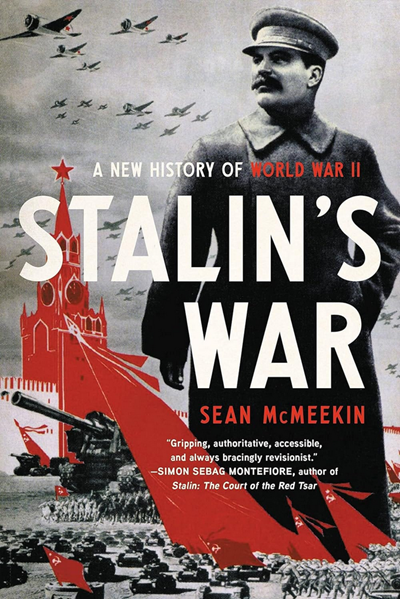
Big Serge: “One of the first things that stands out about your work is that you have found success writing about topics which are very familiar to people and have a large extant corpus of writing. World War One, the Russian Revolution, World War Two, and now a broad survey of Communism – these are all subjects with no shortage of literature, and yet you have consistently managed to write books that feel refreshing and new. In a sense, your books help “reset” how people understand these events, so for example Stalin’s War was very popular and was not perceived as just another World War Two book. Would you say that this is your explicit objective when you write, and more generally, how do you approach the challenge of writing about familiar subjects?”
Dr. McMeekin: “Yes, I think that is an important goal when I write. I have often been called a revisionist, and it is not usually meant as a compliment, but I don’t particularly mind the label. I have never understood the idea that a historian’s job is simply to reinforce or regurgitate, in slightly different form, our existing knowledge of major events. If there is nothing new to say, why write a book?
Of course, it is not easy to say something genuinely new about events such as the First World War, the Russian Revolution, or World War Two. The scholar in me would like to think that I have been able to do so owing to my discovery of new materials, especially in Russian and other archives less well-trodden by western historians until recently, and that is certainly part of it. But I think it is more important that I come to this material – and older material, too – with new questions, and often surprisingly obvious ones.
For example, in The Russian Origins of the First World War, I simply took up Fritz Fischer’s challenge, which for some reason had been forgotten after “Fischerites” (most of them less than careful readers of Fischer, apparently) took over the field. In the original 1961 edition of Griff nach der Weltmacht (Germany’s “Bid” or “Grab” for World Power, a title translated more blandly but descriptively into English as Germany’s Aims in the First World War), Fischer pointed out that he was able to subject German war aims to withering scrutiny because basically every German file (not destroyed in the wars) had been declassified and opened to historians owing to Germany’s abject defeat in 1945 – while pointing out that, if the secret French, British, and Russian files on 1914 were ever opened, a historian could do the same thing for one of the Entente Powers. I had already done a Fischer-esque history on German WWI strategy, especially Germany’s use of pan-Islam (The Berlin-Baghdad Express), inspired by a similar epigraph in an old edition of John Buchan’s wartime thriller Greenmantle – Buchan predicted that a historian would come along one day to tell the story “with ample documents”, joking that when this happened he would retire and “fall to reading Miss Austen in a hermitage”. So it was a logical progression to ask, if Fischer can do this for Germany’s war aims, why not Russia?
Readers may have missed the obvious Fischer inspiration for Russian Origins owing to the editors at Harvard/Belknap, who thought my original title – the obviously Fischer-inspired Russia’s Aims in the First World War – was boring and unsexy. Probably this helped sell books, but it did lend my critics an easy line that I was “blaming Russia for the First World War” rather than simply applying a Fischer-esque lens to Russia’s war aims. Some also called me Russophobic, which is understandable, though I think it misses the point. To my mind, subjecting Russian strategic thinking, wartime diplomacy and maneuvering to the same scrutiny as those routinely applied to Germany and the other Powers is taking the country seriously on its own terms, rather than ignoring Russia, as nearly every historian of, say, Gallipoli has done.
A book on Russian war aims was also long overdue. Other than an underwhelming Chai Lieven study from 1983 and a few articles, no one had really done this for Russia since Soviet scholars and archivists had (with very different motivations) published annotated volumes of secret Russian diplomatic correspondence back in the 1920s. For me, this was a door wide open, and I walked right in. Stalin’s War is in many ways a sequel to Russia’s Aims in the First World War (my own title!), written in a similar spirit, albeit much longer and in some ways more ambitious.
With the Russian Revolution, it was probably still harder to say anything really new, particularly after the popular histories of Richard Pipes and Orlando Figes (and a huge new literature written partly in response to them) came out in the 1990s. And I do not think my “take” was quite as revisionist or controversial as those on WWI or WW2. What I did try to do, in order to add something new to the story, was to combine my own research in a number of areas (Russian army morale reports before and after Order No. 1, depositions taken after the July Days, police reports from 1917, Bolshevik finances and expropriation policies, etc.) with new work done by others since 1991 on, especially, Russia’s military performance in WWI (a topic almost completely ignored in Cold War era literature on the Revolution, both Soviet and western), to reinterpret both the February and October Revolutions. In full disclosure, I would have preferred to write an ambitious history on just 1917, where I had the most original material and new points to make, but my publisher wanted a one-volume “comprehensive” history of the Revolution, so that is what I wrote. Like most historians and writers, I like to think that I write entirely from inspiration with a free hand, but of course there are all kinds of factors that play into our work.
Getting back to your question – while I have certainly done original research for all of these books, I am hardly the only historian to take advantage of Russian archives opened after the collapse of the USSR in 1991 – including, I should add, all the incredible archival material compiled by Russian researchers in the 1990s and 2000s into huge published volumes of Soviet-era documents. I think it is my mindset that differentiates me from other scholars who have taken similar advantage of this opportunity. Simon Sebag Montefiore, for example, uncovered incredibly rich veins of new material for Stalin. Court of the Red Tsar, as Antony Beevor did for Stalingrad, both of which books made an enormous splash. They’re not exactly “revisionists”, though. Rather, these historians retell stories already partly familiar, but with reams of fascinating new details that greatly enrich the story. I think this is a wonderful way to write history, and thousands of readers evidently agree. It is just not what I do.”
Big Serge: “I’m glad you brought up The Russian Origins of the First World War. This was the first of your books that I read, and I found it interesting for a counterintuitive reason, in that its arguments seem like they should be obvious and not particularly controversial. The essence of the book is that the Tsarist state had agency and tried to use the First World War to achieve important strategic objectives. That should be obvious, after all this was an immensely powerful state with a long pedigree of muscular foreign policy, but people are very accustomed to the Guns of August sort of narrative where all the agency and initiative is with Germany, and everyone else is reduced to the role of objects in a story where Germany is the sole subject.
It makes me think somewhat of a quip that Dr. Stephen Kotkin has used in interviews about his Stalin biographies, when he says that the “big secret” of the Soviet archives was that the communists really were communist. His point is that, even in a very convoluted and secretive regime, sometimes what you see really is what you get. I think you made a similar sort of point with Russian Origins. If I could paraphrase you, the big reveal is that the big, powerful Tsarist Empire was behaving like a big powerful empire, in that it had cogent war aims and it consistently sought to work towards those – so consistently in fact that the war aims were initially largely unchanged after the fall of the monarchy in 1917. You’re saying something very similar with Stalin’s War: the shocking secret here is that a powerful, expansionist, heavily militarized Soviet regime acted like it and worked aggressively to pursue its own peculiar interests.
How do you conceptualize this? It strikes me as a little bit odd, because, as you say, there is sometimes a bit of a stigma round the label “revisionist”, but your books generally present schemas that are fairly intuitive: Tsarist Russia was a big, powerful empire that pursued big imperial aims; Stalin was the protagonist of his own story and exercised a muscular, self-interested foreign policy; the Bolsheviks used extraordinary violence to conquer an anarchic environment. Are you surprised that people are surprised at these things?”
Dr. McMeekin: “I wish I was surprised, and perhaps at first I was, but I suppose that, over the years, I have become inured to the shocked! Shocked! reactions I receive when I point out fairly obvious things. Historians, like most groups, tend to be pack animals, who like to run in safe herds. When it comes to a familiar subject such as the outbreak of World War I, the literature tends to groove around well-trodden themes and questions. Certainly it has done since Fischerites took over the field: it’s Germany all the time, with perhaps a nod to Austria-Hungary in the Serbian backstory, or Britain with the naval race. France and Russia had almost disappeared from the story, as if one of the two major continental alliance blocs was irrelevant. I was heartened that my own treatment of Russia’s role in the outbreak of the war and Russia’s war aims garnered attention and shaped the conversation, both in itself and through Christopher Clark’s bestseller Sleepwalkers (which draws on Russian Origins). By contrast, Stefan Schmidt’s pathbreaking 2009 study of the French role in the outbreak of the war (Frankreichs Aussenpolitik in der Julikrise 1914), which Clark and I draw on heavily, has still not been translated into English, making barely a ripple in the profession. Clark and I have poked around with English-language publishers, trying to gin up interest in a translation, but so far without luck.
With the Second World War, I suppose the “shock” value is still greater, and perhaps therefore even less surprising. In Germany, after all, there are laws on the books making it illegal to “trivialize” the Holocaust, for example by foregrounding Soviet war crimes on the eastern front, and of course whole areas of the war such as the Molotov-Ribbentrop Pact, Soviet war plans in 1941, and even Lend-Lease are highly sensitive in Russia, though I’ll note that there has been a curious exception for the “full-on” revisionism of Rezun-Suvorov (Icebreaker, etc.) – perhaps because his thesis is so extreme as to be easily caricatured, or maybe just because his books sell so well, it has never been difficult to find them in Russian bookstores. In a way, I also think the popularity of Suvorov’s books in Russia relates to the way they do take the Soviet Union seriously as a great power, as I do, of course – whether or not one agrees with his thesis, and I’m sure many of his Russian readers do not, it is less condescending than western histories that treat the Soviets as passive victims of fate in the Barbarossa story before Stalin woke them up.
I was perhaps more surprised at the visceral reaction to Stalin’s War in Britain, particularly my discussion of Operation Pike (eg British plans to bomb Soviet oil installations in Baku in 1940), which sent certain reviewers into paroxysms of rage I found absolutely bewildering. If anything, I should have thought my sharply critical treatment of Hopkins and Roosevelt would have offended Americans far more gravely than my slightly more sympathetic portrayal of Britain’s wartime statesmen, but it was quite the opposite. Certainly some American Roosevelt admirers were annoyed, but this was nothing like British reviewers’ hysteria over Operation Pike. Curiously enough I had dinner not long ago with one of these reviewers, and he brought up Stalin’s War. He was very civil, full of British charm, but he still wanted desperately to know why I had argued that Britain “should have gone to war against the Soviet Union instead of Nazi Germany”. As always when I am accused of this – another reviewer stated this point blank in the TLS – I simply asked him if he could locate a passage in the book where I had stated any such thing? The entire subject of World War II has become so encrusted with emotion and taboos that I think it clouds people’s vision. They see ghosts.”
Comments Off on “The ‘big secret’ of the Soviet archives was that the communists really were communist”
The Mexican-American War 1846-48
Real Time History
Published 16 May 2025In the early 19th century, the United States and Mexico share a massive cross-continental border, but US settlement in Mexico, expansionist ideals and religious differences put the young republics on a collision course. As tensions boil over into bloodshed, the tiny, inexperienced US army marches to a war which will forge the modern United States.
Chapters:
00:00 Texas Republic
05:06 Declaration of War
07:03 The US Army
09:26 British Muskets in the Mexican Army
16:19 The Mexican Army
18:24 The Battles of Palo Alto and Resaca de la Palma
21:38 California and New Mexico
25:11 US Volunteers
28:40 Battle of Monterrey
33:03 Expanding the War
36:59 The Pedregal Battles
40:18 Battles for Mexico City
43:42 Treaty of Guadalupe Hidalgo
45:14 Legacy
(more…)
Comments Off on The Mexican-American War 1846-48


