
HardThrasher
Published 9 Apr 2024How did one man, Rolf Engels, go from student, to victim, to head of the SS Rocket Weapons programme reporting directly to Himmler? How did the Nazi state work, and how did a man like Rocket Rolf navigate the game of snakes and ladders and somehow come out on top?
(more…)
February 12, 2026
Inside the Nazi State: One Man’s Descent Into Darkness
Comments Off on Inside the Nazi State: One Man’s Descent Into Darkness
February 11, 2026
The Korean War Week 86: Koje-do: A Simmering Cauldron – February 10, 1952
The Korean War by Indy Neidell
Published 10 Feb 2026An astonishing accusation about chemical weapons by Soviet diplomat Yakov Malik dominates headlines this week, as the POW issue continues to plague ceasefire negotiations. But those are far from the only developments this week. Elsewhere, overcrowding, poor conditions, and lack of firm control escalate tensions at the UN’s Koje-do POW camp, perhaps beginning to precipitate unpredictable and dangerous results …
00:00 Intro
00:47 Recap
01:29 Item 5
06:05 NK Ingenuity
07:03 Poison Gas
08:37 Screening POWs
10:17 Koje-Do
11:47 Operation Clam-up
13:21 Summary
14:29 Conclusion
15:03 Call to Action
(more…)
Comments Off on The Korean War Week 86: Koje-do: A Simmering Cauldron – February 10, 1952
February 10, 2026
Trump’s bullying gets NATO members to get serious about defence
Living in a country that’s starting to feel a bit like little Melos facing the might of Athens in its prime, I can assure you that, for all of his other questionable moves, Trump has succeeded in forcing the NATO allies to address their freeloading on defence where every president before him had come up empty:
There are downsides to insulting and threatening friends and acting like a Mafia don slapping around his goons. You risk turning them against you, for one thing. But if those friends have been freeloading off you for years, well, there are some upsides, too. We’re seeing that as President Donald Trump’s rough treatment of our European allies has driven them to huffily make steps to actually defend themselves rather than continue to rely on the American defense umbrella.
There’s No Incentive Like a Kick in the Rear
For years, Trump has pointed out that the prosperous nations of Western Europe have long free-loaded off of American military might to maintain their security—especially against Russia’s threat from the East. He claims that, during his first term, he told NATO leaders if they didn’t meet the alliance target of 2 percent of GDP on military spending per member, they’d be on their own. According to him:
One of the presidents of a big country stood up, said, “Well, sir, if we don’t pay and we’re attacked by Russia, will you protect us?” I said, “You didn’t pay. You’re delinquent?” He said, “Yes, let’s say that happened.”
“No, I would not protect you. In fact, I would encourage them to do whatever the hell they want. You got to pay. You got to pay your bills.”
Those were rough words for supposed allies. They didn’t stand alone. Since then, Trump has also threatened to acquire Greenland over the protests of Europeans, Denmark (which governs the island territory), and Greenlanders themselves. That’s on top of his trade war antics which imperil the commerce that most effectively binds people together in peaceful relations. Such bullying has an impact.
“European governments and corporations are racing to reduce their exposure to U.S. technology, military hardware and energy resources as transatlantic relations sour,” Politico‘s Nicholas Vinocur and Zoya Sheftalovich wrote last week. “At a weekend retreat in Zagreb, Croatia, conservative European leaders including [German Chancellor Friedrich] Merz said it was time for the bloc to beef up its homegrown mutual-defense clause, which binds EU countries to an agreement to defend any EU country that comes under attack.”
“Military spending across the European Union is ramping up in what observers have noted is a significant and ‘extraordinary’ pivot from the comparatively placid postwar decades,” Northeastern University’s Tanner Stening observed last summer. “As part of the ReArm Europe plan, EU member states hope to mobilize up to 800 billion euros. In June, NATO leaders agreed to increase defense spending up to 5% of each country’s gross domestic product by 2035.”
Commenting on the Trump administration, eugyppius clearly understands something that a lot of Trump’s critics (and many fans) don’t seem to comprehend:
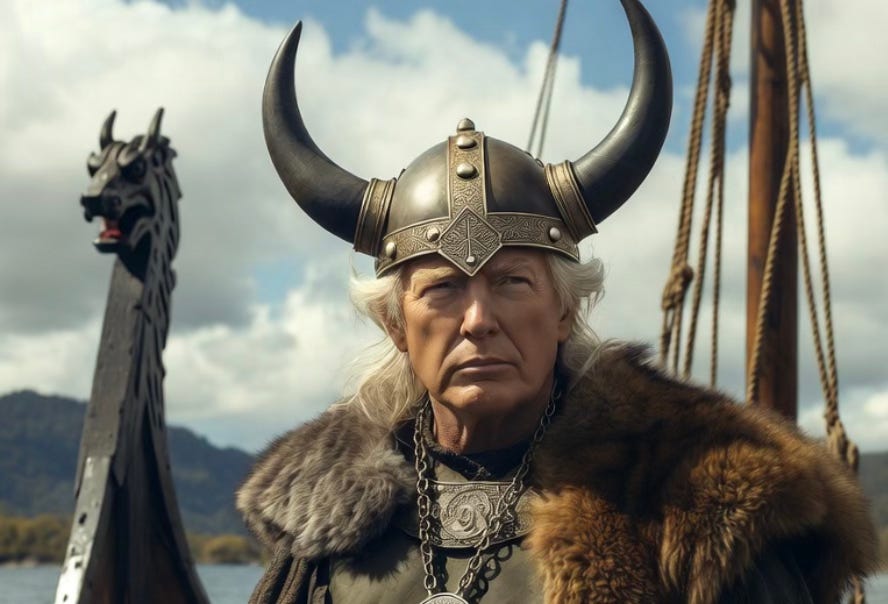
AI-generated image from AndrewSullivan.substack.com
An unstudied impression: Donald Trump is like a shark, in that he must always swim forward or risk suffocation. He, his administration and the media ecosystem that has grown up around Trump’s political persona depends upon action and controversy. In fallow news cycles, Trump steadily loses the initiative and two things happen: First, the media establishment and the leftist activist machine begin gathering their own critical momentum. Second, the vast MAGA-adjacent social media sphere must turn to other controversies to keep the clicks and the ad revenue flowing. Both of these work against the forty-seventh president and his purposes.
Since Trump’s initial barrage of executive orders has subsided, the media cycle has therefore lurched from one moment of hysteria and excitement to the next. Each new controversy totally eclipses the last. Hardly anybody remembers or talks about Nicolás Maduro any longer; the twin Minneapolis ICE shootings and associated protests, too, have faded. What were hailed as pivotal events which would finally discredit Trump’s programme this time look, in retrospect, like passing trivialities – not necessarily because they didn’t matter, but because sustained attention in this crazy messaging environment is impossible.
And on Trump’s pimp-handed dealings with the NATO allies:
Trump and NATO: Much of Trump’s MAGA base remains firmly isolationist and demands that the United States abandon the NATO alliance. Trump himself knows this and he has periodically questioned the utility of NATO. Formally, however, Trump’s administration stands behind the alliance, as anyone can see from reading the 2026 National Defense Strategy and the 2025 National Security Strategy. Yes, Trump wants European countries to increase defence spending. Yes, he still hopes to complete a strategic pivot away from Europe towards China. And yes, in the longer term, he probably nurtures ambitions of reducing the importance of NATO in favour of separate bilateral agreements with various European states. Such arrangements would also provide a lever for present and future administrations to disrupt the various policies and initiatives of the European Union, which Trump clearly despises and which at least as presently constructed amounts to a suicide pact for all of us on the Continent. These populist pressures and future ambitions, together with a general distrust and legitimate scorn for Eurocrat elites, seem to be why NATO periodically fades from Trump’s favour, although never for very long. All of this is to say that I really don’t think Trump’s January bluster was a mere Art-of-the-Deal negotiating tactic, but a reflection of real tensions and contradictions within Trumpism.
Trump and Europe: Here again, we see two competing tendencies. Generally, the Trump administration has followed a sly strategy of pursuing ties with the more or less aligned and presently ascendant populist-right movements of Europe. The Trump administration has also defended our rights to free speech, particularly on social media; relentlessly attacked our insane energy transition; and criticised our elites for their failure (or refusal) to stop mass migration. The purpose of these efforts is to isolate the Eurotards by fertilising the hostile populism that is growing ominously just beneath their double chins. If you are wondering why Trump bothers with this, I refer you to my previous paragraph: Sympathetic governments in key European states, joined to the United States, would be a means of sidelining the European Union and remaking Atlanticism in Trump’s image.
Exactly how to help the populist right into power is a much harder nut to crack. Expressing overt support for parties like Alternative für Deutschland can hurt more than it helps, and the Americans don’t have more direct means of influencing domestic politics over here. At the very least, this a long-term project requiring tactics and strategies we have yet to explore, and probably some institutions we have yet to create.
Update, 11 February: Welcome, Instapundit readers! Have a look around at some of my other posts you may find of interest. I send out a daily summary of posts here through my Substack – https://substack.com/@nicholasrusson that you can subscribe to if you’d like to be informed of new posts in the future.
Heightening tensions in the Indian Ocean
On Substack, Fergus Mason updates us on what’s happening around the UK/US military base on Diego Garcia in the Chagos Islands in the Indian Ocean:

Diego Garcia
One of the great mysteries of Keir Starmer’s government is why he’s so determined to give the Chagos Islands to Mauritius, which is 1,200 miles away and has never owned them. Even now, as he desperately fights for his political survival, Starmer is pushing ahead with plans to give away the strategic archipelago then pay tens of billions of pounds to lease back one of the islands. It’s an odd thing to be so focused on — but whether his compulsion to surrender the islands is driven by corruption or naivete, it’s sending out signals of weakness. And those signals are being noticed.
The Maldives Makes A Grab
Last Thursday the Republic of Maldives announced that it had rejected the UN International Tribunal for the Law of the Sea’s ruling on its maritime boundaries, and sent an armed boat to carry out a “special surveillance operation” in the northern part of the Chagos island’s Exclusive Economic Zone (EEZ). The Chagos EEZ is claimed by Mauritius, but of course actually belongs to Britain until Starmer’s surrender deal is approved by Parliament. However, the Maldivian government has now decided to make its own claim on the area — and it’s very publicly doing something about it. The “coast guard vessel” CGS Dharumavantha — a former Turkish Navy fast attack craft — is now operating in the area, along with drones from the Maldives National Defence Force Air Corps.
Of course, the Maldives has no real claim to the Chagos islands or any part of their waters. The country — a tiny group of islands southwest of Sri Lanka, with a land area of just 115 square miles — was a British crown colony from 1796 to 1953, and a British protectorate until 1965. Like Mauritius, it has never owned the Chagos Islands. However, it’s just 300 miles away from them, much closer than Mauritius. It appears that its leader, President Mohamed Muizzi, has decided that if the key British territory is up for grabs the Maldives should be the ones to grab it. It’s true the Maldives doesn’t have much of a navy, but then Mauritius doesn’t have much of a navy either and is a lot further away. If the Maldives can seize control over part of the extremely valuable Chagos Marine Protected Area (MPA), and even possibly some of the northern islands, there isn’t a lot Mauritius can do about it.
Why would the Maldives be so keen to seize part of the Chagos EEZ? That one’s simple. Under British protection, the Chagos MPA (which is the largest marine nature reserve in the entire world) has been officially off limits to commercial fishing since 2010 but, in practice, has barely been fished at all since 1968. This makes it a unique and potentially lucrative resource in the Indian Ocean region, which has seen its ecosystems devastated by destructive fishing methods. The wealth of the MPA is the main reason Mauritius wants the Chagos islands. Its own coastal waters have been blighted by overfishing, including the destruction of coral reefs by explosives and bleach injection, and now it wants to plunder the MPA. The Maldives is also busily engaged in destroying its own fish stocks (fishing is the country’s largest industry and employs half the population) and is desperate for new waters to pillage. They don’t just want access for their own boats, either. Like Mauritius, the Maldives under Muizzi’s rule is an increasingly close ally of China.
The Scourge Of The Seas
China has the world’s largest fishing fleet, and it’s not even close. Over 44% of all commercial fishing is carried out by Chinese boats — and they’re notorious for flouting international law. Chinese boats regularly change their names and disable their satellite tracking systems to conceal their identity, then fish illegally in other countries’ waters. They violate quotas, catch protected species and strip whole swathes of ocean clean of any life much larger than plankton with massive, indiscriminate drift nets. Chinese fishing boats have also been implicated in people trafficking, drug smuggling and acting as spying and covert action platforms for the Chinese navy.
If either Mauritius or the Maldives gain control of the Chagos MPA it’s a certainty they will immediately give Chinese boats access, and this priceless nature reserve will rapidly be trawled and drift-netted into a barren, lifeless wasteland. From China’s point of view, of course, it doesn’t matter which of their lackeys takes over the Chagos islands as long as one of them does, so don’t expect them to step in to help Mauritius. They don’t care who they get the fishing rights from.
Comments Off on Heightening tensions in the Indian Ocean
FAMAS G1: Simplified for Export
Forgotten Weapons
Published 17 Sept 2025The FAMAS G1 was developed as a lower-cost option for FAMAS export sales. The original F1 model had been offered for international sale, but it attracted little interest largely because of its high price. In response, GIAT created the G1 with many of the extra features left optional. This allowed them to reduce the price by up to 40%. Specific feature reductions included:
- Omitting the bipod legs
- Omitting the grenade launching sights and barrel fittings
- Omitting the night sights
- Omitting the burst fire mechanism
- Replacing the trigger guard with a molded whole-hand trigger guard
The mechanism stayed the same, and all of the omitted features could be included as options. This still failed to generate any export sales, in part because GIAT came under ownership of FN, and FN’s competing assault rifle options were more profitable than the FAMAS.
The G1 did contribute elements like the whole-hand trigger guard to the mid-1990s G2 model adopted by the French Navy, however.
(more…)
Comments Off on FAMAS G1: Simplified for Export
QotD: The (historical) walls of Jericho
These strategic (and operational) considerations dictate some of the tactical realities of most sieges. The attacker’s army is generally going to be larger and stronger, typically a lot larger and stronger, because if the two sides were anywhere near parity with each other the defender would risk a battle rather than submit to a siege. Thus the main problem the attacker faces is access: if the attacker can get into the settlement, that will typically be sufficient to ensure victory.
The problem standing between that attacking army and access was, of course, walls (though as we will see, walls rarely stand alone as part of a defensive system). Even very early Neolithic settlements often show concerns for defense and signs of fortification. The oldest set of city walls belong to one of the oldest excavated cities (which should tell us how short the interval between the development of large population centers and the need to fortify those population centers was), Jericho in the West Bank. The site was inhabited beginning around 10,000 BC and the initial phase of construction on what appears to be a city wall reinforced with a defensive tower was c. 8000 BC. It is striking just how substantial the fortifications are, given how early they were constructed: initially the wall was a 3.6m stone perimeter wall, supported by a 8.5m tall tower, all in stone. That setup was eventually reinforced with a defensive ditch dug 2.7m deep and 8.2m wide cutting through the bedrock (that is a ditch even Roel Konijnendijk could be proud of!), by which point the main wall was enhanced to be some 1.5-2m thick and anywhere from 3.7-5.2m high. That is a serious wall and unlikely the first defensive system protecting the site; chances are there were older fortifications, perhaps in perishable materials, which do not survive. Simply put, no one starts by building a 4m by 2m stone wall reinforced by a massive stone tower and a huge ditch through the bedrock; clearly city walls [were] something people had already been thinking about for some time.
I want to stress just how deep into the past a site like Jericho is. At 8000 BC, Jericho’s wall and tower pre-date the earliest writing anywhere (the Kish tablet, c. 3200 BC) by c. 4,800 years. The tower of Jericho was more ancient to the Great Pyramid of Giza (c. 2600 BC), than the Great Pyramid is to us. In short, the problem of walled cities – and taking walled cities – was a very old problem, one which predated writing by thousands of years. By the time the arrival of writing allows us to see even a little more clearly, Egypt, Mesopotamia and the Levant are already filled with walled cities, often with stunningly impressive stone or brick walls. Gilgamesh (r. 2900-2700 BC) brags about the walls of Uruk in the Epic of Gilgamesh (composed c. 2100) as enclosing more than three square miles and being made of superior baked bricks (rather than inferior mudbrick); there is evidence to suggest, by the by, that the historical Gilgamesh (or Bilgames) did build Uruk’s walls and that they would have lived up to the poem’s billing. Meanwhile, in Egypt, we have artwork like the Towns Palette, which appears to commemorate the successful sieges of a number of walled towns
So a would-be agrarian conqueror in Egypt, Mesopotamia or the Levant, from well before the Bronze Age would have already had to contest with the problem of how to seize fortified towns. Of course depictions like these make it difficult to reconstruct siege tactics (the animals on the Towns Palette likely represent armies, rather than a strategy of “use a giant bird as a siege weapon”), so we’re going to jump ahead to the (Neo)Assyrian Empire (911-609 BC; note that we are jumping ahead thousands of years).
Bret Devereaux, “Collections: Fortification, Part I: The Besieger’s Playbook”, A Collection of Unmitigated Pedantry, 2021-10-29.
Comments Off on QotD: The (historical) walls of Jericho
February 9, 2026
The origins of the First Special Service Force (the “Devil’s Brigade”)
Project ’44 has a nice introduction to the formation and organization of the joint US-Canadian First Special Service Force during the Second World War. The unit was featured in the 1968 movie The Devil’s Brigade, although many liberties were taken in the film’s portrayal of events:

Sgt. Pat O’Neill (Jeremy Slate) in the messhall scene in The Devil’s Brigade (1968).
In August 1942, a unit unlike any other in Canadian military history was formed. Today it is widely known by its nickname, the “Devil’s Brigade”, but officially it was designated the First Special Service Force (FSSF).
This unique formation was a joint Canadian–American unit born from the unconventional ideas of British scientist Geoffrey Pyke. Pyke envisioned a small, elite force operating deep behind German lines in occupied Norway, spreading disruption and chaos. Although this original concept was judged impractical, the decision was made to create the unit regardless.
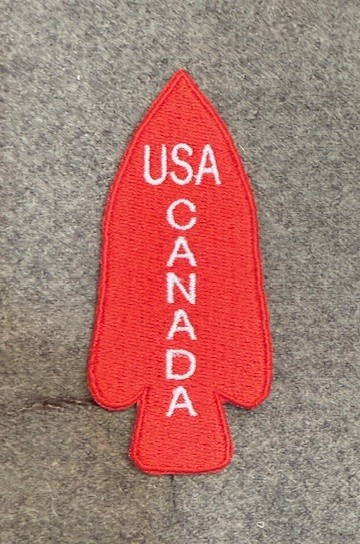
FSSF patch from Project ’44
The combat element of the Force was composed of roughly equal numbers of Canadians and Americans, while the supporting echelon units were entirely American. Most Canadian subaltern officers were recruited almost directly from the Officer Training Centre in Brockville, and the majority of the Other Ranks were drawn from units across Canada. Some personnel were even selected directly from the 1st Canadian Parachute Battalion, much to the frustration of that unit’s chain of command.
The Force was commanded throughout its existence by American Lieutenant Colonel Robert Frederick. The initial Canadian second-in-command, Lieutenant Colonel McQueen, was injured during parachute training and broke his ankle. Because of the limited time available for training, he was returned to his original unit and replaced by Canadian Lieutenant Colonel Williamson.
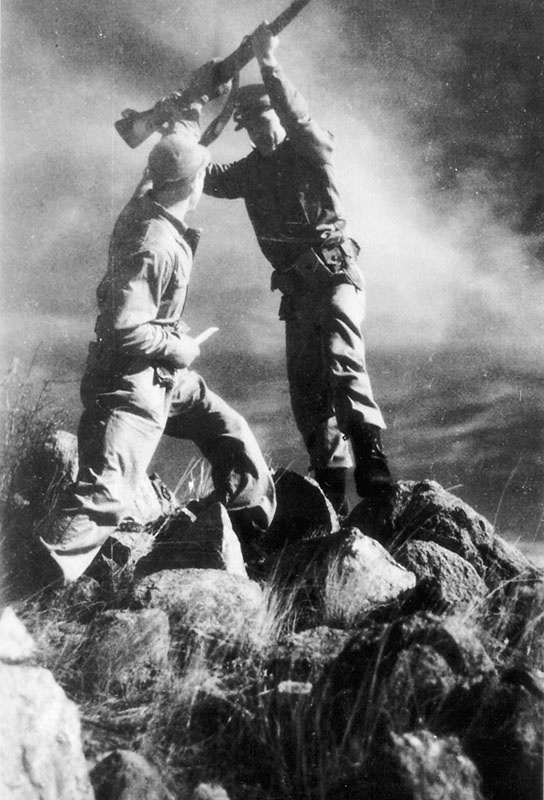
Orval Logan and Stuart Diamond demonstrate hand-to-hand combat
Photo by Paul Moore from Project ’44Williamson served both as second-in-command of the FSSF and as Commanding Officer of the 2nd Canadian Parachute Battalion. This designation served as the administrative cover name for the Canadian component of the Force and was later changed to the 1st Canadian Special Service Battalion. This was not a tactical formation in the field, but rather an administrative structure created to manage Canadian personnel within the joint unit.
As a combined Canadian–American formation, personnel from both nations were distributed evenly throughout the Force. While its overall role and employment resembled that of a brigade, its internal organization followed American regimental doctrine. The Force consisted of three regiments. Whereas a standard American infantry regiment normally contained three battalions and approximately 3,000 soldiers, each regiment within the FSSF comprised only 32 officers and 385 Other Ranks, for a total authorized strength of 412 personnel.
Keeping Up with the Pattons
The Tank Museum
Published 10 Oct 2025M46, M47, M48 and M60. They saw action in Korea, Vietnam, The Gulf and held the line in the Cold War. For almost 40 years the US produced a succession of good tanks — but they never seemed to be good enough for the top brass.
Time after time, designers sought a perfection that seemed to lay out of reach until the arrival of the step-changing M1 Abrams.
Up till then, you have what can be called “The Patton” family: a series of closely related tanks that are only intended to be temporary until the next big thing arrived …
This is the story of the “Patton” family of tanks; tanks that the US tried and failed to replace time after time, yet which despite this ended up becoming the armoured backbone of the Free World during the Cold War.
In this film, Tank Museum Historian, James Donaldson, walks us through the progression of US tanks from the M26 Pershing right up to the M1 Abrams. Commonly known as The Patton Family, this group of tanks were good… but never quite good enough. Always meant to be a stopgap, the Pattons persisted where their prospective replacements failed, leading them to become the vehicles that endured the Cold War around the globe.
00:00 | Introduction
00:58 | From Pershing to Patton
03:50 | Replacing the M46
06:25 | A Third Patton
10:01 | Yet Another Stopgap
12:44 | Irreplaceable?
(more…)
Comments Off on Keeping Up with the Pattons
February 8, 2026
WW1: The Eastern Front in 1914 | EP 5
The Rest Is History
Published 8 Sept 2025While the Western front was raging following the outbreak of the First World War in 1914, what was unfolding on the Eastern Front? Why was it an even bloodier and more brutal arena than the West? As Austria took on its great antagonist — the spark of the entire war — Serbia, why were its early campaigns constantly blighted by disaster? What terrible mistake did Russia, with its behemoth of an army, make? How would its dramatic war with Germany unfold? And, would this be the beginning of the end of the Habsburg Empire?
Join Dominic and Tom as they discuss the outbreak of the First World War on the Eastern Front, and its early clashes.
—————————————————
0:00 Adobe AD
0:50 Intro
3:27 The Eastern Front explained
5:15 The Serbian Front
33:23 Uber AD
34:02 Folio Society AD
35:33 Russia invades Germany
(more…)
Comments Off on WW1: The Eastern Front in 1914 | EP 5
February 7, 2026
S.R.E.M.: Britain’s Experimental WW2 Bullpup Sniper
Forgotten Weapons
Published 15 Sept 2025The Sniper Rifle Experimental Model (S.R.E.M.) was designed by the “Czech Section” of small arms designers who had taken refuge in the UK to escape German occupation of Czechoslovakia. The intention was to develop a scoped sniper rifle that could be fired and cycled without disturbing the shooter’s sight picture. The idea that the designers came up with was to use the pistol grip as a moving charging handle, similar to the Czech BESA machine gun already in British service.
In 1944, the Essex Engineering Works in the UK got a contract to make 22 sample S.R.E.M.s, although only 2 were actually made. Really, the whole concept was a bit of a red herring, as the recoil from 8mm Mauser (this was made in 8mm, expected the post-war the UK would be adopting it or another modern rimless round to replace the .303) would disturb the sight picture regardless of the mechanism used to cycle the action. The project was cancelled in 1945, and this example is the only known survivor today.
(more…)
Comments Off on S.R.E.M.: Britain’s Experimental WW2 Bullpup Sniper
February 6, 2026
Dresden Part 2 – Firestorm Dresden: Three Days In Hell!
HardThrasher
Published 5 Feb 2026In “Firestorm Dresden: 3 Days in Hell”*, we’ll unpack the bombing and subsequent firestorm in February 1945. We’ll look at how first the RAF night raids and then the US 8th Air Force daylight attacks unfolded, the damage they did and the horrific impact on the ground. We’ll look at how the aftermath shaped the myths and understanding surrounding the raid, and the fate of Arthur Harris and those who’d planned the raid.
* Proof once more, as if it were needed, how shit AI is — I have, apparently, to put the title of the video into the first words in the description to attract Google’s attention … I am so sorry to brutalise the English language like this.
[NR: Part one was posted here on January 22nd, should you want to watch it first.]
00:00 – 02:22 – Opening
02:26 – 06:20 – The weather
06:20 – 16:12 – The attack
16:18 – 25:17 – Horror on the ground
25:22 – 29:26 – USAAF Attacks
29:30 – 34:30 – Dealing with the bodies
34:34 – 44:59 – Reaction in the west
45:03 – 48:06 – The Soviet view
48:10 – 54:27 – Summing up and close
(more…)
Comments Off on Dresden Part 2 – Firestorm Dresden: Three Days In Hell!
February 5, 2026
On The Line with Vice-Admiral Angus Topshee, commander of the Royal Canadian Navy
The Line
Published 3 February, 2025Today on On The Line, Matt Gurney is joined by Vice-Admiral Angus Topshee, commander of the Royal Canadian Navy, for an extended, wide-ranging conversation recorded in the library of the Royal Canadian Military Institute in downtown Toronto. The discussion ranges across geopolitics, the state of the world, the state of Canada’s navy, what’s going right for the fleet, and what still needs to improve.
First, a correction from your host. During the conversation, Matt incorrectly stated at several points that Canada intends to procure 15 new submarines. Admiral Topshee was too kind to interrupt him during the recording, but the correct number is 12. That mistake was entirely Matt’s, and he regrets the error.
With that out of the way, the conversation spans the globe. Admiral Topshee discusses what’s happening in Europe with Russia and Ukraine, and in the Pacific, where growing Chinese power and influence is challenging long-held assumptions about global security. There’s also extensive discussion of the Arctic, why it matters, and what is changing there. Procurement comes up as well — shipyards, new ships for the fleet, and what it will actually cost to deliver on plans that now enjoy broad political support.
They also spend time on what Canada itself needs to sustain a much larger navy and armed forces. Do we have enough bases? Enough reservists? Are people being enrolled into the navy quickly enough? And how, realistically, could Canada expand its forces rapidly in a time of war?
It’s a long, free-ranging conversation about geopolitics, the evolution of warfare, and the future of the Royal Canadian Navy. Check it out today on On The Line. And special thanks to the Royal Canadian Military Institute for hosting this recording of the podcast. For more like this, visit ReadTheLine.ca, and as always, like and subscribe.
0:00 Intro
0:26 Vice-Admiral Angus Topshee
54:16 Outro#OnTheLine #RoyalCanadianNavy #AngusTopshee #CanadianForces #Geopolitics #ArcticSecurity #NavalPower #CanadaDefence #MattGurney
Comments Off on On The Line with Vice-Admiral Angus Topshee, commander of the Royal Canadian Navy
February 4, 2026
The Korean War Week 85: Futilely Pounding North Korea? – February 3, 1952
The Korean War by Indy Neidell
Published 3 Feb 2026The UN forces are by now having trouble just keeping their planes in the skies, thanks to shortages of spare parts, so for long can they maintain aerial supremacy over Korea? And though the aerial campaign to destroy North Korean infrastructure has been stepped up, so too has the enemy’s ability to quickly rebuild. And at the armistice talks, the big issue this week is which countries will form inspection teams after an armistice, and who might be out of the question. The Soviets?
00:00 Intro
01:06 Recap
01:30 The POW Lists
07:12 The Soviets
10:25 Communist Manpower
12:01 Air Force Supply Issues
13:21 Summary
13:34 Conclusion
14:17 Call to Action
(more…)
Comments Off on The Korean War Week 85: Futilely Pounding North Korea? – February 3, 1952
French Trials FN CAL: Adding Rifle Grenade Capability
Forgotten Weapons
Published 10 Sept 2025In the 1970s when the French Army was looking for a new rifle 5.56mm, they tested a number of foreign rifles alongside development the FAMAS at St Etienne. These included the HK33, the M16, and the FN CAL — and today we are looking at the FN CAL. It already had a four-position selector switch (safe/semi/full/burst), fulfilling one of the French Army requirements. But it did not have sufficient grenade launching capability, and so several examples were modified for trials with unique rifle grenade launching hardware.
Ultimately the HK33 was the best performing rifle, but it was not seen as a politically acceptable option and the FAMAS was chosen instead. I have not seen the trials reports to understand specifically why the FN CAL was unsuccessful, but we know that it was unsuccessful in many other trials, and FN dropped it for the distinct FNC design instead before long.
Full FN CAL teardown: • FN CAL: Short-Lived Predecessor to the FNC
HK33F Video: • Roller Delay in France: The H&K 33F (Trial…Many thanks to the IRCGN (Institut de Recherche Criminelle de la Gendarmerie Nationale) for allowing me access to film these trials prototypes for you!
(more…)
Comments Off on French Trials FN CAL: Adding Rifle Grenade Capability
February 2, 2026
The Biggest Naval Battle in History: Leyte Gulf 1944
Real Time History
Published 5 Sept 2025In Fall 1944, Japan is set on stopping the US from re-capturing the Philippines, a vital trade route between the Japanese home islands and the resource-rich occupied territories to the south. With a complex plan they want to strike the US Navy as it’s landing on Leyte island. The resulting series of battles is today known as the Battle of Leyte Gulf, the biggest naval battle in history.
(more…)
Comments Off on The Biggest Naval Battle in History: Leyte Gulf 1944


