
The Rest Is History
Published 4 Sept 2025What happened at the crucial, bloody, Battle of Ypres in October 1914? How did the battle come about? Why did the Germans and the British fight each other so brutally and for so long to take Ypres? What made the fighting so particularly violent? How were the British able to repel the relentless German onslaught time after time? What was the famous “Kindermord” — “the Massacre of the Innocents” — in the German army, and how true was it? And, what would be the outcome of this almighty clash?
Join Dominic and Tom as they discuss the terrible Battle of Ypres; its significance to the First World War overall, and its consequences for the rise of Hitler in Germany later on….
0:00 – Adobe Express AD
0:49 – Intro: To the Front
3:26 – The Kindermord Myth
5:02 – Race to Ypres
11:04 – The Ypres Salient
17:07 – Crisis at Gheluvelt
23:29 – Uber & Folio Society ADs
25:43 – November Slaughter
32:05 – The Langemark Legend
44:02 – Why the War Didn’t Stop
(more…)
January 31, 2026
WW1: Hell in the Trenches | EP 4
January 30, 2026
Japanese Last-Ditch Pole Spear Bayonet
Forgotten Weapons
Published 8 Sept 2025Japanese bayonets followed the same trend of simplification as Arisaka rifles towards the end of World War Two, culminating in what is today called the “pole bayonet”. Abandoning even the fittings to mount to a rifle, these bayonets were intended to be lashed to a pole to create a spear. The Japanese government did not have the military forces to repulse an American invasion of the home islands, and was actively planning to sacrifice millions of Japanese civilians in a hopeless defense, literally having them charge American machine guns with spears. Some of this was done on outer island battles, like Saipan and Okinawa but the scale in Japan itself would have been unimaginable. It was the nuclear bombs on Hiroshima and Nagasaki that led to a Japanese surrender and prevented this from becoming a reality.
(more…)
January 29, 2026
QotD: Nitpicking the Roman army in Gladiator (2000)
We pick up in an improbably mud-soaked clearing with a title card informing us that we’re in “Germania”, which is correct in a very broad sense that this is the Second Marcomannic War and the enemies here are the Marcomanni and Quadi, who are Germani (Germanic-language speakers), but the army here isn’t operating out of the Roman provinces of Germania (superior and inferior) which are on the Rhine, but rather on the Danube, from the provinces of Noricum and Pannonia (Superior). But in the sense that we’re in Germania magna, the greater zone of Germanic cultural influence, sure, fine.
In the process of Maximus riding up, the failure of negotiations and Maximus riding to join his cavalry, we get something of an overview of the Roman army and its position and both are wrong. Let’s start with the soldiers: we see a very clear distinction between two kinds of soldiers, the mail-clad auxilia, all archers, and the legionaries wearing the lorica segmentata and there appear to be about the same number of both groups. And here is where we first see the clear influence of the Column of Trajan (and to an unfortunately lesser degree, the far more appropriate Column of Marcus Aurelius) on the depiction, because this use of armor to distinctly signal the Roman citizen legionaries and non-citizen auxilia is straight from the Column of Trajan, completed probably around 113 and commemorating Trajan’s two Dacian Wars (101-102, 105-106).
What this sequence gets correct is that the Roman army was divided into those two groups, they were roughly equal in number (by this period, the auxilia probably modestly outnumber the legions in total manpower)1 and Trajan’s Column does use that visual signifier to distinguish them. This component is the crux of the verisimilitude that leads people to trust the rest of this sequence.
The problems start almost immediately from there. Roman auxilia were far more varied than what we see here in terms of equipment and tactics and only very few of them were archers. So let’s break down Roman auxiliary contingents. With all due caveats about the limits of our evidence, infantry auxilia outnumber cavalry by about 2:1 in attested auxilia units (auxilia were grouped into cavalry alae and infantry cohortes, generally of 480 men (sometimes around 800), but unlike for legionary citizen-infantry, these cohorts were not grouped into larger legions).2 So we ought to expect about a third of our auxilia to be cavalry, which is important because the cavalry detachments of Roman legions were very small (and mostly for scouting and messenger duties). Auxilia cavalry ranged in equipment and could include horse archers and even ultra-heavy cataphract cavalry, but most were mailed shock cavalry, equipped quite a lot like how Gallic or Germanic warrior-aristocrats or Roman legionary cavalry would be.
Of the remainder, the most common kind of infantry auxilia by far seem to have been heavy infantry, fighting in fairly heavy armor. These fellows get depicted in Roman artwork generally in mail armor, with flat oval shields (as opposed to the curved, rectangular imperial-period Roman scutum), spears and swords. These fellows, totally absent in this sequence are all over the Column of Trajan, with their flat oval shields being frequently seen (although one must distinguish them from Dacians who carry the same shield; the auxilia stick out for their mail and helmets). A bit less than 10% of auxilia units are attested as cohortes sagittariorum (“cohort of archers”). We also know the Romans used slingers within the auxilia, but as far as we can tell, not in specialized units; they may have been brigaded in with other auxilia cohorts. In either case, they appear in fairly small numbers. Finally, we also see on things like the Column of Trajan Roman allied or auxiliary units that are substantially lighter infantry: on the Column of Trajan, these are local troops shown wielding large clubs and stripped to the waist, presumably representing troops local to the Danube region, fighting in local (unarmored, with heavy two-handed weapons) style.
So whereas the army we see is a nearly even split between legionary heavy infantry and auxilia archers (with a small amount of legionary cavalry waiting for Maximus to show up to lead them), in practice a typical Roman field army would have far fewer archers, indeed around ten times fewer: not almost 50% of the force, but in fact probably a bit less than 5% of the force (since they’re less than 10% of the auxilia who would make up around half of a Roman field army). Meanwhile we’re simply missing the – by far – two most common sorts of auxilia cohorts, those of heavy infantry or heavy cavalry. This mangling of the structure of a Roman army is going to have implications when we get to Maximus’ overall plan for the battle as well.
Meanwhile, the legionary infantry are also much too uniform, literally. This is easily the most pardonable error, because what has happened here is that director Ridley Scott has copied the Column of Trajan but far too uncritically. After all, the Column of Trajan is not a photograph and thus has space for the artists producing it to take liberties, particularly in the name of imperial ideology and propaganda. In this case, showing large numbers of identically equipped soldiers, often moving in unified formation, serves the same rhetorical purpose in antiquity as it does today, suggesting an impressive, inhumanly uniformed and disciplined source. Moreover, the segmented Roman body armor, which we call the lorica segmentata (we don’t know what the Romans called it), was very distinctive to the legions, as it was the one armor that it seems like the auxilia probably (the evidence here can be tricky) didn’t share. And keeping the legions distinct from the auxilia also matters, as the legionary soldiers are higher status citizens who thus get “higher billing” in the imagery, as it were, than the auxilia. So showing all of the legions equipped neatly with this armor makes them seem distinct, impressive and uniform.
In short, it served Trajan’s image (and thus the artists aim) to suggest that all of his legions wore this armor.
Archaeology tells us quite clearly it was not so. Indeed, the lorica segmentata, so iconic because of its use in this way on the Column of Trajan, was probably the least common of the three major types of Roman legionary body armor in this period. The most common armor of the Roman legions was almost certainly still – as it had been in the Late Republic – mail, exactly the same as we see the auxilia wearing. We find fragments of Roman mail in legionary sites in all corners of the Empire and it remained common everywhere. To head off a standard question: no, it does not seem that the Romans ever got the idea to layer other defenses over mail, so when it was worn, it was the “primary” armor (worn over a padded textile defense called a subarmalis, but not under any other armor).3 We also see mail represented in Roman artwork, including on very high status soldiers, like senior centurions.
The next most common armor was probably scale armor, which we find very frequently in the East (that is, on the frontier with the Parthians/Sassanids) and often enough (if less frequently) in the West (that is, the Rhine/Danube frontier). We also know that some auxilia units wore this armor too and we see quite a bit of scale armor – wholly absent in this sequence – on the Column of – wait for it – Marcus Aurelius (completed c. 193). That’s the column that commemorates this war. Contemporary with this fictional battle. But it is less famous and somewhat less well-preserved than 70-years-earlier Column of Trajan, which they pretty evidently used quite a bit more of.
The lorica segmentata shows up the least often and – to my knowledge – effectively exclusively in the west on the Rhine/Danube frontier, where it is still probably not the most common (although it may have been more common than scale on that frontier). So what we ought to see in this army are legionaries who are marked out by their large scuta (the big Roman shield, by this period distinctly rectangular and also (as in the republic) curved), but in a range of mail, scale and lorica segmentata (with mail and segmentata being the most common, because we are on the Danube frontier, but scale hardly rare), along with auxilia divided into specialist cohorts (480 man units) each with different sets of armor and weapons: a few missile cohorts (archers, slingers), a lot more heavy infantry cohorts with spears and long shields, some lighter troops, and so on. The auxilia ought to be wearing basically every armor under the sun except for the lorica segmentata (which to my knowledge we’ve only ever found in sites associated with the legions).
Finally, these units are backed up by a whole load of catapults. We see two kinds, dual-arm arrow-throwing machines (which most folks would casually call ballistae) and single-armed pot-throwing machines (which most folks would casually call catapults), all of them in stationary mounts. Now on the one hand, “the Romans use lots of torsion-based catapults as artillery” is a true statement about the Roman army of this period, but on the other hand once again beyond that basic idea, most of this is wrong. Once again there’s an issue of verisimilitude here: the appearance of strange catapults and the true fact that the Romans used a lot of unusual catapults is likely to lead the viewer to assume some research has been done here and thus that these are the right catapults. For the most part, they are not.
We can start with the easy one, the larger single-armed pot-throwers. These are onagers, a late-Roman simplified single-arm torsion catapult, named for their fearsome “kick” (like an ass, an onager). These are popular favorites for Roman artillery, for instance showing up in both Rome: Total War and Total War: Rome II (both of which have main campaigns set during the Late Republic). There’s only one problem, which is that Gladiator (much less the even earlier Total War games) is set substantially too early for an onager to appear. Our first attestation of the onager is in Ammianus Marcellinus, writing in the last two decades of the 300s AD about the events of 353-378 (his work was broader than this, but only the back end survives). Vegetius, writing roughly contemporary with Ammianus also mentions them. But before the late fourth century, we don’t have any evidence for this design and it doesn’t show up on the Columns of Trajan or Marcus. So this isn’t just a little bit too early for these catapults but, given the evidence we have, around 150 years too early, the equivalent of having a line of M1 Abrams show up in a film about the Battle of Gettysburg.
What we do have are a number of twin-armed bolt or arrow-throwing machines and the Romans certainly had those, though what we see doesn’t match up well with what the Romans used. What we see is a single size of fairly large arrow-throwing engines, aimed upward to fire in fairly high arcs and built with large metal cases containing the torsion springs (generally made of hair or sinew, tightly coiled up; it is the coiling of these springs which stores the energy of the machine).
These two-armed torsion catapults came in a wide range of sizes and could be designed to throw either arrows/bolts or stones (the latter carved into spheres of rather precise caliber for specific machines). And we ought to see a pretty wide range of sizes here, from massive one-talent engines, which threw a 1 talent (26kg) stone and stood about three times the height of a man, to much smaller anti-personnel weapons (scorpiones) that were more like a “crew served” weapon than a large artillery piece. By Trajan’s time, the Romans had even taken to mounting these smaller crew-served engines on mule-drawn carts (called carroballistae) to allow them to be rapidly repositioned, something like early modern “horse artillery” (they were not meant to fire on the move; when we see them on Trajan’s Column, at least one of the operators is usually standing on the ground outside of the cart to winch the machine). These smaller machines, which would have made up the bulk of those deployed in a field battle, seem mostly absent in the sequence.
The result of all of this is that the Roman army presented in the opening moments of Gladiator manages to strike a remarkably unhappy balance: having just enough of the appearance of accuracy to decisively influence two decades of subsequent depictions of the Roman army without actually being particularly correct about anything beyond a very surface level. But subsequent pop-culture (again, I think Rome: Total War played a significant role here) would codify this vision of the Roman army – fire-throwing onagers, lots of auxilia archers, legionary rather than auxiliary cavalry, uniform use of the lorica segmentata – as the dominant model for quite some time.
But the army isn’t the only thing that’s wrong.
Bret Devereaux, “Collections: Nitpicking Gladiator’s Iconic Opening Battle, Part I”, A Collection of Unmitigated Pedantry, 2025-06-06.
- See figures in P. Holder, Auxiliary Deployment in the Reign of Hadrian (2003).
- There’s some complexity here because some infantry auxilia cohorts had small attached cavalry contingents too.
- I suppose I should note that is an odd exception for a type of very fine armor sometimes called lorica plumata (“feathered armor”) by modern writers where metal scales were mounted on mail armor (typically with extremely fine, small rings), rather than on a textile backing. This armor type seems to have been rare and must have been very expensive.
January 28, 2026
The Korean War Week 84: Inside Truman’s Diary – January 27, 1952
The Korean War by Indy Neidell
Published 27 Jan 2026Things heat up in the Panmunjom Peace Talks, which each side arguing that the other side’s proposals violate the Geneva Convention, but by the end of the week they talks are in recess. Naval aircraft pound the North Korean infrastructure all week long, though, and US President Harry Truman has a few things to say about the Soviet Union that the world may wish to hear.
00:00 Intro
00:51 Recap
01:29 Repatriation and Parole
05:29 Airfields
07:22 Naval Aircraft Get Busy
10:36 Truman’s Diary
11:42 Summary
(more…)
January 27, 2026
QotD: “Two world wars and one World Cup!”
“Don’t let’s be beastly to the Germans,” Noël Coward had jeered in 1943. “It was just those nasty Nazis who persuaded them to fight.” It hadn’t been true then, of course, and the wartime generation still hadn’t quite forgiven the Germans, not only for their crimes against humanity, but for bouncing back faster than the British in the 1950s.
Erhard’s “economic miracle” had rubbed salt in the wounds of a nation that had sacrificed its status as a great power in order to save Europe. And now that same Europe had cold-shouldered the British, excluding us not once but twice from their new “economic community”. In the 1960s and 70s it was often the British, not the Germans, who felt despised and rejected. After 1966, Germanophobic football fans would chant “Two world wars and one World Cup”, but that was mere bravado. Everyone knew that the boot was now firmly on the other foot — and in many British eyes, it was a jackboot.
Daniel Johnson, “How I discovered Germany”, The Critic, 2020-08-02.
January 26, 2026
The 2026 US National Defence Strategy
Noah looks at the recently released American National Defence Strategy and identifies areas of interest (or concern) for Canada (edited for typos):
The 2026 National Defense Strategy is out, and with it we get a few references to Canada. While our mention is little, and when there is it is fairly mundane, there is a message. You either step up or get stepped over. [NR: This has always been true, but administrations in the past have been more coy about it than President Trump … who is the opposite of coy. On the other hand, the Canadian government has been quite blatant about giving mere lip service to shared US-Canadian defence interests and slacking off completely on any serious work to keep the Canadian Armed Forces in a state to be able to do what the government pretends to want.]
This policy was shadowdropped in the middle of the night, so I decided to quickly rush to get just about anything out about it. This isn’t a full analysis, but more a quick rundown with some personal thoughts for those who want the quick go of whats happening.
To start, here are the direct mentions of Canada:
We will engage in good faith with our neighbors, from Canada to our partners in Central and South America, but we will ensure that they respect and do their part to defend our shared interests. And where they do not, we will stand ready to take focused decisive action that concretely advances U.S. interests.
The policy continues:
Canada also has a vital role to play in helping defend North America against other threats, including by strengthening defenses against a missile, and undersea threats. In addition, U.S. partners throughout the Western Hemisphere can do far more to help combat illegal migration as well as to degrade narco-terrorists and prevent U.S. adversaries from controlling or otherwise exercising undue influence over key terrain, especially Greenland, the Gulf of America, and the Panama Canal.
The strategy itself is fairly domestic in focus, with repeated mention of the Western Hemisphere and borders as the key areas for which the United States should focus. It takes a backseat approach to the Indo-Pacific, favoring a collaborative approach to Chinese containment that focuses on “peace through strength”, instead of what the NDS refers to as “confrontation”.
In this regard, it is funny that despite criticisms today from President Trump regarding Canada’s trade deal with China, as well as criticism over an apparent lack of Canadian support for Golden Dome, the NDS further states that “President Trump seeks a stable peace, fair trade, and respectful relations with China.” [NR: I think Noah is being a bit naive here … Trump wants to deal with China as a normal trading partner, but China’s actions in so many ways show that China doesn’t want to reciprocate.]
The strategy further states that “Our goal in doing so is not to dominate China; nor is it to strangle or humiliate them. Rather, our goal is simple: To prevent anyone, including China, from being able to dominate us or our allies.”
On today’s Golden Dome comments, I wanna take note that Canada has been discussing participation fairly openly and trying to figure out in what ways we can align even without full participation. There is no indication the current government is against Golden Dome.
The RCAF has its own IAMD study underway in Canadian Shield. It is already fairly well aligned to what the Americans are doing. People will focus on space-based interceptors and such, but Golden Dome is far more extensive than that. There’s much we align on without joining.
Canada is also undertaking its own extensive modernization of both NORAD and space-related assets, both of which will significantly contribute to Continental Defence in a variety of different ways. That includes OTHR and F-35, yes, but is so much more extensive.
From autonomous vehicles in the Arctic to ground- and space-based optical capabilities, AEW&C aircraft, new satellite constellations for both communication and surveillance, domestic launch investments, and even establishing a VLF communication capability.
There is so much going on that can and will contribute to collective Continental Defence. Much more than I believe anyone truly knows about, even myself. We need to highlight and promote these investments if we want mentalities to change and people to recognize the effort.

January 25, 2026
Germany’s Conquerors of the Skies – Luftwaffe Aces – WW2 Gallery 07
World War Two
Published 24 Jan 2026From the legendary Erich Hartmann to the intense but brief career of Hans-Joachim Marseille, today we dive into the lives of five of Germany’s most elite pilots from World War 2. This is the first gallery episode we’ve done in some time, but there could be more in the pipeline: that all depends on you. If you like this format, let us know in the comments. We’d love to hear what you’ve got to say, and whether you want us to cover Allied and other Axis aces too.
(more…)
Grand Strategy of the Roman Empire – Part ONE, the start of the debate
Adrian Goldsworthy. Historian and Novelist
Published 20 Aug 2025Following on from videos about military planning under the Republic, and about forts and garrisons, today we will begin to look at one of the big debates in the study of the Roman army and the Roman empire — did the Romans plan in a rational and informed way how to secure and defend their empire for the long term future. In short, did the Roman emperors and their advisors have a Grand Strategy which informed their decisions. This time, we will think about how this all started, and in particular Edward N. Luttwak, The Grand Strategy of the Roman Empire (1976), which really kicked off and did much to shape the debate.
January 24, 2026
Potato Digger at War: Marlin Model 1917 Machine Gun
Forgotten Weapons
Published 27 Aug 2025John Browning’s first machine gun design was a gas operated system that used a swinging lever instead of a linear piston. He presented the first prototype to Colt in 1890, and it went into production in 1895. The US Navy bought a couple hundred, but the Army opted not to adopt it (much to Colt’s surprise). It was offered for sale internationally, but didn’t become very popular until World War One broke out.
By this time, Colt had improved it a bit with a finned detachable barrel, and they started getting orders for thousands of the guns from Belgium, Russia, Canada, Britain, and elsewhere. Unable to keep up with demand, they licensed the design to the Marlin company. Marlin made a few additional improvements (pistol grip attachment, sights, and access door for clearing malfunctions) and made several thousand for allied nations as well as 2,500 fort he US Army to use as training guns in 1917. They further improved the design by changing it to a linear gas piston, and sold some 38,000 to the US military for aircraft use.
3D animation of the Colt 1895 mechanism from vbbsmyt: • Browning 1895 ‘Potato digger’
Marlin 7MG Aircraft Gun: • Marlin 7MG aka Model 1917 Aircraft Machine…
(more…)
January 23, 2026
Canadian schizophrenia: “Resist US aggression!” but also “Disarm law-abiding civilians!”
Returning to a topic I’ve been mocking all week on the socials, in The Line, Matt Gurney gently suggests to the Canadian government that it’s just not reasonable to expect Canadian civilians to wage some kind of fierce guerilla war against a feared American invasion while actively disarming Canadians who legally own guns:

A lot has happened, is the thing. A lot is still happening. And it all seems to be happening faster.
But it’s still worth slowing things down just a little bit when the news stories arrive in particularly baffling sequences. Consider just two you may have seen this week: Canada is thinking about fighting an insurgency in case the Americans invade us, and Canada is also working hard to disarm its civilian population. Can I just interject here a moment and suggest that these goals are at odds? That this might be a stupid way of doing things? That the Canadian federal right hand would be shocked and appalled to discover what the left hand was doing?
Let’s take a minute and set up the insurgency thing. It comes from an article published this week in The Globe and Mail. Canadian soldiers are not frantically digging trenches quite yet. The overall consensus is that a U.S. invasion of Canada is unlikely. But clearly, the current trajectory of U.S. geopolitics has shifted the prospect from “batshit crazy” to “it would be weird but we should probably think about it”. So the military is thinking about it — it’s now a contingency being considered, just like the military plans for natural disasters or less bizarre military scenarios, like a war requiring a mobilization or an attack by a terror group or hostile nation on Canadian soil.
And what is the military thinking? Allow me to quote from the Globe:
The two senior government officials said military planners are modelling a U.S. invasion from the south, expecting American forces to overcome Canada’s strategic positions on land and at sea within a week and possibly as quickly as two days.
Canada does not have the number of military personnel or the sophisticated equipment needed to fend off a conventional American attack, they said. So, the military envisions unconventional warfare in which small groups of irregular military or armed civilians would resort to ambushes, sabotage, drone warfare or hit-and-run tactics.
One of the officials said the model includes tactics used by the Afghan mujahedeen in their hit-and-run attacks on Russian soldiers during the 1979-1989 Soviet-Afghan War. These were the same tactics employed by the Taliban in their 20-year war against the U.S. and allied forces that included Canada. Many of the 158 Canadian soldiers killed in Afghanistan from 2001 to 2014 were struck by improvised explosive devices or IEDs.
Mmm. This yogurt is tasty.
Let me say three things here: first, I can confirm some of the Globe‘s reporting via my own sources. I know for a fact that members of the Canadian Armed Forces are talking, in a very conceptual, high-level way, about what an insurgency against an invader could and would look like in Canada. I do not know of any serious plans or preparations. But discussions? Absolutely. Second, the plan above, in very vague terms, is probably about correct, in terms of how the Canadian population could resist an invader. The actual shooting war would be over almost immediately — the U.S.’s military advantage would be overwhelming. I think two days is optimistic, frankly. I’m not sure it would take much more than two hours to smash any meaningful military resistance.
So, longer term insurgency against a larger and more advanced force would be the only real option, and in that kind of fight, we’d have some real advantages. We’d be a tougher nut to crack, in many ways, than either Iraq or Afghanistan.
But only if we don’t hobble ourselves first. And this brings us to the third point I’d like to make: did you notice the part about “armed civilians”? Because I sure did.
Civilians, sometimes augmented by experienced military personnel in technical and leadership roles, are always the backbone of an insurgency. They have to be. Insurgencies are hit-and-run affairs, and you can’t do that if you’re driving a tank back to a base. In order to be effective, the population must be armed, or somehow have the means to arm itself. Not to be cute, but the resistance being armed is a necessary precondition for a successful armed resistance.
And we are disarming ourselves.
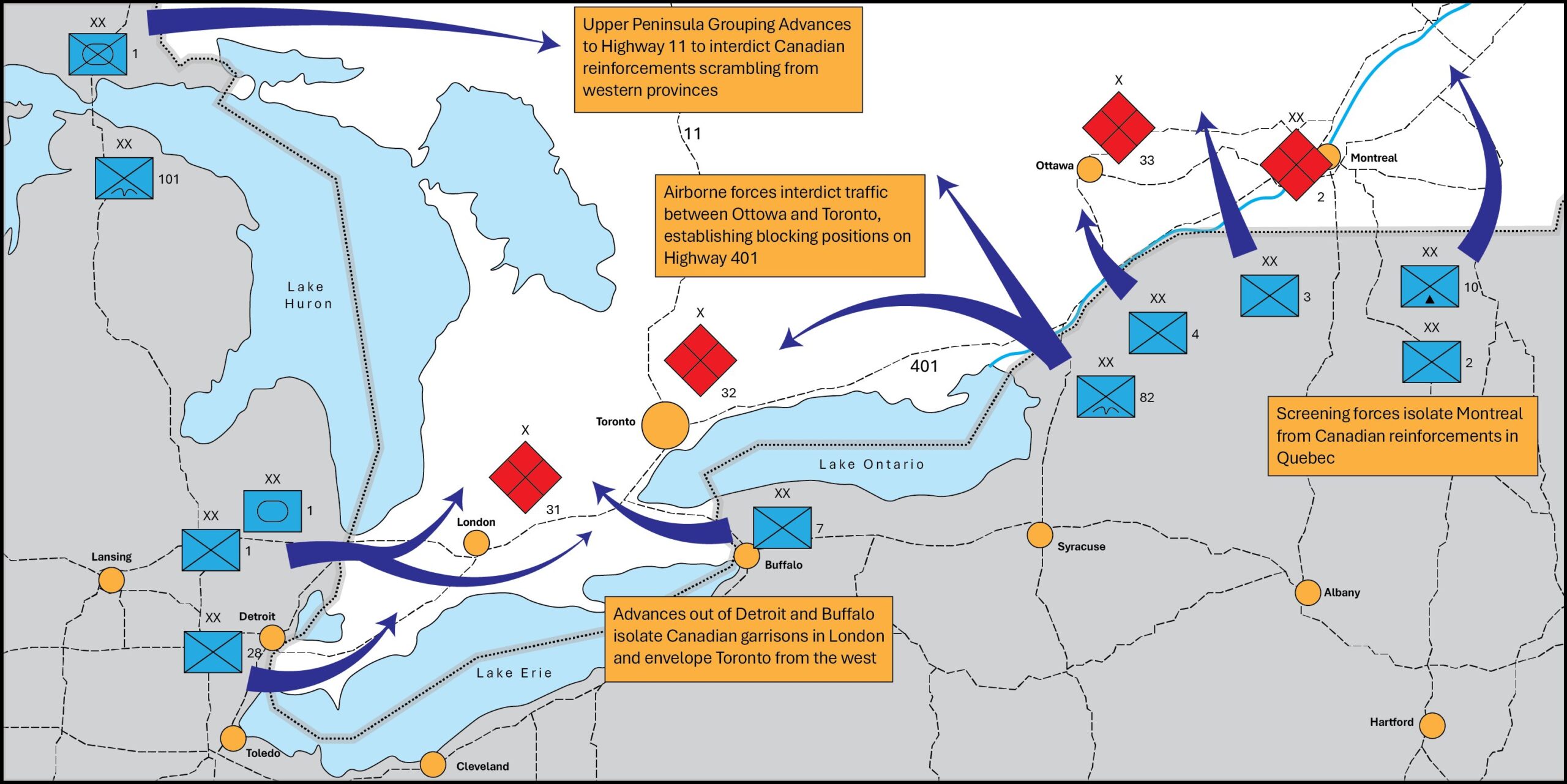
For the record, Canada and the US have historically had plans to defend against one another even at times we’ve otherwise been very peaceful and friendly. About a year ago, Big Serge suggested updates to the old US “War Plan Red” scenario invasion of Canada:
The country’s political and economic center of gravity is the urban corridor from Toronto to Montreal, but a significant share of the Canadian Army is dispersed, with large garrisons in Quebec, Halifax, and the western provinces. Only handful of brigades are garrisoned in the critical theater.
Manifest Destiny, 2025? Big Serge’s updated map for the old US War Plan Red for a military invasion of Canada.
The war will be won quickly and decisively, without massive destruction of Canadian cities, if American forces can establish blocking positions to isolate the urban corridor from peripheral Canadian garrisons. In this maneuver scheme, we utilize highly mobile elements including 1st Cavalry Division and airborne forces to block the highways into Toronto, while an eastern screening group isolates the urban centers from reinforcements scrambling in from Quebec.
Proving my near-Nostradamus-level ability to foresee the future, I remarked that “As to why Trump would want to invade a frozen failed state on the brink of bankruptcy, even Big Serge doesn’t have an answer”. Now, of course, the biggest risk to US security would come from Canadian “snowbirds” in Florida, Texas, and Arizona, who may be prone to driving their motor homes or golf carts to attack ICE and US Border Patrol facilities before the Bingo games start at 8.
WW1: 1 Million Vs 1 Million at the Marne | EP 3
The Rest Is History
Published 1 Sept 2025What extraordinary events saw the French — already on the brink of defeat — take on the formerly formidable German army in a remarkable counter-offensive on the 4th of September, in France, in a clash that would later become known as the Miracle on the Marne? Why was this such a decisive moment in the events of the First World War How did it relate to the famous Schlieffen plan? Did it really see the French charging into battle in Renault taxis? And, why did it become one of the most legendary moments in all of French history?
(more…)
January 22, 2026
Dresden Part 1 – Targets, Tangents & Genocide
HardThrasher
Published 20 Jan 2026Was Dresden a war crime or a late-war military decision made in cold blood? The firebombing of Dresden (13–14 Feb 1945) remains one of the most infamous episodes of the WW2 history: a firestorm, a shattered city, and a death toll that still sparks argument today.
But most of what “everyone knows” about Dresden is wrong. In Part 1 of this two-part series, you and I will dig into the real reasons Dresden became a target. We also ask the uncomfortable questions: Was Dresden an “innocent” city? How Nazi was it? And what does Dresden reveal about the logic — and limits — of strategic bombing? And because this is my video and I’ll do as I damn well please, we’ll also do a quick overview of nearly 1,000 years of history, because why not. Thus in this you will also get the Northern Crusades, a discussion of pottery, a smattering of Central European history and long discussion of how the Nazis subverted power and used it to abuse people whilst being wildly incompetent at the basics
00:00 – Start
04:39 – Part 1 – A Brief History of Everything in Central Europe
17:36 – Rise of the Nazis and the Nuremberg Laws
30:25 – Military and Industrial Dresden
34:03 – Failure to Prepare for War
40:37 – How did it become a target?
52:37 – Survivor’s Club
(more…)
January 21, 2026
“It is a deal so bad that only Keir Starmer could have negotiated it”
In Spiked, Fraser Myers says that British Prime Minister Keir Starmer fully deserves to be humiliated over his give-it-all-away negotiations for the Chagos Islands, which includes the strategic naval base at Diego Garcia:
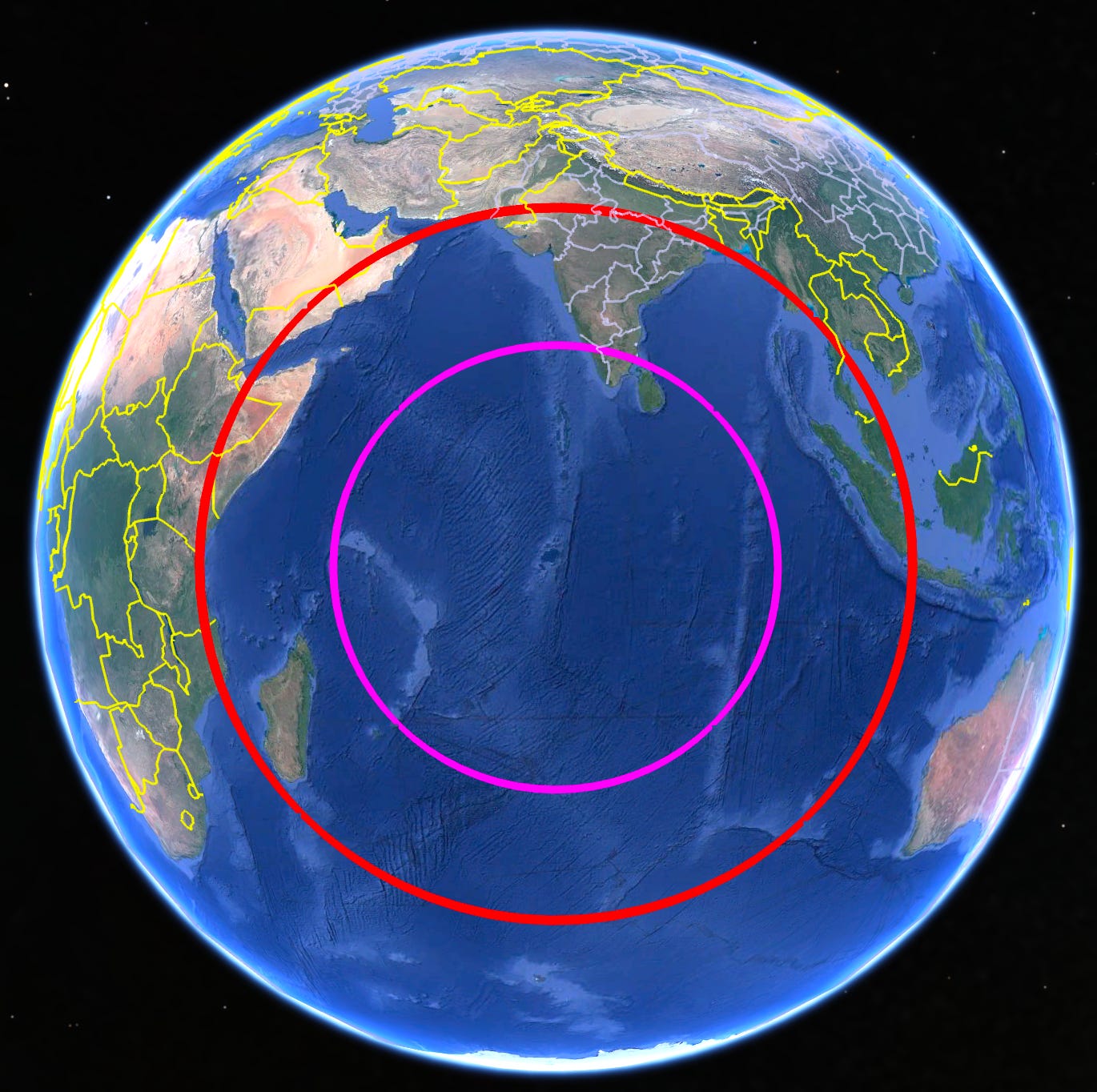
In the middle of that map is Diego Garcia, British Indian Ocean Territory and home to one of the most strategic airfields and anchorages on the planet. […] The red circle is 2,000 nautical miles from the island. The purple circle is 1,150 nautical miles, roughly the distance from London to Malta, that represents the distance from Diego Garcia. That circle is also the distance from Diego Garcia to the island of Mauritius.
Caption and image from CDR Salamander.
With the assistance of the brightest and best of the UK Foreign Office, the Labour government agreed to an arrangement that would hand over territory containing an Anglo-American military base to an unfriendly country, condemn its former inhabitants to permanent exile, and pay tens of billions of pounds for the pleasure.
I’m talking, of course, about Chagos (officially, the British Indian Ocean Territory), which has briefly caught the attention of the world’s most powerful man. This morning, amid a flurry of Truth Social posts about his designs on Greenland, US president Donald Trump’s gaze briefly alighted on this small, tropical archipelago on the other side of the planet. And he did not hold back in his criticism of Britain’s plans: “Shockingly, our ‘brilliant’ NATO Ally, the United Kingdom, is currently planning to give away the Island of Diego Garcia [the largest of the Chagos Islands], the site of a vital US Military Base, to Mauritius, and to do so FOR NO REASON WHATSOEVER”, he wrote. “The UK giving away extremely important land is an act of GREAT STUPIDITY”.
Trump’s reaction has widely been described as a major about-turn. But, in truth, his team has veered all over the place on the Chagos question. In October 2024, when Starmer initially agreed to hand over the islands, Marco Rubio, then still a US senator for Florida, reportedly warned that this would allow “Communist China” to spy on the US Navy, given Mauritius’s alliance with China. Yet in February 2025, when Starmer visited the Oval Office, the US president said he was “inclined to go along with” the UK’s proposals. And by May, when the deal was signed between the British and Mauritian governments, Rubio, by now US secretary of state, welcomed it. He claimed that Trump himself had “expressed his support for this monumental achievement”, hailing the deal that would cede sovereignty to Mauritius, while Diego Garcia would be leased to Britain for the next 99 years.
Of course, Trump’s motivation for bashing Starmer’s deal now has little to do with the Chagos Islands themselves. The real prize for the US president is in a different hemisphere entirely, as he freely admits. In a bizarre non-sequitur, the US president’s Truth Social post goes on to say that the Chagos deal is “another in a very long line of reasons why Greenland has to be acquired” by the US. This smackdown over Chagos, this attempt to humiliate Starmer and Britain on the global stage, is clearly part of Trump’s broader pressure campaign against the European powers, in his bid to seize Greenland for the US.
Nevertheless, it really should not have taken Trump’s intervention to put the brakes on the dreadful Chagos deal. Whichever way you spin it, this arrangement has never been in Britain’s national interest, nor the interests of the Chagossians who call the islands their home. It poses a risk to Western security interests, handing sovereignty over a territory, where almost 400 UK and US troops and 2,000 contractors are based, to a country that’s allied to China. The cost of leasing back Diego Garcia from Mauritius is also eye-watering. Although the Labour government tried to present the cost as just £3.4 billion, the true figure is believed to be 10 times as much, at around £34.7 billion.
So what on Earth possessed Starmer to sign up to such a risible deal? What leverage was a tiny island like Mauritius able to gain over Britain?
The Korean War Week 83: The Medics’ War! – January 20, 1952
The Korean War by Indy Neidell
Published 20 Jan 2026There’s discussion — and disagreement — in UN Command and Washington about whether or not to poll all the POWs the UN side holds to see where they would like to go should they be released. There are arguments for and against this, and it brings up a couple different interpretations of the Geneva Convention. This week we also talk a lot about recent medical advances in field medicine in Korea, and the development of the “Medics’ War”.
00:00 Intro
00:44 Recap
01:14 Poll the POWS
04:52 UN Decleration
08:19 52nd Medical Battalion
10:56 Cho-Do Island
11:45 Summary
12:06 Conclusion
12:49 Memorial
(more…)
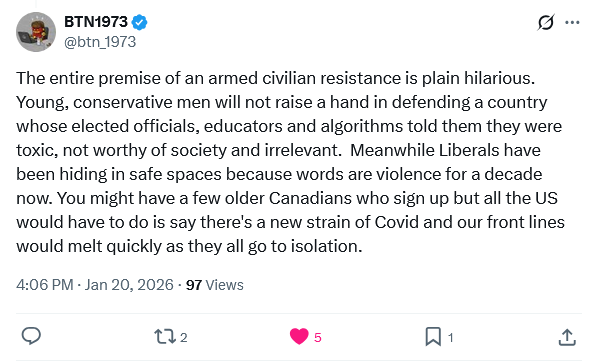
We’ll resist the Yankee hordes with our … um, strongly worded tweets?
A brilliant example of the general case of progressives never taking into account the impact of their own pet schemes is the Canadian Armed Forces including “armed civil resistance” as part of their contingency planning for an American invasion … at the same time that the Canadian government is moving heaven and earth to disarm as many Canadians as possible:
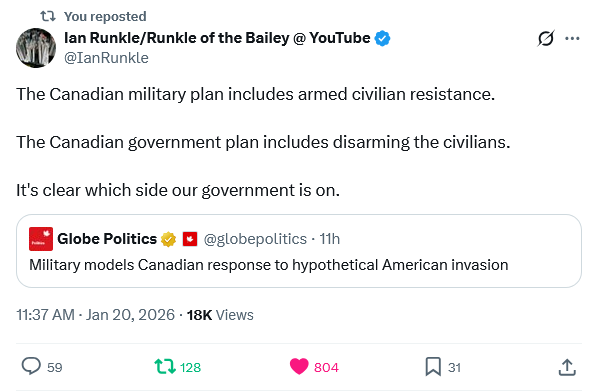
Jason James writes:
Canadian military planners have modeled a potential US invasion from the south.
Their plan?
An armed civilian resistance.
I’m not sure if they’ve checked in with the Liberal government yet, but they’ve outlawed most “assault style” weapons (meaning anything that could actually be used to mount such a resistance).
And depending on where the US invades, they might have a difficult time finding civilians who actually own anything beyond kitchen knives.
Furthermore, anyone who does own hunting rifles or the few legal “assault style” weapons would be more inclined to fight on the side of the Americans than defend a socialist wasteland that sold their future to China.
So what’s the plan then? Mobilize the Mexican cartels and Chinese organized crime gangs who actually have some fire power? Form a militia of IRGC operatives and Indian drug gangs to fight American special forces?
I highly doubt any of them would be interested in walking into certain death for a country they have no allegiance to.
So I guess we’re down to a handful of lesbians and communists armed with broom handles defending Vancouver and Toronto from the greatest military power the world has ever known.
Good luck with that, comrades.
No disrespect to James, but the weapons the federal government are trying to confiscate are not “weapons of war” or “assault weapons” — they are mostly semi-automatic guns that look vaguely like military weapons. The feds offered to send all confiscated weapons to Ukraine as they fight a desperate war of defence against the Russian invaders and need anything they can get. And Ukraine refused the offer because these weapons would not be useful in combat. But the basis for confiscating them in the first place is that they’re all dangerous military weapons.
This is likely what would happen if such an invasion materialized:
Of course, you can always depend on Not the Bee to provide a tasteful selection of topical memes.


