
Adrian Goldsworthy. Historian and Novelist
Published 11 Dec 2024Continuing the series “The Conquered and the Proud”, this video looks at the political system created by Augustus — the Principate or rule of a princeps or “first”. We look at the twin elements of his formal power, the tribunician potestas and the maius imperium proconsulare. Next time we we look at Augustus, the provinces and imperial expansion.
May 8, 2025
Augustus and the creation of the Principate – The Conquered and the Proud 13
Comments Off on Augustus and the creation of the Principate – The Conquered and the Proud 13
QotD: Trade empires
The final (and possibly ultimate) sort of empire is the Trade Empire. These develop more because exploring traders have a need for safe bases and secure lines of communication to make their trade work. Theoretically trade empires could be land based (and both the American West and the Chinese spread down the Silk Road argue the case that they started as trade security rather than conquest … no matter how they finished). But in reality the main cause of and reason for trade empires is the development of water transport. Specifically ocean transport.
So let us consider the motives of Empire in a few cases.
The Phoenicians had a magnificent trade empire, though with a few elements we find familiar from the more recent Viking version, or indeed the Venetian “Republic” — namely a bit of raiding, and quite a bit of slave trading. All three broadened into a bit of conquest — Carthage, Normandy and the sack of Constantinople in the 4th Crusade come to mind — but all those offshoots were by-products of the original cultures, and none of them became the norm for the ongoing home culture (each of which faded away as circumstances changed and they failed to adapt). So we could say that they were essentially trading empires.
Greece and Carthage and Rome were also trade empires, initially letting their security concerns drag them into a bit of conquest on the side. The difference in their cases was that the conquest element became dominant and completely changed the “homeland”. The city states of Greece becoming the world-conquering hordes of Alexander, and completely undermining the vibrant city state cultures that had proceeded them. The Phoenician trading city of Carthage becoming an expansionary conquest state that eventually pushed Rome too hard. And Rome’s overseas campaigns in Spain and North Africa completely undermining the independent farmer/citizen/soldier class of the Roman Republic, and replacing them with a system of professional troops whose loyalty could only be bought by ever increasing conquests by the emperors.
Naturally every expansion eventually reaches limits, and the concern reverts to trying to secure what you have, and hold the outsiders further away. Which is why, amusingly, people like the Romans and the Chinese came through their expansionary conquest phase, and then found themselves back in the position of having to protect the fringes through deals with tribes that can be traded with/employed by/or paid tribute. Cue Attila the Hun and his ilk.
So empires on the way down may also be considered trade and security empires I suppose, though many still had a conquest impulse (for fame or fortune or simply to pay the defenders off) built in, or tried to act as if they were still conquering hordes. Cue Constantinople and Belisarius.
In fact most empires will go through a variety of stages, though I think it fair to say that most empires have a core purpose and attitude, no matter how they tinker at the edges to deal with specific circumstances.
Nigel Davies, “Types of Empires: Security, Conquest, and Trade”, rethinking history, 2020-05-02.
Comments Off on QotD: Trade empires
May 7, 2025
The Korean War Week 46 – The MacArthur Senate Hearings Begin – May 6, 1951
The Korean War by Indy Neidell
Published 6 May 2025The Senate Hearings digging into Douglas MacArthur’s dismissal as UN forces commander begin this week, though they’ll likely continue for some time. Meanwhile in the field, the Chinese Spring Offensive that raged all last week continues, although it cannot reach Seoul, and by the end of the week the enemy seems to be withdrawing on all fronts.
(more…)
Comments Off on The Korean War Week 46 – The MacArthur Senate Hearings Begin – May 6, 1951
Boldly Bombing Bugger All – The Bomber War Episode 1
HardThrasher
Published 13 Oct 2023To see more on the Fairey Battle go here – The Fairey Battle – Light Bomber, Hea… also subscribe to Rex’s channel, he’s ace
Selected Online Resources
https://en.m.wikipedia.org/wiki/Point…
https://en.m.wikipedia.org/wiki/Butt_…
https://en.m.wikipedia.org/wiki/Area_…
https://en.m.wikipedia.org/wiki/Casab…
https://discovery.nationalarchives.go… – Western War Plan W5a and W6Selected Bibliography
America’s Pursuit of Precision Bombing 1910-1945 – McFarland et al.
Dresden – Sinclair McKay
Dresden; Tuesday … – Fredrick Taylor
Absolute War – The Firebombing of Tokyo – Chris Bellamy
Black Snow –
Bomber Command – Max Hastings
Bomber Command’s War Against Germany, An Official History – Nobel Franklin et al.
The Bomber Mafia – Malcolm Gladwell
Undaunted and Through Adversity (Vol 1 &2) – Ben Kite
United States Strategic Bombing Survey (European War) (USSBS) Sept 1945 – Var. – https://collections.nlm.nih.gov/catal…
America’s Pursuit of Precision Bombing 1910-1945, McFarland
Big Week – James Holland
Comments Off on Boldly Bombing Bugger All – The Bomber War Episode 1
QotD: China’s millennia-long struggles between farmers and nomads
But this time it wasn’t just Chinese peasants moving around and changing the way they lived. For the first time in recorded history, the Chinese civilizational heartland of the Yellow River valley was invaded and occupied by a massive number of non-Chinese people. It’s an extremely sensitive and difficult to discuss topic in China, but there is genetic evidence of substantial steppe admixture in Northern Chinese lineages, and it seems likely that this is around when it kicked off. Meanwhile, remember that huge numbers of Northern Chinese were migrating to the South at around this time. Our best guess from both ancient DNA and linguistic2 evidence is that the modern Southern Chinese are pretty close to what the Northern Chinese were a couple thousand years ago, while the modern Northern Chinese have a good amount of Turkic and Mongolic ancestry.
The thing is you don’t even need to look at the genetics, it’s also quite apparent from the literary, artistic, and military record that over time a hybrid aristocracy emerged in the North with influences from both the old Chinese nobility and the invaders. The change is visible in everything from fighting style (suddenly Chinese armies are using cavalry), to fashion (pants!), to preferred hobbies (suddenly a lot more archery and falconry). It was this mixed-blood elite that finally reunified North and South China, and eventually gave rise to the glorious Tang dynasty.
This may have been the most shocking fact I learned from this book. I’d always thought of the Tang as the most quintessentially Chinese of all Chinese rulers (and moreover the real beginning of “modern” Chinese history). Chinese people tend to think that way too — “Tang” is a still-used archaic ethnonym for the Chinese ethnicity (the same way that it’s recently gotten trendy in the West to use a different archaic ethnonym, also the name of an ancient dynasty, “Han”).3 The idea that the Tang actually represented an intrusion of alien Turkic influences into Chinese society is not at all the mainstream view within China, but it’s pretty much the Western scholarly consensus, and Graff lays it out convincingly.
There’s a lot more to say about the great Tang, and this book has a lot of details on their expeditions past the Tarim Basin into Central Asia and their battles with Arab armies. But all of that is getting back into the well-covered part of Chinese history, the part that you can read about anywhere else. And I’ve gotten all the way to the end of this review while neglecting the most important part: were there preppers in the Jin dynasty, and if so how did they deal with the total breakdown of society followed by two centuries of anarchy?
Were there ever. While most of the country fell prey to bands of marauders and tribesmen who roamed the land committing unspeakable crimes, there were a few village headmen and petty aristocrats who constructed fortifications, stockpiled food and weaponry, and carved order out of chaos. There, in their redoubts, they kept the flame of civilization alive and sheltered their people against the long night. If you ever run into me at a party, there’s even odds I’ll quote this passage at you:
When his home was threatened by troops of one of the princely armies in 301, [Yu Gun, a minor official] led his kinsmen and other members of the community into the high country to the northwest. “In this high and dangerous defile, he blocked the footpaths, erected fortifications, planted [defensive] hedges, examined merit, made measurements, equalized labor and rest, shared possessions, repaired implements, measured strength and employed the able, making all things correspond to what they should.” On several occasions when bandits threatened his hilltop sanctuary, he was able to deter them simply by deploying his armed followers in orderly ranks.
There’s so much that’s beautiful in this passage, I feel like I could write an entire book about it. One thing I love is the way it embodies Joseph de Maistre’s aphorism that “contre-révolution ne sera point une révolution contraire, mais le contraire de la révolution.” Yu doesn’t just oppose strength with strength, he battles the insanity and entropic forces raging outside his walls by creating hierarchy, tranquility, and harmony within. His “armed followers in orderly ranks” are a military manifestation of the “making all things correspond to what they should” that preceded them. And there’s something very profound and very true in the image of the forces of disorder recoiling from his little island of civilization like a vampire faced with a crucifix.
John Psmith, “REVIEW: Medieval Chinese Warfare, 300-900 by David A. Graff”, Mr. and Mrs. Psmith’s Bookshelf, 2023-06-05.
1. Yes, alas, this means some of the death tolls parodied in the “Chinese history be like” meme are almost certainly exaggerations. When the census says 160 million one year and 120 million the next, it’s possible that a ton of people died, but it’s also possible that it just got a lot harder to take a census.
2. All the high mountains and sheltered valleys in Southern China mean it has massively greater linguistic diversity than the North, but many of those languages actually turn out on closer inspection to be snapshots of Northern Chinese languages at some much earlier point in history. It’s more evidence, consistent with the genetic evidence, that repeated waves of migrants have entered Southern China from the North, and then stayed fairly isolated.
3. The word in Chinese for overseas Chinatowns literally translates as something like “Tang people street”.
Comments Off on QotD: China’s millennia-long struggles between farmers and nomads
May 6, 2025
1949: How the Arab-Israeli War Ended – W2W 27
TimeGhost History
Published 5 May 2025In early 1949, the Arab-Israeli War finally comes to an uneasy end. After brutal fighting, armistice talks in Rhodes redraw borders with a green pencil line, displacing hundreds of thousands and reshaping the Middle East. Egypt, Jordan, Syria, and Lebanon reluctantly sign ceasefires, leaving core issues — Jerusalem, refugees, and recognition — unresolved. But can forced armistices really bring lasting peace, or is Palestine fated to endless conflict?
(more…)
Comments Off on 1949: How the Arab-Israeli War Ended – W2W 27
Gilboa Snake: Is the Double-AR Really so Dumb? (Re-Cut for YouTube)
Forgotten Weapons
Published 7 Jan 2025YouTube removed this video, so I re-cut it to meet their requirements (I think … for now). If you want to get off YouTube and support historical & education gun channels, please consider subscribing to History of Weapons & War: weaponsandwar.tv
The Gilboa Snake is an Israeli rifle (from the same designer behind the Cornershot) that essentially combines two standard ARs into a single unit. In its civilian configuration it has two of every part — barrels, bolts (mirrored, so one ejects left and the other right), triggers, buffers, etc. In its military setup, the triggers and recoil system are combined into single units, and this makes the gun arguably practical. With a single trigger, a person fires two rounds simultaneously, resulting in either two simultaneous hits at close range, or the potential for one hit at longer range instead of what might be a miss with a regular rifle. This is a concept that has been experimented with by pretty much all major militaries over the past decades; the Russians, French, and Americans all had rifles like this. Other approaches to the end result included duplex and triplex ammunition (multiple bullets in one case) and hyper-burst firing mechanisms (like the Russian AN-94 and German G11). Ultimately all of the different systems were deemed poor compromises compared to normal rifles, but it’s not as bizarre of an idea as it might first appear.
Unfortunately, the civilian Snake has to have two separate triggers to avoid machine gun classification in the US. It’s difficult to fire both triggers simultaneously, and this limits the practical military applications of the gun.
Oh, and don’t miss the unique elements in the Snake to allow for the barrels to be zeroed before mounting sights!
(more…)
Comments Off on Gilboa Snake: Is the Double-AR Really so Dumb? (Re-Cut for YouTube)
QotD: World War I shattered the European notion of what “war” actually was
We’ve actually talked before about just how profoundly our modern view of war and battle (and battlefields) is conditioned by the experience of the first world war and the vast literary production of the generation that went through those trenches. Certainly for English (and German and French, etc.) literature, World War I seems to almost snap the tradition in half, making everything before it feel trite and washing the whole of war literature in grim tones of field grey.
And, of course, that is the point. World War I was a new kind of war that shattered the old certainties born out of the old kinds of war. It is often a mistake to assume those old certainties had been born out of some eternal peace, but while the 1800s had not seen a general European war, they had seen many wars, in the many imperial possessions of European countries, on the edges of what the British or French considered “Europe” and also in the heart of Europe itself (not to mention a few dust–ups in the Americas). These were not peaceful societies confronting their first war and shocked by the experience, but very bellicose societies encountering for the first time a new sort of war and being stunned at how different it was from what they had expected, from the wars of their (recent!) past.
All of which is to say war, war really does change. And warriors with it.
Bret Devereaux, “Collections: The Universal Warrior, Part IIb: A Soldier’s Lot”, A Collection of Unmitigated Pedantry, 2021-02-05.
Comments Off on QotD: World War I shattered the European notion of what “war” actually was
May 5, 2025
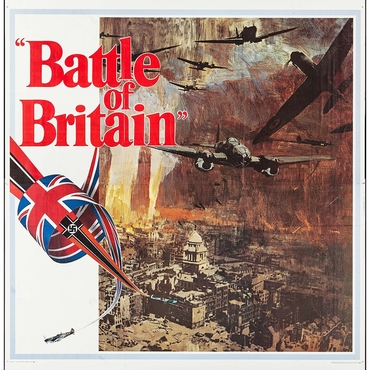
Remembering The Battle of Britain (1969)
At SteynOnline, Rick McGinnis discusses the 1969 film The Battle of Britain, which was considered a financial flop at the time it was released and only turned a profit once home VCR sales provided a new revenue stream — it was how I first watched the movie, although I do remember seeing posters for it at the cinema while it was in theatrical release.
The best recent depictions of the war – my subjective list includes Band of Brothers, The Pacific, Saving Private Ryan, Dunkirk, Das Boot, Greyhound and Letters from Iwo Jima – were mostly made with veterans advising on historical accuracy and mostly being heard. This wasn’t always the case: for at least two decades following the war, when veterans were still thick on the ground, historical accuracy was frequently sacrificed in the interest of adventure, drama, comedy or romance.
(My subjective list includes Kelly’s Heroes, The Dirty Dozen, The Guns of Navarone, D-Day The Sixth of June, Where Eagles Dare, Operation Petticoat, From Here to Eternity and Von Ryan’s Express. Not that these aren’t entertaining, enjoyable films; they just shouldn’t be considered history.)
If there was a turning point – a film that struggled and mostly succeeded in telling a plausibly accurate story about the war to audiences likely to contain not just veterans but civilians with lived memories – it was probably Guy Hamilton’s Battle of Britain, released in 1969, barely thirty years after the event it commemorates.
While in pre-production for the film, 007 producer Harry Saltzman and his co-producer (and veteran RAF pilot) Benjamin Fisz realized that their American backers at MGM were nervous about making a film about something Americans knew little about. This led to The Battle for the Battle of Britain, a short TV documentary about the film and the event that it was based on, hosted and narrated by one of the film’s stars, Michael Caine.
Included with the 2005 collector’s edition DVD of Hamilton’s film, The Battle for the Battle of Britain begins with a series of “man on the street” interviews conducted outside the American embassy in London. Older interview subjects talk vaguely about how they’d admired the British for standing alone against Nazi Germany at the time; younger ones almost unanimously admit that they don’t’ know anything about it. One woman states that she doesn’t wish to give an opinion since she works for the embassy. At the time these interviews were made the average age of a British pilot who fought in the battle and survived would have been around fifty, as the vast majority of the young men who flew to defend England in the summer of 1940 were on either side or twenty.
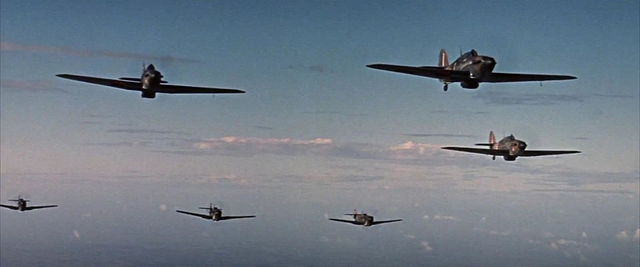
Making Battle of Britain felt like a duty in 1969; it attracted a cast of big stars who were willing to work for scale just to be involved, but that didn’t stop the film from going massively over schedule and over budget. Historical accuracy was so important that Saltzman and Lisz ended up collecting what became the world’s 35th largest air force, rebuilding wrecked airframes and making planes that had sat on concrete plinths outside museums and airfields flyable again.
Still from The Battle of Britain
The film begins with the fall of France in the spring of 1940, and British pilots and air crew struggling to get back in the air ahead of the rapidly approaching German army. We meet the three RAF squadron leaders who will be at the centre of the action: Caine’s Canfield, Robert Shaw as the curt, intense “Skipper”, and Colin Harvey (Christopher Plummer), a Canadian married to Maggie (Susannah York), an officer in the Women’s Auxiliary Air Force.
Back across the channel we meet Sir Laurence Olivier as Air Chief Marshal Sir Hugh Dowding, the head of Fighter Command and the man who will lead the English in the air battle to come. Blunt and charmless, Dowding had the unenviable task of telling Sir Winston Churchill, only just appointed Prime Minister, that he doesn’t support his promise to send more fighter squadrons across the Channel to aid the French as they would be squandered in a lost cause and, in any case, he needs every plane and pilot he has to fight the German invasion that’s doubtless coming.
Comments Off on Remembering The Battle of Britain (1969)
The Bloody Battle of Agincourt | Animated Episode
The Rest Is History
Published 30 Nov 2024“We few, we happy few, we band of brothers”.
The Battle of Agincourt in 1415 endures as perhaps the most totemic battle in the whole of English history. Thanks in part to Shakespeare’s masterful Henry V, the myths and legends of that bloody day echo across time, forever enshrining the young Henry as the greatest warrior king England had ever known. So too the enduring idea of the English as plucky underdogs, facing down unfavourable odds with brazen grit. And though the exact numbers of men who fought in the two armies is hotly contested, the prospect was certainly intimidating for the English host looking down upon the vast French force amassed below them the day before the battle. Hungry and weary after an unexpectedly long march, and demoralised by the number of French that would be taking to the field, the situation certainly seemed dire for the English. One man amongst them, however, held true to his belief that the day could still be won: Henry V. An undeniably brilliant military commander, he infused his men with a sense of patriotic mission, convincing them that theirs was truly a divinely ordained task, and therefore in this — and his careful strategic planning the night before the battle — he proves a striking case of one individual changing the course of history. However, the French too had plans in place for the day ahead: total warfare. In other words, to overwhelm the English in a single devastating moment of impact, sweeping the lethal Welsh archers aside. So it was that dawn broke on the 25th of October to the site of King Henry wearing a helmet surmounted by a glittering crown and bearing the emblems of both France and England, astride his little grey horse, and riding up and down his lines of weathered silver clad men, preparing them to stride into legend … then, as the French cavalry began their charge, the sky went black as 75,000 arrows blocked out the sun. What else would that apocalyptic day hold in store?
Join Tom and Dominic as they describe the epochal Battle of Agincourt. From the days building up to it, to the moment that the two armies shattered together in the rain and mud of France. It is a story of courage and cowardice, kings and peasants, blood and bowels, tragedy and triumph.
00:00 What is to come …
00:50 Shakespeare and Henry V
02:53 Agincourt is exceptional
04:15 The battle is a test of God’s favour
05:27 The English see the French forces …
09:30 The French aren’t offering battle
10:40 Why the French delay
11:13 The French think they’re going to win
11:35 An ominous silence
12:35 Henry’s plan
20:50 The French plan
24:28 How big were the armies
28:49 The lay of the land
34:50 Henry makes the first move
37:00 The French charge into darkness
38:57 The French army advances
45:50 Reaction to the slaughter
(more…)
Comments Off on The Bloody Battle of Agincourt | Animated Episode
QotD: English intelligentsia and the Soviet Union
I am well acquainted with all the arguments against freedom of thought and speech — the arguments which claim that it cannot exist, and the arguments which claim that it ought not to. I answer simply that they don’t convince me and that our civilization over a period of 400 years has been founded on the opposite notice. For quite a decade past I have believed that the existing Russian regime is a mainly evil thing, and I claim the right to say so, in spite of the fact that we are allies with the U.S.S.R. in a war which I want to see won. If I had to choose a text to justify myself, I should choose the line from Milton:
“By the known rules of ancient liberty.”The word ancient emphasizes the fact that intellectual freedom is a deep‐rooted tradition without which our characteristic Western culture could only doubtfully exist. From that tradition many of our intellectuals are visibly turning away. They have accepted the principle that a book should be published or suppressed, praised or damned, not on its merits but according to political expediency.
And others who do not actually hold this view assent to it from sheer cowardice. An example of this is the failure of the numerous and vocal English pacifists to raise their voices against the prevalent worship of Russian militarism. According to these pacifists, all violence is evil, and they have urged us at every stage of the war to give in or at least to make a compromise peace. But how many of them have ever suggested that war is also evil when it is waged by the Red Army? Apparently the Russians have a right to defend themselves, whereas for us to do so is a deadly sin. One can explain this contradiction in only one way — that is, by a cowardly desire to keep in with the bulk of the intelligentsia, whose patriotism is directed toward the U.S.S.R. rather than toward Britain.
I know that the English intelligentsia have plenty of reason for their timidity and dishonesty; indeed, I know by heart the arguments by which they justify themselves. But at least let us have no more nonsense about defending liberty against fascism. If liberty means anything at all, it means the right to tell people what they do not want to hear. The common people still vaguely subscribe to that doctrine and act on it. In our country — it is not the same in all countries: it was not so in Republican France, and it is not so in the United States today — it is the liberals who fear liberty and the intellectuals who want to do dirt on the intellect: it is to draw attention to that fact I have written this preface.
George Orwell “The Freedom of the Press”, 1945 (written as the preface to Animal Farm, but not published in Orwell’s lifetime).
Comments Off on QotD: English intelligentsia and the Soviet Union
May 4, 2025
The Clean German Myth, Doomed B-17 Pilots, and Japan’s Rapid Victories – Out of the Foxholes Live
World War Two
Published 3 May, 20205Indy and Sparty tackle some more of your interesting questions in another live Out of the Foxholes. Today they look at loss rates of B-17 crews, the myth of the clean Wehrmacht, and ask why the West was apparently so unprepared for Japan’s attack.
(more…)
Comments Off on The Clean German Myth, Doomed B-17 Pilots, and Japan’s Rapid Victories – Out of the Foxholes Live
One Fine Day in the British Empire 100 years ago
Nigel Biggar discusses One Fine Day by Matthew Parker, which looks at the state of the British Empire in the mid-1920s with a moderately jaundiced eye (as you’d expect for a modern popular history about the empire):
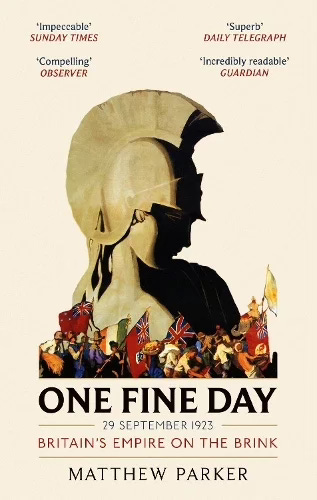
The approach is imaginative: to present a snapshot of the British Empire a century ago, five years after its victory in the First World War, when its territory was most extensive and at what must have seemed its zenith. The result is a display of the Empire in all its ad hoc variety, from the white-majority settler “dominion” of Australia to the non-settler “protectorate” of Uganda. The reader meets colonial officials who were sympathetic and conscientious in their dealings with those they ruled, as well as some who were brutally arrogant and dismissive. He also hears from native people who appreciated the benefits of imperial rule, as well as those who felt humiliated by Western dominance. And he learns that, if the British were late in introducing democracy to India, they were the very first to do so, for its like had never been seen before. To its great credit, no one can read this book and conclude that the British Empire was a morally simple thing.
However, it seems that our snap-shooter was fascinated mainly by the Empire in the east and grew tired as he travelled westward. Of the thirty-seven chapters, he devotes twenty-two to Australasia, the Pacific, South-East Asia, and India. There is very little mention of the Empire in South Africa, almost nothing on the Middle East (Egypt, Palestine, and Iraq) and hardly a reference to Canada. In addition, the publisher appears to have become alarmed at the length, since readers wanting to consult the notes or bibliography are directed to the author’s website.
What is more, the synchronic approach suffers from myopia, relegating major imperial achievements to walk-on parts. We do hear about the Empire’s humanitarian suppression of slavery, but only incidentally. The reader is not told that Britain (along with France and Denmark) was among the first states in the history of the world to repudiate slave-trading and slavery in the early 1800s and that it used its imperial power throughout the second half of its life to abolish slavery from Brazil across Africa to India and New Zealand. And in ending his book by reporting the 1923 cession of Rwanda to Belgium and Jubaland to Italy as tokens of imminent imperial dissolution — “Very soon, of course, the trickle became a flood” is the very last sentence — the author allows the reader to overlook the extraordinary, heroic contribution that the British Empire went on to make in the Second World War, when, between the Fall of France in May 1940 and the German invasion of Russia in June 1941, it offered the only military resistance to the massively murderous, racist regime in Nazi Berlin, with the sole exception of Greece.
While our imperial tourist is a generally an honest reporter, presenting the good as well as the bad elements of the Empire, his account is not innocent of unfairly negative bias.
The problem first manifests itself in the decision to open his account with the story of the mining ruination of a tiny Pacific territory by the British Phosphate Company. He then returns to this in the book’s closing pages, where describes it as a tale of “extractive colonialism at its most literal”. While an attentive reader of the pages in between will notice that the Empire sometimes brought native people economic opportunities and benefits, the lasting impression given by this bookending is that it was — as neo-Marxists have always claimed — basically exploitative. And yet Rudolf von Albertini, whose work was based “on exhaustive examination of the literature on most parts of the colonial world to 1940” (according to the eminent imperial economic historian, David Fieldhouse) judged “that colonial economics cannot be understood through concepts such as plunder economics and exploitation”.1
Parker’s negative bias appears most strongly in his crude, unreflective understanding of the racial attitudes of the imperial British. While he does bring onto the stage colonial Britons who express a range of views of other peoples, including sympathy and benevolence (albeit usually “paternalistic”), he nevertheless tells us that “ideas of white supremacy remained a guiding structural principle of the empire. This racist ideology was a coping stone of empire” (p. 8). What he has in mind is specifically the idea of a fixed “hierarchy of races”, with whites permanently established at the top — “what we would now call white supremacism” (p. 65). Such a view could claim the authority of natural science, since at the turn of the twentieth century “European scientists all still agreed that human beings were naturally unequal … and that there was a hierarchy of races” (p. 138).
1. D.K. Fieldhouse, The West and the Third World (Oxford: Blackwell, 1999), p. 168; R. von Albertini with Albert Wirz, European Colonial Rule, 1880–1940: The Impact of the West on India, Southeast Asia, and Africa, trans. John G. Williamson (Oxford: Clio, 1982), p. 507.
Comments Off on One Fine Day in the British Empire 100 years ago
Everyday Life in the Roman Empire – Culture and Literacy in the Roman Empire
seangabb
Published 28 Dec 2024This is the eighth video in my series on Everyday Life in the Roman Empire. In this, I wander about at the beginning, with talk of poetry and philosophy, before realising that the real theme is the extent of ancient literacy. The whole of the remainder is given over to this, and how it enabled a literary civilisation wholly different from our own.
Introduction – 00:00:00
Our perceptions of culture in the Ancient world – 00:01:40
Virgil – 00:03:45
Catullus – 00:05:17
Philosophy in Rome – 00:06:23
The Romans and Stoicism – 00:08:40
The Romans and Epicureanism – 00:10:27
Pretty silver things from Roman Britain – 00:16:25
Broad-based cultural participation in the Ancient World? – 00:19:26
The Ancient World: a largely illiterate civilisation (no spectacles) – 00:28:27
The Ancient World: a largely illiterate civilisation (expensive education, expensive books) – 00:35:40
The Ancient World: a largely illiterate civilisation (economic imperatives) – 00:42:35
The Ancient World: a largely illiterate civilisation (expensive writing materials) – 00:44:44
The Ancient World: a largely illiterate civilisation (difficulties of reading) – 00:49:16
The Ancient memory – 00:53:14
The primacy of oral communication – 00:55:23
The Ancient World: a largely illiterate civilisation (the Second Sophistic and linguistic change) – 00:59:53
Bibliography – 01:08:10
(more…)
Comments Off on Everyday Life in the Roman Empire – Culture and Literacy in the Roman Empire
May 3, 2025
Development of the Uzi Family: Standard, Mini, and Micro
Forgotten Weapons
Published 4 Jan 2025The Uzi was originally designed in the 1950s, and it was on the technological cutting edge at the time. The stamped receiver, telescoping bolt, and compact magazine-in-grip layout made it an inexpensive and effective weapon. Its sedate 600 round/minute rate of fire helped as well, making it easy to shoot effectively. Uziel Gal experimented with a compact version at that time, but dropped the idea when he proved unable to make a smaller version with the same low rate of fire as the standard pattern.
Fast forward to the late 1970s, and the designers at IMI revisited the idea of a compact Uzi. They were willing to accept the increased rate of fire of a shorter receiver and lighter bolt, and their first prototypes were ready in 1978. full export sales began in 1980. The gun was advertised as having a 900 rpm rate of fire, but the reality was much higher.
The final step of classic Uzi development was the Micro Uzi, introduced in 1986. This was actually developed form the semiautomatic, closed-bolt Uzi Pistol made for American commercial sales. That pistol was given a select-fire trigger group and a folding stock, and it became a micro-compact submachine gun for only the most tactical of operators. It was advertised as having a 1200 rpm rate of fire, but this was again underestimated to improve sales.
In reality, the standard Uzi does fire at about 600 rpm. The Mini (in closed-bolt form) ran at 1300+ in my testing at S&B, and the Micro was over 1400 rpm. Where the original Uzi is best kept in fully automatic mode and can easily fire single shots when desired, the Mini and Micro Uzis are definitely best suited to semiautomatic use. Firing them in fully automatic is a much more difficult proposition if one wants to maintain any level of accuracy and situational awareness.
Thanks to Sellier & Bellot for giving me access to this set of Uzis to film for you!
(more…)
Comments Off on Development of the Uzi Family: Standard, Mini, and Micro


