
TimeGhost History
Published 12 May 2025By early 1949, Chiang Kai Shek’s Kuomintang is falling apart. Hundreds of thousands of Nationalist troops surrender as city after city fall to Mao Zedong. Beijing falls without a fight and the Communists cross the Yangtze. Chiang’s final plan is escape and he moves tons of gold and his best troops to Taiwan. Meanwhile, Mao declares victory and the birth of the People’s Republic of China.
(more…)
May 13, 2025
Mao Wins the Civil War – Chinese Civil War Part 4 – W2W 28
Comments Off on Mao Wins the Civil War – Chinese Civil War Part 4 – W2W 28
Gout – The Disease of Kings
Tasting History with Max Miller
Published 7 Jan 2025Sliced roast venison with a spiced red wine sauce and a sprinkling of salt
City/Region: England
Time Period: 1723Gout has plagued people for thousands of years, but mostly the rich people. It often follows an indulgent diet full of red meat and alcohol, so for a long time only the rich had regular access to a gout-inducing food.
This recipe from 1723 is delicious, as well it ought to be as it flies in the face of the rules you should follow to prevent gout with venison (red meat) served with a wine sauce (alcohol). Venison is best when it’s not cooked past medium, and this recipe is tender and flavorful with the rosemary coming through. The sauce could really go on anything, and you could swap out the red wine for something different. Port would be delicious, though I would reduce the amount of sugar a bit.
I don’t expect most people will have a larding needle on hand, and I think you could probably skip the larding and still end up with a flavorful, tender dish.
To roast a Haunch of Venison.
First lard it with Bacon, and stick it thin with Rosemary; then roast it with a brisk Fire; but let it not lye too near it; bate it with fresh Butter; then boil a Pint of Claret with a little beaten Ginger, Cinnamon and Sugar, with a half a dozen whole Cloves, and some grated bread; and when they have boil’d enough, put in a little Salt, Vinegar and fresh Butter; dish your Venison, strew Salt about the Dish, and serve it with this Sauce.
— The Cooks and Confectioners Dictionary: Or, the Accomplish’d Housewives Companion by John Nott, 1723
Comments Off on Gout – The Disease of Kings
May 12, 2025
The rise of the Hansa
At Works in Progress, Agree Ahmed describes the conditions in northern Europe in the Middle Ages that helped create the Hanseatic League:
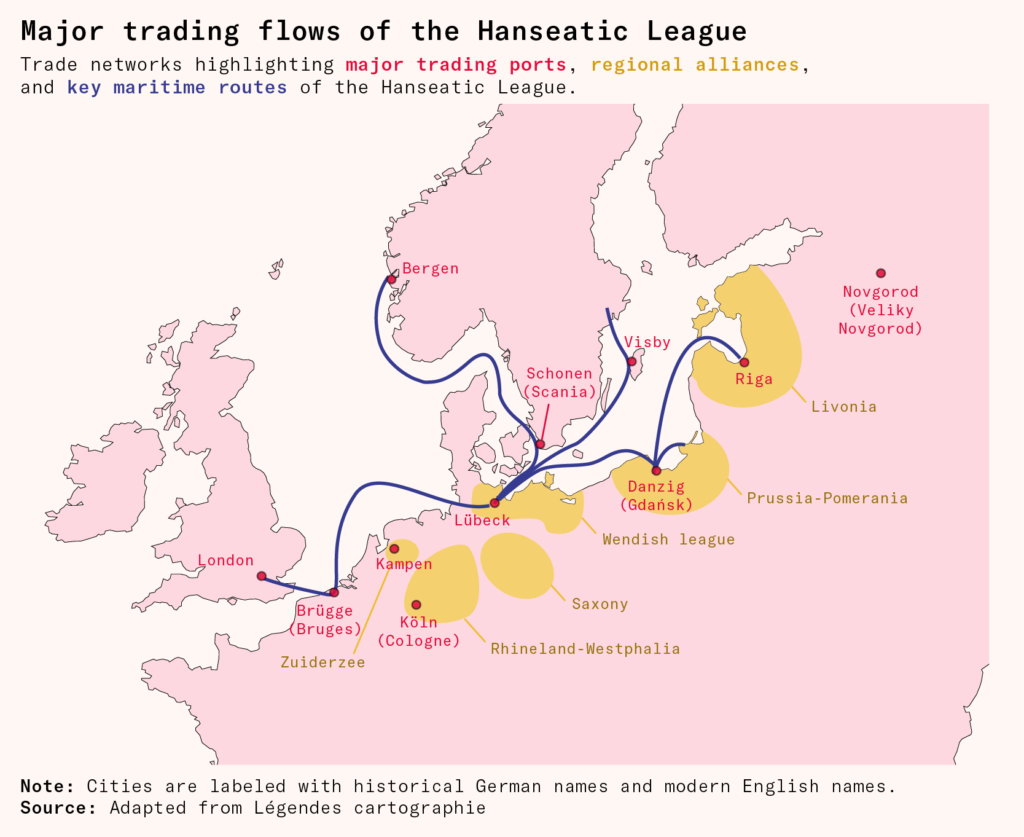
Today, we typically think of coalitions in the context of modern electoral politics. So it might be surprising that one of the greatest case studies in the history of coalitions is a community of medieval German merchants known as the Hansa.
Starting as individual traveling traders, the Hansa built up coalitions for collective bargaining, collective action, and collective security. Through this process, they formed Northern Europe’s first ever long-distance trade network.
Without corporate structures, they built supply chains that distributed goods between Northern Europe’s major ports, with capillaries that spread into each city’s hinterlands. Without formal territory, their laws governed trading hubs spanning thousands of miles, from London all the way to Western Russia. And, despite being composed of hundreds of member cities, the Hanseatic League had no head of state. Yet the Hansa still managed to sign treaty after treaty with foreign rulers and, a few times, even fought (and won!) wars.
[…]
Better climate, more arable land, and better farming techniques lifted Europe’s crop yields to above subsistence levels for the first time since the Roman period. After several centuries of decline, Europe’s population grew from 18 million in the 600s to over 70 million by the 1300s – nearly triple the population of the Roman period. The nutritional surplus allowed for Europe’s first significant artisan class since the Roman empire. Each town had common craftsmen like blacksmiths, leatherworkers, and carpenters. But local skills and resources allowed for the emergence of specialized crafts, which were unique to specific regions and could therefore be traded.
Tax-hungry lords across Europe began to set up permanent marketplaces for their growing communities. And so hundreds of towns formed in Europe, filled with workers who had flocked from countryside manors. These towns were the first substantial permanent markets in Northern Europe’s history.
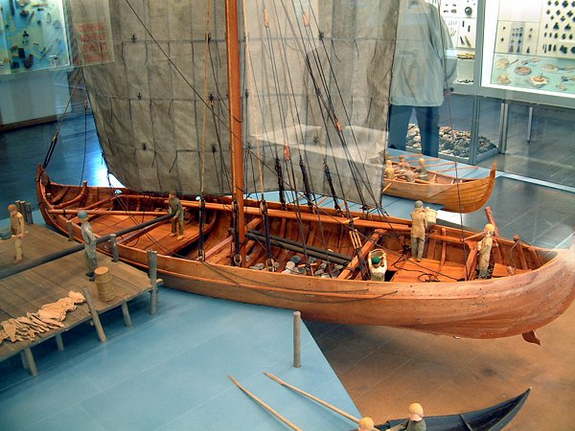
As production accelerated, so did shipping. The warmer climate meant waterways in the North and Baltic Seas were navigable for longer stretches of the year. Meanwhile innovations in boatmaking dramatically improved shipping capacity. Excavations of the few surviving ships from this era show that, in the span of a few centuries, vessels tripled their average tonnage from 10 to 30 while dropping the number of rowers required by a factor of four.
The breakthrough in tonnage starting in 900 can be credited to the knarr, a Viking-style ship that was shorter and wider than the longboat that preceded it, allowing it to load substantially more cargo with a smaller crew. Prior to the knarr, trade convoys had to carry cargo on longboats, which were agile but could only carry small fractions of what the knarr could.
A model knarr in the Hedeby Viking Museum in Germany.
Image Source: Europabild via Wikimedia.When Northern Europe’s first long-haul merchants set off on their voyages, they faced a world that had not yet been ordered for trade. Sailors had to worry about pirates in the Baltic and shipwrecks at icelocked winter ports.
Riverways gave merchants access to inland communities, where they could find products at lower prices to then sell for a profit in major port cities. But riverside towns were more interested in their own engineering projects or grinding their grain and so would block rivers with dams and water mills, and they would redirect water to irrigate fields.
And even if a river were clear of obstructive mills or dams, it might be heavily punctuated by toll stations. The Rhine River, a key shipping artery that connected inland Germany with the Baltic coast, had tolls approximately every five kilometers.
Under the laws of the Holy Roman Empire, the right to collect tolls on the Rhine could only be granted by the Emperor. But unauthorized tolling stations, or tolls levied in excess of what was authorized, were so rampant that the malpractice had a name: the lonia iniusta (Latin for “unjust tolls”). Some local authorities enforced toll collections along rivers by running chains from bank to bank, making it impossible for a boat to pass without paying. Others would patrol the river on their own boats and deny vessels passage until they paid up.
In the first four years of the Great Interregnum Period (1250–73), when the Empire had no emperor, the number of toll stations on the Rhine doubled to 20. This is the origin of the term “robber baron”: local barons, operating out of riverside castles, would set up illicit toll stations and demand significant shares of merchant cargo in order to pass.
The journey on land wasn’t much easier. Toll booths were similarly common. Nominally, these were to pay the landowner for the maintenance of the roads and bridges but in reality they were usually left dilapidated. Merchants voyaging on land had to load their wares on the backs of mules and horses (which were about a third the speed of ships). The narrow widths of medieval roads meant these caravans stretched out in long lines, leaving animals and cargo physically exposed. These vulnerable, slow moving, value-dense caravans attracted bandits who roamed the isolated roads between towns. It was nearly guaranteed a caravan would face an attempted robbery – either illegally by bandits or (somewhat) legally in the form of a toll shakedown – over the course of a sufficiently long trip.
As a matter of safety, Northern European merchants learned to move together in armed groups. These traveling merchant bands were called hansas, a Lower German word meaning “company” or “troop”. When a hansa formed for a trip, they elected an alderman (literally “elder man”) who would speak on behalf of the group to the various authorities – lords, princes, bishops, and other rulers – they might encounter along the way.
Once they completed the arduous journey, the merchants had to deal with the local governments of their destination cities, each of which had different and constantly changing laws. To protect the local merchants and craftsmen within their city walls from competition, princes might demand exorbitant taxes from foreign merchants or deny them access to the city altogether. Merchant bands had to negotiate collectively to secure the right to trade within each city in which they wished to conduct business. And if they made it into the city walls, they might not make it out: capricious lords might suddenly imprison foreign merchants (as happened to German merchants in England in 1468 and Novgorod in 1494), raid their offices, or seize their merchandise.
Local laws threatened foreign merchants more than they protected them. Most town courts, themselves newly formed, had minimal experience adjudicating long distance commercial disputes. When such disputes did arise, courts could take weeks or months to arbitrate them, and were heavily biased towards locals over foreign traders. Without sovereign states, merchants were left dealing with a fractured landscape of town courts, where each market had its own idiosyncratic laws. And because foreign traders could evade punishment by fleeing overseas, courts in England, France, Italy, and the Holy Roman Empire often collectively punished foreign merchant communities for the unpaid debts of their countrymen.
The lack of early medieval records makes it difficult to quantify just how much Northern European commerce grew as a result of continuous long distance trade. Before the late medieval period, Northern Europe’s archaeological record of trade shows just several dozen sites known as emporiums: small, temporary settlements outside of towns where foreign merchants traded with locals. But starting in the late medieval period (1300 to 1500), Lower German merchants began to change this.
H/T to Niccolo Soldo for the link.
Hiding Sir John A. from the woke mob
Woke iconoclasm swept across the country, but the statue of Sir John A. Macdonald outside the Ontario Legislature in Queen’s Park was hidden away inside a plywood box. James Pew catches up on the situation inside Queen’s Park Crescent:
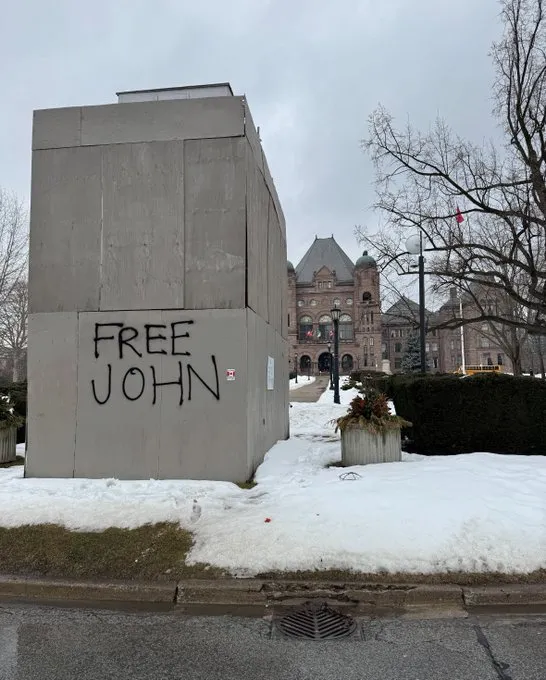
“Free John” spray painted on the plywood boards covering the statue of Sir John A. MacDonald in Queen’s Park Toronto.
It’s not just historical content distorted by bad actors, it is the entire way history is thought about, taught, and used to legitimize all sorts of nefarious agendas, which forms a broader set of concerns. For instance, a Toronto man recently found himself in trouble over a meaningful act of non-destructive civil disobedience involving a monument to a beloved and needlessly contentious Canadian historical figure. Daniel Tate is an ardent patriot and founder of a civic advocacy group called IntegrityTO, who describe themselves as “a coalition of concerned citizens who want to restore integrity-driven leadership so that Toronto can be a great city once again”. In a minor act of public vandalism, and in a moment of frustration over the disrespect shown to Canada’s boxed up father of confederation, Tate spray painted “Free John” on the plywood hoarding covering the statue of Sir John A. Macdonald at Queen’s Park in Toronto. No paint touched the statue itself, just the plywood that hides it away from the public, and protects it from the angry and destructive social justice mob.
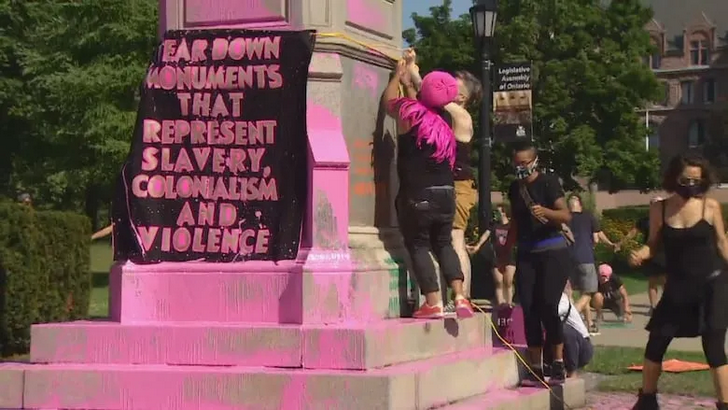
Sir John A’s Queen’s Park statue initially became the unseen centerpiece of the current unsightly plywood enclosure after an incident which took place in 2020; three radical social justice activists splashed it with pink paint. It is worth pointing out that this cherished monument to the father of confederation was first installed in 1894. And although Black Lives Matter activists Daniel Gooch, Danielle Smith, and Jenna Reid initially found themselves in hot water over their costly and disrespectful acts of public vandalism (they also painted statues of Egerton Ryerson and King Edward VII Equestrian), all charges were withdrawn in 2021. In their statement to the media the group said, “along with a coalition of artists, the group artistically disrupted statues of slaveholders and monuments to colonialism at Ryerson University and at Queen’s Park”. One would think Daniel Tate should be extended the same leniency for his “artistic disruption”.
Image of Black Lives Matter activists vandalizing the Queen’s Park statue of Sir John A. MacDonald, (via CBC)
As it stands, Tate has been criminally charged with mischief under $5000 which carries a maximum penalty of two years in prison. Still in the preliminary stages, his next court appearance is scheduled for June 30.
Last month Tate appeared on AM 640’s The Oakley Show where he remarked, “The sad irony of it, people were defacing and vandalizing national monuments with impunity … four or five years ago. No Charges. We were all watching aghast at how this was all happening. And, it was acceptable somehow. And here I am five years later. I didn’t even deface a statue or a monument, it was literally a piece of plywood – the cheapest plywood you could find. And now I’m clogging the criminal justice system with this completely frivolous charge.”
While covering Tate’s case, independent journalist Daniel Bordman said, “This is a great example of 2-Tier policing because if he wrote Free Palestine instead he’d probably be given the key to the city”. And journalist Anthony Furey posted the following on X: “There has been so much lawlessness and disorder on Toronto streets in recent years that goes totally unchecked … But if you write FREE JOHN on a boarded up statue of Sir John A, police handcuff and arrest you on the spot – which is what happened to Daniel Tate the other week”.
This begs the question, if security was on-site to arrest Tate in the immediate moments that followed his minor spray paint transgression, why does Sir John A. need to be boxed up at all? One security guard around the clock would suffice. Does the Queen’s Park premises not already have security? It appears they keep a close eye on Sir John A’s unfortunate wooden container. So, why not free John? Beef up security a little if necessary, but let our first Prime Minister once again be visible and unadulterated in his rightful place of honour. For the sake of our blessed Holy Peter, it’s been five bloody years!
Comments Off on Hiding Sir John A. from the woke mob
(A Few of) The Many Faces of the Dutch M95 Carbine
Forgotten Weapons
Published 16 Jun 2015When the Dutch military adopted the M95 Mannlicher rifle, they made a rifle for standard infantry, and a variety of carbines for specialist troops. These included artillery, cavalry, bicycle, engineers, and colonial service carbines. During World War I they attempted to standardize these and reduce the number of different designs, but met with only limited success. By the time World War II began, there were at least 13 different variants of M95 carbine in service with the Dutch military.
Comments Off on (A Few of) The Many Faces of the Dutch M95 Carbine
QotD: The Gracchi
Tiberius and Gaius Gracchus’ tribunates – both of which ended with them being killed (I think it is perfectly fair to say “murdered”) – typically occupy a position in survey coverage of the Roman Republic as the inciting incident that begins (if not quite causes) the collapse of the Republic itself, the first outbreak of violence in Roman politics, the first escalation in a spiral that would lead to the repeated outbreak of civil war in the first century. And that is certainly how they were understood in antiquity; both Plutarch and Appian make this claim (App. BCiv. 1.17; Plut. Ti. Gracch. 20.1). And in part because the sources (again, Plutarch and Appian) frame the Gracchi quite positively and in part, to be frank, because their reforms are generally “left-coded” in a university environment that is inherently sympathetic to left-coded things, the Gracchi tend to come across to students as righteous reformers killed by foolish, hidebound and greedy reactionary Roman senators. And that is, to be fair, a potentially valid reading (if employed with some caveats).
But it is also generally the only reading students get and it is not the only valid reading of the evidence we have. So for this week, I want to complicate the Gracchi, presenting some of the details that often get left out of introductory surveys. In particular, we’re going to discuss the problems that Tiberius Gracchus’ key law, the Lex Sempronia Agraria was designed to solve and I am going to argue that Tiberius was attempting to solve a problem that didn’t exist (though he couldn’t have known it), a view which is now quite common in the scholarship but almost entirely absent in how we tend to teach the Gracchi.
But more to the point, I am going to argue that Tiberius and Gaius Gracchus’ behavior did, in fact, violate the norms of the Republic and that it was not entirely unreasonable for the senatorial elite to conclude these men, in their unrestrained and nakedly ambitious approach to politics, represented a real threat to the Roman political order and that they might be aiming for something approaching a “soft coup” in the context of a political order whose features – including the democratic ones – worked through an unwritten constitution of norms (what the Romans called the mos maiorum, “the customs of the ancestors”), which both brothers actively undermined. The claim that the Gracchi threatened to make themselves tyrants was not an empty claim and that is the dark reflection of their role as well intentioned reformers.
In short, then, if the only version of the Gracchi you have encountered is that of the near-saintly, then martyred proto-progressive reformers, that’s not quite the complete picture (and the left-coding of their ideas is decidedly anachronistic). Naturally, in trying to complicate this picture, I am essentially taking the position of prosecutor, so this “take” is going to be far more negative on the Gracchi than how I would, say, teach them in class or, indeed, how I regard them myself.
So the way we’re going to approach this problem is first to discuss the problem that Tiberius Gracchus thought he was addressing (and some of the issues there), before walking through the means he used to push forward the Lex Sempronia Agraria. Then I want to look at some of the wide-ranging laws proposed by Gaius Gracchus to assess the degree to which those laws cohere and ways we might understand his program and actions, potentially rather more negatively.
Bret Devereaux, “Collections: On the Gracchi, Part I: Tiberius Gracchus”, A Collection of Unmitigated Pedantry, 2025-01-17.
Comments Off on QotD: The Gracchi
May 11, 2025
Why Yugoslavia Fell in Just 11 Days?
World War Two
Published 10 May 2025In this Fireside Chat, Indy and Sparty answer questions on the German invasions of Yugoslavia and Greece. Why did the Yugoslav state fall so quickly? Why were the Greeks able to hold out so much better? And why was the airborne assault on Crete so chaotic on both sides?
(more…)
Comments Off on Why Yugoslavia Fell in Just 11 Days?
History of Britain, I: Hail Prettanike! Early References to the British Isles
Thersites the Historian
Published 6 Jan 2025The natural starting point for examining the history of Britain is to look at how the island and its inhabitants first entered the historical record.
Comments Off on History of Britain, I: Hail Prettanike! Early References to the British Isles
May 10, 2025
How did ancient people travel without maps? | How did they imagine the world?
Historia Militum
Published 15 Nov 2024Today we are straying away from the Roman military, but only a bit! Travel and Geography is still a very important aspect to understand when thinking about the military logistics of the Roman Empire, but it was just as important for its administration and civilian life. This video explains why most pop culture and visual depictions of Roman maps are wrong!
Scale Maps? (0:00)
Case 1: The Island Mosaic (2:55)
Case 2: Notitia Dignitatum (3:38)
Case 3: Madaba Mosaic (4:10)
Travel itineraries (5:07)
Cursus Publicus (8:06)
The Antonine Itinerary (8:47)
Galen’s Adventure (10:10)
Milestones (13:25)
Crossroads and visual itineraries (14:56)Small mistake! At 16:36, I meant to say “topological” diagrams, which disregard the accuracy of both scale and direction. “Topographical” diagrams, on the other hand, are very much to scale!
Primary Sources:
Historia Augusta, Alexander Severus 45, 2–3
Galen, De simplicium medicamentorum temperamentis 9Secondary Sources:
Adams, C., & Laurence, R. (Eds.) (2001). Travel and Geography in the Roman Empire
The Antonine Itinerary by Bernd Löhberg: https://www.tabulae-geographicae.de/e…
Comments Off on How did ancient people travel without maps? | How did they imagine the world?
May 9, 2025
Nazi vs. Nazi – The Rebellion Within – Rise of Hitler 16, April 1931
World War Two
Published 8 May 2025April 1931 plunges Hitler’s Nazis into crisis as SA leader Walter Stennes leads a dramatic internal revolt, challenging Hitler’s oath to legality. Meanwhile the Nazis loose their only ministerial post and President Hindenburg’s emergency decree intensifies clashes with communists, leading to mass arrests during banned protests.
(more…)
Comments Off on Nazi vs. Nazi – The Rebellion Within – Rise of Hitler 16, April 1931
Steyr AUGs of the Falkland Islands Defense Force
Forgotten Weapons
Published 8 Jan 2025The Falkland Islands Defense Force is a small organization independent of the British military, run directly by the Falkland Islands government. When it decided to update its small arms form the L1A1 SLR (aka British FAL) in the early 1990s, the British assumed they would purchase the new L85A1 rifles. However, by that time the flaws in the L85 were pretty well known, and the Islanders exercised their independence and chose to adopt something different. After investigating a number of different options they chose to use the Steyr AUG. At this time the AUG was in service with a number of other nations including the Australians and New Zealanders, and Steyr offered good terms and good support for the FIDF.
The FIDF purchased about 160 AUG rifles in total, including a small number of carbines and heavy-barreled LMGs. The carbines were particularly useful in a maritime role, which was part of the FIDF mission at the time (fisheries patrol). The LMG version, fitted with an Elcan C79 4x optic, was intended to supplant the FN MAG as a support weapon, but was found unfit for that role. Instead, most of the LMGs were converted to standard rifles via simple barrel swap. In addition, the Elcan optics proved prone to breakage, and were eventually replaced with British SUSATs. Indeed, some of the standard AUGs had their factory scopes replaced with SUSATs as well.
The AUG remained the standard rifle for the FIDF until recently, when the service received L85A3 rifles from the British. The AUG was not configured to use the bullet-trap blank adapters that the British used, and the L85s were intended to allow better integrated training between the two forces. A formal replacement for the AUG has not yet been determined, as it remains a bit unclear what the British military will decide to do to replace the L85 in the coming years.
Many thanks to the FIDF for giving me access to their armory to dig out these rifles to film for you! They remain today a small but quite well-equipped all-volunteer force dedicated to maintaining the security of the Falkland Islands.
(more…)
Comments Off on Steyr AUGs of the Falkland Islands Defense Force
May 8, 2025
Aftermath
I’ve read a few books on what happened in Europe after the surrender of Nazi Germany in May of 1945, but there is always more to learn about a continent-wide struggle to recover from a disaster of the magnitude of World War Two:
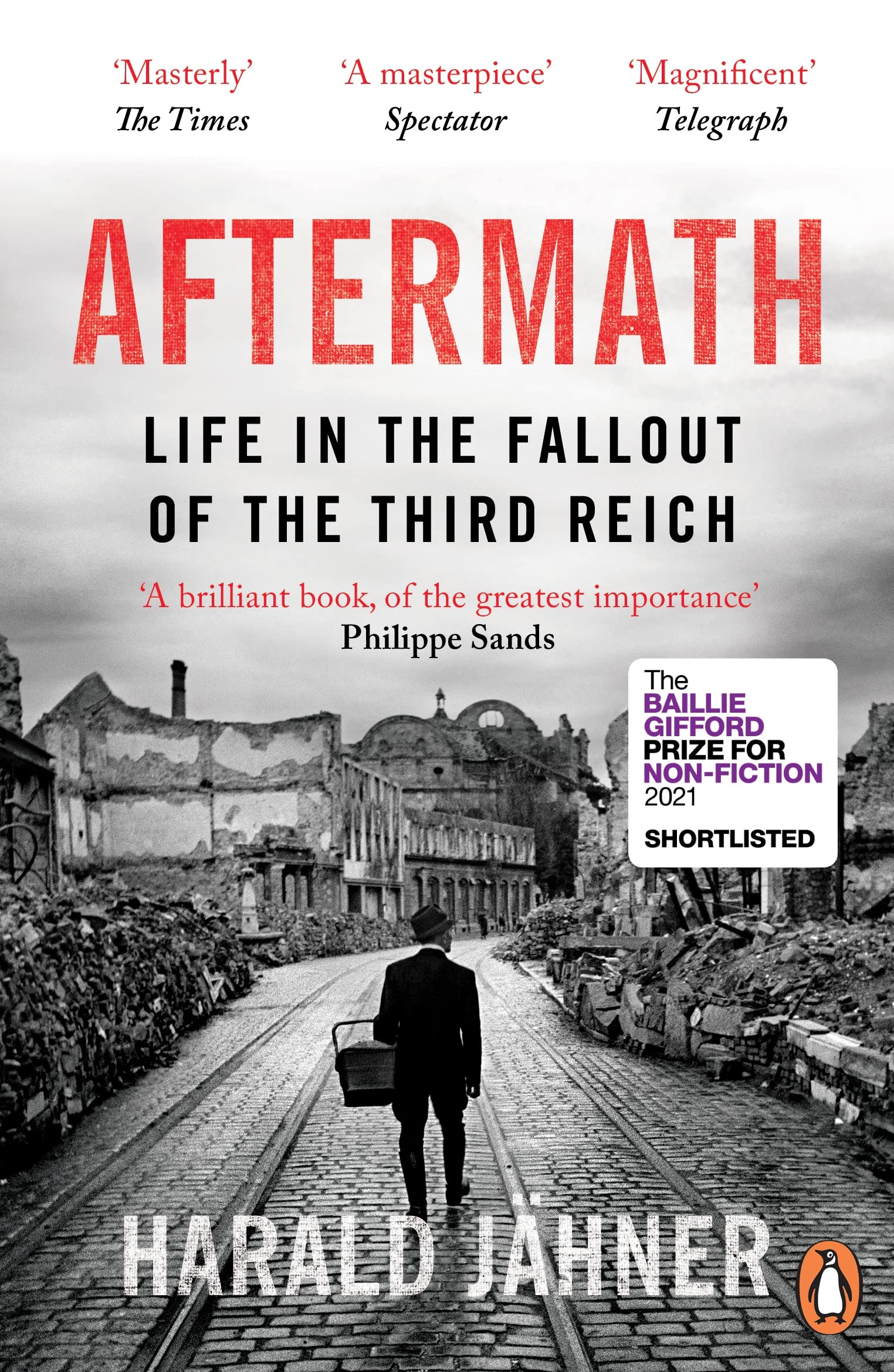
On a train journey earlier this year between Cologne and Berlin, I began to read Harald Jähner’s Aftermath, a fascinating account of the years when Germany emerged from the destruction and shame of the Third Reich.
The war ended 80 years ago today, and in the defeated nation the scenes were primeval and apocalyptic. In Berlin, journalist Ruth Andreas-Friedrich, along with a doctor, actor and musical conductor, discovered a white ox wandering through the streets and, after finding a Russian soldier to shoot it, found themselves suddenly surrounded by a ravenous mob. She recalled: “Suddenly, as if the underworld had been spying on them, a noisy crowd gathered around the dead ox. They crept from a hundred basements. Women, men, children. Were they lured by the smell of blood? Within minutes they were scrambling for meat.” The bourgeois of Middle Europe reduced to an animal state.
Germany was a pile of rubble; the ruins in the Reich‘s capital amounted to 55 million cubic metres, enough for a wall 30 metres wide and 5 metres high stretching all the way to Cologne. In West Berlin, for the next 22 years, up to 800 lorries a day unloaded so much rubble on the former Factory of Armaments Technology that it became known as Teufelsberg, or Devil’s Mountain. The last “rubble brigade” in Dresden only finished work in 1977.
Although Nazi party members were made to clear rubble as a punishment, the Germans hardly needed encouragement; on 23 April, the war not yet over, the municipal building of Mannheim had already declared WE ARE REBUILDING.
The communal process of clearing away seemed to serve a psychological function for a hungry, defeated people, and was encouraged by the new authorities — all the “heroic cinematic rhetoric” employed by the UFA film company of the Nazi regime now used to get the country clearing up. There was even a cinema genre called Trümmerfilm, rubble films, one — And The Heavens Above Us — ending with the Lord’s Prayer being recited among the ruins of Germany.
German POWs, “dispirited, disciplined and dutiful to the point of submissiveness”, made life easy for occupying soldiers while their former victims were far more troublesome. (Russian POWs in France caused such anarchy that they called in a Soviet liaison officer who selected ten at random and shot them, bringing the mob under control.) This led to a bizarre alliance between Allied and German law enforcement working hand-in-hand from the early days of the occupation, with joint raids and weapons searches on displaced persons from Poland and the Soviet Union, which the Poles and Russians “of course saw as an intolerable provocation”.
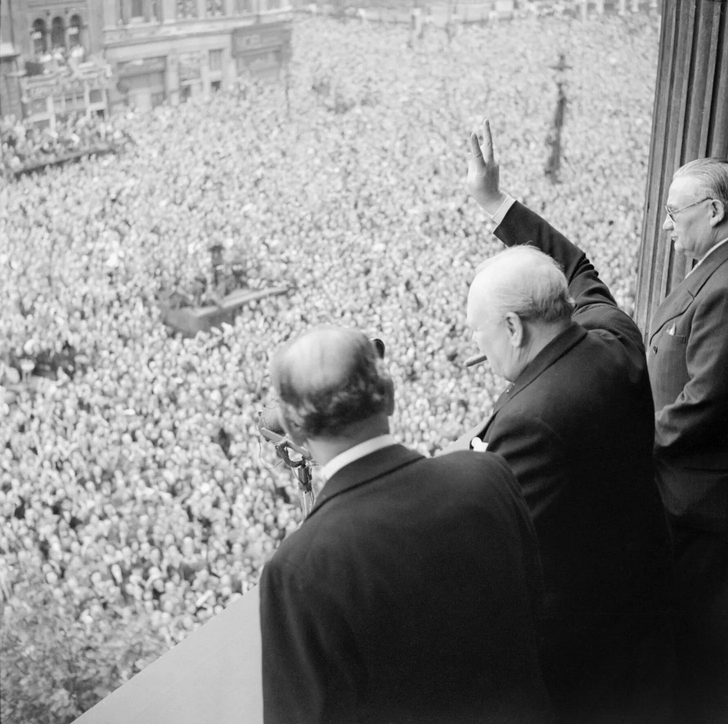
London cheered on May 8, 1945. In Berlin they searched for food and cleared rubble
In a strange irony, there was now a large-scale migration of Jews from Poland to Germany, fleeing fresh persecution despite the horror they had endured. Even here in a camp system under Allied control, there were anti-Semitic attacks from other survivors, so that Jews were eventually separated altogether following the conclusions of the Harrison Report. The Americans, in a likely first in European history, now made Jews an explicitly privileged group, with superior camp conditions.
The Polish Jews set up their own camp in the Munich district of Bogenhausen where locals were confused and disorientated by the new arrivals. These eastern Jews actually looked like the alien caricatures Nazi propaganda had bombarded them with, dressed in oriental clothes from the shtetl, totally unlike the assimilated German Jews they had grown up with. One local complained that “the Jews from the old days were really, how can I put it, very intelligent, polite and unusually friendly and elegant people. And of course the ones who turned up after the war included all sorts.” The Jews “from the old days” were “the good Jews”, he lamented.
Holocaust guilt was in the distant future for most, and newly re-established newspapers weren’t remotely shy about publishing anti-Semitic content. One printed a resident’s complaint about Polish Jews that “these were not people who had been persecuted” but “the sputum, the yeast and the scum of elements who were never deported but, to avoid regular work, came here from the eastern states, in many cases completely illegally, and are now spreading themselves raggedly about the place.”
Comments Off on Aftermath
Dambusters – Was It Worth It?
HardThrasher
Published 5 May 2025The third and final part in a series on the Dambusters Raid; looking at the attacks themselves and their aftermath
(more…)
Comments Off on Dambusters – Was It Worth It?
Ted Gioia is apparently “the guy you consult about the total collapse of everything“
I’ve been reading Ted Gioia‘s work for a few years now, but I somehow failed to pick up on the fact that he’s some kind of Bond supervillain:
Many articles have been written about me over the years. But I’ve never been hit with an opening sentence like the one published on Monday by The Atlantic.
Last year, I visited the music historian Ted Gioia to talk about the death of civilization.
Whoa! That makes me feel like a Bond villain.
I need some henchmen — any volunteers?
Ted appears to like the classic goon uniforms for his to-be-recruited legion of minions.
What an unexpected turnabout! For many years, I was known as an expert on music, especially jazz and blues.
But now I’ve taken on a new guise. I’m the guy you consult about the total collapse of everything.
I don’t sing the blues. I don’t write about the blues. I now deliver the blues.
I originally declined the interview request from The Atlantic. But their staff writer Spencer Kornhaber pushed back, insisting that I was an essential source for his article.
The subject was, he explained, a “pervasive suspicion that we’re in an era of cultural decline, especially in arts and entertainment”.
He said that I needed to be part of the story — because everybody saw me as the decline-of-culture guy.
This caught me surprise. But I thought it over. maybe this is why I don’t get invited to many parties anymore.
Dammit, Ted, we’re trying to have some fun here — and you keep droning on about the collapse of the Roman empire.
I eventually agreed to a phone conversation with Spencer, and that went well. And this led to him getting on a plane, and visiting me at home here in Austin.
To help him in his research, I laid out more than 40 books on a countertop in my library — these were essential works, I explained, for anyone studying social or cultural decline.
[At a future date, I will provide more details about these books, and share a reading list on — to quote The Atlantic — the “death of civilization”.]
But this begs the question: Is our culture really collapsing?
I spoke with Spencer for many hours about this subject. But only a few of my comments found their way into the finished article.
So today I’ll offer a fuller diagnosis for your benefit.


Comments Off on Ted Gioia is apparently “the guy you consult about the total collapse of everything“
Augustus and the creation of the Principate – The Conquered and the Proud 13
Adrian Goldsworthy. Historian and Novelist
Published 11 Dec 2024Continuing the series “The Conquered and the Proud”, this video looks at the political system created by Augustus — the Principate or rule of a princeps or “first”. We look at the twin elements of his formal power, the tribunician potestas and the maius imperium proconsulare. Next time we we look at Augustus, the provinces and imperial expansion.
Comments Off on Augustus and the creation of the Principate – The Conquered and the Proud 13


