
Who was Gaius Marius’ son, and how did he set out to bring down his father’s rival, Sulla? Which two rising stars in Sulla’s faction, Crassus and Pompey, would go on to bring down the Republic, with Julius Caesar? And, how did a momentous battle in the East see Sulla elevated to the master of Rome?
Join Tom and Dominic as they reach the climactic conclusion to the remarkable rise of one of Rome’s greatest generals: Lucius Cornelius Sulla, a man who would destroy his rivals, win victories in the east, and ruthlessly change the destiny of the Roman Republic forever.
0:00 The Roman Republic Implodes
0:40 Sulla’s Return
3:05 Cinna and the Marians
8:03 Cinna’s Disastrous Plan
12:20 Sulla’s Enemies Collapse
14:07 Crassus Joins Sulla
17:01 The Rise of Pompey
21:16 Marius the Younger
24:13 The Marian Cause Collapses
25:03 The Samnites March on Rome
26:03 The Battle of the Colline Gate
28:45 Anthropic
29:57 Sulla Takes Control of Rome
35:05 The Proscriptions Begin
41:18 The End of the Marians
42:41 Pompey the “Teenage Butcher”
44:20 Pompey Demands a Triumph
47:28 Sulla’s Great Paradox
48:02 Sulla Becomes Dictator
51:27 Rebuilding the Republic
54:00 Sulla Gives Up Power
55:30 Sulla’s Wild Retirement
58:42 The Death of Sulla
59:58 Did Sulla Doom the Republic?
1:01:54 Why Didn’t Sulla Become Emperor?
1:02:46 Julius Caesar Learns from Sulla
1:04:01 Cicero Bonus Episode
September 12, 2026
How the Roman Republic Collapsed Into Civil War
Model 1867 Trapdoor: A Unique Rifle for West Point Cadets
Forgotten Weapons
Published 24 Apr 2026When the US military academy at West Point opened in 1802, one of the things it did was train cadets in rifle drill. The cadets were as young as 14 at that time, and the standard US infantry rifle was quite long and heavy, and it was not well suited to cadet use. A series of shortened and converted rifles were used until 1830, when Springfield made its first model of rifle specifically for the cadets. From that year forward, each new service rifle was accompanied by a slightly smaller version for West Point. In 1867 the first Trapdoor Springfield (aka Allin conversion) cadet rifle was introduced.
The 1867 Cadet Trapdoor was unusual in that it was not a shortened version of the regular rifle. Instead, it used a whole bunch of unique parts, including a different lock plate, hammer, and breechblock. The barrel was reduced to 29 3/4 inches, it used the .50-55 cartridge, and it had no provision for sling swivels. Only 424 of these rifles were made before a new cadet model was introduced in 1869 which used standard parts. Two further Cadet models of the Trapdoor would follow in 1873 (the .45 caliber change) and 1884 (change to sights and other details), and these were the last cadet rifles made by Springfield. The next rifle after the 1884 Trapdoor was the Krag-Jorgenson, and by this time minimum age at West Point was up to 17 and the Krag was a much handier rifle to begin with — so a Cadet model was not necessary.
The American Society of Arms Collectors has an excellent paper on Cadet rifles written by David Hanes, which is publicly available here:
https://americansocietyofarmscollecto…
(more…)
September 11, 2026
“The Army we have is not the Army we need”
The Canadian Army is re-organizing and the most visible sign of the new organization is the reconstitution of the 1st Canadian Division:

Formation patch for the 1st Canadian Division during the First World War.
On Sept. 10, the Canadian Army undergoes one of the largest changes in its history as it transitions from divisions responsible for geographic regions in Canada to divisions with purpose-driven mandates.
“The Army we have is not the Army we need“, said Lieutenant-General (LGen) Michael Wright, Commander of the Canadian Army, in Inflection Point 2025, which laid out the rationale for and plan to launch a full-scale modernization of the Canadian Army.
This means 3rd Canadian Division, which has represented Western Canada for nearly 40 years, will be stood down on Sept. 10.
In its place will stand up 1st Canadian Division, which will assume command of the Canadian Army’s three Regular Force brigade groups — 1 Canadian Mechanized Brigade Group (1 CMBG), 2 CMBG and 5 Groupe-brigade mécanisé du Canada (5 GBMC) — and 6th Canadian Combat Support Brigade (6 CCSB), the brigade designed to enable the rest of the Army to conduct its operations. In addition, 1st Canadian Division will also assume command over three newly formed formations: 1st Canadian Artillery Brigade, 1st Canadian Sustainment Brigade and 3rd Canadian Light Infantry Regiment.
It’s all part of a push to move the Army away from “contribution warfare,” explained LGen Wright on the Feb. 4 edition of the Canadian Army Podcast. Going forward, the goal is to equip and position the Army to be capable of participating in major combat operations as an equal partner.
If you, like me, were wondering where the 3rd Canadian Light Infantry Regiment came from, it’s composed of existing battalions from the other regular infantry regiments, reducing them each to just their first and second battalions:
The first of the three new formations being stood up as part of 1st Canadian Division is 3rd Canadian Light Infantry Regiment, which is a reassignment of existing units. The third battalions from the Princess Patricia’s Canadian Light Infantry, Royal Canadian Regiment and Royal 22e Régiment will be brought together to form the new regiment. LGen Wright explained the new formation will “ensure [the Army is] able to respond with high-readiness forces at scale”.
I’m sure there’ll be no morale issues at all with three battalions-worth of trained infantrymen being rebadged to a brand new unit with no history, traditions, or battle honours. And I’m sure we needed a few more combat postings for Colonels kicking around with nothing much to do …
Capturing 9/11: Bill Biggart’s Final Images
Imperial War Museums
Published 2 Sep 2026On 11th September 2001, photojournalist Bill Biggart headed to the World Trade Center to document the unfolding attacks. Bill Biggart tragically passed away when the North Tower collapsed, but he left behind a remarkable final record of the day. Featuring testimony from his widow, Wendy Doremus, and photographs recovered from the damaged camera found in the rubble, this film tells the story behind some of the last images taken at Ground Zero, now available to see at IWM London.
00:00 The Morning of 9/11
01:06 Bill goes to Lower Manhattan
01:25 The South Tower is Hit
03:08 The South Tower Collapses
03:57 Bill Photographs the Emergency Workers
04:48 The North Tower Collapses
05:57 Bill’s Last Ever Photo
06:09 The Days After 9/11
07:30 Finding His Cameras and Photos
09:10 Visit Bill’s Photos at IWM LondonVisit the 9/11 Photography Display at IWM London: https://www.iwm.org.uk/visits/iwm-lon…
“Let’s roll!”
Mark Steyn on the Neil Young song — yes, that Neil Young — that best captured the events on Flight 93 on the eleventh of September, 2001:

“Plumes of smoke billow from the World Trade Center towers in Lower Manhattan, New York City, after a Boeing 767 hits each tower during the September 11 attacks.”
Photo by Michael Foran via Wikimedia Commons.
[T]here was one striking exception to the stultifying conformity of cultural critique, one lonely example of an A-list star confronting a specific 9/11 event head-on and offering his voice in full-throated support of authentic American heroism. Even more impressively, it came from a Canadian — and at a time when Jean Chrétien’s ministry was mostly engaged in petty sniping about alleged offenses to its amour propre. When I was, oh, fourteen years old I saw Neil Young with Crosby, Stills, Nash & … plus his compatriot Joni Mitchell and The Band. And to be honest in the intervening decades I can’t say I gave Neil Young much thought — and, whenever I’ve chanced to be tootling around and “After the Gold Rush” or “Heart of Gold” comes on the radio, I’m reminded of why I haven’t much missed him. Nevertheless, just a few weeks after September 11th, Neil Young offered a new song that took its inspiration from what I called in the papers that week “the only good news of the day” — the turn of events on Flight 93, the fourth plane, the one supposedly headed for the White House or the Capitol or Camp David that Tuesday morning but whose passengers rose up and overpowered the hijackers. Flight 93 crashed in a Pennsylvania field, but its fallen heroes saved hundreds of lives, including perhaps the Vice-President’s or multiple congressmen, and denied Osama bin Laden an even more iconic remaking of the Washington skyline and the symbolic (and potentially actual) decapitation of the Great Satan. Todd Beamer’s last words, heard by a GTE telephone operator to whom he’d been speaking, were, “Are you ready, guys? Let’s roll!”
It was hard to credit from the disposition of even moderate Democrats just a couple of years later; but Young, a very leftie celebrity, was genuinely moved by Lisa Beamer’s account of her husband’s sacrifice. As he put it:
She was talking about how he always used to say that (‘let’s roll’) with the kids when they’d go out and do something, that it’s what he said a lot when he had a job to do. And it’s just so poignant, and there’s no more of a legendary, heroic act than what those people did. With no promise of martyrdom, no promise of any reward anywhere for this, other than just knowing that you did the right thing. And not even having a chance to think about it or plan it or do anything – just a gut reaction that was heroic and ultimately cost them all their lives. What more can you say? It was just so obvious that somebody had to write something or do something …because it’s just such a great image – the whole story about the heroism of the passengers on Flight 93. I think it’s a legendary story that’s gonna go down through the ages; it’ll never be forgotten.
It was indeed “just so obvious”, and for writers there are two reactions to that: you jump on it and write it immediately — as a book, a play, a poem, a movie — or you figure some other guy must surely have got to it. Except in this case no one did. Neil Young was perhaps being too naïve with regard to contemporary culture’s ambivalence about unabashed heroism. So he waited, and waited. “I was very surprised,” he said, “that I didn’t hear any songs.”
And eventually he got tired of waiting. “So, I just wrote it. I couldn’t stop it anymore.” He took Todd Beamer’s catchphrase, turned it into a song title, and sang it out for real — no playing for irony or nuance.
Neil Young’s “Let’s Roll” is a dark, driving anthem that begins with a church organ (Young’s own, acquired in Europe) and over its ominous drone the sound of cellphones ringing. That was the most important weapon the passengers had: the mobile telephone. By all accounts, the hijackers of Flight 93 weren’t exactly the cream of Osama’s toxic crop. The flight was halfway across the continent before the boobs made their move and started meandering back east to their target. It was getting on for 9.30 on that Tuesday morning. By the time the passengers began calling home, their families were aware of what had happened at the World Trade Center. Unlike those on the earlier flights, the hostages on 93 knew they were not on a conventionally hijacked aircraft bound for Cuba or Libya, but were conscripts on an airborne missile intended to kill thousands of their fellow citizens. So, unlike the earlier passengers, they understood the FAA’s cobwebbed 1970s hijack procedures would not save them. The terrorists took charge at 9.28am. The pushback started at 9.57. In those 29 minutes, ordinary American citizens decided that, if they had to die, they would die as warriors. Put yourself in their shoes, on those phones, in that time-frame. Neil Young does, and, after the plaintive unanswered phones, and the organ, and a bit of guitar, an aged rock star’s familiar rasp captures the moment:
I know I said I love you
I know you know it’s true
I got to put the phone down
And do what we gotta do…The song can’t be said to be of much melodic interest. In those first four bars, 17 of the 27 monosyllables are all set to the same single note: “know I said”, “love”, “I know you know”, “I got to put”, “phone”, “do what we got”, and what follows plonks along in the same vein. It’s what Sammy Cahn used to call “the kind of tune a lyricist writes”; the words are set as you’d expect, without any of the great transformative intervals that can give a bi-syllable a power way beyond what it would have as mere speech. But it’s urgent speech, and the track is great. At the time Young was working on an album with Booker T and the MGs, and in the studio one day unveiled the song to the guys somewhat sheepishly. Booker T Jones liked it. “You don’t have to figure out what to do on a song like that,” he said. “We were just able to pull it off.” He and the MGs aren’t much into vocals (as you’ll know from “Green Onions” and “Time is Tight” and their other killer instrumentals), but they gamely provide the old croaker with some discreet background support here. And of course Jones’ Hammond organ and Donald “Duck” Dunn’s bass keep driving the narrative relentlessly forward. Above the band, Neil Young distills the essence of those last, haunting cell conversations in a way few songwriters had either the courage or the inclination to do.
The Ancient Greeks 05 – The Greeks Fight Back 4 – Liberation to Empire
seangabb
Published 1 Apr 2026Greece: A Brief History, c.700 BC – 500 AD
What happens when victory creates power?
In this final lecture on the Persian invasion, we examine the consequences of Greek victory — and the transformation of liberation into empire. With the Persians driven out, unity collapses. Athens and Sparta begin to diverge, and a new political order emerges in the Greek world.
We explore:
– The rebuilding and fortification of Athens
– Themistocles and the rise of Athenian naval power
– Spartan suspicion and the fall of Pausanias
– The ostracism and exile of Themistocles
– The creation of the Delian League
– The transformation of alliance into Athenian empireThis lecture shows how victory over Persia leads directly to the rise of Athens — and to the tensions that will eventually produce the Peloponnesian War.
QotD: Sherman on some military lessons learned during the American Civil War
Very few of the battles in which I have participated were fought as described in European text-books, viz., in great masses, in perfect order, manœuvring by corps, divisions, and brigades. We were generally in a wooded country, and, though our lines were deployed according to tactics, the men generally fought in strong skirmish-lines, taking advantage of the shape of ground, and of every cover. We were generally the assailants, and in wooded and broken countries the “defensive” had a positive advantage over us, for they were always ready, had cover, and always knew the ground to their immediate front; whereas we, their assailants, had to grope our way over unknown ground, and generally found a cleared field or prepared entanglements that held us for a time under a close and withering fire.
Rarely did the opposing lines in compact order come into actual contact, but when, as at Peach-Tree Creek and Atlanta, the lines did become commingled, the men fought individually in every possible style, more frequently with the musket clubbed than with the bayonet, and in some instances the men clinched like wrestlers, and went to the ground together. Europeans frequently criticized our war, because we did not always take full advantage of a victory; the true reason was, that habitually the woods served as a screen, and we often did not realize the fact that our enemy had retreated till he was already miles away and was again intrenched, having left a mere shirmish-line to cover the movement, in turn to fall back to the new position.
Our war was fought with the muzzle-loading rifle. Toward the close I had one brigade (Walcutt’s) armed with breech-loading “Spencer’s”. The cavalry generally had breach-loading carbines: “Spencer’s” and “Sharp’s”, both of which were good arms.
The only change that breech-loading arms will probably make in the art and practice of war will be to increase the amount of ammunition to be expended, and necessarily to be carried along; to still further “thin out” the lines of attack, and to reduce battles to short, quick, decisive conflicts. It does not in the least affect the grand strategy, or the necessity for perfect organization, drill, and discipline. The companies and battalions will be more dispersed, and the men will be less under the immediate eye of their officers, and therefore a higher order of intelligence and courage on the part of the individual soldier will be an element of strength.
When a regiment is deployed as skirmishers, and crosses an open field or woods, under heavy fire, if each man runs forward from tree to tree, or stump to stump, and yet preserves a good general alignment, it gives great confidence to the men themselves, for they always keep their eyes well to the right and left, and watch their comrades; but when some few hold back, stick too close or too long to a comfortable log, it often stops the line and defeats the whole object. Therefore, the more we improve the fire-arm the more will be the necessity for good organization, good discipline and intelligence on the part of the individual soldier and officer.
There is, of course, such a thing as individual courage, which has a value in war, but familiarity with danger, experience in war and its common attendants, and personal habit, are equally valuable traits, and these are the qualities with which we usually have to deal in war. All men naturally shrink from pain and danger, and only incur their risk from some higher motive, or from habit; so that I would define true courage to be a perfect sensibility of the measure of danger, and a mental willingness to incur it, rather than that insensibility to danger of which I have heard far more than I have seen.
The most courageous men are generally unconscious of possessing the quality; therefore, when one professes it too openly, by words or bearing, there is reason to mistrust it. I would further illustrate my meaning by describing a man of true courage to be one who possesses all his faculties and senses perfectly when serious danger is actually present.
Modern wars have not materially changed the relative values or proportions of the several arms of service: infantry, artillery, cavalry, and engineers. If any thing, the infantry has been increased in value. The danger of cavalry attempting to charge infantry armed with breech-loading rifles was fully illustrated at Sedan, and with us very frequently.
So improbable has such a thing become that we have omitted the infantry-square from our recent tactics. Still, cavalry against cavalry, and as auxiliary to infantry, will always be valuable, while all great wars will, as heretofore, depend chiefly on the infantry. Artillery is more valuable with new and inexperienced troops than with veterans. In the early stages of the war the field-guns often bore the proportion of six to a thousand men; but toward the close of the war one gun, or at most two, to a thousand men, was deemed enough.
[…]
It was one of Professor (Dennis Hart) Mahan’s maxims that the spade was as useful in war as the musket, and to this I will add the axe. The habit of intrenching certainly does have the effect of making new troops timid. When a line of battle is once covered by a good parapet, made by the engineers or by the labor of the men themselves, it does require an effort to make them leave it in the face of danger; but when the enemy is intrenched, it becomes absolutely necessary to permit each brigade and division of the troops immediately opposed to throw up a corresponding trench for their own protection in case of a sudden sally. We invariably did this in all our recent campaigns, and it had no ill effect, though sometimes our troops were a little too slow in leaving their well-covered lines to assail the enemy in position or on retreat.
Even our skirmishers were in the habit of rolling logs together, or of making a lunette of rails, with dirt in front, to cover their bodies; and, though it revealed their position, I cannot say that it worked a bad effect; so that, as a rule, it may safely be left to the men themselves. On the “defensive”, there is no doubt of the propriety of fortifying; but in the assailing army the general must watch closely to see that his men do not neglect an opportunity to drop his precautionary defenses, and act promptly on the “offensive” at every chance.
I have many a time crept forward to the skirmish line to avail myself of the cover of the pickets’ “little fort”, to observe more closely some expected result; and always talked familiarly with the men, and was astonished to see how well they comprehended the general object, and how accurately they were informed of the state of facts existing miles away from their particular corps. Soldiers are very quick to catch the general drift and purpose of a campaign, and are always sensible when they are well commanded or well cared for. Once impressed with this fact, and that they are making progress, they bear cheerfully any amount of labor and privation.
William Tecumseh Sherman, “Sherman on Tactics”, Tactical Notebook, 2026-06-10. (Selection from Memoirs of William T. Sherman (1875) by Bruce Ivar Gudmundsson, minus an observation that sieges were now unimportant which was disproved in 1914.)
September 10, 2026
The tragedy of the commons at sea
When a valuable commodity isn’t directly owned by anyone, the incentives are for everyone to grab as much of the commodity as they can. Nobody will preserve it, because they wouldn’t get the benefit from it: it would be shared among all the other users. Fishing grounds outside coastal waters are valuable commodities that nobody owns:

Nobody owns the ocean floor off the Georges Bank, and so between 1960 and 1994 the New England cod population collapsed by roughly 70 percent while every fishing fleet on the Atlantic raced to pull up fish before a competitor did. This race is the entirely predictable consequence of absent ownership.
Garrett Hardin formalized the problem in 1968, but the mechanism is older than economics itself. When no individual owns a resource, no individual bears the full cost of depleting it. The cost gets distributed across everyone; the benefit goes straight to whoever acts first. You extract as much as you physically can before the next boat arrives. So does the next boat. The resource disappears, and everyone stands around pointing fingers at greed. The actual culprit is the property rights regime, or rather the absence of one.
State managers offer themselves as the solution: quotas, licensing boards, regulatory agencies. The Atlantic fisheries commission issued exactly these instruments. The cod is still not back. Bureaucrats lack the price signals, local knowledge, and personal stakes that make stewardship rational. A regulator who mismanages a fishery keeps his salary; an owner who does the same loses his capital.
Private ownership forces the owner to think in time. Iceland extended exclusive fishing rights to its own coastal fishermen in 1975, drove foreign trawlers out, and now holds one of the best-managed cod stocks in the North Atlantic. Property rights did what Brussels-style quota spreadsheets could not: they tied the fisherman’s future income to the health of the stock today.
Common ownership produces a sprint to zero.
Hardtack Hash from Steerage on a Victorian Ocean Liner
Tasting History with Max Miller
Published 17 Mar 2026Hash made from pulverized hardtack, salt pork, and vegetables, served with mashed potatoes
City/Region: England
Time Period: 1894Third class, or steerage, on the Titanic was served breakfast, dinner, tea, and supper, which was a major upgrade from other ships in decades past. Before this, third class passengers were given their rations, which they had to prepare and cook on their own. Sometimes they had to wait in line to use a stove, and not everyone would get a turn.
This meal hearkens back to that time. The recipe uses ingredients that were included in third class rations, and comes from a cookbook for sailors in 1894. I really can’t recommend making this. It’s … not great. There’s essentially no flavor, and the hash turns into a kind of paste in your mouth with the only texture coming from the onions. If I was really hungry and had no other options, I suppose it would be fine, but you shouldn’t feel the need to make this.
Biscuit Hash. (Cold Meat Cookery)
Ingredients
6lbs. Broken biscuits, steeped
2lbs. Cold salt beef or pork.
1/2lb. dripping.
2 onions.
1 cooked carrot.
1 cooked turnip.
1 teaspoonful pepper.
1 teaspoonful mixed spice.
Method — Chop the meat, onions, and vegetables finely; squeeze the water well out of the biscuits, and rub them through a coarse wire sieve; add all the other ingredients, and mix thoroughly. Put it into a baking tin, and brown in a moderate oven until firm. Cut into squares and serve.
— Cookery for Seamen by Alexander Quinlan and N.E. Mann, 1894
QotD: The Victorian Workhouse diet and the modern “wellness” diet
The principle behind the New Poor Law of 1834 was “less eligibility”. Life inside the workhouse had to be made worse than the life of the poorest labourer surviving outside, or people might actually choose it. Misery was the policy, and the food was central to it.
The diet was built around gruel, bread, and watery broth. Thin oatmeal porridge. Pease soup. A little cheese. Meat, where it appeared at all, appeared in quantities a working man would have laughed at, carefully weighed out on a handful of days a year. Strip a population of meat and feed it on cheap starch, and you get people who are weak, compliant, and grateful for very little. The men with the ledgers understood that completely. They wrote the smallness down, in ounces, and signed it.
Now read that menu back slowly.
Porridge to start the day. Wholegrain bread as the base of every plate. Beans and pulses for protein. Broth-based soups. Dairy in moderation. Red meat cut right back, if you have it at all.
That is the workhouse diet, almost line for line. The gruel that was once the punishment for being poor is now the breakfast of the health-conscious. The near-absence of meat, once an economy forced on people who had no say in it, is now sold to you as the enlightened, heart-healthy choice you are making of your own free will.
They worked out the cheapest way to keep a body upright and dependent, and wrote it down in ounces.
A century and a half later the same menu comes back with a wellness label on it, and this time people pay extra for the privilege.
Sama Hoole, The social media site formerly known as Twitter, 2026-06-04.
September 9, 2026
The Korean War Week 116 – Marines Fight to Hold the Line – September 8, 1952
The Korean War by Indy Neidell
Published 8 Sep 2026The “Outpost War” is in full swing this week as the fight rages for posts known simply by names like Bruce, Felix, and Gary, which are still worth dying over to both sides. Also, this week we take a look at something we haven’t covered before — the dental care of the troops.
00:00 Intro
00:55 Recap
01:57 Outpost Bruce
05:02 Bunker Hill
07:21 Relief
09:56 The War in the Skies
11:05 Dental Care
13:49 Summary
14:28 Conclusion
15:00 Call to Action
Government pension funds
If there’s anything that offends a government, it’s a big investment fund sitting there useless (that is, useless to the government, not to the beneficiaries). There’s a pattern when governments start looking interested in private pension funds:

Every pension system a government controls becomes a government slush fund. This is the historical record, not cynicism.
Argentina’s government nationalized $30 billion in private pension assets in 2008, converting workers’ individual accounts into state-controlled funds. The official rationale was protection from market volatility. The actual result was that the Kirchner administration gained a captive pool of capital to finance deficit spending. Your retirement savings, transformed into political currency.
Hungary pulled the same move in 2010, effectively confiscating $14 billion from private pension accounts under Viktor Orbán. Poland followed by seizing roughly half of private pension fund assets in 2013 to reduce its reported public debt. These are the predictable endpoint of any arrangement where the state holds custodial authority over your savings, not fringe cases.
The United States did it more slowly. Congress raided Social Security’s trust fund beginning in the 1960s, replacing actual assets with government IOUs and spending the cash on discretionary programs. The system now carries $23 trillion in unfunded liabilities. Workers who paid into it for forty years will receive whatever Congress decides to give them: a grant subject to political revision, not enforceable property.
Private ownership means enforceable claim. A pension fund you own contractually cannot be redirected to cover a budget shortfall in Buenos Aires or Budapest. The moment government intermediates between your labor and your retirement capital, political priorities start competing with your financial security. They generally win.
Socialists will do anything within their power to get their dirty paws on your hard-earned money. We should do everything we can to stop them.
QotD: Subordinate officers in pre-modern armies
One of the key divides that shows up repeatedly is the division between commoners elevated to positions of minor authority and aristocrats in positions of command. Indeed, we have this in our modern armies: this is the distinction between non-commissioned officers (NCOs) which are generally soldiers promoted from the lower ranks and commissioned officers who enter the military typically at the rank of lieutenant (or its equivalent). That system is a hold-over from the origins of modern military structure in Europe’s early-modern gunpowder armies: the commissioned officers (whose commission, to be clear, came from the king) were drawn from the aristocracy and often the nobility, while their non-comissioned subordinates were drawn from the common soldiery who were in turn recruited from the peasantry. Because no peasant could become a knight or noble (under normal circumstances) so too no sergeant could (under normal circumstances) become a lieutenant; the social orders were thus kept separate, civilian mirroring military.
But exactly where that divide occurs and its significance varies wildly. In the modern military structure, a second lieutenant, the lowest commissioned officer, typically commands a platoon of c. 40 soldiers while a sergeant typically leads a squad or section (around 10 soldiers). By contrast in the Roman army, the centurion – a senior NCO like the sergeant promoted from the common soldiers – led a century of 60-80 soldiers; more senior centurions (the primi ordines) commanded an entire cohort (480 soldiers). So the line between NCO and commissioned officer can be drawn in very different places in different societies.
Likewise an important distinction is often made around the emergence of a professional officer class (following on the emphasis made on this point by Samuel P. Huntington in The Soldier and the State (1957)) and the officers who came before which Huntington describes as “amateurs”. This is, I’d argue, a mistaken understanding of the role of military aristocrats in their societies; they were no more amateurs at war than a person born into serfdom is am amateur farmer. Neither the serf nor his military aristocrat overlord is a professional, but neither of them is an amateur either; the categories are not exclusive. Nevertheless there is a difference between truly “amateur” officers (which certainly existed), military aristocrats for whom war is a born-calling, and professional officers.
For this discussion, however, much of this complexity is beside the point. That isn’t to say it is unimportant generally (it is very important generally) but that for this topic here, we can define “officer” very broadly and so avoid having to untangle the particular social context of each military in question. Consequently we’re going to just define officer here as anyone who has command over other combatants, effectively lumping NCOs and commissioned officers (and their ancient equivalents) together. That isn’t because those distinctions are unimportant (they are important!) but because they aren’t quite relevant here, since we are really focused on how command structures enable armies to respond with ability and execute complex plans. It is command, not social status per se that we’re focused on.
Bret Devereaux, “Collections: Total Generalship: Commanding Pre-Modern Armies, Part IIIb: Officers”, A Collection of Unmitigated Pedantry, 2022-06-24.
September 8, 2026
We should stop using the terms “capitalism” and “capitalist”
On his Substack, Lorenzo Warby returns to the issue of how we describe the (theoretical) predominant economic system by which the west has risen to wealth and power using terms coined by the man who hated it more than any other:
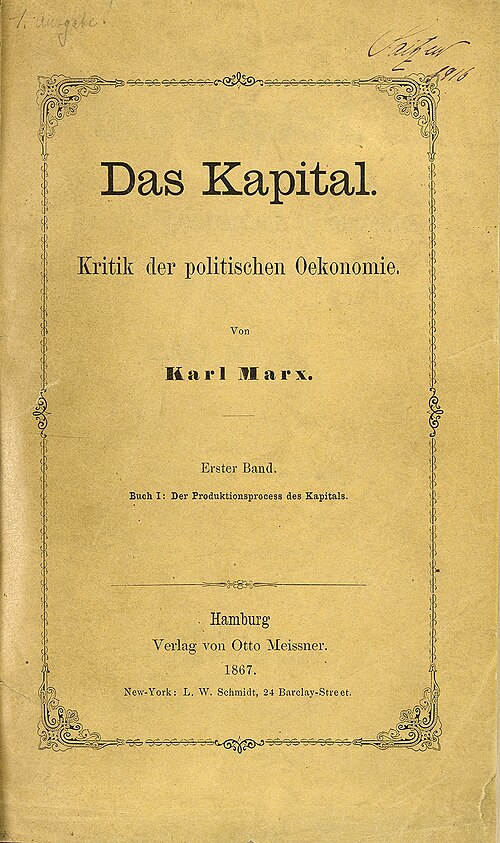
Title page of Das Kapital in the first German edition of Volume 1.
Wikimedia Commons.
It would be a great improvement to our understanding of social dynamics if people stopped using the terms capitalism and capitalist. Given how ubiquitous these terms are, this may seem a strong claim, but it is one that is easy to sustain.
The Marxist definition of capitalism is:
The socio-economic system where social relations are based on commodities for exchange, in particular private ownership of the means of production and on the exploitation of wage labour.
According to Wikipedia:
Capitalism is an economic system based on the private ownership of the means of production and its use for the purpose of obtaining profit.
The first problem is the ism. There is no role for the state here. The state becomes, implicitly or explicitly, a “reflection” of the economic system, despite the fact that people do not describe non-state societies as “capitalist” even though such societies can have lots of private ownership used for the purposes of gaining income.
Non-state societies cannot manage the scale of economic activity so as to have, for example, firms. Their economic production is overwhelmingly centred on households.
Sedentism — living in dwellings — created households that then became, for millennia, the centre of most economic activity. Even states were governed out of royal or imperial households. It is factories, and offices, that move economic activity out of households.
The mass energy-use take-off we call the Industrial Revolution has brought the arc of economic history that began with sedentism to an end. When economist Robin Hanson writes about the shift from farmer “back” to forager patterns, it is the effects of the supplanting of households from the centre of economic activity that he is pointing to (without fully grasping that).
Note that this shift away from households being central to economic activity is very much about energy use: it applies to both commerce and to state activity (including state production). It is not inherently “capitalist”.
State production also produces commodities: calling such “state capitalism” just shows how much capitalism is a ridiculously protean term.
Eliding the state
The exclusion of the state in defining capitalism is not analytically benign. A classic and continuing use of the term capitalism is to romanticise the state. By viewing the state as a “reflection” of the economic system, all bad things, all disliked features, can be based on the malign influence of “capitalists”, of the dynamics of “capitalism”, with the state reduced to an instrument or reflection of such dynamics. (The same thing can be done in reverse, blaming all bad things on the state — see anarcho-capitalism — but that is much less common.)
The natural — and used — implication of blaming private commerce for all bad things is that, if good people, with good intentions, and proper understanding, run the state, it can do anything needed for their program to be achieved. This is very obvious if one, for example, reads the program of the Democratic Socialists of America.
The term capitalism thereby becomes a vehicle for getting the state profoundly wrong; for not understanding that the state is a fundamental structuring feature of any state society; for not understanding that, across history, states have been the dominant extractor and creator of surplus, and so of class structures. That, when it comes to state societies, the state itself is fundamental.
Sulla Seized Rome… Then Marius Returned for Revenge | Rome’s First Civil War
The Rest Is History
Published 7 Sep 2026What shocking, unprecedented act did Sulla commit with his legions after having his ambitions frustrated once more by his bitter rival, the tribune Marius? How did Marius escape capture and death? And, would Marius retaliate …?
Join Tom and Dominic as they unfold the mounting rivalry between two Roman generals — Marius and Sulla — as they battle for ultimate control of the empire, and Sulla takes a fateful step that will change the fate of the Republic forever …
0:00 Sulla: The First Roman General to March on Rome
4:31 Marius Seizes Sulla’s Command
11:47 Sulla Marches on Rome
19:50 Mithridates: Rome’s Great Enemy in the East
23:25 The Massacre of the Romans in Asia
26:46 Athens Revolts Against Rome
30:34 Rome’s Generals Become Warlords
34:38 Pressure
35:46 Marius: Fugitive and Outlaw
41:02 Rome Descends Into Political Violence
45:13 Marius Raises a Private Army
48:15 Marius Returns to Rome
49:06 Marius’s Seventh Consulship and Death
51:44 Sulla Goes to War in Greece
53:40 The Siege of Athens
56:59 Sulla Storms Athens
59:51 Sulla Faces Mithridates’ Army
1:00:48 Sulla Makes Peace with Mithridates
1:03:33 Sulla’s Revenge on Athens
1:04:58 Rome’s First Civil War Looms


