
World War Two and Spartacus Olsson
Published 14 Mar 2026In Q3 1934, Adolf Hitler completed the transformation of Nazi Germany from a dictatorship into an absolute Führer state. In this episode of Death of Democracy, we examine the aftermath of the Night of the Long Knives, the destruction of the SA leadership, and the consolidation of Hitler’s personal rule after the death of President Paul von Hindenburg.
From the creation of the People’s Court (Volksgerichtshof) to the rise of the SS under Heinrich Himmler, the Nazi regime tightened its grip on the state, the press, and everyday life. Meanwhile, propaganda, economic control under Hjalmar Schacht’s New Plan, and growing antisemitic persecution reshaped German society.
Using contemporary voices from Victor Klemperer, Luise Solmitz, and other witnesses, this episode explores how Hitler’s popularity soared even as terror and repression intensified. Watch the full Death of Democracy series to understand how the Nazi regime consolidated power step by step — and how ordinary societies can slide into dictatorship.
(more…)
March 15, 2026
How to Go From President to King – Death of Democracy 07 – Q3 1934
QotD: The Roman Empire “worked” for centuries because it was run like the Roman army
The Roman Empire is a good example. It worked because they ran it like the Army.
A Roman legion is technically a “manipular phalanx”. A phalanx — that is, a tactical formation — that can detach parts of itself to pursue smaller tactical objectives. As far as I know, the Legion was an administrative unit, not a tactical one — the largest tactical formation was the cohort — but it doesn’t really matter. The point is, the Romans were accustomed to independently-operating tactical units. So long as they maintained formation, the sub-commanders had very broad latitude to do whatever they needed to do. They were expected to be able to command what we’d call “combined arms” (a vexillation). Ancient Auftragstaktik.
They ran their Empire the same way. So long as the sub-commanders (the Governors) “held formation”, they could pursue the agreed-upon tactical objectives (peace, revenue maximization) as they saw fit. They could put together what amounted to an administrative vexillation, using whoever was available at the time. The Emperor basically dealt with personnel problems, like a general — he had his broad policy objectives, but most of the stuff he ruled on boiled down to personnel matters; he’d direct his sub-commanders to fix a problem in whatever way seemed best to them.
We run our polities like bureaucracies — businesses, not armies. The Army’s basic problem is how to keep itself occupied in peacetime — it assumes that it exists, and always will exist, because it’s necessary; should the Army cease to exist, so will the State. Business’s basic problem is to generate enough output to keep itself in existence — a very different proposition, requiring a very different mindset.
A State bureaucracy is the worst of both worlds — it assumes it always will exist, like the Army, so it needs to find a way to keep itself occupied during “peacetime”; but that means it needs to produce enough output to justify itself in “peacetime”, because it’s never not peacetime — the business mentality.
Severian, commenting on “Means and Ends”, Founding Questions, 2025-09-04.
March 14, 2026
What a Mickey Mouse idea!
In my far-distant youth, a “Mickey Mouse idea” would be a way of disparaging someone’s notions and hopes, belittling and ridiculing it to prevent it from being realized. In spite of that somewhat dubious association, Ted Gioia has a Mickey Mouse idea to save Disney, and it might just work … except that the studio seems to think their most famous creation is somehow tainted and disreputable:
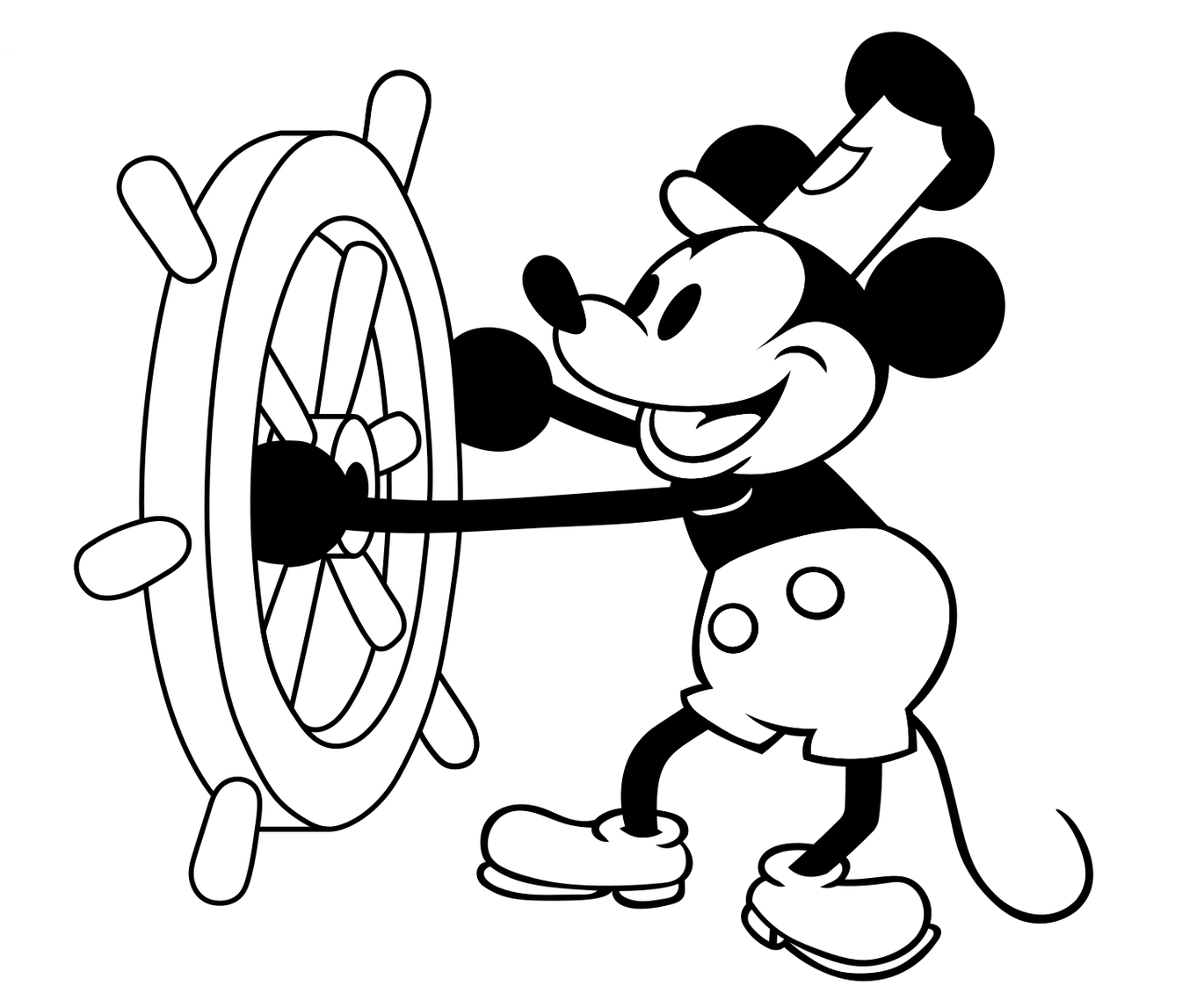
Do aging sports stars still get hired to shake hands with tourists at Las Vegas casinos? It happened to Joe Louis. It happened to Mickey Mantle. What a sad final chapter to such illustrious careers.
Once they were great. Now they merely greet.
I fear this is Mickey Mouse’s fate today. He does his meet-and-greet routine at the theme park, then goes home to a trailer park in Orlando. Here he gripes to Minnie that he deserves better than this Walmart-ish door-tending gig. She tells him to stop whining and take Pluto for a walk.
Ah if I ran Disney I’d bring Mickey Mouse back from exile. I’d give him a movie contract, a record deal, and a tickertape parade down Main Street USA.
I’d tell the shareholders: Watch out K-Pop Demon Hunters, the Mouse is Back!
But that’s just my dream, not reality. This little fella is just as charming as ever, but his corporate overseers don’t want what he has to offer. Disney is pushing ahead on hundreds of projects right now, but none of them involve Mickey Mouse.
Back in 2002 there was some buzz about a new Disney full-length animated film entitled The Search for Mickey Mouse. This was a big deal. It would be the studio’s 50th animated feature film, and release was scheduled for Mickey’s 75th anniversary.
But the studio pulled the plug. Two years later, Disney tossed a few cheese scraps in Mickey’s direction via a 68-minute reunion with Donald Duck — but they sent the film straight to DVD after a few showings in a Hollywood theater.
It was a low-budget affair. But the theater was packed to the brim, and audiences loved the movie. That didn’t matter. The studio had other priorities.
That was our beloved mouse’s last moment of glory. Since then Mickey has appeared in a 6-minute cartoon — back in 2013 — and been granted a few on-screen cameos in low-profile short films. I’m tempted to say That’s All Folks as I contemplate Mickey’s prospects for future, but Bugs Bunny owns that line. So I’ll simply note that this is what extinction looks like when it happens onscreen.
Why is he getting cancelled?
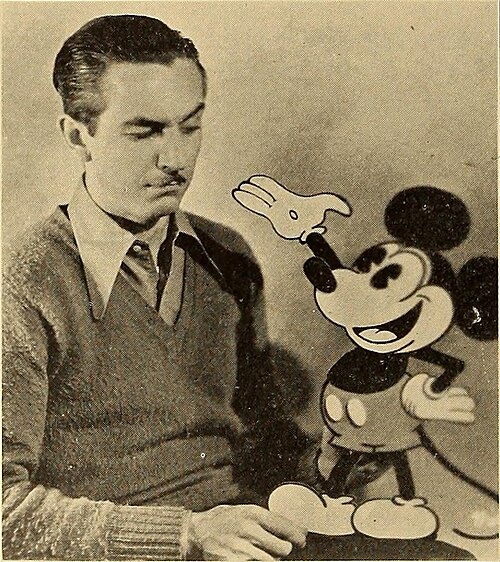
Walt Disney with Mickey Mouse (Source)
Not long ago, Mickey Mouse was the most famous storytelling character in the world. Time magazine claimed that he was better known than even Santa Claus. Everybody in the world recognized his face — not even Winston Churchill or Greta Garbo could make that claim.
Mickey’s exile is, of course, due to his problematic copyright status. Some aspects of Mickey are entering the public domain, and even though Disney could protect his more updated modern look, it’s possible that some outsiders might earn a few coins from a Mickey Mouse resurgence.
Disney would rather go mouse-less than let that happen. That’s a bad decision — a triumphant return of Mickey would go along way toward charming audiences and fixing Disney’s tarnished reputation. He is, after all, the most beloved character in the company’s entire history.
In two years, Mickey Mouse will have reached the ripe ago of one hundred. That would be a great time for a comeback — not just for Mickey but for the whole Disney brand.
Belgian Aces in Exile – Belgian Fighter Aces – WW2 Gallery 10
World War Two
Published 12 Mar 2026Belgium might have been quickly overrun by the Germans in 1940, but many Belgian airmen continued the fight by flying with Britain’s RAF, and quite a few of them were good enough to score five or more aerial victories and become Flying Aces. Here are a few of their stories.
(more…)
Palmer Cavalry Carbine
Forgotten Weapons
Published 20 Jun 2015The Palmer was the first bolt action firearm adopted by the US military — it was a single-shot rimfire carbine patented in 1863 and sold to the US cavalry in 1865. The guns were ordered during the Civil War, but were not delivered until just after the end of fighting, and thus never saw actual combat service. The design is very reminiscent of the later Ward-Burton rifle, using the same style of interrupted-thread locking lugs. The Palmer, however, has a separate hammer which must be cocked independently of the bolt operation.
March 13, 2026
The Raj – a cut-and-dried case of plunder?
Celina considers the claim that the period of British rule over India was a period of British plunder of Indian resources:
The historical evaluation of the British Raj has increasingly become a battleground for competing political and academic narratives. In the 21st century, the discourse has shifted significantly toward an oppression narrative that characterises the period from 1757 to 1948 as one of singular depredation. This perspective, popularised by public intellectuals such as Shashi Tharoor and economic historians like Utsa Patnaik, posits that British rule was defined by systematic deindustrialisation, engineered genocide, the intentional dismantling of educational systems, and the looting of wealth on a scale that defies standard economic modelling.1 However, when subjected to the rigours of aggregate statistical data, comparative institutional analysis, and a sense of historical proportion, these claims frequently reveal themselves as founded on misleading anecdotes and founding myths rather than objective economic realities.2 To accurately understand the trajectory of India under British influence, it is essential to move beyond evocative stories, such as Winston Churchill’s peevish marginal notes and examine the underlying population trajectories, industrial output figures, and the structural transition from a traditional to a constructed capitalist economy.3
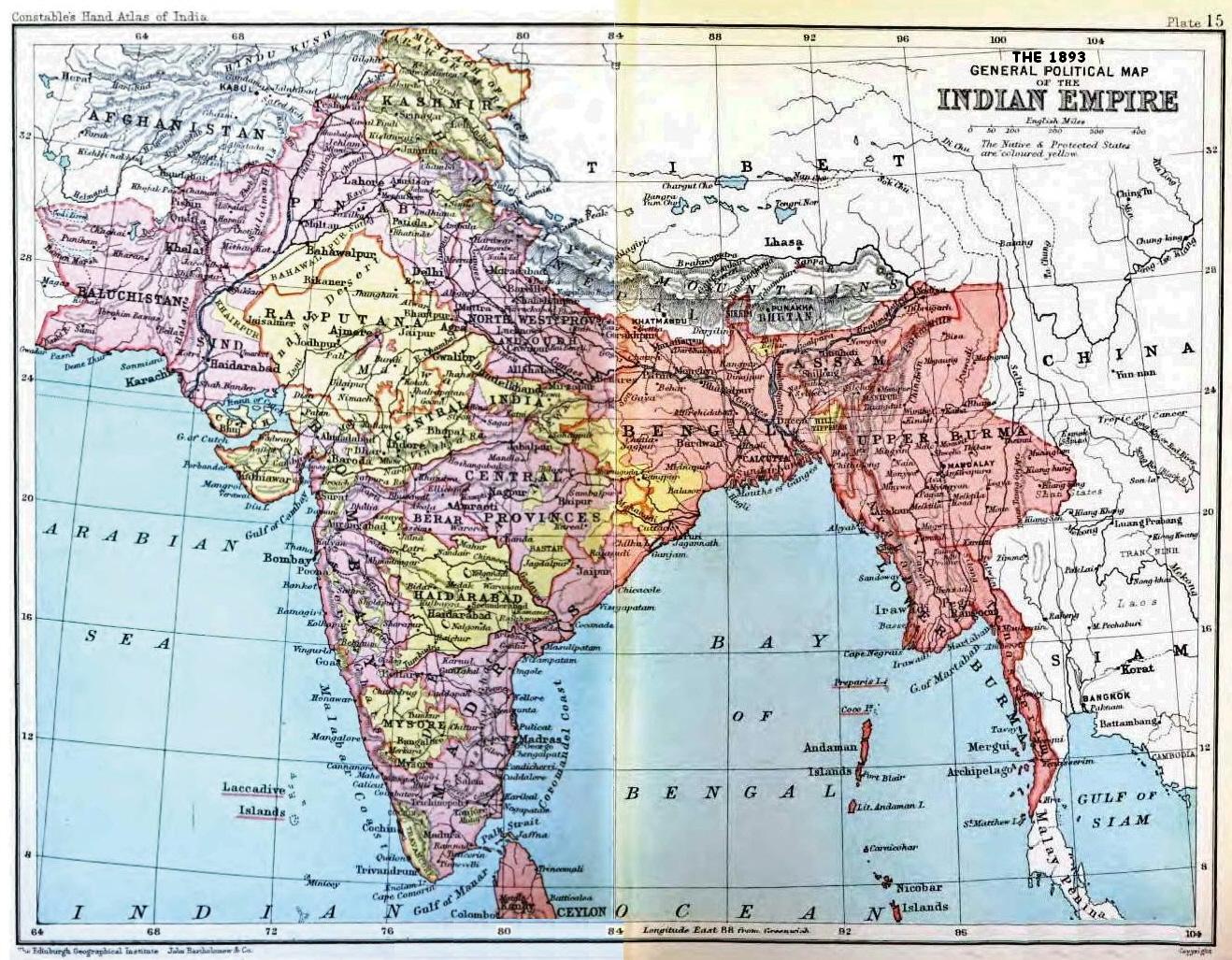
“Political Map of the Indian Empire, 1893” from Constable’s Hand Atlas of India, London: Archibald Constable and Sons, 1893. (via Wikimedia)
Chronology and the Context of the Great Divergence
A critical assessment must begin with a precise periodisation of Indian history. The interaction between Europe and the subcontinent can be divided into four distinct phases: the pre-European period (before 1505), the era of initial coastal contact and Portuguese outposts (1505–1757), the transition under the East India Company (1757–1818), and the era of English domination and formal Raj rule (1818–1948).4 The central contention of modern critics centers on the final period, arguing that India’s share of the global economy collapsed from approximately 24.4% in 1700 to roughly 4.2% by 1950.5
While these proportions are grounded in data, most notably the work of Angus Maddison, the interpretation of this decline as evidence of absolute impoverishment is a fundamental statistical fallacy. The decline in India’s share of world GDP was not the result of a shrinking absolute economy, but rather the consequence of the Great Divergence. During this period, Western Europe, North America, and eventually Japan experienced explosive, intensive growth through the Industrial Revolution, while India remained largely stationary.6
Between 1850 and 1947, India’s absolute GDP in 1990 international dollar terms actually grew from $125.7 billion to $213.7 billion, representing a 70% increase.7 The stagnation in per capita terms, GDP per capita was approximately $550 in 1700 and $619 in 1950, reflects a classic Malthusian trap.8 The unprecedented population growth stimulated by the introduction of Western medicine, increased land cultivation, and the relative political stability of the Raj absorbed almost all economic gains.9 Far from being genocided, the Indian population expanded from 165 million in 1700 to nearly 390 million by 1941.10
- https://en.wikipedia.org/wiki/Shashi_Tharoor%27s_Oxford_Union_speech
- https://winstonchurchill.hillsdale.edu/tharoor-inglorious-empire/
- https://www.reddit.com/r/AskHistorians/comments/l9nve2/he_peevishely_wrote_on_the_margins_of_the_file/
- https://en.wikipedia.org/wiki/Economic_history_of_India
- Ibid
- https://winstonchurchill.hillsdale.edu/tharoor-inglorious-empire/
- https://www.rug.nl/ggdc/historicaldevelopment/maddison/
- Ibid
- https://winstonchurchill.hillsdale.edu/tharoor-inglorious-empire/
- https://www.rug.nl/ggdc/historicaldevelopment/maddison/
Enacting the original proposed 12th Amendment
At Astral Codex Ten, guest writer David Speiser discusses the two “extra” proposed amendments that didn’t make it into the Bill of Rights, but crucially, didn’t have an expiration date. The 11th did eventually make its way into the Constitution as the 27th Amendment in 1992, leaving only the 12th original still in limbo. The proposed 12th was a doozy:
Here is the text of the Congressional Apportionment Amendment, the sole unratified amendment from the Bill of Rights:
After the first enumeration required by the first article of the Constitution, there shall be one Representative for every thirty thousand, until the number shall amount to one hundred, after which the proportion shall be so regulated by Congress, that there shall be not less than one hundred Representatives, nor less than one Representative for every forty thousand persons, until the number of Representatives shall amount to two hundred, after which the proportion shall be so regulated by Congress, that there shall not be less than two hundred Representatives, nor more than one Representative for every fifty thousand persons.
In other words, there will be one Representative per X people, depending on the size of the US. Once the US is big enough, it will top out at one Representative per 50,000 citizens.
(if you’ve noticed something off about this description, good work — we’ll cover it in the section “A Troublesome Typo”, near the end)
The US is far bigger than in the Framers’ time, so it’s the 50,000 number that would apply in the present day. This would increase the size of the House of Representatives from 435 reps to 6,6412. Wyoming would have 12 seats; California would have 791. Here’s a map:
This would give the U.S. the largest legislature in the world, topping the 2,904-member National People’s Congress of China. It would land us right about the middle of the list of citizens per representative, at #104, right between Hungary and Qatar (we currently sit at #3, right between Afghanistan and Pakistan).
Would this solve the issues that make Congress so hated? It would be a step in the right direction. Our various think tanks identified three primary reasons behind the estrangement of Congress and citizens: gerrymandering, national partisan polarization, and the influence of large donors. This fixes, or at least ameliorates, all of them.
Gerrymandering: Gerrymandering many small districts is a harder problem than gerrymandering a few big ones. Durable gerrymandering requires drawing districts with the exact right combination of cities and rural areas, but there are only a limited number of each per state. With too many districts, achievable margins decrease and the gerrymander is more likely to fail.
We can see this with state legislatures vs. congressional delegations. A dominant party has equal incentive to gerrymander each, but most states have more legislature seats than Congressional ones, and so the legislatures end up less gerrymandered. Here are some real numbers from last election cycle1:
So for example, in Republican-dominated North Carolina, 50.9% of people voted Trump, 60% of state senate seats are held by Republicans, and 71.4% of their House seats belong to Republicans. The state senate (50 seats) is only half as gerrymandered as the House delegation (14 seats).
In many states, the new CAA-compliant delegation would be about the same size as the state legislature, and so could also be expected to halve gerrymandering.
As a bonus, the Electoral College bias towards small states would be essentially solved. Currently, a Wyomingite’s presidential vote controls three times as many electoral votes as a Californian’s. Under the CAA, both states would be about equal.
Money: This one is intuitive. If you can effectively buy 1/435 elections, you’ve bought 0.23% of Congress. If the same money only buys you 0.02% of Congress, you’re less incentivized to try to buy House elections and more incentivized to try to buy Senate seats or just to gain influence within a given political party. Money in politics is still a thing, but it becomes much harder to coordinate among people. This makes it easier for somebody to run for Congress without having to fundraise millions of dollars. Because it’s less worth it to spend so much money on any one seat, elections to the House become cheaper2.
Polarization: Some of the think tanks that want to increase the size of Congress by a few hundred members rather than a few thousand claim that this increase will fix political polarization by making representatives more answerable to their constituents who tend to care more about local issues than national ones.
I’m more skeptical of this claim, mainly because it seems that all politics is national politics now. There’s one newspaper and three websites and all they care about is national politics. My Congressional representative ran for office touting her background in energy conservation and water management, arguing that in a drying state and a warming climate we really need somebody in Congress who knows water problems inside and out. Now that she’s actually in Congress, it seems that her main job is calling Donald Trump a pedophile3. The incentives here are to get noticed by the press and to go viral talking about how evil the other side is, so that people who are angry at the evil other side will give you money and you can win your next election.
But maybe Big Congress can solve that. Maybe in a district of less than 50,000 there will be less incentive to go viral and more incentive to connect with your constituents. At the very least, it seems that people trust their state representatives more. And when my state representative and my state Senator tell me about the good work that they’ve done and ask for me to vote for them again, they point to legislation that they’ve passed, not clips of them calling their opponents pedophiles.
- In case this smacks of cherry-picking, here is a breakdown of the “error” in every state’s Congressional delegation, state house delegation, and state senate delegation. “Error” here is defined as the difference between the representation of each state’s delegation and the percentage of that state that voted for Trump over Harris (or vice versa). In only two states, Florida and Virginia, is the error greatest in the largest body, and both of those states would have Congressional delegations larger than that largest body. In the case of Florida, their delegation would be nearly quadruple the size of their state house.
- There could also be an effect from the structure of the TV market. Stations sell ads by region, and each existing media region is larger than the new Congressional districts. So absent a change in market structure, a candidate who wanted to purchase TV advertising couldn’t target their own district easily; they would have to overpay to target a much larger region.
- And just to harp on this more, we just blew by the Colorado River Compact agreement deadline and now the federal government is going to start mandating cuts; everybody’s going to sue everybody else. Lake Powell is quite possibly going to dead pool this year, and as far as I can find the congressperson who ran on water issues is saying nothing about it.


What did ordinary Tudors do for work? Inside the 16th-century daily grind
HistoryExtra
Published 4 Nov 2025From sunrise in the fields to the heat of the brew house, Ruth Goodman reveals the untold story of how the Tudors really worked.
Forget silk-clad courtiers – most people in the 16th-century toiled from dawn to dusk just to keep food on the table. Men ploughed, hedged, and hauled in the fields while women brewed ale, milked cows, churned butter, and raised children – often all at once. Every Tudor household was a finely balanced machine of survival.
In this episode of her new series on Tudor Life, historian Ruth Goodman explains how every pair of hands mattered. It wasn’t as simple as “men’s work” and “women’s work”. You’ll hear how the two worlds were completely intertwined. And what about those who were unable to work? This video sheds light on an innovative 16th-century welfare scheme that made all the difference.
Filmed on location at Plas Mawr – an Elizabethan townhouse in Conwy, North Wales, now in the care of Cadw – this series with Ruth looks beyond the royals who often dominate the headlines, and considers the everyday routines of those living in England and Wales in the Tudor era.
00:54 How did Tudors earn money?
03:20 Where did men work?
08:15 What if you were unable to work?
QotD: “I was one-shotted in my teens by Guns, Germs, and Steel“
Jane Psmith, “BRIEFLY NOTED: Further Arguments Against Jared Diamond”, Mr. and Mrs. Psmith’s Bookshelf, 2025-11-03.
March 12, 2026
QotD: Roman armies of the middle and late Republic
It is hard to tell if the Roman triple-line (triplex acies) fighting system created the demand for synchronized discipline or if the Romans, having already developed a tradition of drill and synchronized discipline, adopted a fighting style that leveraged that advantage. Probably a bit of both, but in any event our evidence for the Roman army before the very late third century is very poor. By the time we truly see the Roman army clearly (c. 225 BC) the system seems to already [have been] in place for some time.
A Roman consular army was a complex machine. It was composed of an infantry line of two legions (in the center) and two socii “wings” (alae) to each side, along with cavalry detachments covering the flanks. Each of those infantry blocks (two legions, two alae) in turn was broken down into thirty separate maneuvering units (called maniples, generally consisting of 120 men; half as many for the triarii), which were in turn subdivided into centuries, but centuries didn’t really maneuver independently. In front of this was a light infantry screening force (the velites). So notionally there were in the heavy infantry of a standard two-legion consular army something like 120 different “chess pieces” that notionally the general could move around on their own and thus notionally the legion was capable of fairly complex tactical maneuvers.
You may have noted that word “notionally” because now we get into the limits of drill and synchronized discipline, because this isn’t a system for limitless tactical flexibility of the sort one gets in video games. Instead, recall that the idea here is to create coordinated movement and fighting (the synchronized discipline) through rigorous, repeated practice (drill). Of course one needs to practice specific things. Some of those things are going to be obvious: a drill for marching forward, or for turning the unit or for advancing on the charge.
In the Roman case, a “standard” battle involved the successive engagement and potentially retreat of each heavy infantry line: first the hastati (the first line) formed a solid line (filling the gaps) and attacked and then, if unsuccessful, retreated and the next line (the principes) would try and so on. Those maneuvers would need to be practiced: forming up, then having each maniple close the gap (we don’t quite know how they did this, but see below), the attack itself (which also involved usually throwing pila – heavy javelins), then retreat behind the next line if things went poorly. It’s also pretty clear from a battle like Cynoscephelae (197) or Bibracte (58) that individual maniples or cohorts (the Romans start using the larger 480-man-cohort as the basic maneuver unit during the second century BC) could be “driven” over the battlefield to a degree so there were probably drills for wheeling and turning.
Now even in this “standard” battle there is a lot of movement: maniples need to open and close gaps, advance and retreat and so on. This is what I mean by saying this army is a complex machine: it has a lot of moving parts that need to move together. The men in a maniple need to move together to make that mutually-supporting line and the maniples need to move together with each other to cover flanks and allow retreats. In terms of how the individual men moved, I’ve tended to think in terms of a “flow” model akin to this video of South Korean riot police training, rather than the clunkier Spartacus (1960) model.
But once an army has practiced all of these drills, it creates the opportunity for great improvisation and more complex tactics as well. Commanders, both the general but also his subordinates, can tell a unit to perform a particular maneuver that they have drilled, assuming the communication infrastructure exists in terms of instruments, standard shouted commands and battle standards (and note [that] Roman methods of battlefield communication were relatively well developed). That, for instance, allowed Aemilius Paullus to give orders to his first legion at Pydna for each of those maneuver units to either push forward or give ground independently, presenting the Macedonian phalanx with a tactical problem (an unevenly resisting line) it did not have a good solution for (Plut. Aem. 20.8-10). Having good junior officers […] was required but it wasn’t enough – those officers needed units which were already sufficiently drilled so that their orders (to press hard or retreat and reform in this case) could actually be carried out by soldiers for whom the response to those calls had become natural through that very drill.
At the same time I don’t want to give the wrong impression: even for the Romans battles where there was this sort of on-the-field improvising led by the general were uncommon (though not extremely rare). For the majority of battles, the legionary “machine” simply pushed forward in its standard way, even when – as at Cannae (216) – pushing forward normally proved to be disastrous. Just because an army can fight flexibly doesn’t mean it will or even that it should.
Bret Devereaux, “Collections: Total Generalship: Commanding Pre-Modern Armies, Part IIIa”, A Collection of Unmitigated Pedantry, 2022-06-17.
March 11, 2026
The Korean War Week 90: No Surrender, No Armistice … No Hope? – March 10, 1952
The Korean War by Indy Neidell
Published 10 Mar 2026Ultimatums and blackmail! Well, sort of. US President Harry Truman is trying to strong arm South Korean President Syngman Rhee into accepting any armistice negotiated, but the armistice talks are taking forever, so there are those who wish to simply give the Communists a take it or leave it ultimatum. What might such an ultimatum be? Find out this week!
00:58 Recap
01:26 Inspection Teams
03:15 Ultimatums
05:08 Epidemic Disease
07:54 Syngman Rhee
10:57 ROK Training Programs
16:30 Summary
16:46 Conclusion
(more…)
March 10, 2026
Austria’s Inbred Emperor who Demanded Dumplings – Marillenknödel
Tasting History with Max Miller
Published 9 Sept 2025Apricots wrapped in a soft dough with a crunchy exterior and sprinkled with powdered sugar
City/Region: Austria
Time Period: 1858Ferdinand I of Austria was emperor in name only. Incredibly inbred, Ferdinand had various disabilities and ailments that affected his ability to rule, though it’s said that he spoke five languages and was very witty. As the empire was run by others, not much is written about Ferdinand’s rule, but one thing that he did do as emperor was to demand dumplings at every meal.
And I can see why; they’re absolutely delicious. The apricots are sweet and juicy, the dough is soft, and the crunchy exterior of breadcrumbs, butter, sugar, and cinnamon is wonderful.
Apricot and Plum Dumplings With quark dough.
You mix 4 deciliters flour and 20 decagrams quark with 3 yolks to make a soft dough. Roll out fairly thick, cut into large pieces, enough to wrap a plum [or apricot], then seal them well … Boil the dumplings in salted water. Lift them out carefully with a spoon so they don’t stick to the bottom, then transfer with a slotted spoon into hot butter in a dish. Let them brown on one side. In the butter, you can first brown some sugar and breadcrumbs…coat with sugar, cinnamon, and brown breadcrumbs.
— Die Süddeutsche Küche by Katharina Prato, 1858
QotD: The slave trade
Brett Pike @ClassicLearner
The Ottoman slave trade, the trans Saharan slave trade, the trans Indian slave trade, lasted for thousands of years and enslaved millions of people … Yet school children are led to believe that slavery was a uniquely European activity.Now why do you think that is?
The Arabs, Turks, and Indians collectively enslaved three times as many people as Europeans, their slave trades lasted three times as long, and the only reason they ended was that Europeans — in particular the British — used military power to force them to stop.
Yet we get the exclusive blame for slavery.
Why?
Simple.
We’re the only ones who felt bad about slavery.
Even at the height of the slave trade it was morally controversial. It never sat right with us. We’re genuinely ashamed of it.
No one else feels bad about it. At all.
And they know this. They know that the European soul is profoundly empathetic in a way that their own petty, clannish chauvinism is not. And in that universalizing empathic conscience they smell weakness, and in weakness, opportunity.
They remind us endlessly of the role we played in continuing slavery, knowing full well that we will be either too courteous, or too distracted by guilt, to point to the much larger role that they played.
By pressing on that sore nerve they sustain a moral assault on our conscience that they then exploit for financial benefits: welfare parasitism, preferment in admissions and hiring, open borders.
The slave societies have found a way to take their revenge for the end slavery, enslaving us with our own conscience.
And they don’t feel the slightest twinge of guilt about that, either.
John Carter, The social media site formerly known as Twitter, 2025-12-08.
March 9, 2026
The FIRST Tank Battle – Villers-Bretonneux, 1918: Mark IV v A7V
The Tank Museum and Queensland Museum
Published 14 Nov 2025By spring 1918, the British Mark IV tank has been in service for almost a year. It had proved itself during the Battle of Cambrai – the males attacking concrete emplacements, and the females fending off the infantry. But the Mark IV has never been tested against another tank …
The German A7V hasn’t served on the battlefield very long. While it has mobility and stability issues, it does have thicker armour than the British tanks – and is more heavily armed. On paper, this looks like it will be a close call.
Villers-Bretonneux is the first time in history that a tank fought another tank. It’s a day that would change the face of warfare forever.
00:00 | Introduction
00:50 | The Mark IV
02:57 | The A7V
05:30 | The Battle of Villers-Bretonneux
06:44 | Mark IV vs A7V
09:09 | Who won?
(more…)
March 8, 2026
How to Destroy Your Own Revolution: Night of the Long Knives – Death of Democracy 06 – Q2 1934
World War Two and Spartacus Olsson
Published 7 Mar 2026In the spring of 1934, Nazi Germany stands on the edge of internal collapse. In this episode of Death of Democracy, we follow the escalating conflict between Adolf Hitler, the SA stormtroopers, and the German Army that culminates in the Night of the Long Knives. As economic cracks appear behind the Nazi “recovery”, Joseph Goebbels launches propaganda campaigns against critics while Heinrich Himmler expands SS power over the Gestapo.
When Vice-Chancellor Franz von Papen publicly challenges the regime, Hitler moves decisively. On June 30, 1934, the Nazi leader unleashes a purge that eliminates Ernst Röhm, the SA leadership, and political rivals — consolidating absolute power.
Using contemporary voices from Martha Dodd, Victor Klemperer, and underground SPD reports, this episode explores how terror, propaganda, and political maneuvering reshaped Germany in just a few months — and paved the way for dictatorship.
Watch the full Death of Democracy series to understand how democracies collapse from within.
(more…)


