
One way to tell if you’re dealing with an actual Fascist is whether your subject has that theory of state power. If he doesn’t, you might be dealing with (say) a garden variety conservative-militarist strongman like Admiral Horthy in Hungary. Rulers like that will kill you if you look like a political threat, but they’re not invested in totalitarianizing their entire society.
Occasionally you’ll get one of these like Francisco Franco who borrows fascist tropes as propaganda tools but keeps a tight rein on the actual Fascist elements in his power base (the Falange). Franco remained a conservative monarchist all his life and passed power to the Spanish royal family on his death.
This highlights one of the other big lies about Fascism; that it’s a “conservative” ideology. Not true. Franco, a true reactionary, wanted to preserve and if necessary resurrect the power relations of pre-Civil-War Spain. Actual Fascism aims at a fundamental transformation of society into a perfected state never seen before. All of its type examples were influenced by Nietzschean ideas about the transformation of Man into Superman; Fascist art glorified speed, power, technology, and futurism.
Eric S. Raymond, “Spotting the wild Fascist”, Armed and Dangerous, 2019-04-30.
July 20, 2022
QotD: Fascism and the state
July 19, 2022
Barbarian Europe: Part 2 – The Fall of Rome
seangabb
Published 22 Apr 2021In 400 AD, the Roman Empire covered roughly the same area as it had in 100 AD. By 500 AD, all the Western Provinces of the Empire had been overrun by barbarians. Between April and July 2021, Sean Gabb explored this transformation with his students. Here is one of his lectures. All student contributions have been removed.
(more…)
July 18, 2022
John von Neumann, The Man From The Future
One of the readers of Scott Alexander’s Astral Codex Ten has contributed a review of The Man From The Future: The Visionary Life of John von Neumann by Ananyo Bhattacharya. This is one of perhaps a dozen or so anonymous reviews that Scott publishes every year with the readers voting for the best review and the names of the contributors withheld until after the voting is finished:

John von Neumann invented the digital computer. The fields of game theory and cellular automata. Important pieces of modern economics, set theory, and particle physics. A substantial part of the technology behind the atom and hydrogen bombs. Several whole fields of mathematics I hadn’t previously heard of, like “operator algebras”, “continuous geometry”, and “ergodic theory”.
The Man From The Future, by Ananyo Bhattacharya, touches on all these things. But you don’t read a von Neumann biography to learn more about the invention of ergodic theory. You read it to gawk at an extreme human specimen, maybe the smartest man who ever lived.
By age 6, he could multiply eight-digit numbers in his head. At the same age, he spoke conversational ancient Greek; later, he would add Latin, French, German, English, and Yiddish (sometimes joked about also speaking Spanish, but he would just put “el” before English words and add -o to the end). Rumor had it he memorized everything he ever read. A fellow mathematician once tried to test this by asking him to recite Tale Of Two Cities, and reported that “he immediately began to recite the first chapter and continued until asked to stop after about ten or fifteen minutes”.
A group of scientists encountered a problem that the computers of the day couldn’t handle, and asked von Neumann for advice on designing a new generation of computers that was up to the task. But:
When the presentation was completed, he scribbled on a pad, stared so blankly that a RAND scientist later said he looked as if “his mind had slipped his face out of gear”, then said “Gentlemen, you do not need the computer. I have the answer.” While the scientists sat in stunned silence, Von Neumann reeled off the various steps which would provide the solution to the problem.
Do these sound a little too much like urban legends? The Tale Of Two Cities story comes straight from the mathematician involved — von Neumann’s friend Herman Goldstine, writing about his experience in The Computer From Pascal to von Neumann. The computer anecdote is of less certain provenance, quoted without attribution in a 1957 obituary in Life. But this is part of the fun of reading von Neumann biographies: figuring out what one can or can’t believe about a figure of such mythic proportions.
This is not really what Bhattacharya is here for. He does not entirely resist gawking. But he is at least as interested in giving us a tour of early 20th century mathematics, framed by the life of its most brilliant practitioner. The book devotes more pages to set theory than to von Neumann’s childhood, and spends more time on von Neumann’s formalization of quantum mechanics than on his first marriage (to be fair, so did von Neumann — hence the divorce).
Still, for those of us who never made their high school math tutors cry with joy at ever having met them (another von Neumann story, this one well-attested), the man himself is more of a draw than his ergodic theory. And there’s enough in The Man From The Future — and in some of the few hundred references it cites — to start to get a coherent picture.
General Patton Orders War Crimes – WAH 069 – July 17, 1943
World War Two
Published 17 Jul 2022This week, we see a contrast in the way different civilians behave within occupied Ukraine, Patton orders war crimes, and Jewish resistance give up one of their own fighters.
(more…)
Russian Invasion of Finland – The Winter War 1939-40
Mark Felton Productions
Published 24 Mar 2022Find out why Russia invaded neutral Finland in late 1939, and how the outnumbered and outgunned Finns managed to defend their country for 3 months until making peace with Stalin.
(more…)
QotD: The basis of belief in pre-modern polytheistic societies
For the Roman (or most any ancient polytheist) there is never much question of if the gods exist. True atheism was extremely rare in the pre-modern world – the closest ancient philosophy gets to is Epicureanism, which posits that the gods absolutely do exist, but they simply do not care about you (the fancy theological term here is immanence (the state of being manifest in the material world). Epicureans believed the gods existed, but were not immanent, that they did not care about and were little involved with the daily functioning of the world we inhabit). But the existence of the gods was self-evident in the natural phenomena of the world. Belief was never at issue.
(This is, as an aside, much the world-view we might expect from a universe – as is often the case in speculative fiction or high fantasy – where divine beings are not merely immanent, but obviously so, intervening in major, visibly supernatural ways. The point at which this or that supernatural, divine being brings someone back to life, grants them eternal youth or makes swords light on fire ought to be a pretty substantial theological awakening for everyone there. Even for other polytheists, such displays demand the institution of cult and ritual.)
This, of course, loops back to one of my favorite points about history: it is generally safe to assume that people in the past believed their own religion. Which is to say that polytheists genuinely believe there are many gods and that those gods have power over their lives, and act accordingly.
In many ways, polytheistic religions, both ancient and modern (by modern polytheisms, I mean long-standing traditional religious structures like Hinduism and Shinto, rather than various “New Age” or “Neo-pagan” systems, which often do not follow these principles), fall out quite logically from this conclusion. If the world is full of gods who possess great power, then it is necessary to be on their good side – quite regardless of it they are morally good, have appropriate life philosophies, or anything else. After all, such powerful beings can do you or your community great good or great harm, so it is necessary to be in their good graces or at the very least to not anger them.
Consequently, it does not matter if you do not particularly like one god or other. The Greeks quite clearly did not like Ares (the Romans were much more comfortable with Mars), but that doesn’t mean he stopped being powerful and thus needing to be appeased.
So if these polytheistic religions are about knowledge, then what do you need to know? There are two big things: first you need to know what gods exist who pertain to you, and second you need to know what those gods want.
Two things I want to pull out here. First: the exact nature and qualities of the gods do not really matter, because remember, the goal is practical results. Crops need to grow, ships need to sail, rain needs to fall and the precise length of Zeus’ beard is profoundly unimportant to those objectives, but getting Zeus to bring storms at the right times is indispensable. The nature of the gods largely does not matter – what matters is what you need to do to keep them happy.
Second, you may be saying – you keep ramming home the idea that you have to cultivate all of the gods – what is this “pertaining to you” business? What I mean by this is that while the polytheist typically accepts the existence of vast numbers of gods (often vast beyond counting), typically only a subset of those gods might be immediately relevant. Some gods are tied to specific places, or specific families, or jobs, or problems – if you don’t live in that place, belong to that family, hold that job, etc., then you don’t need to develop a relationship with that god.
Nevertheless, everyone typically needs to develop a relationship with the big gods – the sort whose name you know from a high school or college class – that control big parts of life we all share, along with a bunch of smaller gods which pertain to smaller parts of our lives or perhaps only to select groups of people (we’ll talk more about these “little” gods later in this series, because they are fascinating).
Bret Devereaux, “Collections: Practical Polytheism, Part I: Knowledge”, A Collection of Unmitigated Pedantry, 2019-10-25.
July 17, 2022
Who Let the Dogs Out?! – The Invasion of Sicily – WW2 – 203 – July 16, 1943
World War Two
Published 16 Jul 2022The Allies have begun their fight to take back Western Europe with Operation Husky. That’s not the only news though. They are also trying to extend their foothold in the Solomons, and Germany and the USSR continue smashing into one another at Kursk.
(more…)
Earlier almost-steam-engine developments
In the latest Age of Invention newsletter, Anton Howes picks up the story of the development of the steam engine (part one was linked here):
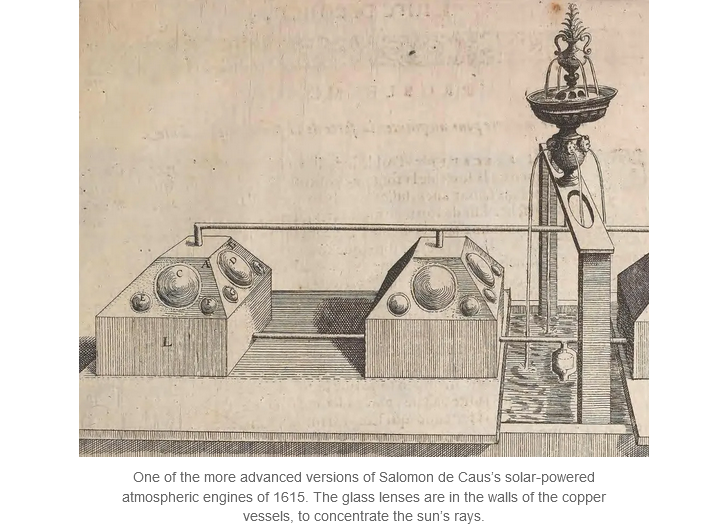
As I explained in Part I, the spark for my investigation was noticing that one Salomon de Caus, as early as 1615, had very probably made what amounts to a solar-powered version of Savery’s engine. By concentrating the sun’s rays on trapped air above the water in copper vessels, the resulting expansion of the trapped air and steam drove the water up a pipe to make a fountain flow. Most crucially of all, however, when the vessels cooled again they sucked water up and into them from a cistern below — a principle that de Caus also applied to having statues make music when the sun shone, and which he hinted may be useful for other things too.
Noticing this machine was a big shock to me, but de Caus’s invention was not even that original. It was actually an improvement of another, almost entirely ignored device described by Hero of Alexandria as early as the 1st Century, and which Hero in turn derived from one Philo of Byzantium who wrote in the 3rd Century BC.
Philo’s original device was very simple: a hollow leaden sphere with a bent tube rising out of it and into some water at the bottom of a jug. As the sun heated the sphere, the expanding air was pushed up the tube and into the jug’s water, escaping by bubbling out of the water. And crucially, when the sphere was removed from the sun and allowed to cool, the water was then drawn up the tube and into the sphere — Philo, about 1,900 years before Savery, had already encapsulated in a simple model the power of condensation to raise water.
Philo’s device was simple, but the principles it illustrated do appear to have been applied. Hero’s work, for example, includes a libas, or “dripper” fountain. In this alternative version of Philo’s apparatus, Hero connected the jug and sphere by two other pipes to a cistern underneath, as well as starting with some water already in the sphere. The jug now acted more like a funnel, into which the original bent tube now dripped its water like a fountain when the sun shone on the sphere. When cooled, however, the sphere replenished itself from the cistern underneath. It was almost exactly like de Caus’s version, which merely improved the strength of the fountain when it was heated, seemingly by replacing the lead with more heat-conductive copper and by using glass convex lenses to concentrate the sun’s rays.
Hero’s solar-powered dripping fountain doesn’t sound all that impressive, but both Philo and Hero appreciated the wider potential of its underlying principles.
Philo, for example, noted that it might make use of alternative heat sources: he described how his apparatus would work whether pouring hot water over the sphere, or by heating it over a fire. Once it cooled, it would always draw the water up.
Hero even suggested a mechanical use for the effect. By setting a fire on a hollow, airtight altar, the heated air within would flow down a tube into a sphere full of water, which in turn would be pushed up another tube into a hanging bucket. The bucket, when sufficiently heavy with water, would then pull on a rope to open some temple doors. Crucially, when the fire was extinguished, Hero noted that the cooling of the air in the altar would draw the water back into the sphere again, lighten the bucket, and so allow the doors to be closed by a counterweight. Although the condensing phase was really just for resetting the device, the fundamental ideas behind a Savery engine were already there: it raised water, used a fuel, and exploited condensation. It even did some light mechanical work.
The Berthier After World War One
Forgotten Weapons
Published 31 Jul 2017http://www.patreon.com/ForgottenWeapons
In the aftermath of World War One, France would face the need to replace virtually all of its small arms, because nearly everything it had been using was either a wartime stopgap (like the Ruby, Chauchat, and Berthier 07/15) or had been obsolete before the war began (like the Lebel and Mle 1892 revolver). The first focus of the rearming was a new light machine gun, which would be adopted in the form of the Chatellerault M24/29. Plans were made to develop a semiautomatic infantry rifle and bolt action support troops’ rifle (both in the new 7.5mm rimless cartridge), but these would not prove to be as quickly realized. As a result, the Berthier Mle 1916 carbines would remain in major frontline service right up to the outbreak of World War Two.
During the twenty years between the wars, the Berthiers would see a series of changes and upgrades including:
– Sling bars replacing swivels
– Revised handguard profile
– Raised sights
– Removal of the clearing rods
– Adoption of the 1932N cartridge and associated rechambering
– New metal finishesProduction of new carbines in fact continued all the way until 1939, with at least 160,000 made in 1919 and later. Many of the alterations made during this postwar period are evident on examples found today, and there is a collecting premium on guns that do not exhibit these peacetime modifications. So, let’s have a look, shall we?
If you enjoy Forgotten Weapons, check out its sister channel, InRangeTV! http://www.youtube.com/InRangeTVShow

QotD: When “the revolution” is in danger, resort to whatever will energize the masses
The problem with that, of course, is that Revolutionary France immediately found herself at war with the rest of Europe. Europe’s crowned heads have rarely been brainiacs, but again, anyone marginally saner than Robespierre saw immediately where the Declaration of the Rights of Man and Citizen was heading. They did the smart thing and invaded, which put the Enlightened in a real bind — war being the third most un-Enlightened thing ever. But they’d rather be hypocrites than dead, the Enlightened, so they had to knock together a new set of national symbols on the fly, ones men would fight and die for (absolutely no one was willing to bleed for “Reason”; whaddaya know).
To their credit, they did a hell of a job. La Marseillaise, Lady Liberty, La patrie en danger! … good stuff. It was part of Napoleon’s singular genius that he could turn these Roman Republic-inspired symbols into first his “consulship”, then his emperorship, but it didn’t have to go that way; Revolutionary France might’ve held out had the Littlest Corporal been killed in action. The important thing here is to note how effective such explicitly nationalist, indeed rabidly jingoist, symbols are, even when pushed by guys who not five minutes ago were proclaiming the Brotherhood of Man.
The Soviets did the same thing, and for the same reasons — look how fast “Workers of the world, unite!” became first the Molotov-Ribbentrop Pact, then the Great Patriotic War for the Fatherland – but they, too, went through an incredibly fecund period of inventing unifying symbols. Even though History has passed few clearer judgments than she has on Communism, you have to admit that as a symbol, the Soviet hammer-and-sickle is world class.
Severian, “Repost: National Symbols”, Founding Questions, 2021-10-27.
July 16, 2022
Barbarian Europe: Part 1 – A Lurking Menace
seangabb
Published 18 Apr 2021In 400 AD, the Roman Empire covered roughly the same area as it had in 100 AD. By 500 AD, all the Western Provinces of the Empire had been overrun by barbarians. Between April and July 2021, Sean Gabb explored this transformation with his students. Here is one of his lectures. All student contributions have been removed.
More by Sean Gabb on the Ancient World: https://www.classicstuition.co.uk/
Learn Latin or Greek or both with him: https://www.udemy.com/user/sean-gabb/
His historical novels (under the pen name “Richard Blake”): https://www.amazon.co.uk/Richard-Blak…
A viable … conservative … party in Quebec? Isn’t that somewhere in Revelations?
In the free-to-cheapskates portion of a Paul Wells column on the unlikely and certainly unpredicted rise of a conservative party in Quebec, he points out just how ephemeral such parties have been in the past:

My Big Book of Columnists’ Clichés tells me I should call Duhaime the leader of Quebec’s “upstart” Conservative party, but if we’re being accurate here, it hasn’t really upstarted yet. Or maybe it keeps upstarting and then unstarting. Quebec had a Parti conservateur in the 19th and early 20th centuries, under whose banner eight premiers were elected. Maurice Duplessis essentially shut it down in the 1930s when he formed the Union Nationale. There was a Parti conservateur for a minute in the mid-60s, to no great effect. And there’s been a Parti conservateur since 2009.
The latest party’s impact on electoral politics so far has been negligible. It won less than 1.5% of the vote in 2018, the year Legault’s amorphous populist-nationalist Coalition Avenir Québec (CAQ) swept to power. It’s never elected a member to the National Assembly. For the past year, its only MNA has been a woman who got booted from Legault’s party for, uh, contributing to Duhaime’s.
But things have been getting weird in Quebec this year. An Angus Reid Institute poll last week put Duhaime’s upstart party (see how easy it is?) in second place, well behind Legault’s CAQ but ahead of the historic Liberal and PQ parties and the urban social democrats in Québec Solidaire.
The Quebec Conservatives are, in fact, the leading party among male voters age 18-34 and 35-54. They’re not nearly as competitive among young women or among older voters in general. Duhaime would need his vote to keep growing, and not just a little, to have any chance of winning an election. Frankly he’s likelier to win zero seats, and perhaps likeliest to win somewhere between zero and a dozen.
But the party has already gone from 500 memberships to 60,000 since Duhaime, a former Ottawa political staffer (Bloc Québécois, then Canadian Alliance) and Quebec City talk-radio host, became its leader in 2021. That’s three times as many memberships as the CAQ had when Legault became premier.
Duhaime is working on something, a discourse starkly different from Legault’s and also different, in important ways, from the recent positions of the federal Conservatives. He’s against vaccine restrictions — but he’s been careful not to associate with truck convoy protesters. He’s against Legault’s new French language law, Bill 96. Not because it’s mean to anglophones, although Duhaime is making at least a modest attempt to appeal to conservative anglophone voters, but because the law makes blanket use of the Constitution’s “notwithstanding” clause to sidestep Charter rights. Duhaime says no government should curtail rights so easily. He wants a great big dose of private for-profit health care.
After two years of legislation by order-in-council and intermittent curfews and the most sweeping use of the notwithstanding clause in 40 years, Legault’s Premier-knows-best shtick has opened up room on his libertarian right. Enough room for a solid competitor? Duhaime himself shrugged when I asked him, during a brief chat after the parking-lot scrum.
“We might win this,” he said. “We might get zero seats. On est la ‘wild card’ de la gang.”
Anti-Tank Chats #4 Bazooka | The Tank Museum
The Tank Museum
Published 18 Mar 2022Join Stuart Wheeler for an Anti-Tank Chat and discover the US military’s development of the Bazooka anti-tank weapon.
(more…)
July 15, 2022
HMCS Sackville Walkaround
iChaseGaming
Published 25 Jul 2019Moved to Halifax, must visit HMCS Sackville 😀 and here she is!
(more…)
QotD: Modern and historical multiculturalism
Yet over the last 20 years we have deprecated “unity” and championed “diversity”. Americans are being urged by popular culture, universities, schools and government to emphasize their innate differences rather than their common similarities.
Sometimes the strained effort turns comical. Some hyphenate or add accents or foreign pronunciations to their names. Others fabricate phony ethnic pedigrees in hopes of gaining an edge in job-seeking or admissions.
The common theme is to be anything other than just normal Americans for whom race, gender and ethnicity are incidental rather than essential to their character.
But unchecked tribalism historically leads to nihilism. Meritocracy is abandoned as bureaucrats select their own rather than the best-qualified. A Tower of Babel chaos ensues as the common language is replaced by myriad local tongues, in the fashion of fifth century imperial Rome. Class differences are subordinated to tribal animosities. Almost every contentious issue is distilled into racial or ethnic victims and victimizers.
History always offers guidance to the eventual end game when people are unwilling to give up their chauvinism. Vicious tribal war can break out as in contemporary Syria. The nation can fragment into ethnic enclaves as seen in the Balkans. Or factions can stake out regional no-go zones of power as we seen in Iraq and Libya.
In sum, the present identity-politics divisiveness is not a sustainable model for a multiracial nation, and it will soon reach its natural limits one way or another. On a number of fronts, if Americans do not address these growing crises, history will. And it won’t be pretty.
Victor Davis Hanson, “Things That Can’t Go on Forever Simply Don’t”, PJ Media, 2019-04-17.


