
Forgotten Weapons
Published 17 Mar 2018The Stoner 63 was a remarkably advanced and clever modular firearm designed by Eugene Stoner (along with Bob Fremont and Jim Sullivan) after he left Armalite. This was tested by DARPA and the US Marine Corps in 1963, and showed significant potential — enough that the US Navy SEALs adopted it and kept it in service into the 1980s. It was a fantastic balance of weight and controllability, offering a belt-fed 5.56mm platform at less than half the weight of the M60. The other fundamental characteristic of the Stoner 63 was modularity. It was built around a single universal receiver component which could be configured into a multitude of different configurations, from carbine to medium machine gun. Today we have one of the rarer configurations, an Automatic Rifle type. In addition, today’s rifle is actually a Stoner 63A, the improved version introduced in 1966 to resolve some of the problems that had been found in the original.
Ultimately, the Stoner system was able to achieve its remarkably light weight by sacrificing durability. The weapon was engineered extremely well and was not a danger to itself (like, for example, the FG-42), but it was prone to damage when mishandled by the average grunt. This would limit its application to elite units like the SEALs, who were willing to devote the necessary care to the maintenance and operation of the guns in exchange for the excellent handling characteristics it offered.
(more…)
July 24, 2022
Stoner 63A Automatic Rifle – The Original Modular Weapon
QotD: British armour from BAOR to the first Gulf War
During the Cold War there was a clear threat in the form of the Soviet 3rd Shock Army, which was lined up, facing off against BAOR [British Army of the Rhine] units. It made an enormous amount of sense to contribute to a NATO operation to deter Moscow from chancing their luck, and ensure that they could not force the border and take over Western Germany.
To that end generations of British soldiers were stationed there training for a war that they hoped would never come. To this day there are still serving Cold War veterans who even into the late 1980s knew where they would deploy to, and the likely exact spot in the field or woods where they would dig their trenches and realistically be killed.
This force though was essentially a static one, designed to operate defensively and underpinned by an enormous static logistical and support network stretching from the Inner German Border all the way back to Antwerp and then the UK. The British Army was able to sustain armour in large numbers in part because it had the threat to face, the space to operate and the support network in place to enable this to occur. To this day the subject of how well supported BAOR was through the extensive rear communications zone efforts, and the widespread workshops (such as in Belgium) designed to repair and support UK units is not widely known or told, but deserves much greater recognition.
This matters because when people look back to the size of the British Army in 1990 and look at how many tanks we had then compared to now, they forget that the Army’s MBT capability was essentially a static garrison force waiting to conduct a defensive campaign against a peer threat where it expected to take heavy losses and probably operate very quickly in an NBC environment. It was not intended to be a deployable force capable of operating across the planet on an enduring basis.
This is why when people talk about how many tanks were deployed in 1991 to the Gulf War (some 220 Challenger 1’s were deployed) they forget that this was the first time since Suez that the UK had operated heavy armour overseas. It took many months to get this force into place, and it came at the cost of gutting the operational capability of the remaining BAOR units, who found their logistical support chains hammered in order to support the forces assigned to GRANBY.
The harsh, and perhaps slightly uncomfortable reality for the UK is that OP GRANBY required nearly 6 months of build up at the cost of gutting wider armoured warfare capability – proving that away from home, having 900 tanks is irrelevant if you are operating outside normal parameters and are having to effectively cannibalise or mothball most of them to keep 220 in the Gulf.
By contrast OP TELIC saw over 100 tanks deployed, but a significantly shorter lead in time for the deployment – testament to the significant investments made in the intervening period in logistical capabilities.
Sir Humphrey, “Tanks for nothing — Why it does not matter if the British Army has fewer tanks than Cambodia”, Thin Pinstriped Line, 2019-04-24.
July 23, 2022
Barbarian Europe: Part 3 – Barbarism and Christianity
seangabb
Published 1 May 2021In 400 AD, the Roman Empire covered roughly the same area as it had in 100 AD. By 500 AD, all the Western Provinces of the Empire had been overrun by barbarians. Between April and July 2021, Sean Gabb explored this transformation with his students. Here is one of his lectures. All student contributions have been removed.
(more…)
Tank Chat #152 | Swiss Centurion | The Tank Museum
The Tank Museum
Published 25 Mar 2022
(more…)
QotD: “The New Journalism” and “narrative journalism”
This is the news cycle in a nutshell. There is very little news. It has been at least a generation since the major news outlets in America have done reporting. Most of it is just stenography. The “journalist” copies what a government spokesbot has sent to them and dresses it up with some commentary. Then there are the narratives that are designed to give the public a way to repeat the official truth that sounds convincing to them and their acquaintances.
The source of this is the “new journalism” that emerged in the 1960’s. The late British reporter Chris Munnion chronicled this in his book Banana Sunday. He spent most of his life covering Africa for the Telegraph. In the 1960’s he noticed Americans showing up with pre-written narratives. They would seek out quotes and pictures to fill out the story they had prepared for the trip. Even if the facts contradicted the narrative, they stuck with the narrative because that was the new journalism.
Narrative journalism is just accepted these days. The “news” has always been a form of passive-aggressive political activism so its evolution into story telling on behalf of powerful interests seems natural. When you think of the New York Times, Washington Post and Wall Street Journal as propaganda arms of their respective clients in the managerial elite, it all makes sense. Instead of the Ministry of Truth we have the mainstream media “speaking truth to power”.
That last bit gets mocked by normal people on this side of the great divide because they have woken up to the reality of this age. As if often the case, however, there is a kernel of truth locked in this media fabrication. The people inside these disinformation operations genuinely fear the public. When they say “speak truth to power” they mean broadcast their truth to you in the hopes that you will buy it. Modern mass media is mostly a defensive weapon of the elites.
The Z Man, “The Lying Liars”, The Z Blog, 2022-04-20.
July 22, 2022
Inventing historical connections with slavery where they don’t exist
In Quillette, David Foster recounts the story from the National Museum of Wales which effectively fabricated a connection to the slave trade as part of their politically correct performative “decolonization” efforts:
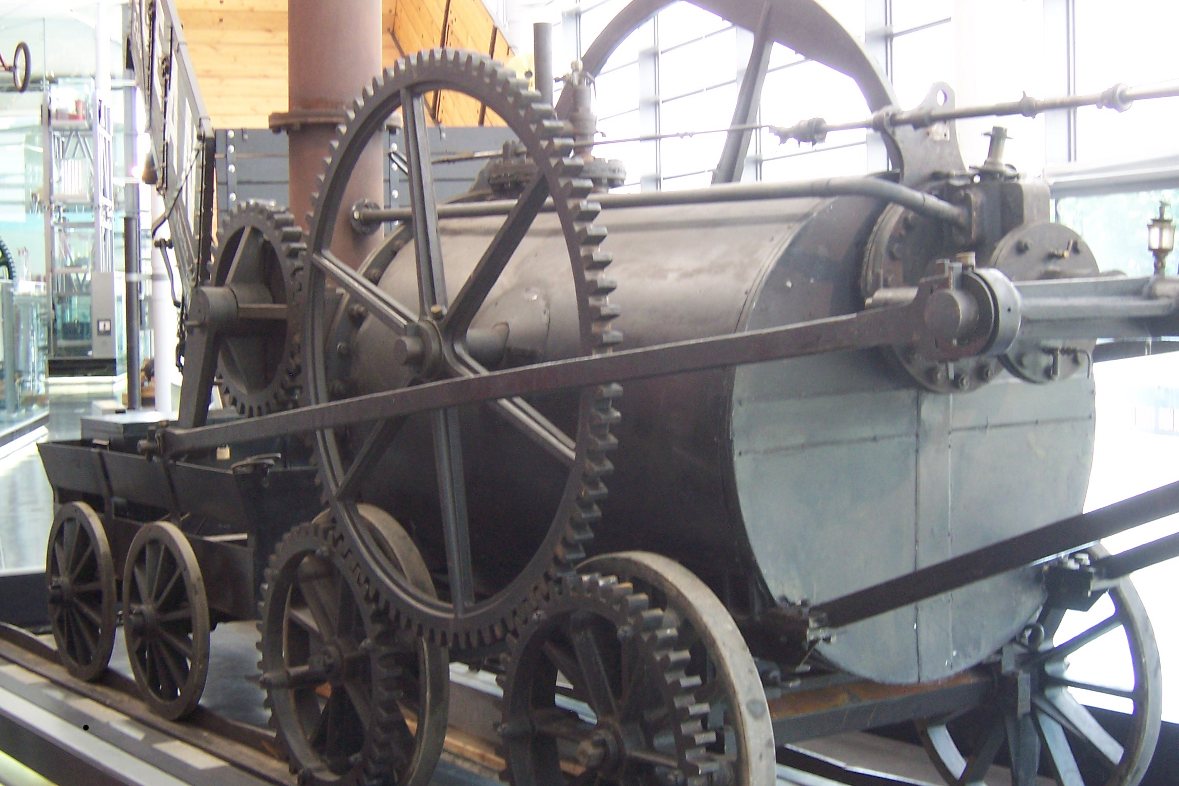
A replica of Richard Trevithick’s 1802 steam locomotive at the National Waterfront Museum in Swansea.
Photo by Chris55 via Wikimedia Commons.
In March, Britain’s Daily Telegraph and GB News channel both reported that the National Museum of Wales would be relabelling a replica of the first steam-powered locomotive, unveiled by its Cornish inventor Richard Trevithick in 1804. Trevithick had no links to slavery, but the amendment has apparently been included anyway as part of the museum’s commitment to “decolonizing” its collection. In a statement defending what it described as the addition of “historical context”, the museum said: “Although there might not be direct links between the Trevithick locomotive and the slave trade, we acknowledge the reality that links to slavery are woven into the warp and weft of Welsh society.” The statement continued:
Trade and colonial exploitation were embedded in Wales’ economy and society and were fundamental to Wales’ development as an industrialised nation. As we continue to audit the collection, we will explore how the slave trade linked and fed into the development of the steam and railway infrastructure in Wales.
[…]
When a society compulsively disrespects its historical accomplishments — when it obsessively seeks to turn every good thing into a bad thing — the outlook for that society is bleak. It destroys social cohesion, and sends the wrong kind of message to actual and potential opponents. The matter of the steam locomotive display in Wales may seem minor, and certainly trivial when compared with the appalling events in Ukraine or the threat of Iranian nuclear weapons. But it is not.
The behavior of the museum administrators in Wales is of a piece with other contemporary symptoms, such as the eagerness within influential circles in the US to embrace the conclusions of the New York Times‘s revisionist 1619 project. It is part of the politicization of everything. Science, technology, and art cannot — indeed, must not — be appreciated simply on the grounds of beauty, utility, or truth; everything must be reduced to race, gender, and other academically and media-approved categories of analysis.
Trends such as these have real-world implications, including the growth and decline of nations and their relative power. Writing in 1940, C.S. Lewis, warned about the dangers of what he called the National Repentance Movement, which focused on the need to apologize for Britain’s sins (thought to include the Treaty of Versailles) and to forgive Britain’s enemies.
Certainly, the British State had done many bad things during its long and eventful history — as well as many good things. But the excessive focus on its sins was part of a phenomenon manifested in a 1933 motion debated at the Oxford Union: “This House will under no circumstances fight for King and country”. To the Nazis and the Imperial Japanese, attitudes like these indicated that aggression would not meet much resistance. They also informed a policy of appeasement.
Liberals and progressives (as they call themselves) claim to be greatly concerned with physical sustainability of resources and ecosystems. But they are too eager to undercut the social sustainability of their own societies and the physical infrastructures on which those societies depend, however fond they may be of repeating the word “infrastructure”.
Why Did The First World War Break Out? (July Crisis 1914)
[My 2014 series on “The Origins of World War I” can be read here. Although I’d read a fair bit of history on the period, once I began researching the period, even I was surprised at how many different contributing causes there were.]
The Great War
Published 15 Jul 2022The assassination of Archduke Franz Ferdinand and his wife in Sarajevo on the 28th of June 1914 kicked off a crisis among the European Powers. Tensions that built up in the decades before erupted and in early August 1914 the world was at war. But what happened in these fateful July weeks 1914?
(more…)
Sexual liberation to sexual revolution to … today’s sexual desert
Chris Bray thinks that the sexual revolution “missed a turn, somewhere out in the desert”:
The discussion of what we didn’t mean to do is becoming an interesting one:
After decades of sexual liberation — Mattachine, Stonewall, Loving v. Virginia, Griswold v. Connecticut, Second Wave feminism and the Sexual Revolution, Lawrence v. Texas, Obergefell v. Hodges, and whatever else I’m missing in there (and I’m not sure Roe belongs on the list, but maybe) — we somehow arrive at a moment in which we merge a sexualized display of childhood and a relentless media-driven commodification of sexuality with the very clear reality that nobody’s having any sex:
One of the most comprehensive sex studies to date — the National Survey of Sexual Health and Behavior — found evidence of declines in all types of partnered sexual activity in the U.S. Over the course of the study from 2009 to 2018, those surveyed reported declines in penile-vaginal intercourse, anal sex and partnered masturbation …
Over the last 22 years, Herbenick has co-authored several studies about our sexual activity. Her most recent research finds that all of us, regardless of age, are having less sex, with the most dramatic decline among teenagers.
At the start of the study in 2009, 79% of those ages 14 to 17, revealed they were not having sex. By 2018, that number rose to 89%.
Liberation stabbed pleasure in the heart; we emptied sex. Hypersexualization turns out to be desexualization. The unrelenting joylessness and death odor of contemporary sexual culture emerges from seventy years of growing openness and freedom. How?
There’s no way to fully cover a question of that scope in a single post — but I refer, as a start, to the earlier posts I wrote about the sexualization of childhood and the way Jim Jones used sex as a weapon. Breaking barriers and repressive anchors broke connections and reference points: Yes, some people were trapped in oppressive societal norms, and it’s not at all my view that all the sexual liberation in our past wasn’t really liberating. But we broke marriage to set people free, and whoops. Some people experienced bourgeois heteronormativity as a prison, and so set out to release everybody from their cages, which seem to have not been cages for a whole lot of people. Congratulations, we’ve freed you from being part of a family.

Winemaking in the Middle Ages | The Process, Taste, Storage and Use
Kobean History
Published 31 Aug 2020
(more…)
QotD: Spoiler – there was no technological solution to trench warfare in WW1
All of which is to say, again, that the problem facing generals – German, French, British and later American – on the Western Front (and also Italian and Austrian generals on the Italian front) was effectively unsolvable with the technologies at the time. Methodical Battle probably represented the best that could be done with the technology of the time. The technologies that would have enabled actually breaking the trench stalemate were decades away in their maturity: tanks that could be paired with motorized infantry to create fast moving forces, aircraft that could effectively deliver close air support, cheaper, smaller radios which could coordinate those operations and so on. These were not small development problems that could have been solved with a bit more focus and funding but major complexes of multiple interlocking engineering problems combined with multiple necessary doctrinal revolutions which were in turn premised on technologies that didn’t exist yet which even in the heat of war would have taken many more years to solve; one need merely look at the progression of design in interwar tanks to see all of the problems and variations that needed to be developed and refined to see that even a legion of genius engineers would have required far more time than the war allowed.
It is easy to sit in judgement over the policy makers and generals of the war – and again, to be fair, some of those men made terrible decisions out of a mix of incompetence, malice and indifference (though I am fascinated how, in the Anglophone world, so much of the opprobrium is focused on British generals when frankly probably no British commander even makes the bottom five worst generals. Most lists of “worst generals” are really just “generals people have heard of” with little regard to their actual records and so you see baffling choices like placing Joseph Joffre who stopped the German offensive in 1914 on such lists while leaving Helmuth von Moltke who botched the offensive off of them. Robert Doughty does a good job of pointing out that men like Haig and Foch who were supposedly such incompetent generals in 1915 and 1916 show remarkable skill in 1918).
But the problem these generals faced was fundamentally beyond their ability or anyone’s ability to solve. We didn’t get into it here, but every conceivable secondary theater of war was also tried, along with naval actions, submarines, propaganda, and internal agitation. This on top of the invention of entirely new branches of the army (armor! air!) and the development of almost entirely new sciences to facilitate those branches. Did the generals of WWI solve the trench stalemate? No. But I’d argue no one could have.
Bret Devereaux, “Collections: No Man’s Land, Part II: Breaking the Stalemate”, A Collection of Unmitigated Pedantry, 2021-09-24.
July 21, 2022
Hidden flaws in vintage wooden planes
Rex Krueger
Published 20 Jul 2022Find the problems that can make wooden planes unusable. Find them BEFORE you buy.
(more…)
QotD: The history of the self-portrait
Severian, “As I Can”, Founding Questions, 2022-04-18.
July 20, 2022
Climate change is nothing new, and it was warmer in England for a few hundred years in the Middle Ages
If you’ve been reading the blog for a while, you’ll have noticed that I’m not a fan of trying to panic people about climate change … catastrophism just isn’t my thing. I certainly don’t deny that climate change happens and I agree that it is happening now, but I’m highly skeptical that human action has more than a minor influence compared to the ups and downs of long-term climate shifts driven by natural forces. Ed West has a thumbnail sketch of just how much the European (and especially English) climate change impacted ordinary people during the Middle Ages:

Chart from the Journal of Quaternary Science Reviews showing Greenland ice core data over the last 10,000 years. At the end of the Minoan Warming came the Bronze Age Collapse, after the Roman Warming came the fall of the western Roman Empire.
The climate is changing, with all that entails, something we’ve known about for several decades now. Among the early proponents of the theory of climate change was mid-century climatologist Hubert Lamb, who spent most of his career at the Met Office and during the course of his studies made a curious historical discovery.
It was once widely believed that climate remained relatively stable over recorded history, civilisational lifespans being too brief to see such grand changes. But while looking into medieval chroniclers, Lamb was struck by the numerous references to vineyards in England, some as far as the midlands. As long as anyone had ever remembered, the country had been too cold to grow wine, except in tiny pockets of Sussex which occasionally produced almost-drinkable white.
William of Malmesbury, living in the 12th century, observed of his native Wiltshire that “in this region the vines are thicker, the grapes more plentiful and their flavour more delightful than in any other part of England. Those who drink this wine do not have to contort their lips because of the sharp and unpleasant taste, indeed it is little inferior to French wine in sweetness.” How could that have been?
Lamb concluded that Europe must have been considerably warmer during the Middle Ages, and in 1965 produced his great study outlining the theory of the Medieval Warm Period; this posited that Europe was at its hottest in the High Middle Ages (1000-1300) and then became unusually cool between 1500 and 1700.
Since then, Lamb’s thesis has been reinforced by analysis of pollen in peat bogs, as well as the radioactive isotope Carbon-14 found in tree rings (the less sun, the more Carbon-14). In Medieval Europe, every summer was a hot girl summer — and tiny changes could make earth-shattering differences.
The people of Europe enjoyed that extended period of warmer weather for about 300 years, then things suddenly got far worse:
Across Europe, people must have noticed a change. Farmers in the Saastal Valley in Switzerland were probably the first to observe what was happening, back in the 1250s, when the Allalin Glacier began to flow down the mountain. Surviving plant material from Iceland suggests an abrupt decrease in the temperature from 1275 — and, as Rosen points out, a reduction of one degree made a harvest failure seven times more likely. From 1308 England saw four cold winters in succession; the Thames froze, chroniclers recalling dogs chasing rabbits across the icy surface for the first time.
As with many things, change was gradual, until it was dramatic, for then came the disastrous year of 1315. The Chronicle of Guillaume de Nangis, written by a monk at the Abbey of Saint-Denis outside Paris, recorded that in April the rains came down hard — and didn’t stop until August.
Drenched and starved of sunlight, the crops failed across Europe. The price of food doubled and then quadrupled. By May 1316, crop production in England was down by up to 85 percent and there was “most savage, atrocious death”, as a chronicler put it. Hopeless townsfolk walked into the countryside, searching for any bits of food; men wandered across the country to work, only to return and find their wives and children dead from starvation. At one point, on the road near St Albans, no food could be found even for the king. Emaciated bodies could be seen floating face down in flooded fields.
The Great Famine killed anywhere between 5-12% of the European population, although some areas, such as Flanders, suffered far worse death rates, losing up to a quarter of their population to hunger.
The Myth of Rosie the Riveter – On the Homefront 016
World War Two
Published 19 Jul 2022With American men going off to fight the war, there are concerns about a labor shortage. Enter Rosie the Riveter. The women who answered the “We Can Do It” call and entered the factories. But did she really exist?
(more…)
Book Review: The Wipers Times
Forgotten Weapons
Published 6 May 2018Get your copy here: https://amzn.to/2jzWnkI
Or here: https://amzn.to/2JOpMm3The Wipers Times was a satirical trench newspaper printed from February 1916 until December 1918 by British Captain F.J. Roberts and a crew of assistants. Such papers were not particularly uncommon, but the Wipers Times was particularly successful, well written, and long-lived, and it has survived in reprints today to a greater extent than any other similar work. A total of 23 issues were printed, and they consist of poetry, commentary, mock advertisements, advice columns, and short stories. While much of the humor is still quite accessible to us today, much of it also includes references, abbreviations, and inside jokes that are inscrutable to those who are not quite knowledgeable about life in the trenches.
Roberts and his cohorts were legitimate front-line soldiers, not writing as visiting journalists or from the safety of the rear echelons. Beyond its basic entertainment value, their writings also provide a rare and interesting view into the minds of men who were truly living the Great War.
Note that a book about the newspaper has also been printed, titled The Wipers Times, and with a very similar cover. If you want to buy a copy of the reprinted original issues, make sure you are not buying that book.
The BBC made a 90 minute program based on the Times, which is available in its entirely on YouTube here:
https://www.youtube.com/watch?v=SKPXu…[The original channel has been deleted, but I believe this is the same video: https://www.youtube.com/watch?v=juZBxhUYRpg]
(more…)


