
Tasting History with Max Miller
Published 16 Dec 2022
(more…)
December 25, 2022
What the heck is Wassail?
Comments Off on What the heck is Wassail?
Stalin’s Christmas Surprise – Major Offensives to Come – WW2 – 226 – December 24, 1943
World War Two
Published 24 Dec 2022Twas the night before Christmas and the war was grinding on. The Moro River Campaign continues in Italy with Canadian infantry pushing past the Gully and into “Little Stalingrad”. Generally, the Allied advance to Rome is turning into a stalemate though, but Winston Churchill still believes an amphibious landing is the way to break this. Joseph Stalin also has some pretty big plans to bring the USSR back to its pre-Barbarossa borders. In the Pacific, there is attrition over Rabaul and stalemate on Bougainville.
(more…)
Comments Off on Stalin’s Christmas Surprise – Major Offensives to Come – WW2 – 226 – December 24, 1943
December 24, 2022
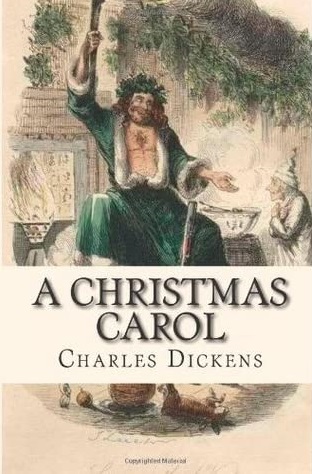
The abiding influence of A Christmas Carol by Charles Dickens
So many of our fading-but-still-fondly remembered Christmas traditions seem to come back to Victorian times, and especially those featured in Charles Dickens’ most famous Christmas story (certainly helped by the popularity of the Alistair Sim film adaptation):
Even in our supposedly rationalist secular era, we find one of these thin places or times in the unlikely guise of Christmas and its rich repository of ghost stories. The supernatural was not banished by the developments of modernity but rather it evolved and adapted, moving from enchanted woods to gothic houses to the streets and rooms of Victorian cities. Just as in earlier times, they found their place where it is dark, in the dead of winter, when the nights close in and fireside stories cause the mind to play tricks and shadows to seemingly change their forms.
Among the many writers who have tried their hand at yuletide ghost stories, none loom larger than Charles Dickens who, with A Christmas Carol (subtitled Being a Ghost Story of Christmas), fundamentally influenced the way we perceive and celebrate the festivity. To fully understand how and why Christmas became a thin place and remains so, we have to delve into a scourge at the very heart of Dickens’s story and our society still — loneliness.
Christmas is one of those times when, as a much earlier writer, Dante, put it: “There is no greater sorrow than to recall in misery the time when we were happy.” And what time is happier, or more melancholic when irretrievable, than a childhood Christmas? Victorian writers knew that when we are alone at Christmas, a time that seems intrinsically meant for loved ones congregating (the perpetual renewal of the Nativity scene), our ghosts, borne by memory, absence and regret, would instead arrive.
Dickens knew the power of myth, and how the beautiful lie might reveal the hidden truth. Determined to speak out about the horrors of child labour and poverty he had directly experienced and witnessed, Dickens first toyed with writing a strident but fairly unwieldly political jeremiad until he realised, correctly, that there was a much more seductive approach available, through the Trojan Horse of storytelling. It was all too easy to turn away from a lecture or respond with platitudes and fallacies, but a heart-stirring tale had the ability to get under one’s skin. His characters and settings were constructed not just from satirical observations of the powerful but from encounters Dickens had had with the powerless, during his lengthy night walks around London. He was also deeply inspired, and haunted, by macabre tales that his cockney nursemaid Mary Weller used to delight in telling him as a child — full of Faustian pacts, treacherous innkeepers, poisons “distilled from toads’ eyes and spiders’ knees”, the Black Cat and Captain Murderer. To add to the unease, Weller would claim the horrors were true and she had witnessed them herself or had heard them from relatives who were eyewitnesses. As Dickens later recounted, in The Uncommercial Traveller, she “took a fiendish enjoyment of my terrors, and used to begin, I remember — as a sort of introductory overture — by clawing the air with both hands, and uttering a long low hollow groan”.
A Christmas Carol has this oral tradition feel, albeit delivered in a short, and affordable, novella form. It also rebalances Dickens’s heavy lean towards sentimentality (the pitiable figure of Tiny Tim, for instance) with the resolutely unsentimental tactic of terrifying child readers. This was necessary for reasons of veracity — existence was unsentimental in those days — but also as a myth-making technique. There are few lessons that stay with us longer and deeper than those which strike mortal fear in us and then propose a way out.
At the heart of the story and its extraordinary legacy is loneliness. Rereading A Christmas Carol, its power initially comes from its status as a social tract and a fable. What is crucial, however, is its existential quality. It shows that the system then in place, and perhaps still, not only oppresses and squanders but it also alienates. Dickens takes the traditional Christmas theme of visitation (the announcing angel, the wandering star leading to the Christ child, the shepherds, the Magi) and makes it sinister. Salvation can come only through the painful process of facing the truth (“Without their visits,” said the Ghost, “you cannot hope to shun the path I tread”). It can only emerge from Scrooge seeing that he has betrayed and marginalised not only his fellow human beings but himself, acknowledging that he belongs to the Malthusian “surplus population” he castigates, that he is alone and bereft (“Will you not speak to me?” he begs the final phantom), and the only precious hope he has left is to be found through gratitude and selfless communion with others.
History-Makers: Saint Nicholas to Santa Claus
Overly Sarcastic Productions
Published 23 Dec 2022Merry Sinterklaasfeest to all, and to all a good night.
Our content is intended for teenage audiences and up.
(more…)
Comments Off on History-Makers: Saint Nicholas to Santa Claus
December 23, 2022
A Jungle Miracle – War Against Humanity 092
World War Two
Published 22 Dec 2022Two escapes, one from the Nazis in Kovno (Kaunas) Lithuania, from the prison at Fort IX, and one from Japanese terror on Panay in the Philippines this week, will help to document the crimes of the Axis powers.
(more…)
Comments Off on A Jungle Miracle – War Against Humanity 092
December 22, 2022
QotD: Sparta as the pre-eminent foe of tyranny
One of the ways that Sparta positioned itself was as the state which championed the freedom of the Greeks. Sparta had fought the Persian tyrant, had helped to oust tyrants in Athens and had later framed Athens itself as a “tyrant city”. Sparta itself had never had a tyrant (until Cleomenes III seized sole power in the 220s). On the flip side, Spartan hegemony was, apparently, little better than Athenian hegemony, given how Sparta’s own allies consistently reacted to it and Sparta would, in the end, do absolutely nothing to stop Philip II of Macedon from consolidating sole rule over Greece. When the call went out to once again resist a foreign invader in 338, Sparta was conspicuous in its absence.
It also matters exactly how tyranny is understood here. For the ancient Greeks, tyranny was a technical term, meaning a specific kind of one-man rule – a lot like how we use the word dictatorship to mean monarchies that are not kingdoms (though in Greece this word didn’t have quite so strong a negative connotation). Sparta was pretty reliable in opposing one-man rule, but that doesn’t mean it supported “free” governments. For instance, after the Peloponnesian War, Sparta foisted a brutal oligarchy – what the Athenians came to call “The Thirty Tyrants” – on Athens; their rule was so bad and harsh that it only lasted eight months (another feat of awful Spartan statecraft). Such a government was tyrannical, but not a tyranny in the technical sense.
But the Spartan reputation for fighting against tyrannies – both in the minds of the Greeks and in the popular consciousness – is predicted on fighting one very specific monarchy: the Achaemenids of Persia. […] This is the thing for which Sparta is given the most credit in popular culture, but Sparta’s record in this regard is awful. Sparta (along with Athens) leads the Greek coalition in the second Persian war and – as discussed – much of the Spartan reputation was built out of that. But Sparta had largely been a no-show during the first Persian war, and in the subsequent decades, Sparta’s commitment to opposing Persia was opportunistic at best.
During the late stages of the Peloponnesian War, Sparta essentially allied with Persia, taking funding and ships first from the Persian satrap Tissaphernes and later from Cyrus the Younger (a Persian prince and satrap). Sparta, after all, lacked the economic foundation to finance their own navy and the Spartans had – belatedly – realized that they needed a navy to defeat Athens. And of course the Persians – and any Spartan paying attention – knew that the Athenian navy was the one thing keeping Persia out of Greek affairs. So Sparta accepted Persian money to build up the fleets necessary to bring down the Athenian navy, with the consequence that the Ionian Greeks once again became subjects to the Persian Empire.
Subsequent Spartan diplomatic incompetence would lead to the Corinthian War (395-387), which turned into a nasty stalemate – due in part to the limitations of Spartan siege and naval capabilities. Unable to end the conflict on their own, the Spartans turned to Persia – again – to help them out, and the Persians brokered a pro-Spartan peace by threatening the Corinthians with Persian intervention in favor of Sparta. The subequent treaty – the “King’s Peace” (since it was imposed by the Persian Great King, Artaxerxes II) was highly favorable to Persia. All of Ionian, Cyprus, Aeolia and Carnia fell under Persian control and the treaty barred the Greeks from forming defensive leagues – meaning that it prevented the formation of any Greek coalition large enough to resist Persian influence. The treaty essentially made Sparta into Persia’s local enforcer in Greece, a role it would hold until its defeat in 371.
If Sparta held the objective of excluding Persian influence or tyranny from Greece, it failed completely and abjectly. Sparta opened not only the windows but also the doors to Persian influence in Greece – between 410 and 370, Sparta probably did more than any Greek state had ever or would ever do to push Greece into the Persian sphere of influence. Sparta would also refuse to participate in Alexander’s invasion of Persia – a point Alexander mocked them for by dedicating the spoils of his victories “from all of the Greeks, except the Spartans” (Arr. Anab. 1.16.7); for their part, the Spartans instead tried to use it as an opportunity to seize Crete and petitioned the Persians for aid in their war against Alexander, before being crushed by Alexander’s local commander, Antipater, in what Alexander termed “a clash of mice”.
Bret Devereaux, “Collections: This. Isn’t. Sparta. Part VII: Spartan Ends”, A Collection of Unmitigated Pedantry, 2019-09-27.
Comments Off on QotD: Sparta as the pre-eminent foe of tyranny
December 21, 2022
The Nazi Quest for Thor’s Hammer – WW2 Documentary Special
World War Two
Published 20 Dec 2022Books, films, and comics are filled with Nazi scientists and explorers travelling the globe to get their hands on ancient artifacts or summoning daemons with black magic. But how much of it is grounded in reality? Well, some of it. In the neo-pagan religion invented by Reichsführer-SS Heinrich Himmler, the world can only be explained through the occult.
(more…)
Comments Off on The Nazi Quest for Thor’s Hammer – WW2 Documentary Special
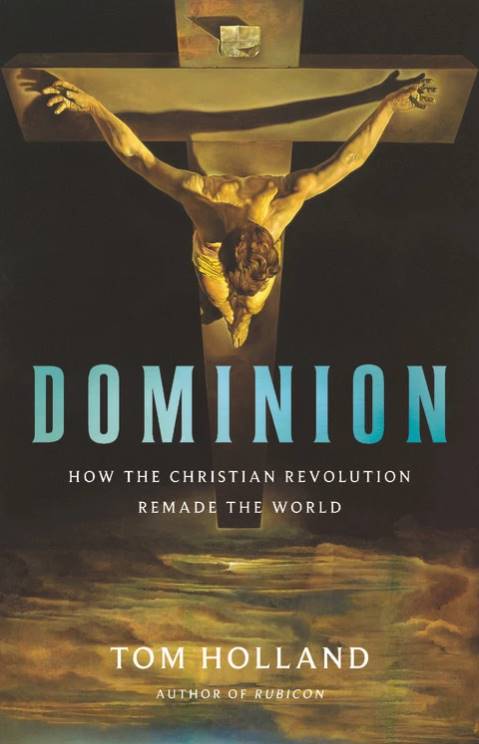
Tom Holland’s Dominion
Ed West expands on the review he wrote when Holland’s book was first published in 2019:
The Romans are the most “epic” figures in history, to use my young son’s favourite word, exerting a glamour and allure that no civilisation has successfully matched. This magnetism can also appear heightened by what followed, the illiterate bleakness of the early Middle Ages, and the fun-sucking religion that came with it. Many down the years have lamented the switch from the Rome of the Caesars to the Rome of the popes.
The young Tom Holland was one of them. Raised as an Anglican, the historian’s childhood fascination with dinosaurs evolved into one for the equally glamorous ancients. “Although I vaguely continued to believe in God,” he writes: “I found him infinitely less charismatic than the gods of the Greeks: Apollo, Athena, Dionysus. I liked the way that they did not lay down laws, or condemn other deities as demons; I liked their rock-star glamour. As a result, by the time I came to read Edward Gibbon and his great history of the decline and fall of the Roman Empire, I was more ready to accept his interpretation of the triumph of Christianity: that it had ushered in an ‘age of superstition and credulity’. My childhood instinct to see the biblical God as the po-faced enemy of liberty and fun was rationalised.”
This, indeed, is a widespread view. Since Gibbon wrote his great work in the late 18th century there has existed the popular idea that the Renaissance, with its return to classical values, and the Enlightenment, which saw the birth of reason over superstition, were a reaction to Christianity, which had in those thousand dark medieval years suppressed science and freedom.
Yet the truth and paradox, as Holland shows in this truly epic account of how Christianity came to shape the West, is that the western idea of secularism is itself a very Christian one. Liberalism was never a reaction to Christianity, it was a product, perhaps one might heresy; ditto Marxism, socialism and the various progressive creeds of the modern era, right up to the current Great Awokening with its focus on the sanctity of victimhood.
All our assumptions about progress, the rights of the individual, our horror of racism and sexual exploitation, even the acceptance of gay marriage, are the products of Christianity. They are not in themselves universal or “natural”, and to the Romans these ideas of human rights and dignity would have been incomprehensible, laughable even.
Holland made his name with thrilling popular histories set in the ancient world, yet the more he studied antiquity, the more alien it became to him. It wasn’t just that Spartans or Romans killed innocents in large numbers, but that they lacked even the suggestion that the weak might be worth pitying. “That my belief in God had faded over the course of my teenage years did not mean that I had ceased to be Christian,” he writes.
Cruelties such as the exposure of infants – especially female infants – were almost universally accepted in antiquity, except among one or two small German tribes and, at the other end of the empire, a monotheistic people in the eastern Mediterranean. Perhaps the obscenest horror, however, was the practice of crucifixion, a death so cruel that Roman writers barely touched on the subject. Indeed only “four detailed accounts of the process by which a man might be sentenced to the cross, and then suffer his punishment, have survived from antiquity. Remarkably, they all describe the same execution.”
This is the story of how on that one Friday in Judea the world was changed forever — with a moral revolution like nothing before or since.
Comments Off on Tom Holland’s Dominion
December 20, 2022
A true behind-the-scenes look at George Orwell’s Nineteen Eighty-Four
In Spiked, Alexander Adams reports on a new, limited edition of the surviving portion of George Orwell’s manuscript for the novel:
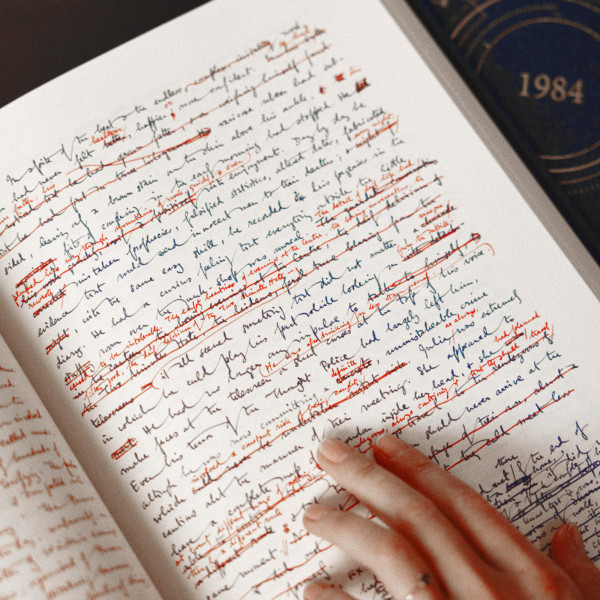
A photo from SP Books’ web page showing the reproduction of Orwell’s manuscript.
SP Books, https://www.spbooks.com/150-1984-9791095457114.html
Published by SP Books, this is Nineteen Eighty-Four as you’ve never seen it before. It reproduces, in colour facsimile, the 197 surviving pages of Orwell’s manuscript, held by the John Hay Library at Brown University, Rhode Island. We see Orwell’s work in fountain pen and ballpoint (complete with ink blots), as well as 14 typewritten sides. We are even given his doodles and pen tests. Readers will remember how Winston also marvels at the beauty of the paper and binding of a blank book he buys from a junk shop.
This edition contains what amounts to 44 per cent of the text of the published novel. It is in a jumbled state, with pages missing and drastic changes made. There are many crossings out and additions. The handwriting can be a little tricky to decipher – Orwell had a habit of using cursive joining lines between words and using abbreviations. Added to that, the script can be somewhat crabbed, especially where Orwell adds text between existing lines. With a little patience, though, the reader can adjust to Orwell’s writing, especially if familiar with the text, and glimpse this most familiar of novels anew.
This version includes an introduction by Orwell scholar DJ Taylor. He tells us that although Orwell usually wrote quickly, he took five years to complete Nineteen Eighty-Four. Taylor details the difficult conditions that explain the novel’s long gestation. The death of Orwell’s first wife in 1945, the effort of raising their young son alone and the toll of tuberculosis all slowed work and drained the author’s energy (tuberculosis would kill him in 1950, only months after the novel’s publication). There are indications that Orwell let the book go to publication even though he thought it was not properly finished.
Looking at this draft, we can see Orwell revising heavily as he wrote. Some revisions are minor, such as Trotsky-figure Goldstein’s description of the workings of the Party and his description of the geopolitics of Oceania, Eurasia and Eastasia. Other changes are more significant. Here, in the propaganda film described by Winston at the start of his diary, there is a graphic passage about the lynching of a pregnant black woman. Orwell seems to have cut these lines on grounds of decency. He also reduced the references to race overall, perhaps uncomfortable about the implications of speaking so generally about groups and types. Orwell’s background as a policeman in Burma no doubt made him sensitive to racial issues.
Comments Off on A true behind-the-scenes look at George Orwell’s Nineteen Eighty-Four
Coming of the Sea Peoples: Part 2 – The Old and New Chronology of the Bronze Age
seangabb
Published 2 May 2021The Late Bronze Age is a story of collapse. From New Kingdom Egypt to Hittite Anatolia, from the Assyrian Empire to Babylonia and Mycenaean Greece, the coming of the Sea Peoples is a terror that threatens the end of all things. Between April and July 2021, Sean Gabb explored this collapse with his students. Here is one of his lectures. All student contributions have been removed.
(more…)
Comments Off on Coming of the Sea Peoples: Part 2 – The Old and New Chronology of the Bronze Age
The forgotten Thomas Savery
In the latest Age of Invention newsletter, Anton Howes remembers the work of inventor Thomas Savery:

Screenshot from “Savery’s Miners Friend – 1698”, a YouTube video by Guy Janssen (https://www.youtube.com/watch?v=Dt5VvrEIj8w)
We know surprisingly little about Thomas Savery — the inventor of the first widely-used steam engine. Unfortunately, his achievements were almost immediately overshadowed by the engine of Thomas Newcomen, and so he’s often only mentioned as a sort of afterthought — a loose and rather odd-seeming pebble before the firmer stepping stones of Newcomen, Watt, Trevithick, and other steam engine pioneers in the standard and simple narratives of technological progress that people like to tell. I’ve often seen Savery’s name omitted entirely.
He is even neglected by the experts. The Newcomen Society, of which I am a new member, has an excellent journal — it is the best place to find scholarly detail about all steam pioneers, and about the history of engineering in general. Yet even it only mentions Savery in passing. In over a century, Savery has been named in the titles of just three of its articles, and the last was published in 1986.
I think Savery is extremely under-rated, and deserves to be studied more. Fortunately, we do know quite a bit about the engine he designed, which he intended primarily for raising the water out of mines. Steam was admitted into a chamber, and then sprayed with cold water to condense it. This caused mine water to be sucked up a pipe beneath it, by creating a partial vacuum within the chamber and thus exploiting the relative pressure of the atmosphere on the surface of the mine water. Then, hot steam was readmitted to the chamber, this time pushing the raised water further up through another pipe above. Two chambers, the one sucking while the other pushed, created a continuous flow. (Video here.) We have dozens of images and technical descriptions of Savery’s engine, as it continued to be used for decades, especially in continental Europe.
But we know essentially nothing about Savery’s background, training, inspiration, or profession, and most of the supposedly known biographical details we have for him are simply wrong. There is no evidence that he was a “military engineer” or a “trenchmaster”, for example — mere speculation that has been repeated so often as to take on the appearance of fact. Savery simply appears out of nowhere in the 1690s, with his inventions almost fully formed.
Yet in Savery’s own writings we can see a few tantalising hints of how he thought, including some flashes of brilliance. I kept coming across them by chance, when investigating various energy-related themes with Carbon Upcycling. Take the following aside, from Savery’s 1702 prospectus for his steam engine: “I have only this to urge, that water in its fall from any determinate height, has simply a force answerable and equal to the force that raises it”. Savery here seems to be hinting at some idea of the conservation of energy, and perhaps of a theoretical maximum efficiency — in a phrase that is remarkably similar to that used by the pioneers of water wheel theory half a century later, and to Sadi Carnot when he applied the same ideas to early thermodynamics.
Savery, frustratingly, doesn’t expand any further on the point, except to then casually mention the notions of both mechanical work and horsepower — over eighty years before James Watt. Savery noted that when an engine will raise as much water as two horses can in the same time, “then I say, such an engine will do the work or labour of ten or twelve horses” — ten horsepower, rather than two, because you’d need a much larger team of horses from which to rotate fresh ones while the others rested, to keep raising water as continuously as the force of a stream could turn a water-wheel, or his steam engine could pump. (Incidentally, Watt wasn’t even the second person to use horsepower — the same concept was also mentioned by John Theophilus Desaguliers in the 1720s and John Smeaton in the 1770s. Watt just managed to get all the credit later on. Perhaps watts should really be called saveries, even if he was less precise.)
Comments Off on The forgotten Thomas Savery
Eggnog: A Christmas History
Tasting History with Max Miller
Published 22 Dec 2020
(more…)
Comments Off on Eggnog: A Christmas History
QotD: Myrna Loy
She goes on to provide a short list: John Barrymore (“just because he felt like a little redhead now and then didn’t incline me to join the club …”), Clark Gable (she shoved him off her back porch one night after he made a pass “and, boy, did he punish me for that!”), Spencer Tracy (“he chased me for years, then sulked adorably when I married someone else …”) and Leslie Howard (despite both of them being married he “wanted to whisk me off to the South Seas, and, believe me, that was tempting …”).
“These days you’re made to feel dull and defensive if you weren’t the Whore of Babylon,” Loy writes. “Well, succumbing isn’t the only interesting aspect of a relationship.”
It’s no surprise that a woman who understands this much was such a natural in screwball comedies, where succumbing is usually held at bay until the last shot, the better to draw out the difficulties, obstacles and improbabilities set up like an obstacle course along the way.
Of the over 120 films she made, most of the first half of her career – largely bit parts, vamps and “exotics” – is forgotten, her reputation based on the fourteen she made with William Powell (six of which were Thin Man pictures), along with titles like The Best Years of Our Lives, The Bachelor and the Bobby Soxer, Mr. Blandings Builds His Dream House and Cheaper by the Dozen.
If she had a type onscreen – and Loy tried hard to avoid becoming a type – she would become Nora Charles, the paragon of wives: supportive but not obsequious, the equal of any spouse, ready with a wisecrack and a bit of fun, and always beautifully turned out. Quite a stretch, she’d admit, for a woman divorced four times, childless and openly dismissive of her domestic skills.
Rick McGinnis, “Do You Take This Woman? Myrna Loy and Third Finger, Left Hand“, Steyn Online, 2022-09-17.
Comments Off on QotD: Myrna Loy
December 19, 2022
Napoleon’s Downfall: German Wars of Liberation 1813
Real Time History
Published 16 Dec 2022After Napoleon’s defeat in Russia in 1812, the situation on the European continent is rapidly shifting. Prussia and Austria are leaving their unhappy alliance with the French. Prussian general Yorck even pledges his support to the Russian Army which is on the move towards Berlin. At Lützen and Bautzen Napoleon still manages to beat the new coalition, but his losses from Russia put him on the backfoot.
(more…)
Comments Off on Napoleon’s Downfall: German Wars of Liberation 1813
December 18, 2022
A Super Bomber to Break Japan – WW2 – 225 – December 17, 1943
World War Two
Published 17 Dec 2022This war has now lasted as long as the Great War did, but there’s no signs of it slowing. The Soviets have three offensives going on on the Eastern Front, in Italy the Allies are attacking at San Pietro and over the Moro River, in the Pacific there are Allied landings on New Britain, but in Pacific Command, the big talk is all about a new super bomber.
(more…)
Comments Off on A Super Bomber to Break Japan – WW2 – 225 – December 17, 1943


