
Tasting History with Max Miller
Published 18 Apr 2023
(more…)
April 19, 2023
World War 2 Ice Cream of the US NAVY
Comments Off on World War 2 Ice Cream of the US NAVY
Time to remove US nuclear weapons from Europe?
CDR Salamander has long advocated getting the final few American “tactical” nuclear weapons off European soil and makes the case for doing it now:
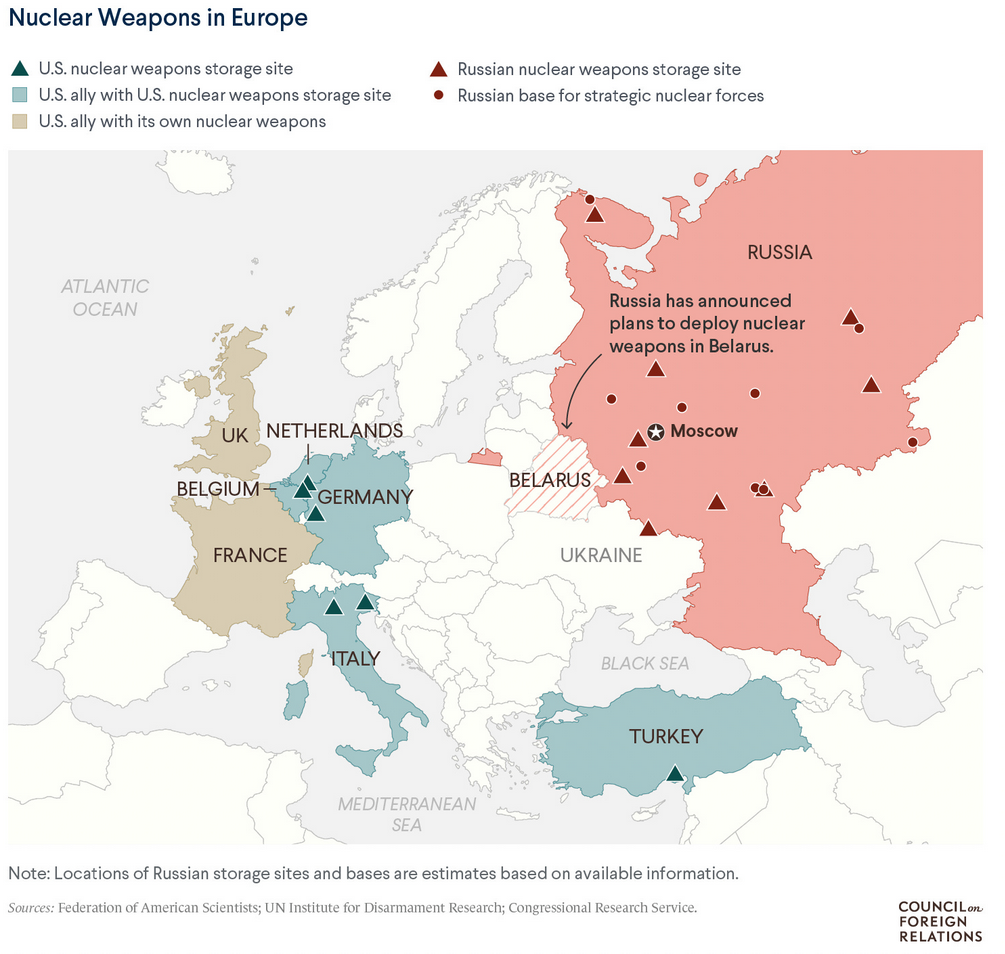
It may seem like a strange thing to propose while there is the largest land war in Europe since 1945 going on, but as it is something I’ve been a supporter of for a few decades I might as well be consistent: we are long overdue to remove American nuclear weapons from Europe.
It is 2023. Just look at this map.
[…]
The Soviet Union stopped existing over three decades ago.
Even though we’ve decreased from 7,000 warheads down to 100 … there really is no reason to keep what remains in Europe.
- Gravity bombs on continental Europe – that require tactical aircraft to deliver them – are the least survivable, reliable, or timely way to deliver a nuclear weapon.
- There is no such thing as a tactical nuclear weapon. I don’t care what some theorist proposes to defend their pet theories, you lob one nuke an order of magnitude larger than the Hiroshima bomb and only a foolish nation would let their strategic nuclear forces stay unused and in danger.
- Gravity bombs are not a first strike weapon and are a poor second strike weapon. As such, you have to consider that the the time gap from approval to flash-boom would be so long the war would be over before your F-XX pickled their nuke over their target – even if the aircraft made it off the ground.
- If they are NATO weapons, you not only have to get NATO to approve their use, but host nation to as well … in addition to the USA. Do you really think the Russians would not leverage their influence with the useful idiots in the Euro-Green parties, former communists, and general black-block anti-nuke activists to politically of physically stop the use of the nukes, especially in BEL, NLD, DEU, and ITA? Add that to point 3 above.
- Especially with the weapons in Turkey – the risk of these bombs having a bad day due to human or natural causes is non-zero. In the days of mutually assured destruction, those non-zero odds were manageable, but there is no reasonable person in the third decade of the 21st Century who can with a straight face explain to you why any tactical, operational, or strategic use justify their presence. They deter no enemy, but puts every friend in danger.
- Look again at the map above. Exactly what target set are you going to “service” at that range (non-refueled)?
- If things go nuclear in Europe then the right weapons are either British, French, and if they must be American are sitting in a silo in CONUS, a SSBN in the Atlantic, or a B-2 in Missouri.
Comments Off on Time to remove US nuclear weapons from Europe?
Philip II of Macedon (359 to 336 B.C.E.)
Historia Civilis
Published 24 May 2017
(more…)
Comments Off on Philip II of Macedon (359 to 336 B.C.E.)
April 18, 2023
Canada’s Prime Minister was never supposed to be like a US or French President
In The Line, Mitch Heimpel shows a few of the “presidential” accretions to the Canadian political system that really don’t belong in a Parliamentary system like ours:
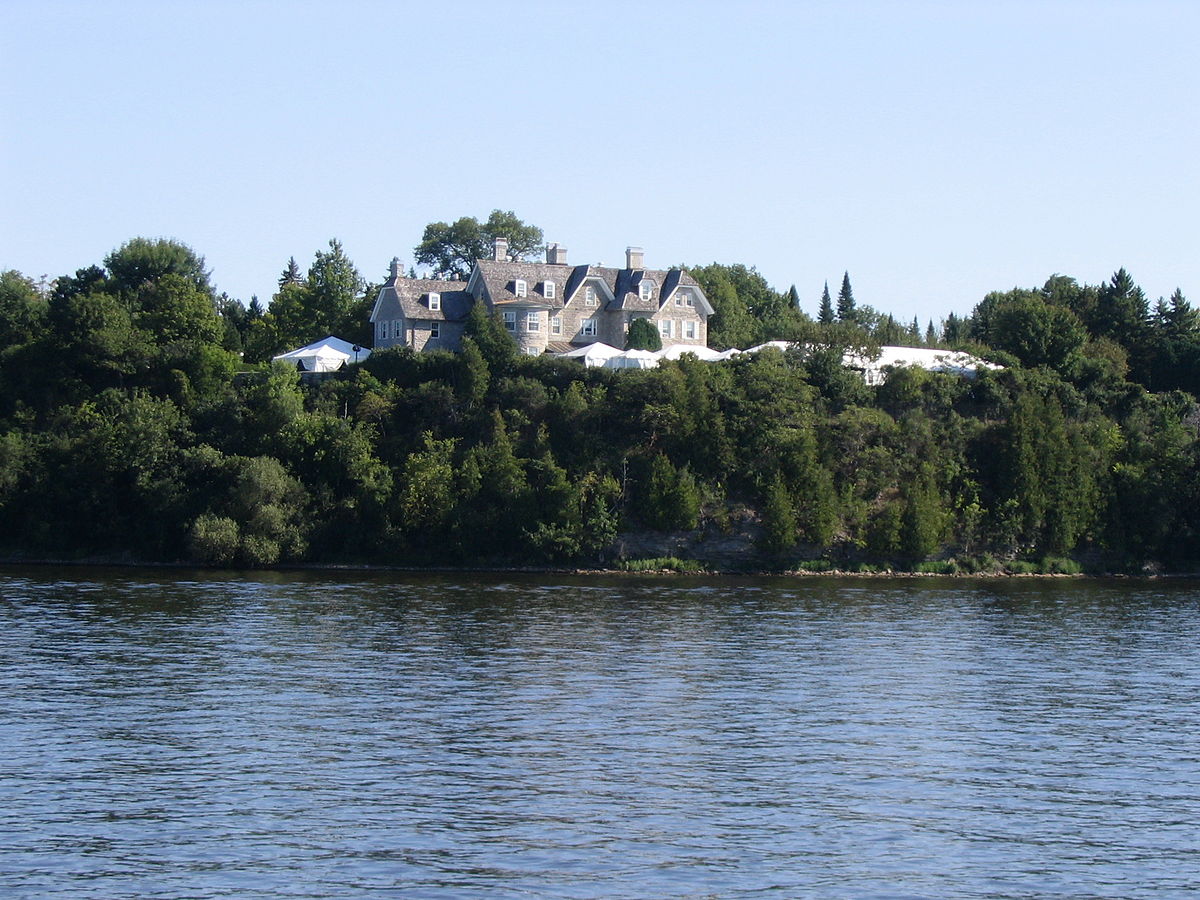
The official residence of the Prime Minister of Canada, 24 Sussex Drive, as seen from the Ottawa River. Ottawa, Ontario, Canada. (La résidence officielle du Premier ministre du Canada 24, promenade Sussex vu de la rivière des Outaouais).
Photo by sookie via Wikimedia Commons.
A couple of recent news stories, first about the Prime Minister’s Chief of Staff appearing (again) before a parliamentary committee, and the second about the level of decay of the official residence at 24 Sussex, have led me to realize how thoroughly we have presidentialised Canadian politics, and how thoroughly it has been to our detriment.
Parliamentary systems are not supposed to operate as presidential systems. They are intended to be far more managerial and transitory. They are intended to handle the affairs of state, without embodying the state. That distance is supposed to allow us all to access to a degree of patriotism without allowing partisanship to evolve into some kind of invasive cyst. This is why the weird, presidential appendages that have evolved in our own system over the years have proven so awkward and, ultimately, unwelcome. And unhealthy.
Let’s start with the easier target, 24 Sussex Drive, and get this out of the way off the top. The prime minister of a G7 nation should not live in squalor. Rat infestations, like the ones that recently contributed to the full closure of the prime minister’s ostensible home, are not acceptable. Official residences in various states of disrepair are a poor reflection on the nation, if for no other reason than it shows that we can’t even get basic carpentry and maintenance correct.
But the official residences of prime ministers are not supposed to be grand palaces either. They are supposed to emphasize the temporary nature of the occupant. The change of a prime minister, even without an election, should be a regular occurrence — and not just in Australia. Something that functions as a secure and defensible site with pleasant family home while also including the ability to host cabinet meetings or small events and maybe some staff as a working residence seems more than adequate.
It should not be the White House. It should not be the Elysée Palace. Nor should it attempt to compete with them. That’s not the job, or at least it’s not supposed to be. It should never be the subject of all this controversy and scrutiny, because it shouldn’t symbolize anything. It should be a secure place where the head of government and their family sleep until replaced by the next head of government and family.
Our fixation on it, and the fear every PM has of being seen spending a penny on its upkeep and repair, is a small but telling sign of how we’ve invested too much importance and symbolism in one person.
Comments Off on Canada’s Prime Minister was never supposed to be like a US or French President
Guadalcanal’s Red Beach Landing: America’s First Offensive in WW2
Forgotten Weapons
Published 24 Dec 2022After (formally) joining World War Two in the wake of Pearl Harbor, the United States endured a series of defeats at the hands of the Japanese. The Philippines garrison fell, Wake Island fell, Guam fell. British possessions in Southeast Asia teetered and fell as well — the campaign was not going well for the Allies.
The first American offensive of the war would come on August 7th, 1942 with the landing of the 1st and 5th Marines at Red Beach on Guadalcanal. Part of a multi-prong assault (the nearby Japanese bases on Tulagi and Gavutu/Tanambogo were also captured at the same time), the attack on Guadalcanal was made to secure the airstrip under Japanese construction there. If the island became an operational Japanese air base, Allied supply shipping to Australia would come under threat, and this could imperil the whole area of operations.
Fortunately for the Marines, US intelligence massively overestimated the Japanese force on Guadalcanal. It was in fact only a few hundred infantry, leading a work force of about 3,000 laborers (mostly Koreans). They thought the US landings were just a small raid, and dispersed into the jungle to wait for the US departure. Instead, the Marines were there to take the airfield and hold it. They were not, however, very well prepared. The Navy suffered a massive defeat in the waters off Guadalcanal the very next night, and would pull out of the area August 9th, leaving the Marines with dangerously low supplies of food, ammunition, and other essentials.
(more…)
Comments Off on Guadalcanal’s Red Beach Landing: America’s First Offensive in WW2
QotD: The worldview of the fanatic
More importantly, though, this is the logical endpoint of “democracy”, and now everyone gets to see it firsthand. In theory, democracy works by channeling competing vices. If men were angels, no government would be necessary, James Madison said, but since they’re not the best we can do is incentivize bad people to do good things in pursuit of their own selfish interest. It’s a nice thought, but it can only work (if, indeed, it can work) in a culture like Madison’s, in which public men are concerned about their dignity, honor, and posthumous reputation.
Obviously none of those hold in Current Year America, since they were all invented by the Pale Penis People, and even if they weren’t, they can’t matter to atheists anyway — one only defends one’s dignity and honor if one believes he’ll be called to account for them, and who’s going to do the accounting? There is no God, and as for the bar of History, what could that possibly matter to a cultural marxist? To them, as to their Puritan forbears, “history” is really soteriology. The past is nothing but a catalog of freely chosen error. For the fanatic, “history” begins anew each dawn, because why study endless iterations of Error when you already have the Truth?
Severian, “The Stakeholder State”, Rotten Chestnuts, 2020-01-22.
Comments Off on QotD: The worldview of the fanatic
April 17, 2023
Orwell’s The Road to Wigan Pier
Daniel Nuccio on one of George Orwell’s early works that prefigured the bestsellers he is best known for today:
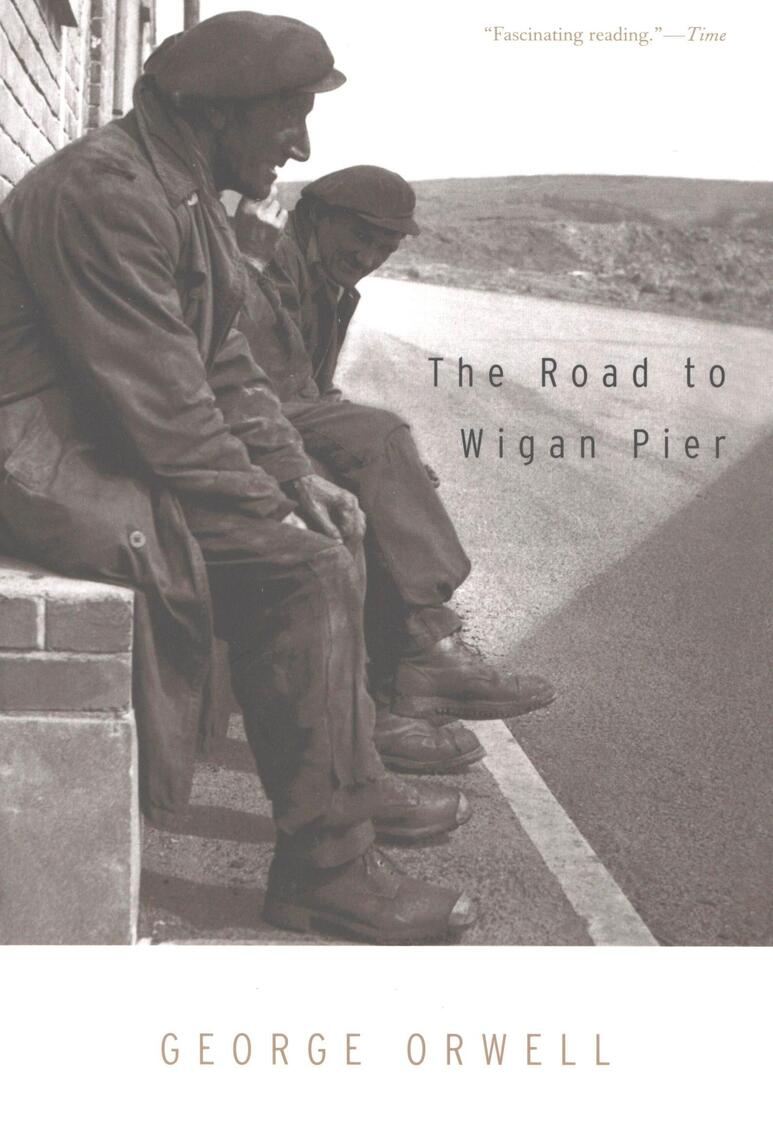
Written for a group of British socialists known as the Left Book Club, the oeuvre is part documentation of the life of Britain’s impoverished working class with particular focus on the dignity and importance of coal miners and part autobiographical account of Orwell overcoming his own class prejudices, united by themes developed throughout regarding the economic commonalities of and social distinctions between Britain’s low-level bourgeoisie and working class, as well as the downside of industrialization and hypocrisy of fashionable socialism.
By Orwell’s account, Britain’s class system at the time, partly based on economic stratification, partly in an unofficial caste system, fostered a seemingly contradictory world in which middle-class bourgeoisie and the working class might experience little difference in income, but drastic differences in their respective places in British society. Yet, even as unemployment and poverty festered and spread, with the middle class eventually “feeling the pinch”, social distinctions, Orwell reported, naturally won out over the narrowing economic gap between classes. Lower-level middle class Brits, despite being working class by any objective economic metric, still chose to identify as bourgeoisie.
Rampant industrialism likely exacerbated these problems as it fundamentally transformed Britain into a machine society, likely to its detriment, according to Orwell’s description. Consequently, these and other factors, Orwell argued, positioned Britain at a crossroads at which the country and its people inevitably would be forced to choose between socialism and fascism.
From his depiction of 1930s British society, it would seem fascism was perhaps going to win out (and perhaps would have if not for later events unbeknownst to Orwell at the time). His prescribed antidote was socialism. Yet, Orwell claimed, the hypocrisy, offensiveness, and buffoonish self-satirizing nature of many socialists tended to drive most normal people away.
Reading The Road to Wigan Pier as an American more than eighty years after its publication, the world Orwell depicts in some ways seems foreign. In many others it is amusingly, if not unsettlingly familiar.
Although not as ingrained as in Britain, the United States maintains its own version of a class system in the form of a superficial yet meaningful distinction between middle class and working class that many Americans yoke to personal character and economic reality.
Nowhere is this more obvious than America’s approach to higher education and the jobs afforded to those with a college degree versus those without. Attaining a degree from a four-year college or university, at least to many members of the American middle class, is seen as something of a sacrament that affirms one’s position in the American middle class. Receiving the sacrament of higher education signals one’s position along with one’s sophistication, respectability, and intelligence. It saves one from the indignity of blue-collar work and the impecunious state with which such work is associated.
Comments Off on Orwell’s The Road to Wigan Pier
Tank Chats Reloaded | Panzer IV | The Tank Museum
The Tank Museum
Published 30 Dec 2022Let’s go inside Panzer IV with another episode of Tank Chats Reloaded. Chris Copson takes a detailed look inside the tank which was considered the backbone of the Wehrmacht‘s Panzer force, uncovering the reality of what it might’ve been like to serve as a Panzer crew member in WW2.
(more…)
Comments Off on Tank Chats Reloaded | Panzer IV | The Tank Museum
QotD: Tenant-farming (aka “sharecropping”) in pre-modern societies
In many cases, small freeholders might also work as tenants on a nearby large estate as well. There are many good reasons for a small free-holding peasant to want this sort of arrangement […]. So a given area of countryside might have free-holding subsistence farmers who do flexible sharecropping labor on the big estate from time to time alongside full-time tenants who worked land entirely or almost entirely owned by the large landholder. Now, as you might imagine, the situation of tenants – open to eviction and owing their landlords considerable rent – makes them very vulnerable to the landlord compared to neighboring freeholders.
That said, tenants in this sense were generally considered free persons who had the right to leave (even if, as a matter of survival, it was rarely an option, leaving them under the control of their landlords), in contrast to non-free laborers, an umbrella-category covering a wide range of individuals and statuses. I should be clear on one point: nearly every pre-modern complex agrarian society had some form of non-free labor, though the specifics of those systems varied significantly from place to place. Slavery of some form tends to be the rule, rather than the exception for these pre-modern agrarian societies. Two of the largest categories of note here are chattel slavery and debt bondage (also called “debt-peonage”), which in some cases could also shade into each other, but were often considered separate (many ancient societies abolished debt bondage but not chattel slavery for instance and debt-bondsmen often couldn’t be freely sold, unlike chattel slaves). Chattel slaves could be bought, sold and freely traded by their slave masters. In many societies these people were enslaved through warfare with captured soldiers and civilians alike reduced to bondage; the heritability of that status varies quite a lot from one society to the next, as does the likelihood of manumission (that is, becoming free).
Under debt bondage, people who fell into debt might sell (or be forced to sell) dependent family members (selling children is fairly common) or their own person to repay the debt; that bonded status might be permanent, or might hold only till the debt is repaid. In the later case, as remains true in a depressing amount of the world, it was often trivially easy for powerful landlord/slave-holders to ensure that the debt was never paid and in some systems this debt-peon status was heritable. Needless to say, the situation of both of these groups could be and often was quite terrible. The abolition of debt-bondage in Athens and Rome in the sixth and fourth centuries B.C. respectively is generally taken as a strong marker of the rising importance and political influence of the class of rural, poorer citizens and you can readily see why this is a reform they would press for.
Bret Devereaux, “Collections: Bread, How Did They Make It? Part II: Big Farms”, A Collection of Unmitigated Pedantry, 2020-07-31.
Comments Off on QotD: Tenant-farming (aka “sharecropping”) in pre-modern societies
April 16, 2023
The short-term mindset in architecture
Our house was built in the first half of the 19th century, although we’re not sure exactly when. We know it was here in the early 1840s but it could be 20 years older than that … in the first half of the 1800s, you didn’t need to get a building permit in Upper Canada before you started, and there was minimal government record-keeping at the time. Our house isn’t anything special architecturally, but it was built extremely solidly. It was intended to stand the test of time. This is not at all true for most of what we build today:
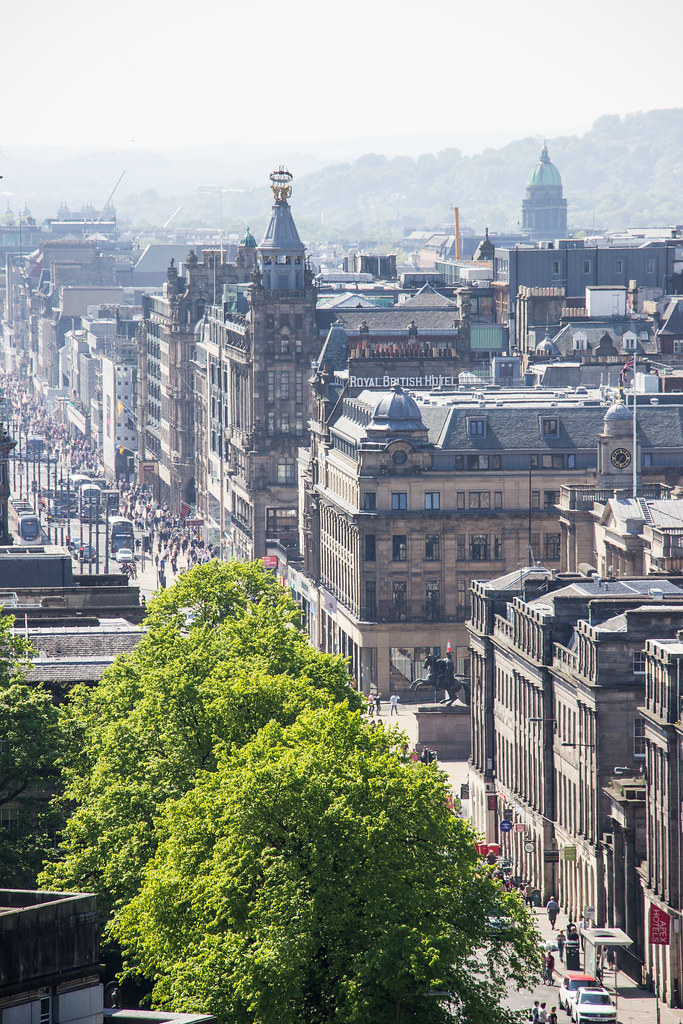
“Princes Street, New Town, Edinburgh, Scotland” by Billy Wilson Photography is licensed under CC BY-NC 2.0 

 .
.
I have had some work done on my house recently. For context, it’s an Edwardian terrace with a rear extension built sometime in the 1980s. Oddly fascinating for me was the sheer difference in build quality between the original section of the property and the newer part at the back. The older part of the house is sturdy, solid and lauded by the workmen as a “proper building”. The newer section has been a huge source of ridicule and contempt: shoddy timber placement, wobbly floors, dangerous electrical wiring, crumbling cement and poor brickwork plague it.
The tradesmen’s comments had me thinking a lot about the general quality of our infrastructure, both national and local, and how we sometimes take for granted the fact that a huge portion of what we use every day is so old. Not only that, but a lot of it is almost universally considered very beautiful and important to our shared cultural heritage.
Take a stroll through any city in Great Britain, and you are more than likely to at some point come across the “old town”. Despite the Luftwaffe’s (and post war town planner’s) best efforts, a lot of pre-war buildings still inhabit the centres of our towns and cities. These prove to be fine examples of the world we used to live in. Even in the poorest of cities, my own town of Hull for example, there exists a great plethora of dramatic and beautiful buildings which were constructed, almost exclusively, by the late Georgians, Victorians and Edwardians. Take a trip to London, Edinburgh, central Durham and a number of other places, and you will see that even the lampposts are adorned gorgeously, with striking and intricate ironwork.
Why is this? Why did they bother to do such a good job? Why do we still heavily rely on their work for our own sense of cultural identity and our basic infrastructural needs? Why can’t our own contemporary efforts compete, despite great advances in the field of civil engineering and construction materials? I think the answer boils down to one thing: civic pride.
The Victorians were building for eternity; we build for temporary needs in a utilitarian fashion. They knew their “mission”, and they saw it an absolute necessity to make everything they did permanent; we do not. They designed buildings to be functional and beautiful; we seek to make buildings which will be functional for 50 years before they are “recycled”.
Speak to a modern student of architecture about their course, and you will find that very few opportunities exist for those who want to pursue a path for traditional design techniques. Their learning aim is to make things which can be used temporarily, then pulled down for something else. This is an attitude which would be totally alien to the Victorians who designed and built the lecture halls these students now learn in.
Comments Off on The short-term mindset in architecture
4,000 German teens trapped in Tarnopol – WW2 – Week 242 – April 15, 1944
World War Two
Published 15 Apr 2023Thousands of German soldiers, mostly new teenage recruits, are obeying Hitler’s “Fortress Directive” and are surrounded in Tarnopol; it does not go well for them. German forces in Ukraine manage to all pull back across the Dniester, but they are under serious pressure in the Crimea. Meanwhile, in India, the Japanese siege of Kohima continues, and in China they are poised to launch a gigantic offensive.
(more…)
Comments Off on 4,000 German teens trapped in Tarnopol – WW2 – Week 242 – April 15, 1944
Do Foucault and Derrida deserve the blame for PoMo excesses?
In Spiked, Patrick West says that it’s a misunderstanding of Foucault and Derrida to blame them for the rise of wokeness:

Michel Foucault speaking at the Hospital das Clínicas of the State University of Guanabara in Brazil, 1974.
Public domain image from the Arquivo Nacional Collection via Wikimedia Commons.
It has become common to blame wokeness on its supposed philosophical parent: postmodernism. As the standard narrative goes, postmodernism is the ideology that entrenched itself in Anglophone universities in the 1980s and 1990s. It talked of relativism, of the absence of objective truth, of the spectre of a pervasive, invisible power, and it was generally anti-Western. A whole generation of professors, writers, journalists and a fair few activists have subsequently been raised on this diet of postmodern thinking. And the result is a cultural elite that is wedded to wokeness.
[…]
For these critics of woke, Foucault’s influence, in particular, is seemingly everywhere. According to [Douglas] Murray [in The War on The West], it’s through the “anti-colonial” philosophy popularised by the Foucault-inspired scholar, Edward Said, that Foucault and therefore postmodernism have filtered down into woke philosophy, which holds that Western society is uniquely racist and to blame for all of today’s ills. Equally, right-wing critics of wokeness will claim that the trans movement has sprung from the postmodern contention that sexuality and gender are entirely socially constructed and therefore plastic and malleable.
If Foucault is regarded as the father of wokeness then 19th-century philosopher Friedrich Nietzsche tends to be regarded as the grandfather. After all, Foucault was profoundly influenced by Nietzsche and even proudly declared himself to be “Nietzchean”. Nietzsche, like Foucault, also saw all human behaviour stemming from the desire for power. And he conceived of morality – good and evil, right and wrong – as the mere manifestation of the will to power. As he wrote of the “origin of knowledge”, in The Joyous Science (1883): “Gradually, the human brain became full of such judgements and convictions, and a ferment, a struggle, and lust for power developed in this tangle. Not only utility and delight but every kind of impulse took sides in this fight about ‘truths’.” One can see this Nietzschean sentiment at work in Foucault’s Discipline and Punish (1975): “Power produces knowledge … power and knowledge directly imply one another.”
So, according to this largely right-wing narrative, wokeness is the product of a 20th-century philosophical assault on truth, objectivity and the West. And it was inspired by Nietzsche and led by several “cultural Marxist” thinkers.
There are several problems with this rather neat story. The first error is to use the phrase “cultural Marxism” to talk of postmodernism or wokeness. This term doesn’t really make sense. Marx himself conceived of his work as a historical materialism. It was focussed on class and the means of production, not on culture. Yes, in the 1940s and 1950s, some Frankfurt School thinkers, who sometimes presented themselves as Marxist, did focus on culture rather than class. But as Joanna Williams writes in How Woke Won (2022), their thinking “represented less a continuation of Marxism and more a break with Marx”.
Moreover, postmodern thinkers were broadly opposed to Marxism. Many may have been signed-up Communists in their youth (the French Communist Party dominated left-wing politics at the time), but by the 1960s they had become highly critical of Marxist politics. They rejected the idea that history was progressing “dialectically” towards a communist future, or “telos”. And they were often hostile to the scientific objectivity and “Enlightenment” values so central to Marxism. Foucault wrote that history was not the story of progress; it was but a series of non-linear discontinuities and contingencies. And Jean-François Lyotard (1924-1998), in his highly-influential The Postmodern Condition (1979), announced and celebrated the end of “grand narratives”, and with it the end of the Marxist “grand narrative” of progress. Lyotard’s writings from the 1970s onwards were violently antithetical to Marxism, especially its claims to objective truth.
As for wokeness itself, it has nothing to do with Marxism. With their myopic focus on race and gender, woke activists are utterly blind to the material, class-structure of society. Today, bizarrely, it’s often conservatives who are more attuned to the plight of the working class than woke “radicals”. As Williams writes, “critics who insist that woke is simply Marxism in disguise are wide of the mark”.
Comments Off on Do Foucault and Derrida deserve the blame for PoMo excesses?
Coopering a 36 gallon beer barrel with hand tools
Jamestown Cooperage
Published 28 Jun 2021I am a practicing traditional cooper who makes barrels, buckets, washtubs, and butter churns by hand. I use mostly traditional skills and handtools to build round, conical wooden vessels for history museums, national parks, and collectors.
Comments Off on Coopering a 36 gallon beer barrel with hand tools
QotD: Homo electronicus and the permanent caloric surplus
Excess fat cranks up estrogen levels. You don’t need to be House MD to interpret this finding:
In males with increasing obesity there is increased aromatase activity, which irreversibly converts testosterone to estradiol resulting in decreased testosterone and elevated estrogen levels.
Or this one:
A study supports the link between excess weight and higher hormone levels. The study found that estrogen and testosterone levels dropped quite a bit when overweight and obese women lost weight.
This is not to say those swishy subalterns were fat — indeed, they were comically scrawny compared to Postmodern people. But a little goes a long way when it comes to hormones, especially in a world where “intermittent fasting” wasn’t a fad diet, but a way of life. Any one of us would keel over from hunger if we were forced to eat the kind of diet George Orwell described as his public school’s standard fare.
Follow that trend out to the Current Year, when pretty much everyone is grossly obese compared to even the Silent Generation. Heartiste and other “game” bloggers loved pointing out that the average modern woman weighs as much as the average man did in the 1960s. And while I think that’s overblown — we’re also several inches taller, on average, than 1960s people — there’s definitely something to it, especially when you consider how far the bell curve has shifted to the fat end. Not only do people weigh a lot more on average, the people who weigh more than average now weigh a hell of a lot more than heavier-than-average people did back when. See, for example, the ballooning weight of offensive linemen, who are professionally fat — in 2011 a quarterback, Cam Newton, weighed more than the average offensive lineman in the 1960s.
Put the two trends together and you have, on average, a hormone cocktail way, way different than even 50 years ago … and that’s before you add in things like all-but-universal hormonal contraception, lots of which ends up in municipal drinking water.
Severian, “Recent Evolution”, Rotten Chestnuts, 2020-09-28.
Comments Off on QotD: Homo electronicus and the permanent caloric surplus
April 15, 2023
Do the Germans Know About Operation Overlord?
World War Two
Published 14 Apr 2023We are getting closer and closer to D-Day and the potential liberation of Nazi Europe. But how much do the Germans know about this? Is the leak inside the British Embassy in Ankara enough to thwart the efforts of Operation Bodyguard, Operation Fortitude, and everything else the Allies are doing to deceive Adolf Hitler? Let’s find out. This is the story of Cicero.
(more…)
Comments Off on Do the Germans Know About Operation Overlord?


