
Forgotten Weapons
Published 18 May 2020The Type 68 is a North Korean hybrid of the Tokarev and the High Power, used as a military service pistol until replaced by the Beak-Du-San copy of the CZ75. The general outline of the gun is a copy of the Tokarev, with a modular removable fire control group, lack of manual safety, and tall thin sights. It is chambered for 7.62x25mm, and uses a magazine identical to the standard Tokarev except for not having a magazine catch cut, as the Type 68 has a heel magazine release.
Internally, the High Power elements include a detent-retained barrel pin, use of a solid barrel cam instead of a 1911/Tokarev swinging link, and a fixed barrel bushing. Two patterns of markings exist, one with a date and North Korean marking, and one (like this example) with only a serial number.
North Korean guns of all types are very rare in the United States. A very small number of Type 68s have come into the US, generally through Central America (probably via Cuba) and South Africa (via Rhodesia/Zimbabwe).
Update: It appears that the original design work for these was done by an independent engineering firm in Yugoslavia. The design (a TT33 with High Power type locking and angled slide serrations) was not completed in time for the trials that would lead to adoption of the Yugoslav M57, and the drawings were transferred to “another country” — probably North Korea.
(more…)
April 15, 2023
Type 68 North Korean Tokarev/High Power Hybrid
April 14, 2023
QotD: The three great strategic sins
The first sin is the sin of of not having a strategy in the first place, what we might call “emotive” strategy. As Clausewitz notes, policy (again, note above how what we’re calling strategy is closest to policy in Clausewitz’ sense) is “subject to reason alone” whereas the “primordial violence, hatred and enmity” is provided for in another part of the trinity (“will” or “passion”). To replace policy with passion is to invert their proper relationship and court destruction.
The second sin is the elevation of operational concerns over strategic ones, the usurpation of strategy with operations, which we have discussed before. This is, by the by, also an error in managing the relationship of the trinity, allowing the general’s role in managing friction to usurp the state’s role in managing politics.
Perhaps the greatest example of this is the Japanese attack on Pearl Harbor; an operational consideration (the destruction of the US Pacific Fleet) and even the tactics necessary to achieve that operational objective, were elevated above the strategic consideration of “should Japan, in the midst of an endless, probably unwinnable war against a third-rate power (the Republic of China) also go to war with a first-rate power (the United States) in order to free up oil-supplies for the first war”. Hara Tadaichi’s pithy summary is always worth quoting, “We won a great tactical victory at Pearl Harbor and thereby lost the war.”
How does this error happen? It tends to come from two main sources. First, it usually occurs most dramatically in military systems where the military leadership – which has been trained for operations and tactics, not strategy, which you will recall is the province of kings, ministers and presidents – usurps the leadership of the state. Second, it tends to occur when those military leaders – influenced by their operational training – take the operational conditions of their planning as assumed constants. “What do we do if we go to war with the United States” becomes “What do we do when we go to war with the United States” which elides out the strategic question “should we go to war with the United States?” entirely – and catastrophically, as for Imperial Japan, the answer to that unasked question of should we do this was clearly Oh my, NO.
(Bibliography note: It would hardly be fitting for me to declare these errors common and not provide examples. Two of the best case-studies I have read in this kind of strategic-thinking-failure-as-organizational-culture-failure are I. Hull, Absolute Destruction: Military Culture and the Practices of War in Imperial Germany (2005) and Parshall and Tully, Shattered Sword: The Untold Story of the Battle of Midway (2005). Also worth checking out, Daddis, “Chasing the Austerlitz Ideal: The Enduring Quest for Decisive Battle” in Armed Forces Journal (2006): 38-41. The same themes naturally come up in Daddis, Withdrawal: Reassessing America’s Final Years in Vietnam (2017)).
The third and final sin is easy to understand: a failure to update the strategy as conditions change. Quite often this happens in conjunction with the second sin, as once those operational concerns take over the place of strategy, it becomes difficult for leaders to consider new strategy as opposed to simply new operations in the pursuit of strategic goals which are often already lost beyond all retrieval. But this can happen without a subordination failure, due to sunk-costs and the different incentives faced by the state and its leaders. The classic example being functionally every major power in the First World War: by 1915 or 1916, it ought to have been obvious that no gains made as a result of the war could possibly be worth its continuance. Yet it was continued, both because having lost so much it seemed wrong to give up without “victory” and also because, for the politicians who had initially supported the war, to admit it was a useless waste was political suicide.
Bret Devereaux, “Collections: The Battle of Helm’s Deep, Part VIII: The Mind of Saruman”, A Collection of Unmitigated Pedantry, 2020-06-19.
April 13, 2023
Beeching plus 60
In The Critic, Peter Caddick-Adams notes that it’s just past 60 years since one of the most controversial documents the British government published during the latter half of the 20th century: The Beeching Report.
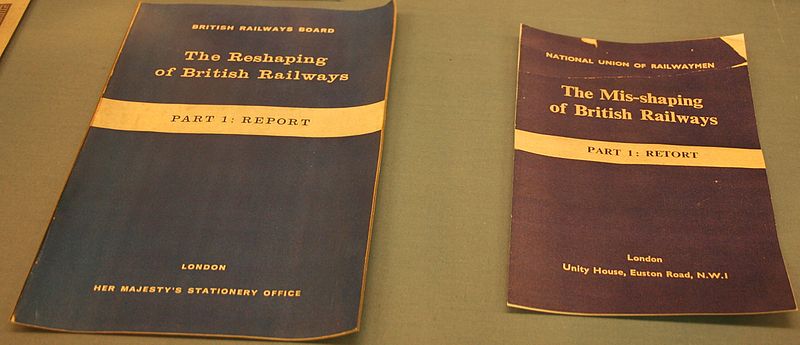
The British Railways Board’s publication The Reshaping of British Railways, Part 1: Report, Beeching’s first report, which famously recommended the closure of many uneconomic British railway lines. Many of the closures were implemented. This copy is displayed at the National Railway Museum in York beside a copy of the National Union of Railwaymen’s published response, The Mis-shaping of British Railways, Part 1: Retort.
Photo by RobertG via Wikimedia Commons.
Wednesday, 27 March 1963 marked the day when a civil servant with a doctorate in physics, seconded from ICI, proudly flourished a report he had written. That man was Dr Richard Beeching, and the result of his recommendations contained in The Reshaping of British Railways are with us to this day.
Beeching identified many unprofitable rail services and suggested the widespread elimination of a huge number of routes. He identified 2,363 stations for closure, along with 6,000 miles of track — a third of the existing network — with the loss of 67,700 jobs. His stated aim was to prune the railway system back into a profitable concern. Behind Beeching, seconded to the newly-established British Railways Board, stood the figure of the publisher-turned-Prime Minister, Harold Macmillan. He knew a thing or two about railways, having been a pre-nationalisation director of the Great Western Railway. It put him in the delightful position of never having to pay for a train ticket.
Macmillan observed from a shareholder’s point of view, “you can pour all in money you want, but you can never make the damned things pay for themselves”. In his view, the railway network and infrastructure of wagon works, tiny branch lines, cottages for signallers, crossings keepers and station masters, with most halts staffed 18 hours a day, amounted to a social service, albeit an expensive one. It had made the prosperity of Victorian Britain possible and was sustaining it still. From nationalisation in 1948, the railways themselves had attempted to make savings, closing 3,000 miles of track and reducing staff from 648,000 to 474,000. That famous Ealing comedy film of 1953, The Titfield Thunderbolt, about a group of villagers trying to keep their branch line operating after British Railways decided to close it, already reflected concern and railway nostalgia.
Britain’s literary and celluloid love affair with iron rails and steam began as long ago as 1905 with the publication of Edith Nesbit’s The Railway Children, a success which peaked when the book was made into a highly successful movie in 1970. Meanwhile, professional sleuths and loafers like Sherlock Holmes, Bulldog Drummond, Lord Peter Wimsey, Hercule Poirot and Bertie Wooster capitalised on the branch line network in their methodology of moving swiftly about pastoral England in their hunts for miscreants. It was the success of The Lady Vanishes, a 1938 mystery thriller set on a continental train, that launched Alfred Hitchcock as a world-class director. David Lean’s Brief Encounter of 1945, based on Noël Coward’s earlier one-act play, Still Life, attached deep romance to station platforms and waiting rooms, reminiscent of so much heartache in the recently fought world war. It is still regarded as one of the greatest of all British-made films. None of this mattered to Beeching, the man who was “Britain’s most-hated civil servant” at his death in 1985, a moniker still used today.
There’s an argument that Beeching was deliberately set up as a patsy for the real villains, Ernest Marples and Harold MacMillan:
The cold, dispassionate Beeching was absolutely the wrong man for the job. As he told the Daily Mirror at the time, “I have no experience of railways, except as a passenger. So, I am not a practical railwayman. But I am a very practical man.” John Betjeman, writing persuasively and eloquently in the Daily Telegraph each week, and later Ian Hislop, hit the right note in observing that Beeching, and all he stood for were technocrats. They “weren’t open to arguments of romantic notions of rural England, or the warp-and-weft of the train in our national identity. They didn’t buy any of that, and went for a straightforward profit and loss approach, from which we are still reeling today”.
However, it has also been argued that Beeching was the unwitting fall-guy for the Minister of Transport of the day, Ernest Marples. He was a self-made businessman who “got things done”, but he retained an air of shadiness about him. Macmillan should have known better. Marples had been managing director of Marples Ridgway, awarded contracts to build the first motorways. When challenged about a conflict of interest, he sold his 80 per cent shareholding to his wife. Elevated to the peerage, Marples fled to Monaco in 1975 to avoid prosecution for tax fraud. So, in some ways, the thing was a stitch-up. Marples directly benefited from the widespread cuts advocated by his subordinate, Beeching. Macmillan had his eye off the ball and was already considering retirement, hastened by an operation for prostate cancer six months after Beeching’s report.
The Prime Minister was astute enough to ensure the press presented the cuts in a positive way, however. From the Cabinet papers of the day, we now know the day before the publication of The Reshaping of British Railways, Beeching’s findings were rewritten to suggest the cuts were the first phase of a co-ordinated national transport policy, with advanced plans to replace the axed rail networks with improved minor roads and local bus services. In reality this was political fantasy (my inner lawyer cautions against more extremist language), for the bus-road subsidy would have cost more than that already paid to the railways. The promise of replacement bus services should have come with a guarantee of remaining in place for at least 10-15 years, because most were withdrawn after two, forcing more motor traffic onto an already inadequate road network.
A Brief History of Gin
No Nonsense Gin Drinking
Published 21 Jul 2019Pay attention class! No running, shouting or talking at the back! It’s time to learn all about gin!
(more…)
April 12, 2023
French Onion Soup from 1651
Tasting History with Max Miller
Published 11 Apr 2023
(more…)
Miniature Railway (1959)
British Pathé
Published 13 Apr 2014Romney, Kent.
L/S of a lovely looking train locomotive. A man stands next to it and one realises how small the train is. It is one third of an ordinary train size — says voiceover. However, this is not a toy but a regular public railway, smallest in the world. It is officially known as the Romney Hythe and Dymchurch Railway, it runs between Romney and Dungeness and its passengers are children. This tiny railway must conform to the same Ministry of Transport regulations as any other trains. M/S of a driver Mr Bill Hart, checking the train. C/U shot of a plaque reading “Winston Churchill”. This is the engine’s name. Several shots of Mr Hart checking the train. Mr Hart enters his cabin and starts shovelling coal into the boiler. C/U shot of the coal being thrown in and a little door closed. This train takes one third of the coal needed for a regular size train. The train starts moving.
L/S of the two men turning locomotive on turntable to place it on rails. M/S of a woman cleaning windows along the train. Children arrive and station master, Reg Marsh, directs them to their coaches. M/S of the group of girls entering the train. M/S of the station master Mr Marsh blowing a whistle as a sign that train leaves the station. M/S of an elderly man looking at a huge pocket watch on a chain, and afterwards, in direction of the train. He is Captain Howey, a man responsible for having the line built. C/U shot of the watch — Roman numerals. M/S of Mr Howey as he puts the watch in his pocket. C/U shot of Mr Howey’s face.
M/S of the little train moving. C/U shot of its little chimney with a smoke coming out. M/S of the Rose family from Sanderstead, Surrey with their dog Trixie enjoying the ride C/U shot of driver’s face with the smoke covering it up to the point it becomes invisible. Another little train passes it going in different direction. Several shots of the two little trains moving. A car stops to wait for the train to pass. L/S of the little train as it approaches the station.
Note: Another driver appearing in the film is Peter Catt. Combined print for this story is missing.
(more…)
April 11, 2023
Canada’s colonial past
Peter Shawn Taylor talks to Nigel Biggar, author of the recent book Colonialism: A Moral Reckoning:

C2C Journal: Explain what you mean by a “moral reckoning” for colonialism – and how does that differ from the now-standard historians’ view that it was a shameful era characterized by exploitation, racism and violence?
Nigel Biggar: My first degree from Oxford is in history but professionally I am a theologian and ethicist. An ethicist is in the business of thinking about rights and wrongs and complicated moral issues. As I have previously written about the morality of war, I wanted to bring that ethical expertise to the very complicated historical phenomenon of empire.
And while my critics claim I am not an historian, they are not ethicists. My book is not a chronology. Each chapter deals with a different moral issue: motives, violence, racism, slavery, et cetera. Then I try to bring it to a conclusion with an overall view of the record of British imperialism, morally speaking. There are the evils of the British Empire, and there are its benefits as well.
[…]
C2C: One of your chapters takes a close look at Canada’s Indian Residential Schools. Take us through an ethicist’s view of a topic that has come to be considered this country’s greatest sin.
NB: The motivation for establishing residential schools was basically humanitarian. That is, they were meant to enable pupils to survive in a world that was changing radically. Notwithstanding any abuses and deficiencies that may have come later, we have to deal with the fact that native Canadians were asking for these schools in the beginning. They lobbied for them in treaties. And this was because they recognized that for their people to survive, they needed to adapt. They wanted their young people to learn English or French and how to farm. They recognized that the old ways could not be sustained any longer.
A lot of people today have a hard time coming to grips with the fact that the past was a very different place. For most people, the 19th century was pretty damn brutal. When we consider the conditions in residential schools today, we are horrified. But what is horrifying are the conditions in which most people of that time had to live. It is true mortality among native kids in these schools was generally higher and conditions were poorer. Sexual abuse was also a problem, but mostly by fellow pupils. I don’t want to sweep any of that under the table. Maybe the Canadian government should have spent more money on residential schools. But to make that case you need to identify what the government of the day should have spent less on. And I haven’t seen that argument made anywhere.
The Truth and Reconciliation Commission has many lurid tales about kids being seized from their parents. No doubt that, after education became compulsory in the 1920s, some children were distressed at being taken away. But this too has to be understood in light of the fact that the idea all children must have a certain level of education was gaining tremendous traction in Canada, Britain and throughout Europe at this time. So compulsory education for native children must be considered in that regard. And what might people say today if the Government of Canada had refused to educate Indigenous children?
Again, I don’t want to downplay the defects of residential schools. But we need to provide context in order to understand these things in proportion. It must also be considered significant that since the early 1990s, Canadian media have declined to give voice to many natives who want to offer positive expressions of residential schools, as J.R. Miller points out in his authoritative history of the residential school system, Shingwauk’s Vision. According to Miller, the verdict for the schools must be given in “muted and equivocal terms”. The wholesale damnation of residential schools is overwrought and unfair.
The amplifier may have been the key technological innovation that let vocalists and guitarists become stars
Chris Dalla Riva, guest-posting at Ted Gioia’s Honest Broker, considers how instrumental hits used to be far more popular before (among other factors) microphone technology let vocalists compete with orchestras and guitar amplifiers let the strings dominate the pop music market:
Clarinet players aren’t sex symbols. I say this with no disrespect for those that play the single-reeded woodwind. But if you asked a random person on the street to name a clarinet player, I suspect most people couldn’t come up with one, let alone one known for their good looks. Then again, this isn’t a particular indictment of clarinetists. If you asked that same person to name a sexy musician, I’d bet a large sum of money they’d name a vocalist.
This wasn’t always the case, though. In Kelly Schrum’s book Some Wore Bobby Sox: The Emergence of Teenage Girls’ Culture, 1920-1945, she notes that in high school yearbooks in the 1930s some students expressed a passion for “Benny Goodman while other girls had a ‘weakness’ for Artie Shaw or were classified as Glenn Miller ‘fanatics’, faithful fans of Tommy Dorsey, or ‘Happy while listening to Kay Kyser’. Cab Calloway, Xavier Cugat, and Harry James were also popular favorites.” Of those musicians, only Calloway was a singer. Goodman, Shaw, and Kyser played the clarinet. Miller and Dorsey played the trombone. Cugat played violin. James played trumpet.
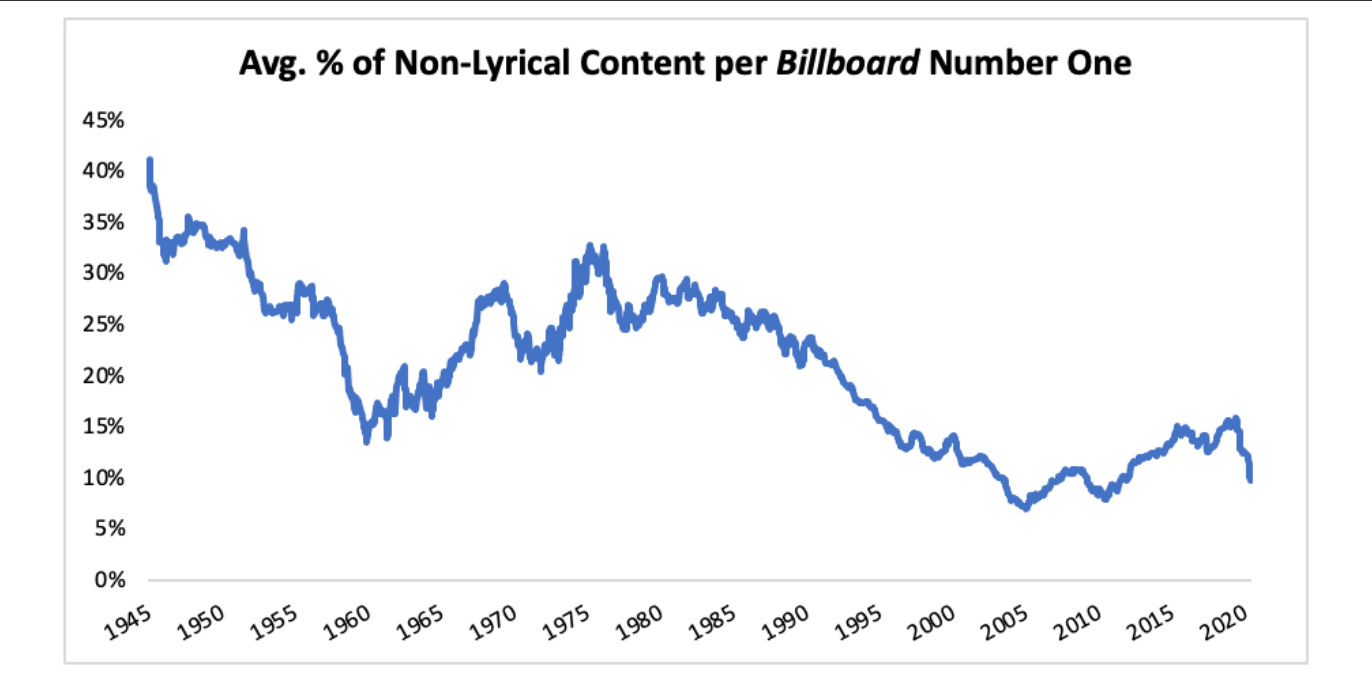
Given that our contemporary musical world is dominated by vocalists, this seems bizarre. It feels like if you have a musical group it must be centered around the vocalist. If we measure the average percent of instrumental content per Billboard number hit between 1940 and 2021, we see demonstrable evidence for not just the decline of the instrumental superstar but the instrumentalist generally, with the sharpest declines beginning in the 1950s and the 1990s.
NOTE: Data from July 1940 to August 1958 comes from Billboard‘s Best Sellers in Stores chart. After August 1958, Billboard deprecated that chart in favor of the Hot 100, which initially aggregated sales, jukebox, and radio data. The Hot 100 remains the premiere pop chart, though it has come to include many more sources, like streams and digital downloads. The above displays a 50-song rolling average.
What’s going on here? How could throngs of high schoolers long for the clarinet-wielding Artie Shaw 80 years ago when most teenagers today would struggle to name a musician who isn’t also a singer. I believe it comes down to four factors: improved technology, the 1942 musicians’ strike, WWII, television, and hip-hop.
Improved Technology
In the VH1-produced documentary The Brian Setzer Orchestra Story, Dave Kaplan, Setzer’s manager, recounts a conversation he had with Setzer before assembling a guitar-fronted big band in the 1990s: “Nobody had ever fronted a big band with an electric guitar … I asked Brian, ‘Why wouldn’t somebody have tried it?’ [Setzer replied,] ‘Well there weren’t amps.'” Albeit a simplification, Setzer’s quip is pretty accurate.
While there were some famous guitar players among the big bands of the first half of the 20th century, we don’t see the guitar become a driving force in popular music until amplification improved. This was not only a boon for the guitarists but also vocalists. Unlike brass and wind instruments, you can sing while you play the guitar. Thus, it’s not shocking that the rise of the guitar coincided with the rise of the vocalist.
But it wasn’t just guitar amplification technology that was vital. It was also microphone technology. Again, microphones had to improve so vocalists could compete with the cacophony of a loud band. On top of this, recording had to change to capture more subtlety in the human voice.
LeMat Centerfire Pistol and Carbine
Forgotten Weapons
Published 27 Nov 2014Colonel LeMat is best known for his 9-shot muzzleloading .42 caliber revolver with its 20 gauge shot barrel acting as cylinder axis pin — several thousand of these revolvers were imported and used in the field by Confederate officers during the US Civil War (and modern reproductions are available as well). What are less well-known are the pinfire and centerfire versions of LeMat’s revolver, and the carbine variants as well.
In this video I’m taking a look at a centerfire LeMat revolver and a centerfire LeMat carbine, both extremely rare guns. They use the same basic principles as the early muzzleloading guns, but look quite different. In these guns, the shotgun remains 20 gauge but uses a self-contained shell loaded from the rear, and the 9 rifles shots are designed for an 11mm (.44 caliber) cartridge very similar to that used in the French 1873 service revolver.
(more…)
April 10, 2023
The Crimean Naval War at Sea – Battleships, Bombardments and the Black Sea
Drachinifel
Published 5 Apr 2023Today we take a look at most of the naval theaters of the Crimean War on conjunction with the fine people @realtimehistory find their video here: Last Crusade or F…
(more…)
US Army and Marine Corps deployments other than with the American Expeditionary Forces (AEF)
Another excerpt from John Sayen’s Battalion: An Organizational Study of United States Infantry currently being serialized on Bruce Gudmundsson’s Tactical Notebook shows where US infantry units (US Army and USMC) were deployed aside from those assigned to Pershing’s AEF on the Western Front in France:
Apart from the war in Europe, the principal military concern of the Wilson administration during 1917-18 was the protection of resources and installations considered vital to the war effort. The threat of German sabotage in the United States was taken very seriously. In addition, Mexico was still unstable politically and sporadic border clashes continued to occur into 1919. Mexican oil was also regarded as an essential resource and the troops stationed on the Mexican border were prepared to invade in order to keep it flowing. However, all the National Guard, National Army, and even the Regular Army regiments raised for wartime only were reserved for duty with the AEF. (The National Army 332nd and 339th Regiments did deploy to Italy and North Russia, respectively, but both remained under AEF command.) This left non-AEF assignments in the hands of the pre-war Regular Army regiments.
Out of 38 Regular infantry regiments available in 1917, 25 were on guard duty within the Continental United States or on the Mexican border and 13 garrisoned U.S. possessions overseas. Local defense forces raised in Hawaii and the Philippines eventually freed the pre-war regiments stationed in those places for duty elsewhere. By the end of the war the 15th Infantry in China, the 33rd and 65th (Puerto Rican) Infantry in the Canal Zone, and the 27th and 31st Infantry (both under the AEF tables) in Siberia were the only non-AEF regiments still overseas. Inside the United States state militia (non-National Guard) units and 48 newly raised battalions of “United States Guards” (recruited from men physically disqualified for overseas service) had freed 20 regiments from stateside guard duties, but not in time for any of them to fight in France.
Only twelve pre-war regiments actually saw combat in the AEF. Nine of them served with the early-arriving 1st, 2nd, and 3rd AEF Divisions. The other three were with the late arriving 5th and 7th Divisions. One more reached France with the 8th Division, but only days ahead of the Armistice. By this time, the Regular Army regiments had long ago been stripped of most of their pre-war men to provide cadre for new units. They were refilled with so many draftees that their makeup scarcely differed from those of the National Army.*
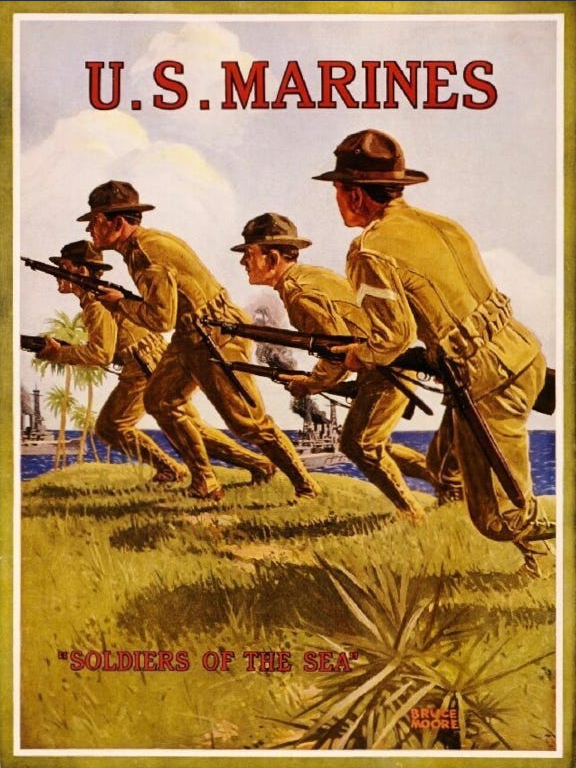
The situation with the Marines was similar to that of the Regular Army. Most Marine regiments had to perform security and colonial policing duties that kept them away from the “real” war in France. Also like the Army, the Marines made Herculean efforts to accommodate a flood of recruits, acquiring training bases at Quantico Virginia and Parris Island South Carolina, as their existing facilities became too crowded. The Second Regiment (First Provisional Brigade) continued to police Haiti while the Third and Fourth Regiments (Second Provisional Brigade) did the same for the Dominican Republic. The First Regiment remained at Philadelphia as the core of the Advance Base Force (ABF) but its role soon became little more than that of a caretaker of ABF equipment.
Although there was little danger from the German High Seas Fleet ABF units might still be needed in the Caribbean to help secure the Panama Canal and a few other critical points against potential attacks by German surface raiders or heavily armed “U-cruisers.” Political unrest was endangering both the Cuban sugar crop and Mexican oil. To address such concerns, the Marines raised the Seventh, Eighth, and Ninth Regiments as infantry units in August, October, and November 1917, respectively. The Seventh, with eight companies went to Guantanamo, Cuba, to protect American sugar interests. The Ninth Regiment (nine companies) and the headquarters of the Third Provisional Brigade followed. The Eighth Regiment with 10 companies, meanwhile, went to Fort Crockett near Galveston, Texas to be available to seize the Mexican oil fields with an amphibious landing, should the situation in Mexico get out of hand.
Three other rifle companies (possibly the ones missing from the Seventh and Ninth Regiments) occupied the Virgin Islands against possible raids by German submarines. In August 1918, the Seventh and Ninth Regiments expanded to 10 companies each. The situation in Cuba having subsided, the Marine garrison there was reduced to just the Seventh Regiment. The Ninth Regiment and the Third Brigade headquarters joined the Eighth at Fort Crockett.**
* Order of Battle of the United States Land Forces in the World War op cit pp. 310-314 and 1372-1379. A battalion of United States Guards was allowed 31 officers and 600 men. These units were recruited mainly from draftees physically disqualified for overseas service. The 27th and 31st Infantry when sent to Siberia were configured as AEF regiments, though they were never part of the AEF. Large numbers of men had to be drafted out of the 8th Division to build these two regiments up to AEF strength. This seriously disrupted the 8th Division’s organization.
** Order of Battle of the United States Land Forces in the World War op cit pp. 1372-78; Truman R. Strobridge, A Brief History of the Ninth Marines (Washington DC, Historical Division HQ US Marine Corps; revised version 1967) pp. 1-2; James S. Santelli, A Brief History of the Eighth Marines (Washington DC, Historical Division HQ US Marine Corps; 1976) pp. 1-3; and James S. Santelli, A Brief History of the Seventh Marines (Washington DC, Historical Division HQ US Marine Corps; 1980) pp. 1-5.
1970: Welcome to SEALAND | Nationwide | Voice of the People | BBC Archive
BBC Archive
Published 18 Dec 2022Nationwide‘s Bob Wellings is winched up to meet the Bates, the first family of the Principality of Sealand.
Formerly HM Fort Roughs, Sealand is a concrete and iron platform in the North Sea about seven miles off the Suffolk coast. What has drawn the family to this remote place? How does living in such an unusual environment effect their day-to-day life? What are their plans for it?
Originally broadcast 19 March, 1970.
(more…)
QotD: Interaction between “big” farmers and subsistence farmers in pre-modern societies
And then just over the way, you have the large manor estate, or the Roman villa, or the lands owned by a monastery (because yes, large landholders were sometimes organizations; in medieval Europe, monasteries filled this function in some places) or even just a very rich, successful peasant household. Something of that sort. They have the capital (plow-teams, manure, storage, processing) to more intensively farm the little land our small farmers have, but also, where the small farmer has more labor than land, the large landholder has more land than labor.
The other basic reality that is going to shape our large farmers is their different goals. By and large our small farmers were subsistence farmers – they were trying to farm enough to survive. Subsistence and a little bit more. But most large landholders are looking to use the surplus from their large holdings to support some other activity – typically the lifestyle of wealthy elites, which in turn require supporting many non-farmers as domestic servants, retainers (including military retainers), merchants and craftsmen (who provide the status-signalling luxuries). They may even need the surplus to support political activities (warfare, electioneering, royal patronage, and so on). Consequently, our large landholders want a lot of surplus, which can be readily converted into other things.
The space for a transactional relationship is pretty obvious, though as we will see, the power imbalances here are extreme, so this relationship tends to be quite exploitative in most cases. Let’s start with the labor component. But the fact that our large landholders are looking mainly to produce a large surplus (they are still not, as a rule, profit maximizing, by the by, because often social status and political ends are more important than raw economic profit for maintaining their position in society) means that instead of having a farm to support a family unit, they are seeking labor to support the farm, trying to tailor their labor to the minimum requirements of their holdings.
[…]
The tricky thing for the large landholder is that labor needs throughout the year are not constant. The window for the planting season is generally very narrow and fairly labor intensive: a lot needs to get done in a fairly short time. But harvest is even narrower and more labor intensive. In between those, there is still a fair lot of work to do, but it is not so urgent nor does it require so much labor.
You can readily imagine then the ideal labor arrangement would be to have a permanent labor supply that meets only the low-ebb labor demands of the off-seasons and then supplement that labor supply during the peak seasons (harvest and to a lesser extent planting) with just temporary labor for those seasons. Roman latifundia may have actually come close to realizing this theory; enslaved workers (put into bondage as part of Rome’s many wars of conquest) composed the villa’s primary year-round work force, but the owner (or more likely the villa’s overseer, the vilicus, who might himself be an enslaved person) could contract in sharecroppers or wage labor to cover the needs of the peak labor periods. Those temporary laborers are going to come from the surrounding rural population (again, households with too much labor and too little land who need more work to survive). Some Roman estates may have actually leased out land to tenant farmers for the purpose of creating that “flexible” local labor supply on marginal parts of the estate’s own grounds. Consequently, the large estates of the very wealthy required the impoverished many subsistence farmers in order to function.
Bret Devereaux, “Collections: Bread, How Did They Make It? Part II: Big Farms”, A Collection of Unmitigated Pedantry, 2020-07-31.
April 9, 2023
New Offensive in the Crimea – WW2 – Week 241 – April 8, 1944
World War Two
Published 8 Apr 2023The Soviets are finally going to try and push the Axis out of Sevastopol and the Crimea. They also continue to drive the Axis back in Transnistria. Over in Burma and Northeastern India, the Japanese have the Allies under siege at not one, but two towns, and are also attacking Imphal from several points, but the Japanese have way bigger future plans up their sleeves in China.
(more…)
USMC units in the American Expeditionary Forces (AEF) in France
Another interesting excerpt from John Sayen’s Battalion: An Organizational Study of United States Infantry currently being serialized on Bruce Gudmundsson’s Tactical Notebook discusses the role of the US Marine Corps on the Western Front as part of Pershing’s AEF:
“How Twenty Marines Took Bouresches” by Frank E. Schoonover.
Originally published in the Ladies’ Home Journal Vol. 24 No. 1, via Wikimedia Commons
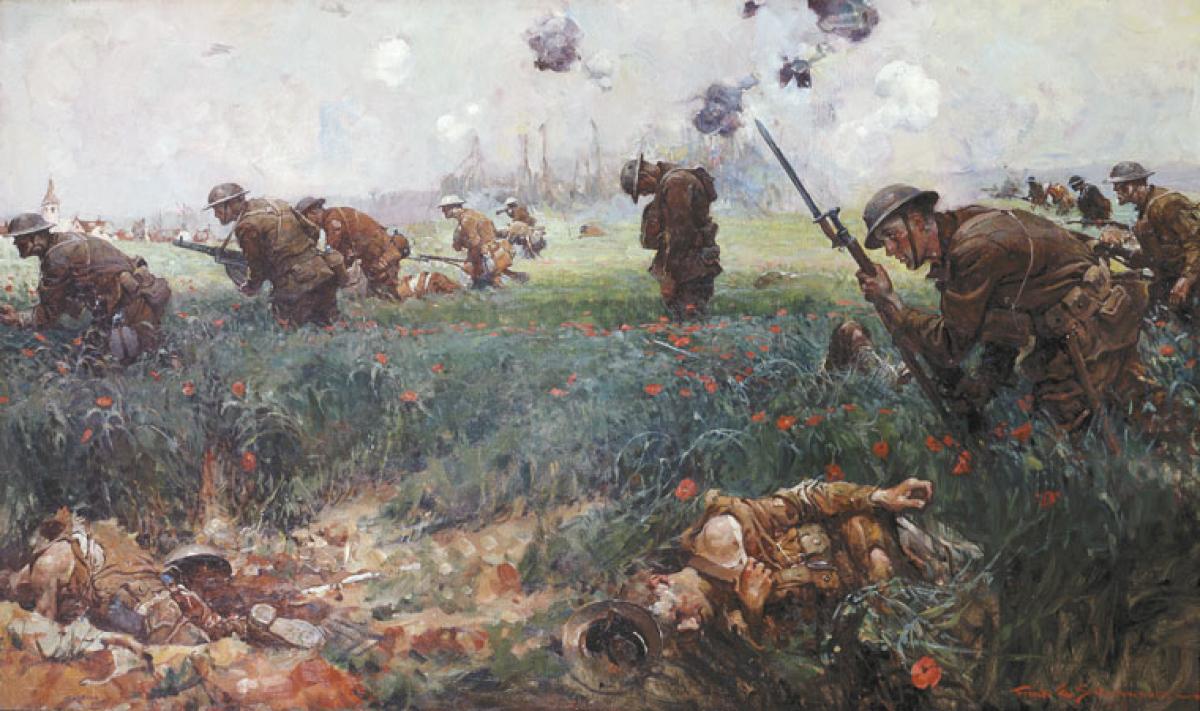
The Fifth Regiment arrived in France in July 1917. Being the fifth regiment of a four-regiment division, it soon found itself relegated to the sidelines and stuck with all the odd jobs such as providing military police details, couriers, and guards. Correctly reasoning that a larger unit would not be so easily pigeonholed, General Barnett [the Marine Corps Commandant] in October 1917 augmented the Fifth Regiment with the newly formed Sixth Regiment and Sixth Machinegun Battalion. The whole force constituted the AEF Fourth Brigade, or half the infantry of the AEF 2nd Division.*
Although the organization of the Fourth Brigade’s infantry regiments was supposed to be the same as that of all the other AEF infantry regiments, it did in fact differ in some details (see Appendix 2.6). Every Marine rifle and machinegun company had two additional sergeants to serve as gas NCOs and the Marines added gas officers to each battalion headquarters. Whether this helped reduce the number of gas casualties is unclear.
Marine enlisted men also tended to be given higher ranks than their Army counterparts. In a Marine regiment a platoon sergeant was not just the senior sergeant in a platoon, he was a gunnery sergeant, ranking as an Army sergeant first class (a rank that the Army awarded only to specialists) and well above a sergeant. Sergeants commanded all four sections in a Marine rifle platoon and this allowed an additional sergeant per half-platoon. The rifle section included two men trained equipped as snipers (enough for one sniper per half-platoon). Two more snipers were in company headquarters. Since 1887 when test results had exposed their poor marksmanship, the Marines had made rifle shooting into even more of a fetish than it had been in the Army. In contrast to the many soldiers sent into battle without even having fired their rifles, no Marine was even allowed overseas if he had not qualified as an expert rifleman or sharpshooter.
To give extra promotion, pay, and recognition (but not leadership responsibility) to the best shots the Marines introduced the rank of corporal (technical). The rank was also given to mechanics, horseshoers, saddlers, teamsters, and five senior operators in the telephone section of the regimental signal platoon to reward technical proficiency. However, despite their important but difficult and thankless duties, Marine cooks only ranked as privates.
[…]
The Marine AEF regiments differed from their Army counterparts in more than just structural details. They had a huge advantage in manpower quality. Except for about 7,100 draftees accepted during the war’s last weeks, the nearly 79,000 Marines who served in the war were all volunteers. About one sixth of these men had joined prior to the war. This was several times the Army’s percentage of pre-war men, even if those who had only National Guard service are included. Many Marine wartime volunteers were college men and included a lot of athletes.
The large number of officer-quality enlisted men persuaded General Barnett to direct on 4 June 1917 that, in future, all officers be appointed from the ranks. This move had the strong backing of Secretary Daniels who favored the practice of commissioning enlisted men. Such a system would be more in line with what the Germans and French were doing. Even the college men would have to have several months’ enlisted service before they could hope for a commission. By then their leadership potential could be properly evaluated. In addition, many pre-war enlisted men of greater age and experience but less education and growth potential could also become officers. Better still, the Marines were mostly infantry. Unlike the Army, they had few service or technical positions into which their best and brightest could be drained. Instead of getting the dregs, Marine infantry regiments got all the best officers and men. They were always kept at full strength with fully trained replacements, despite heavy casualties.**
The high quality men that the Marines were able to contribute to the AEF provoked a good deal of jealousy within the Army in general and from General Pershing in particular. The latter praised the Marines in private but refused to do so in public. Although Pershing had accepted the Fourth Marine Brigade into the AEF, he rebuffed every offer to send Marine artillery to France. The presence of both Marine infantry and artillery in France would have paved the way for the formation of a Marine AEF division. That would have given the Marines much more publicity at Army expense.
Late in the war Pershing relented enough to accept another Marine infantry brigade, the Fifth, which reached France in September 1918. However, although nearly all these Marines had qualified as expert marksmen, he employed them in menial jobs in the rear areas. At the same time, Pershing was rushing thousands of untrained Army recruits into front line combat where they were routinely and needlessly slaughtered.***
* Major David N. Buckner USMC, A Brief History of the Tenth Marines (Washington DC, Historical Div. HQMC; 1981) pp. 16-17.
** Heinl pp. 191-228; and J. Robert Moskin, The Story of the U.S. Marine Corps (New York, Paddington Press Ltd. 1979) pp. 138-139; LtGen William K. Jones USMC(Ret) A Brief History of the 6th Marines (Washington DC, History and Museum Div. HQMC 1987) p 1.
*** Heinl pp. 194-195 and 208-210; Allan R. Millett, Bullard op cit p. 321.


