
Merchants are a bit of a break from the people we have so far discussed in that they, by definition, live in the realm of the market (in the economic sense, although often also in a physical sense). […] so much of the world of our farmers and even our millers and bakers was governed by non-market interactions: horizontal and vertical social ties that carried expectations that weren’t quite transactional and certainly not monetized. By contrast, merchants work with transactions and tend to be the first group in any society to attempt to monetize their operations once money becomes available. I find students are often quick to feel identity with the merchant class, because these folks are more likely to travel, more likely to use money, more likely to employ or be employed in wage-labor; they feel more like modern people.
It thus tends to come as something of a surprise that with stunning consistency, the merchant class tended to be at best cordially disliked and at worst despised by the broader community (although not typically to the point of suffering legal disability, as did some other jobs; see S. Bond, Trade and Taboo: Disreputable Professions in the Roman Mediterranean (2016) for this in Rome). This often strikes students as strange, both because we tend to think rather better of our own modern merchants but also because the image they have of the merchant class certainly looks elite.
For the farmers who need to sell their crops (for reasons we will get to in a moment) and purchase the things they need that they cannot produce, the merchant feels like an adversary: always pushing his prices to his best advantage. We expect this, but remember that our pre-modern farmers are just not that exposed to market interactions; most of their relationships are reciprocal, not transactional – the horizontal relationships we discussed before. The merchant’s “money-grubbing” feels like a betrayal of trust in a society where you banquet your neighbors in the good years so they’ll help you in the bad years. The necessary function of a merchant is to transgress the “rules” of village interactions which – and this resounds from the sources – the farmers tend to understand as being “cheated”.
At the same time, while most merchant types are humble, the high-risk and potentially high-reward involved in trade meant that some merchants (again, a small number) could become very rich. That, as you might imagine, did not go over well for the traditionally wealthy in these societies, the large landholders. Again, the values here often strike modern readers as topsy-turvy compared to our own, but to the elite large landholders (who dominate the literary and political culture of their societies), the morally correct way to earn great wealth is to inherit it (or capture it in war). The morally correct way to hold that wealth is with large landed estates. Anything else is morally suspect, and so the idea that a successful merchant could – by a process that again, strikes the large landholder, just like the small farmer, as “cheating” – leap-frog the social pyramid and skip to the top, without putting in the work at either having distinguished wealthy ancestors or tremendous military success was an open insult to elite values. Often laws were put in place to limit the ability of wealthy non-aristocrats (likely merchants or successful artisans) from displaying their wealth (sumptuary laws) so as to keep them from competing with the aristocrats; at Rome, senators were forbidden from owning ships with much the same logic (Roman senators being clever, they still invested in trade through proxies while at the same time disapproving of the activity in public politics).
[…] As far as elites were concerned, merchants didn’t seem to produce anything (the theory of comparative advantage which explains how merchants produce value without producing things by moving things to where they are most valued would have to wait until 1776 to be mentioned and the early 1800s to be properly explained) and so the only explanation for their wealth was that they made it by deception and trickery, distorting the “real” value of things (this faulty assumption that the “real value” of things is inherent in them, or a product of their production, rather than their use value to an end user or consumer, does not go away in the modern period).
Merchants also – almost by definition being foreigners in their communities – often suffered as members of “middleman minorities“, where certain tasks, particularly banking, commerce and tax collection are – for the reasons just discussed above – outsourced to foreigners or ethnic minorities who then tend to face violence and discrimination because of the power and prominence those tasks give them in society. Disdain for merchants was thus often packaged with ethnic hatred or racism – anyone exposed to the tropes of European or Near Eastern antisemitism (or more precisely, anti-Jewish sentiment) is familiar with this toxic brew, but the same tropes were applied to other middlemen minorities engaged in trade – Chinese people in much of South East Asia, Armenians in Turkey, Parsis in India and on and on. Violence against these groups was always self-destructive (in addition to being abhorrent on its face) – the economic services they provided were valuable to the broader society in ways that the broader society did not understand.
Bret Devereaux, “Collections: Bread, How Did They Make It? Part IV: Markets, Merchants and the Tax Man”, A Collection of Unmitigated Pedantry, 2020-08-21.
July 5, 2023
QotD: The role of merchants in pre-modern societies
July 4, 2023
Shock! Horror! Apparently you can’t trust that Abraham Lincoln quote about not believing what you read on the internet!
As a long-time collector of quotations, I almost had to take to my fainting couch when it became clear that President Lincoln never said anything about the internet being a tissue of lies. My original quotations collection (webbed here, but no longer actively maintained) was not particularly well-policed in the sense of ensuring that the quotations were both accurate and properly attributed. This is because I began collecting them before the internet was a thing for most people. When I began the blog, I tried to ensure that anything I quoted could at least be traced back to the site I found it on (which isn’t a particularly rigorous chain of evidence, but at the least it ensured I couldn’t be accused of making shit up).
In James Delingpole’s article on this topic, I was sorry to find that the very first fake quote he listed is indeed one that I had included in my original collection:
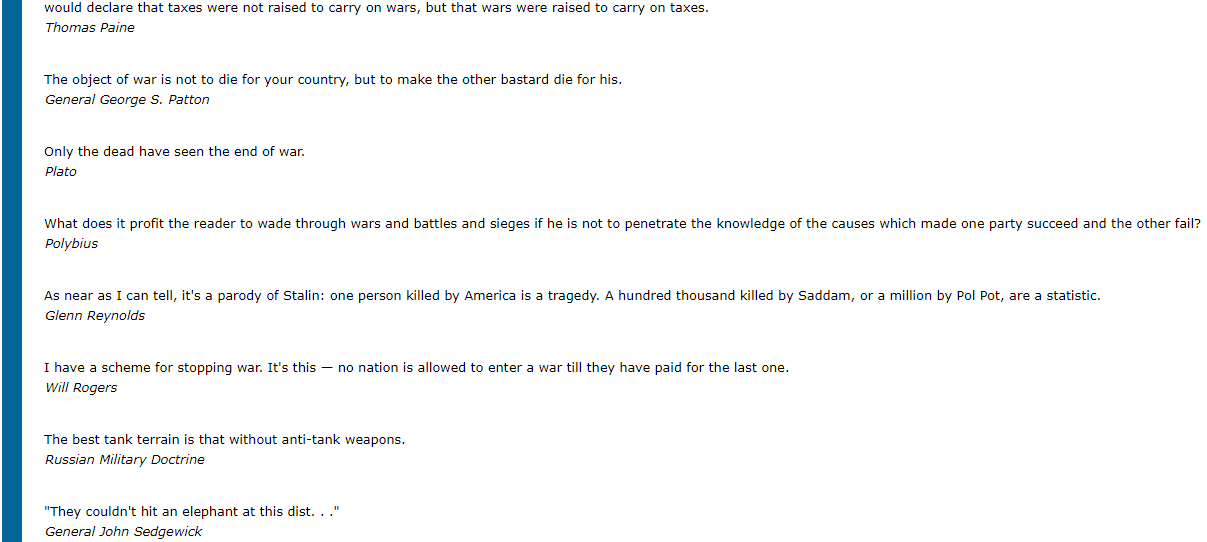
Only the dead have seen the end of war – Plato
I became aware of this marvellous quotation – so wise, pithy and dark – on one of my frequent trips to the Imperial War Museum. It’s one of a series inscribed on the wall beside the ramp leading down to the World War I/trench section. Another of my favourites is attributed to Thucydides: “There were great numbers of young men who had never been in a war and were consequently far from unwilling to join in this one.”
The Plato quote is so good it has been used many times since, inter alia by General Douglas MacArthur in a speech at West Point in 1962, as an aphorism apparently oft-cited by grunts in the ‘Nam, and by Ridley Scott in Black Hawk Down. But the quote is fake. Or at least its attribution is.
In fact it derives not from the Classical Age but from the early 20th century. It was invented by the Madrid-born philosopher, poet and later Harvard professor George Santayana. He clearly had a gift for this sort of thing for he also coined another of those phrases which you’ve always thought was devised by someone much more famous: “Those who cannot remember the past are condemned to repeat it.” Usually this is attributed, in various forms, to Edmund Burke or Winston Churchill. But the former didn’t say it and the latter – as I suspect he quite often did – plagiarised it.
Fake quotes, whether genuine sayings that have been misattributed or fabrications which have been lent authenticity by putting them in the mouths of someone famous, have been a bugbear of mine for a while. I can probably date this to the time someone called me out on my favourite George Orwell quote: “In times of universal deceit, truth-telling becomes a revolutionary act”.
Annoyingly, I had used it a good half dozen times in articles and in internet chats before I learned that Orwell had never said it. I felt cheated and also foolish: surely as an English literature graduate I ought to have known such a thing, in the way that film buffs know that Ingrid Bergman never said “Play it again, Sam”.
But these are easy mistakes to make now that fake quotes are everywhere. Probably, this has always been the case but they have definitely proliferated with the advent of the internet, the shortening of attention spans (which make us more susceptible to gnomic verities that appear to sum everything up and obviate the need for further thought) and the corresponding appetite for meme-friendly aphorisms.
Many of these fake quotes, I’ve noticed, are printed over photographs or images of the alleged author. It’s a cheap trick but an effective one. No one ever is going to be fooled by a joke quote like: “Don’t believe everything you read on the internet. Abraham Lincoln, 1865.” But shove it on top of a picture of the 16th president with those familiar features – the wart, the chin beard, the lined skin and sunken eyes – and for a fraction of a second, the subconscious is taken in.
He finishes off the article thusly:
I’m reminded here, somewhat, of the introductory talk that Mark Crispin Miller used to give his students when he was still allowed by New York University to conduct his course on Propaganda. I paraphrase – you really should listen to this podcast interview for the full account – but essentially Miller warned his audience: “Be prepared to be very upset. You may be shocked to discover how many of the ideas you imagined to be your own are in fact the result of propaganda.”
It would definitely have come as a shock to the younger me. When you’ve had what you consider to be a superb education, steeped in classical literature, you tend to kid yourself that you are just too damn clever, too well-read, to fall for the kind of cheap confidence tricks that fool the unwashed masses.
Which, when you think about it, is what makes the faking of those classical quotes so cunning. They deviously exploit one of one of the cultural assumptions most deeply embedded in both the “educated” and “uneducated” classes alike: this idea that if one of the Ancient Greeks or Romans said it, it must be true because there’s almost nothing about the world that they didn’t know. Another thing they exploit is that the “educated” are rarely as clever as we pretend to be. For example, presented with a vaguely plausible quote with a fancy classical name attached, passing few of us are going to go: “Hang on a second. Did he really say that? Let me check …” Instead, we’ll go “Ah. The great Thucydides. He was the Greek general who wrote Anabasis. The sea! The sea!” and congratulate ourselves on what marvellously well-informed people we are.
Did you catch that palmed card there? Thucydides didn’t write Anabasis because he was far too busy writing the Commentarii de Bello Gallico!
Buster Keaton Rides Again (1965)
NFB
Published 15 Jun 2015In this film Keaton rides across Canada on a railway scooter and, between times, rests in a specially appointed passenger coach where he and Mrs. Keaton lived during their Canadian film assignment. This film is about how Buster Keaton made a Canadian travel film, The Railrodder. In this informal study the comedian regales the film crew with anecdotes of a lifetime in show business. Excerpts from his silent slapstick films are shown
Directed by John Spotton – 1965.
From the American Revolution: Short Land Pattern Brown Bess
Forgotten Weapons
Published 22 Mar 2023The standard weapon of the British Army in the American War of Independence was the “Brown Bess”, and today we are looking at a 1769 Short Land Pattern example of the Brown Bess. This was a smoothbore .75 caliber, 10.2 pound flintlock with a whopping 42 inch barrel (the Long Land Pattern it superseded had a 46” barrel). Adopted in 1769, it would serve as the British standard infantry arm until 1797.
This particular example was issued to the 53rd Infantry Regiment, otherwise known as the King’s Shropshire Light Infantry. This regiment arrived in Quebec City in May 1776 and participated in the fighting at Ticonderoga and Saratoga, where several of its companies were captured and interned until the end of the war.
(more…)
QotD: The (arguments over the) founding of America
No, in its ambitious and often excellent 1619 Project, the New York Times wants to do more than that. So it insists that the very ideals were false from the get-go — and tells us this before anything else. Even though those ideals eventually led to the emancipation of slaves and the slow, uneven and incomplete attempt to realize racial equality over the succeeding centuries, they were still “false when they were written”. America was not founded in defense of liberty and equality against monarchy, while hypocritically ignoring the massive question of slavery. It was founded in defense of slavery and white supremacy, which was masked by highfalutin’ rhetoric about universal freedom. That’s the subtext of the entire project, and often, also, the actual text.
Hence the replacing of 1776 (or even 1620 when the pilgrims first showed up) with 1619 as the “true” founding. “True” is a strong word. 1776, the authors imply, is a smoke-screen to distract you from the overwhelming reality of white supremacy as America’s “true” identity. “We may never have revolted against Britain if the founders had not understood that slavery empowered them to do so; nor if they had not believed that independence was required in order to ensure that slavery would continue. It is not incidental that 10 of this nation’s first 12 presidents were enslavers, and some might argue that this nation was founded not as a democracy but as a slavocracy,” Hannah-Jones writes. That’s a nice little displacement there: “some might argue”. In fact, Nikole Hannah-Jones is arguing it, almost every essay in the project assumes it — and the New York Times is emphatically and institutionally endorsing it.
Hence the insistence that everything about America today is related to that same slavocracy — biased medicine, brutal economics, confounding traffic, destructive financial crises, the 2016 election, and even our expanding waistlines! Am I exaggerating? The NYT editorializes: “No aspect of the country that would be formed here has been untouched by the years of slavery that followed … it is finally time to tell our story truthfully”. Finally! All previous accounts of American history have essentially been white lies, the NYT tells us, literally and figuratively. All that rhetoric about liberty, progress, prosperity, toleration was a distraction in order to perpetrate those lies, and make white people feel better about themselves.
Andrew Sullivan, “The New York Times Has Abandoned Liberalism for Activism”, New York, 2019-09-13.
July 3, 2023
Nuclear power
One of the readers of Scott Alexander’s Astral Codex Ten has contributed a review of Safe Enough? A History of Nuclear Power and Accident Risk, by Thomas Wellock. This is one of perhaps a dozen or so anonymous reviews that Scott publishes every year with the readers voting for the best review and the names of the contributors withheld until after the voting is finished:
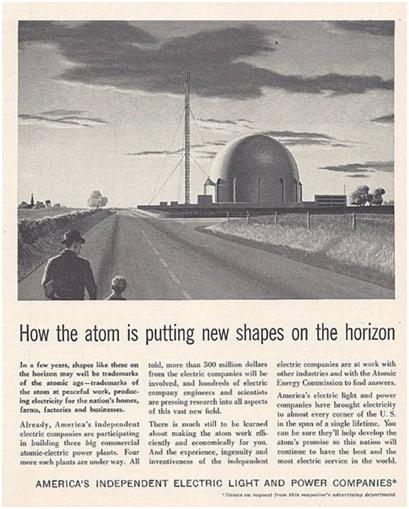
Let me put Wellock and Rasmussen aside for a moment, and try out a metaphor. The process of Probabilistic Risk Assessment is akin to asking a retailer to answer the question “What would happen if we let a flaming cat loose into your furniture store?”
If the retailer took the notion seriously, she might systematically examine each piece of furniture and engineer placement to minimize possible damage. She might search everyone entering the building for cats, and train the staff in emergency cat herding protocols. Perhaps every once in a while she would hold a drill, where a non-flaming cat was covered with ink and let loose in the store, so the furniture store staff could see what path it took, and how many minutes were required to fish it out from under the beds.
“This seems silly — I mean, what are the odds that someone would ignite a cat?”, you ask. Well, here is the story of the Brown’s Ferry Nuclear Plant fire, in March 1975, which occurred slightly more than a year after the Rasmussen Report was released, as later conveyed by the anti-nuclear group Friends of the Earth.
Just below the plant’s control room, two electricians were trying to seal air leaks in the cable spreading room, where the electrical cables that control the two reactors are separated and routed through different tunnels to the reactor buildings. They were using strips of spongy foam rubber to seal the leaks. They were also using candles to determine whether or not the leaks had been successfully plugged — by observing how the flame was affected by escaping air.
The electrical engineer put the candle too close to the foam rubber, and it burst into flame.
The fire, of course, began to spread out of control. Among the problems encountered during the thirty minutes between ignition and plant shutdown:
- The engineers spent 15 minutes trying to put the fire out themselves, rather than sound the alarm per protocol;
- When the engineers decided to call in the alarm, no one could remember the correct telephone number;
- Electricians had covered the CO2 fire suppression triggers with metal plates, blocking access; and
- Despite the fact that “control board indicating lights were randomly glowing brightly, dimming, and going out; numerous alarms occurring; and smoke coming from beneath panel 9-3, which is the control panel for the emergency core cooling system (ECCS)”, operators tried the equivalent of unplugging the control panel and rebooting it to see if that fixed things. For ten minutes.
This was exactly the sort of Rube Goldberg cascade predicted by Rasmussen’s team. Applied to nuclear power plants, the mathematics of Probabilistic Risk Assessment ultimately showed that “nuclear events” were much more likely to occur than previously believed. But accidents also started small, and with proper planning there were ample opportunities to interrupt the cascade. The computer model of the MIT engineers seemed, in principle, to be an excellent fit to reality.
As a reminder, there are over 20,000 parts in a utility-scale plant. The path to nuclear safety was, to the early nuclear bureaucracy, quite simple: Analyze, inspect, and model the relationship of every single one of them.
The Battle That Prevented A Nuclear World War Three | Kapyong: The Forgotten War | Timeline
Timeline – World History Documentaries
Published 2 Jul 2023On April 24, 1951, following a rout of the South Korean army, the Chinese People Volunteer Army pursued their enemy to the lines of Australian and Canadian troops still digging fall-back defences, 39 kilometres to the rear. Here, sometimes at the length of a bayonet, often in total darkness, individual was pitted against individual in a struggle between a superpower and a cluster of other nations from across the world. They fought for a valley, the ancient and traditional invasion route to Seoul. If it fell the southern capital and the war, was lost. The United Nations troops had the military advantage of the high ground and artillery support: the Chinese relied entirely on vastly superior numbers. As a result, young men from both sides found a battle which was very close and very personal.
The Battle of Kapyong became the turning point of China’s Fifth Offensive in that Korea spring. The aim of the offensive was to finally drive the foreign troops out of South Korea and into the sea. What happened instead, changed the history of the Korean War. The Chinese were denied victory and forced back into negotiations. Had they succeeded, another crushing defeat for the US could have triggered events that led to a nuclear holocaust in Asia — and World War Three.
(more…)
Three Forgotten Roman Megaprojects
toldinstone
Published 31 Mar 2023The longest tunnel in ancient history. A highway suspended over a raging river. A secret harbor for the Roman navy. These are three of the most impressive Roman engineering projects that you’ve probably never heard of.
(more…)
QotD: The key weakness of the royal cause in the English Civil War
[T]he power of the mighty hath no foundation, but in the opinion and belief of the people.
A king whose knights won’t ride out to battle on his behalf is just a weirdo in funny clothes. Charles I lost for a lot of reasons, but far from the least of them was that his “foundation” was badly cracked. However attached one might be to the notion of monarchy in the abstract, it – monarchy – is always intimately connected to the personality of the monarch … and Charles I was a real piece of work, even by the world-class standards of Renaissance princes. Parliament was outgunned, often outmanned, and suffered from what should’ve been a critical shortage of experienced leadership. But all those massive advantages were offset by the fact that the Royalist forces were fighting for Charles I, personally.
(This is not the place for a long discussion of the course of the English Civil Wars – and I’m not qualified to give you one in any case – but a quick look at the top commanders of the opposing sides will illustrate the point. Prince Rupert was arguably the equal, mano-a-mano, of any Parliamentary general, up to and including Cromwell. But he was still a Prince, and carried on like one (like a young one, to boot) … and even if he weren’t, he was still running the show on behalf of his uncle. Cromwell, on the other hand, inspired fanatic loyalty, not least because he embodied a cause that was much higher than himself).
Severian, “Hobbes (III)”, Founding Questions, 2020-12-12.
July 2, 2023
Allies Liberate Cherbourg – WW2 – Week 253 – July 1, 1944
World War Two
Published 1 Jul 2023Several weeks after the invasion of Normandy began, the Allies finally take a port city there, though the actual harbor has been destroyed. On Saipan the Americans have the advantage, in Finland, the Soviets do, but the big news is the Soviet destruction of huge chunks of German Army Group Center, demolishing entire Army Corps, and surrounding tens of thousands of the enemy.
(more…)
Tank Chats #170 | Sd. Kfz. 251 | The Tank Museum
The Tank Museum
Published 31 Mar 2023Curator David Willey is back with another Tank Chat. This time, he will be discussing the Sonderkraftfahrzeug 251, which is more commonly referred to as the Sd.Kfz. 251.
(more…)
QotD: Processes for fighting the last war
The same applies to “cyber” or “information warfare”; there is no doubt that technology has changed the so-called “battlespace”, making it bigger and more complex by, in effect, adding an invisible dimension. We have been conducting “information operations” for decades, even millennia — I would argue that at the end of the Third Servile War (73-72 BCE) when Marcus Licinius Crassus crucified 6,000 of Spartacus’ followers on the Appian Way (it is not clear if Spartacus, himself was among them) that it was psychological warfare which is either a subset of or a near relation to information warfare. But the tools have changed and with them, tactics need to change, too, but some principles will remain as they were 2,000 years ago, or 100 years ago (the Zimmerman Telegram) or 75 years ago (Turing, the Enigma machine and Bletchley Manor).
Ted Campbell, “Following the blind leader (3)”, Ted Campbell’s Point of View, 2019-05-21.
July 1, 2023
Grover Cleveland “still holds the record for the most vetoes of any American president in two terms (584 in all)”
Mister, we could use a man like Grover Cleveland again:
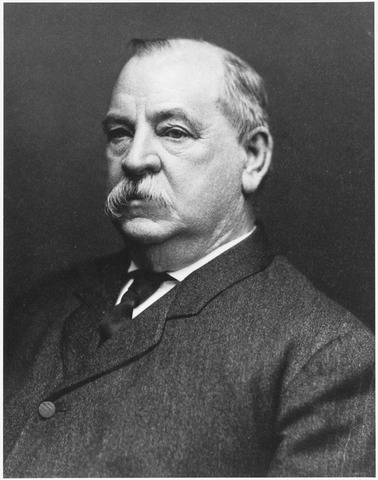
Grover Cleveland (1837-1908), President of the United States, 1885-89 and 1893-97.
Photo from the National Archives and Records Administration (NAID 518139) via Wikimedia Commons.
When the city council of Buffalo, New York, sent the mayor a measure to fund Fourth of July celebrations in 1882, conventional wisdom suggested that approving it was the politically wise and patriotic thing to do. After all, the money would pay for festivities planned by the Grand Army of the Republic (GAR), a very influential organization of Civil War veterans.
The conventional wisdom underestimated the mayor. He vetoed the appropriation, and proudly took the heat for it. After a year in the job in which he earned the title, “the veto mayor”, he moved on to become “the veto governor” of the State of New York and finally, “the veto president” of the United States. His name was Grover Cleveland. On the matter of minding the till and pinching pennies on behalf of the taxpayer, he puts to shame the great majority of public officials here and everywhere.
In his recent biography titled A Man of Iron: The Turbulent Life and Improbable Presidency of Grover Cleveland, Troy Senik recounts Grover’s message explaining the veto:
[T]he money contributed should be a free gift of the citizens and taxpayers and should not be extorted from them by taxation. This is so because the purpose for which this money is asked does not involve their protection or interest as members of the community, and it may or may not be approved by them.
This was a man unafraid to draw the line on public spending for two principal reasons: 1) Government should not be a grab bag of goodies for whatever cause somebody thinks is “good” and 2) Failure to keep government spending in check encourages politicians to buy votes and corrupt the political process.
That all sounds quaint and frumpy in these enlightened times of trillion-dollar deficits. Even more out-of-step with current fashion is what Cleveland did as soon as he issued his veto. Senik reveals,
Cleveland made a personal donation equal to 10 percent of the GAR’s budget request, then deputized the president of the city council to help raise the rest through private funds. In the end, the organization raised 40 percent more than it had requested from the city treasury.
Personally, Grover loved pork in his sausage, but he hated it in bills. He once expressed the wish that he would be remembered more for the laws he killed than the ones he signed. He still holds the record for the most vetoes of any American president in two terms (584 in all).
The Newfoundlanders at Beaumont-Hamel
Vlogging Through History
Published 12 Feb 2022Just after the explosion of the Hawthorn Ridge mine, the 29th Division assaulted German positions at Hawthorn Ridge and the Y Ravine outside the village of Beaumont-Hamel, suffering dreadful losses. No unit suffered more in that attack than the Newfoundland Regiment, part of the third wave that morning. Join me as we visit the Beaumont-Hamel Newfoundland Memorial.
(more…)
QotD: The ever-increasing size and number of artillery pieces in WW1 trench battles
So by the Second Battle of Artois (May, 1915), the barrage was four days long and included 293 heavy guns and 1,075 lighter pieces. At Verdun (February, 1916) the Germans brought in 1,201 guns, mostly heavy indirect fire artillery (of which the Germans had more than the French) with a shifting barrage that expected to fire 2 million shells in the first six days and 4 million during the first 18 days. At the Somme (1916) the British barrage lasted from the 24th of June to the attack on July 1 (so a seven-day barrage); a shorter barrage was proposed but could not be managed because the British didn’t have enough guns to throw enough shells in the shorter time frame. A longer barrage was also out: the British didn’t have the shells for it. By Passchendaele (1917) the British were deploying some 3,000 artillery pieces; one for every 15 yards of frontage they were attacking.
These efforts didn’t merely get to be more, but also more complex. It was recognized that if the infantry could start their advance while the shells were still falling, that would give them an advantage in the race to the parapet. The solution was the “creeping” barrage which slowly lifted, moving further towards the enemy’s rear. These could be run by carefully planned time-table (but disaster might strike if the infantry moved too slow or the barrage lifted too early) or, if you could guarantee observation by aircraft, be lifted based on your own movements (in as much as your aircraft pilots, with their MK1 eyeballs, could tell what was happening below them). […]
I find that most casual students of military history assume that these barrages generally failed. I suspect this has a lot to do with how certain attacks with ineffective barrages (e.g. the Somme generally, the ANZAC Corps’ attack at Passchendaele) have ended up as emblematic of the entire war (and in some cases, nationality-defining events) in the English-language discussion. And absolutely, sometimes the barrages just failed and attacks were stopped cold with terrible losses. But rather more frequently, the barrages worked: they inflicted tremendous casualties on defenders and allowed the attackers to win the race to the parapet which in turn meant the remaining defenders were likely to be swiftly grenaded or bayoneted. This is part of why WWI commanders continued to believe that they were “on the verge of a breakthrough”, that each attack had come so close, because initially there were often promising gains. They were wrong, of course, about being that close, but opening attacks regularly overran the initial enemy positions. Even the worst debacles of the war, like at the Somme, generally did so.
And at this point, you may be wondering if you’d been lied to, because you were always told this was a war where advances where measured in feet and meters instead of miles or kilometers and how can that be if initial attacks generally did, in fact, overrun the forward enemy positions? I’ll push this even further – typically, in the initial phases of these battles (the first few days) the casualty rates between attacker and defender were close to even, or favored the attacker. This is of course connected to the fact that the leading cause of battle deaths in the war was not rifle fire, machine guns, grenades, bayonets but in fact artillery fire and the attacker was the one blasting fixed positions with literal tons of artillery fire. So what is going on?
Because both sides quickly figured out that their forward positions were badly exposed to artillery barrages and began designing defenses in depth, with rear positions well out of the reach of all but the largest enemy artillery. For instance, most of the so-called “Hindenburg Line” (the Germans called it the Siegfriedstellung or “Siegfried Position”) was set in multiple lines […] The plan consisted of a thin initially defense which was assumed to fall in the event of an attack, but still featured channels made by heavy barbed wire and machine guns designed to inflict maximum casualties on an advancing force (and be dangerous enough to require the artillery barrage and planned assault). Then behind that was more open ground and then a second line of trenches, this time much more solid, with communications trenches cutting vertically and the battle positions horizontally, enabling reserves to be brought up through those trenches without being exposed to fire. Finally the reserves themselves were in a third line of trenches even further back, well outside of the enemy’s barrage (or indeed the range of all but their heaviest guns). Of course while your artillery is in the back, out of range of the enemy artillery, the enemy infantry is attacking into your artillery range. This keeps your artillery from being disabled into the initial barrage (you hope) so that it can be brought into action for the counter-attack.
And now the enemy of the attacker is friction (as we’ve discussed before with defense in depth). If everything possible goes right, you open with the barrage, your infantry sweeps forward, the creeping barrage lifts and you win the race to the parapet. The forward enemy defenders are either blasted apart by the barrage or butchered in their holes by your gas, grenades and bayonets. Great! Now you need to then attack again out of those enemy positions to get to the next line, but your forces are disorganized and disoriented, your troops are tired and your supplies, reinforcements and artillery (including many heavy guns that weigh many tons and shoot shells that also weigh 100+lbs a pop) have to get to you through the terrain the barrage created […]
So rapidly the power of your initial attack runs out. And then the counter-attacks, as inevitable as the rising sun, start. Your opponents can shell you from nice, prepared positions, while your artillery now has to move forward to support you. Their troops can ride railways to staging posts close to the front lines, advance through well-maintained communications trenches directly to you, while your troops have to advance over open group, under artillery fire, in order to support you. The brutal calculus begins to take its toll, you lose ground and the casualty ratios swings in favor of the “defender” (who to be clear, is now attacking positions he once held). Eventually your footholds are lost and both sides end up more or less where they started, minus a few hundreds or thousands of dead. This – not the popular image – this is the stalemate: the attacker frequently wins tactically, but operational conditions make it impossible to make victory stick.
The brutal irony of this “defensive” stalemate is that at any given moment in a battle that might last months and swing from offensive to defensive and back again that casualties typically favored the side which was attacking at any given moment. More ironic yet, the problem here is that the artillery itself is digging the hole you cannot climb out of, because it is the barrage that tears up the landscape, obliterating roads, making movement and communication nearly impossible for the attacker (but not for the defender). But without the barrage, there’s no way to suppress enemy artillery and machine guns to make it possible to cross no man’s land. Even with tanks, an attack without supporting artillery is suicide; enemy artillery will calmly knock out your tanks (which are quite slow; this is in 1918, not 1939).
The problem, for the attacker and the defender isn’t machine guns, it is artillery: the artillery that makes assaults possible in the first place makes actual victory – breaking through the enemy and restoring maneuver – impossible.
Bret Devereaux, “Collections: No Man’s Land, Part I: The Trench Stalemate”, A Collection of Unmitigated Pedantry, 2021-09-17.


