
CGP Grey
Published 28 Mar 2023
(more…)
June 30, 2023
The Coolest ”’Country”’ Flag You Need To Know
Comments Off on The Coolest ”’Country”’ Flag You Need To Know
QotD: Changing patterns of combat on the Great Plains
The popular image of the Great Plains Native America is unarmored, of course, but that image fundamentally formed in the late 19th century, when – after centuries of the development of gunpowder weapons – everyone was unarmored. A longer view shows that Plains Native Americans were perfectly capable of both developing or adopting defensive measures which worked. And to get a full sense of that, we need to outline the major phases of the changing warfare on the Great Plains.
F.R. Secoy (op. cit.) essentially breaks warfare into four phases, which happen at different times in different places, based on if they have horses, guns, both or neither. Because horses entered the Great Plains from the South (via the Spanish) but firearms entered the region from the North (via the British and the French, the Spanish having prohibited gun-sales to Native Americans) and spread out from there, for a brief time many of these systems were active on the Plains at once, as both guns and horses diffused through the region.
In the pre-horse, pre-gun phase (described by McGinnis as well, op. cit., 8-9), battles consisted of long-range missile exchanges between warriors who stood behind large shields which protected their whole bodies. Native American warriors in this system also wore armor, heavy leather coats, laminated in multiple layers using thick hide with glue that was sometimes mixed with sand or gravel (one more example of how “leather armor” is almost always hardened leather armor, not modern clothing-leather). Some of this armor may have been effectively quilted leather as well. Clearly, there was plenty of concern about survivability here.
Both guns and horses were apt to disrupt this system. Horses allowed attackers to rapidly close the distance between the two opposing lines of shield-protected foot-missile-warriors, causing the shield-lines to drop away (though smaller shields, used on horseback to ward off arrows and blows were still used) and for both sides to seek instead the mobility of mounted fighting. That was not the end for armor though, because contact with a supply of horses meant contact with the Spanish, and the Apache at least swiftly adopted some of the Spanish methods of making leather “buff coats” into their own armor tradition and copied the shape and pattern of the buff coat itself (while often still making the material using their own tradition). As Secoy notes (op. cit., 18-20), our sources are quite clear that these forms of armor (both original and Spanish-influenced Native armors) were quite effective at resisting the archery fire that dominated both the pre-horse, pre-gun system and the post-horse, pre-gun system.
Meanwhile on the Northern Plains, while the horse had not yet arrived, firearms had, and these had different effects. Firearms spelled the end of the armor once they became common enough, since there was no protection which could resist bullets; some shield use survived, since arrows remained fairly common as well. But this didn’t lead to suicidal warfare. Instead – as had happened on the East Coast as well, Native Americans adapted their warfare to the increased lethality of firearms (on this, note Lee, op. cit. above) by mostly avoiding pitched battles as they became too lethal (which, by the by, the relatively low lethality of pitched battles pre-gunpowder is often taken to mean that Native North American warfare in general was low-lethality; this is wrong. As with most forms of non-state warfare, most of the killing happened in surprise raids and ambushes, which could be extremely lethal and were still quite common).
Once the horse and the firearm were both in wide use in an area, warfare shifted again. War parties became smaller, faster moving and more reliant on surprise (essentially an extension of the raiding-focus of the pre-horse, post-gun system to the high mobility horses supplied). Infantry battle dropped away entirely because it was too lethal and resulted in casualties that low-population density nomads could not sustain (the contrast with the much higher population-density agrarian United States, which was self-immolating in massively costly massed-infantry engagements during the American Civil War, 1861-1865, at exactly this time is striking). These are fairly big, noticeable changes in warfare patterns!
In short, the tactics used in all four of these systems were conditions by casualty aversion, which makes a lot of sense in the context of a low-population density society which simply cannot afford massive losses.
Bret Devereaux, “Collections: That Dothraki Horde, Part IV: Screamers and Howlers”, A Collection of Unmitigated Pedantry, 2021-01-08.
Comments Off on QotD: Changing patterns of combat on the Great Plains
June 29, 2023
The End of Nazi Intelligence in 1944 – WW2 Documentary Special
World War Two
Published 27 Jun 2023After years of undermining the Nazi regime and aiding the resistance, Abwehr Chief Wilhelm Canaris finally loses his battle with Heinrich Himmler and the SS. The Abwehr Trojan Horse is no more, and German intelligence is at death’s door at the most crucial moment.
(more…)
Comments Off on The End of Nazi Intelligence in 1944 – WW2 Documentary Special
Miller’s Musket Conversion: The Trapdoor We Have At Home
Forgotten Weapons
Published 15 Mar 2023In 1865, brothers William and George Miller of Meriden CT patented a system to convert percussion muskets to use the new rimfire ammunition that was becoming available. Between 1865 and 1867, the local Meridan Manufacturing Company converted 2,000 surplus US Model 1861 muskets (mostly made by Parker & Snow) to the Miller system, using .58 rimfire ammunition. The US military tested one of these conversions in 1867, and found it to suffer from some gas leakage and about a 3% misfire rate. There was no further Army interest, although the New York and Maryland state militias did both purchase small numbers of the guns.
(more…)
Comments Off on Miller’s Musket Conversion: The Trapdoor We Have At Home
QotD: The costs of taxation
Assuming that:
- the average individual (in those days) is forced to give a third of what he earns to government (which will do nothing productive with it, but turn it straight into trash of one kind or another), and that
- whenever three such individuals are taxed at that rate, in effect, one whole human being — including all his or her potential accomplishments, his creations, his ability to raise the standard of living for himself, for his family and friends, for everyone around him, and for society in general — has been economically obliterated, then
- how many human lives in total have been obliterated in that way since the Constitution, with its taxing powers, was ratified in 1789?
It turns out to be a very difficult question to answer. Tax rates have varied over the years, and so has the number of Americans subject to taxation. In the end, my colleage estimated that it had consumed the productive capacity of some fifty million (50,000,000) innocent human lives. That’s roughly four times the number of victims claimed by Adolf Hitler. It almost equals the number of individuals killed in all of the Second World War. It fits in somewhere between the number of Russians slaughtered by Josef Stalin and Chinese killed by Mao Zedong.
And according to political scientist R.J. Rummel, it’s properly called “democide”, since, for this purpose, everybody gets to be the Jews.
So now you finally know where your flying car went, and why there’s no cure yet for cancer. You know why there’s no luxury hotel aboard a Big Wheel space station, no vacation resort on the Moon, and no scientific base on Mars or Titan. All of those things, and many more that we expected to have (or still haven’t imagined) by now, were devoured, sometimes quite literally, by grants to investigate the territoriality of tree frogs, programs to feed individuals who can’t — or won’t — work (which is properly the job of churches), programs to keep people from smoking the wrong vegetable or (to quote the late Saint George Carlin) shooting, snorting, or rubbing it into their bellies), not to mention enforcing laws against licking the wrong toad.
Not the ones squatting in the White House.
L. Neil Smith, “Economic Genocide”, Libertarian Enterprise, 2014-06-29.
Comments Off on QotD: The costs of taxation
June 28, 2023
“I’ll forgive Dartnell for not writing ‘Lest Darkness Fall’ For Dummies“
Jane Psmith reviews The Knowledge by Lewis Dartnell, despite it not being quite what she was hoping it would be:
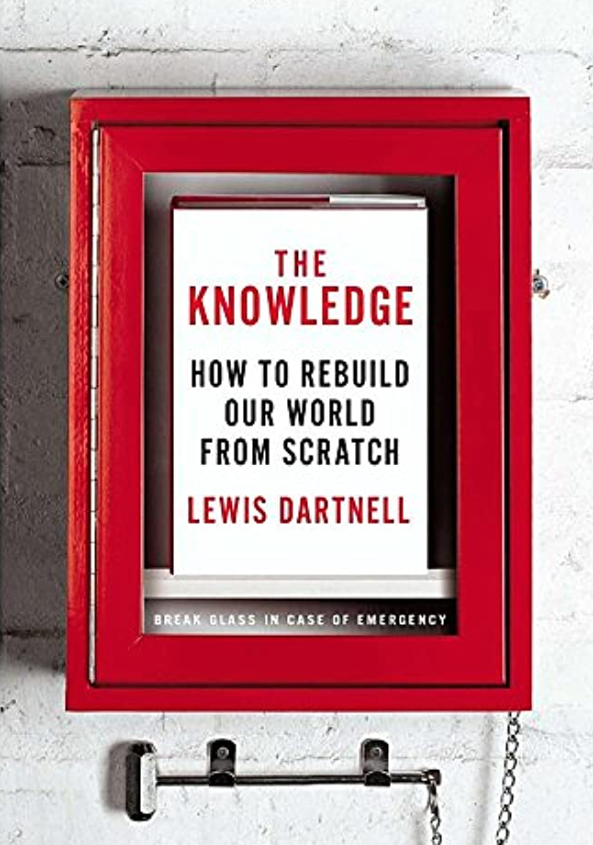
This is not the book I wanted to read.
The book I wanted to read was a detailed guide to bootstrapping your way to industrial civilization (or at least antibiotics) if you should happen to be dumped back in, say, the late Bronze Age.1 After all, there are plenty of technologies that didn’t make it big for centuries or millennia after their material preconditions were met, and with our 20/20 hindsight we could skip a lot of the dead ends that accompanied real-world technological progress.
Off the top of my head, for example, there’s no reason you couldn’t do double-entry bookkeeping with Arabic numerals as soon as you have something to write on, and it would probably have been useful at any point in history — just not useful enough that anyone got really motivated to invent it. Or, here, another one: the wheelbarrow is just two simple machines stuck together, is substantially more efficient than carrying things yourself, and yet somehow didn’t make it to Europe until the twelfth or thirteenth century AD. Or switching to women’s work, I’ve always taken comfort in the fact that with my arcane knowledge of purling I could revolutionize any medieval market.2 And while the full Green Revolution package depends on tremendous quantities of fertilizer to fuel the grains’ high yields, you could get some way along that path with just knowledge of plant genetics, painstaking record-keeping, and a lot of hand pollination. In fact, with a couple latifundia at your disposal in 100 BC, you could probably do it faster than Norman Borlaug did. But speaking of fertilizer, the Italian peninsula is full of niter deposits, and while your revolutio viridis is running through those you could be figuring out whether it’s faster to spin up a chemical industry to the point you could do the Haber-Bosch process at scale or to get to the Peruvian guano islands. (After about thirty seconds of consideration my money’s on Peru, though it’s a shame we’re trying to do this with the Romans since they were never a notably nautical bunch and 100 BC was a low point even for them; you’ll have to wipe out the Mediterranean pirates early and find Greek or Egyptian shipwrights.) And another question: can you go straight from the Antikythera mechanism to the Jacquard machine, and if not what do you need in between? Inquiring minds want to know.3
But I’ll forgive Dartnell for not writing “Lest Darkness Fall” For Dummies, which I’ll admit is a pretty niche pitch, because The Knowledge is doing something almost as cool.4 Like my imaginary book, it employs a familiar fictional conceit to explain how practical things work. Instead of time travel, though, Dartnell takes as his premise the sudden disappearance (probably plague, definitely not zombies) of almost all of humanity, leaving behind a few survivors but all the incredible complexity of our technological civilization. How would you survive? And more importantly, how would you rebuild?
1. I read the Nantucket Trilogy at an impressionable age.
2. Knitting came to Europe in the thirteenth century, but the complementary purl stitch, which is necessary to create stretchy ribbing, didn’t. If you’ve ever wondered why medieval hosen were made of woven fabric and fit the leg relatively poorly, that’s why. When purling came to England, Elizabeth I paid an exorbitant amount of money for her first pair of silk stockings and refused to go back to cloth.
3. Obviously you would also need to motivate people to actually do any of these things, which is its own set of complications — Jason Crawford at Roots of Progress has a great review of Robert Allen’s classic The British Industrial Revolution in Global Perspective that gets much deeper into why no one actually cared about automation and mechanization — but please allow me to imagine here.
4. Please do not recommend How To Invent Everything, which purports to do something like this. It doesn’t go nearly deep enough to be interesting, let alone useful. You know, in the hypothetical that I’m sent back in time.
How to Fund a War: Lend Lease, Billion Dollar Gift, and Aid to Britain
OTD Military History
Published 27 Jun 2023Programs like Lend Lease, Mutual Aid, and the Billion Dollar Gift were support from Canada and the United States that helped Britain with war supplies and material in the darkest days of World War 2.
(more…)
Comments Off on How to Fund a War: Lend Lease, Billion Dollar Gift, and Aid to Britain
The Treaty of Versailles: 100 Years Later
Gresham College
Published 4 Jun 2019The Treaty of Versailles was signed in June 1919. Did the treaty lead to the outbreak of World War II? Was the attempt to creat a new world order a failure?
A lecture by Margaret MacMillan, University of Toronto
04 June 2019 6pm (UK time)
https://www.gresham.ac.uk/lectures-an…A century has passed since the Treaty of Versailles was signed on 28 June 1919. After WWI the treaty imposed peace terms which have remained the subject of controversy ever since. It also attempted to set up a new international order to ensure that there would never again be such a destructive war as that of 1914-18. Professor MacMillan, a specialist in British imperial history and the international history of the 19th and 20th centuries, will consider if the treaty led to the outbreak of the Second World War and whether the attempt to create a new world order was a failure.
(more…)
Comments Off on The Treaty of Versailles: 100 Years Later
June 27, 2023
Uncancelled History with Douglas Murray | EP. 05 Winston Churchill
Nebulous Media
Published 20 Dec 2022Andrew Roberts joins Douglas Murray on this episode to discuss Winston Churchill. The two discuss the soldier, writer and prime minister in detail, leaving nothing off limits. Should the British Bulldog stay cancelled?
(more…)
Comments Off on Uncancelled History with Douglas Murray | EP. 05 Winston Churchill
QotD: Nelson Mandela, Thabo Mbeki, and the ANC
The impression Johnson gives is very much that of a man in way over his head, and when Mandela did try to assert himself, the results were usually buffoonish:
He declared that the solution to continuing violence in KwaZulu-Natal was for everyone to join the ANC … In 1995 he told a May Day rally that if the IFP continued to resist the ANC he would cut off all funding to KwaZulu-Natal, the most populous province. This was a completely unconstitutional threat which had to be quickly retracted. Similarly, when he dismissed Winnie from government he failed to read the constitution and thus had to reappoint her and later dismiss her again. Visiting Tanzania, he announced that: “We are going to sideline and even crush all dissident forces in our country.”
Mandela also made a lot of genuinely very big-hearted speeches pitching a “rainbow nation” vision of South Africa and begging whites not to flee the country, but every time the interests of justice conflicted with those of the ANC, he showed himself to be a party man first and foremost. The most revolting examples of this are two incidents in which independent prosecutors were investigating ANC atrocities (in one case a massacre of dozens of protestors, the other case an incident where some Zulus were kept in a cage inside a local ANC party HQ and tortured for months), and Mandela staked the full power of his moral authority on blocking the inquiries. In the case of the massacre, Mandela went so far as to declare that he had ordered the gunmen to shoot, which everybody knew to be a lie, but which meant that any attempt to pursue the coverup would mean taking down Mandela too. Nobody had the stomach to face that prospect, so the prosecutors dropped the case.
If Mandela was a figurehead, then who was really in charge? The answer is the main character of this book: Thabo Mbeki, the deputy president. Mbeki is a villain of almost Shakespearean proportions — paranoid, controlling, obsessive, bad with crowds yet charming in person. Even before Mandela was out of prison, he was already angling for the number two spot, shaping the narrative, quietly interposing himself between the charismatic Nobel peace prize winner and the true levers of power.
This was bad news for South Africa, because in contrast to Mandela’s “rainbow nation” optimism, Mbeki was a committed black nationalist who immediately set about purging whites from the government and looting white wealth, with little regard for whether this might kill the goose that lays the golden eggs. Johnson ascribes a psychological motivation to all this, asserting that Mbeki suffered from a crushing inferiority complex vis-a-vis the white elites, and quoting several truly bizarre and unhinged public speeches in support of his diagnosis. A more prosaic explanation would just be that like many tyrants in the making, Mbeki sought to create and elevate “new men”, men who owed him everything and whose loyalty could thereby be assured.
Whatever the case, Mbeki quickly began to insist that South Africa’s military, corporations, and government agencies bring their racial proportions into exact alignment with the demographic breakdown of the country as a whole. But as Johnson points out, this kind of affirmative action has very different effects in a country like South Africa where 75% of the population is eligible than it does in a country like the United States where only 13% of the population gets a boost. Crudely, an organization can cope with a small percentage of its staff being underqualified, or even dead weight. Sinecures are found for these people, roles where they look important but can’t do too much harm. The overall drag on efficiency is manageable, especially if every other company is working under the same constraints.
John Psmith, “REVIEW: South Africa’s Brave New World, by R.W. Johnson”, Mr. and Mrs. Psmith’s Bookshelf, 2023-03-20.
Comments Off on QotD: Nelson Mandela, Thabo Mbeki, and the ANC
June 26, 2023
DShK-38: The Soviet Monster .50 Cal HMG
Forgotten Weapons
Published 10 Mar 2023In 1925 the USSR began a program to develop a heavy machine gun for antiaircraft use. After some initial experimentation with a converted Dreyse machine gun, they brought in Degtyarev to scale up his recently-adopted light machine gun to the task. Degtyarev’s first design was ready in 1930, and underwent testing until 1933. It was designated the DK, and used a 30-round drum magazine. This contributed to an unacceptably low rate of fire (~360 rpm), and the feed system was replaced by an ingenious development of Georgiy Shpagin to use belts instead.
Fitted with the Shpagin feed system, the DShK finished field testing in 1939 and was adopted as the model 1938. Production was slow, and the guns were not used on anything like the scale of American M2 use during World War Two. A total of about 9000 were in use at the end of the war, although the subsequent update to the DshKM (aka DShK 38/46) pattern would see it fitted to many armored vehicles, and total production eventually topped one million.
This example is a very early production 1939 example, most likely a Finnish capture piece from the Winter War or Continuation War.
(more…)
Comments Off on DShK-38: The Soviet Monster .50 Cal HMG
June 25, 2023
The Greatest Pincer Movement in Military History – WW2 – Week 252 – June 24, 1944
World War Two
Published 24 Jun 2023The Red Army surges forward in Operation Bagration, a mighty new offensive to destroy German Army Group Centre. Fighting continues in Normandy, Italy, and Finland. The United States Navy tears the heart out of the Imperial Japanese Navy in the Philippine Sea even as the Imperial Japanese Army has success in China. The British and Indian armies lift the siege of Kohima.
(more…)
Comments Off on The Greatest Pincer Movement in Military History – WW2 – Week 252 – June 24, 1944
June 24, 2023
Official mythmaking about the Empire Windrush in 1948
The Armchair General unpacks some of the story-spinning being conducted by the British government and various charities to mark the 75th anniversary of the voyage of the Empire Windrush from Jamaica to Britain:
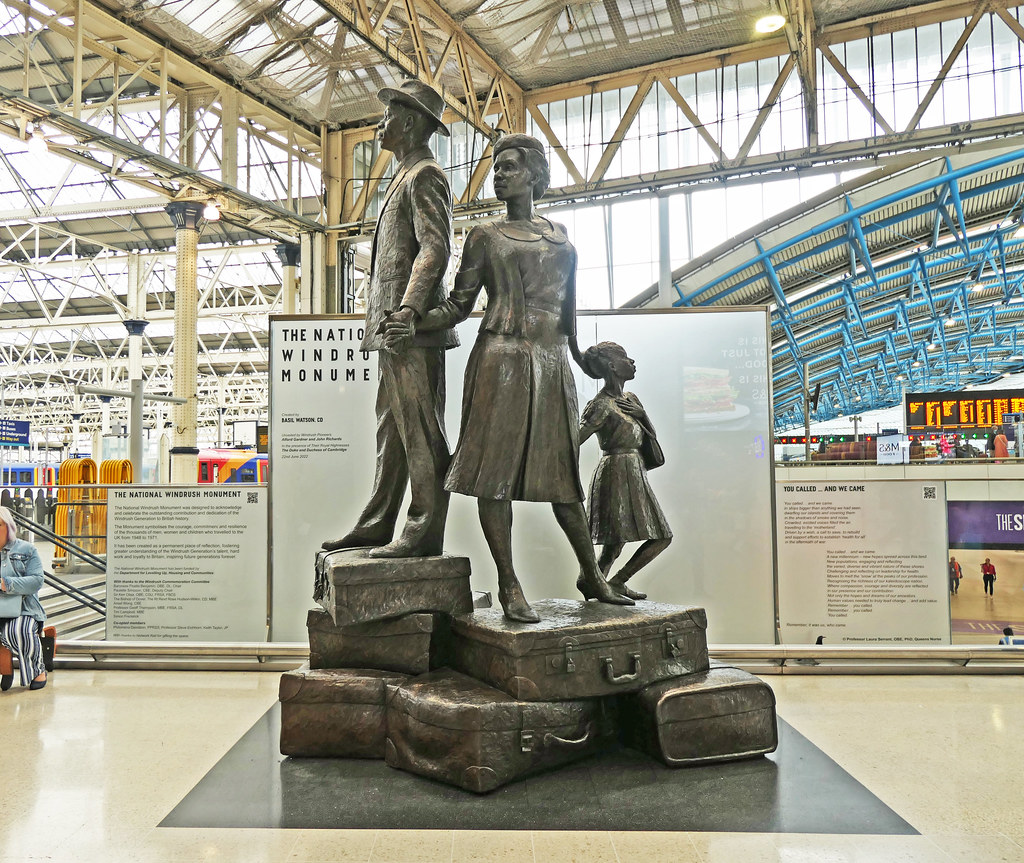
“The National Windrush Monument” by amandabhslater is licensed under CC BY-SA 2.0 

 .
.
The Armchair General notes that there is much excitement about the 75th anniversary of the arrival of the ship called the Empire Windrush — which arrived on 22 June 1948 — and the contribution of the so-called Windrush Generation.
The myth currently being constructed is that those coming from Jamaica on the ship were invited, in order to rebuild a Britain struggling to recover from Word War II; we are told that, with so many young men killed in the fighting, Britain needed menial workers to selflessly come and rebuild our economy. Indeed, this view of events has been cemented in a much-lauded poem by Professor Laura Serrant.
Remember … you called.
Remember … you called
YOU. Called.
Remember, it was us, who came.Like almost any story constructed by governments and charities over at least the last thirty years, this narrative is dodgy at best and downright dishonest at worst. The simple fact is that the ship’s operator had expected to leave Jamaica under capacity and so offered passage at half price: many local men (and it was all men) took the opportunity.
Writing in The Spectator, in an article well worth reading in full, Ed West points out that the British government certainly did not encourage these immigrants at all.
Far from calling them, the British government was alarmed by the news. A Privy Council memo sent to the Colonial Office on 15 June stated that the government should not help the migrants: “Otherwise there might be a real danger that successful efforts to secure adequate conditions of these men on arrival might actually encourage a further influx.”
Colonial Secretary Arthur Creech Jones replied: “These people have British passports and they must be allowed to land.” But, he added confidently: “They won’t last one winter in England.” Indeed, Britain had recently endured some very harsh winters.
The Ministry of Labour was also unhappy about the arrival of the Jamaican men, minister George Isaacs warning that if they attempted to find work in areas of serious unemployment “there will be trouble eventually”. He said: “The arrival of these substantial numbers of men under no organised arrangement is bound to result in considerable difficulty and disappointment. I hope no encouragement will be given to others to follow their example.”
Nor was it the solely the evil Tories who were concerned:
Soon afterwards, 11 concerned Labour MPs wrote to Prime Minister Clement Attlee stating that the government should “by legislation if necessary, control immigration in the political, social, economic and fiscal interests of our people … In our opinion such legislation or administration action would be almost universally approved by our people.” The letter was sent on 22 June; that same day the Windrush arrived at Tilbury.
One can hardly be surprised: after all, 75 years ago, the Labour Party at least strove to represent the working class of Britain and the simple fact is that there was, at the time, massive unemployment — so much so that the government was heavily subsidising tickets to Australia (at £10) in order to encourage British people to emigrate (over 2 million British people left between 1948 and 1960).
There is a certain amount of well-intentioned inclusive myth-making in this story, and from a historical point of view the idea that “diversity built Britain”, the birthplace of the Industrial Revolution, is bizarre. Until 1952 Britain was the richest country in Europe, after which we massively fell behind our continental rivals – so if diversity did “build” the country, it didn’t do a great job.
One can argue, I think, that the Windrush Generation made a great many contributions, in common with many immigrants; and if their contribution was not, in reality, as large as is claimed, then they share that with the EEC/EU’s Common Market which, again (and despite all the claims), brought no discernible benefit to the UK.
H/T to Tim Worstall for the link.
Comments Off on Official mythmaking about the Empire Windrush in 1948
The Most Reliable and Versatile Sub-orbital Rockets Ever Made; the Black Brant Sounding Rockets
Polyus
Published 31 Aug 2018The Black Brant series of sounding rockets was a great success and a proud contribution to the global race for space. While not as glamorous as an orbital rocket, the Black Brants helped scientists from around the globe research and better understand the Aurora and the Earth’s ionosphere.
(more…)
Comments Off on The Most Reliable and Versatile Sub-orbital Rockets Ever Made; the Black Brant Sounding Rockets
QotD: The plight of miners in pre-industrial societies
In the ancient Mediterranean, the clear testimony of the sources is that mining was a low-status occupation, one for enslaved people, criminals and the truly desperate. Being “sent to the mines” is presented, alongside being sent to work in the mills, as a standard terrible punishment for enslaved people who didn’t obey their owners and it is fairly clear in many cases that being sent to the mines was effectively a delayed death sentence. Diodorus Siculus describes mining labor in the gold mines of Egypt this way, in a passage that is fairly representative of the ancient sources on mining labor more generally (3.13.3, trans Oldfather (1935)):
For no leniency or respite of any kind is given to any man who is sick, or maimed, or aged, or in the case of a woman for her weakness, but all without exception are compelled by blows to persevere in their labours, until through ill-treatment they die in the midst of their tortures. Consequently the poor unfortunates believe, because their punishment is so excessively severe, that the future will always be more terrible than the present and therefore look forward to death as more to be desired than life.
It is clear that conditions in Greek and Roman mines were not much better. Examples of chains and fetters – and sometimes human remains still so chained – occur in numerous Greek and Roman mines. Unfortunately our sources are mostly concerned with precious metal mines and those mines also seem to have been the worst sorts of mines to work in, since the long underground shafts and galleries exposed the miners to greater dangers from bad air to mine-collapses. That said, it is hard to imagine working an open-pit iron mine by hand, while perhaps somewhat safer, was any less back-breaking, miserable toil, even if it might have been marginally safer.
Conditions were not always so bad though, particularly for free miners (being paid a wage) who tended to be treated better, especially where their labor was sorely needed. For instance, a set of rules for the Roman mines at Vipasca, Spain provided for contractors to supply various amenities, including public baths maintained year-round. The labor force at Vipasca was clearly free and these amenities seem to have been a concession to the need to make the life of the workers livable in order to get a sufficient number of them in a relatively sparsely populated part of Spain.
The conditions for miners in medieval Europe seems to have been somewhat better. We see mining communities often setting up their own institutions and occasionally even having their own guilds (for instance, there was a coal-workers guild in Liege in the 13th century) or internal regulations. These mining communities, which in large mining operations might become small towns in their own right, seem to have often had some degree of legal privileges when compared to the general rural population (though it should be noted that, as the mines were typically owned by the local lord or state, exemption from taxes was essentially illusory as the lord or king’s cut of the mine’s profits was the taxes). It does seem notable that while conditions in medieval mines were never quite so bad as those in the ancient world, the rapid expansion of mining activity beginning in the 15th century seems to have coincided with a loss of the special status and privileges of earlier medieval European miners and the status associated with the labor declined back down to effectively the bottom of the social spectrum.
(That said, it seems necessary to note that precious metal-mining done by non-free Native American laborers at the order of European colonial states appears to have been every bit as cruel and deadly as mining in the ancient world.)
Bret Devereaux, “Iron, How Did They Make It? Part I, Mining”, A Collection of Unmitigated Pedantry, 2020-09-18.
Comments Off on QotD: The plight of miners in pre-industrial societies


