
World War Two
Published 22 Jun 2023How do you blast through the obstacles and minefields on the beaches of Normandy? How do you get thousands of tonnes of tanks, guns, and men into the fight? And what about reopening the shattered French ports? You need men who are as skilled in construction as they are destruction. You need the engineers.
(more…)
June 23, 2023
The Combat Engineers of D-Day – WW2 Special Documentary
Comments Off on The Combat Engineers of D-Day – WW2 Special Documentary
From Operation Barbarossa in 1941 to the disinformation and cover-up over the origins of the Wuhan Coronavirus
Chris Bray outlines the utterly amazing situation between the Soviet Union and Nazi Germany on the eve of Hitler launching Operation Barbarossa — where Stalin refused to believe that Hitler would attack Russia despite overwhelming evidence from many sources — to the parallel situation over Covid:
Several sources quite specifically reported to the Soviet government that the Germans would invade around dawn on June 22. Their reports can be found in the Soviet archives in a “folder of dubious and misleading reports”. Then, shortly before dawn on June 22, Germany invaded the Soviet Union. Military leaders on the border called in reports of the invasion, and the people they talked to in Moscow declined to believe them. Soviet border troops held their fire, seeing Germans while being ordered to understand that no true invasion could possibly be underway. Stalin knew better, and contradicting Josef Stalin was known to be a fatal mistake. Achieving an entirely avoidable surprise, the Germans destroyed much of the Soviet air force on the ground, parked wingtip-to-wingtip for the convenience of the invader’s bombers.
[…]
An invasion that could have been met with brutal severity from the first moment instead achieved considerable initial success against a supine nation because the Soviet leader, and the chain of subordinates beneath him who were forced to adopt his conception of facts and truth, assumed that things they didn’t wish to believe constituted disinformation. Millions of lives were wasted for that illusion. A society that categorizes inconvenient truths in this way is committing a form of suicide, hiding from hard facts that demand acknowledgment.
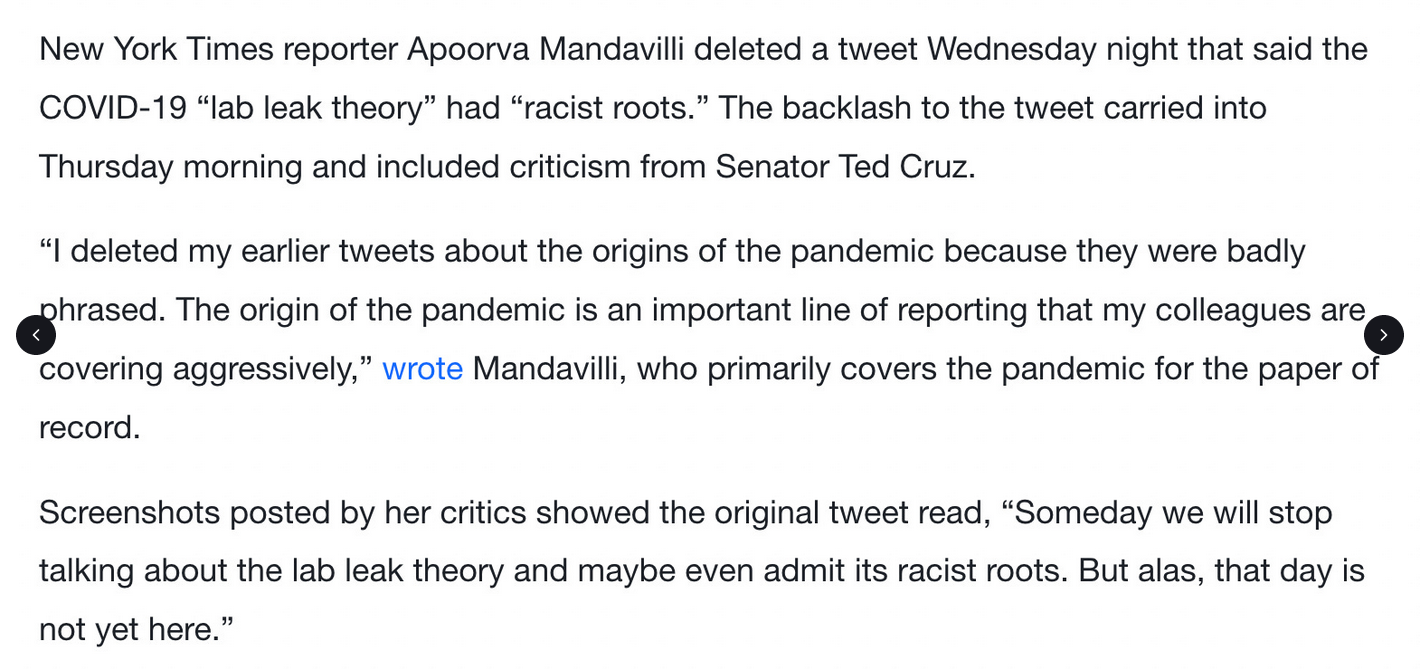
Now: In 2021, the lab leak theory was a disgusting lie with “racist roots”.
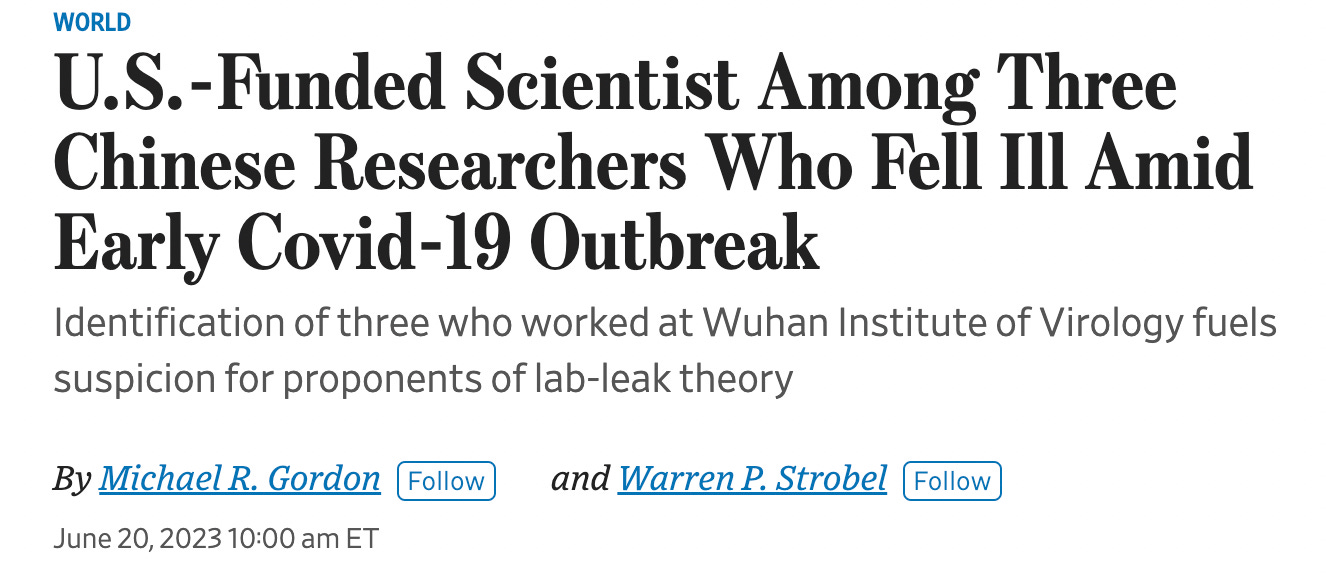
In June of 2023, the, uh, first people who got sick with Covid turn out to have been, uh, scientists at the lab in Wuhan. BUT THEY PROBABLY HAD SOME BAT SOUP AT THE WET MARKET, IS WHY, or something.
Stupid conspiracy theorists, you people are such MORONS, do you actually bel— okay, that one’s true too.
We’ve somehow developed an industry of professional information barriers, dimwitted parasitical human garbage whose sole function in life is to prevent understanding by pasting “disinformation” stickers on things that you’re not supposed to know.
Comments Off on From Operation Barbarossa in 1941 to the disinformation and cover-up over the origins of the Wuhan Coronavirus
FG-42: Perhaps the Most Impressive WW2 Shoulder Rifle
Forgotten Weapons
Published 8 Mar 2023The first production version of the FG42 used a fantastically complex milled receiver and a distinctive sharply swept-back pistol grip. A contract to make 5,000 of them was awarded to Krieghoff in late spring of 1943, but by the fall its replacement was already well into development. The milled receiver used a lot of high-nickel steel which was becoming difficult for Germany to acquire, and it was decided to develop a stamped receiver to ease production obstacles. Ultimately only about 2,000 of the early Type E FG42 rifles were actually made, and only 12 or 15 are registered in the US. They are a remarkably advanced rifle, and extremely interesting.
(more…)
Comments Off on FG-42: Perhaps the Most Impressive WW2 Shoulder Rifle
June 22, 2023
Britain’s 17th century repeats: first time as tragedy, the second time as farce?
Dominic Sandbrook on the parallels between Britain in the 1600s and today:
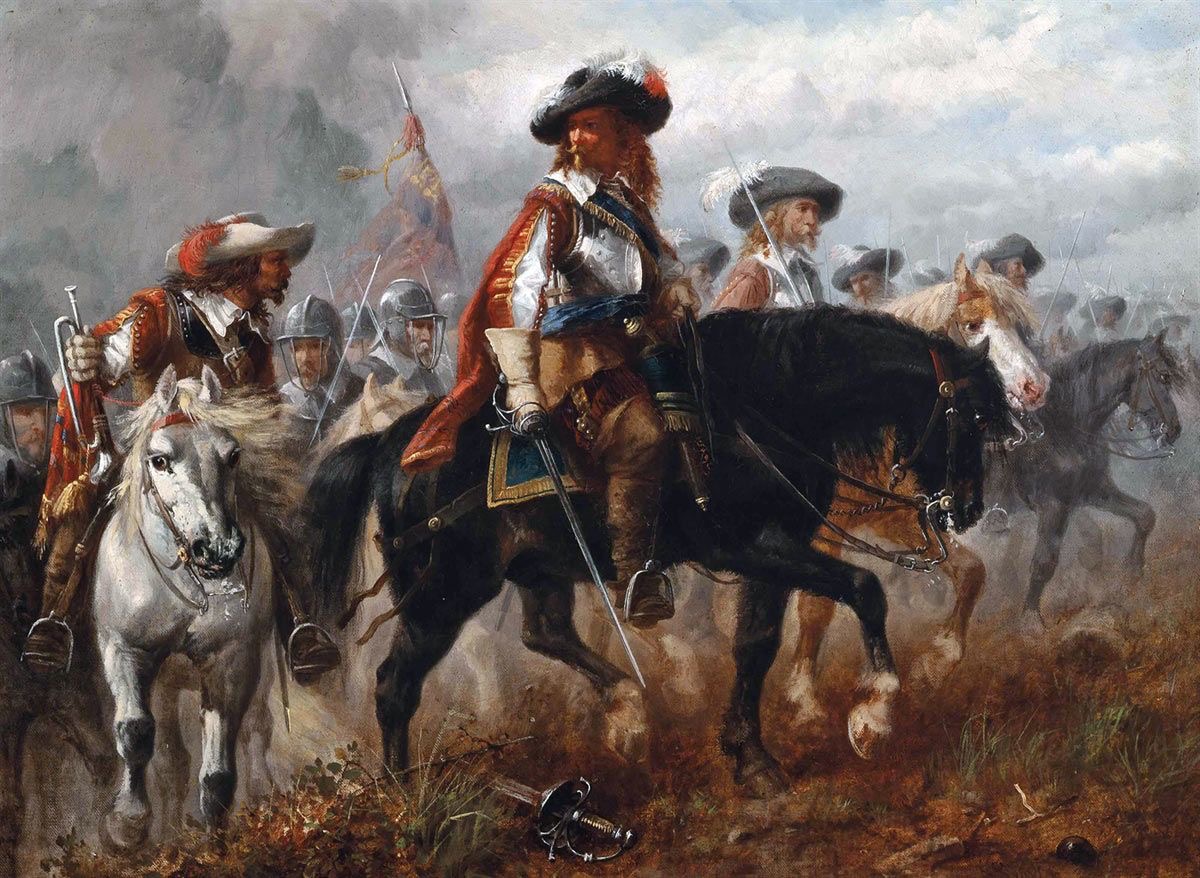
King Charles I and Prince Rupert before the Battle of Naseby 14th June 1645 during the English Civil War.
19th century artist unknown, from Wikimedia Commons.
A sunny Wednesday in early June 1665, and Samuel Pepys was suffering in the heat. It was “the hottest day that ever I felt in my life”, he confided to his diary, “and it is confessed so by all other people the hottest they ever knew in England”.
Pepys spent some of the day strolling with friends in the New Exchange, a shopping arcade on the south side of the Strand, before repairing to Vauxhall’s Spring Gardens, where he “walked an hour or two with great pleasure”. There was something on his mind, though. For as long as he could remember, relations with England’s neighbours had been distinctly fraught, and Lord Sandwich’s fleet was currently engaged in a struggle with the Dutch. London simmered with rumours about the outcome of the battle, but there was no certainty: as Pepys put it, “ill reports run up and down of his being killed, but without ground”.
By evening, “weary with walking and with the mighty heat of the weather”, the diarist had returned to his house in the City. The day had been pleasant enough, but now something else was troubling him. In Drury Lane, he had seen “two or three houses marked with a red cross upon the doors, and “‘Lord have mercy upon us’ writ there”. Pepys knew immediately what that meant. Plague — the first sign of the epidemic that would kill an estimated 100,000 people, a quarter of the capital’s population, in the next 18 months. To calm his nerves, he noted: “I was forced to buy some roll-tobacco to smell to and [chew], which took away the apprehension.”
Reading Pepys’s diary, you sometimes forget that he was born almost four centuries ago. In many respects he was utterly different from us, with assumptions and anxieties we can scarcely understand; and yet often he feels almost thrillingly contemporary, as if you might bump into him in the street tomorrow afternoon. Indeed, you merely have to re-read that diary entry, and you might be looking in a mirror: the stifling heat, the fears of disease, the foreign wars, the fake news.
The past is never just a mirror, of course, and it’s the height of narcissism to cast our predecessors as mere foreshadowings of ourselves. But there are times when, for obvious reasons, a particular historical moment catches the imagination — as is the case today with Pepys’s moment, the mid-17th century.
Just look, for example, at the titles in Britain’s bookshops. For a long time, commercial publishers were terrified of the 17th century. The Stuarts weren’t as sexy as the Tudors, and the age of Oliver Cromwell seemed too dark, too violent, too religious, too complicated for ordinary readers. Why read about perhaps the most significant moment in all our history — the titanic revolutionary conflict of the 1640s and 1650s, when armies surged across the map of our islands, a king was tried and executed, and a farmer from East Anglia tried to turn Britain into a religious commonwealth — when you could read yet another book about Catherine Howard?
And then, as if responding to some subterranean shift in the cultural landscape, something changed. The last few years alone have given us excellent books on Cromwell by Paul Lay and Ronald Hutton, as well as Anna Keay’s dazzling social history of Britain in the 1650s, and Malcolm Gaskill’s haunting account of witchcraft among the settlers who tried to build a new England on the other side of the Atlantic. Meanwhile, Robert Harris’s most recent blockbuster, Act of Oblivion, follows the hunt for Charles I’s Parliamentarian killers from England to America.
Even politicians are at it. In the Conservative MP Jesse Norman’s new novel The Winding Stair, which charts the bitter feud between Sir Francis Bacon, father of the Scientific Revolution, and Sir Edward Coke, the most influential jurist of the early modern era, we appear to be plunged back into the world of early 17th-century Jacobean England. But right from the first few pages, the parallels are obvious. Among his characters, for example, is James I, a man with “bulging, expressive eyes” and an “awkward gait”, who “dresses finely, yet somehow manages to look ill-kempt”, and always “loves to display his learning with a classical or biblical line”. Even if you didn’t know that Norman had been at Eton with Boris Johnson, worked for him as a junior minister and eventually released a blistering public letter calling for his removal, you’d probably spot the parallel.
Comments Off on Britain’s 17th century repeats: first time as tragedy, the second time as farce?
QotD: Nuclear non-proliferation and the Russo-Ukraine war
The failure of the earlier League of Nations was crucial to preparing the way for the Second World War. Today, we see none of this, with most participants — excepting North Korea and Iran — still playing by the rules. This is where we return to Nevil Shute. Twice, using his technical expertise, Shute attempted to predict future war in a novel, and twice he got it wrong. With On the Beach, the author wrote of a 37-day war that “had flared all around the northern hemisphere”. Albania had dropped a “cobalt bomb” on Naples, which escalated into wider conflicts and eventually a Russo-Chinese exchange.
As one of Shute’s characters, a scientist, explained, “The trouble is, the damn things got too cheap. The original uranium bomb cost about fifty thousand quid towards the end. Every little pipsqueak country like Albania had a stockpile of them, and every little country that had that, thought it could defeat the major countries in a surprise attack”. Significantly, Shute’s future war, set in 1963, wasn’t triggered by the usual NATO-Warsaw Pact arsenals of nuclear weapons, but the proliferation of them elsewhere. Then, as now, it is not Russian or Chinese aggression that should worry those with nightmares of nuclear cataclysm, but that of other countries. Thanks to the NPT, IAEA and the UN, these possibilities are contained. Today, the world’s weapons of mass destruction stand at one tenth of their number during the Cold War.
Indeed, the very origins of the current Ukraine crisis illustrate how the international order has managed to contain potential proliferation. When the Soviet Union disintegrated in 1991, Ukraine possessed the world’s third largest nuclear arsenal, greater than those of Britain, France and China combined. Kyiv soon realised it couldn’t afford to maintain the warheads and remain a credible nuclear military power. A solution was found, whereby the weapons would be destroyed, but only in exchange for security assurances that the United States and Russia would respect Ukraine’s independence, sovereignty and territorial integrity.
What Ukraine signed on 5 December 1994 was the Budapest Memorandum of Security Assurances, in which Bill Clinton for the United States, Boris Yeltsin for Russia and John Major for Great Britain promised to protect Ukraine and its territorial integrity in recognition of Kyiv surrendering the protection of its nuclear arsenal. There was no mention of military guarantees, which Ukraine assumed were implied. Additionally, Kyiv promised to adhere to the Non-Proliferation Treaty (NPT).
After the annexation of Crimea by Russia in 2014, the G7 nations complained that Russia had breached the Budapest Memorandum. Vladimir Putin replied evasively that since, in his view, a new regime had seized power from Ukraine’s previously pro-Moscow premier Viktor Yanukovych, “Russia has not signed any obligatory documents with this new state”. Since then, Russia has lied and prevaricated over its betrayal of Budapest. In 2016, Sergey Lavrov went so far as to claim, “Russia never violated Budapest memorandum. It contained only one obligation, not to attack Ukraine with nukes” — a gross distortion of the Memorandum’s many obligations.
However, the West responded in 2014 only with mild economic sanctions. Arguably, the apathy of the anti-interventionist Barack Obama and David Cameron, influenced by a London awash with Russian money, emboldened Vladimir Putin. Few experts disagree that had the West responded in 2014 as they did in 2022, Russia’s expansionist ambitions into Ukraine would have ended long ago. Yet, there is plenty of room for optimism. The Russo-Ukraine conflict has not spread because of the international order and its treaties. Apart from North Korea and Iran, neither of whom have quite perfected their devilish devices, nuclear proliferation of third parties has been held in check.
The Kremlin shows no sign of taking steps to escalate to a nuclear level. It is not in its interests, or those of its allies, to do so. None of the 32 nations who recently abstained from condemning Russia in the 24 February UN vote would welcome Vladimir Putin and his cronies flinging nukes around. The qualified support of major powers like China, India and Pakistan is attached to the cheap oil and arms procurements they have negotiated with Moscow. Any hint of Tsar Vladimir “going nuclear” would see their abstentions morph into support for the West. Putin, for all his rhetoric, cannot afford to go it alone with just the six who voted with him at the UN. In military terms, they offer nothing.
The world’s various international arms treaties provide plenty of optimism that this will remain a regional war. So far, Putin’s threats have melted away as the morning mist. The scenario he implies, akin that in On the Beach and other nuclear-war-scare novels and films, is so unlikely as to be discounted. They and all the rest of the post-apocalyptic genre are written as nail-biting entertainment, not history or current affairs.
Peter Caddick-Adams, “Putin, Shute and nukes”, The Critic, 2023-03-09.
Comments Off on QotD: Nuclear non-proliferation and the Russo-Ukraine war
June 21, 2023
Scuttling of the German High Seas Fleet at Scapa Flow, Orkney, 21 June 1919 in the Great War
CEFRG (Canadian Expeditionary Force Research Group)
Published 3 Apr 2020The German High Seas Fleet decided to sink as many of its own ships as possible to prevent them from falling into Allied hands. In total, 52 of 74 ships were sabotaged to keep them from Britain, France, Italy and the USA. Most of these nations wanted a share for their navies, and knowing she could not have them all to herself, Britain wanted the ships scrapped to prevent other nations from gaining naval superiority.
On the morning of 21 June 1919, the British fleet left Scapa Flow for exercises, and Rear Admiral Sydney Freemantle, commander of the 1st Battle Squadron guarding the ships, planned to return two days later to board and seize the ships.
Already occupying Germany west of the Rhine, the Allied Powers expected Germany to accept all articles of the Treaty of Versailles by 23 June, and threatened to occupy territory east of the Rhine if all demands were not met. German Rear Admiral Ludwig von Reuter, following orders he had received after the breakdown of negotiations, seized the opportunity with the British fleet having just left the harbour, gave the order to scuttle all ships as his crews opened seacocks, torpedo tubes and portholes to flood them, and once again hoisted the flag of the Imperial German Navy.
The final battle casualties of the Great War occurred on this day, with nine German sailors killed and sixteen wounded by the British during brawls when they refused to help save the ships. For his part, von Reuter was imprisoned along with 1,800 of his men, but was released the following year. Upon his return to Germany, he was praised as the man who had preserved the honour of the German High Seas Fleet (in typical fashion, Freemantle had angrily accused von Reuter of having behaved without honour).
Of the 52 ships scuttled in 1919, seven remain at the bottom of the sea today. They are registered under the Ancient Monuments and Archaeological Areas Act 1979, and provide some of the best shipwreck diving in Europe.
Comments Off on Scuttling of the German High Seas Fleet at Scapa Flow, Orkney, 21 June 1919 in the Great War
June 20, 2023
MAC Operational Briefcase (the H&K We Have at Home)
Forgotten Weapons
Published 3 Mar 2023Note: This video was proactively deleted to avoid a channel strike when YouTube went nuts over suppressors. I am reposting it today since they have rolled back those policy changes.
If a swanky outfit like H&K can make an “Operational Briefcase” with a submachine gun hidden inside it, then you can bet Military Armament Corporation is going to do the same! MAC made these briefcases for both the M10 and M11 submachine guns, and made a shortened suppressor for the M10 pattern guns to fit. They actually have a distinct advantage over the H&K type by fitting a gun with suppressor — but a distinct disadvantage in the exposed trigger bar on the bottom of the case, with no safety device of any kind.
Note: Possession of the briefcase with a semiauto MAC-type pistol that fits it is potentially seen as constructive possession of an AOW. A machine gun can be legally fitted in the case, but a semiauto pistol in it is considered a disguised weapon, and thus requires registration as an AOW.
(more…)
Comments Off on MAC Operational Briefcase (the H&K We Have at Home)
QotD: When kings and emperors become gods
Divine rulership was not universal however – it was subject to cultural context. In Egypt, the Pharaoh was the Living Horus, a physical incarnation of the divine; when he died he became Osiris, the ruler over the underworld. The mystery of the duality whereby a Pharaoh was both a specific person (and might be a different person in the future) but also the same god each time seems to owe something to the multipart Egyptian conception of the soul. Naram-Sin, an Akkadian King (2254-2218 B.C.) represents himself as divine (shown by his having horns) on his victory stele; future kings of Akkad followed suit in claiming a form of divinity, albeit a lesser one than the big-time great gods.
But in Mesopotamia, the rulers of Akkad were the exception; other Mesopotamian kings (Sumerian, Babylonian, etc) did not claim to be gods – even very great kings (at least while alive – declaring a legendary ruler a god is rather more like a divine founder figure). Hammurabi (king of Babylon, c.1810-c.1750 B.C.) is shown in his royal artwork very much a man – albeit one who receives his mandate to rule from the gods Shamash and Marduk. Crucially, and I want to stress this, the Achaemenid kings of Persia were not considered gods (except inasmuch as some of them also occupied the position of Pharaoh of Egypt; it’s not clear how seriously they took this – less seriously than Alexander and Ptolemy, quite clearly). The assumption that the Persians practiced a divine kingship is mostly a product of Greek misunderstandings of Persian court ritual, magnified in the popular culture by centuries of using the Persian “other” as a mirror and (usually false) contrast for European cultures.
But the practice that my students often find most confusing is that of the Roman emperors. To be clear, Roman emperors were not divinized while they were alive. Augustus had his adoptive father, Julius Caesar divinized (this practice would repeat for future emperors divinizing their predecessors), but not himself; the emperor Vespasian, on his deathbed, famously made fun of this by declaring as a joke, “Alas! I think I’m becoming a god” (Suet. Vesp. 23.4). And yet, at the same time, outside of Rome, even Augustus – the first emperor – received cult and divine honors, either to his person or to his genius (remember, that’s not how smart he is, but the divine spirit that protects him and his family).
I think it is common for us, sitting outside of these systems, to view this sort of two-step dance, “I’m not a god, but you can give me divine honors in the provinces and call me a god, just don’t do it too loudly” as fundamentally cynical – and to some degree it might have been; Augustus was capable of immense cynicism. But I think it is possible to view this relationship outside of that cynicism through the lens of the ideas and rules we’ve laid out.
Bret Devereaux, “Collections: Practical Polytheism, Part IV: Little Gods and Big People”, A Collection of Unmitigated Pedantry, 2019-11-15.
Comments Off on QotD: When kings and emperors become gods
June 19, 2023
1963: Mockumentary Predicts The Future of 1988 | Time On Our Hands | Past Predictions | BBC
BBC Archive
Published 17 Jun 2023Russian moon landings, week long traffic jams, a workforce replaced by automation and above all, too much leisure time!
These are just some of the bold predictions made in Don Haworth’s 1963 BBC “mockumentary” Time on Our Hands – a remarkable film which projects the viewer a quarter of a century into the future.
Imagine how the futuristic inhabitants of 1988 — a society freed from the shackles of endless hard work — might reflect on the way people live and work in 1963. Its aim is to look back at the extraordinary, almost unbelievable, events of the intervening 25 years — referred to as “the years of the transformation”.
“This Buoyant programme could be repeated a dozen times and still intrigue, delight and disturb me”
Dennis Potter, Daily Herald TV critic, 1963This footage is compiled of excerpts from Time On Our Hands, a faux-documentary film by Don Haworth.
Originally broadcast 19 March, 1963.
Comments Off on 1963: Mockumentary Predicts The Future of 1988 | Time On Our Hands | Past Predictions | BBC
June 18, 2023
Titanic Clash Looms In Pacific – WW2 – Week 251 – June 17, 1944
World War Two
Published 17 Jun 2023Japanese and American navies are heading for a showdown in the Philippine Sea, even as American forces land on Saipan in the Marianas in force. The Japanese have Changsha under siege in China, the Allies advance in both Normandy and Italy, the Soviets advance in Finland, and the massive Soviet summer operation is coming together and will begin in a matter of days.
(more…)
Comments Off on Titanic Clash Looms In Pacific – WW2 – Week 251 – June 17, 1944
June 17, 2023
Why Rommel Lost the Battle for North Africa
Real Time History
Published 16 Jun 2023The North African campaign of WW2 is one of the most famous ones. The almost mythical story of the British “Desert Rats” defeating Erwin Rommel’s Afrika Korps. But why did Rommel lose in North Africa?
(more…)
China’s long-term revenge for the Opium Wars
In Quillette, Aaron Sarin discusses what he calls the “Reverse Opium War” with Chinese drugs flooding the US street drug culture:
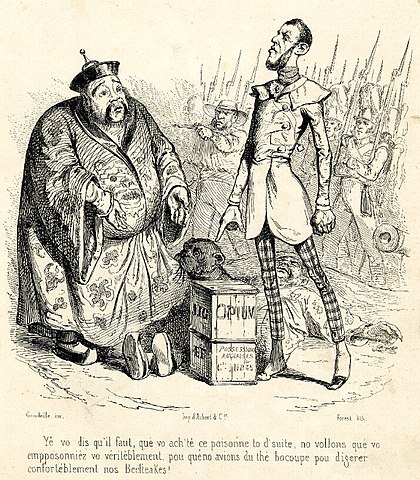
Jean-Jacques Grandville cartoon originally published in Charivari in 1840. “I tell you to immediately buy the gift here. We want you to poison yourself completely, because we need a lot of tea in order to digest our beefsteaks.”
Image and translated caption from Wikimedia Commons.
An epidemic is stalking American cities. Every day, men and women die on sidewalks, in bus shelters, on park benches. Some die sprawled in crowded plazas at midday; others die slumped in the corners of lonely gas station bathrooms. Internally, however, the circumstances are the same. They all end their lives swimming in the warm amniotic dream of a lethally dangerous opioid. When it comes, the moment of death is imperceptible: coaxed by the drug further and further from shore, the user simply floats out too far, passing some unmarked point of no return. The heartbeat weakens, the breathing slows and shallows. As soft an end as anyone might wish for.
This is the fentanyl crisis. It may seem strange to connect a very modern and very American phenomenon to a brace of wars waged 200 years ago by the British Empire on the last of the Chinese dynasties. But so the rhetoric runs: we are witnessing a Reverse Opium War; a belated Sinic revenge.
The Communist Party teaches schoolchildren that China was once a glorious superpower, until it was brought low by that subtlest and most devious of British weapons: Lachryma papaveris (poppy tears). Opium sapped the nation’s strength, and when the Chinese authorities banned it, then Britain went to war — twice.
Those wars crippled the Qing and heralded a “century of humiliation” for China — multiple military defeats and lopsided treaties, the Anglo-French looting and burning of the Emperor’s Summer Palace, the Japanese Rape of Nanking and lethal human experimentation by Unit 731 — ending only with the liberating forces of Marxism-Leninism in 1949. Now some commentators are telling us that history has inverted, that karma has kicked in.
Before examining this idea, we should remind ourselves of the American predicament. Ten years ago, fentanyl began its steady flow from China to the United States. Within just three years the drug had surpassed heroin to become the most frequent cause of American overdose deaths. Fentanyl is many times more powerful than heroin, and so there should be no surprise that lethality has spiked since the great Chinese flow began: in 2012, heroin topped the list with 6,155 deaths; by 2016, fentanyl was proving three times as deadly, with 18,335 deaths. The opioid’s influence seeps into all corners of the narcotics market, due to dealers hiding it in cocaine, heroin, and ecstasy. And it leaks across social strata, killing the homeless but also the rock star Prince, who passed away in an elevator at his Paisley Park estate after ingesting fentanyl disguised as Vicodin.
Under American pressure, the Chinese authorities agreed to regulate fentanyl analogs and two fentanyl precursor chemicals, but it soon turned out that shipments were being rerouted via Mexico. With this new arrangement, the crisis only deepened: between 2019 and 2021, the opioid killed 200 Americans a day. Last year alone, the DEA seized quantities of the drug equivalent to 410 million lethal doses. That’s enough to kill everyone in the US. Even a pandemic couldn’t stem the flow for long: in fact, Wuhan is one of the world’s most reliable suppliers of fentanyl precursors (a role it played both before and after starring at the eye of the COVID storm).
The booming fentanyl trade does not appear to rely on traditional criminal organisations, in the way that East Asian methamphetamine trafficking depends on the Triads. Instead, it turns out to be small family-based groups and legitimate businesses who manufacture and move the drug. Usually located on China’s south-eastern seaboard — Zhejiang, Fujian, Guangdong — these groups use the cover of the vast Chinese chemical industry to channel ingredients into the manufacture of fentanyl-class drugs and their precursors.
Comments Off on China’s long-term revenge for the Opium Wars
Webley-Fosbery Automatic Revolver
Forgotten Weapons
Published 9 Jun 2013This is an update to our previous video on the Webley-Fosbery, which was taken on a low-res camera in a dark room — hopefully this will be a big improvement!
The Webley-Fosbery was an early automatic handgun based on a revolver design. The top half of the frame slides back under recoil, recocking the hammer and indexing to the next round in the cylinder. They were made commercially in both .38 and .455 calibers, with the .455 version attracting interest from British Army officers into World War I.
Comments Off on Webley-Fosbery Automatic Revolver
June 16, 2023
Friday Foundlings
A few items that I didn’t feel required a full post of their own, but might be of interest:
- “Lunch of suffering”: plain “white people food” goes viral in China
- From a review of Njal’s Saga – “There are only about 40,000 people in medieval Iceland. The book focuses on the Southwest Quarter, so let’s say 10,000 there. Each of our characters is a large landowning farmer with many children, servants, tenants, etc; if he is patriarch of a 20 person household, then there must be about 500 such patriarchs. Each of these 500 relevant Icelanders is profiled in loving depth. And if there are 500 characters in Njal’s Saga, and n people can have n(n-1)/2 possible two-person feuds, that’s 124,750 possible feuds. Of these, about 124,749 actually take place over the course of the saga (Njal and his friend Gunnar are best buds, and refuse to feud for any reason).”
- The Canadian government continues to rack up the internet regulation wins – “The fallout from Bill C-11 has been the subject of several posts this week, including the demands from a wide range of services for exceptions to the law and warnings from streaming services such as PBS and AMC that they may block the Canadian market due to the regulatory burden imposed by the law. While those stories focus on the availability of services and content in Canada, a new Variety report points to another negative impact from the bill: less film and television production in Canada, at least in the short term. Throughout the Bill C-11 debate, there were concerns that the large streamers might pause their productions in Canada given the uncertainty over whether they would ‘count’ for the purposes of new CRTC imposed contribution requirements. In other words, the bill could initially lead to less investment in Canada.”
- Random meme of the day:

Comments Off on Friday Foundlings
Blackadder at 40
Ed West remembers his first encounter with the brilliant, devious, and hilarious Edmund Blackadder:
What do these famous figures from British history all have in common? Elizabeth I, George III, George IV, Victoria and Albert, the Duke of Wellington, Dr Samuel Johnson, Sir Walter Raleigh, Sir Douglas Haig, Richard III, er Richard IV, William Pitt the Younger, William Pitt the Even Younger …
They’re all, of course, characters in the greatest tale of our island story, a giant rollercoaster of a comedy in four sizzling chapters, one that was first shown 40 years ago today.
New British stamps issued on the 40th anniversary of the BBC comedy series Blackadder
I was probably always going to love history — my dad was obsessed with it — but Blackadder helped imprint the idea that the past can be one great black comedy. History is funny because people’s behaviour is often quite irrational, or spiteful, or motivated by petty reasons that contrast with their high-minded principles — and no doubt we will seem the same to future generations, too.
That was the whole idea behind Blackadder because, as creator Richard Curtis points out in a documentary screened tonight on Gold, he’s “a modern person in the stupidity of ancient times”.
Yet when the idea was first proposed by Curtis and Rowan Atkinson, they were advised that there are two sitcom premises that can never work — shows set in heaven and hell, or those in historical settings. And Blackadder was lucky to survive its first season.
Atkinson and Curtis had met at Oxford, going on to work together on Not the Nine O’Clock News, where they’d met producer John Lloyd. The two men were inspired by Fawlty Towers, but were also determined to avoid any comparison with John Cleese and Connie Booth’s great creation, so decided on a setting as far removed from a south coast hotel as possible.
Aired on 15 June, 1983, The Black Adder was quite lavish. There were location shots in places like Alnwick Castle and huge amounts spent on costumes and horses. Curtis says that one of the hats Atkinson wore was worth more than he was paid for writing the episode. It featured such big names as Brian Blessed and Peter Cook, the godfather of alternative comedy whose presence granted the show its place in the apostolic succession. But, while the first series has its moments, it was flawed; the original Blackadder was a weasel-like and pathetic figure, and less clever than his sidekick Baldrick. The comedy didn’t exactly work.
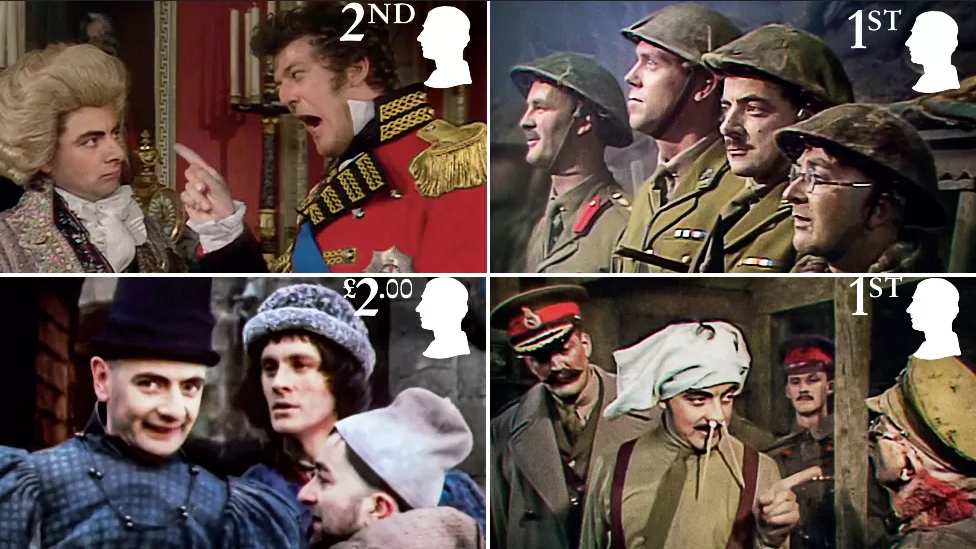
I was fortunate enough to encounter the second series, set in Elizabethan England, before I saw any of the first series. The original has its funny moments, but Ed is quite correct that it’s less than the sum of its parts. Brian Blessed steals every scene he’s in (as always), and Peter Cook’s portrayal of Richard III is great. The rest … is kinda funny if you know a bit of the history. Thankfully, there was more to come.
Blackadder II aired at the start of January 1986, and had a much smaller budget and a simpler set up — and it was far, far funnier, the protagonist no longer a conniving weasel but a court sycophant with Baldrick and Percy as comedy punchbags.
“Well, it is said, Percy, that civilised man seeks out good and intelligent company, so that through learned discourse he may rise above the savage and closer to God. Personally, however, I like to start the day with a total dickhead to remind me I’m best.”
(Fans of comedy shows who quote the lines endlessly can become quite tedious but, well, tough.)
Or: “The eyes are open, the mouth moves, but Mr. Brain has long since departed, hasn’t he, Percy?”
Towards Baldrick he is somewhat more indulgent, telling him that “Thinking is so important“.
“I’ve been in your service since I was two and a half my Lord,” his dogsbody protests upon being thrown out: “Well that is why I am so utterly sick of the sight of you.”
Elton also thought the medieval era to be too squalid and wanted Season 2 set in the “sexier” Elizabethan era (and indeed Edmund’s outfit is rather sexy, as Percy might put it).
Comments Off on Blackadder at 40


